Through market attractiveness analysis, total addressable market evaluation, company benchmarking matrices, interactive Excel dashboards, expanded supply chain intelligence, emerging startup coverage, and detailed product insights, The Business Research Company’s 2026 market reports provide more actionable and strategically valuable research.
Therapeutic Proteins Market CAGR Analysis And Future Market Development
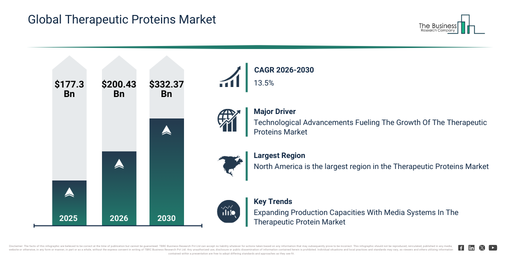
The market for therapeutic proteins has experienced substantial expansion in recent years. Projections indicate an increase from $177.3 billion in 2025 to $200.43 billion in 2026, representing a compound annual growth rate (CAGR) of 13.0%. This historic period growth is driven by the effective commercialization of insulin therapies, a growing incidence of chronic conditions, robust clinical effectiveness of protein-based medications, advancements in biotechnology research, and a rise in regulatory approvals.
The therapeutic proteins market is projected to expand swiftly over the coming years, with its value anticipated to climb to $332.37 billion by 2030, reflecting a compound annual growth rate (CAGR) of 13.5%. This forecasted growth is largely driven by the broadening of pipelines in oncology and immunology, an uptick in biologics approvals, heightened investment in biopharmaceutical research and development, greater acceptance of biosimilars, and enhanced manufacturing scalability. Key trends shaping the period include the proliferation of recombinant protein therapies, a surge in demand for targeted biologics, the emergence of personalized protein medicines, wider utilization of long-acting proteins, and ongoing breakthroughs in protein expression systems.
Download A Free Sample Report For Comprehensive Market Insights:
#Therapeutic Proteins Market Growth Factors: Which Forces Are Supporting Market Expansion?
The therapeutic proteins market is gaining momentum due to progress in protein-based drug development. These proteins cannot be manufactured through chemical synthesis; instead, they are produced using genetic engineering and recombinant DNA technology within living cells or organisms. Advanced protein-engineering platform technologies, including glycoengineering, pegylation, Fc-fusion, albumin fusion, and albumin drug conjugation, contribute to enhancing production yield, product purity, circulating half-life, targeting capabilities, and the overall functionality of therapeutic protein drugs. Over the past five years, the FDA has approved several therapeutic proteins developed via these technologies, such as belimumab, ipilimumab, taliglucerase alfa, albiglutide, and recombinant human coagulation factor IX.
Therapeutic Proteins Market Driver: Rising Prevalence Of Chronic Diseases, Including Diabetes, Fuels Growth Of Therapeutic Protein Market
A surge in chronic disease prevalence, notably diabetes, is anticipated to boost the therapeutic protein market in the coming years. Chronic diseases are defined as conditions persisting for a year or more, restricting daily activities and demanding ongoing medical attention or both. Diabetes, a chronic health issue, arises when the body fails to produce sufficient insulin or utilizes insulin inefficiently. For diabetes management, various protein therapeutics, including insulin and GLP-1 receptor agonists, are employed to control blood sugar levels. These agents prompt insulin secretion when blood glucose rises and simultaneously suppress glucagon production, a hormone that elevates blood sugar. As reported by the British Diabetic Association (Diabetes UK) in May 2024, a UK-based charity focused on patients, healthcare professionals, and research, approximately 4.4 million individuals in the UK were diagnosed with diabetes during 2022-23. Of these, about 8% have type 1 diabetes, type 2 diabetes constitutes roughly 90%, and the remaining 2% encompasses other less common diabetes forms. Consequently, the growing incidence of chronic diseases like diabetes is fueling expansion within the therapeutic protein market.
Therapeutic Proteins Market Segment Performance And Strategic Opportunities
The therapeutic proteins market covered in this report is segmented –
1) By Product Type: Insulin, Fusion Protein, Erythropoietin, Interferon, Human Growth Hormone, Follicle Stimulating Hormone
2) By Function: Enzymatic And Regulatory Activity, Special Targeting Activity, Vaccines
3) By Application: Metabolic Disorders, Immunologic Disorders, Hematological Disorders, Cancer, Hormonal Disorders, Genetic Disorders, Other Applications
Subsegments:
1) By Insulin: Rapid-Acting Insulin, Short-Acting Insulin, Intermediate-Acting Insulin, Long-Acting Insulin
2) By Fusion Protein: Tnf-Alpha Inhibitors, Anti-Cd20 Fusion Proteins, Other Targeted Fusion Proteins
3) By Erythropoietin: Epoetin Alpha, Darbepoetin Alfa, Other Erythropoietin Variants
4) By Interferon: Interferon Alpha, Interferon Beta, Interferon Gamma
5) By Human Growth Hormone: Somatropin, Somatrem
6) By Follicle Stimulating Hormone: Follitropin Alpha, Follitropin Beta
Therapeutic Proteins Market Industry Trends: What Changes Are Reshaping Demand?
Leading industry players in the therapeutic protein sector are actively introducing advanced media systems to satisfy the rising demand for these biopharmaceuticals while strengthening their market position. Such media systems are specifically engineered production platforms that optimize the manufacturing process for therapeutic monoclonal antibodies. A notable example comes from Lonza Group AG, a Swiss pharmaceutical manufacturing firm, which launched its TheraPRO CHO Media System in July 2023—a novel cell culture platform designed to enhance both productivity and quality in therapeutic protein production. This chemically defined two-component production method is characterized by its user-friendly design, which simplifies media preparation. The system offers complete scalability capabilities and is backed by technical specialists who possess extensive experience in troubleshooting complex production challenges.
Therapeutic Proteins Market Key Players: Which Companies Shape Industry Competition?
Major companies operating in the therapeutic proteins market are Pfizer Inc., Johnson & Johnson Services Inc., F. Hoffmann-La Roche Ltd., Merck & Co. Inc., AbbVie Inc., Novartis International AG, Sanofi S.A, Bristol Myers Squibb Co., AstraZeneca plc, Abbott Laboratories, GlaxoSmithKline plc, Eli Lilly and Company, Boehringer Ingelheim International GmbH, Amgen Inc., Novo Nordisk A/S, Baxter International Inc., Teva Pharmaceutical Industries Ltd., CSL Behring LLC, Chugai Pharmaceutical Co. Ltd., Biogen Inc., Kyowa Kirin Co. Ltd., Oramed Pharmaceuticals Inc., Sandoz International GmbH, Hualan Biological Engineering Inc., Genentech Inc., ProBiogen AG, Diasome Pharmaceuticals Inc., Generex Biotechnology Corp., GeneScience Pharmaceuticals Co. Ltd.
Access The Complete Therapeutic Proteins Market Report:
Therapeutic Proteins Market Geographic Distribution And Regional Opportunities
North America was the largest region in the therapeutic proteins market in 2025. The regions covered in the therapeutic proteins market report are Asia-Pacific, South East Asia, Western Europe, Eastern Europe, North America, South America, Middle East, Africa.
Get in touch with us:
The Business Research Company: https://www.thebusinessresearchcompany.com/?utm_source=BlogsPR&utm_medium=Paid&utm_campaign=home_page_test
Americas: +1 310-496-7795
Asia: +44 7882 955267 & +91 8897263534
Europe: +44 7882 955267
Email us at: marketing@tbrc.info
Follow us on:
LinkedIn: https://in.linkedin.com/company/the-business-research-company
YouTube: https://www.youtube.com/channel/UC24_fI0rV8cR5DxlCpgmyFQ
Global Market Model: https://www.thebusinessresearchcompany.com/global-market-model