Featuring market attractiveness scoring, total addressable market sizing, company benchmarking matrices, interactive Excel dashboards, deeper supply chain intelligence, emerging startup tracking, and granular product-level insights, The Business Research Company’s 2026 market reports are built to deliver research that is both more actionable and more strategically valuable.
Teleradiology Software Market Size And Revenue Outlook Through 2030
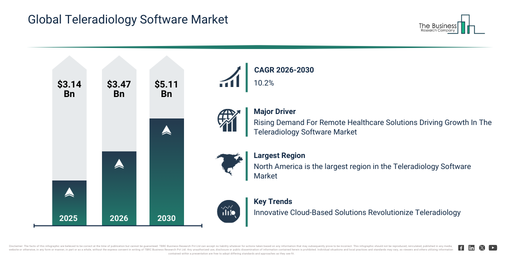
The market for teleradiology software has seen rapid growth in recent years. A substantial increase is anticipated, with its value rising from $3.14 billion in 2025 to $3.47 billion in 2026, at a compound annual growth rate (CAGR) of 10.5%. The market’s past expansion is due to factors such as growth in medical imaging procedure volumes, shortage of radiologists in many regions, expansion of hospital digital infrastructure, increased adoption of pacs solutions, and the rising need for after-hours radiology services.
The teleradiology software market is projected for significant expansion over the coming years. By 2030, its value is anticipated to reach $5.11 billion, exhibiting a compound annual growth rate (CAGR) of 10.2%. This anticipated growth during the forecast period stems from factors such as the rising need for quick diagnostic results, the proliferation of telehealth and remote diagnostic services, increased capital expenditure in AI-powered imaging analytics, a heightened emphasis on interoperability across various healthcare platforms, and the wider acceptance of cloud-native radiology platforms. Key trends for the same period encompass a greater uptake of AI-assisted image interpretation tools, an increase in the utilization of cloud-based teleradiology platforms, the expanding integration of PACS and RIS systems, the broadening of cross-border radiology services, and a strengthened commitment to workflow automation and precision in reporting.
Get A Free Sample Report With In-Depth Market Insights:
Teleradiology Software Market Growth Factors: What’s Supporting Expansion?
The increasing adoption of remote healthcare solutions is anticipated to propel the expansion of the teleradiology software market in the future. Remote healthcare solutions refer to various technologies and services that allow medical professionals to deliver care from a distance. The growing need for these solutions is driven by factors such as improved access to care, responses to pandemics, and enhanced patient involvement. Teleradiology software supports the advancement of remote healthcare by improving the accessibility of radiological services, boosting diagnostic efficiency, and fostering better collaboration among healthcare providers. The growing preference for remote healthcare solutions is a key factor driving the growth of the teleradiology software market.
Teleradiology Software Market Segment Analysis: What Are The Core Market Categories?
The teleradiology software market covered in this report is segmented –
1) By Type: Radiology Information System, Picture Archiving And Communication System (PACS), Vendor Neutral Archive (VNA)
2) By Deployment: Web-Based, Cloud-Based, On-Premises
3) By Imaging Technique: X-Ray, Computed Tomography (CT), Magnetic Resonance Imaging (MRI), Ultrasound, Nuclear Imaging, Other Imaging Techniques
4) By End User: Hospitals, Clinics, Other End Users
Subsegments:
1) By Radiology Information System (RIS): Workflow Management In RIS, Scheduling And Reporting Features, Integration With Electronic Health Records (EHR), Patient Management And Communication Tools
2) By Picture Archiving And Communication System (PACS): Imaging Storage Solutions, Advanced Image Retrieval Features, Integration With Modalities (e.g., MRI, CT), 3D Visualization And Analysis Tools
3) By Vendor Neutral Archive (VNA): Data Management And Storage Solutions, Interoperability Features For Multiple Systems, Long-Term Data Retention Solutions, Secure Access And Sharing Capabilities
Teleradiology Software Market Trends Shaping Long-Term Demand
Leading companies within the teleradiology software market are actively developing sophisticated solutions, including cloud-based teleradiology offerings, to provide greater flexibility, scalability, and remote accessibility. These cloud-based teleradiology solutions represent digital platforms that empower radiologists to remotely access, interpret, and share medical imaging via internet-based systems, thereby enhancing adaptability and collaboration in healthcare.
Teleradiology Software Market Top Companies Driving Competitive Growth
Major companies operating in the teleradiology software market are McKesson Corporation, Siemens Healthineers AG, Fujifilm Holdings Corporation, Koninklijke Philips N.V., Cerner Corporation, Carestream Health, VRad (Virtual Radiologic), Evertech Corp., Medsynaptic Pvt. Ltd., NucleusHealth LLC, RamSoft Inc., ONRAD Inc., Teleradiology Solutions, MedWeb, USARAD Holdings Inc., Telerad Tech Private Limited, Radical Imaging LLC, Agfa-Gevaert Group, Impose Technologies Pvt Ltd., OpenRad, Infinitt Healthcare Co. Ltd., Dicom Systems Inc
View The Full Teleradiology Software Market Report:
Teleradiology Software Market Geographic Analysis: Where Is Demand Rising Fastest?
North America was the largest region in the teleradiology Software market in 2025. Asia-Pacific is expected to be the fastest-growing region in the forecast period. The regions covered in the teleradiology software market report are Asia-Pacific, South East Asia, Western Europe, Eastern Europe, North America, South America, Middle East, Africa.
Reach Out To Our Team:
The Business Research Company: https://www.thebusinessresearchcompany.com/
Americas: +1 310-496-7795
Asia: +44 7882 955267 & +91 8897263534
Europe: +44 7882 955267
Email us at: marketing@tbrc.info
Follow us on:
LinkedIn: https://in.linkedin.com/company/the-business-research-company
YouTube: https://www.youtube.com/channel/UC24_fI0rV8cR5DxlCpgmyFQ
Global Market Model: https://www.thebusinessresearchcompany.com/global-market-model
Leave a Reply