Month: June 2026

  • Smart Home Market Outlook Through 2030 With Analysis Of Industry Trends And Developments

    Smart Home Market Outlook Through 2030 With Analysis Of Industry Trends And Developments

    The Business Research Company’s 2026 market reports feature advanced enhancements such as market attractiveness analysis, total addressable market evaluation, company benchmarking matrices, interactive Excel dashboards, expanded supply chain intelligence, emerging startup coverage, and detailed product insights, delivering more actionable and strategically valuable research.

    What Growth In Market Value Is Anticipated For The Smart Home Market Between 2026 And 2030?

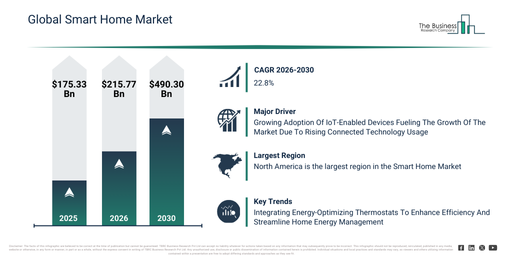
    The smart home market size has seen significant expansion in recent years. Projections indicate it will expand from $175.33 billion in 2025 to $215.77 billion in 2026, demonstrating a compound annual growth rate (CAGR) of 23.1%. This historical expansion can be ascribed to several factors, including the increasing integration of IoT devices, a surge in consumer demand for home automation, heightened awareness concerning energy efficiency, the broader implementation of smart security systems, and the rising prevalence of smartphones and mobile applications.

    The smart home market is projected to experience significant expansion in the coming years. By 2030, its size is expected to reach $490.30 billion, exhibiting a compound annual growth rate (CAGR) of 22.8%. This growth during the forecast period is driven by increased investment in smart home infrastructure, the expanding integration of artificial intelligence and machine learning, the rising adoption of voice-controlled devices, growing demand for retrofit solutions, and a heightened focus on sustainable and energy-efficient solutions. Furthermore, major developments predicted for this period include technological advancements in AI-driven automation, innovations in Matter protocol interoperability, the progression of 5G and edge computing integration, ongoing research into sustainable home solutions, and improvements in predictive maintenance and smart appliance management.

    Download A Free Sample Report For Comprehensive Market Insights:

    https://www.thebusinessresearchcompany.com/sample.aspx?id=30746&type=smp

    What Major Growth Factors Are Impacting The Smart Home Market?

    The increasing integration of Internet of Things (IoT)-enabled devices is anticipated to drive the expansion of the smart home market in the future. These IoT-enabled devices are electronic products fitted with sensors, software, and network capabilities, which facilitate data collection and interaction with other systems, thereby enabling remote oversight and automation. Their uptake is on the rise because entities are pursuing real-time data and automation to refine operations, cut expenses, and enhance choices made across residences, urban areas, and various sectors. The smart home infrastructure accommodates IoT-enabled devices by incorporating IoT functionalities into environmental controls, safety setups, illumination, and domestic appliances, consequently bolstering ease of use, operational efficiency, and energy regulation. As an illustration, data from IoT Analytics, a research firm from Germany specializing in IoT market intelligence, indicated that in September 2024, the count of connected IoT devices hit 16.6 billion in 2023, marking a 15% rise from 14.4 billion recorded in 2022. Consequently, the expanding use of Internet of Things (IoT)-enabled devices is propelling the growth of the smart home market.

    What Are The Core Segment Classifications In The Smart Home Market?

    The smart home market covered in this report is segmented –

    1) By Type: Audio Equipment, Video Devices, Gaming Consoles

    2) By Device Type: Safety And Security Access Control, Home Appliances, Heating, Ventilation And Air Conditioning, Lighting Control, Smart Entertainment Devices, Smart Kitchen Appliances, Other Device Types

    3) By Protocol: Wired, Wireless

    4) By Sales Channel: Direct-To-Consumer (DTC) Or Online, Retail, Professional Or System Integrators

    5) By Application: Retrofit, New Construction

    Subsegments:

    1) By Audio Equipment: Smart Speakers, Wireless Home Audio Systems, Sound Bars, Multi Room Audio Devices, Home Theater Audio Systems

    2) By Video Devices: Smart Televisions, Streaming Media Players, Projectors, Video Casting Devices, Smart Display Screens

    3) By Gaming Consoles: Home Gaming Consoles, Portable Gaming Consoles, Virtual Reality Gaming Devices, Motion Sensing Gaming Devices, Cloud Based Gaming Consoles

    Which Trends Are Expected To Shape The Smart Home Market?

    Leading corporations in the smart home market are concentrating on developing energy-optimization solutions, such as integrated smart thermostats, to improve household energy efficiency, lower electricity expenses, and enhance automated climate control. Integrated smart thermostats are defined as connected devices that intelligently manage heating and cooling, synchronize with energy storage or backup systems, and adapt to occupancy patterns to maximize energy usage. For instance, in May 2025, Generac Holdings Inc., a US-based energy technology company, unveiled the ecobee by Generac Smart Thermostat Enhanced with Home Energy Management. This specific integrated smart thermostat includes features like climate adjustment based on occupancy, integration with PWRcell solar battery storage for reduced grid dependence, and seamless coordination with Generac Home Standby Generators to maintain comfort during power interruptions.

    Who Are The Prominent Players Across The Smart Home Market?

    Major companies operating in the smart home market are Amazon.com Inc., Apple Inc., Samsung Electronics Co. Ltd., Robert Bosch GmbH, LG Electronics Inc., Schneider Electric SE, Xiaomi Corporation, Honeywell International Inc., ABB Ltd., Legrand SA, Signify N.V., TP-Link Technologies Co. Ltd., Somfy SA, Anker Innovations Technology Co. Ltd., Lutron Electronics Co. Inc., Control4 Corporation, iRobot Corporation, Aqara, ecobee Inc., Tuya Inc., Nanoleaf Ltd., Eve Systems GmbH

    Access The Complete Smart Home Market Report:

    https://www.thebusinessresearchcompany.com/report/smart-home-market-report

    Which Geographic Region Represents The Largest Smart Home Market Share?

    North America was the largest region in the smart home market in 2025. Asia-Pacific is expected to be the fastest-growing region in the forecast period. The regions covered in the smart home market report are Asia-Pacific, South East Asia, Western Europe, Eastern Europe, North America, South America, Middle East, Africa.

    Access a Customized Smart Home Market Report for Deeper Competitive Insights

    https://www.thebusinessresearchcompany.com/sample.aspx?id=30746&type=smp

    Get in touch with us:

    The Business Research Company: https://www.thebusinessresearchcompany.com/

    Americas: +1 310-496-7795

    Asia: +44 7882 955267 & +91 8897263534

    Europe: +44 7882 955267

    Email us at: marketing@tbrc.info

    Follow us on:

    LinkedIn: https://in.linkedin.com/company/the-business-research-company

    YouTube: https://www.youtube.com/channel/UC24_fI0rV8cR5DxlCpgmyFQ

    Global Market Model: https://www.thebusinessresearchcompany.com/global-market-model
  • Sleep Disorder Market Revenue Anticipated To Reach $65.5 Billion By 2030 With 14.4% CAGR

    Sleep Disorder Market Revenue Anticipated To Reach $65.5 Billion By 2030 With 14.4% CAGR

    The Business Research Company’s 2026 market reports feature advanced enhancements such as market attractiveness analysis, total addressable market evaluation, company benchmarking matrices, interactive Excel dashboards, expanded supply chain intelligence, emerging startup coverage, and detailed product insights, delivering more actionable and strategically valuable research.

    What Is The Expected Market Value Outlook For The Sleep Disorder Market Through 2030?

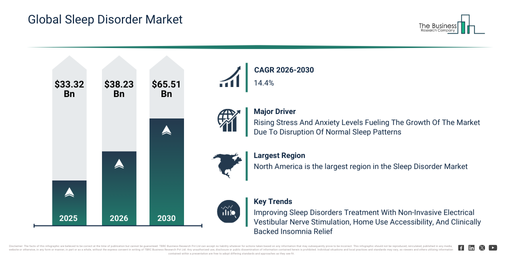
    The sleep disorder market has experienced substantial expansion in recent years. Its projected growth trajectory indicates an increase from $33.32 billion in 2025 to $38.23 billion in 2026, at a compound annual growth rate (CAGR) of 14.7%. Historically, this market’s development can be attributed to heightened awareness regarding sleep health, the rising occurrence of insomnia and sleep apnea, increased adoption of sleep diagnostic services, an expanding geriatric population, a surge in stress and lifestyle-related sleep issues, and the growing use of smartphones and wearable devices for sleep tracking.

    The sleep disorder market is anticipated to experience substantial growth in the next few years, with projections indicating it will reach $65.51 billion by 2030, expanding at a compound annual growth rate (CAGR) of 14.4%. This expansion during the forecast period is primarily driven by factors such as the increased utilization of telemedicine services for sleep-related conditions, the growing adoption of wearable devices for sleep tracking, the rise in home-based diagnostic testing, the wider use of cognitive behavioral therapy applications, and heightened government initiatives promoting sleep health awareness. Significant trends expected during this period include advancements in wearable sleep monitoring technology, improvements in home-based sleep diagnostic tools, progress in AI-driven sleep analysis, innovative non-invasive therapies for sleep apnea, developments in telemedicine for sleep consultations, and enhancements in cognitive behavioral therapy applications.

    Download A Free Sample Report For Comprehensive Market Insights:

    https://www.thebusinessresearchcompany.com/sample.aspx?id=30744&type=smp

    What Market Drivers Are Helping Shape The Sleep Disorder Market Expansion?

    Rising stress and anxiety levels are projected to fuel the expansion of the sleep disorder market. These levels signify the extent of psychological pressure and persistent worry in a population, frequently stemming from environmental, societal, or economic stressors. The rise in stress and anxiety is attributed to pressures in the workplace, with employees encountering increased workloads, strict deadlines, and uncertainty regarding their employment. Stress and anxiety contribute to sleep disorders by disturbing typical sleep cycles and making it harder to initiate or maintain sleep. They negatively impact overall health by hindering restorative sleep, resulting in tiredness, reduced mental function, and a greater susceptibility to long-term illnesses. For example, data from May 2024, released by the US-based American Psychiatric Association (APA), indicated that 43% of U.S. adults reported increased anxiety in 2024 compared to the prior year. This figure represents an increase from 37% in 2023 and 32% in 2022. Consequently, escalating stress and anxiety levels are a key factor driving the expansion of the sleep disorder market.

    How Is The Sleep Disorder Market Structured Across Different Market Segments?

    The sleep disorder market covered in this report is segmented –

    1) By Disorder Type: Insomnia, Sleep Apnea, Restless Legs Syndrome, Narcolepsy, Circadian Rhythm Disorders

    2) By Treatment: Cognitive Behavioral Therapy, Medication Therapy, Psychiatric Treatment, Behavioral Treatment

    3) By Diagnostic Method: Polysomnography, Home Sleep Testing, Actigraphy, Sleep Diaries, Questionnaires and Screening

    4) By Distribution Channel: Retail Pharmacies, Online Sales, Hospital Pharmacies

    5) By End-User: Hospitals And Sleep Centers, Home Care Settings, Academic

    Subsegments:

    1) By Insomnia: Acute Insomnia, Chronic Insomnia, Onset Insomnia, Maintenance Insomnia, Behavioral Insomnia, Medication-Induced Insomnia

    2) By Sleep Apnea: Obstructive Sleep Apnea, Central Sleep Apnea, Complex Sleep Apnea Syndrome, Mild Sleep Apnea, Moderate Sleep Apnea, Severe Sleep Apnea, Pediatric Sleep Apnea, Treatment-Resistant Sleep Apnea

    3) By Restless Legs Syndrome: Primary Restless Legs Syndrome, Secondary Restless Legs Syndrome, Mild Restless Legs Syndrome, Moderate Restless Legs Syndrome, Severe Restless Legs Syndrome, Intermittent Restless Legs Syndrome, Chronic Persistent Restless Legs Syndrome

    4) By Narcolepsy: Narcolepsy Type 1, Narcolepsy Type 2, Idiopathic Hypersomnia, Pediatric Narcolepsy, Treatment-Resistant Narcolepsy, Secondary Narcolepsy

    5) By Circadian Rhythm Disorders: Delayed Sleep Phase Disorder, Advanced Sleep Phase Disorder, Shift Work Sleep Disorder, Jet Lag Disorder, Irregular Sleep-Wake Rhythm Disorder, Non-24-Hour Sleep-Wake Disorder

    What Trends Are Affecting The Sleep Disorder Market Dynamics?

    Leading companies within the sleep disorder market are concentrating on developing advanced therapeutic technologies, including electrical vestibular nerve stimulation (VeNS) methods. This focus aims to provide non-drug treatment options that enhance sleep quality, regulate circadian rhythms, and support patients dealing with chronic insomnia. The electrical vestibular nerve stimulation (VeNS) method itself is a non-invasive therapeutic approach that delivers low-level electrical pulses to the vestibular nerve, a key neural pathway that influences brain regions involved in sleep regulation without the need for surgical intervention or pharmaceuticals. As an illustration, in October 2024, Neurovalens Ltd., a UK–based health-tech company, launched Modius Sleep. This FDA-cleared, non-invasive device is specifically designed to treat chronic insomnia using electrical vestibular nerve stimulation (VeNS). The headset-style medical device is worn for about 30 minutes each evening, transmitting safe electrical pulses to the vestibular nerve to influence the hypothalamus and brainstem areas that govern circadian rhythm and sleep patterns, thereby assisting users in falling asleep more quickly and remaining asleep for longer periods.

    Which Companies Form The Competitive Landscape Of The Sleep Disorder Market?

    Major companies operating in the sleep disorder market are Johnson & Johnson, Merck & Co. Inc., Pfizer Inc., Sanofi S.A., GlaxoSmithKline plc, Eli Lilly and Company, Takeda Pharmaceutical Company Limited, Teva Pharmaceutical Industries Ltd., Otsuka Holdings Co. Ltd., Biogen Inc., Union Chimique Belge S.A., Sun Pharmaceutical Industries Ltd., Eisai Co. Ltd., Jazz Pharmaceuticals plc, Aurobindo Pharma Ltd., Dr. Reddy’s Laboratories Limited, H. Lundbeck A/S, Sumitomo Pharma Co. Ltd., Neurocrine Biosciences Inc., Harmony Biosciences Holdings Inc., Vanda Pharmaceuticals Inc.

    Access The Complete Sleep Disorder Market Report:

    https://www.thebusinessresearchcompany.com/report/sleep-disorder-market-report

    Which Region Leads The Sleep Disorder Market By Size?

    North America was the largest region in the sleep disorder market in 2025. Asia-Pacific is expected to be the fastest-growing region in the forecast period. The regions covered in the sleep disorder market report are Asia-Pacific, South East Asia, Western Europe, Eastern Europe, North America, South America, Middle East, Africa.

    Access a Customized Sleep Disorder Market Report for Deeper Competitive Insights

    https://www.thebusinessresearchcompany.com/sample.aspx?id=30744&type=smp

    Get in touch with us:

    The Business Research Company: https://www.thebusinessresearchcompany.com/

    Americas: +1 310-496-7795

    Asia: +44 7882 955267 & +91 8897263534

    Europe: +44 7882 955267

    Email us at: marketing@tbrc.info

    Follow us on:

    LinkedIn: https://in.linkedin.com/company/the-business-research-company

    YouTube: https://www.youtube.com/channel/UC24_fI0rV8cR5DxlCpgmyFQ

    Global Market Model: https://www.thebusinessresearchcompany.com/global-market-model
  • Single-Detector Gamma Camera Market Outlook Assessing Future Opportunities And Growth Prospects

    Single-Detector Gamma Camera Market Outlook Assessing Future Opportunities And Growth Prospects

    The Business Research Company’s 2026 market reports feature advanced enhancements such as market attractiveness analysis, total addressable market evaluation, company benchmarking matrices, interactive Excel dashboards, expanded supply chain intelligence, emerging startup coverage, and detailed product insights, delivering more actionable and strategically valuable research.

    How Will The Market Value Of The Single-Detector Gamma Camera Market Increase Between 2026 And 2030?

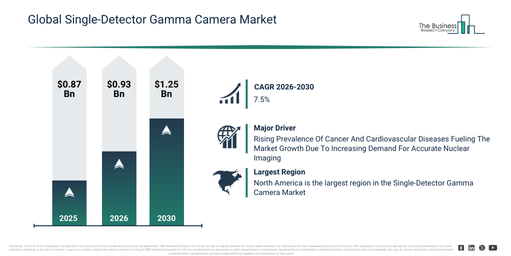
    The single-detector gamma camera market has witnessed substantial growth in recent years. Its value is anticipated to rise from $0.87 billion in 2025 to $0.93 billion in 2026, exhibiting a compound annual growth rate (CAGR) of 7.8%. This historical expansion can be attributed to several factors, including the increasing prevalence of chronic diseases, greater adoption of nuclear medicine diagnostics, an expanding geriatric population, the development of healthcare infrastructure, and the rising need for early disease detection.

    The single-detector gamma camera market is projected to experience substantial expansion in the coming years, reaching $1.25 billion by 2030, exhibiting a compound annual growth rate (CAGR) of 7.5%. This anticipated growth during the forecast period is driven by several factors, including the escalating global prevalence of cancer and cardiovascular ailments, increased investment in healthcare infrastructure (particularly within developing economies), the growing embrace of sophisticated gamma camera systems, the broader application of nuclear medicine in both diagnostics and research, and the heightened need for non-invasive diagnostic imaging techniques. Key trends anticipated during this period encompass technological progress in detectors and imaging systems, advancements in hybrid imaging, the evolution of digital and solid-state gamma cameras, ongoing research and development into new radiopharmaceuticals and imaging protocols, and the increasing incorporation of artificial intelligence (AI) and automated image processing.

    Download A Free Sample Report For Comprehensive Market Insights:

    https://www.thebusinessresearchcompany.com/sample.aspx?id=30743&type=smp

    Which Significant Factors Are Encouraging Growth In The Single-Detector Gamma Camera Market?

    The expanding occurrence of cancer and cardiovascular ailments is anticipated to drive the advancement of the single-detector gamma camera market in the future. The term ‘prevalence’ for these conditions indicates the number of individuals within a particular population who are currently affected by some form of cancer or a heart and blood vessel disease during a defined timeframe. This prevalence is increasing due to an aging global population and greater exposure to risk factors like poor dietary habits and lack of physical activity, which heighten susceptibility to these illnesses. Single-detector gamma cameras aid in diagnosing cancer and cardiovascular conditions by offering essential nuclear imaging. This imaging allows medical professionals to identify, evaluate, and track functional alterations in organs impacted by cancer and heart-related ailments. For instance, the Centers for Disease Control and Prevention, a public health agency based in Switzerland, reported in August 2025 that 90% of the nation’s 4.9 trillion dollars in yearly healthcare expenditure is linked to people with chronic and mental health issues. Annually, over 84,000 Americans succumb to heart disease or stroke, and the expenses related to cardiovascular diseases are predicted to hit approximately $2 trillion by 2050. Consequently, the increasing occurrence of cancer and cardiovascular diseases is stimulating the expansion of the single-detector gamma camera market. The increasing need for nuclear medicine imaging is anticipated to boost the expansion of the single-detector gamma camera market in the coming years. Nuclear medicine imaging involves employing tiny quantities of radioactive substances to visualize and diagnose various illnesses, such as cancer, cardiovascular ailments, and neurological disorders, by utilizing imaging methods that deliver functional and molecular insights. This heightened demand stems from the growing incidence of chronic and intricate diseases, coupled with the necessity for accurate diagnostic instruments. Single-detector gamma cameras facilitate nuclear medicine imaging by providing dependable, economical, and high-resolution images crucial for identifying and overseeing a range of medical conditions. For example, AMN Healthcare, a US-based provider of healthcare workforce solutions, reported in September 2025 that nuclear medicine technologists are forecast to see an 8% increase in job opportunities by 2031, a rate exceeding the average across all professions, with national average salaries typically falling between $68,000 and $95,000 per year, and experienced professionals earning substantially more. Consequently, the rising requirement for nuclear medicine imaging is fueling the advancement of the single-detector gamma camera market.

    Which Segment-Based Categories Are Covered In The Single-Detector Gamma Camera Market?

    The single-detector gamma camera market covered in this report is segmented –

    1) By Type Of Detector: High-Energy General-Purpose Gamma Cameras, Low-Energy High-Resolution Gamma Cameras, Specialized Gamma Cameras

    2) By Type Or Design: Stationary Type Single-Detector Gamma Camera, Mobile Type Single-Detector Gamma Camera Or Single-Head Mobile Gamma Cameras

    3) By Technology: Static Imaging, Dynamic Imaging, Tomographic Imaging (Single Photon Emission Computed Tomography (SPECT)), Quantitative Imaging

    4) By Application: Oncology, Cardiology, Neurology, Bone Scintigraphy, Pulmonary Scintigraphy

    5) By End-User: Hospitals, Diagnostic Imaging Centers, Research Institutions, Outpatient Clinics

    Subsegments:

    1) By High-Energy General-Purpose Gamma Cameras: Cardiac Imaging Gamma Cameras, Whole-Body Imaging Gamma Cameras, Multi-Purpose Imaging Gamma Cameras

    2) By Low-Energy High-Resolution Gamma Cameras: Thyroid Imaging Gamma Cameras, Bone Scintigraphy Gamma Cameras, Renal Imaging Gamma Cameras

    3) By Specialized Gamma Cameras: Cardiac SPECT Imaging Gamma Cameras, Brain SPECT Imaging Gamma Cameras, Liver SPECT Imaging Gamma Cameras

    Who Are The Key Market Participants In The Single-Detector Gamma Camera Market?

    Major companies operating in the single-detector gamma camera market are Siemens Healthineers AG, GE HealthCare Technologies Inc., Koninklijke Philips N.V., Canon Medical Systems Corporation, Digirad Corporation, Serac Life Sciences Limited, Biodex Medical Systems Inc., Beijing Huitai Medical Equipment Co. Ltd., Electronic & Engineering Co. Private Limited, DVS Medical Inc., NUVIATech Instruments, Dilon Technologies Inc., Serac Imaging Systems Limited, RadRays Medical Technology, AdvanScint Imaging Solutions, MedNova Imaging Ltd., GBT Medical Technologies, United Imaging Healthcare Co. Ltd.

    Access The Complete Single-Detector Gamma Camera Market Report:

    https://www.thebusinessresearchcompany.com/report/single-detector-gamma-camera-market-report

    Which Region Has The Strongest Presence In The Single-Detector Gamma Camera Market?

    North America was the largest region in the single-detector gamma camera market in 2025. Asia-Pacific is expected to be the fastest-growing region in the forecast period. The regions covered in the single-detector gamma camera market report are Asia-Pacific, South East Asia, Western Europe, Eastern Europe, North America, South America, Middle East, Africa.

    Access a Customized Single-Detector Gamma Camera Market Report for Deeper Competitive Insights

    https://www.thebusinessresearchcompany.com/sample.aspx?id=30743&type=smp

    Get in touch with us:

    The Business Research Company: https://www.thebusinessresearchcompany.com/

    Americas: +1 310-496-7795

    Asia: +44 7882 955267 & +91 8897263534

    Europe: +44 7882 955267

    Email us at: marketing@tbrc.info

    Follow us on:

    LinkedIn: https://in.linkedin.com/company/the-business-research-company

    YouTube: https://www.youtube.com/channel/UC24_fI0rV8cR5DxlCpgmyFQ

    Global Market Model: https://www.thebusinessresearchcompany.com/global-market-model
  • Single Use Medical Devices Market Industry Forecast Reflecting Growth To $42.43 Billion By 2030

    Single Use Medical Devices Market Industry Forecast Reflecting Growth To $42.43 Billion By 2030

    The Business Research Company’s 2026 market reports feature advanced enhancements such as market attractiveness analysis, total addressable market evaluation, company benchmarking matrices, interactive Excel dashboards, expanded supply chain intelligence, emerging startup coverage, and detailed product insights, delivering more actionable and strategically valuable research.

    What Will Be The Estimated Market Size Of The Single Use Medical Devices Market By 2030?

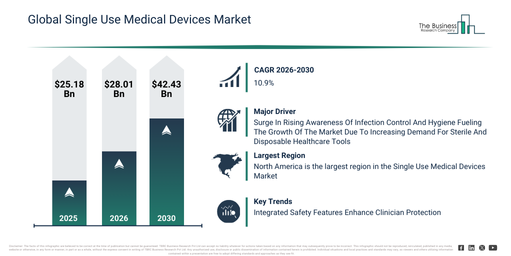
    The single-use medical devices market size has seen significant growth in recent years. It is forecast to increase from $25.18 billion in 2025 to $28.01 billion in 2026, demonstrating a compound annual growth rate (CAGR) of 11.2%. This market’s past expansion can be attributed to several factors, including a heightened need for infection control, a worldwide rise in surgical procedures, the increasing occurrence of chronic diseases, a greater number of hospital admissions and emergency situations, and the growing preference for disposable equipment to ensure safety.

    The market size for single-use medical devices is projected to experience considerable expansion over the coming years. This sector is expected to reach $42.43 billion by 2030, growing at a compound annual growth rate (CAGR) of 10.9%. The projected increase in this period can be attributed to progress in biodegradable materials, new developments in smart disposable devices, the incorporation of automation into manufacturing processes, improvements in sterile barrier packaging, and novel lightweight designs. Important trends for the forecast duration encompass advancements in biodegradable disposable materials, breakthroughs in intelligent single-use devices, the adoption of automation in production, enhancements in sterile packaging technology, and creative approaches to lightweight device designs.

    Download A Free Sample Report For Comprehensive Market Insights:

    https://www.thebusinessresearchcompany.com/sample.aspx?id=30742&type=smp

    What Core Drivers Are Transforming The Single Use Medical Devices Market?

    The expanding understanding of infection control and hygiene practices is anticipated to boost the future expansion of the single-use medical devices market. These practices are crucial within healthcare environments for preventing hospital-acquired infections (HAIs) and cross-contamination, issues that can result in longer hospitalizations, higher treatment expenses, and increased rates of illness and death. This heightened awareness of infection control and hygiene stems largely from more stringent regulatory frameworks that prioritize patient safety and the avoidance of hospital-acquired infections. The single-use medical devices market contributes to this progression by supplying sterile, disposable instruments that minimize contamination risks and uphold adherence to hygiene protocols. For example, data from May 2023, published by the World Health Organization (WHO), a Switzerland-based United Nations (UN) specialized agency, indicated that approximately 1 in 10 patients in acute care hospitals contract at least one healthcare-associated infection (HAI) during their admission. This rate is notably higher in low and middle income countries compared to high income ones, underscoring the pervasive infection risk present in clinical settings. Consequently, the increasing understanding of infection prevention and hygiene is accelerating the uptake of single-use medical devices throughout hospitals and clinics.

    What Are The Major Segment Categories Within The Single Use Medical Devices Market?

    The single use medical devices market covered in this report is segmented –

    1) By Product Type: Syringes, Catheters, Surgical Instruments, Diagnostic Devices, Other Product Types

    2) By Material: Plastic, Metal, Glass, Other Materials

    3) By Application: Hospitals, Clinics, Ambulatory Surgical Centers, Home Healthcare, Other Applications

    4) By End-User: Healthcare Providers, Diagnostic Centers, Other End-Users

    Subsegments:

    1) By Syringes: Insulin Syringes, Tuberculin Syringes, Prefilled Syringes, Safety Syringes, Oral Syringes, Auto-Disable Syringes

    2) By Catheters: Intravenous (IV) Catheters, Urinary (Foley) Catheters, Central Venous Catheters, Peripheral Arterial Catheters, Dialysis Catheters, Cardiovascular (Angiography) Catheters

    3) By Surgical Instruments: Disposable Scalpels, Disposable Forceps, Disposable Scissors, Disposable Needle Holders, Disposable Retractors, Disposable Trocar Sets

    4) By Diagnostic Devices: Blood Glucose Test Strips, Rapid Diagnostic Test Kits, Single-Use Endoscopic Accessories, Specimen Collection Swabs, Disposable ECG Electrodes, Disposable Ultrasound Probe Covers

    5) By Other Product Types: Infusion Sets, Wound Dressings, Gloves And Gowns, Suction And Drainage Sets, Oxygen Masks And Cannulas, Disposable Dental Supplies

    What Trends Are Impacting The Single Use Medical Devices Market?

    Major companies operating in the single-use medical devices market are prioritizing the development of innovative solutions, such as blood control safety IV catheters that integrate automatic pathogen exposure mitigation and vessel entry confirmation, to gain a competitive advantage. Blood control safety IV catheters refer to single-use intravenous (IV) devices specifically designed to minimize blood exposure and prevent needlestick injuries during catheter insertion and use. For instance, in May 2024, MedSource Labs, a US-based medical device company, launched the ClearSafe Comfort and TrueSafe Comfort Blood Control Safety IV Catheters. These feature active blood control check valve technology to significantly reduce bloodborne pathogen exposure risk, a translucent flashback chamber for accurate vessel entry confirmation, and an ergonomic non-slip grip for ease of handling. This trend enhances procedural safety and efficiency but may increase procurement costs and require training for optimal utilization.

    Which Organizations Are Operating Within The Single Use Medical Devices Market?

    Major companies operating in the single use medical devices market are Cardinal Health Inc., Medtronic plc, 3M Health Care, Medline Industries LP, Fresenius Medical Care AG, Becton Dickinson and Company, Boston Scientific Corporation, Baxter International Inc., Shandong Weigao Group Medical Polymer Company Limited, B. Braun Melsungen Aktiengesellschaft, Terumo Corporation, Nipro Corporation, Coloplast A/S, Teleflex Incorporated, West Pharmaceutical Services Inc., Paul Hartmann Aktiengesellschaft, ConvaTec Group plc, Ambu A/S, Mercator Medical S.A., Bio-Med HealthCare Products Pvt. Ltd., HLL Lifecare Limited

    Access The Complete Single Use Medical Devices Market Report:

    https://www.thebusinessresearchcompany.com/report/single-use-medical-devices-market-report

    Which Region Stands As The Largest Contributor To The Single Use Medical Devices Market?

    North America was the largest region in the single use medical devices market in 2025. Asia-Pacific is expected to be the fastest-growing region in the forecast period. The regions covered in the single use medical devices market report are Asia-Pacific, South East Asia, Western Europe, Eastern Europe, North America, South America, Middle East, Africa.

    Access a Customized Single Use Medical Devices Market Report for Deeper Competitive Insights

    https://www.thebusinessresearchcompany.com/sample.aspx?id=30742&type=smp

    Get in touch with us:

    The Business Research Company: https://www.thebusinessresearchcompany.com/

    Americas: +1 310-496-7795

    Asia: +44 7882 955267 & +91 8897263534

    Europe: +44 7882 955267

    Email us at: marketing@tbrc.info

    Follow us on:

    LinkedIn: https://in.linkedin.com/company/the-business-research-company

    YouTube: https://www.youtube.com/channel/UC24_fI0rV8cR5DxlCpgmyFQ

    Global Market Model: https://www.thebusinessresearchcompany.com/global-market-model
  • Semiconductor Timing Integrated Circuit (IC) Market Forecast Analysis Through 2030 With Insights On Industry Expansion

    Semiconductor Timing Integrated Circuit (IC) Market Forecast Analysis Through 2030 With Insights On Industry Expansion

    The Business Research Company’s 2026 market reports feature advanced enhancements such as market attractiveness analysis, total addressable market evaluation, company benchmarking matrices, interactive Excel dashboards, expanded supply chain intelligence, emerging startup coverage, and detailed product insights, delivering more actionable and strategically valuable research.

    What Is The Estimated Growth In Market Size Of The Semiconductor Timing Integrated Circuit (IC) Market During 2026–2030?

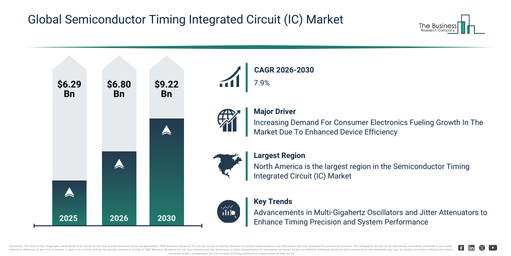
    The semiconductor timing IC market has experienced robust expansion in recent years. Projections indicate it will grow from $6.29 billion in 2025 to $6.80 billion in 2026, achieving a compound annual growth rate (CAGR) of 8.2%. Historically, this market’s growth can be attributed to factors such as the escalating demand for consumer electronics, the widespread adoption of communication systems, increased integration in automotive electronics, the ongoing expansion of industrial automation, and the heightened deployment in healthcare devices.

    The semiconductor timing IC market is anticipated to experience substantial expansion over the coming years, with its size projected to reach $9.22 billion by 2030, growing at a compound annual growth rate (CAGR) of 7.9%. This expansion throughout the forecast period is driven by the growing adoption of 5g and telecommunications infrastructure, a rising need for low-power timing solutions, the increasing deployment of IoT and connected devices, the enlargement of data centers and cloud computing, and the accelerating integration in electric vehicles and smart automotive systems. Key trends during this period include technological advancements in mixed-signal and digital timing ICs, innovations in programmable and multi-output clock generators, the development of low-power and high-precision timing ICs, ongoing research and development for automotive and electric vehicle timing solutions, and progress in crystal oscillators and jitter attenuation technologies.

    Download A Free Sample Report For Comprehensive Market Insights:

    https://www.thebusinessresearchcompany.com/sample.aspx?id=30740&type=smp

    Which Growth Factors Are Strengthening The Semiconductor Timing Integrated Circuit (IC) Market Landscape?

    The expanding requirement for consumer electronics is projected to fuel the advancement of the semiconductor timing integrated circuit (IC) market moving forward. Consumer electronics encompass electronic gadgets crafted for daily individual or domestic utilization, mainly for leisure, interaction, and amusement. These items differentiate themselves from industrial or expert machinery by focusing on non-commercial applications within households or daily routines. The need for consumer electronics is escalating due to swift technological progress, with novel and enhanced gadgets drawing in more users and promoting regular replacements. Semiconductor timing ICs facilitate this demand by supplying accurate timing and synchronization for these devices, guaranteeing their efficient and dependable functioning. For instance, in June 2025, data from the Australian Bureau of Statistics (ABS, an Australia-based official national statistical agency, revealed that electrical and electronic goods retailing increased by 3.9% during that single month, signifying continuous consumer demand expansion for electronics products. This indicates more robust consumer expenditure compared to the beginning of the year. Consequently, the rising demand for consumer electronics is propelling the growth of the semiconductor timing integrated circuit (IC) market.

    How Is The Semiconductor Timing Integrated Circuit (IC) Market Distributed Across Key Segments?

    The semiconductor timing integrated circuit (ic) market covered in this report is segmented –

    1) By Type Of Timing Integrated Circuit (IC): Crystal Oscillators, Real-Time Clock (RTC) Integrated Circuits (ICs), Frequency Synthesizers, Programmable Timing Integrated Circuits (IC), Clock Buffers and Clock Distribution Integrated Circuits (IC)

    2) By Technology: Analog Timing ICs, Digital Timing ICs, Mixed-Signal Timing ICs, Low-Power Timing ICs

    3) By Distribution Channel: Direct Sales, Distributors and Resellers, Online Platforms, Value-Added Resellers (VARs)

    4) By Application: Communication Systems, Consumer Electronics, Automotive Electronics, Industrial Automation, Healthcare Devices

    5) By End-User Sector: Telecommunications, Information Technology (IT) And Computing, Consumer Goods, Medical Equipment, Automotive

    Subsegments:

    1) By Crystal Oscillators: Surface Mount Device Oscillators, Through Hole Oscillators, Temperature Compensated Crystal Oscillators, Voltage Controlled Crystal Oscillators, Oven Controlled Crystal Oscillators

    2) By Real-Time Clock (RTC) Integrated Circuits: Serial Interface Real-Time Clocks, Parallel Interface Real-Time Clocks, Integrated Battery Backup Real-Time Clocks, Low Power Real-Time Clocks

    3) By Frequency Synthesizers: Integer Frequency Synthesizers, Fractional Frequency Synthesizers, Direct Digital Synthesizers, Phase Locked Loop Synthesizers

    4) By Programmable Timing Integrated Circuits: Digitally Controlled Oscillators, Programmable Clock Generators, Configurable Delay Lines, Frequency Agile Timing Controllers

    5) By Clock Buffers and Clock Distribution Integrated Circuits: Fanout Buffers, Clock Multiplexers, Jitter Attenuating Clock Buffers, Zero Delay Buffers, Differential Clock Distributors

    Which Trends Are Affecting The Semiconductor Timing Integrated Circuit (IC) Market Framework?

    Leading companies within the semiconductor timing integrated circuit (IC) market are prioritizing the development of products like multi-gigahertz oscillators and jitter attenuators to address the increasing need for ultra-low jitter, high-frequency, and thermally robust timing solutions in AI, 5G, and advanced computing systems. These multi-gigahertz oscillators and jitter attenuators are specialized ICs engineered to generate and stabilize high-speed clock signals, offering femtosecond-level precision and flexible programmable outputs, thereby surpassing conventional analog timing solutions often characterized by higher jitter and limited thermal stability. For example, in June 2025, Mixed-Signal Devices, a US-based semiconductor company, introduced its MS11X0 oscillator and MS15X0 jitter attenuator families, an innovative product line that provides up to 2 GHz output frequency, ultra-low jitter (as precise as 19 fs RMS), ±20 ppm thermal stability, and compact CMOS packages. These devices feature factory-programmable outputs, adaptive DSP-based timing engines, and strong environmental resilience, making them suitable for AI compute fabrics, 5G network synchronization, coherent optics, and high-speed SerDes interfaces. They integrate CMOS precision and Virtual Crystal architecture, which simplifies clock tree design, reduces component counts, and enhances reliability across complex electronic systems.

    Who Are The Businesses Driving Activity In The Semiconductor Timing Integrated Circuit (IC) Market?

    Major companies operating in the semiconductor timing integrated circuit (ic) market are Texas Instruments Incorporated, STMicroelectronics N.V., Infineon Technologies AG, KYOCERA Corporation, NXP Semiconductors N.V., Murata Manufacturing Co. Ltd., Analog Devices Inc., Renesas Electronics Corporation, Seiko Epson Corporation, ON Semiconductor Corporation, Skyworks Solutions Inc., Microchip Technology Incorporated, ROHM Co. Ltd., MaxLinear Inc., Vishay Intertechnology Inc., Diodes Incorporated, Nuvoton Technology Corporation, Silicon Laboratories Inc., Semtech Corporation, SiTime Corporation, Rakon Limited, Abracon LLC

    Access The Complete Semiconductor Timing Integrated Circuit (IC) Market Report:

    https://www.thebusinessresearchcompany.com/report/semiconductor-timing-integrated-circuit-ic-market-report

    What Is The Largest Regional Market In The Semiconductor Timing Integrated Circuit (IC) Market?

    North America was the largest region in the mobile semiconductor timing IC market in 2025. Asia-Pacific is expected to be the fastest-growing region in the forecast period. The regions covered in the semiconductor timing integrated circuit (ic) market report are Asia-Pacific, South East Asia, Western Europe, Eastern Europe, North America, South America, Middle East, Africa.

    Access a Customized Semiconductor Timing Integrated Circuit (IC) Market Report for Deeper Competitive Insights

    https://www.thebusinessresearchcompany.com/sample.aspx?id=30740&type=smp

    Get in touch with us:

    The Business Research Company: https://www.thebusinessresearchcompany.com/

    Americas: +1 310-496-7795

    Asia: +44 7882 955267 & +91 8897263534

    Europe: +44 7882 955267

    Email us at: marketing@tbrc.info

    Follow us on:

    LinkedIn: https://in.linkedin.com/company/the-business-research-company

    YouTube: https://www.youtube.com/channel/UC24_fI0rV8cR5DxlCpgmyFQ

    Global Market Model: https://www.thebusinessresearchcompany.com/global-market-model
  • Robotic Catheter Navigation Systems Market Growth Outlook Indicating Expansion To $2.22 Billion By 2030

    Robotic Catheter Navigation Systems Market Growth Outlook Indicating Expansion To $2.22 Billion By 2030

    The Business Research Company’s 2026 market reports feature advanced enhancements such as market attractiveness analysis, total addressable market evaluation, company benchmarking matrices, interactive Excel dashboards, expanded supply chain intelligence, emerging startup coverage, and detailed product insights, delivering more actionable and strategically valuable research.

    What Market Value Expansion Is Expected For The Robotic Catheter Navigation Systems Market Over The Forecast Period?

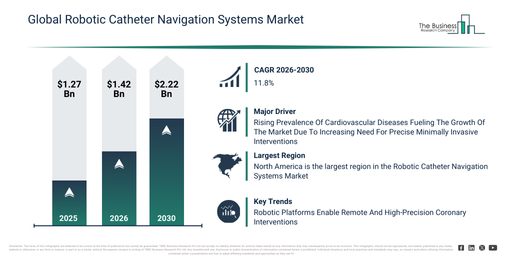
    The robotic catheter navigation systems market has experienced substantial growth in recent years. Its value is expected to increase from $1.27 billion in 2025 to $1.42 billion in 2026, achieving a compound annual growth rate (CAGR) of 12.0%. The expansion observed historically can be attributed to the rising prevalence of cardiovascular diseases, a growing demand for minimally invasive procedures, the increasing adoption of robotic-assisted surgeries, the expansion of cardiac catheterization labs, and an overall rise in healthcare expenditure.

    The robotic catheter navigation systems market size is projected to experience swift expansion in the coming years. By 2030, this market is anticipated to reach a valuation of $2.22 billion, exhibiting a compound annual growth rate (CAGR) of 11.8%. Factors contributing to this growth during the projected period include a heightened emphasis on precision medicine, the growing embrace of hybrid robotic systems, increased expenditure in research and development, broader applications in neurovascular procedures, and a rising demand from patients for quicker recuperation. Key trends expected within the forecast timeframe encompass advancements in robotic navigation technology, the integration of this technology with imaging and mapping systems, significant innovations in catheter design and materials, ongoing research and development in artificial intelligence and machine learning, and the incorporation of robotic systems with telemedicine platforms.

    Download A Free Sample Report For Comprehensive Market Insights:

    https://www.thebusinessresearchcompany.com/sample.aspx?id=30731&type=smp

    What Important Drivers Are Powering The Robotic Catheter Navigation Systems Market Growth?

    The increasing incidence of cardiovascular ailments is projected to drive the expansion of the robotic catheter navigation systems market in the foreseeable future. These conditions encompass a range of issues impacting the heart and blood vessels, such as heart attacks, strokes, and high blood pressure. The rise in cardiovascular diseases is attributed to unhealthy lifestyle choices, including inadequate diet, insufficient physical activity, and smoking. Robotic catheter navigation systems assist in managing cardiovascular diseases by facilitating accurate, minimally invasive movement within blood vessels during both diagnostic and therapeutic interventions. Such systems enhance patient results through improved procedural precision, fewer complications, and quicker recovery periods. As an illustration, the Centers for Disease Control, a US government body, reported in October 2024 that around 919,032 individuals succumbed to cardiovascular disease in 2023, representing 1 in every 3 fatalities. Consequently, the growing occurrence of cardiovascular diseases is a key factor propelling the expansion of the robotic catheter navigation systems market.

    How Does Segment Analysis Break Down The Robotic Catheter Navigation Systems Market Structure?

    The robotic catheter navigation systems market covered in this report is segmented –

    1) By Product Type: Magnetic Navigation Systems, Electromechanical Navigation Systems, Other Product Types

    2) By Application: Cardiology, Neurology, Urology, Gastroenterology, Other Application

    3) By End-User: Hospitals, Ambulatory Surgical Centers, Specialty Clinics, Other End-Users

    Subsegments:

    1) By Magnetic Navigation Systems: Magnetic Field Generators, Catheter Steering Units, Imaging And Visualization Tools, Navigation Software Platforms, Sensor Modules

    2) By Electromechanical Navigation Systems: Motorized Catheter Devices, Control Consoles, Imaging Integration Modules, Position Sensors, Monitoring Software

    3) By Other Product Types: Accessories And Consumables, Support And Maintenance Tools, Data Management Software, Calibration Equipment, Connectivity Modules

    What Trends Are Influencing The Robotic Catheter Navigation Systems Market?

    Leading companies in the robotic catheter navigation systems market are concentrating on developing sophisticated solutions, such as robotic platforms featuring integrated control command units, to enhance procedural exactitude and safety within interventional cardiology. Robotic platforms with integrated control command units empower physicians to remotely manage coronary angioplasty instruments from a shielded cockpit, thereby substantially diminishing radiation exposure for the medical personnel while simultaneously improving the steadiness and accuracy of catheter placement through robotic aid, which enables intricate vascular interventions with millimeter-level precision. For instance, in May 2023, ROBOCATH SAS, a France-based medical robotics company dedicated to creating intelligent solutions for cardiovascular treatments, introduced its R-One+ robotic platform. This robotic platform with integrated control command units is engineered to execute coronary angioplasties by allowing cardiologists to operate devices from a control room or cath lab cockpit, incorporating advanced hand gesture controls and superior ergonomic conditions. The system additionally offers enhanced visibility via radioscopy and hemodynamic monitoring screens to expedite the uptake of robotic percutaneous coronary interventions (PCI) and foster safer working environments for healthcare professionals.

    Which Firms Are Competing In The Robotic Catheter Navigation Systems Market?

    Major companies operating in the robotic catheter navigation systems market are Johnson & Johnson., Abbott Laboratories, Medtronic plc., Siemens Healthineers Inc, Boston Scientific Corporation, Intuitive Surgical, Terumo Corporation, Springer Nature Link, Biotronik SE & Co. KG, LivaNova PLC, MicroPort Scientific Corporation, ClearPoint Neuro Inc, Imricor Medical Systems Inc., Stereotaxis Inc., Acutus Medical Inc., John Wiley & Sons Inc., Arxiv, Auris Health, Catheter Precision Inc., Robocath S.A.

    Access The Complete Robotic Catheter Navigation Systems Market Report:

    https://www.thebusinessresearchcompany.com/report/robotic-catheter-navigation-systems-market-report

    Which Region Contributes The Most To The Robotic Catheter Navigation Systems Market?

    North America was the largest region in the robotic catheter navigation systems market in 2025. Asia-Pacific is expected to be the fastest-growing region in the forecast period. The regions covered in the robotic catheter navigation systems market report are Asia-Pacific, South East Asia, Western Europe, Eastern Europe, North America, South America, Middle East, Africa.

    Access a Customized Robotic Catheter Navigation Systems Market Report for Deeper Competitive Insights

    https://www.thebusinessresearchcompany.com/sample.aspx?id=30731&type=smp

    Get in touch with us:

    The Business Research Company: https://www.thebusinessresearchcompany.com/

    Americas: +1 310-496-7795

    Asia: +44 7882 955267 & +91 8897263534

    Europe: +44 7882 955267

    Email us at: marketing@tbrc.info

    Follow us on:

    LinkedIn: https://in.linkedin.com/company/the-business-research-company

    YouTube: https://www.youtube.com/channel/UC24_fI0rV8cR5DxlCpgmyFQ

    Global Market Model: https://www.thebusinessresearchcompany.com/global-market-model
  • Global Robotic Balance Training Systems Market Anticipated To Grow To $3.25 Billion By 2030 At 16.7% CAGR

    Global Robotic Balance Training Systems Market Anticipated To Grow To $3.25 Billion By 2030 At 16.7% CAGR

    The Business Research Company’s 2026 market reports feature advanced enhancements such as market attractiveness analysis, total addressable market evaluation, company benchmarking matrices, interactive Excel dashboards, expanded supply chain intelligence, emerging startup coverage, and detailed product insights, delivering more actionable and strategically valuable research.

    How Will The Market Value Of The Robotic Balance Training Systems Market Change Between 2026 And 2030?

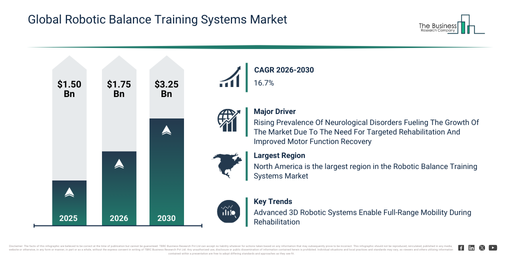
    The robotic balance training systems market has observed swift growth in its size during recent years. Projections indicate it will expand from $1.50 billion in 2025 to $1.75 billion in 2026, demonstrating a compound annual growth rate (CAGR) of 17.0%. Historically, this expansion has been driven by the increasing prevalence of balance and mobility disorders, the growing adoption of robotic rehabilitation technologies, a rising demand for measurable therapy outcomes, expanding rehabilitation infrastructure investments, and an increasing focus on fall-prevention programs.

    The market for robotic balance training systems is anticipated to experience substantial expansion over the coming years. This market is projected to reach $3.25 billion by 2030, demonstrating a compound annual growth rate (CAGR) of 16.7%. Several factors are driving this anticipated growth, including a globally expanding elderly population, the increasing integration of AI-enabled rehabilitation technologies, a greater incorporation of robotics into clinical practices, the wider availability of service and support networks, and an escalating need for sophisticated post-acute rehabilitation options. Key trends expected during this period involve enhancements in AI-powered adaptive training algorithms, novelties in virtual reality (VR) and augmented reality (AR) immersive rehabilitation, progress in multi-sensor fusion technologies, ongoing research and development in designing compact robotic systems, and improvements in cloud-connected rehabilitation platforms.

    Download A Free Sample Report For Comprehensive Market Insights:

    https://www.thebusinessresearchcompany.com/sample.aspx?id=30730&type=smp

    Which Major Factors Are Contributing To The Development Of The Robotic Balance Training Systems Market?

    The escalating occurrence of neurological disorders is projected to drive the expansion of the robotic balance training systems market moving forward. Neurological disorders are medical conditions that impact the brain, spinal cord, and nerves, disrupting typical nervous system functions and leading to impairments in movement, cognition, sensation, behavior, or overall bodily control. This rise in prevalence stems from unhealthy lifestyle habits, including poor diet, physical inactivity, smoking, excessive alcohol consumption, and chronic stress. Robotic balance training systems assist in managing neurological disorders by offering guided, repetitive, and controlled exercises to enhance stability, coordination, and motor function. They improve patient recovery through fostering neuroplasticity, reducing fall risk, and accelerating rehabilitation outcomes. For instance, in June 2025, according to Brain Research UK, a United Kingdom-based neurological charity, the prevalence of neurological conditions increased from 10.5 million people in 2024 to an estimated 11 million in 2025, marking a 4.8 % rise year over year. Therefore, the rising demand for targeted CNS drug delivery is driving the growth of the robotic balance training systems market.

    What Segment Types Are Included In The Robotic Balance Training Systems Market Analysis?

    The robotic balance training systems market covered in this report is segmented –

    1) By Product Type: Treadmill-Based Systems, Platform-Based Systems, Wearable Systems, Others Product Types

    2) By Technology: Sensor-Based, AI-Enabled, Virtual Reality Integrated, Others Technology

    3) By Distribution Or Channel Type: Direct Sales, Distributor-Based Sales, Online Or Partner-Based Procurement Channels

    4) By Application: Rehabilitation Centers, Hospitals And Clinics, Home Care Settings, Others Application

    5) By End User: Hospitals, Physical Therapy Clinics, Sports Facilities, Home Care

    Subsegments:

    1) By Treadmill-Based Systems: Body Weight Support Treadmill, Fixed Speed Treadmill, Adjustable Speed Treadmill, Split Belt Treadmill

    2) By Platform-Based Systems: Static Platform Systems, Dynamic Platform Systems, Force Plate Systems, Multi-Axis Balance Platforms

    3) By Wearable Systems: Lower Limb Exoskeleton, Full Body Exoskeleton, Ankle And Foot Orthosis, Hip And Knee Support Devices

    4) By Other Product Types: Robotic Walker Systems, Hybrid Balance Training Devices, Multi-Modal Rehabilitation Devices, Assistive Balance Robots

    Which Trends Are Guiding The Development Of The Robotic Balance Training Systems Market?

    Leading companies operating in the robotic balance training systems market are concentrating on developing advanced robotic solutions, such as 3D robotic body-weight support systems, to facilitate unrestricted mobility during rehabilitation exercises. 3D Robotic Body-Weight Support Systems are defined as rehabilitation devices that assist patients with walking or performing motor exercises by partially supporting their body weight across three dimensions. For instance, in March 2023, Aretech LLC, a US-based developer of advanced rehabilitation technologies, introduced ZeroG 3D. This platform is engineered to support patients weighing up to 450 pounds while enabling free movement in any direction, incorporating customizable boundaries and multi-directional tracking. The solution also provides dynamic body-weight support of up to 200 pounds and adaptable workspaces for training on treadmills or stairs, thereby accelerating the effectiveness of gait and balance therapy in clinical settings.

    Who Are The Major Companies Operating In The Robotic Balance Training Systems Market?

    Major companies operating in the robotic balance training systems market are Yaskawa Electric Corporation, Fourier Intelligence Co. Ltd., Reha Technology AG, Stereotaxis Inc., Cyberdyne Inc., Genrobotics Medical & Mobility Co. Ltd., Neofect Co. Ltd., Ekso Bionics Holdings Inc., Tyromotion GmbH, ReWalk Robotics Ltd., Bertec Corporation, DIH Medical Group, Rex Bionics Ltd., Bionik Laboratories Corp., Aretech LLC, Kinestica d.o.o., Shenzhen Milebot Robotics Co. Ltd., Guangzhou Yikang Medical Equipment Co. Ltd., Balance International Innovations GmbH, Motorika USA Inc.

    Access The Complete Robotic Balance Training Systems Market Report:

    https://www.thebusinessresearchcompany.com/report/robotic-balance-training-systems-market-report

    Which Regional Market Leads The Robotic Balance Training Systems Market?

    North America was the largest region in the robotic balance training systems market in 2025. Asia-Pacific is expected to be the fastest-growing region in the forecast period. The regions covered in the robotic balance training systems market report are Asia-Pacific, South East Asia, Western Europe, Eastern Europe, North America, South America, Middle East, Africa.

    Access a Customized Robotic Balance Training Systems Market Report for Deeper Competitive Insights

    https://www.thebusinessresearchcompany.com/sample.aspx?id=30730&type=smp

    Get in touch with us:

    The Business Research Company: https://www.thebusinessresearchcompany.com/

    Americas: +1 310-496-7795

    Asia: +44 7882 955267 & +91 8897263534

    Europe: +44 7882 955267

    Email us at: marketing@tbrc.info

    Follow us on:

    LinkedIn: https://in.linkedin.com/company/the-business-research-company

    YouTube: https://www.youtube.com/channel/UC24_fI0rV8cR5DxlCpgmyFQ

    Global Market Model: https://www.thebusinessresearchcompany.com/global-market-model
  • Robot-Assisted Rehabilitation Treadmills Market Future Analysis Covering Industry Shifts And Growth Potential

    Robot-Assisted Rehabilitation Treadmills Market Future Analysis Covering Industry Shifts And Growth Potential

    The Business Research Company’s 2026 market reports feature advanced enhancements such as market attractiveness analysis, total addressable market evaluation, company benchmarking matrices, interactive Excel dashboards, expanded supply chain intelligence, emerging startup coverage, and detailed product insights, delivering more actionable and strategically valuable research.

    What Is The Forecasted Rise In Market Size Of The Robot-Assisted Rehabilitation Treadmills Market During The Forecast Period?

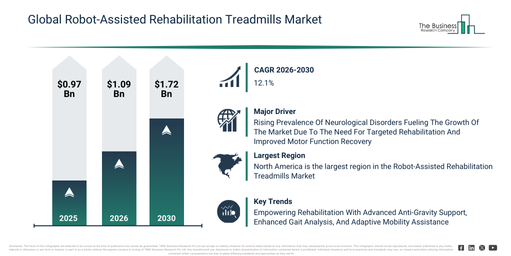
    The robot-assisted rehabilitation treadmills market has experienced substantial growth in recent years. It is anticipated to expand from $0.97 billion in 2025 to $1.09 billion in 2026, exhibiting a compound annual growth rate (CAGR) of 12.4%. This growth in the historic period has been primarily driven by factors such as the increasing adoption of robotic rehabilitation devices, the growing prevalence of neurological disorders, a rising demand for advanced physiotherapy solutions, the expansion of rehabilitation centers, and an increasing focus on patient mobility restoration.

    The robot-assisted rehabilitation treadmills market size is anticipated to experience swift growth in the upcoming years. It is predicted to expand to $1.72 billion in 2030, demonstrating a compound annual growth rate (CAGR) of 12.1%. This expansion during the forecast period can be attributed to increased investment in medical robotics, a growing demand for technology-assisted rehabilitation, a heightened focus on personalized therapy solutions, the broadening of outpatient rehabilitation services, and an expanding elderly population needing mobility support. Key trends identified for the forecast period encompass technological advancements in robotic gait training systems, innovations within sensor-integrated rehabilitation treadmills, progress in artificial intelligence-assisted rehabilitation, ongoing research and development in neurorehabilitation robotics, and improvements in immersive rehabilitation technologies.

    Download A Free Sample Report For Comprehensive Market Insights:

    https://www.thebusinessresearchcompany.com/sample.aspx?id=30729&type=smp

    What Key Growth Drivers Are Influencing The Robot-Assisted Rehabilitation Treadmills Market?

    The rising occurrence of neurological disorders is anticipated to propel the growth of the robot-assisted rehabilitation treadmills market moving forward. These medical conditions affect the brain, spinal cord, and nerves, disrupting normal nervous system function and leading to impairments in movement, cognition, sensation, behavior, or overall bodily control. The increasing prevalence of neurological disorders is attributable to unhealthy lifestyle habits, including poor diet, physical inactivity, smoking, excessive alcohol consumption, and chronic stress. Robot-assisted rehabilitation treadmills aid in managing neurological disorders by providing guided, repetitive gait training coupled with real-time feedback and support. They enhance patient outcomes by improving mobility, muscle strength, balance, and functional recovery during the rehabilitation process. For instance, in June 2025, Brain Research UK, a United Kingdom-based neurological charity, indicated that the prevalence of neurological conditions rose from 10.5 million people in 2024 to an estimated 11 million in 2025, marking a 4.8 % rise year over year. Therefore, the increasing demand for targeted CNS drug delivery is driving the growth of the robot-assisted rehabilitation treadmills market.

    Which Segment Divisions Form The Structure Of The Robot-Assisted Rehabilitation Treadmills Market?

    The robot-assisted rehabilitation treadmills market covered in this report is segmented –

    1) By Product Type: End-Effector Based Treadmills, Exoskeleton Based Treadmills, Gait Training Treadmills, Other Product Types

    2) By Technology: Semi-Automated, Fully Automated

    3) By Application: Neurological Rehabilitation, Orthopedic Rehabilitation, Geriatric Rehabilitation, Other Applications

    4) By End-User: Hospitals, Rehabilitation Centers, Clinics, Home Care Settings, Other End-Users

    Subsegments:

    1) By End-Effector Based Treadmills: Footplate Based Gait Systems, Distal Joint Guidance Systems, Force Feedback Assisted Platforms, Balance And Stability Training Platforms

    2) By Exoskeleton Based Treadmills: Lower Limb Robotic Exoskeletons, Hip And Knee Joint Assisted Exoskeletons, Full Leg Support Robotic Frames, Wearable Motorized Gait Support Systems

    3) By Gait Training Treadmills: Body Weight Support Treadmills, Robotic Assisted Speed Regulated Treadmills, Dynamic Gait And Posture Training Systems, Multidirectional Gait Correction Treadmills

    4) By Other Product Types: Hybrid Gait Rehabilitation Systems, Robotic Balance Training Platforms, Neuromuscular Reeducation Devices, Specialized Rehabilitation Motion Platforms

    What Trends Are Influencing The Future Of The Robot-Assisted Rehabilitation Treadmills Market?

    Leading companies in the robot-assisted rehabilitation treadmills market are focusing on developing advanced products, such as anti-gravity body weight support systems, to enhance patient mobility outcomes, accelerate recovery times, and improve clinical rehabilitation protocols. Anti-gravity body weight support systems are integrated mechanisms that decrease a patient’s effective body weight during treadmill walking, allowing individuals with mobility impairments to participate in gait training with less risk of falls and reduced physical strain. For instance, in June 2024, ReWalk Robotics Ltd., an Israel-based provider of rehabilitation technology solutions, launched the AlterG NEO Anti-Gravity Treadmill. This is a cost-effective, user-friendly treadmill that features the company’s patented Differential Air Pressure (DAP) technology. This core technology offers precise and consistent unweighting, enabling safe rehabilitation and athletic training by reducing stress on injured joints and muscles. Its updated design and accessible price point are specifically aimed at making the benefits of anti-gravity therapy available to a broader range of physical rehabilitation clinics and athletic training facilities.

    Which Companies Are Influencing The Robot-Assisted Rehabilitation Treadmills Market?

    Major companies operating in the robot-assisted rehabilitation treadmills market are HIWIN Corp., Biodex Medical Systems Inc., Reha Technology AG, Guangzhou Longest Science & Technology Co. Ltd., Hocoma AG, Motek Medical B.V., Ekso Bionics Holdings Inc., Tyromotion GmbH, ReWalk Robotics Ltd., Meditouch Ltd., Woodway USA Inc., Restorative Therapies Inc., BAMA Teknoloji A.Ş., Aretech LLC, Bionik Laboratories Corp., Techno Concept Inc., Rex Bionics Plc, Rehab‑Robotics Company Limited, LokoHelp Group GmbH, ZARYA

    Access The Complete Robot-Assisted Rehabilitation Treadmills Market Report:

    https://www.thebusinessresearchcompany.com/report/robot-assisted-rehabilitation-treadmills-market-report

    Which Region Holds The Largest Share In The Robot-Assisted Rehabilitation Treadmills Market?

    North America was the largest region in the robot-assisted rehabilitation treadmills market in 2025. Asia-Pacific is expected to be the fastest-growing region in the forecast period. The regions covered in the robot-assisted rehabilitation treadmills market report are Asia-Pacific, South East Asia, Western Europe, Eastern Europe, North America, South America, Middle East, Africa.

    Access a Customized Robot-Assisted Rehabilitation Treadmills Market Report for Deeper Competitive Insights

    https://www.thebusinessresearchcompany.com/sample.aspx?id=30729&type=smp

    Get in touch with us:

    The Business Research Company: https://www.thebusinessresearchcompany.com/

    Americas: +1 310-496-7795

    Asia: +44 7882 955267 & +91 8897263534

    Europe: +44 7882 955267

    Email us at: marketing@tbrc.info

    Follow us on:

    LinkedIn: https://in.linkedin.com/company/the-business-research-company

    YouTube: https://www.youtube.com/channel/UC24_fI0rV8cR5DxlCpgmyFQ

    Global Market Model: https://www.thebusinessresearchcompany.com/global-market-model
  • Responder Hydration Monitoring Systems Market Analysis Reflecting Expansion Trends And Industry Performance

    Responder Hydration Monitoring Systems Market Analysis Reflecting Expansion Trends And Industry Performance

    The Business Research Company’s 2026 market reports feature advanced enhancements such as market attractiveness analysis, total addressable market evaluation, company benchmarking matrices, interactive Excel dashboards, expanded supply chain intelligence, emerging startup coverage, and detailed product insights, delivering more actionable and strategically valuable research.

    How Is The Responder Hydration Monitoring Systems Market’s Market Value Anticipated To Evolve From 2026 To 2030?

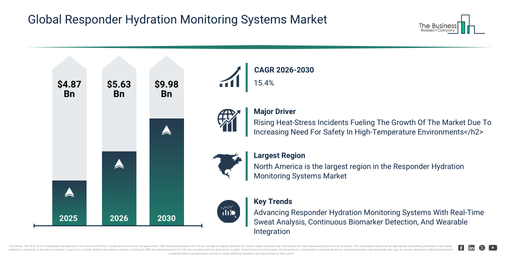
    The responder hydration monitoring systems market has experienced rapid expansion in recent years. This market is projected to increase from $4.87 billion in 2025 to $5.63 billion in 2026, achieving a compound annual growth rate (CAGR) of 15.7%. The growth observed in the historic period stems from the increasing adoption of wearable health devices, growing awareness of hydration and wellness, rising demand from sports and fitness users, expansion of occupational safety initiatives, and increasing use of remote patient monitoring.

    The responder hydration monitoring systems market size is anticipated to undergo significant growth over the upcoming years. It is projected to expand to $9.98 billion by 2030, demonstrating a compound annual growth rate (CAGR) of 15.4%. This anticipated expansion within the forecast period is primarily fueled by the increasing incorporation of hydration sensors into smart wearables, a rising adoption among first responders and industrial workers, a heightened emphasis on preventive healthcare, the expansion of corporate wellness programs, and a growing demand for cloud-based analytics services. Noteworthy trends for the forecast period include technological improvements in hydration sensing, breakthroughs in non-invasive wearable patches, advancements in AI-based hydration analytics, continuous research and development to enhance biosensor accuracy, and the escalating integration of IoT and cloud platforms.

    Download A Free Sample Report For Comprehensive Market Insights:

    https://www.thebusinessresearchcompany.com/sample.aspx?id=30728&type=smp

    Which Core Factors Are Supporting The Expansion Of The Responder Hydration Monitoring Systems Market?

    The anticipated expansion of the responder hydration monitoring systems market is driven by the growing number of heat-stress incidents. These incidents are defined as medical emergencies where the body struggles to regulate its temperature, typically due to extended exposure to high heat or intense physical activity. An uptick in their occurrence is primarily attributable to increasingly common and severe heat conditions, coupled with demanding work-related and emergency operations. Responder hydration monitoring systems are instrumental in reducing heat-stress incidents by continuously monitoring fluid loss, core body temperature, and physiological stress in real time. Such systems enhance responder safety and operational effectiveness through providing early warnings and facilitating prompt actions to avert heat-induced ailments. As an illustration, in July 2024, data from the Korea Disease Control and Prevention Agency (KDCA), a South Korea-based government agency tasked with organ transplant management and disease control, indicated that a total of 2,818 patients suffered from heat-related illnesses, including 32 presumed deaths, in 2023. This figure marked an 80.2% increase compared with 2022, with male patients constituting 77.8% or 2,192 cases and female patients making up 22.2% or 626 cases. Consequently, the escalation of heat-stress incidents is propelling the expansion of the responder hydration monitoring systems market.

    How Are Different Segment Groups Identified Within The Responder Hydration Monitoring Systems Market?

    The responder hydration monitoring systems market covered in this report is segmented –

    1) By Product Type: Wearable Hydration Monitors, Smart Water Bottles, Patch-Based Sensors, Other Products

    2) By Technology: Bioimpedance, Optical Sensors, Electrochemical Sensors, Other Technologies

    3) By Sales / Distribution Channel: Direct Device Sales, B2B Institutional Sales, E-Commerce And Retail Sales

    4) By Application: Military, Firefighters, Emergency Medical Services, Sports And Fitness, Other Applications

    5) By End-User: Individual, Institutional

    Subsegments:

    1) By Wearable Hydration Monitors: Wrist-Worn Hydration Trackers, Chest-Strap Hydration Monitoring Devices, Headband Hydration Sensor Units, Smart Armband Hydration Monitors, Clip-On Hydration Detection Devices

    2) By Smart Water Bottles: Hydration-Tracking Smart Bottles, Temperature-Sensing Smart Bottles, App-Connected Water Intake Bottles, Self-Monitoring Fluid Level Bottles, Sensor-Embedded Hydration Bottles

    3) By Patch-Based Sensors: Sweat-Analysis Hydration Patches, Skin-Adhesive Hydration Sensor Patches, Real-Time Hydration Tracking Patches, Heat-Responsive Hydration Patch Sensors, Flexible Wearable Hydration Patches

    4) By Other Products: Handheld Hydration Testing Devices, Hydration Monitoring Chest Modules, Portable Electrolyte Measurement Tools, Hydration Assessment Field Kits, Multi-Parameter Wearable Sensor Units

    Which Trends Are Contributing To Changes In The Responder Hydration Monitoring Systems Market?

    Key players in the responder hydration monitoring systems market are prioritizing the creation of sophisticated capabilities, including real-time sweat analysis, aimed at enhancing hydration evaluation, tracking electrolyte equilibrium, and providing comprehensive physiological understanding for individuals like first responders, athletes, and elite professionals. This method, known as real-time sweat analysis, involves the ongoing measurement of specific biomarkers found in sweat, such as electrolytes and hydration markers, employing wearable sensors to deliver instant information on a person’s hydration level as conditions evolve. As an illustration, in October 2025, Innovosens AB, a Swedish firm specializing in wearable sensing solutions, introduced HydroSense, an innovative sweat sensor engineered for uninterrupted hydration and electrolyte tracking. The HydroSense system features tiny, skin-adhered sensors that analyze sweat composition continuously, providing practical hydration insights directly to connected wearable technology or mobile apps. This empowers both users and their support personnel to make well-founded decisions regarding fluid and electrolyte replenishment, thereby enhancing performance and mitigating stress linked to heat.

    Who Are The Companies Shaping The Responder Hydration Monitoring Systems Market Landscape?

    Major companies operating in the responder hydration monitoring systems market are GE HealthCare Technologies Inc., Masimo Corporation, Abena A/S, John Wiley & Sons Inc., ResearchGate GmbH, Nix Biosensors Inc., Wearable Technologies AG, BSX Technologies Inc., Mode Sensors Inc., Kenzen Inc., WearOptimo Pty Ltd., GraphWear Technologies Inc., MX3 Diagonistics Inc., DC Rainmaker Inc., Intake Health Inc., Epicore Biosystems Inc, Sixty Inc., HDrop Inc., iHydrate Technologies Inc., Oura Health Oy

    Access The Complete Responder Hydration Monitoring Systems Market Report:

    https://www.thebusinessresearchcompany.com/report/responder-hydration-monitoring-systems-market-report

    Which Region Is The Dominant Market In The Responder Hydration Monitoring Systems Market?

    North America was the largest region in the responder hydration monitoring systems market in 2025. Asia-Pacific is expected to be the fastest-growing region in the forecast period. The regions covered in the responder hydration monitoring systems market report are Asia-Pacific, South East Asia, Western Europe, Eastern Europe, North America, South America, Middle East, Africa.

    Access a Customized Responder Hydration Monitoring Systems Market Report for Deeper Competitive Insights

    https://www.thebusinessresearchcompany.com/sample.aspx?id=30728&type=smp

    Get in touch with us:

    The Business Research Company: https://www.thebusinessresearchcompany.com/

    Americas: +1 310-496-7795

    Asia: +44 7882 955267 & +91 8897263534

    Europe: +44 7882 955267

    Email us at: marketing@tbrc.info

    Follow us on:

    LinkedIn: https://in.linkedin.com/company/the-business-research-company

    YouTube: https://www.youtube.com/channel/UC24_fI0rV8cR5DxlCpgmyFQ

    Global Market Model: https://www.thebusinessresearchcompany.com/global-market-model
  • Global Rescue Airway Devices Market Revenue Expected To Reach $4.48 Billion By 2030

    Global Rescue Airway Devices Market Revenue Expected To Reach $4.48 Billion By 2030

    The Business Research Company’s 2026 market reports feature advanced enhancements such as market attractiveness analysis, total addressable market evaluation, company benchmarking matrices, interactive Excel dashboards, expanded supply chain intelligence, emerging startup coverage, and detailed product insights, delivering more actionable and strategically valuable research.

    By 2030, How Much Growth In Market Size Is Expected For The Rescue Airway Devices Market?

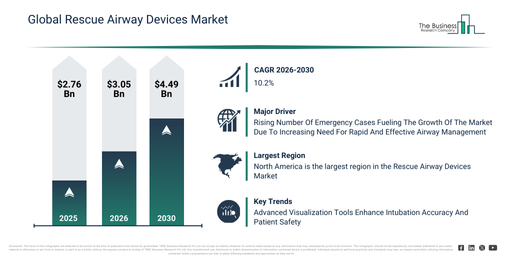
    The rescue airway devices market has experienced rapid expansion in recent years. It is anticipated to expand from $2.76 billion in 2025 to $3.05 billion in 2026, demonstrating a compound annual growth rate (CAGR) of 10.4%. The historical period’s growth can be linked to factors such as increasing mobile connectivity, rising sensor integration, expanding IoT adoption, growing data analytics usage, and increasing indoor positioning demand.

    The rescue airway devices market is poised for rapid expansion over the next few years, with projections indicating it will reach $4.49 billion by 2030, exhibiting a compound annual growth rate (CAGR) of 10.2%. This anticipated growth during the forecast period is largely driven by factors such as the increasing implementation of context-aware automation, the growing need for real-time localization, the ongoing expansion of smart infrastructure, the broadening scope of AI-enabled processing, and the rising adoption of multi-modal sensing. Prominent trends throughout this period encompass advancements in adaptive sensing, innovations in ambient automation, developments in multimodal fusion, extensive research in predictive intelligence, and significant technology upgrades in spatial computing.

    Download A Free Sample Report For Comprehensive Market Insights:

    https://www.thebusinessresearchcompany.com/sample.aspx?id=30727&type=smp

    What Are The Main Drivers Accelerating The Growth Of The Rescue Airway Devices Market?

    The expansion of the rescue airway devices market is anticipated to be fueled by an increasing volume of emergency situations. Such cases encompass critical medical events like vehicular crashes, heart attacks, respiratory distress, and serious injuries demanding immediate life-saving actions. This escalation in emergency cases stems from an uptick in road traffic accidents and violence-related harm among populations that are increasingly urbanized and rely on motorized transport, leading individuals to seek prompt hospital care. Rescue airway devices are instrumental in handling these emergencies, facilitating swift, dependable, and efficient airway management both before and within hospitals, thus ensuring sufficient oxygen supply and lowering the risk of complications during urgent medical attention. For instance, in October 2025, according to the NHS England, a UK-based government health agency, there were around 401,800 admissions to hospital in an emergency via all accident and emergency departments in September 2025, averaging 13,400 people per day, with a further 133,800 emergency admissions that did not come via accident and emergency, averaging 4,500 per day. Consequently, the growing frequency of emergency incidents is propelling the market growth for rescue airway devices.

    What Segment Categories Are Evaluated In The Rescue Airway Devices Market Study?

    The rescue airway devices market covered in this report is segmented –

    1) By Product Type: Supraglottic Airway Devices (SGA), Laryngeal Mask Airways (LMA), Intubating Laryngeal Mask Airways (ILMA), Laryngeal Tubes, I-Gel Airway Devices, Other Product Types

    2) By Material: Silicone, Polyvinyl Chloride (PVC), Thermoplastic Elastomers (TPE), Other Materials

    3) By Anatomical Placement: Simple Adjuncts (Upper Airway), Supraglottic Or Extraglottic Airway Devices (SADs Or EGDs), Infraglottic Or Tracheal Devices (Definitive Airway), Airway Access Or Visualization Tools, Ventilation Or Resuscitation Devices

    4) By End User: Hospitals, Ambulatory Surgery Centers (ASC), Clinics, Emergency Medical Services (EMS) Providers, Military And Government Medical Units, Other End Users

    Subsegments:

    1) By Supraglottic Airway Devices (SGA): First Generation Supraglottic Devices, Second Generation Supraglottic Devices, Reusable Supraglottic Devices, Disposable Supraglottic Devices

    2) By Laryngeal Mask Airways (LMA): Reusable Laryngeal Mask Airways, Disposable Laryngeal Mask Airways, First Generation Laryngeal Mask Airways, Second Generation Laryngeal Mask Airways

    3) By Intubating Laryngeal Mask Airways (ILMA): Reusable Intubating Laryngeal Mask Airways, Disposable Intubating Laryngeal Mask Airways, Silicone Intubating Mask Airways, Polyvinyl Chloride Intubating Mask Airways

    4) By Laryngeal Tubes: Single Lumen Laryngeal Tubes, Dual Lumen Laryngeal Tubes, Reusable Laryngeal Tubes, Disposable Laryngeal Tubes

    5) By I-Gel Airway Devices: Standard I-Gel Airway Devices, Pediatric I-Gel Airway Devices, Adult I-Gel Airway Devices, Disposable I-Gel Airway Devices

    6) By Other Product Types: Pharyngeal Airway Devices, Oropharyngeal Airway Devices, Nasopharyngeal Airway Devices, Cuffed Pharyngeal Airway Devices

    What Trends Are Shaping The Rescue Airway Devices Market Structure?

    Major companies operating in the rescue airway devices market are concentrating on developing sophisticated visual technologies, such as integrated video laryngoscopy systems, to enhance clinician visibility, procedural precision, and patient well-being during airway management in both routine and complex clinical scenarios. Integrated video laryngoscopy solutions are defined as instruments that merge high-resolution video imaging with user-friendly controls and software connectivity, allowing medical professionals to visually guide intubation in real time and effortlessly share imaging data with hospital information systems. For instance, in January 2025, Ambu A/S, a Denmark-based medical technology company, introduced the Ambu SureSight Connect video laryngoscopy solution, specifically designed to facilitate efficient endotracheal intubation in operating rooms and intensive care units. This solution seamlessly connects with Ambu’s digital platforms, including Ambu aView 2 Advance and Ambu aBox 2, thereby streamlining workflows, reducing task complexity, and equipping clinicians with extensive airway visualization capabilities. It stands as the sole airway visualization offering that features a one-lung ventilation solution and incorporates all devices recommended for airway assessment and intubation, thus broadening its utility across clinical settings.

    Which Industry Players Are Present In The Rescue Airway Devices Market?

    Major companies operating in the rescue airway devices market are Medtronic plc, Medline Industries LP, GE HealthCare Technologies Inc., Becton, Dickinson and Company, Olympus Corporation, Smiths Group plc, Drägerwerk AG & Co. KGaA, Teleflex Incorporated, Cook Medical LLC, Nihon Kohden Corporation, Fisher & Paykel Healthcare Corporation Limited, Ambu A/S, Armstrong Medical Ltd., Vyaire Medical Inc., Vygon S.A., Intersurgical Ltd., Mercury Enterprises LLC, SunMed LLC, Verathon Inc., SourceMark LLC

    Access The Complete Rescue Airway Devices Market Report:

    https://www.thebusinessresearchcompany.com/report/rescue-airway-devices-market-report

    Which Area Represents The Largest Portion Of The Rescue Airway Devices Market?

    North America was the largest region in the rescue airway devices market in 2025. Asia-Pacific is expected to be the fastest-growing region in the forecast period. The regions covered in the rescue airway devices market report are Asia-Pacific, South East Asia, Western Europe, Eastern Europe, North America, South America, Middle East, Africa.

    Access a Customized Rescue Airway Devices Market Report for Deeper Competitive Insights

    https://www.thebusinessresearchcompany.com/sample.aspx?id=30727&type=smp

    Get in touch with us:

    The Business Research Company: https://www.thebusinessresearchcompany.com/

    Americas: +1 310-496-7795

    Asia: +44 7882 955267 & +91 8897263534

    Europe: +44 7882 955267

    Email us at: marketing@tbrc.info

    Follow us on:

    LinkedIn: https://in.linkedin.com/company/the-business-research-company

    YouTube: https://www.youtube.com/channel/UC24_fI0rV8cR5DxlCpgmyFQ

    Global Market Model: https://www.thebusinessresearchcompany.com/global-market-model