
Hormonal Intrauterine Devices (IUDs) Market Expansion to $4.29 Billion by 2029: Key Drivers and Trends
Uncover key drivers, emerging technologies, and competitive movements shaping the hormonal intrauterine devices (iuds) market from 2025–2034 with trusted insights from The Business Research Company
What Is The Base Market Size For The Hormonal Intrauterine Devices (IUDs) Market Today And What Will It Reach By 2029?
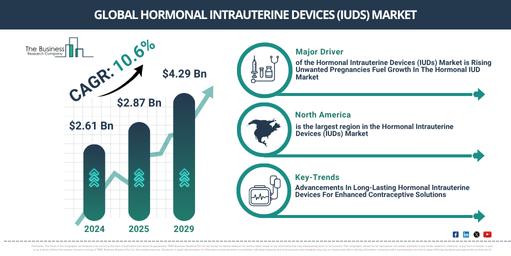
The market for hormonal intrauterine devices (IUDs) has shown considerable expansion in recent years. It is anticipated to grow from $2.61 billion in 2024 to $2.87 billion in 2025, achieving a compound annual growth rate (CAGR) of 10.2%. The historical increase can be attributed to the introduction of safer and more efficacious hormonal formulations, a heightened demand for extended-duration birth control options, increased endorsements from healthcare providers, greater public understanding of available contraceptive choices, and continuous advancements in medical technology and device engineering.
The hormonal intrauterine devices (iuds) market size is anticipated to experience substantial growth in the upcoming years. It is projected to expand to $4.29 billion by 2029, achieving a compound annual growth rate (CAGR) of 10.6%. The expansion observed during the forecast period can be attributed to heightened awareness of birth control alternatives, a growing preference for long-acting reversible contraception, improvements in the safety and effectiveness of these devices, an increasing focus on personalized healthcare solutions, and more widespread access through healthcare providers. Significant trends foreseen in the forecast period involve technological progress in device development, greater customization of contraceptive choices, an increase in patient-centered healthcare models, a rising demand for environmentally friendly products, and the creation of new contraceptive offerings.
Access A Free Sample Of The Report:
https://www.thebusinessresearchcompany.com/sample.aspx?id=19091&type=smp
What Factors Are Boosting The Hormonal Intrauterine Devices (IUDs) Market?
The projected expansion of the hormonal intrauterine devices market is anticipated due to the rise in unwanted pregnancies. These are defined as conceptions that occur without prior planning or desire. Such pregnancies may arise from multiple factors, such as failed contraception, limited access to birth control methods, improper contraceptive use, or experiences of sexual violence. When individuals have restricted access to reliable contraception, it heightens the likelihood of unwanted pregnancies, as it diminishes their autonomy in reproductive decisions. Hormonal IUDs offer significant efficacy in preventing conception, exhibiting a failure rate of less than 1%. These devices provide extended protection for 3 to 7 years, based on the specific type, making them a dependable choice for individuals aiming to prevent unwanted pregnancies. An illustrative example comes from August 2023, where data from the Office for Health Improvement & Disparities, a UK-based governmental unit of the UK’s Department of Health and Social Care, revealed that from January to June 2022, residents of England and Wales underwent 123,219 abortions. This represented a 17% increase when contrasted with the corresponding timeframe in 2021. Consequently, the rising incidence of unwanted pregnancies is a primary factor fueling the expansion of the hormonal intrauterine devices market.
How Is The Hormonal Intrauterine Devices (IUDs) Market Categorized By Application, Type, And Region?
The hormonal intrauterine devices (iuds)market covered in this report is segmented –
1) By Type: 13 Milligram Hormonal Intrauterine Devices, 19 Milligram Hormonal Intrauterine Devices, 52 Milligram Hormonal Intrauterine Devices
2) By Device Design: Framed Intrauterine Devices, Frameless Intrauterine Devices
3) By Hormone Type: Levonorgestrel Releasing Intrauterine Devices, Progesterone Releasing Intrauterine Devices
4) By Application: Age 20-24, Age 25-34, Age 35-44, Other Applications
Subsegments:
1) By 13 Milligram Hormonal Intrauterine Devices: Low-Dose 13 Mg IUDs, Specialty 13 Mg IUDs For Specific Conditions
2) By 19 Milligram Hormonal Intrauterine Devices: Low-Dose 19 Mg IUDs, Specialty 19 Mg IUDs For Specific Conditions
3) By 52 Milligram Hormonal Intrauterine Devices: Standard 52 Mg IUDs, Extended-Release 52 Mg IUDs, Specialty 52 Mg IUDs For Heavy Menstrual Bleeding Or Endometriosis
What Key Trends Are Driving Growth In The Hormonal Intrauterine Devices (IUDs) Market?
Leading companies within the hormonal intrauterine devices market are prioritizing the creation of advanced products, such as levonorgestrel-releasing intrauterine systems, to deliver more tailored contraceptive solutions for women. Levonorgestrel-releasing intrauterine systems (LNG-IUS) are hormonal intrauterine devices designed to steadily release levonorgestrel, a synthetic progestin, into the uterus. This hormone functions by thickening cervical mucus and modifying the uterine lining, thereby preventing sperm from reaching the egg. For example, in November 2022, Medicines360, a US-based pharmaceutical organization dedicated to enhancing women’s access to essential medicines and health products, unveiled the U.S. Food and Drug Administration (FDA)-approved LILETTA. LILETTA is recognized as one of the longest-lasting hormonal IUDs in the U.S., approved for contraception for up to 8 years and for treating heavy menstrual bleeding for up to 5 years. It demonstrates approximately 99% effectiveness in averting pregnancy across diverse populations. The device includes an ergonomic inserter for simple placement on the same day as a consultation and can be removed by a healthcare provider whenever desired. Available by prescription, LILETTA is offered at a reduced cost via the 340B drug pricing program, reinforcing Medicines360’s commitment to improving access to women’s healthcare.
Who Are The Global Leaders Steering The Hormonal Intrauterine Devices (IUDs) Market Forward?
Major companies operating in the hormonal intrauterine devices (IUDs) market are Merck & Co. Inc., AbbVie Inc., Bayer AG, Organon & Companies, Gedeon Richter Plc, Meril Life Science Pvt Ltd., Bharat Serums and Vaccines Limited, Teva UK Limited, EurimPharm Produktions GmbH, HRA Pharma SAS, Medicines360, Hll Lifecare Limited, Pregna International Ltd., Allergan plc, Actavis Inc., DKT WomanCare Global, CrossBay Medical Inc., SMB Corporation of India, Oy Leiras, OCON Healthcare
Download The Full Report Here:
Which Region Is Projected To Achieve The Fastest Growth In The Hormonal Intrauterine Devices (IUDs) Market?
North America was the largest region in the hormonal intrauterine devices (IUDs) market in 2024. Asia-Pacific is expected to be the fastest-growing region in the forecast period. The regions covered in the hormonal intrauterine devices (IUDs) market report are Asia-Pacific, Western Europe, Eastern Europe, North America, South America, Middle East, Africa.
Get A Report Customized For You Here:
https://www.thebusinessresearchcompany.com/customise?id=19091&type=smp
Browse Through More Reports Similar to the Global Hormonal Intrauterine Devices (IUDs) Market 2025, By The Business Research Company
Hormonal Contraceptives Global Market Report 2025
https://www.thebusinessresearchcompany.com/report/hormonal-contraceptives-global-market-report
Drugs For Hormonal Replacement Therapy Global Market Report 2025
Handheld Surgical Devices And Equipment Global Market Report 2025
Get in touch with us:
The Business Research Company: https://www.thebusinessresearchcompany.com/
Americas +1 310-496-7795
Asia +44 7882 955267 & +91 8897263534
Europe +44 7882 955267
Email us at info@tbrc.info
Follow us on:
LinkedIn: https://in.linkedin.com/company/the-business-research-company
YouTube: https://www.youtube.com/channel/UC24_fI0rV8cR5DxlCpgmyFQ
Global Market Model: https://www.thebusinessresearchcompany.com/global-market-model

