Long-Read Sequencing Market Outlook For 2026–2030 Covering Growth Drivers And Industry Trends
The Business Research Company’s 2026 market reports feature enhanced tools like market attractiveness analysis, TAM assessment, and company scoring matrices, along with interactive dashboards, deeper supply chain insights, and startup coverage strengthening the depth, usability, and strategic value of insights.
What Level Of Market Value Growth Is Predicted For The Long-Read Sequencing Market From 2026 To 2030?
The long-read sequencing market has seen substantial growth in recent years. Its value is expected to rise from $1.15 billion in 2025 to $1.46 billion in 2026, achieving a compound annual growth rate (CAGR) of 26.8%. This historical growth can be attributed to factors like the drawbacks of short-read sequencing, an increase in genomics research, innovations in nanopore sequencing technology, the need for accurate genome assembly, and augmented funding in the life sciences sector.
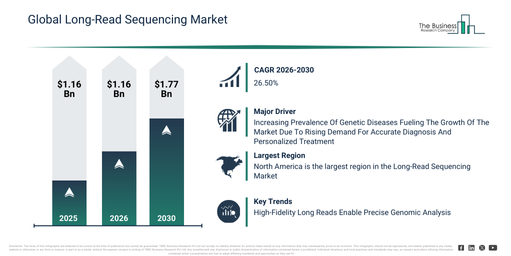
The long-read sequencing market is projected to experience substantial expansion in the coming years. Its valuation is anticipated to reach $3.74 billion by 2030, exhibiting a compound annual growth rate (CAGR) of 26.5%. This anticipated growth during the forecast timeframe is attributable to factors such as increased clinical adoption of long-read sequencing, a reduction in sequencing expenses, the incorporation of AI-based analytical methods, broadened applications in oncology diagnostics, and the rise of population genomics initiatives. Key trends foreseen for this period encompass a greater embrace of long-read technologies, advancements in detecting structural variants, the development of hybrid sequencing methodologies, a wider focus on rare disease genomics, and an increasing application in assembling complex genomes.
Access Your Free Sample Report For In-Depth Market Analysis:
https://www.thebusinessresearchcompany.com/report/long-read-sequencing-global-market-report
What Key Factors Are Affecting The Long-Read Sequencing Market Demand?
The expanding occurrence of genetic diseases is projected to drive the growth of the long-read sequencing market in the coming years. Genetic diseases are disorders resulting from changes or mutations in DNA, which can be either inherited or occur spontaneously, thereby impacting health, development, or various bodily functions. The rising frequency of genetic diseases is attributable to enhanced awareness and advancements in diagnostic technologies, enabling earlier and more accurate detection of conditions that were previously undiagnosed. Long-read sequencing improves the management of genetic disorders by offering highly accurate and comprehensive genomic insights, making it an ideal tool for diagnosing complex and rare conditions. It reduces diagnostic uncertainty through the detection of structural variations and intricate mutations, thus enhancing personalized treatment and clinical decision-making. For instance, in October 2024, according to the Cystic Fibrosis Trust, a UK-based national charity, there were 11,148 people living with cystic fibrosis (CF) in the UK in 2022, increasing to 11,318 in 2023. Therefore, the growing prevalence of genetic diseases is a significant impetus for the long-read sequencing market’s expansion.
How Is The Long-Read Sequencing Market Categorized Across Its Segment Groups?
The long-read sequencing market covered in this report is segmented –
1) By Product And Service: Instruments Or Platforms, Consumables And Reagents, Services And Software
2) By Workflow: Pre-Sequencing, Sequencing, Data Analysis
3) By Technology Platform: Single Molecule Real-Time (SMRT) High-Fidelity (HiFi) Sequencing, Synthetic Long-Read Or Linked-Read, Hybrid And Other Emerging
4) By Application: Human Genomics And Rare-Disease Diagnostics, Oncology And Liquid Biopsy, Metagenomics And Microbiome, Transcriptomics, Agri Genomics And Plant Or Animal Breeding, Other Applications
5) By End User: Academic And Research Institutes, Hospitals And Clinics, Pharmaceutical And Biotechnology Companies, Other End-Uses
Subsegments:
1) By Instruments Or Platforms: Single-Molecule Real-Time (SMRT) Sequencers, Nanopore Sequencers
2) By Consumables And Reagents: Library Preparation Kits, Sample Preparation Kits, Sequencing Kits
3) By Services And Software: Sequencing Services, Data Analysis Services, Bioinformatics Software
What Trends Are Influencing Changes In The Long-Read Sequencing Market?
Leading companies in the long-read sequencing market are dedicated to developing advanced solutions, including HiFi reads, to boost sequencing precision, detect intricate genetic variations, and accelerate genomic research. High-fidelity (HiFi) reads are long DNA sequences produced by certain long-read sequencing technologies, which offer both extensive read lengths and extremely low error rates, enabling the precise identification of complex genetic variants and structural variations. For example, in November 2024, Pacific Biosciences of California Inc., a US-based biotechnology company, launched its Vega system, representing its initial benchtop long-read sequencing platform engineered for quicker and more accessible genomic analysis. This device is a compact, affordable benchtop long-read sequencer that delivers highly accurate HiFi data with 99.9% read accuracy. It facilitates fast, versatile sequencing for applications such as RNA, targeted, and small genome sequencing, thereby extending advanced genomics capabilities to a greater number of laboratories. Vega simplifies workflows with integrated computing and user-friendly operation, empowering researchers to efficiently uncover complex genetic insights.
Which Firms Are Influencing Competition In The Long-Read Sequencing Market?
Major companies operating in the long-read sequencing market are Thermo Fisher Scientific Inc., Agilent Technologies Inc., Revvity Inc., Bio-Rad Laboratories Inc., BGI Genomics Co. Ltd., Novogene Co. Ltd., Takara Bio Inc., Oxford Nanopore Technologies plc, Pacific Biosciences of California Inc., New England Biolabs Inc., Roche Sequencing Solutions Inc., The Garvan Institute, Element Biosciences Inc., Eurofins Genomics, CD Genomics, BaseClear B.V, France Génomique, GrandOmics Biosciences Co. Ltd., Future Genomics Technologies B.V., MicrobesNG
Get The Full Long-Read Sequencing Market Report:
https://www.thebusinessresearchcompany.com/report/long-read-sequencing-global-market-report
Which Region Leads The Long-Read Sequencing Market In Terms Of Market Share?
North America was the largest region in the long-read sequencing market in 2025. Asia-Pacific is expected to be the fastest-growing region in the forecast period. The regions covered in the long-read sequencing market report are Asia-Pacific, South East Asia, Western Europe, Eastern Europe, North America, South America, Middle East, Africa.
Request A Customized Long-Read Sequencing Market Report For Competitive Insights:
https://www.thebusinessresearchcompany.com/report/long-read-sequencing-global-market-report
Browse Through More Reports Similar to the Global Long-Read Sequencing Market 2026, By The Business Research Company
Next Generation Sequencing Market 2026
https://www.thebusinessresearchcompany.com/report/next-generation-sequencing-market
Dna Sequencing Market Report 2026
https://www.thebusinessresearchcompany.com/report/dna-sequencing-global-market-report
Protein Sequencing Market Report 2026
https://www.thebusinessresearchcompany.com/report/protein-sequencing-global-market-report
Get in touch with us:
The Business Research Company: https://www.thebusinessresearchcompany.com/
Americas +1 310-496-7795
Asia +44 7882 955267 & +91 8897263534
Europe +44 7882 955267
Email us at info@tbrc.info
Follow us on:
LinkedIn: https://in.linkedin.com/company/the-business-research-company
YouTube: https://www.youtube.com/channel/UC24_fI0rV8cR5DxlCpgmyFQ
Global Market Model: https://www.thebusinessresearchcompany.com/global-market-model