Laboratory Centrifuge Market Analysis With Focus On Growth Potential And Future Outlook
The Business Research Company’s 2026 market reports feature enhanced tools like market attractiveness analysis, TAM assessment, and company scoring matrices, along with interactive dashboards, deeper supply chain insights, and startup coverage strengthening the depth, usability, and strategic value of insights.
What Is The Estimated Market Size Of The Laboratory Centrifuge Market In 2026, And How Will Its Value Evolve By 2030?
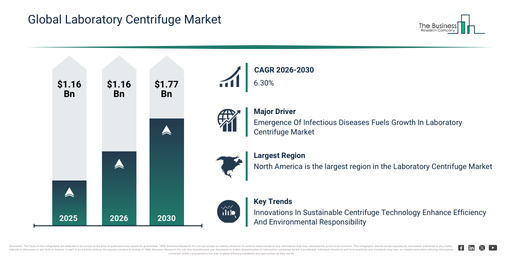
The laboratory centrifuge market size has seen substantial growth in recent years. It is forecast to expand from $1.64 billion in 2025 to $1.74 billion in 2026, exhibiting a compound annual growth rate (CAGR) of 6.0%. This historical increase can be ascribed to several factors, including a rise in biomedical research activities, the widening scope of hospital diagnostic testing, the growing utilization of centrifugation in genomics workflows, the availability of advanced laboratory infrastructure, and an increase in clinical sample processing volumes.
The laboratory centrifuge market size is anticipated to experience robust growth over the coming years. It is projected to expand to $2.22 billion by 2030, exhibiting a compound annual growth rate (CAGR) of 6.3%. This expansion during the forecast period is largely attributable to factors such as increasing demand for automated centrifuge systems, the expansion of molecular diagnostics, the growing adoption of precision medicine, rising investments in life sciences research, and an increasing focus on laboratory efficiency optimization. Significant trends expected during the forecast period include the increasing adoption of high-speed centrifugation systems, a rising demand for refrigerated and ultracentrifuges, the growing integration of digital control interfaces, the expansion of compact benchtop centrifuges, and an enhanced focus on sample integrity.
Access Your Free Sample Report For In-Depth Market Analysis:
https://www.thebusinessresearchcompany.com/report/laboratory-centrifuge-global-market-report
Which Key Factors Are Driving The Laboratory Centrifuge Market Growth?
The emergence of infectious diseases is a primary factor fueling the expansion of the laboratory centrifuge market. Pathogens such as SARS, the Zika virus, Ebola, and COVID-19 have increasingly resulted in infections across various global regions, contributing to a rise in the worldwide disease burden. It is estimated that approximately 60% of known human pathogens and up to 75% of emerging human pathogens are zoonotic infectious agents, which are animal diseases that adapt to infect human hosts. Climate change is projected to significantly alter the epidemiology of infectious diseases by shifting the geographical ranges of microbes and vectors. Microbes possess the ability to adapt to higher temperatures, leading to growing concern that global warming will favor heat-tolerant microbes capable of overcoming human endothermy defenses, consequently introducing new infectious diseases and modifying the epidemiology of many existing ones. Laboratory centrifuge systems are utilized for the purification of cells, organelles, viruses, proteins, and nucleic acids. For instance, in August 2024, data published by the UK Health Security Agency, a UK-based executive agency, indicated that England recorded 368 measles cases in 2023, representing a nearly sevenfold increase from the 53 cases reported in 2022, with the West Midlands and London accounting for 44% and 33% of the cases, respectively. Therefore, the proliferation of infectious diseases boosts the demand for lab testing solutions, thus propelling the laboratory centrifuge market.
Which Segment Types Are Examined In The Laboratory Centrifuge Market Segment Study?
The laboratory centrifuge market covered in this report is segmented –
1) By Product: Equipment, Accessories
2) By Model Type: Benchtop Centrifuges, Floor-Standing Centrifuges
3) By Rotor Design: Fixed-Angle Rotors, Swinging-Bucket Rotors, Vertical Rotors, Other Rotors
4) By Application: Diagnostics, Microbiology, Cellomics, Genomics, Proteomics, Blood Component Separation, Other Applications
5) By End User: Hospitals, Biotechnology And Pharmaceutical Companies, Academic And Research Institutions
Subsegments:
1) By Equipment: Floor Model Centrifuges, Bench-Top Centrifuges, Ultracentrifuges, Microcentrifuges, High-Speed Centrifuges, Refrigerated Centrifuges, Clinical Centrifuges, Continuous Flow Centrifuges
2) By Accessories: Rotors, Buckets, Adapters, Tubes And Containers, Cleaning And Maintenance Kits
Which Trends Are Guiding The Direction Of The Laboratory Centrifuge Market?
Leading companies within the laboratory centrifuge market are concentrating on developing advanced offerings, such as centrifuges incorporating natural refrigerant cooling systems, to mitigate environmental effects and improve performance for high-throughput uses. Centrifuges utilizing natural refrigerant cooling systems are devices that employ eco-friendly coolants to maintain samples at low temperatures while rapidly spinning them to efficiently separate materials and protect temperature-sensitive specimens. For example, in March 2025, Thermo Fisher Scientific, a US-based life sciences organization, unveiled its first more sustainable large-capacity and superspeed centrifuges, which are outfitted with a next-generation natural refrigerant cooling system. This system is engineered to support laboratory processes requiring high speed and large volumes. The centrifuges offer precise temperature regulation, better energy efficiency, and a reduced environmental impact, thereby helping laboratories achieve both operational excellence and their sustainability targets.
Which Players Are Part Of The Competitive Landscape Of The Laboratory Centrifuge Market?
Major companies operating in the laboratory centrifuge market are Thermo Fisher Scientific Inc., Danaher Corporation, Agilent Technologies Inc., Sartorius AG, PerkinElmer Inc., Shimadzu Corporation, Bio-Rad Laboratories Inc., Hettich Holding GmbH & Co KG, Eppendorf AG, Haier Biomedical Co Ltd., Heal Force Bio-Medical Engineering Co Ltd., Harvard Bioscience Inc., REMI GROUP, VISION Scientific Co Ltd., LW Scientific, Sigma Laborzentrifugen GmbH, Benchmark Scientific Inc., Neuation Technologies Pvt Ltd., Laby Instruments Industry, HERMLE Labortechnik GmbH, Antylia Scientific Instrument Co Ltd., Meditech Technologies India Private Limited, Andreas Hettich GmbH & Co KG
Get The Full Laboratory Centrifuge Market Report:
https://www.thebusinessresearchcompany.com/report/laboratory-centrifuge-global-market-report
Which Geographic Region Dominates The Laboratory Centrifuge Market?
North America was the largest region in the laboratory centrifuge market in 2025. The regions covered in the laboratory centrifuge market report are Asia-Pacific, South East Asia, Western Europe, Eastern Europe, North America, South America, Middle East, Africa.
Request A Customized Laboratory Centrifuge Market Report For Competitive Insights:
https://www.thebusinessresearchcompany.com/report/laboratory-centrifuge-global-market-report
Browse Through More Reports Similar to the Global Laboratory Centrifuge Market 2026, By The Business Research Company
Industrial Centrifuge Market Report 2026
https://www.thebusinessresearchcompany.com/report/industrial-centrifuge-global-market-report
Medical Centrifuge Market Report 2026
https://www.thebusinessresearchcompany.com/report/medical-centrifuge-global-market-report
Biofuels Market Report 2026
https://www.thebusinessresearchcompany.com/report/biofuels-global-market-report
Get in touch with us:
The Business Research Company: https://www.thebusinessresearchcompany.com/
Americas +1 310-496-7795
Asia +44 7882 955267 & +91 8897263534
Europe +44 7882 955267
Email us at info@tbrc.info
Follow us on:
LinkedIn: https://in.linkedin.com/company/the-business-research-company
YouTube: https://www.youtube.com/channel/UC24_fI0rV8cR5DxlCpgmyFQ
Global Market Model: https://www.thebusinessresearchcompany.com/global-market-model
[KClientError] [REQ_ERR: OPERATION_TIMEDOUT] [KTrafficClient] Something is wrong.