Biothreat Detection Systems Market Forecast to Reach $3.49 Billion by 2030 at 10% CAGR
The Business Research Company’s 2026 market reports feature advanced enhancements such as market attractiveness analysis, total addressable market evaluation, company benchmarking matrices, interactive Excel dashboards, expanded supply chain intelligence, emerging startup coverage, and detailed product insights, delivering more actionable and strategically valuable research.
What Is The Forecasted Rise In Market Size Of The Biothreat Detection Systems Market During The Forecast Period?
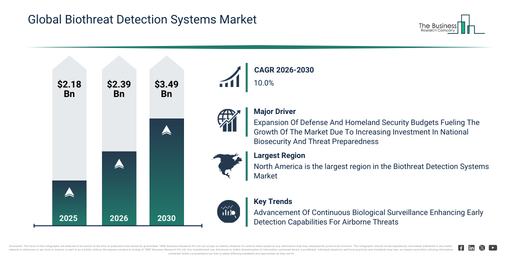
The biothreat detection systems market has experienced robust expansion in recent years. It is projected to increase from $2.18 billion in 2025 to $2.39 billion in 2026, achieving a compound annual growth rate (CAGR) of 9.7%. The historical growth in this sector is attributable to factors such as heightened public health surveillance initiatives, augmented investment in biodefense programs, the expansion of laboratory diagnostic capabilities, an increasing awareness of pandemic preparedness, and the implementation of molecular detection platforms.
The biothreat detection systems market is projected for significant expansion over the coming years. It is anticipated to reach $3.49 billion in 2030, exhibiting a compound annual growth rate (CAGR) of 10.0%. This anticipated growth during the forecast period stems from factors such as a heightened demand for early-warning biothreat systems, the escalating integration of AI-driven analytics, the broadening of environmental monitoring networks, an intensified focus on national biosecurity strategies, and the increasing uptake of portable, field-deployable systems. Key trends expected within this period encompass the increased deployment of automated bioaerosol monitoring systems, a surge in the adoption of rapid molecular detection technologies, the expansion of integrated surveillance networks, the growing utilization of portable detection kits, and an elevated emphasis on real-time threat analytics.
Download A Free Sample Report For Comprehensive Market Insights:
https://www.thebusinessresearchcompany.com/sample.aspx?id=33043&type=smp
Which Drivers Are Advancing The Biothreat Detection Systems Market Growth?
The future growth of the biothreat detection systems market is projected to be propelled by the increasing defense and homeland security budgets. These budgets denote government-allocated financial resources specifically for national defense, military operations, intelligence, border protection, counterterrorism, emergency preparedness, and the safeguarding of critical infrastructure and public safety. Such defense and homeland security budgets are on the rise due to escalating geopolitical tensions, which necessitate greater investment in national security and threat readiness. Biothreat detection systems aid defense and homeland security budgets by enabling the early identification and rapid response to biological threats, thereby reducing the cost and impact of large-scale outbreaks, emergency interventions, and national security incidents. For instance, in April 2025, according to the Stockholm International Peace Research Institute (SIPRI), a Sweden-based independent international institute, in 2024 United Kingdom raised its military spending by 2.8% to $81.8 billion, positioning it as the world’s sixth-largest defense spender. Thus, the expansion of defense and homeland security budgets is actively driving the growth of the biothreat detection systems market.
How Is The Biothreat Detection Systems Market Distributed Across Key Segments?
The biothreat detection systems market covered in this report is segmented –
1. By Technology: Polymerase Chain Reaction Based Detection; Immunological Detection; Biosensors; Microarrays; Other Technologies
2. By Detection Type: Biological Agents; Chemical Agents; Radiological Agents
3. By Application: Military And Defense; Public Health; Environmental Monitoring; Agriculture; Other Applications
4. By End-User: Government Agencies; Hospitals And Healthcare Facilities; Research Laboratories; Commercial And Industrial; Other End-Users
Subsegments:
1. By Polymerase Chain Reaction Based Detection: Real Time Polymerase Chain Reaction; Digital Polymerase Chain Reaction; Multiplex Polymerase Chain Reaction; Reverse Transcription Polymerase Chain Reaction; Quantitative Polymerase Chain Reaction
2. By Immunological Detection: Enzyme Linked Immunosorbent Assay; Lateral Flow Assay; Agglutination Assay; Western Blot Assay; Immunofluorescence Assay
3. By Biosensors: Electrochemical Biosensors; Optical Biosensors; Piezoelectric Biosensors; Thermal Biosensors; Magnetic Biosensors
4. By Microarrays: DNA Microarrays; Protein Microarrays; Antibody Microarrays; Peptide Microarrays; Cell Microarrays
5. By Other Technologies: Next Generation Sequencing; Flow Cytometry; Mass Spectrometry; Microfluidics Platforms; Lab On A Chip Systems
Which Trends Are Guiding The Development Of The Biothreat Detection Systems Market?
Major companies within the biothreat detection systems market are concentrating on developing advanced continuous biological surveillance technologies, including real-time aerosol-based pathogen monitoring systems. This effort is aimed at enabling the swift detection of airborne biological threats in public environments and critical infrastructure. Real-time aerosol-based pathogen monitoring systems operate by continuously collecting and examining air samples to pinpoint biological agents, thereby allowing authorities to identify emerging health threats or deliberate releases before extensive exposure can take place. For example, in August 2023, BioFlyte Inc., a US-based biodefense technology company, launched an innovative biothreat surveillance pilot program at Pittsburgh International Airport. This pilot involves deploying autonomous units for air sampling and pathogen detection across airport facilities, which facilitates the near real-time identification of airborne biological threats. It also integrates alerting capabilities to assist rapid responses by public health and security personnel, strengthening early-warning preparedness for high-traffic transportation hubs.
Which Key Players Are Active In The Biothreat Detection Systems Market?
Major companies operating in the biothreat detection systems market are Roche Diagnostics AG, Thermo Fisher Scientific Inc., Abbott Laboratories, Eurofins Scientific SE, Agilent Technologies Inc., Battelle Memorial Institute, Illumina Inc., Smiths Group, Shimadzu Corporation, Bruker Corporation, Bio Rad Laboratories Inc., QIAGEN NV, Tecan Group Ltd., DiaSorin S.p.A., Emergent BioSolutions Inc., Physical Sciences Inc, DetectaChem Inc., PositiveID Corporation, AdVnt Biotechnologies, Alexeter Technologies LLC.
Access The Complete Biothreat Detection Systems Market Report:
https://www.thebusinessresearchcompany.com/report/biothreat-detection-systems-market-report
Which Region Accounts For The Highest Share Of The Biothreat Detection Systems Market?
North America was the largest region in the biothreat detection systems market in 2025. Asia-Pacific is expected to be the fastest-growing region in the forecast period. The regions covered in the biothreat detection systems market report are Asia-Pacific, South East Asia, Western Europe, Eastern Europe, North America, South America, Middle East, Africa.
Access a Customized Biothreat Detection Systems Market Report for Deeper Competitive Insights
Get in touch with us:
The Business Research Company: https://www.thebusinessresearchcompany.com/
Americas: +1 310-496-7795
Asia: +44 7882 955267 & +91 8897263534
Europe: +44 7882 955267
Email us at: marketing@tbrc.info
Follow us on:
LinkedIn: https://in.linkedin.com/company/the-business-research-company
YouTube: https://www.youtube.com/channel/UC24_fI0rV8cR5DxlCpgmyFQ
Global Market Model: https://www.thebusinessresearchcompany.com/global-market-model