Global Brain Bionics Market Expected to Reach $7.35 Billion by 2030 at 13.8% CAGR
The Business Research Company’s 2026 market reports feature advanced enhancements such as market attractiveness analysis, total addressable market evaluation, company benchmarking matrices, interactive Excel dashboards, expanded supply chain intelligence, emerging startup coverage, and detailed product insights, delivering more actionable and strategically valuable research.
What Market Value Expansion Is Expected For The Brain Bionics Market Over The Forecast Period?
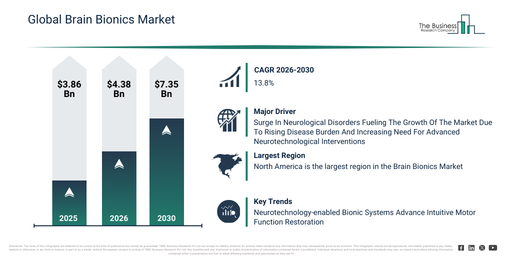
The brain bionics market has experienced rapid growth in recent years. Its valuation is set to increase from $3.86 billion in 2025 to $4.38 billion in 2026, achieving a compound annual growth rate (CAGR) of 13.6%. This historical growth can be linked to developments in neuroscience research, the rising occurrence of neurological disorders, the early clinical implementation of deep brain stimulation, the expansion of academic neurotechnology programs, and increasing investments in medical device innovation.
The brain bionics market is anticipated to experience substantial growth in the upcoming years, with its value projected to reach $7.35 billion in 2030, exhibiting a compound annual growth rate (CAGR) of 13.8%. This expansion over the forecast period is driven by factors such as the increasing demand for personalized neurotherapies, the expansion of brain-computer interface clinical trials, the growing integration of cloud-based neural data platforms, the rising adoption of home-based neurofeedback systems, and increasing regulatory approvals for implantable neurodevices. Significant trends observed during this period include the increasing adoption of implantable neural interfaces, the rising integration of AI-driven neural signal processing, the growing use of non-invasive brain-computer interfaces, the expansion of closed-loop neuromodulation systems, and an enhanced focus on personalized neurotherapy solutions.
Download A Free Sample Report For Comprehensive Market Insights:
https://www.thebusinessresearchcompany.com/sample.aspx?id=33045&type=smp
Which Growth Drivers Are Expected To Support The Brain Bionics Market Forward?
The increasing occurrence of neurological disorders is projected to boost the expansion of the brain bionics market moving forward. Neurological disorders encompass conditions and diseases impacting the brain, spinal cord, and nerves, leading to diminished movement, cognitive abilities, sensation, or behavior. The rise in neurological disorders is primarily attributed to an aging population, which heightens the risk of conditions like Parkinson’s disease, epilepsy, stroke, and dementia. Brain bionics facilitates the management and treatment of neurological disorders through direct interaction between neural circuits and artificial systems, aiming to restore lost functions, modulate atypical brain activity, and enhance rehabilitation results. For instance, in December 2025, the Medical Republic, an Australia-based media company, stated that neurological conditions accounted for over 350,000 hospital admissions and 130,000 emergency department visits during 2023–24. Thus, the growing prevalence of neurological disorders is a significant driver for the brain bionics market’s growth.
Which Segment-Based Categories Are Covered In The Brain Bionics Market?
The brain bionics market covered in this report is segmented –
1) By Product Type: Neuroprosthetics; Brain-Machine Interfaces (BMIs); Neuromodulation Devices; Transcranial Magnetic Stimulation Devices
2) By Technology: Electrodes And Sensors; Software And Algorithms; Cloud-Based Platforms; Wearable Devices
3) By User Demographics: Adults; Pediatrics; Elderly
4) By Application: Neurorehabilitation; Cognitive Enhancement; Pain Management; Neurodegenerative Disorders; Acute Interstitial Nephritis Disorders
5) By End User: Hospitals; Academic And Research Institutes; Home Care Settings; Pharmaceutical And Biotech Companies
Subsegments:
1) By Neuroprosthetics: Cochlear Implants; Retinal Implants; Deep Brain Stimulation Implants; Spinal Cord Stimulation Implants; Peripheral Nerve Stimulation Implants
2) By Brain-Machine Interfaces (BMIs): Invasive Brain-Machine Interfaces; Partially Invasive Brain-Machine Interfaces; Non-Invasive Brain-Machine Interfaces; Assistive Communication Brain-Machine Interfaces; Motor Control Brain-Machine Interfaces
3) By Neuromodulation Devices: Deep Brain Stimulation Devices; Spinal Cord Stimulation Devices; Vagus Nerve Stimulation Devices; Sacral Nerve Stimulation Devices; Peripheral Nerve Stimulation Devices
4) By Transcranial Magnetic Stimulation Devices: Repetitive Transcranial Magnetic Stimulation Devices; Deep Transcranial Magnetic Stimulation Devices; Single-Pulse Transcranial Magnetic Stimulation Devices; Paired-Pulse Transcranial Magnetic Stimulation Devices; Portable Transcranial Magnetic Stimulation Devices
Which Trends Are Affecting The Brain Bionics Market Framework?
Leading companies within the brain bionics market are actively pursuing the creation of advanced solutions, such as brain-controlled bionic prosthetics, to improve the restoration of motor functions, enhance user control precision, and facilitate more natural human-machine interactions. These brain-controlled bionic systems refer to prosthetic devices powered by neurotechnology, utilizing brain-computer interface (BCI) signals to translate neural activity into exact mechanical movements, thereby allowing individuals to operate artificial limbs through thought rather than physical input. For example, in October 2025, BrainCo Inc., a US-based neurotechnology firm, unveiled a brain-controlled bionic hand specifically designed to assist amputees in regaining functional hand movements by interpreting brain signals in real-time. This bionic hand incorporates non-invasive brain-sensing technology alongside sophisticated AI algorithms to decode user intent and convert it into smooth, responsive motion. This methodology significantly boosts control precision, shortens the learning period for users, and enables more intuitive interaction compared to traditional myoelectric prosthetics. Through the convergence of neuroscience, artificial intelligence, and robotics, this innovation fosters improved rehabilitation outcomes and greater independence for users, aligning with the broader market’s increasing demand for intelligent, brain-actuated bionic technologies.
Which Organizations Are Involved In The Brain Bionics Market?
Major companies operating in the brain bionics market are NeuroPace Inc., Medtronic plc, BrainsWay Ltd., Boston Scientific Corporation, Kernel Labs Inc., LivaNova plc, Neuronetics Inc., Neuralink Corporation, Synchron Inc., Cala Health Inc., MindMaze SA, Emotiv Inc., Abbott Neuromodulation, MagVenture A/S, Paradromics Inc., Axoft LLC, Neuroelectrics Barcelona S.L.U., Blackrock Neurotech Inc., Soterix Medical Inc., Neurable Inc., Bitbrain Technologies S.L., BrainGate Consortium.
Access The Complete Brain Bionics Market Report:
https://www.thebusinessresearchcompany.com/report/brain-bionics-market-report
Which Area Represents The Largest Portion Of The Brain Bionics Market?
North America was the largest region in the brain bionics market in 2025. Asia-Pacific is expected to be the fastest-growing region in the forecast period. The regions covered in the brain bionics market report are Asia-Pacific, South East Asia, Western Europe, Eastern Europe, North America, South America, Middle East, Africa.
Access a Customized Brain Bionics Market Report for Deeper Competitive Insights
Get in touch with us:
The Business Research Company: https://www.thebusinessresearchcompany.com/
Americas: +1 310-496-7795
Asia: +44 7882 955267 & +91 8897263534
Europe: +44 7882 955267
Email us at: marketing@tbrc.info
Follow us on:
LinkedIn: https://in.linkedin.com/company/the-business-research-company
YouTube: https://www.youtube.com/channel/UC24_fI0rV8cR5DxlCpgmyFQ
Global Market Model: https://www.thebusinessresearchcompany.com/global-market-model