
Robotic Biobanking Systems Market Size In 2026: Regional Growth, Key Segments And Future Outlook
Built to provide research that’s more actionable and strategically valuable, The Business Research Company’s 2026 market reports include market attractiveness analysis, total addressable market sizing, company benchmarking matrices, interactive Excel dashboards, broader supply chain intelligence, emerging startup tracking, and in-depth product insights.
Robotic Biobanking Systems Market Revenue Outlook: What CAGR Lies Ahead Through 2030?
The robotic biobanking systems market has recently seen rapid expansion. This market is expected to grow from $2.3 billion in 2025 to $2.65 billion in 2026, achieving a compound annual growth rate (CAGR) of 14.9%. Historical growth can be ascribed to several factors, including an increase in clinical research samples, investments in biobank infrastructure, the need for sample traceability, the constraints of manual storage, and the initial adoption of automation.
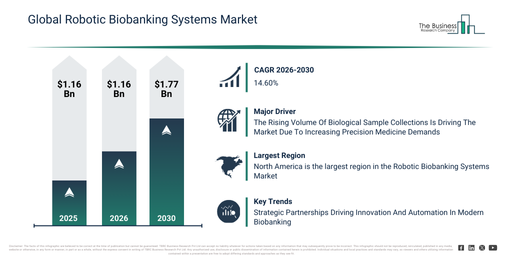
The market size for robotic biobanking systems is anticipated to expand rapidly in the coming years. It is forecast to reach $4.57 billion by 2030, exhibiting a compound annual growth rate (CAGR) of 14.6%. Driving this growth during the forecast period are factors such as the rise of precision medicine, the broadening scope of genomic studies, the conduct of large-scale clinical trials, the adoption of digital biorepository management, and the application of AI-enabled sample analytics. Key trends identified for the forecast period involve automated sample storage and retrieval, improved sample traceability, streamlined high-throughput biobank operations, minimized human handling errors, and comprehensive long-term sample integrity management.
Get A Free Sample Report With In-Depth Market Insights:
Robotic Biobanking Systems Market Development Factors: What’s Supporting Demand?
The increasing quantity of biological sample collections is anticipated to drive the expansion of the robotic biobanking systems market in the future. These collections encompass biological materials such as blood, tissue, saliva, or other biospecimens, along with their associated data, which are systematically gathered and stored for use in biomedical research, diagnostics, and therapeutic development. The growing emphasis on precision medicine primarily fuels the rising volume of biological sample collections, as modern healthcare increasingly relies on extensive, well-characterized biospecimen repositories to facilitate genomic research, biomarker discovery, and the development of individualized treatment strategies. Robotic biobanking systems support this growth by automating the handling, storage, and retrieval of samples, thereby guaranteeing scalability, accuracy, and efficiency in managing rapidly expanding sample inventories. For instance, in July 2025, according to the UK Biobank Limited, a large-scale UK biomedical database, UK Biobank plans to relocate over 11 million samples to its new Manchester headquarters in 2026. This new facility will feature four next-generation automated freezers capable of accommodating up to 20 million samples, and robotic systems will be able to retrieve approximately 1 million samples annually, which is four times faster than the current capacity. Consequently, the expanding volume of biological sample collections is propelling the growth of the robotic biobanking systems market.
Robotic Biobanking Systems Market Segment Landscape And Growth Outlook
The robotic biobanking systems market covered in this report is segmented –
1) By Product Type: Automated Sample Storage Systems, Automated Sample Retrieval Systems, Automated Sample Processing Systems
2) By Sample Type: Blood, Tissue, Cells, Deoxyribonucleic Acid (DNA) Or Ribonucleic Acid (RNA)
3) By Storage Type: Cryogenic, Ambient, Refrigerated
4) By Application: Clinical Research, Pharmaceutical And Biotech Research, Academic And Research Institutes, Biobank Management
5) By End-User: Hospitals, Research Institutes, Pharma And Biotech, Contract Research Organizations (CROs)
Subsegments:
1) By Automated Sample Storage Systems: Modular Storage Units, High-Throughput Storage Systems, Compact Storage Systems, Integrated Storage And Tracking Platforms
2) By Automated Sample Retrieval Systems: Barcode-Based Retrieval Systems, Robotic Arm Retrieval Systems, Automated Carousel Retrieval Systems, Vertical Lift Retrieval Systems
3) By Automated Sample Processing Systems: Automated Sample Aliquoting Systems, Automated Sample Sorting Systems, Automated Sample Labeling Systems, Automated Sample Tracking Systems
Robotic Biobanking Systems Market Transformation Trends: What Innovations Are Driving Change?
Major companies operating in the robotic biobanking systems market are increasingly focusing on forming strategic collaborations to expand their technological capabilities, improve service accessibility, and expedite the integration of automation into advanced biobanking workflows. These strategic collaborations involve mutually beneficial partnerships among technology providers, healthcare institutions, and research organizations, all aimed at leveraging their complementary strengths to drive innovation, optimize operational efficiency, and broaden their market presence. For instance, in October 2025, Abu Dhabi Biobank, a UAE-based hybrid cord blood bank, partnered with NMC Healthcare, a UAE-based healthcare provider, to enhance access to private and public cord blood banking services across key hospitals in the region. This initiative supports personalized healthcare and advances stem cell research by incorporating robotic and automated biobanking systems. The collaboration intends to establish one of the largest regional repositories of cord blood samples, utilizing advanced robotic handling and long-term automated storage technologies. Additionally, it focuses on promoting awareness and education regarding the benefits of cord blood preservation, enabling families to contribute to future-ready biomedical research and regenerative medicine initiatives.
Robotic Biobanking Systems Market Leading Players And Competitive Positioning
Major companies operating in the robotic biobanking systems market are Thermo Fisher Scientific Inc., Beckman Coulter Inc., Tecan Group Ltd., Hamilton Company, Azenta Life Sciences, Haier Biomedical Co., BICO, SPT Labtech Ltd., HighRes Biosolutions Inc., LiCONiC AG, ASKION GmbH, Angelantoni Life Science Srl, SciRobotics Ltd., MGI Tech Co. Ltd., B Medical Systems S.a.r.l, Sakura Finetek Japan Co. Ltd., Panasonic Healthcare Co. Ltd., Brooks Automation Inc., Labcyte Inc., RTS Life Science Ltd., Kriosystem Life Sciences S.r.l.
View The Full Robotic Biobanking Systems Market Report:
Robotic Biobanking Systems Market Regional Split: Which Areas Are Fueling Growth?
North America was the largest region in the robotic biobanking systems market in 2025. Asia-Pacific is expected to be the fastest-growing region in the forecast period. The regions covered in the robotic biobanking systems market report are Asia-Pacific, South East Asia, Western Europe, Eastern Europe, North America, South America, Middle East, Africa.
Reach Out To Our Team:
The Business Research Company: https://www.thebusinessresearchcompany.com/
Americas: +1 310-496-7795
Asia: +44 7882 955267 & +91 8897263534
Europe: +44 7882 955267
Email us at: marketing@tbrc.info
Follow us on:
LinkedIn: https://in.linkedin.com/company/the-business-research-company
YouTube: https://www.youtube.com/channel/UC24_fI0rV8cR5DxlCpgmyFQ
Global Market Model: https://www.thebusinessresearchcompany.com/global-market-model

