
Smart Hearing Aids Market Forecast To Reach $10.26 Billion By 2030: Key Trends Explained
Backed by market attractiveness analysis, total addressable market sizing, company benchmarking matrices, interactive Excel dashboards, wider supply chain intelligence, emerging startup coverage, and detailed product-level insights, The Business Research Company’s 2026 market reports are designed to offer research that is more actionable and strategically valuable than ever.
Smart Hearing Aids Market Size Forecast: How Big Could The Market Get By 2030?
The smart hearing aids market has demonstrated strong growth in recent years. It is projected to expand from $7.14 billion in 2025 to $7.7 billion in 2026, exhibiting a compound annual growth rate (CAGR) of 7.8%. The historical growth can be attributed to the rising prevalence of hearing loss, increased awareness about hearing health, technological advancements in sound amplification, an expanding geriatric population, and the uptake of traditional hearing aids.
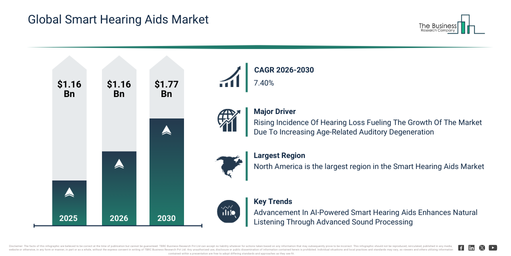
The smart hearing aids market is anticipated to experience substantial expansion in the coming years. By 2030, this market is projected to reach $10.26 billion, exhibiting a compound annual growth rate (CAGR) of 7.4%. This projected growth is driven by factors such as the incorporation of AI and IoT into hearing aids, the proliferation of smart audiology clinics, the creation of rechargeable and Bluetooth-enabled devices, an increasing need for pediatric hearing solutions, and improvements in tinnitus management technologies. Key trends during this period are expected to encompass personalized hearing experiences, the integration of wireless audio streaming, capabilities for remote hearing aid management, enhanced noise reduction and speech clarity, and the adoption of ergonomic and discreet designs.
Get A Free Sample Report With In-Depth Market Insights:
Smart Hearing Aids Market Demand Drivers: What’s Powering Industry Growth?
An increasing occurrence of hearing loss is anticipated to drive the expansion of the smart hearing aids market in the future. This condition, hearing loss, describes a partial or total inability to detect sounds in either one or both ears, which impacts an individual’s capacity to communicate and process auditory data. The growing prevalence of hearing impairment is linked to the aging demographic, given that the auditory system’s natural decline frequently happens as people get older. Through sophisticated digital processing, smart hearing aids assist in managing hearing issues by boosting sound, minimizing ambient noise, and improving speech intelligibility. These devices automatically adjust to various surroundings, thereby enhancing the user’s overall hearing experience and communication effectiveness. As an illustration, in May 2024, data from the Department of Health, Disability, and Ageing, an Australia-based government administration, indicated that approximately 3.6 million individuals suffered from some level of hearing loss, with projections showing this figure is expected to reach about 7.8 million by 2060. Consequently, the increasing occurrence of hearing loss is fueling the expansion of the smart hearing aids market.
Smart Hearing Aids Market Segmentation: How Does The Market Break Down By Category?
The smart hearing aids market covered in this report is segmented –
1) By Product Type: Behind-The-Ear (BTE), In-The-Ear (ITE), In-The-Canal (ITC), Completely-In-Canal (CIC), Receiver-In-Canal (RIC)
2) By Technology: Bluetooth Enabled, Artificial Intelligence (AI)-Powered, Rechargeable, Tinnitus Masking, Other Technologies
3) By Distribution Channel: Online Stores, Audiology Clinics, Hospitals And Clinics, Retail Pharmacies, Other Distribution Channels
4) By End-User: Adults, Pediatrics
Subsegments:
1) By Behind-The-Ear (BTE): Standard Behind-The-Ear (BTE), Mini Behind-The-Ear (BTE), Power Behind-The-Ear (BTE), Rechargeable Behind-The-Ear (BTE), Bluetooth-Enabled Behind-The-Ear (BTE)
2) By In-The-Ear (ITE): Full Shell In-The-Ear (ITE), Half Shell In-The-Ear (ITE), Wireless In-The-Ear (ITE), In-The-Ear (ITE) With Telecoil, Custom In-The-Ear (ITE)
3) By In-The-Canal (ITC): Standard In-The-Canal (ITC), Mini In-The-Canal (ITC), Rechargeable In-The-Canal (ITC), Directional Microphone In-The-Canal (ITC), Wireless In-The-Canal (ITC)
4) By Completely-In-Canal (CIC): Invisible-In-Canal (IIC), Wireless Completely-In-Canal (CIC), Programmable Completely-In-Canal (CIC), Completely-In-Canal (CIC) With Remote Control, Completely-In-Canal (CIC) With Venting
5) By Receiver-In-Canal (RIC): Mini Receiver-In-Canal (RIC), Power Receiver-In-Canal (RIC), Rechargeable Receiver-In-Canal (RIC), Receiver-In-Canal (RIC) With Open Fit, Wireless Receiver-In-Canal (RIC)
Smart Hearing Aids Market Innovation Trends: What Developments Are Reshaping The Industry?
Key players within the smart hearing aids market are dedicating their efforts to creating sophisticated products, such as artificial intelligence (AI)-powered hearing aids, aiming to elevate natural hearing experiences through advanced sound processing. AI-powered hearing aids harness artificial intelligence to adapt instantly to diverse sound settings and improve speech understanding. They continually learn user behaviors to offer a personalized and more authentic hearing experience. For example, in February 2025, GN Store Nord A/S, a Denmark-based producer of hearing aids, unveiled ReSound Vivia, its most advanced hearing collection. This innovative device employs a dedicated Deep Neural Network (DNN) chip, trained on millions of speech samples, to deliver remarkable speech clarity in loud environments, all while preserving a subtle, comfortable design and extended battery life. Vivia’s Intelligent Focus function imitates natural human listening by prioritizing sounds based on the user’s visual focus, providing a more intuitive and effortless hearing experience.
Smart Hearing Aids Market Industry Leaders And Competitive Landscape
Major companies operating in the smart hearing aids market are Sonova Holding AG, GN Store Nord A S, WS Audiology, Starkey Hearing Technologies, Jabra Enhance, Widex, Beltone, Unitron, Amplifon Hearing Health Care, Eargo Inc, Audicus, iHEAR Medical, MDHearing, SoundWorld Solutions, Lexie Hearing, Audien Hearing, Melosound, Austar Hearing Science And Technology Xiamen Co Ltd, Soundwave Hearing LLC, Tweak Hearing, Rexton Hearing, Phonak, Oticon
View The Full Smart Hearing Aids Market Report:
Smart Hearing Aids Market Regional Analysis And Top Geography
North America was the largest region in the smart hearing aids market in 2025. The regions covered in the smart hearing aids market report are Asia-Pacific, South East Asia, Western Europe, Eastern Europe, North America, South America, Middle East, Africa.
Reach Out To Our Team:
The Business Research Company: https://www.thebusinessresearchcompany.com/
Americas: +1 310-496-7795
Asia: +44 7882 955267 & +91 8897263534
Europe: +44 7882 955267
Email us at: marketing@tbrc.info
Follow us on:
LinkedIn: https://in.linkedin.com/company/the-business-research-company
YouTube: https://www.youtube.com/channel/UC24_fI0rV8cR5DxlCpgmyFQ
Global Market Model: https://www.thebusinessresearchcompany.com/global-market-model

