
Smart Prosthetics Market Set To Expand From $3.18 Billion In 2026: Growth Outlook Through 2030
Featuring market attractiveness scoring, total addressable market sizing, company benchmarking matrices, interactive Excel dashboards, deeper supply chain intelligence, emerging startup tracking, and granular product-level insights, The Business Research Company’s 2026 market reports are built to deliver research that is both more actionable and more strategically valuable.
Smart Prosthetics Market Forecast: What Value Will The Market Reach By 2030?
The smart prosthetics market has demonstrated substantial growth in recent years. This market is projected to expand from $2.03 billion in 2025 to $2.23 billion in 2026, achieving a compound annual growth rate (CAGR) of 9.9%. The historical expansion can be attributed to elements such as the restricted functionality of conventional prosthetics, the dependence on mechanical prosthetic limbs, the development of orthopedic clinic infrastructure, increased awareness regarding mobility solutions, and the prompt integration by rehabilitation centers.
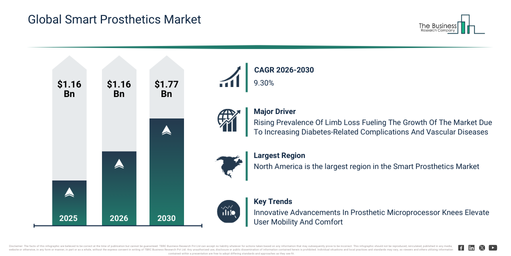
The smart prosthetics market size is projected to undergo substantial expansion in the upcoming years, with its value set to reach $3.18 billion in 2030, demonstrating a compound annual growth rate (CAGR) of 9.3%. This anticipated growth during the forecast period is driven by advancements in bionic and hybrid prosthetic technologies, the incorporation of AI and sensor-based systems, an increase in pediatric applications, the rising demographic of elderly individuals requiring prosthetics, and the broadening reach of direct and online sales channels. Prominent trends for the forecast period encompass a growing adoption of microprocessor-controlled prosthetics, the integration of sensor-based movement recognition capabilities, an increasing demand for myoelectric and hybrid prosthetics, the expansion of rehabilitation and orthopedic clinics, and a concentrated focus on customizing prosthetics for both pediatric and adult users.
Get A Free Sample Report With In-Depth Market Insights:
Smart Prosthetics Market Industry Drivers: What’s Behind The Revenue Growth?
The growing occurrence of limb loss is anticipated to fuel the expansion of the smart prosthetics market in the future. Limb loss is defined as a state where one or more limbs are partially or entirely removed due to injury, illness, or birth defects. The incidence of limb loss is climbing, driven by an increase in global cases of diabetes-related issues, especially peripheral artery disease and neuropathic ulcers, which frequently result in non-traumatic lower limb amputations. Smart prosthetics help individuals with limb loss regain natural movement by deciphering muscle signals and adjusting to actions instantly, thereby improving mobility and autonomy while also enhancing agility, command, and comfort to elevate everyday function and overall quality of life. For example, as reported in December 2024 by the Archives of Rehabilitation Research and Clinical Translation, a US-based peer-reviewed medical journal, an estimated 2,309,000 individuals in the US are living with limb loss, with roughly 91% having experienced lower extremity amputations and 9.2% upper extremity amputations; this figure is projected to rise by 145% by 2060. Consequently, the rising prevalence of limb loss is propelling the development of the smart prosthetics market.
Smart Prosthetics Market Segment Breakdown: Which Categories Lead On Revenue?
The smart prosthetics market covered in this report is segmented –
1) By Product Type: Bionic Limbs, Myoelectric Prosthetics, Hybrid Prosthetics
2) By Technology: Microprocessor-Controlled, Bluetooth-Enabled, Sensor-Integrated, Other Technologies
3) By Distribution Channel: Direct Sales, Distributors, Online Sales, Other Distribution Channels
4) By Application: Orthopedic Clinics, Hospitals, Rehabilitation Centers, Other Applications
5) By End-User: Adults, Pediatrics
Subsegments:
1) By Bionic Limbs: Upper-Limb Bionic Prosthetics, Lower-Limb Bionic Prosthetics, Modular Bionic Limbs, Lightweight Bionic Limbs
2) By Myoelectric Prosthetics: Single-Joint Myoelectric Prosthetics, Multi-Joint Myoelectric Prosthetics, Sensor-Integrated Myoelectric Prosthetics, Adaptive Myoelectric Prosthetics
3) By Hybrid Prosthetics: Combination Mechanical-Electrical Prosthetics, Sensor-Assisted Hybrid Prosthetics, Custom-Fit Hybrid Prosthetics, Multi-Functional Hybrid Prosthetics
#Smart Prosthetics Market Growth Trends: What’s Shaping The Future Outlook?
Leading companies within the smart prosthetics market are concentrating on the creation of cutting-edge products, such as prosthetic microprocessor knees, designed to improve user movement, increase stability, and decrease energy consumption during activity. These prosthetic microprocessor knees are artificial knee joints equipped with integrated computers that automatically modify movement for a more fluid, secure, and authentic walking experience. For example, in July 2024, Ottobock UK, a UK-based medical equipment manufacturer, released the Genium X4, which is the latest iteration of their prosthetic microprocessor knee (MPK) and represents a significant advancement in mobility technology. The Genium X4 utilizes Optimized Physiological Gait (OPG) 3.0 technology, providing a smooth and nearly natural walking sensation. Its core features include enhanced slope climbing, a dedicated start-to-walk function, improved stability during the stance phase, dynamic backward movement, and an intuitive cycling mode. This knee is entirely waterproof and resistant to corrosion, offers up to five days of battery life, and provides customizable MyMode presets.
Smart Prosthetics Market Key Players Shaping Industry Direction
Major companies operating in the smart prosthetics market are Hanger Inc., Ottobock SE & Co. KGaA, Össur hf., Blatchford Group Limited, Trulife Limited, RSLSteeper, PROTEOR SAS, Fillauer LLC, WillowWood LLC, CURE International Inc., Advanced Arm Dynamics Inc., Open Bionics Ltd., Syntouch LLC, Coapt LLC, COVVI Ltd., Endolite India Private Limited, Medical Center Orthotics & Prosthetics Inc., Infinite Biomedical Technologies, Taska Prosthetics, LimbLogic Prosthetics
View The Full Smart Prosthetics Market Report:
Smart Prosthetics Market Regional Analysis: Which Region Leads By Revenue?
North America was the largest region in the smart prosthetics market in 2025. Asia-Pacific is expected to be the fastest-growing region in the forecast period. The regions covered in the smart prosthetics market report are Asia-Pacific, South East Asia, Western Europe, Eastern Europe, North America, South America, Middle East, Africa.
Reach Out To Our Team:
The Business Research Company: https://www.thebusinessresearchcompany.com/
Americas: +1 310-496-7795
Asia: +44 7882 955267 & +91 8897263534
Europe: +44 7882 955267
Email us at: marketing@tbrc.info
Follow us on:
LinkedIn: https://in.linkedin.com/company/the-business-research-company
YouTube: https://www.youtube.com/channel/UC24_fI0rV8cR5DxlCpgmyFQ
Global Market Model: https://www.thebusinessresearchcompany.com/global-market-model

