Genome Sequencing Market Outlook Through 2030: Understanding The Growth Opportunity
Built to provide research that’s more actionable and strategically valuable, The Business Research Company’s 2026 market reports include market attractiveness analysis, total addressable market sizing, company benchmarking matrices, interactive Excel dashboards, broader supply chain intelligence, emerging startup tracking, and in-depth product insights.
Genome Sequencing Market Value Growth And Long-Term Outlook
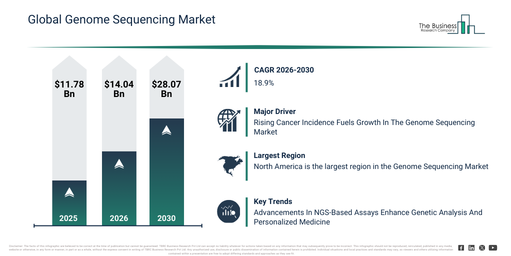
The genome sequencing market has recently undergone rapid expansion. Its value is expected to escalate from $11.78 billion in 2025 to $14.04 billion in 2026, showing a compound annual growth rate (CAGR) of 19.2%. This growth in the preceding period can be attributed to various elements, including the restricted availability of advanced sequencing systems, continued reliance on conventional Sanger sequencing, burgeoning genomics research initiatives, increased government investment in genome projects, and a heightened understanding of personalized medicine.
The genome sequencing market is poised for significant expansion in the coming years, projected to reach $28.07 billion in 2030, exhibiting a compound annual growth rate (CAGR) of 18.9%. This anticipated growth during the forecast period is driven by several factors, including advancements in next-generation sequencing systems, the broadening of bioinformatics platforms, greater integration of precision medicine programs, increased partnerships between biotech and pharmaceutical firms, and the proliferation of solutions for genomic data storage and management. Key trends expected within this period encompass the growing acceptance of next-generation sequencing (NGS) technologies, an escalating need for precision medicine and tailored therapies, the broadening scope of bioinformatics and data analysis offerings, an uptick in environmental and microbiome genomics applications, and the incorporation of specialized genome sequencing solutions into research.
Get A Free Sample Report With In-Depth Market Insights:
Genome Sequencing Market Development Factors: What’s Supporting Demand?
The increasing incidence of cancer is poised to boost the growth of the genome sequencing market moving forward. Cancer, a group of conditions defined by the unrestrained proliferation and dissemination of abnormal cells which can be fatal if not controlled, is becoming more prevalent. This rise in cancer cases stems from several factors, including an aging population, lifestyle choices, environmental exposures, and genetic predispositions. Genome sequencing is instrumental in pinpointing genetic mutations and susceptibilities to cancer, thus enabling prompt detection and customized treatment plans. It further identifies inherited cancer risks and assists in tracking the development of cancerous cells. As an illustration, in February 2024, the World Health Organization, a Switzerland-based intergovernmental body, forecasted that new cancer cases are expected to surpass 35 million by 2050, representing a 77% increase compared to 20 million cases in 2022. Therefore, the escalating occurrence of cancer is a primary catalyst for the expansion of the genome sequencing market.
Genome Sequencing Market Segment Landscape: Which Areas Lead Development?
The genome sequencing market covered in this report is segmented –
1) By Product: Consumables, Systems And Software, Services
2) By Technology: Polymerase Chain Reaction (PCR), Sequencing, Microarray, Nucleic Acid Extraction, Purification, Other Technologies
3) By Applications: Diagnostics, Drug Discovery, Precision Medicine, Environmental Genomics, Research, Other Applications
4) By End-User: Hospitals And Clinics, Biotechnology And Pharmaceutical Companies, Contract Research Organizations (CROs), Government, Research Centers, Academic And Government Institutes, Other End-Users
Subsegments:
1) By Consumables: Reagents And Kits, Sequencing Chips And Plates, Sample Preparation Products, Library Preparation Kits, DNA And RNA Extraction Kits
2) By Systems And Software: Next-Generation Sequencing (NGS) Systems, Sanger Sequencing Systems, Bioinformatics Software And Analysis Tools, Data Management And Storage Solutions, Laboratory Information Management Systems (LIMS)
3) By Services: Sequencing Services, Bioinformatics Analysis Services, Consultation And Support Services, Custom Genome Sequencing Solutions, Sample Collection And Preparation Services.
Genome Sequencing Market Transformation Trends: What Innovations Are Driving Change?
Leading companies in the genome sequencing market are concentrating on developing sophisticated solutions, particularly next-generation sequencing (NGS)-based assays, to improve the precision of genetic analysis and support personalized medicine approaches. Next-generation sequencing (NGS)-based assays refer to advanced genomic technologies that allow for swift, high-throughput sequencing of DNA or RNA to examine genetic material. NGS facilitates the simultaneous sequencing of millions of DNA or RNA fragments, generating substantial amounts of data quickly and cost-effectively. As an illustration, in April 2023, Centogene N.V., a Germany-based company specializing in genetic diagnostics for rare diseases, unveiled CentoGenome, an enhanced NGS-based assay. This assay provides continuous diagnostic assistance through proactive diagnosis confirmation and reclassification programs at no additional charge, ensuring consistent patient care and accurate disease management. Utilizing a PCR-free method, CentoGenome reduces bias and boosts sequencing quality, resulting in improved coverage of challenging genomic regions and better insights into coding, regulatory, and intronic areas. The platform incorporates an automated bioinformatics pipeline and medical expert analysis, drawing upon CENTOGENE’s vast bio databank, which comprises data from approximately 700,000 patients across more than 120 countries. This extensive dataset significantly enhances the detection of disease-causing variants, including those associated with spinal muscular atrophy and Parkinson’s disease.
Genome Sequencing Market Industry Leaders And Competitive Landscape
Major companies operating in the genome sequencing market are F. Hoffmann-La Roche Ltd., Thermo Fisher Scientific Inc., Abbott Laboratories, Danaher Corporation, Merck KGaA, Siemens Healthineers, Becton Dickinson and Company, Eurofins Genomics, Agilent Technologies Inc., PerkinElmer, Illumina Inc., bioMérieux, Bio-Rad Laboratories Inc., QIAGEN N.V., 10x Genomics Inc., BGI Group, Oxford Nanopore Technologies plc, Pacific Biosciences of California Inc., GENEWIZ Inc., LI-COR Inc., CENTOGENE N.V., Bioneer Corporation, Strand Life Sciences Pvt Ltd., Nebula Genomics
View The Full Genome Sequencing Market Report:
Genome Sequencing Market Top Region By Revenue And Market Share
North America was the largest region in the genome sequencing market in 2025. Asia-Pacific is expected to be the fastest-growing region in the forecast period. The regions covered in the genome sequencing market report are Asia-Pacific, South East Asia, Western Europe, Eastern Europe, North America, South America, Middle East, Africa.
Reach Out To Our Team:
The Business Research Company: https://www.thebusinessresearchcompany.com/
Americas: +1 310-496-7795
Asia: +44 7882 955267 & +91 8897263534
Europe: +44 7882 955267
Email us at: marketing@tbrc.info
Follow us on:
LinkedIn: https://in.linkedin.com/company/the-business-research-company
YouTube: https://www.youtube.com/channel/UC24_fI0rV8cR5DxlCpgmyFQ
Global Market Model: https://www.thebusinessresearchcompany.com/global-market-model