GLP-1 Receptor Agonist Market Trends Supporting 5.4% CAGR Growth Through 2030
Built to provide research that’s more actionable and strategically valuable, The Business Research Company’s 2026 market reports include market attractiveness analysis, total addressable market sizing, company benchmarking matrices, interactive Excel dashboards, broader supply chain intelligence, emerging startup tracking, and in-depth product insights.
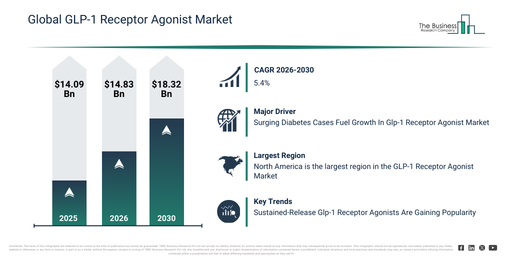
GLP-1 Receptor Agonist Market Set To Climb From $14.83 Billion In 2026 To $18.32 Billion By 2030
The glp-1 receptor agonist market has experienced strong growth in recent years. It is forecast to grow from $14.09 billion in 2025 to $14.83 billion in 2026, at a compound annual growth rate (CAGR) of 5.3%. This historic growth is attributable to the increasing prevalence of type 2 diabetes, greater awareness of glycemic control therapies, robust clinical efficacy compared to traditional antidiabetics, physician preference for incretin-based therapies, and favorable reimbursement in developed markets.
The glp-1 receptor agonist market is projected to experience substantial expansion in the coming years, with its size anticipated to reach $18.32 billion in 2030, demonstrating a compound annual growth rate (CAGR) of 5.4%. This growth during the forecast period can be attributed to factors such as the increasing global obesity population, broader approvals for cardiovascular risk reduction, advancements in oral and combination treatments, deeper market penetration in developing regions, and a growing patient preference for the benefits of weight loss. Furthermore, key trends expected during this period include the application of glp-1 therapies extending beyond diabetes, a heightened demand for long-acting and once-weekly dosage forms, the development of oral glp-1 receptor agonists, an intensified focus on managing weight, and the formation of strategic alliances and licensing deals.
Get A Free Sample Report With In-Depth Market Insights:
GLP-1 Receptor Agonist Market Opportunity Drivers: What’s Unlocking New Revenue Potential?
The increasing occurrence of diabetes is anticipated to propel the GLP-1 receptor agonist market moving forward. This chronic condition arises when the pancreas either fails to produce enough insulin or when the body struggles to use the insulin it produces effectively. Diabetes mellitus is a metabolic disorder characterized by elevated blood sugar. GLP-1 receptor agonists are utilized in diabetes management to encourage the body’s insulin production, thereby assisting in the reduction of blood sugar levels, which is why the rising prevalence of diabetes is set to drive market expansion. For instance, in March 2024, the Office for Health Improvement and Disparities, a UK-based government department, reported that between March 2022 and March 2023, the percentage of individuals with type 1 diabetes receiving all eight recommended care processes increased by 22%. For type 2 diabetes, this percentage grew by 21%, while the proportion achieving target HbA1c levels climbed to 37.9%. These developments underscore how the rising prevalence of diabetes is driving the GLP-1 receptor agonist market.
GLP-1 Receptor Agonist Market Segment Analysis And Revenue Potential
The glp-1 receptor agonist market covered in this report is segmented –
1) By Drug Class: Exenatide, Liraglutide, Dulaglutide, Lixisenatide, Other Drugs
2) By Route Of Administration: Parenteral, Oral
3) By End Users: Hospitals, Surgical Clinics, Other Users
GLP-1 Receptor Agonist Market Innovation Trends Shaping Future Development
Leading companies in the GLP-1 receptor agonist market are prioritizing the development of sustained-release GLP-1 receptor agonists to enhance their market competitiveness. These medications, known as sustained-release GLP-1RAs, are designed to gradually introduce the agonist into the bloodstream, resulting in prolonged effects and fewer required injections compared to conventional GLP-1RAs. For instance, in April 2023, the Japan-based pharmaceuticals firm, Mitsubishi Tanabe Pharma Corporation, introduced Mounjaro 2.5 mg or 5 mg Ateos. This product stands as the world’s inaugural sustained-release GIP/GLP-1 receptor agonist, targeting both GLP-1 and GIP receptors for type 2 diabetes management. While the GLP-1 receptor helps regulate blood sugar, the GIP receptor is crucial for stimulating insulin release and curbing appetite.
GLP-1 Receptor Agonist Market Key Players Shaping Industry Direction
Major companies operating in the glp-1 receptor agonist market are Novo Nordisk A/S, Sanofi SA, Eli Lilly and Company, AstraZeneca Inc., Boehringer Ingelheim International GmbH, Hanmi Pharm Co. Ltd., Pfizer Inc., Amgen Inc., Innovent Biologics Inc., Jiangsu Hengrui Medicine Co., Sun Pharmaceuticals Industries Ltd., PegBio Co. Ltd., Zealand Pharma A/S, Bristol-Myers Squibb Company, Chongqing Lummy Pharmaceutical Co. Ltd., Daiichi Sankyo Company Limited, Dong-A ST Co. Ltd., Eisai Co. Ltd., HanAll Biopharma Co. Ltd., Ipsen SA, Johnson & Johnson, Merck & Co. Inc., Novartis AG.
View The Full GLP-1 Receptor Agonist Market Report:
GLP-1 Receptor Agonist Market Largest Region: Which Geography Holds The Biggest Share?
North America was the largest region in the GLP-1 receptor agonist market in 2025. Asia-Pacific is expected to be the fastest-growing region in the GLP-1 receptor agonist market report during the forecast period. The regions covered in the glp-1 receptor agonist market report are Asia-Pacific, South East Asia, Western Europe, Eastern Europe, North America, South America, Middle East, Africa.
Reach Out To Our Team:
The Business Research Company: https://www.thebusinessresearchcompany.com/
Americas: +1 310-496-7795
Asia: +44 7882 955267 & +91 8897263534
Europe: +44 7882 955267
Email us at: marketing@tbrc.info
Follow us on:
LinkedIn: https://in.linkedin.com/company/the-business-research-company
YouTube: https://www.youtube.com/channel/UC24_fI0rV8cR5DxlCpgmyFQ
Global Market Model: https://www.thebusinessresearchcompany.com/global-market-model