Histone Deacetylase Inhibitors Market Trends Reshaping Industry Growth Through 2030
Built to provide research that’s more actionable and strategically valuable, The Business Research Company’s 2026 market reports include market attractiveness analysis, total addressable market sizing, company benchmarking matrices, interactive Excel dashboards, broader supply chain intelligence, emerging startup tracking, and in-depth product insights.
Histone Deacetylase Inhibitors Market Growth Analysis: How Will Revenue Trend Over The Forecast Period?
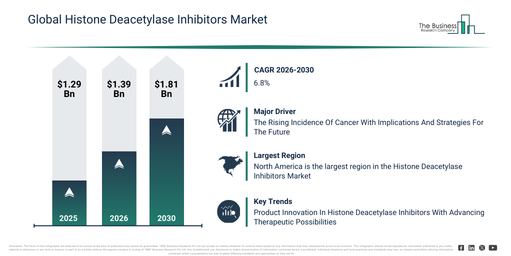
The histone deacetylase inhibitors market size has seen strong growth in recent years. It is anticipated to increase from $1.29 billion in 2025 to $1.39 billion in 2026, demonstrating a compound annual growth rate (CAGR) of 7.6%. This expansion in the past can be attributed to the early success of hdac inhibitors in hematological malignancies, a growing comprehension of epigenetic regulation in disease, the availability of approved first-generation hdac inhibitors, the broadening of cancer research infrastructure, and heightened investment in targeted cancer therapies.
The histone deacetylase inhibitors market is projected to experience robust expansion in the coming years. It is anticipated to reach a valuation of $1.81 billion by 2030, demonstrating a compound annual growth rate (CAGR) of 6.8%. This anticipated growth during the forecast period can be attributed to several factors, including the increasing global incidence of cancer, an expanding pipeline of epigenetic-based therapies, a heightened emphasis on precision oncology approaches, the broadening of clinical trials for neurological and inflammatory conditions, and a rising demand for epigenetic drugs that are both more selective and safer. Key trends projected for the forecast period encompass a greater integration of HDAC inhibitors into oncology treatment protocols, an intensified focus on developing selective and isoform-specific HDAC inhibitors, the increasing uptake of combination therapies that incorporate HDAC inhibitors, the broadening of HDAC inhibitor research to encompass indications beyond cancer, and consistent progress in oral HDAC inhibitor formulations.
Get A Free Sample Report With In-Depth Market Insights:
Histone Deacetylase Inhibitors Market Demand Drivers Opening New Revenue Streams
The histone deacetylase inhibitors market is anticipated to expand due to the rising occurrence of cancer. This increase in cancer cases largely stems from an aging global demographic, greater exposure to risk factors including tobacco, dietary habits, and environmental contaminants, as well as advancements in diagnostic methods that enable earlier and more frequent identification. Histone deacetylase inhibitors combat cancer by modifying chromatin structure, which results in the activation of tumor suppressor genes and the suppression of oncogenes, consequently causing cell cycle arrest and programmed cell death (apoptosis) in malignant cells. An example of this trend is a projection made in February 2024 by the World Health Organization, a US-based intergovernmental organization, which forecasted approximately 35 million new cancer cases in 2050, representing a 77% rise from the approximately 20 million cases estimated in 2022. Consequently, the growing incidence of cancer is stimulating the expansion of the histone deacetylase inhibitors market.
Histone Deacetylase Inhibitors Market Segment Analysis And Revenue Potential
The histone deacetylase inhibitors market covered in this report is segmented –
1) By Classification: Class I Histone Deacetylases (HDACs), Class II Histone Deacetylases (HDACs), Class III Histone Deacetylases (HDACs), Other Classifications
2) By Route Of Administration: Oral, Injectable, Other Routes Of Administration
3) By Distribution Channel: Hospital Pharmacy, Online Pharmacy, Retail Pharmacy, Other Distribution Channels
4) By Application: Oncology, Neurology, Other Applications
5) By End Users: Hospitals, Homecare, Specialty Clinics, Other End Users
Subsegments:
1) By Class I Histone Deacetylases (HDACs): HDAC1 Inhibitors, HDAC2 Inhibitors, HDAC3 Inhibitors, HDAC8 Inhibitors
2) By Class II Histone Deacetylases (HDACs): HDAC4 Inhibitors, HDAC5 Inhibitors, HDAC6 Inhibitors, HDAC7 Inhibitors, HDAC9 Inhibitors, HDAC10 Inhibitors
3) By Class III Histone Deacetylases (HDACs): Sirtuin 1 (SIRT1) Inhibitors, Sirtuin 2 (SIRT2) Inhibitors, Sirtuin 3 (SIRT3) Inhibitors, Sirtuin 4 (SIRT4) Inhibitors, Sirtuin 5 (SIRT5) Inhibitors, Sirtuin 6 (SIRT6) Inhibitors, Sirtuin 7 (SIRT7) Inhibitors
4) By Other Classifications: Dual-acting HDAC Inhibitors, Pan-HDAC Inhibitors, Selective HDAC Inhibitors, Combination Inhibitors (HDAC + Other Mechanisms)
Histone Deacetylase Inhibitors Market Trends Powering Strategic Industry Growth
Leading companies within the histone deacetylase inhibitors market are prioritizing the development of innovative product formulations, such as oral histone deacetylase (HDAC) inhibitors, to broaden treatment options and enhance patient convenience and adherence. An oral histone deacetylase (HDAC) inhibitor is a medication administered by mouth that targets HDAC enzymes involved in gene regulation and shows potential for treating various diseases, including cancer and inflammatory conditions. For instance, in March 2024, Italfarmaco S.p.A., an Italy-based pharmaceutical company, secured Food and Drug Administration approval for Duvyzat (givinostat), an oral histone deacetylase (HDAC) inhibitor, intended for the treatment of Duchenne muscular dystrophy (DMD) in patients aged 6 years and older. Duvyzat functions as a histone deacetylase (HDAC) inhibitor that intervenes in the cascade of events leading to muscle damage, potentially decelerating the progression of muscle deterioration linked to DMD. By curbing HDAC overactivity, it lessens inflammation and fibrosis while also encouraging muscle fiber regeneration. The approval is founded on the pivotal phase 3 EPIDYS trial, which successfully met its primary endpoint, illustrating that patients receiving Duvyzat demonstrated a statistically significant reduction in the time needed to complete the four-stair climb assessment compared to the placebo group.
Histone Deacetylase Inhibitors Market Key Players Shaping Industry Direction
Major companies operating in the histone deacetylase inhibitors market are Syndax Pharmaceuticals Inc., MEI Pharma Inc., Italfarmaco S.p.A., Shenzhen Chipscreen Biosciences Co. Ltd., Celgene Corporation, Spectrum Pharmaceuticals Inc., Curis Inc., Onxeo SA, Celleron Therapeutics, Forum Pharmaceuticals Inc., Merck & Co. Inc., AstraZeneca plc, Novartis AG, Eisai Co. Ltd., Karyopharm Therapeutics Inc., Medivir AB, Huya Bioscience International LLC, Crystal Genomics Inc., Midatech Pharma PLC, Regenacy Pharmaceuticals Inc.
View The Full Histone Deacetylase Inhibitors Market Report:
Histone Deacetylase Inhibitors Market Geographic Analysis: Where Is Demand Rising Fastest?
North America was the largest region in the histone deacetylase inhibitors market in 2025. Asia-Pacific is expected to be the fastest-growing region in the forecast period. The regions covered in the histone deacetylase inhibitors market report are Asia-Pacific, South East Asia, Western Europe, Eastern Europe, North America, South America, Middle East, Africa.
Reach Out To Our Team:
The Business Research Company: https://www.thebusinessresearchcompany.com/
Americas: +1 310-496-7795
Asia: +44 7882 955267 & +91 8897263534
Europe: +44 7882 955267
Email us at: marketing@tbrc.info
Follow us on:
LinkedIn: https://in.linkedin.com/company/the-business-research-company
YouTube: https://www.youtube.com/channel/UC24_fI0rV8cR5DxlCpgmyFQ
Global Market Model: https://www.thebusinessresearchcompany.com/global-market-model
[KClientError] [REQ_ERR: OPERATION_TIMEDOUT] [KTrafficClient] Something is wrong.