Hormonal Contraceptives Market Explained: What Is Fueling Growth To $15.82 Billion By 2030?
Featuring market attractiveness scoring, total addressable market sizing, company benchmarking matrices, interactive Excel dashboards, deeper supply chain intelligence, emerging startup tracking, and granular product-level insights, The Business Research Company’s 2026 market reports are built to deliver research that is both more actionable and more strategically valuable.
Hormonal Contraceptives Market Growth Potential: How Will Market Size Shift Through 2030?
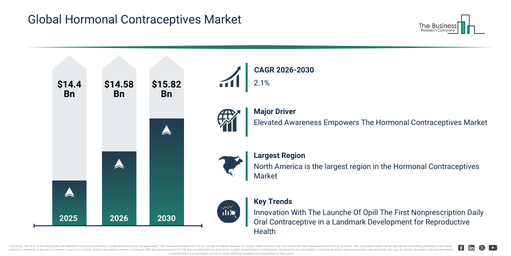
The hormonal contraceptives market has observed a slight increase in its size in recent years. This market is set to expand from $14.4 billion in 2025 to $14.58 billion in 2026, exhibiting a compound annual growth rate (CAGR) of 1.2%. Historically, this growth has been driven by increased awareness of family planning, the introduction of combined oral contraceptives, government programs supporting reproductive health, growing urbanization, and the expansion of gynecology clinics.
The hormonal contraceptives market is anticipated to show steady expansion in the upcoming period, with its size projected to reach $15.82 billion by 2030, demonstrating a compound annual growth rate (CAGR) of 2.1%. This expected growth can be attributed to advancements in personalized hormone therapies, the introduction of male contraceptive products, the broadening of e-commerce platforms for contraceptives, the integration of digital health solutions, and a growing emphasis on preventing sexually transmitted diseases. Significant trends during this forecast period include the rise of individualized hormone-based contraceptives, increased awareness of reversible and non-reversible birth control methods, the expansion of telemedicine and online contraceptive services, the development of male contraceptive options, and a focus on contraceptives that offer dual protection against STDs.
Get A Free Sample Report With In-Depth Market Insights:
Hormonal Contraceptives Market Growth Factors: What’s Supporting Expansion?
The increasing public understanding of hormonal contraceptives has led to a more informed and empowered populace, enabling individuals to select options that align with their reproductive objectives and lifestyles. As people gain greater knowledge about contraceptive choices, they are better equipped to make decisions about their reproductive health, which, in turn, boosts the adoption of hormonal contraceptives that suit their family planning and lifestyle preferences. For instance, in July 2025, the World Health Organization (WHO), a Switzerland-based specialized agency of the United Nations focusing on international public health, indicated that 874 million women now use modern contraceptives. This access to family planning enhances public health, promotes gender equality, strengthens health systems, and fosters economic development, with an additional 70 million women anticipated to gain access by 2030. Therefore, heightened awareness regarding the benefits and application of contraceptives significantly drives the hormonal contraceptives market. The rising healthcare expenditure is projected to fuel the expansion of the hormonal contraceptives market. Healthcare expenditure refers to the overall financial resources allocated by individuals, organizations, or governments for the prevention, treatment, and management of health conditions. This spending is increasing due to advancements in medical technology, as new diagnostic tools, treatments, and innovative therapies often carry higher costs, leading to greater overall healthcare spending. Increased healthcare expenditure promotes the use of hormonal contraceptives by improving access, affordability, awareness, and by supporting research and development as well as family planning initiatives. For example, in December 2024, the Centers for Medicare & Medicaid Services, a US-based agency responsible for administering Medicare and Medicaid programs, reported that in 2023, U.S. health care expenditures rose by 7.5%, reaching $4.9 trillion, which is approximately $14,570 per individual. Consequently, the growing healthcare expenditure is propelling the growth of the hormonal contraceptives market.
Hormonal Contraceptives Market Segment Analysis Spotlighting Growth Areas
The hormonal contraceptives market covered in this report is segmented –
1) By Product: Pills, Injectable Birth Control, Vaginal Rings, Others
2) By End User: Hospitals, Homecare Settings, Gynecology Centers, Clinics, Ambulatory Surgical Centers
3) By Hormones: Progestin-Only, Combined Hormones
4) By Distribution Channel: Drug Stores, Gynecology Or Fertility Clinics, E-Commerce, Other Distribution Channels
Subsegments:
1) By Pills: Combined Oral Contraceptives (COCs), Progestin-Only Pills (POPs), Emergency Contraceptive Pills
2) By Injectable Birth Control: Depot Medroxyprogesterone Acetate (DMPA), Combination Injectable Contraceptives, Subdermal Implants
3) By Vaginal Rings: NuvaRing, Annovera, Other Hormonal Vaginal Rings
4) By Others: Transdermal Patches, Intrauterine Devices (IUDs) with Hormones, Hormonal Implants, Contraceptive Tablets For Men
Hormonal Contraceptives Market Industry Trends: What’s Reshaping Demand?
Leading companies within the hormonal contraceptives market are developing advanced products, such as nonprescription daily oral contraceptives, to improve accessibility and convenience for users. This type of birth control pill can be purchased without a prescription from a healthcare provider. For instance, in July 2023, Perrigo Company PLC, a US-based manufacturer of private label over-the-counter pharmaceuticals, secured approval from the Food and Drug Administration (FDA), a US-based federal agency for protecting the public health, for Opill. Opill is the first nonprescription daily oral contraceptive, which will be available to consumers without a prescription. The introduction of Opill marks a pivotal moment in reproductive health, as it allows individuals to access effective birth control without the barriers of needing a prescription or a healthcare appointment.
Hormonal Contraceptives Market Leading Companies: Who Holds The Strongest Market Presence?
Major companies operating in the hormonal contraceptives market are Bayer AG, Merck & Co. Inc, Viatris, Gedeon Richter, AbbVie, Pfizer, Teva Pharmaceuticals, Mayne Pharma Group Limited, Lupin Limited, HLL Lifecare Limited, Amneal Pharmaceuticals, DKT International, Piramal Pharma Limited, Allergan, Afaxys Inc., Agile Therapeutic, Cipla Limited, Glenmark Pharmaceuticals, Novartis AG, Sun Pharmaceutical Industries Ltd., Apothecus Pharmaceutical Corporation, Famy Care, Mylan Laboratories
View The Full Hormonal Contraceptives Market Report:
Hormonal Contraceptives Market Regional Analysis: Which Geography Leads On Revenue?
North America was the largest region in the hormonal contraceptives market share in 2025. Middle East is expected to be the fastest-growing region in the global hormonal contraceptives market analysis during the forecast period. The regions covered in the hormonal contraceptives market report are Asia-Pacific, South East Asia, Western Europe, Eastern Europe, North America, South America, Middle East, Africa.
Reach Out To Our Team:
The Business Research Company: https://www.thebusinessresearchcompany.com/
Americas: +1 310-496-7795
Asia: +44 7882 955267 & +91 8897263534
Europe: +44 7882 955267
Email us at: marketing@tbrc.info
Follow us on:
LinkedIn: https://in.linkedin.com/company/the-business-research-company
YouTube: https://www.youtube.com/channel/UC24_fI0rV8cR5DxlCpgmyFQ
Global Market Model: https://www.thebusinessresearchcompany.com/global-market-model