
Smart Surgical Helmet Systems Market Analysis: How The Industry Is Evolving Toward A $1.27 Billion Future
Backed by market attractiveness analysis, total addressable market sizing, company benchmarking matrices, interactive Excel dashboards, wider supply chain intelligence, emerging startup coverage, and detailed product-level insights, The Business Research Company’s 2026 market reports are designed to offer research that is more actionable and strategically valuable than ever.
Smart Surgical Helmet Systems Market Size Outlook: How Quickly Will Revenue Expand Through 2030?
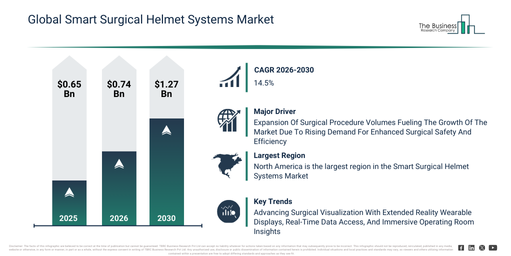
The smart surgical helmet systems market has witnessed rapid growth in recent years. It is projected to expand from $0.65 billion in 2025 to $0.74 billion in 2026, achieving a compound annual growth rate (CAGR) of 14.8%. The historical expansion can be attributed to the increasing adoption of advanced surgical protective equipment, a greater demand for infection control in operating rooms, the rising use of wearable technology in healthcare, the expansion of orthopedic and complex surgical procedures, and an increased focus on surgeon safety and comfort.
The market size for smart surgical helmet systems is projected to experience substantial expansion in the coming years, with expectations to reach $1.27 billion by 2030, growing at a compound annual growth rate (CAGR) of 14.5%. This growth during the forecast period is primarily attributed to the increasing integration of artificial intelligence (AI) and augmented reality (AR) technologies into these systems, a rising demand for enhanced surgical visualization, the growing adoption of minimally invasive and robotic surgical procedures, the ongoing expansion of hospital and surgical center infrastructure, and an increase in investment towards ergonomic and connected surgical equipment. Significant trends anticipated for the forecast period include technology-driven innovations resulting in lightweight and ergonomic helmet designs, advancements in AI-assisted surgical navigation, developments in augmented reality (AR) overlays and real-time imaging, a surge in research and development for smart sterilization and safety features, and innovations in integrated communication and monitoring systems.
Get A Free Sample Report With In-Depth Market Insights:
Smart Surgical Helmet Systems Market Opportunity Drivers: What’s Unlocking New Revenue Potential?
The smart surgical helmet systems market is projected to be driven by the increasing volume of surgical procedures. This rise in surgical procedure volumes signifies a growing number of both elective and emergency operations conducted in hospitals and surgical facilities, largely attributed to an aging global population, a higher incidence of chronic illnesses, and improved availability of healthcare. As the world’s population gets older and the prevalence of chronic and lifestyle-related conditions grows, the demand for surgical treatments also increases. Smart surgical helmet systems play a crucial role in these procedures by offering surgeons superior protection, continuous monitoring, and integrated visual aids. These systems enhance procedural efficiency and patient safety in the operating room through their blend of ergonomic design and advanced technological support. For instance, in June 2025, according to Intuitive Surgical Inc., a US-based medical technology company, approximately 2,683,000 procedures were performed using da Vinci surgical systems in 2024, compared to 2,286,000 procedures in 2023 and 1,875,000 in 2022, demonstrating a year on year increase in 2024. Consequently, the expanding volume of surgical procedures is a key factor propelling the growth of the smart surgical helmet systems market.
Smart Surgical Helmet Systems Market Segment Analysis: What Are The Core Market Categories?
The smart surgical helmet systems market covered in this report is segmented –
1) By Product Type: Integrated Camera Systems, Ventilated Helmet Systems, Communication Enabled Helmets, Other Product Types
2) By Distribution Channel: Direct Sales, Distributors, Online Sales, Other Distribution Channel
3) By Application: Orthopedic Surgery, Neurosurgery, General Surgery, Ear Nose And Throat Surgery, Other Applications
4) By End User: Hospitals, Ambulatory Surgical Centers, Specialty Clinics, Other End Users
Subsegments:
1) By Integrated Camera Systems: High Resolution Camera Systems, Thermal Imaging Camera Systems, Three Dimensional Imaging Camera Systems
2) By Ventilated Helmet Systems: Active Airflow Helmet Systems, Filter Equipped Helmet Systems, Cooling Enhanced Helmet Systems
3) By Communication Enabled Helmets: Wireless Communication Helmet Systems, Hands Free Communication Helmet Systems, Integrated Audio Visual Communication Helmets
4) By Other Product Types: Protective Helmet Accessories, Lighting Integrated Helmet Systems, Modular Surgical Helmet Components
Smart Surgical Helmet Systems Market Innovation Trends Shaping Future Development
Companies actively involved in the smart surgical helmet systems market are prioritizing the development of advanced technological offerings, such as extended reality (XR) wearable displays, to boost surgical accuracy, situational awareness, and decision-making during operations. Extended reality wearable displays are defined as head-mounted devices that merge virtual, augmented, or mixed reality content directly into a surgeon’s view, enabling the projection of vital imaging, live patient information, and interactive guidance during medical procedures. For example, in April 2024, MediThinQ Inc., a medical technology startup from South Korea, launched extended reality (XR) surgical displays specifically designed for smart surgical helmet systems. These wearable displays provide surgeons with an immersive, real-time view of patient anatomy, procedural instructions, and cooperative data sharing within the operating room. By integrating XR technology into wearable surgical helmets, MediThinQ contributes to enhanced precision, reduces cognitive effort, and supports safer, more efficient surgical workflows, thereby broadening worldwide access to next-generation surgical visualization tools.
Smart Surgical Helmet Systems Market Competitive Landscape: Who Leads The Industry?
Major companies operating in the smart surgical helmet systems market are Cardinal Health Inc., Johnson & Johnson, Medtronic plc, 3M Company, Stryker Corporation, Ecolab Inc., Smith & Nephew plc, Baxter International Inc., Zimmer Biomet Holdings Inc., STERIS plc, Arthrex Inc., KARL STORZ SE & Co. KG, Ansell Limited, Integra LifeSciences Holdings Corporation, NuVasive Inc., MicroPort Scientific Corporation, Orthofix Medical Inc., Synaptive Medical Inc., SurgiTel, Maxair Systems, Enova Illumination, Bioservo Technologies AB, Illumigyn Ltd., Kaiser Technology Co. Ltd., THI Total Healthcare Innovation GmbH
View The Full Smart Surgical Helmet Systems Market Report:
Smart Surgical Helmet Systems Market Geographic Landscape: Which Region Dominates Industry Growth?
North America was the largest region in the smart surgical helmet systems market in 2025. Asia-Pacific is expected to be the fastest-growing region in the forecast period. The regions covered in the smart surgical helmet systems market report are Asia-Pacific, South East Asia, Western Europe, Eastern Europe, North America, South America, Middle East, Africa.
Reach Out To Our Team:
The Business Research Company: https://www.thebusinessresearchcompany.com/
Americas: +1 310-496-7795
Asia: +44 7882 955267 & +91 8897263534
Europe: +44 7882 955267
Email us at: marketing@tbrc.info
Follow us on:
LinkedIn: https://in.linkedin.com/company/the-business-research-company
YouTube: https://www.youtube.com/channel/UC24_fI0rV8cR5DxlCpgmyFQ
Global Market Model: https://www.thebusinessresearchcompany.com/global-market-model