MSI-H And dMMR Market Reaches $21.12 Billion In 2026: Forecast And Growth Opportunities
Backed by market attractiveness analysis, total addressable market sizing, company benchmarking matrices, interactive Excel dashboards, wider supply chain intelligence, emerging startup coverage, and detailed product-level insights, The Business Research Company’s 2026 market reports are designed to offer research that is more actionable and strategically valuable than ever.
MSI-H And dMMR Market Value Growth And Long-Term Outlook
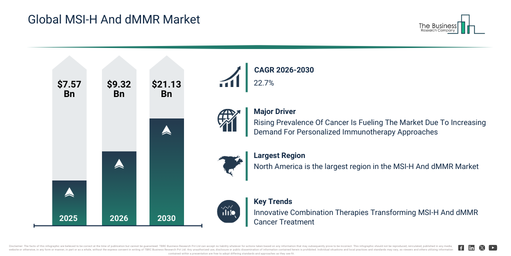
The market size for msi-h and dmmr has demonstrated exponential growth in recent years. It is anticipated to increase from $7.57 billion in 2025 to $9.32 billion in 2026, at a compound annual growth rate (CAGR) of 23.1%. The growth observed in the historical period can be attributed to factors such as the discovery of msi-h and dmmr biomarkers, the initial success of immune checkpoint inhibitors, a rising incidence of colorectal and endometrial cancer, the expansion of molecular diagnostics, and regulatory approvals for biomarker-based therapies.
The market for msi-h and dmmr is projected to experience rapid expansion in the coming years. Its valuation is set to reach $21.13 billion by 2030, exhibiting a compound annual growth rate (CAGR) of 22.7%. This anticipated growth during the projected timeframe stems from factors such as increased uptake of precision oncology, a rise in genomic testing applications in cancer treatment, broader approval for immunotherapy uses, higher investment in biomarker studies, and accumulating clinical data favoring tumor-agnostic strategies. Key trends expected over the forecast period encompass a greater acceptance of immunotherapy for msi-h and dmmr tumors, an expanding application of companion diagnostics for classifying patients, an escalating emphasis on cancer treatments that are tumor-agnostic, the proliferation of combination immunotherapy protocols, and heightened understanding of oncology approaches guided by biomarkers.
Get A Free Sample Report With In-Depth Market Insights:
MSI-H And dMMR Market Growth Backed By Core Demand Fundamentals
The increasing occurrence of cancer is projected to drive the expansion of the MSI-H and dMMR market in the future. Cancer is defined as a collection of illnesses marked by the unregulated multiplication and dissemination of atypical cells throughout the body. This upward trend in cancer cases is largely attributed to demographic aging, considering that the likelihood of developing cancer rises considerably with advancing age due to the accumulated impact of genetic alterations and extended exposure to various risk factors over a lifetime. In oncology, MSI-H and dMMR markers serve to pinpoint tumors exhibiting elevated mutation rates, a consequence of imperfections in DNA repair processes. These particular biomarkers are instrumental in informing immunotherapy choices, given that these types of tumors show a greater propensity to react positively to immune checkpoint inhibitors; furthermore, they offer valuable information regarding patient prognosis and the possibility of underlying genetic syndromes. For example, data released in January 2024 by the American Cancer Society, a non-profit organization based in the US, indicated that in 2023, approximately 1,958,310 new cancer diagnoses and 609,820 fatalities linked to cancer were anticipated in the United States. These figures are forecast to increase in 2024, with around 2,001,140 new cancer cases and 611,720 deaths expected, thereby underscoring an ongoing escalation in both the occurrence and fatality rates of cancer. Consequently, the expanding incidence of cancer is a key factor fueling the expansion of the MSI-H and dMMR market.
MSI-H And dMMR Market Segment Landscape: Which Areas Lead Development?
The msi-h and dmmr market covered in this report is segmented –
1) By Treatment Type: Immune Checkpoint Inhibitors (ICIs), Combination Therapy
2) By Indication: Endometrial, Gastric, Colorectal Cancer, Small Intestine Cancer, Cervical Cancer, Other Indications
3) By Stage: Early Stages, Advanced Stages
4) By End User: Hospitals, Oncology Clinics, Research Institutions, Homecare
Subsegments:
1) By Immune Checkpoint Inhibitors (ICIs): Programmed Cell Death Protein 1 Inhibitors, Programmed Cell Death Ligand 1 Inhibitors, Cytotoxic T-Lymphocyte Antigen 4 Inhibitors
2) By Combination Therapy: Immune Checkpoint Inhibitor + Chemotherapy, Immune Checkpoint Inhibitor + Targeted Therapy, Immune Checkpoint Inhibitor + Radiation Therapy, Immune Checkpoint Inhibitor + Other Immunotherapies
MSI-H And dMMR Market Growth Trends Reshaping The Competitive Landscape
Leading companies in the MSI-H and dMMR market are concentrating on developing innovative treatments, such as combination therapy, to enhance treatment effectiveness and improve patient outcomes. Combination therapy for MSI-H and dMMR cancers involves utilizing two or more distinct treatment modalities, frequently immunotherapy agents like checkpoint inhibitors, or integrating immunotherapy with chemotherapy, targeted therapy, or radiation. This approach aims to boost treatment response, overcome resistance mechanisms, and improve survival rates in patients with tumors exhibiting high microsatellite instability or deficient mismatch repair. For example, in April 2025, Bristol-Myers Squibb Company, a US-based pharmaceutical entity, obtained United States Food and Drug Administration (FDA) approval for the combined use of nivolumab (Opdivo) and ipilimumab (Yervoy) as a first-line treatment for metastatic colorectal cancer (mCRC) with microsatellite instability-high (MSI-H) or mismatch repair deficient (dMMR) characteristics, thereby advancing therapeutic options for this challenging cancer subtype. This approval signifies a major breakthrough in managing MSI-H and dMMR cancers, as it introduces an effective new therapeutic alternative that targets multiple pathways to enhance patient survival and response rates, addressing crucial unmet medical needs in this patient population.
MSI-H And dMMR Market Industry Leaders And Competitive Landscape
Major companies operating in the msi-h and dmmr market are Pfizer Inc., F. Hoffmann-La Roche Ltd, Merck & Co. Inc., AbbVie Inc., Bayer AG, Novartis International AG, AstraZeneca PLC, Bristol-Myers Squibb Company, GSK plc., Takeda Pharmaceutical Company, Incyte Corporation, Exact Sciences Corp., BeiGene LTD., Summit Therapeutics Inc., Tempus Labs Inc., Guardant Health, NeoGenomics Laboratories Inc., Promega Corporation, Caris Life Sciences, and Owkin.
View The Full MSI-H And dMMR Market Report:
MSI-H And dMMR Market Geographic Spread And Regional Opportunities
North America was the largest region in the MSI-H and dMMR market in 2025. The regions covered in the msi-h and dmmr market report are Asia-Pacific, South East Asia, Western Europe, Eastern Europe, North America, South America, Middle East, Africa.
Reach Out To Our Team:
The Business Research Company: https://www.thebusinessresearchcompany.com/
Americas: +1 310-496-7795
Asia: +44 7882 955267 & +91 8897263534
Europe: +44 7882 955267
Email us at: marketing@tbrc.info
Follow us on:
LinkedIn: https://in.linkedin.com/company/the-business-research-company
YouTube: https://www.youtube.com/channel/UC24_fI0rV8cR5DxlCpgmyFQ
Global Market Model: https://www.thebusinessresearchcompany.com/global-market-model