Myeloproliferative Disorders Drugs Market Growth Forecast: Market Size, Key Trends And Emerging Opportunities Through 2030
Featuring market attractiveness scoring, total addressable market sizing, company benchmarking matrices, interactive Excel dashboards, deeper supply chain intelligence, emerging startup tracking, and granular product-level insights, The Business Research Company’s 2026 market reports are built to deliver research that is both more actionable and more strategically valuable.
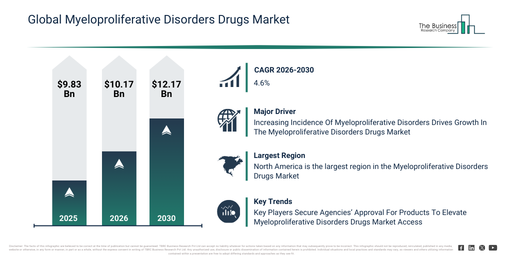
Myeloproliferative Disorders Drugs Market Growth From $10.17 Billion In 2026 To $12.17 Billion By 2030 At A CAGR Of 4.6%
The myeloproliferative disorders drugs market has experienced consistent growth in recent years. It is anticipated to expand from $9.83 billion in 2025 to $10.17 billion in 2026, demonstrating a compound annual growth rate (CAGR) of 3.5%. The expansion witnessed during the historic period was primarily due to the high prevalence of myeloproliferative disorders, advancements in chemotherapy, increasing awareness of blood cancers, the availability of generic drugs, and improvements in supportive care.
The myeloproliferative disorders drugs market size is projected to experience steady growth in the upcoming years. It is expected to reach $12.17 billion in 2030, reflecting a compound annual growth rate (CAGR) of 4.6%. This growth during the forecast period is attributable to the emergence of targeted therapies, increasing research and development investments, the adoption of precision medicine, the expansion of healthcare infrastructure in emerging markets, and favorable regulatory approvals. Major trends anticipated in this period include the development of personalized treatments, a heightened focus on rare blood disorders, advancements in targeted therapies, the expansion of clinical trials, and rising investment in orphan drugs.
Get A Free Sample Report With In-Depth Market Insights:
Myeloproliferative Disorders Drugs Market Growth Factors Behind Sustained Expansion
The increasing occurrence of myeloproliferative disorders is projected to fuel the expansion of the myeloproliferative disorder’s drugs market in the future. These disorders encompass a varied group of illnesses, set apart from acute leukemia by the uncontrolled cellular proliferation of one or more blood cell lines in the bloodstream. The rise in myeloproliferative disorders is largely attributed to factors such as genetic predispositions, excessive exposure to radiation, electrical wiring, or specific chemicals, and the aging population. Medications for myeloproliferative diseases function by blocking the BCR-ABL protein. They achieve this by binding to the ATP pocket in its active site, thereby preventing the subsequent phosphorylation of the target protein, which aids in managing the disorder. For example, data from June 2025, provided by the American Cancer Society, a US-based non-profit organization, indicates that chronic myeloid leukemia accounts for approximately 15% of all new U.S. leukemia cases, with about 9,560 new diagnoses and 1,290 deaths each year. This condition affects roughly 1 in 500 individuals during their lifetime and is generally identified around age 66, although 2% of instances are found in people younger than 20. Consequently, the growing incidence of myeloproliferative disorders is a key factor propelling the expansion of the myeloproliferative disorders drug market.
Myeloproliferative Disorders Drugs Market Segment Outlook: Which Categories Are Growing Fastest?
The myeloproliferative disorders drugs market covered in this report is segmented –
1) By Type: Primary Myelofibrosis, Polycythemia Vera (PV), Essential Thrombocythemia (ET), Chronic Eosinophilic Leukemia Or Hyper eosinophilic Syndrome (HES), Systemic Masto cytosis (SM)
2) By Drug Type: JAK2 Inhibitors, Anti-Neoplastics, Demethylation Agents, Imatinib Mesylate, Other Drug Types
3) By Route Of Administration: Oral, Parenteral, Other Routes Of Administration
4) By Distribution Channel: Hospital Pharmacy, Retail Stores, Drug Stores
Subsegments:
1) By Primary Myelofibrosis: JAK Inhibitors, Immunomodulatory Agents, Supportive Care
2) By Polycythemia Vera (PV): JAK Inhibitors, Hydroxyurea, Phlebotomy, Interferon-alpha
3) By Essential Thrombocythemia (ET): JAK Inhibitors, Hydroxyurea, Anagrelide, Interferon-alpha
4) By Chronic Eosinophilic Leukemia or Hyper Eosinophilic Syndrome (HES): Tyrosine Kinase Inhibitors, Corticosteroids, Interferon-alpha
5) By Systemic Mastocytosis (SM): Tyrosine Kinase Inhibitors, Corticosteroids, Antihistamines, Immunotherapy
Myeloproliferative Disorders Drugs Market Industry Trends Fueling Future Revenue Growth
Leading entities within the myeloproliferative disorder drugs market are prioritizing the development and regulatory clearance of innovative drug solutions from national government agencies to secure a competitive advantage. These new drug solutions, upon their launch and endorsement, are intended to substantially improve access to sophisticated treatments for individuals suffering from myeloproliferative disorders. As an illustration, in September 2023, Novartis AG, a pharmaceutical corporation headquartered in Switzerland, revealed that the National Institute for Health and Care Excellence’s (NICE) had sanctioned Jakavi (ruxolitinib), a JAK 1/2 inhibitor specifically approved for managing polycythaemia vera (PV). Consequently, patients in England and Wales will gain access to Ruxolitinib, a medication designed to fulfill a critical unmet treatment need for qualified patients, given that approximately 24% of those receiving hydroxycarbamide or hydroxyurea (HC or HU) develop resistance or intolerance to these treatments. PV, identified as a subtype of myeloproliferative disorder, represents a rare and fatal blood cancer characterized by an overproduction of red blood cells, which, if left untreated, carries the risk of leading to a heart attack or stroke. Annually, it is estimated that 1,130 new PV diagnoses are recorded in the UK.
Myeloproliferative Disorders Drugs Market Leading Companies And Competitive Benchmarking
Major companies operating in the myeloproliferative disorders drugs market are Novartis AG, Bristol-Myers Squibb Company, Pfizer Inc., Takeda Pharmaceutical Company Limited, Teva Pharmaceutical Industries Ltd., Incyte Corporation, Eli Lilly and Co, F Hoffmann-La Roche Ltd., Mylan NV, Hikma Pharmaceuticals plc, Bayer AG, Sun Pharmaceutical Industries Ltd., Boehringer Ingelheim International GmbH, Sanofi Aventis Inc., AstraZeneca AB, Apotex Inc, Celgene Co., Geron Co., Promedior Inc., Johnson & Johnson Private Limited, AbbVie Inc., Astellas Pharma Inc., Daiichi Sankyo Chemical Pharma Co. Ltd.
View The Full Myeloproliferative Disorders Drugs Market Report:
Myeloproliferative Disorders Drugs Market Geographic Landscape: Which Region Dominates Industry Growth?
North America was the largest region in the myeloproliferative disorder drugs market in 2025. Asia-Pacific is expected to be the fastest-growing region in the global myeloproliferative disorder drugs market report during the forecast period. The regions covered in the myeloproliferative disorders drugs market report are Asia-Pacific, South East Asia, Western Europe, Eastern Europe, North America, South America, Middle East, Africa.
Reach Out To Our Team:
The Business Research Company: https://www.thebusinessresearchcompany.com/
Americas: +1 310-496-7795
Asia: +44 7882 955267 & +91 8897263534
Europe: +44 7882 955267
Email us at: marketing@tbrc.info
Follow us on:
LinkedIn: https://in.linkedin.com/company/the-business-research-company
YouTube: https://www.youtube.com/channel/UC24_fI0rV8cR5DxlCpgmyFQ
Global Market Model: https://www.thebusinessresearchcompany.com/global-market-model