Electrocompetent Cells Market Size In 2026: Growth Outlook And Forecast Through 2030
Built to provide research that’s more actionable and strategically valuable, The Business Research Company’s 2026 market reports include market attractiveness analysis, total addressable market sizing, company benchmarking matrices, interactive Excel dashboards, broader supply chain intelligence, emerging startup tracking, and in-depth product insights.
Electrocompetent Cells Market Size Outlook: How Quickly Will Revenue Expand Through 2030?
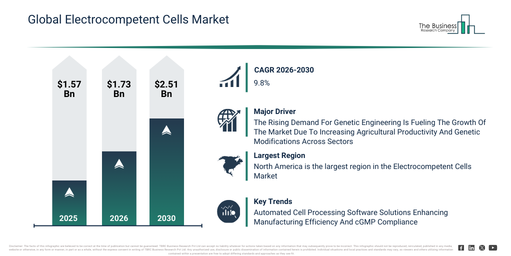
The electrocompetent cells market has experienced significant expansion in recent years. It is projected to increase from $1.57 billion in 2025 to $1.73 billion in 2026, exhibiting a compound annual growth rate (CAGR) of 10.0%. This historical growth can be ascribed to an increase in molecular biology research, the expanded application of plasmid cloning, the proliferation of academic research institutes, a growing demand for recombinant proteins, and the adoption of electroporation techniques.
The electrocompetent cells market size is anticipated to expand significantly in the coming years, with projections indicating a rise to $2.51 billion by 2030, demonstrating a compound annual growth rate (CAGR) of 9.8%. This expansion over the forecast period is propelled by factors such as the growth in gene therapy research, an increase in CRISPR-based studies, the broadening of biotechnology pipelines, greater outsourcing to contract research organizations (CROs), and the necessity for high-throughput genetic engineering. Prominent trends expected during this period involve an escalating demand for high-efficiency transformation cells, their increasing deployment in gene editing applications, wider adoption in synthetic biology research, the proliferation of custom and ready-to-use cell formats, and their growing utilization in therapeutic development.
Get A Free Sample Report With In-Depth Market Insights:
Electrocompetent Cells Market Development Factors: What’s Supporting Demand?
The increasing adoption of genetic engineering is projected to stimulate the growth of the electrocompetent cells market in the future. Genetic engineering involves purposefully modifying an organism’s genetic material to alter its attributes or behavior. The rise in genetic engineering is propelled by the necessity for enhanced agricultural productivity, facilitating the creation of crops with superior yields and pest resistance, thus minimizing chemical dependency. This escalating requirement for genetic engineering boosts the demand for electrocompetent cells, which are essential for efficient DNA transformation. With genetic modifications expanding across various sectors like research, healthcare, and agriculture, the need for premium electrocompetent cells is on the rise. For instance, in April 2025, data from the Economic Research Service, a US-based government agency, indicated that in 2024, genetically engineered, insect-resistant seeds were utilized on 90 percent of cotton acres in the U.S. Therefore, the growing demand for genetic engineering is a primary driver for the expansion of the electrocompetent cells market.
Electrocompetent Cells Market Segment Trends And Revenue Contributors
The electrocompetent cells market covered in this report is segmented –
1) By Product Type: Bacterial Electrocompetent Cells, Yeast Electrocompetent Cells, Plant Electrocompetent Cells, Mammalian Electrocompetent Cells
2) By Technology: Electroporation Technology, Chemical Transformation Technology, Other Technologies
3) By Packaging Format: Tubes, Plates, Custom Formats
4) By Application: Gene Cloning, Protein Expression, Transfection Studies, Gene Editing, Therapeutic Applications, Other Applications
5) By End-User: Pharmaceutical And Biotechnology Companies, Academic And Research Institutes, Contract Research Organizations (CROs), Other End-Users
Subsegments:
1) By Bacterial Electrocompetent Cells: E. coli Electrocompetent Cells, Salmonella Electrocompetent Cells, Clostridium Electrocompetent Cells, Bacillus Electrocompetent Cells
2) By Yeast Electrocompetent Cells: Saccharomyces Cerevisiae Electrocompetent Cells, Pichia Pastoris Electrocompetent Cells, Schizosaccharomyces Pombe Electrocompetent Cells
3) By Plant Electrocompetent Cells: Arabidopsis Thaliana Electrocompetent Cells, Nicotiana Benthamiana Electrocompetent Cells, Maize Electrocompetent Cells
4) By Mammalian Electrocompetent Cells: HEK293 Electrocompetent Cells, Chinese Hamster Ovary (CHO) Electrocompetent Cells, NIH 3T3 Electrocompetent Cells
Electrocompetent Cells Market Transformation Trends: What Innovations Are Driving Change?
Leading companies within the electrocompetent cells market are concentrating on developing sophisticated solutions, particularly automated cell processing technology, to enhance scalability in genetic engineering workflows. This technology utilizes software-driven systems to manage the manipulation, growth, modification, and storage of cells with minimal human intervention. Such an approach significantly boosts operational efficiency, promotes standardization, and improves scalability across sectors like cell therapy, regenerative medicine, and biomanufacturing. As an illustration, in 2024, the US-based biotechnology company Thermo Fisher Scientific Inc. introduced the Gibco Cell Therapy Systems (CTS) Cellmation Software. This validated automation solution is engineered to link and integrate workflows across numerous cell therapy instruments while supporting cGMP compliance. The software unifies key instruments such as the CTS DynaCellect Magnetic Separation System, CTS Rotea Counterflow Centrifugation System, CTS Xenon Electroporation System, Heracell Vios CR CO2 Incubator, and Cryomed Controlled-Rate Freezer through a singular, intuitive interface. This integration cuts manual touchpoints from an approximate 40 in conventional processes, thereby decreasing the potential for errors and contamination, and simultaneously guaranteeing traceability, repeatability, and 21 CFR Part 11 compliance for scaling cGMP manufacturing.
Electrocompetent Cells Market Competitive Landscape: Which Companies Lead The Industry?
Major companies operating in the electrocompetent cells market are Thermo Fisher Scientific Inc., Merck KGaA, Agilent Technologies Inc., Lonza Biosciences, Bio-Rad Laboratories Inc., Takara Bio Inc., Promega Corporation, New England Biolabs, OriGene Technologies, MaxCyte, LGC Biosearch Technologies, IBA GmbH, Zymo Research, Creative Biolabs, Inovio Pharmaceuticals Inc., Canvax, Yeastern Biotech, ZellBio GmbH, Scarab Genomics LLC, Intact Genomics.
View The Full Electrocompetent Cells Market Report:
Electrocompetent Cells Market Largest Region: Which Geography Holds The Highest Market Share?
North America was the largest region in the electrocompetent cells market in 2025. Asia-Pacific is expected to be the fastest-growing region in the forecast period. The regions covered in the electrocompetent cells market report are Asia-Pacific, South East Asia, Western Europe, Eastern Europe, North America, South America, Middle East, Africa.
Reach Out To Our Team:
The Business Research Company: https://www.thebusinessresearchcompany.com/
Americas: +1 310-496-7795
Asia: +44 7882 955267 & +91 8897263534
Europe: +44 7882 955267
Email us at: marketing@tbrc.info
Follow us on:
LinkedIn: https://in.linkedin.com/company/the-business-research-company
YouTube: https://www.youtube.com/channel/UC24_fI0rV8cR5DxlCpgmyFQ
Global Market Model: https://www.thebusinessresearchcompany.com/global-market-model