Familial Amyloid Polyneuropathy Market Forecast: Breaking Down The Numbers Behind Future Expansion
Built to provide research that’s more actionable and strategically valuable, The Business Research Company’s 2026 market reports include market attractiveness analysis, total addressable market sizing, company benchmarking matrices, interactive Excel dashboards, broader supply chain intelligence, emerging startup tracking, and in-depth product insights.
Familial Amyloid Polyneuropathy Market Growth Analysis: How Will Revenue Trend Over The Forecast Period?
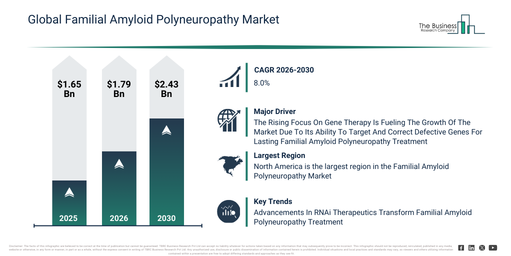
The familial amyloid polyneuropathy market has experienced robust growth in recent years. It is anticipated to expand from $1.65 billion in 2025 to $1.79 billion in 2026, at a compound annual growth rate (CAGR) of 8.3%. The growth observed in the past can be attributed to elements like rare disease diagnosis, increasing genetic disorder awareness, advancements in transplant medicine development, dedicated neurology research, and the embrace of supportive care.
The familial amyloid polyneuropathy market size is anticipated to undergo strong growth in the next few years. It is predicted to expand to $2.43 billion in 2030, at a compound annual growth rate (CAGR) of 8.0%. This expansion during the forecast period can be attributed to innovations in gene therapy, the availability of early genetic testing, increased funding for rare diseases, wider adoption of precision medicine, and the development of specialty pharmacies. Major trends expected during the forecast period involve the growing adoption of TTR stabilizers, the broader implementation of gene silencing therapies, enhanced genetic screening, a heightened focus on rare disease treatment, and the proliferation of specialty care centers.
Get A Free Sample Report With In-Depth Market Insights:
Familial Amyloid Polyneuropathy Market Development Factors: What’s Supporting Demand?
An increasing focus on gene therapy is projected to stimulate the growth of the familial amyloid polyneuropathy market in the future. Gene therapy serves as a treatment strategy designed to modify or replace defective genes, addressing the fundamental origins of diseases. It is becoming more prominent due to its ability to target and rectify faulty genes, offering lasting or permanent cures rather than merely providing symptomatic relief. Specifically for familial amyloid polyneuropathy, gene therapy aims to correct or silence the defective transthyretin (TTR) gene, thus preventing the formation of harmful amyloid protein. This process aids in reducing amyloid deposits, which slows disease progression and helps preserve nerve function. For example, in July 2023, information from the American Society of Gene & Cell Therapy (ASGCT), a US-based professional membership organization, and Citeline, a US-based provider of drugs and devices, indicated that 247 gene therapies were in Phase II at the close of the first quarter of 2023, a number that subsequently rose by 5% to reach 260 by the end of the second quarter. Therefore, the growing emphasis on gene therapy is a key driver for the familial amyloid polyneuropathy market’s expansion.
Familial Amyloid Polyneuropathy Market Segment Landscape And Growth Outlook
The familial amyloid polyneuropathy market covered in this report is segmented –
1) By Treatment: Medication, Gene Therapy, Supportive Care, Pain Management, Symptomatic Treatment
2) By Diagnosis: Genetic Testing, Biopsy, Imaging, Other Diagnosis
3) By Patient Age Group: Pediatric, Adult, Geriatric
4) By Distribution Channel: Hospital Pharmacies, Retail Pharmacies, Online Pharmacies, Specialty Pharmacies, Direct Sales
5) By End-User: Hospitals, Specialty Clinics, Research Institutes, Other End-Users
Subsegments:
1) By Medication: Transthyretin (TTR) Stabilizers, Transthyretin (TTR) Gene Silencers, Tafamidis, Diflunisal, Patisiran
2) By Gene Therapy: Clustered Regularly Interspaced Short Palindromic Repeats (CRISPR) Or Cas9-Based Therapy, RNA Interference (RNAi) Therapy, Antisense Oligonucleotides (ASO) Therapy
3) By Supportive Care: Physical Therapy, Occupational Therapy, Nutritional Support, Psychological Counseling
4) By Pain Management: Non-Steroidal Anti-Inflammatory Drugs (NSAIDs), Opioids, Antidepressants, Anticonvulsants
5) By Symptomatic Treatment: Gastrointestinal Symptom Management, Cardiovascular Symptom Management, Autonomic Dysfunction Management, Orthostatic Hypotension Treatment
Familial Amyloid Polyneuropathy Market Transformation Trends: What Innovations Are Driving Change?
Leading companies within the familial amyloid polyneuropathy market are concentrating on developing advanced treatment solutions, such as RNA interference (RNAi) therapeutics, to slow the progression of the disease and improve patient outcomes. RNA interference (RNAi) therapeutics are sophisticated treatments that silence genes responsible for causing disease by targeting their messenger RNA (mRNA). This method effectively blocks the production of harmful proteins, thereby addressing genetic diseases at their fundamental source. For example, in March 2025, Alnylam Pharmaceuticals, a US-based biopharmaceutical company, launched AMVUTTRA (vutrisiran), which had previously received approval from the Food and Drug Administration (FDA) for the treatment of cardiomyopathy resulting from wild-type or hereditary transthyretin-mediated amyloidosis (ATTR-CM) in adult patients. It is administered as four subcutaneous doses per year and is designed to treat both ATTR-CM and the polyneuropathy associated with hereditary transthyretin-mediated amyloidosis (hATTR-PN). By reducing the production of the transthyretin (TTR) protein, identified as the root cause of the disease, it significantly decreases cardiovascular mortality, hospitalizations, and urgent heart failure visits, as evidenced in the HELIOS-B Phase 3 clinical trial.
Familial Amyloid Polyneuropathy Market Competitive Landscape: Who Leads The Industry?
Major companies operating in the familial amyloid polyneuropathy market are Pfizer Inc., AstraZeneca plc, Novo Nordisk A/S, Regeneron Pharmaceuticals Inc., NYU Langone Hospitals, Alexion Pharmaceuticals Inc., Mount Sinai Medical Center, PTC Therapeutics Inc., Mayo Foundation for Medical Education and Research, Arcturus Therapeutics Inc., Precision BioSciences Inc., Creative Biolabs, Stanford Health Care, Duke University Health System, YolTech Therapeutics
View The Full Familial Amyloid Polyneuropathy Market Report:
Familial Amyloid Polyneuropathy Market Leading Geography: Which Region Contributes The Most Revenue?
North America was the largest region in the familial amyloid polyneuropathy market in 2025. Asia-Pacific is expected to be the fastest-growing region in the forecast period. The regions covered in the familial amyloid polyneuropathy market report are Asia-Pacific, South East Asia, Western Europe, Eastern Europe, North America, South America, Middle East, Africa.
Reach Out To Our Team:
The Business Research Company: https://www.thebusinessresearchcompany.com/
Americas: +1 310-496-7795
Asia: +44 7882 955267 & +91 8897263534
Europe: +44 7882 955267
Email us at: marketing@tbrc.info
Follow us on:
LinkedIn: https://in.linkedin.com/company/the-business-research-company
YouTube: https://www.youtube.com/channel/UC24_fI0rV8cR5DxlCpgmyFQ
Global Market Model: https://www.thebusinessresearchcompany.com/global-market-model