Vision-Language Models (VLM) For Robotics Market Expected To Grow At 27% CAGR Through 2030: What Businesses Need To Know
Backed by market attractiveness analysis, total addressable market sizing, company benchmarking matrices, interactive Excel dashboards, wider supply chain intelligence, emerging startup coverage, and detailed product-level insights, The Business Research Company’s 2026 market reports are designed to offer research that is more actionable and strategically valuable than ever.
Vision-Language Models (VLM) For Robotics Market Revenue Outlook: What CAGR Lies Ahead Through 2030?
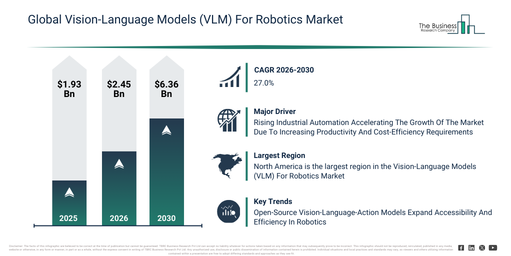
The vision-language models (vlm) for robotics market has experienced substantial expansion in recent years. Projections indicate its value will increase from $1.93 billion in 2025 to reach $2.45 billion by 2026, demonstrating a compound annual growth rate (CAGR) of 26.7%. Historical growth for this market stemmed from factors such as increased industrial robotics adoption, the expansion of machine vision systems, a surge in robotic automation projects, enhancements in robot sensors, and a rise in warehouse robotics.
The vision-language models (vlm) for robotics market is projected to experience substantial growth over the coming years, with its valuation expected to reach $6.36 billion in 2030, progressing at a compound annual growth rate (CAGR) of 27.0%. The expansion during this forecast period can be attributed to the proliferation of autonomous robot fleets, increasing investments in AI-driven robotics, the development of service robotics, a higher demand for human-robot interaction, and the rise of edge AI robotics platforms. Key trends anticipated during this time include the advancement of multimodal robotic perception, an increase in vision-guided command execution, the broader application of language-driven robot control, the incorporation of scene understanding models, and the adoption of multimodal robotic training systems.
Get A Free Sample Report With In-Depth Market Insights:
Vision-Language Models (VLM) For Robotics Market Growth Factors Behind Sustained Expansion
The increasing demand for industrial automation is anticipated to propel the expansion of the vision-language models (VLM) for robotics market in the future. Industrial automation involves the application of advanced technologies such as robotics, artificial intelligence, and control systems to carry out manufacturing and production processes with minimal human involvement, thereby enhancing both efficiency and precision. This demand is escalating as manufacturers face ongoing pressure to elevate productivity while simultaneously decreasing operational expenditures. Automation systems facilitate quicker, more consistent production with reduced labor dependence, fewer errors, and improved utilization of equipment across high-volume and precision-focused industrial operations. As sectors increasingly adopt automation to boost output, robots outfitted with VLMs, capable of interpreting both visual inputs and linguistic instructions, become essential for adaptable, intelligent functioning within intricate industrial environments. For illustration, in September 2024, the International Federation of Robotics (IFR), a Germany-based non-profit organization, stated that approximately 4.28 million units were operational in factories worldwide, marking about a 10% year-on-year growth from the previous year. Consequently, the impetus from industrial automation demand is driving the growth of the vision-language models (VLM) for robotics market moving ahead.
Vision-Language Models (VLM) For Robotics Market Segment Trends And Revenue Contributors
The vision-language models (vlm) for robotics market covered in this report is segmented –
1) By Component: Software; Hardware; Services
2) By Deployment Mode: On Premises; Cloud; Other Deployment Modes
3) By Application: Industrial Robotics; Service Robotics; Autonomous Vehicles; Healthcare Robotics; Consumer Robotics; Other Applications
4) By End User: Manufacturing; Healthcare; Automotive; Retail; Logistics; Defense; Other End Users
Subsegments:
1) By Software: Vision Language Model Platforms; Perception And Scene Understanding Software; Natural Language Processing (NLP) Software; Robotics Operating System (ROS) Integration Software; Simulation And Training Software
2) By Hardware: Cameras And Vision Sensors; Microphones And Audio Sensors; Edge Computing Processors; Graphics Processing Units (GPU); Robotic Controllers
3) By Services: System Integration Services; Model Training And Customization Services; Maintenance And Support Services; Consulting Services; Training And Education Services
Vision-Language Models (VLM) For Robotics Market Industry Trends Fueling Future Revenue Growth
Companies operating in the vision-language models (VLM) for robotics market are concentrating on developing advanced solutions, such as lightweight open-source vision-language-action models, to improve accessibility and performance in robotic perception and control. These vision-language-action models integrate visual inputs, natural language understanding, and action prediction within a unified framework, enabling robots to interpret their environment and execute complex tasks autonomously. For instance, in June 2025, Hugging Face, a US-based AI company, introduced SmolVLA, a compact open-source Vision-Language-Action model specifically designed for robotics that operates efficiently on consumer hardware while delivering performance comparable to much larger models. SmolVLA features a modular architecture, incorporating a lightweight SmolVLM-2 vision-language backbone and a transformer-based Action Expert that predicts robot actions based on perceptual inputs and instructions. Its design reduces visual tokens for faster inference, utilizes layer skipping and interlaced attention for efficient multimodal processing, and supports asynchronous inference to enable action prediction during task execution, all of which contribute to controlling computational load and democratizing access to VLA technology for robotics developers and researchers.
Vision-Language Models (VLM) For Robotics Market Competitive Landscape: Who Leads The Industry?
Major companies operating in the vision-language models (vlm) for robotics market are Amazon.com Inc., Google LLC, Microsoft Corporation, Huawei Technologies Co. Ltd., Tesla Inc., Siemens AG, IBM Research, Meta Platforms Inc., ABB Ltd., NVIDIA Corporation, Samsung Electronics Co. Ltd., Intel Corporation, Baidu Inc., SenseTime, OpenAI LLC, Skild AI, 1X Technologies LLC, Agility Robotics, Covariant, and Preferred Networks.
View The Full Vision-Language Models (VLM) For Robotics Market Report:
Vision-Language Models (VLM) For Robotics Market Geographic Landscape: Which Region Dominates Industry Growth?
North America was the largest region in the vision-language models (VLM) for robotics market in 2025. Asia-Pacific is expected to be the fastest-growing region in the forecast period. The regions covered in the vision-language models (vlm) for robotics market report are Asia-Pacific, South East Asia, Western Europe, Eastern Europe, North America, South America, Middle East, Africa.
Reach Out To Our Team:
The Business Research Company: https://www.thebusinessresearchcompany.com/
Americas: +1 310-496-7795
Asia: +44 7882 955267 & +91 8897263534
Europe: +44 7882 955267
Email us at: marketing@tbrc.info
Follow us on:
LinkedIn: https://in.linkedin.com/company/the-business-research-company
YouTube: https://www.youtube.com/channel/UC24_fI0rV8cR5DxlCpgmyFQ
Global Market Model: https://www.thebusinessresearchcompany.com/global-market-model