Cell Culture Media Ingredients Market Forecast Highlights A $4.81 Billion Opportunity For Industry Participants
Built to provide research that’s more actionable and strategically valuable, The Business Research Company’s 2026 market reports include market attractiveness analysis, total addressable market sizing, company benchmarking matrices, interactive Excel dashboards, broader supply chain intelligence, emerging startup tracking, and in-depth product insights.
Cell Culture Media Ingredients Market Value Analysis: What Growth Lies Ahead Over The Forecast Period?
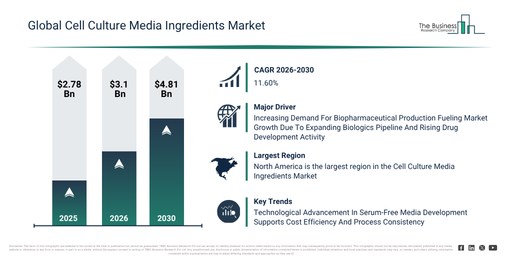
The cell culture media ingredients market size has seen rapid expansion in recent years. It is forecast to grow from $2. 78 billion in 2025 to $3. 1 billion in 2026, exhibiting a compound annual growth rate (CAGR) of 11. 4%. The historical increase in this market can be ascribed to factors such as the rising adoption of cell culture techniques in research, heightened demand in biopharmaceutical manufacturing, the broadening of vaccine development programs, increased academic and clinical research activities, and the proliferation of contract research organizations.
The cell culture media ingredients market is expected to demonstrate substantial expansion over the next few years. It is forecast to grow to $4.81 billion by 2030, achieving a compound annual growth rate (CAGR) of 11.6%. This anticipated growth during the forecast period can be attributed to several factors, including the increasing number of cell and gene therapy pipelines, a rising need for personalized medicine, expanded use of recombinant proteins and growth factors, the adoption of single-use bioprocessing technologies, and advancements in optimized and custom media formulations. Major trends for this period are expected to include the widespread adoption of serum-free and chemically defined media, the expansion of single-use bioprocessing systems, a growing demand for contamination-free aseptic processing, the rise of high-throughput cell culture screening platforms, and the increasing embrace of 3D cell culture and organoid systems.
Get A Free Sample Report With In-Depth Market Insights:
Cell Culture Media Ingredients Market Growth Drivers: What’s Behind The Acceleration?
The growth of the cell culture media ingredients market is significantly propelled by the increasing demand for biopharmaceutical production. This type of production involves the large-scale manufacturing of biologic-based medicines, including monoclonal antibodies, vaccines, and cell and gene therapies, by utilizing living cells. The rising demand is attributed to the rapid expansion of biologics pipelines, which require advanced cell culture systems for both their development and manufacturing. Cell culture media ingredients are essential for these processes, supplying critical nutrients, growth factors, and supplements necessary for optimal cell growth, viability, and productivity. For instance, in December 2024, according to the International Federation of Pharmaceutical Manufacturers & Associations, a Switzerland-based global industry association, over 12,700 medicines are in various stages of clinical development globally, with approximately half classified as biologics. This expanding pipeline is expected to heighten manufacturing demand, with around 700 new medicines projected to be launched by 2035. Therefore, the increasing demand for biopharmaceutical production is driving the growth of the cell culture media ingredients market.
Cell Culture Media Ingredients Market Segment Analysis Spotlighting Growth Areas
The cell culture media ingredients market covered in this report is segmented –
1) By Type: Amino Acids, Vitamins, Sugars, Salts, Buffers, Other Types
2) By Form: Liquid, Powder
3) By Application: Biopharmaceutical Production, Vaccine Production, Drug Discovery And Development, Regenerative Medicine, Cell And Gene Therapy, Diagnostics, Toxicology Testing, Other Applications
4) By End Users: Biotechnology Companies, Pharmaceutical Companies, Academic And Research Institutes, Contract Research Organizations
Subsegments:
1) By Amino Acids: Essential Amino Acids, Non Essential Amino Acids, Conditionally Essential Amino Acids, Branched Chain Amino Acids
2) By Vitamins: Fat Soluble Vitamins, Water Soluble Vitamins, Vitamin B Complex, Vitamin C
3) By Sugars: Monosaccharides, Disaccharides, Polysaccharides, Sugar Alcohols
4) By Salts: Inorganic Salts, Organic Salts, Trace Element Salts, Balanced Salt Solutions
5) By Buffers: Phosphate Buffers, Bicarbonate Buffers, Organic Buffers, Zwitterionic Buffers
6) By Other Types: Growth Factors, Hormones, Lipids, Proteins, Serum Additives
Cell Culture Media Ingredients Market Trends: What’s Defining The Industry’s Next Phase?
Leading firms within the cell culture media ingredients market are prioritizing technological innovations in the creation of serum-free media, including products like efficient-pro medium (+) insulin, with the goal of enhancing production efficiency, minimizing variability, and decreasing reliance on components sourced from animals. Specifically, Efficient-Pro Medium (+) Insulin is characterized as an advanced serum-free and animal-origin-free cell culture medium. It incorporates vital nutrients and growth-promoting elements, notably insulin, directly into its composition to boost cell growth and protein output, thereby removing the requirement for additional external supplements. An illustrative example is the launch of Gibco Efficient-Pro Medium (+) Insulin by Thermo Fisher Scientific, a life sciences company based in the US, in September 2025. This product offers an increase of up to 61% in protein titers, facilitates high viable cell densities with dependable quality, and features sophisticated granulation technology to ensure quick reconstitution and scalability, rendering it exceptionally well-suited for biopharmaceutical manufacturing processes.
Cell Culture Media Ingredients Market Company Landscape And Competitive Strategy
Major companies operating in the cell culture media ingredients market are Thermo Fisher Scientific Inc., Merck KGaA, FUJIFILM Wako Pure Chemical Corporation, Danaher Corporation, GE Healthcare Life Sciences (Cytiva), Becton Dickinson and Company, Corning Incorporated, Lonza Group AG, Avantor Inc., Agilent Technologies Inc., Sartorius AG, Bio-Rad Laboratories Inc., STEMCELL Technologies Inc., Miltenyi Biotec B. V. & Co. KG, Takara Bio Inc., Imperial Life Sciences Pvt. Ltd., PromoCell GmbH, BioLamina AB, Equitech-Bio Inc., Axol Bioscience Ltd., Nucleus Biologics LLC, Plant Cell Technology Inc., Cell Applications Inc.
View The Full Cell Culture Media Ingredients Market Report:
Cell Culture Media Ingredients Market Largest Region: Which Geography Holds The Highest Market Share?
North America was the largest region in the cell culture media ingredients market in 2025. Asia-Pacific is expected to be the fastest-growing region in the forecast period. The regions covered in the cell culture media ingredients market report are Asia-Pacific, South East Asia, Western Europe, Eastern Europe, North America, South America, Middle East and Africa.
Reach Out To Our Team:
The Business Research Company: https://www.thebusinessresearchcompany.com/
Americas: +1 310-496-7795
Asia: +44 7882 955267 & +91 8897263534
Europe: +44 7882 955267
Email us at: marketing@tbrc.info
Follow us on:
LinkedIn: https://in.linkedin.com/company/the-business-research-company
YouTube: https://www.youtube.com/channel/UC24_fI0rV8cR5DxlCpgmyFQ
Global Market Model: https://www.thebusinessresearchcompany.com/global-market-model