Intra-Uterine Contraceptive Devices Market Forecast To Reach $4.78 Billion By 2030: Key Growth Drivers And Industry Trends
Built to provide research that’s more actionable and strategically valuable, The Business Research Company’s 2026 market reports include market attractiveness analysis, total addressable market sizing, company benchmarking matrices, interactive Excel dashboards, broader supply chain intelligence, emerging startup tracking, and in-depth product insights.
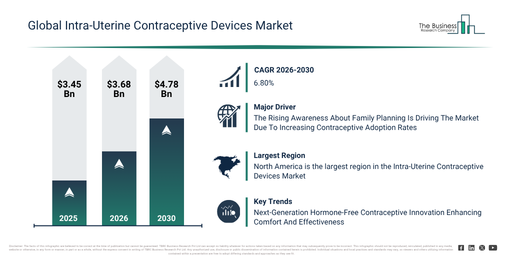
Intra-Uterine Contraceptive Devices Market Forecast: Value Set To Climb From $3.68 Billion To $4.78 Billion
The intra-uterine contraceptive devices market has experienced substantial growth in recent years. It is forecast to expand from $3. 45 billion in 2025 to $3. 68 billion in 2026, exhibiting a compound annual growth rate (CAGR) of 6. 5%. This historical development can be ascribed to increased public knowledge of family planning and the adoption of contraception, government-backed programs for population control and reproductive health, enhanced access to gynecology clinics and maternal healthcare services, improvements in healthcare infrastructure within developing regions, and an increasing preference for long-acting reversible contraceptive methods.
The intra-uterine contraceptive devices market is projected to experience robust expansion over the coming years, reaching $4.78 billion by 2030, demonstrating a compound annual growth rate (CAGR) of 6.8%. This anticipated growth is driven by several factors, including a rising preference for minimally invasive and user-independent contraceptive methods, the proliferation of women-focused healthcare awareness initiatives, the increasing use of advanced hormonal and bioactive intrauterine systems, a global emphasis on lowering unintended pregnancy rates, and ongoing advancements in biocompatible and drug-eluting device technologies. Key trends expected during this period involve robotic assistance for intrauterine device insertions, automation in contraceptive manufacturing powered by Industry 4.0, IoT-enabled smart tracking and inventory management for medical devices, blockchain systems ensuring traceability in the contraceptive supply chain, and mobile reproductive healthcare outreach services facilitated by electric mobility.
Get A Free Sample Report With In-Depth Market Insights:
Intra-Uterine Contraceptive Devices Market Opportunity Drivers: What’s Unlocking New Revenue Potential?
Increased understanding of family planning is anticipated to boost the expansion of the intra-uterine contraceptive devices market in the future. This awareness refers to individuals’ and couples’ comprehension and insight regarding managing the quantity and timing of their offspring via contraceptive approaches. The growth in family planning awareness stems from widespread public health education initiatives advocating for reproductive well-being and educated decisions on contraception. Intrauterine contraceptive devices enhance family planning efforts by providing durable, dependable, and reversible birth control, which aids in effective pregnancy scheduling and spacing between births. For example, data from July 2025, in a report by the World Health Organization (WHO), a Switzerland-based United Nations (UN) organization, indicated that around 874 million women globally used modern contraceptive methods in 2025. Additionally, an estimated 70 million more women are projected to access family planning services by 2030, showcasing ongoing growth in reproductive healthcare access and usage. Consequently, the increased understanding of family planning is fueling the expansion of the intra-uterine contraceptive device market.
Intra-Uterine Contraceptive Devices Market Breakdown By Product Type And Application
The intra-uterine contraceptive devices market covered in this report is segmented –
1) By Product Type: Copper Intrauterine Devices, Hormonal Intrauterine Devices, Bioactive Intrauterine Devices
2) By Age Group: Fifteen To Twenty Four Years, Twenty Five To Thirty Four Years, Thirty Five To Forty Four Years, Above Forty Four Years
3) By Distribution Channel: Direct Sales, Online Retail, Wholesale
4) By Application: Contraception, Treatment Of Menorrhagia, Endometrial Protection
5) By End User: Hospitals, Gynecology Clinics, Community Healthcare, Other End Users
Subsegments:
1) By Copper Intrauterine Devices: Copper T Shaped Devices, Copper Multiload Devices, Copper Frameless Devices
2) By Hormonal Intrauterine Devices: Levonorgestrel Releasing Devices, Low Dose Hormonal Devices, High Dose Hormonal Devices
3) By Bioactive Intrauterine Devices: Silver Ion Releasing Devices, Gold Ion Coated Devices, Drug Eluting Bioactive Devices
Intra-Uterine Contraceptive Devices Market Innovation Trends Shaping Future Development
Leading companies operating within the intra-uterine contraceptive devices market are focusing on developing innovative products, such as hormone-free intrauterine systems, to enhance patient comfort and expand non-hormonal contraceptive choices. A hormone-free intrauterine system is a long-acting contraceptive device placed in the uterus that prevents pregnancy using non-hormonal materials, typically copper, to create a spermicidal intrauterine environment. For instance, in February 2025, Sebela Pharmaceuticals Inc., a US-based pharmaceutical company specializing in gastroenterology and women’s health, announced U. S. Food and Drug Administration approval of MIUDELLA. The product utilizes a flexible nitinol frame with a lower copper dose while maintaining high contraceptive effectiveness, supported by a preloaded delivery system designed for ease of insertion. Its introduction is significant as it represents the first hormone-free intrauterine device approval in over four decades in the United States, highlighting renewed innovation in non-hormonal contraceptive technologies.
Intra-Uterine Contraceptive Devices Market Key Participants And Competitive Landscape
Major companies operating in the intra-uterine contraceptive devices market are AbbVie Inc., Bayer AG, Meril Life Sciences Pvt. Ltd., CooperSurgical Inc., Sebela Pharmaceuticals Inc., DKT International Inc., HRA Pharma Inc., Pregna International Limited, Egemen International, Zhejiang Daji Medical Instruments Co. Ltd., Medicines360, SMB Corporation of India, HLL Lifecare Limited, Injeflex Ind And Com Ltda, Gynocare Services Pvt Ltd., Aetos Pharma Pvt Ltd., Eurogine S. L., Mona Lisa N. V., Ocon Medical Ltd., Prosan International B. V.
View The Full Intra-Uterine Contraceptive Devices Market Report:
Intra-Uterine Contraceptive Devices Market Geographic Analysis: Where Is Demand Accelerating Fastest?
North America was the largest region in the intra-uterine contraceptive devices market in 2025. Asia-Pacific is expected to be the fastest-growing region in the forecast period. The regions covered in the intra-uterine contraceptive devices market report are Asia-Pacific, South East Asia, Western Europe, Eastern Europe, North America, South America, Middle East and Africa.
Reach Out To Our Team:
The Business Research Company: https://www.thebusinessresearchcompany.com/
Americas: +1 310-496-7795
Asia: +44 7882 955267 & +91 8897263534
Europe: +44 7882 955267
Email us at: marketing@tbrc.info
Follow us on:
LinkedIn: https://in.linkedin.com/company/the-business-research-company
YouTube: https://www.youtube.com/channel/UC24_fI0rV8cR5DxlCpgmyFQ
Global Market Model: https://www.thebusinessresearchcompany.com/global-market-model