Nerve Repair Biomaterials Market Growth Potential: What The Latest Forecast Reveals
Built to provide research that’s more actionable and strategically valuable, The Business Research Company’s 2026 market reports include market attractiveness analysis, total addressable market sizing, company benchmarking matrices, interactive Excel dashboards, broader supply chain intelligence, emerging startup tracking, and in-depth product insights.
Nerve Repair Biomaterials Market CAGR Outlook And Future Development
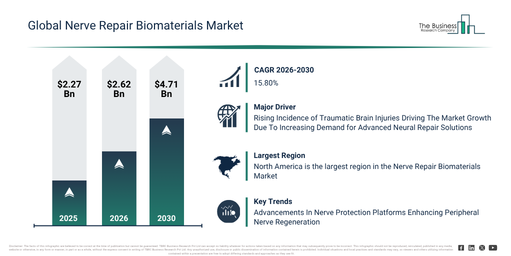
The market for nerve repair biomaterials has experienced substantial growth in recent years. It will grow from $2. 27 billion in 2025 to $2. 62 billion in 2026 at a compound annual growth rate (CAGR) of 15. 6%. This historical expansion can be attributed to the limited effectiveness of autograft nerve repair techniques, the high incidence of traumatic nerve injuries, the lack of advanced biomaterial scaffolds for nerve regeneration, the slow clinical translation of experimental nerve repair solutions, and the high complication rates in traditional nerve graft procedures.
The nerve repair biomaterials market is projected to experience significant expansion over the coming years, anticipated to reach $4.71 billion by 2030, exhibiting a compound annual growth rate (CAGR) of 15.8%. Factors contributing to this growth during the forecast period include progress in regenerative medicine and tissue engineering, an increasing need for less invasive nerve repair techniques, wider uptake of bioengineered and customized implants, an increase in clinical trials for advanced nerve conduits, and the rising incorporation of intelligent biomaterials with bioactive compounds. Key trends expected in this period encompass electrospun nanofiber scaffold designs that facilitate guided axonal regeneration, bioresorbable polymer nerve conduits offering regulated degradation characteristics, hydrogel-based nerve guidance matrices improving cellular migration and repair, biomaterial systems infused with growth factors for faster nerve healing, and stem cell-seeded bioengineered nerve graft scaffolds designed for functional restoration.
Get A Free Sample Report With In-Depth Market Insights:
Nerve Repair Biomaterials Market Expansion Drivers: What’s Shaping Future Growth?
The expanding occurrence of traumatic brain injuries is projected to accelerate the growth of the nerve repair biomaterials market moving forward. Traumatic brain injuries (TBIs) represent a form of acquired brain damage resulting from an external mechanical force that disrupts normal brain function. The increasing prevalence of TBIs is largely attributable to the aging global population, given that older adults are considerably more prone to falls, which stand as the primary cause of TBI, consequently leading to a steady rise in injury-related hospitalizations and fatalities across developed nations. This escalating incidence of TBIs heightens the necessity for advanced nerve repair biomaterials capable of facilitating nerve regeneration, bridging damaged neural tissue, and restoring functional connectivity in affected patients. For example, data from September 2025, provided by the South Dakota Department of Health, a US-based government health agency, indicated that TBI-related deaths in the state climbed from 241 in 2023 to 267 in 2024, signifying an 11% increase. Therefore, the growing incidence of traumatic brain injuries is a key factor propelling the expansion of the nerve repair biomaterials market. The increasing preference for minimally invasive surgical procedures is anticipated to fuel the expansion of the nerve repair biomaterials market moving forward. Minimally invasive surgical procedures involve techniques where surgeons operate through small incisions or natural body openings, resulting in less trauma to surrounding tissues compared to conventional open surgery. The rising adoption of these procedures is primarily driven by advancements in surgical robotics and imaging technologies, which have broadened the spectrum of complex operations achievable with enhanced precision and minimal tissue disruption. This growing demand for minimally invasive surgery directly elevates the need for nerve repair biomaterials capable of supporting delicate nerve repair within restricted surgical spaces, as surgeons require materials compatible with these less intrusive approaches. For instance, in April 2025, the British Association of Aesthetic Plastic Surgeons, a UK-based surgical organization, reported that cosmetic surgical procedures saw a 5% increase between 2023 and 2024, totaling 27,462 procedures performed in 2024. Consequently, the rising preference for minimally invasive surgical procedures is stimulating the growth of the nerve repair biomaterials market.
Nerve Repair Biomaterials Market Segmentation: How Does The Market Break Down By Category?
The nerve repair biomaterials market covered in this report is segmented –
1) By Product Type: Nerve Conduits, Nerve Wraps, Nerve Guides, Nerve Plates, Nerve Grafts
2) By Material Type: Natural Biomaterials, Synthetic Biomaterials, Composite Biomaterials
3) By Application: Peripheral Nerve Repair, Central Nerve Repair, Spinal Cord Injury Repair, Facial Nerve Repair
4) By End User: Hospitals, Specialty Clinics, Ambulatory Surgical Centers, Research Laboratories
Subsegments:
1) By Nerve Conduits: Natural Biomaterial Based Nerve Conduits, Synthetic Biomaterial Based Nerve Conduits, Hybrid Biomaterial Based Nerve Conduits
2) By Nerve Wraps: Collagen Based Nerve Wraps, Synthetic Polymer Based Nerve Wraps, Amniotic Membrane Based Nerve Wraps
3) By Nerve Guides: Biodegradable Nerve Guides, Non Biodegradable Nerve Guides, Electrospun Fiber Based Nerve Guides
4) By Nerve Plates: Resorbable Nerve Plates, Non Resorbable Nerve Plates, Polymer Based Nerve Plates
5) By Nerve Grafts: Autograft Nerve Grafts, Allograft Nerve Grafts, Xenograft Nerve Grafts, Synthetic Nerve Grafts
Nerve Repair Biomaterials Market Strategic Trends: What Defines The Next Growth Phase?
Leading companies in the nerve repair biomaterials market are concentrating on developing sophisticated products, such as nerve protection platforms, to improve axonal regeneration, minimize tissue adhesion, and enhance functional recovery after peripheral nerve injuries. A nerve protection platform broadly encompasses technologies or therapeutic approaches designed to preserve nerve function, prevent damage, and support recovery through protective, regenerative, or advanced delivery methods. For instance, in September 2023, Axogen, Inc., a US-based peripheral nerve repair company, launched Axoguard HA+ Nerve Protector. This product is a porcine submucosa extracellular matrix-based nerve wrap, coated with a proprietary hyaluronate-alginate gel. The nerve protection platform facilitates enhanced nerve gliding to reduce soft tissue attachments, provides long-term structural protection by remodeling into a stable tissue layer, and offers optimized handling for surgeons treating complex nerve injuries near high-mobility joints, thereby expanding clinical options for peripheral nerve protection and regeneration.
Nerve Repair Biomaterials Market Key Players Shaping Industry Direction
Major companies operating in the nerve repair biomaterials market are Medtronic plc, Stryker Corporation, Boston Scientific Corporation, Baxter International Inc., B. Braun SE, Toyobo Co. Ltd., Integra LifeSciences Holdings Corporation, Taibang Biologic Group Co. Ltd., Axogen Inc., PolyNovo Limited, Tissium SA, Checkpoint Surgical Inc., Synapse Biomedical Inc., Collagen Matrix Inc., BioCircuit Technologies Inc., Orthocell Limited, Alafair Biosciences Inc., Regenity AG, Neurotex Ltd, NeuroSigma Inc., TissueGen Inc.
View The Full Nerve Repair Biomaterials Market Report:
Nerve Repair Biomaterials Market Regional Analysis: Which Region Leads By Revenue?
North America was the largest region in the nerve repair biomaterials market in 2025. Asia-Pacific is expected to be the fastest-growing region in the forecast period. The regions covered in the nerve repair biomaterials market report are Asia-Pacific, South East Asia, Western Europe, Eastern Europe, North America, South America, Middle East and Africa.
Reach Out To Our Team:
The Business Research Company: https://www.thebusinessresearchcompany.com/
Americas: +1 310-496-7795
Asia: +44 7882 955267 & +91 8897263534
Europe: +44 7882 955267
Email us at: marketing@tbrc.info
Follow us on:
LinkedIn: https://in.linkedin.com/company/the-business-research-company
YouTube: https://www.youtube.com/channel/UC24_fI0rV8cR5DxlCpgmyFQ
Global Market Model: https://www.thebusinessresearchcompany.com/global-market-model
[KClientError] [REQ_ERR: OPERATION_TIMEDOUT] [KTrafficClient] Something is wrong.