Pancreatic Stone Protein Testing Market Analysis: $1.31 Billion Market Size In 2026 And Future Growth Prospects
Featuring market attractiveness scoring, total addressable market sizing, company benchmarking matrices, interactive Excel dashboards, deeper supply chain intelligence, emerging startup tracking, and granular product-level insights, The Business Research Company’s 2026 market reports are built to deliver research that is both more actionable and more strategically valuable.
Pancreatic Stone Protein Testing Market Growth Potential: How Will Market Size Shift Through 2030?
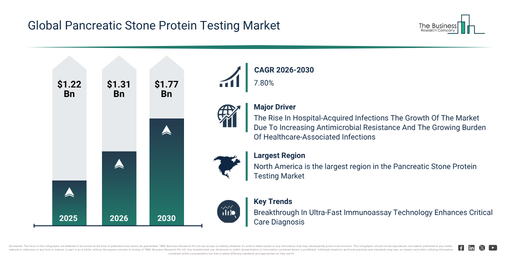
The pancreatic stone protein testing market has experienced robust growth in recent years. It is projected to expand from $1. 22 billion in 2025 to $1. 31 billion in 2026, demonstrating a compound annual growth rate (CAGR) of 7. 5%. The historical market expansion can be attributed to the increasing incidence of sepsis and critical care conditions, rising awareness of early disease biomarker testing, the expansion of hospital laboratory infrastructure, growth in immunoassay diagnostic adoption, and increasing clinical research on pancreatic and inflammatory biomarkers.
The pancreatic stone protein testing market is projected to experience substantial expansion in the coming years, with its size expected to reach $1.77 billion by 2030, exhibiting a compound annual growth rate (CAGR) of 7.8%. This anticipated growth is linked to factors such as an increasing need for early sepsis detection tools, greater adoption of point-of-care diagnostic testing, advancements in precision medicine and biomarker-based diagnostics, the expansion of automated laboratory systems, and rising investment in critical care diagnostic innovation. Key trends during this period are expected to involve the growing acceptance of pancreatic stone protein testing as an initial biomarker for sepsis and systemic inflammation detection, a rise in immunoassay-based diagnostic platforms for rapid PSP quantification, the wider integration of PSP testing into critical care and emergency diagnostics workflows, the development of point-of-care testing devices enabling faster PSP measurement in hospitals, and an increasing preference for multiplex biomarker panels that merge PSP with other inflammatory indicators.
Get A Free Sample Report With In-Depth Market Insights:
Pancreatic Stone Protein Testing Market Growth Momentum: What Factors Are Shaping Demand?
The increasing occurrence of hospital-acquired infections (HAIs) is anticipated to boost the growth of the pancreatic stone protein testing market in the future. Hospital-acquired infections are defined as infections a patient contracts while receiving medical care in a hospital or healthcare facility, which were not present at the time of their admission. The escalating incidence of these infections is largely propelled by rising antimicrobial resistance, where microorganisms develop the ability to withstand common antibiotics, making infections more difficult to treat and control in healthcare environments. Pancreatic stone protein testing assists in combating hospital-acquired infections by enabling the early detection of infection and sepsis risk, which allows for timely intervention and improved patient management within hospital settings. For instance, in November 2024, data from the Australian Institute of Health and Welfare, an Australia-based government agency, showed that hospital-acquired complications (HACs) were recorded in 115,000 public hospitalizations (2.0%) and 34,200 private hospitalizations (0.8%) during 2022–23, with healthcare-associated infections representing the largest share (37%), followed by delirium (13%) and cardiac complications (12%). Thus, the growing incidence of hospital-acquired infections is a significant factor driving the expansion of the pancreatic stone protein testing market.
Pancreatic Stone Protein Testing Market Segment Trends And Revenue Contributors
The pancreatic stone protein testing market covered in this report is segmented –
1) By Product Type: Assay Kits, Instruments, Reagents, Other Product Types
2) By Technology: Immunoassay Based Testing, Enzyme-Linked Immunosorbent Assay Based Testing, Rapid Diagnostic Technologies, Other Technologies
3) By Sample Type: Blood, Serum, Plasma, Other Sample Types
4) By Application: Sepsis Diagnosis, Pancreatitis Diagnosis, Other Applications
5) By End User: Hospitals, Diagnostic Laboratories, Research Institutes, Other End Users
Subsegments:
1) By Assay Kits: Enzyme Linked Immunosorbent Assay Kits, Chemiluminescence Immunoassay Kits, Fluorescence Immunoassay Kits, Rapid Diagnostic Test Kits, Multiplex Assay Kits
2) By Instruments: Immunoassay Analyzers, Clinical Chemistry Analyzers, Automated Laboratory Analyzers, Point Of Care Testing Devices, Microplate Readers
3) By Reagents: Antibodies, Calibrators, Controls, Buffers, Substrates
4) By Other Product Types: Sample Collection Kits, Quality Control Materials, Diagnostic Consumables, Laboratory Accessories, Data Management Software
Pancreatic Stone Protein Testing Market Trends Redefining Industry Growth
Leading companies in the pancreatic stone protein testing market are concentrating on developing innovative platforms, such as ultra-rapid point-of-care immunoassay platforms, to enable prompt and accurate sepsis detection, enhance the speed of clinical decision-making, and decrease patient mortality in critical care environments. These ultra-rapid point-of-care immunoassay platforms represent diagnostic systems engineered to swiftly detect specific biomarkers in a patient’s sample at or near the bedside via antibody-based reactions, delivering results within minutes rather than hours or days. For example, in October 2024, Abionic SA, a Switzerland-based in vitro diagnostics company, secured approval from the U. S. Food and Drug Administration (FDA) for its IVD CAPSULE Pancreatic Stone Protein (PSP) test. This test is specifically designed for rapid, near-patient detection of PSP levels, thereby allowing for the early identification of sepsis in critically ill patients. It operates on ultra-rapid point-of-care immunoassay platforms, which enable biomarker detection at the bedside through antibody-based reactions, with results provided in minutes.
Pancreatic Stone Protein Testing Market Competitive Landscape: Which Companies Lead The Industry?
Major companies operating in the pancreatic stone protein testing market are Cusabio Technology Llc, Fapon Biotech Inc, BioVendor Laboratorní medicína a. s, RayBiotech Life Inc, Creative Diagnostics Inc, Abnova Corporation, Abionic SA, LASCCO SA, Abbexa Ltd
View The Full Pancreatic Stone Protein Testing Market Report:
Pancreatic Stone Protein Testing Market Regional Breakdown: Where Is Demand Concentrated?
North America was the largest region in the pancreatic stone protein testing market in 2025. Asia-Pacific is expected to be the fastest-growing region in the forecast period. The regions covered in the pancreatic stone protein testing market report are Asia-Pacific, South East Asia, Western Europe, Eastern Europe, North America, South America, Middle East and Africa.
Reach Out To Our Team:
The Business Research Company: https://www.thebusinessresearchcompany.com/
Americas: +1 310-496-7795
Asia: +44 7882 955267 & +91 8897263534
Europe: +44 7882 955267
Email us at: marketing@tbrc.info
Follow us on:
LinkedIn: https://in.linkedin.com/company/the-business-research-company
YouTube: https://www.youtube.com/channel/UC24_fI0rV8cR5DxlCpgmyFQ
Global Market Model: https://www.thebusinessresearchcompany.com/global-market-model