Artificial Intelligence (AI) Protein Structure Prediction Market Size Reaches $2.33 Billion In 2026: What Is Driving Growth?
Featuring market attractiveness scoring, total addressable market sizing, company benchmarking matrices, interactive Excel dashboards, deeper supply chain intelligence, emerging startup tracking, and granular product-level insights, The Business Research Company’s 2026 market reports are built to deliver research that is both more actionable and more strategically valuable.
Artificial Intelligence (AI) Protein Structure Prediction Market Poised To Hit $6.62 Billion By 2030 With A 29.8% CAGR
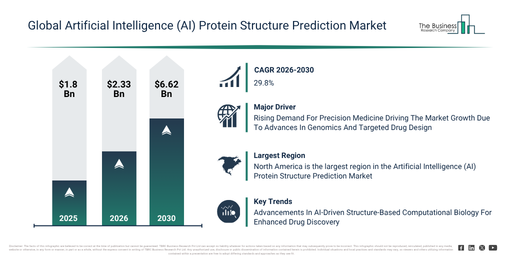
The artificial intelligence (AI) protein structure prediction market size has seen significant expansion in recent years. It is anticipated to increase from $1.8 billion in 2025 to $2.33 billion in 2026, achieving a compound annual growth rate (CAGR) of 29.6%. The historical growth of this market can be attributed to the expansion of genomic and proteomic research, the uptake of AI-based bioinformatics tools, a rise in drug discovery initiatives, the increasing adoption of computational biology applications, and the proliferation of academic and research institutes.
The artificial intelligence (AI) protein structure prediction market is projected to experience substantial expansion over the coming years. By 2030, this market is anticipated to reach a valuation of $6.62 billion, exhibiting a compound annual growth rate (CAGR) of 29.8%. This projected increase is driven by several factors, including the rising need for personalized medicine, greater adoption of cloud and hybrid infrastructures, an increasing emphasis on AI-powered disease diagnosis, the expanding scope of biotechnology and pharmaceutical research and development, and the utilization of high-throughput protein analysis platforms. Key developments expected during this period involve a surge in the deployment of cloud-enabled protein prediction platforms, an escalating requirement for high-performance computing solutions, enhanced integration of molecular modeling and simulation software, the broadening of bioinformatics workflows and data management tools, and a heightened focus on consulting, implementation, and managed services.
Get A Free Sample Report With In-Depth Market Insights:
Artificial Intelligence (AI) Protein Structure Prediction Market Growth Factors: What’s Supporting Expansion?
The increasing need for precision medicine is projected to fuel the expansion of the artificial intelligence (AI) protein structure prediction market in the future. Precision medicine centers on customizing disease prevention and treatment according to an individual’s genetic makeup, environmental influences, and lifestyle choices. Its increasing acceptance stems from breakthroughs in genomic technologies, which allow for the identification of molecular targets relevant to diseases and genetic variations specific to patients. With precision medicine progressively depending on structure-based drug discovery and insights at the molecular level, AI protein structure prediction tools are vital for quickly identifying the three-dimensional structures of therapeutically significant proteins and evaluating how genetic variations affect protein function. For example, in February 2024, data from the Personalized Medicine Coalition, a US-based non-profit organization, showed that in 2023 the US Food and Drug Administration cleared 16 new personalized treatments for rare disease patients, an increase from six in 2022. Consequently, the expanding demand for precision medicine is boosting the development of the artificial intelligence (AI) protein structure prediction market.
Artificial Intelligence (AI) Protein Structure Prediction Market Segment Landscape: Which Areas Lead Development?
The artificial intelligence (AI) protein structure prediction market covered in this report is segmented –
1) By Component: Software, Hardware, Services
2) By Deployment Mode: On-Premise Systems, Hybrid Infrastructure, Cloud-Connected Hardware Platforms
3) By Organization Size: Large Enterprises, Small and Medium-Sized Enterprises
4) By Application: Drug Discovery, Disease Diagnosis, Personalized Medicine, Academic Research, Biotechnology, Other Applications
5) By End-User: Pharmaceutical and Biotechnology Companies, Academic and Research Institutes, Healthcare Providers, Other End Users
Subsegments:
1) By Software: Protein Structure Prediction Platforms, Molecular Modeling And Simulation Software, Sequence Analysis And Alignment Tools, Visualization And Structural Analysis Software, Data Management And Bioinformatics Workflow Software
2) By Hardware: High Performance Computing Systems, Graphics Processing Unit Based Computing Systems, Dedicated Bioinformatics Workstations, Data Storage And Memory Systems, Networking And Data Transfer Infrastructure
3) By Services: Consulting And Implementation Services, Cloud Infrastructure And Platform Services, Integration And Deployment Services, Maintenance And Technical Support Services, Training And Managed Services
Artificial Intelligence (AI) Protein Structure Prediction Market Industry Trends: What’s Reshaping Demand?
Major companies operating in the artificial intelligence (AI) protein structure prediction market are prioritizing the creation of innovative solutions, including structure-based computational biology platforms. These platforms aim to accelerate drug discovery, enable precise protein modeling, and enhance target identification through advanced molecular simulations and AI-driven structural analysis. A structure-based computational biology platform is defined as a digital system that utilizes three-dimensional protein structure data, molecular modeling, and simulation algorithms to examine biomolecular interactions, thereby supporting rational drug design and target validation. For example, in March 2024, Basecamp Research, a UK-based AI company, introduced BaseFold. This deep learning model significantly improves 3D protein structure prediction for large, complex proteins by enhancing AlphaFold2 with its unique BaseGraph dataset from global biodiversity sources, achieving up to 6-fold higher accuracy and 3-fold better small molecule docking. This advancement accelerates AI-driven drug discovery by allowing the accurate modeling of difficult protein structures that were previously scarce in public data.
Artificial Intelligence (AI) Protein Structure Prediction Market Competitive Analysis Of Leading Industry Participants
Major companies operating in the artificial intelligence (AI) protein structure prediction market are Schrödinger Inc., XtalPi Inc., Generate:Biomedicines Inc., Isomorphic Labs Limited, Recursion Pharmaceuticals Inc., Relay Therapeutics Inc., Arzeda Inc., BigHat Biosciences Inc., Levitate Bio Inc., Terray Therapeutics Inc., PostEra Inc., ProteinQure Inc., Genesis Therapeutics Inc., Profluent Bio Inc., Insitro Inc., Absci Corporation, Cyrus Biotechnology Inc., Cloud Pharmaceuticals Inc., Iambic Therapeutics Inc., Insilico Medicine Inc., Latent Labs, and Neoncorte Bio Inc.
View The Full Artificial Intelligence (AI) Protein Structure Prediction Market Report:
Artificial Intelligence (AI) Protein Structure Prediction Market Geographic Distribution And Regional Opportunities
North America was the largest region in the artificial intelligence (AI) protein structure prediction market in 2025. Asia-Pacific is expected to be the fastest-growing region in the forecast period. The regions covered in the artificial intelligence (AI) protein structure prediction market report are Asia-Pacific, South East Asia, Western Europe, Eastern Europe, North America, South America, Middle East, Africa.
Reach Out To Our Team:
The Business Research Company: https://www.thebusinessresearchcompany.com/
Americas: +1 310-496-7795
Asia: +44 7882 955267 & +91 8897263534
Europe: +44 7882 955267
Email us at: marketing@tbrc.info
Follow us on:
LinkedIn: https://in.linkedin.com/company/the-business-research-company
YouTube: https://www.youtube.com/channel/UC24_fI0rV8cR5DxlCpgmyFQ
Global Market Model: https://www.thebusinessresearchcompany.com/global-market-model