Artificial Intelligence In Neuromorphic Computing Market 2026: Market Size, Growth Drivers And Emerging Opportunities
Backed by market attractiveness analysis, total addressable market sizing, company benchmarking matrices, interactive Excel dashboards, wider supply chain intelligence, emerging startup coverage, and detailed product-level insights, The Business Research Company’s 2026 market reports are designed to offer research that is more actionable and strategically valuable than ever.
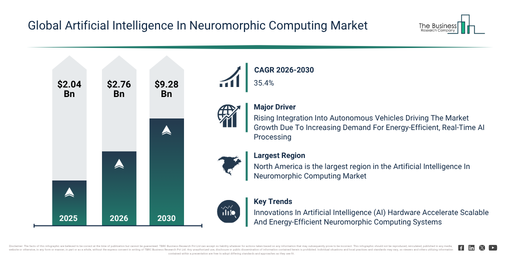
Artificial Intelligence In Neuromorphic Computing Market Set To Climb From $2.76 Billion In 2026 To $9.28 Billion By 2030
The artificial intelligence in neuromorphic computing market has seen significant expansion in recent years. It is anticipated to increase from $2.04 billion in 2025 to $2.76 billion in 2026, exhibiting a compound annual growth rate (CAGR) of 35.1%. The growth observed in prior periods can be attributed to heightened research in brain-inspired computing, a growing requirement for low-power AI hardware, increased integration into consumer electronics, the development of specialized neuromorphic boards, and a stronger emphasis on robotics and automation applications.
The market for artificial intelligence in neuromorphic computing is projected to experience substantial growth over the coming years. Its valuation is set to reach $9.28 billion by 2030, exhibiting a compound annual growth rate (CAGR) of 35.4%. This expansion during the projection period stems from heightened deployment in edge and cloud AI systems, a surge in demand from industrial manufacturing and robotics applications, greater integration within healthcare and life sciences, sectoral growth in aerospace and defense, and increased uptake by data centers and cloud service providers. Key trends anticipated for the forecast timeframe encompass wider acceptance of edge neuromorphic computing, burgeoning demand for spiking neural network hardware, enhanced integration of neuromorphic memory devices, the spread of hybrid computing deployment frameworks, and an escalating emphasis on AI-powered image and signal processing applications.
Get A Free Sample Report With In-Depth Market Insights:
Artificial Intelligence In Neuromorphic Computing Market Growth Momentum: What Factors Are Shaping Demand?
The increasing integration of autonomous vehicles is projected to boost the advancement of artificial intelligence within the neuromorphic computing market in the future. This integration involves embedding sophisticated AI-driven hardware and software systems directly into self-driving vehicle platforms to facilitate real-time sensing, decision-making, and operational management. The rapid pace of autonomous vehicle integration stems from the massive sensor data generated by these vehicles, which traditional GPU and CPU setups find challenging to process effectively under the power and latency limitations of in-vehicle systems, thus pushing the sector towards brain-inspired computing alternatives. The growing rollout of autonomous vehicles establishes a continuous demand for neuromorphic processors, given their capacity for event-driven, ultra-low-latency computations, allowing for instant reactions to changing road environments—a feat conventional architectures cannot achieve with comparable energy efficiency. For example, data from December 2024 by the National Highway Traffic Safety Administration, a US-based government agency, indicates that approximately 4.5 million self-driving vehicles are anticipated to be active on U.S. roads by 2030. Consequently, the expanding integration of autonomous vehicles is a key factor driving the expansion of artificial intelligence in the neuromorphic computing market.
Artificial Intelligence In Neuromorphic Computing Market Breakdown By Product Type And Application
The artificial intelligence in neuromorphic computing market covered in this report is segmented –
1) By Component: Hardware, Software, Services
2) By Technology Architecture: Digital Neuromorphic Processors, Analog Neuromorphic Processors, Mixed-Signal Neuromorphic Systems, Spiking Neural Network Hardware, Non-Spiking Artificial Neural Network Accelerators, Synaptic Transistor Arrays, Three-Dimensional Integrated Neuromorphic Systems
3) By Deployment Mode: Edge Computing, Cloud Computing, Hybrid Computing
4) By Application: Image Recognition, Signal Processing, Data Mining, Robotics, Edge Computing, Other Applications
5) By End-User Industry: Consumer Electronics, Automotive And Transportation, Industrial Manufacturing And Robotics, Healthcare And Life Sciences, Aerospace And Defense, Information Technology And Telecommunications, Data Centers And Cloud Service Providers, Research Institutions And Academia
Subsegments:
1) By Hardware: Neuromorphic Processors, Neuromorphic Memory Devices, Sensor Integrated Chips, Edge Artificial Intelligence Hardware, Neuromorphic Accelerators, Custom Neuromorphic Boards
2) By Software: Neuromorphic Algorithm Platforms, Spiking Neural Network Frameworks, Artificial Intelligence Model Development Tools, Simulation And Emulation Software, Data Training And Optimization Software, Middleware For Neuromorphic Systems
3) By Services: Consulting And Strategy Services, System Integration Services, Deployment And Implementation Services, Maintenance And Support Services, Training And Education Services, Managed Artificial Intelligence Services
Artificial Intelligence In Neuromorphic Computing Market Trends Redefining Industry Growth
Companies operating within the artificial intelligence in the neuromorphic computing market are concentrating on developing sophisticated artificial intelligence (AI)-driven hardware architectures, aiming to improve energy efficiency, scalability, and high-performance neural processing. These AI-driven hardware architectures are advanced computing frameworks specifically engineered to optimize the execution of AI algorithms through specialized processors, enhanced memory configurations, and high-performance parallel processing. For example, in April 2024, Intel Corporation, a US-based semiconductor manufacturing company, introduced its Hala Point, a neuromorphic system constructed using second-generation Loihi processors. Hala Point incorporates 1.15 billion neurons, supports scalable rack-level deployment, and delivers significant improvements in energy-efficient processing for large-scale artificial intelligence research. These capabilities strengthen high-performance neuromorphic experimentation and accelerate scalable system design.
Artificial Intelligence In Neuromorphic Computing Market Competitive Landscape: Which Companies Lead The Industry?
Major companies operating in the artificial intelligence in neuromorphic computing market are Samsung Electronics Co Ltd, International Business Machines Corporation, Intel Corporation, Qualcomm Incorporated, Hewlett Packard Enterprise Company, SK hynix Inc, Tower Semiconductor Ltd, Axelera AI BV, Rain Neuromorphics Inc, Prophesee SA, SynSense AG, Innatera Nanosystems BV, BrainChip Holdings Limited, General Vision Inc, Applied Brain Research Inc, Knowm Inc, Vivum Computing Inc, Blumind Inc, Numenta Inc, Aspirare Technologies Private Limited, and Grayscale AI Ltd.
View The Full Artificial Intelligence In Neuromorphic Computing Market Report:
Artificial Intelligence In Neuromorphic Computing Market Regional Breakdown: Where Is Demand Concentrated?
North America was the largest region in the artificial intelligence in neuromorphic computing market in 2025. Asia-Pacific is expected to be the fastest-growing region in the forecast period. The regions covered in the artificial intelligence in neuromorphic computing market report are Asia-Pacific, South East Asia, Western Europe, Eastern Europe, North America, South America, Middle East, Africa.
Reach Out To Our Team:
The Business Research Company: https://www.thebusinessresearchcompany.com/
Americas: +1 310-496-7795
Asia: +44 7882 955267 & +91 8897263534
Europe: +44 7882 955267
Email us at: marketing@tbrc.info
Follow us on:
LinkedIn: https://in.linkedin.com/company/the-business-research-company
YouTube: https://www.youtube.com/channel/UC24_fI0rV8cR5DxlCpgmyFQ
Global Market Model: https://www.thebusinessresearchcompany.com/global-market-model