Bio-Based Resins Market 2026 Market Size And Growth Forecast: Key Trends To Watch
Built to provide research that’s more actionable and strategically valuable, The Business Research Company’s 2026 market reports include market attractiveness analysis, total addressable market sizing, company benchmarking matrices, interactive Excel dashboards, broader supply chain intelligence, emerging startup tracking, and in-depth product insights.
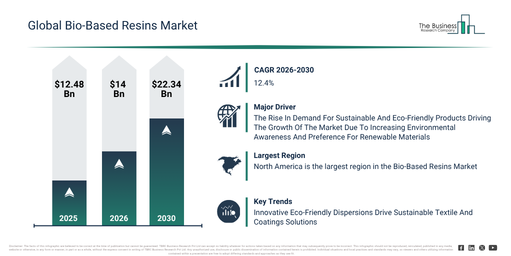
Bio-Based Resins Market Poised To Hit $22.34 Billion By 2030 With A 12.4% CAGR
The bio-based resins market has experienced significant expansion recently. It is projected to increase from $12.48 billion in 2025 to $14 billion in 2026, achieving a compound annual growth rate (CAGR) of 12.2%. The expansion observed historically can be linked to factors like growing environmental awareness, an increase in petroleum prices, the adoption of plant-based raw materials, rising demand in consumer goods, and technological advancements in resin synthesis.
The bio-based resins market is projected to experience substantial expansion over the upcoming years. It will grow to $22.34 billion in 2030 at a compound annual growth rate (CAGR) of 12.4%. This anticipated growth during the forecast period is driven by factors such as heightened demand from the automotive and electronics sectors, the development of sustainable packaging options, increased integration of bio-polymerization technologies, broader applications within healthcare and the food & beverage industries, and governmental support for renewable materials. Key trends expected throughout this period encompass a greater uptake of plant-derived epoxy and polyurethane resins, an escalating need for microbial fermentation techniques, expanding utilization of bio-polymerization approaches, a wider availability of bio-based resins in liquid and pellet formats, and an intensified emphasis on automotive and electronics uses.
Get A Free Sample Report With In-Depth Market Insights:
Bio-Based Resins Market Opportunity Drivers: What’s Unlocking New Revenue Potential?
A rising need for sustainable and environmentally friendly products is projected to fuel the expansion of the bio-based resins market. Such products are crafted to minimize their impact on the environment through the use of renewable materials and reduced reliance on fossil-derived substances. This increasing demand is fueled by heightened environmental awareness, as consumers increasingly favor items that curb pollution, conserve natural resources, and support a more eco-conscious lifestyle. In response to these evolving preferences, manufacturers are integrating bio-based resins as alternatives to petroleum-based materials to elevate their sustainability profiles, adhere to regulatory standards, and bolster brand reputation. Bio-based resins help reduce carbon emissions and overall environmental impact by utilizing renewable feedstocks. For instance, in April 2024, according to the National Association of Convenience Stores, a US-based trade association representing the convenience and fuel retailing industry, the percentage of consumers concerned about the environmental impact of their purchases increased from 66% in 2022 to 68% in 2023 and further to 80% in 2024. Consequently, the growing demand for sustainable and eco-friendly products is driving the growth of the bio-based resins market.
Bio-Based Resins Market Breakdown By Product Type And Application
The bio-based resins market covered in this report is segmented –
1) By Type: Biobased Epoxy Resins, Biobased Acrylic Resins, Biobased Polyester Resins, Biobased Polyurethane Resins, Biobased Phenolic Resins
2) By Raw Material: Plant-Based Oils, Starch, Cellulose, Lignin, Sugars
3) By Technology: Chemical Synthesis, Microbial Fermentation, Bio-Polymerization
4) By Form: Liquid, Powder, Pellet
5) By End-Use Industry: Consumer Goods, Industrial, Healthcare, Food And Beverage, Agriculture, Automotive, Electronics
Subsegments:
1) By Biobased Epoxy Resins: Plant-Based Epoxy Resins, Lignin-Based Epoxy Resins, Soybean Oil-Based Epoxy Resins
2) By Biobased Acrylic Resins: Water-Based Acrylic Resins, Bio-Derived Acrylic Emulsions, Renewable Acrylic Copolymers
3) By Biobased Polyester Resins: Aliphatic Biobased Polyester Resins, Aromatic Biobased Polyester Resins, Unsaturated Biobased Polyester Resins
4) By Biobased Polyurethane Resins: Biobased Polyol-Based Polyurethane Resins, Castor Oil-Based Polyurethane Resins, Soy-Based Polyurethane Resins
5) By Biobased Phenolic Resins: Lignin-Based Phenolic Resins, Tannin-Based Phenolic Resins, Cardanol-Based Phenolic Resins
Bio-Based Resins Market Innovation Trends Shaping Future Development
Companies operating within the bio-based resins market are prioritizing the development of innovative solutions, including bio-based waterborne dispersions, to advance sustainability and reduce the carbon footprint associated with coatings, adhesives, and textile applications. Bio-based waterborne dispersions are eco-friendly polymer particles suspended in water, formed either partially or entirely from renewable resources, and employed in coatings, adhesives, and textiles. As an illustration, in January 2025, Arkema S.A., a specialty materials company based in France, launched its ENCOR bio based waterborne dispersions. This novel product range incorporates up to 30% bio based content and delivers up to a 40% carbon footprint reduction compared to conventional textile resins, thereby supporting sustainable textile production and assisting manufacturers in achieving lower lifecycle emissions. These dispersions are free of formaldehyde and APEO, adhere to Oeko Tex Eco Passport standards, and are engineered to improve end-of-life management with enhanced durability and color fastness, making them suitable for a broad spectrum of performance textile applications while aligning with the growing industry’s need for eco friendly materials.
Bio-Based Resins Market Leading Players And Competitive Positioning
Major companies operating in the bio-based resins market are BASF SE, Mitsubishi Chemical Group Corporation, Toray Industries Inc., Kaneka Corporation, Evonik Industries AG, Covestro AG, Braskem S.A., DuPont de Nemours Inc., DSM-Firmenich AG, UPM-Kymmene Corporation, Arkema S.A., Eastman Chemical Company, Danimer Scientific Inc., Corbion N.V., Gelita AG, NatureWorks LLC, Avantium N.V., Novamont S.p.A., Futerro S.A, Bluepha Co. Ltd., TotalEnergies Corbion B.V., Synthos S.A, Green Dot Bioplastics Inc, and Entropy Resins Inc.
View The Full Bio-Based Resins Market Report:
Bio-Based Resins Market Regional Distribution: Which Areas Power Market Growth?
North America was the largest region in the bio-based resins market in 2025. Asia-Pacific is expected to be the fastest-growing region in the forecast period. The regions covered in the bio-based resins market report are Asia-Pacific, South East Asia, Western Europe, Eastern Europe, North America, South America, Middle East, Africa.
Reach Out To Our Team:
The Business Research Company: https://www.thebusinessresearchcompany.com/
Americas: +1 310-496-7795
Asia: +44 7882 955267 & +91 8897263534
Europe: +44 7882 955267
Email us at: marketing@tbrc.info
Follow us on:
LinkedIn: https://in.linkedin.com/company/the-business-research-company
YouTube: https://www.youtube.com/channel/UC24_fI0rV8cR5DxlCpgmyFQ
Global Market Model: https://www.thebusinessresearchcompany.com/global-market-model