Allergic Contact Dermatitis Market Research 2026: Market Size, Trends, Segments And Growth Forecast
Featuring market attractiveness scoring, total addressable market sizing, company benchmarking matrices, interactive Excel dashboards, deeper supply chain intelligence, emerging startup tracking, and granular product-level insights, The Business Research Company’s 2026 market reports are built to deliver research that is both more actionable and more strategically valuable.
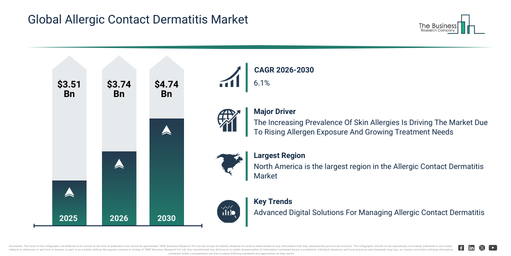
Allergic Contact Dermatitis Market Set To Climb From $3.74 Billion In 2026 To $4.74 Billion By 2030
The market for allergic contact dermatitis has experienced robust expansion in recent years. It is anticipated to expand from $3.51 billion in 2025 to $3.74 billion in 2026, demonstrating a compound annual growth rate (CAGR) of 6.4%. Historically, this market’s growth is largely attributable to factors such as increased exposure to metals and chemicals, limited awareness about skin allergens, the growing adoption of patch testing, rising dermatology research initiatives, and increasing use of topical corticosteroids.
The market for allergic contact dermatitis is projected to experience robust expansion over the coming years. It is anticipated to reach $4.74 billion by 2030, exhibiting a compound annual growth rate (CAGR) of 6.1%. This growth during the forecast period can be primarily attributed to factors such as the advancement of sophisticated immunomodulators, increasing recognition of hypoallergenic products, the broader availability of personalized dermatology treatments, an uptick in occupational skin allergies, and the incorporation of digital dermatology diagnostics. Key trends emerging in this period encompass the global increase in allergic contact dermatitis cases, enhanced awareness and diagnostic accuracy via patch testing, a rising demand for topical corticosteroids and immunomodulators, the expansion of dermatological services for pediatric and geriatric populations, and a growing inclination towards natural and hypoallergenic product options.
Get A Free Sample Report With In-Depth Market Insights:
Allergic Contact Dermatitis Market Growth Factors: What’s Supporting Expansion?
The rising occurrence of skin allergies is anticipated to boost the expansion of the allergic contact dermatitis market moving forward. Skin allergies manifest when the immune system overreacts to particular allergens, resulting in symptoms such as redness, itching, swelling, and rashes. The increase in these cases is largely driven by greater exposure to environmental allergens, cosmetic chemicals, and irritants, coupled with a growing demographic experiencing sensitive skin and compromised skin-barrier function. Allergic contact dermatitis treatments are designed to manage these conditions by mitigating inflammation, relieving itchiness, preventing future reactions, and restoring the skin barrier through the application of topical agents, antihistamines, and lifestyle modifications that reduce allergen contact. For instance, in April 2025, the Asthma and Allergy Foundation of America (AAFA), a US-based suburban nonprofit organization, reported that skin and contact allergies impact roughly 1 in 5 people, with eczema affecting 18.9 million adults and 8 million children in the U.S., highlighting a substantial and growing disease burden. Therefore, the increasing prevalence of skin allergies is fostering the growth of the allergic contact dermatitis market.
Allergic Contact Dermatitis Market Segment Analysis Spotlighting Growth Areas
The allergic contact dermatitis market covered in this report is segmented –
1) By Allergen Type: Metals, Chemicals, Latex, Fragrances, Preservatives
2) By Diagnosis Method: Patch Testing, Clinical Evaluation
3) By Treatment Type: Topical Corticosteroids, Immunomodulators, Oral Corticosteroids
4) By Severity Level: Mild, Moderate, Severe
5) By Patient Demographics: Children, Adults, Elderly
Subsegments:
1) By Metals: Nickel, Cobalt, Chromium
2) By Chemicals: Pesticides, Solvents, Cleaning Agents
3) By Latex: Natural Rubber Latex, Synthetic Latex
4) By Fragrances: Synthetic Fragrances, Natural Fragrances
5) By Preservatives: Parabens, Formaldehyde Releasers, Isothiazolinones
Allergic Contact Dermatitis Market Industry Trends: What’s Reshaping Demand?
Leading companies in the allergic contact dermatitis market are prioritizing the development of sophisticated web- and app-based resource solutions to enable remote consultations with healthcare professionals. Such a solution is a digital platform accessible through websites and mobile applications, offering tools, information, and interactive features to support patient needs, thereby improving patient self-management and adherence to treatment. For example, in November 2024, the American Contact Dermatitis Society, a US-based non-profit organization dedicated to the diagnosis and care of dermatitis through education, research, and advocacy, launched the Contact Allergen Management Program (CAMP) 2.0 to help patients manage allergic contact dermatitis. This tool assists patients in identifying safe products by providing detailed product information and transparent allergen data. It incorporates an enhanced provider interface, an allergen search capability, cross-reactor groupings, and automated allergen information sheets. Patients are able to suggest products, rate their experiences, submit reports, and scan UPC codes for immediate safety feedback. CAMP 2.0 has been expanded to include an unsafe list, highlighting allergens in bold red, and monitors the influence of allergic contact dermatitis on an individual’s quality of life.
Allergic Contact Dermatitis Market Leading Companies: Who Holds The Strongest Market Presence?
Major companies operating in the allergic contact dermatitis market are Bausch Health Companies Inc., GlaxoSmithKline plc, Pfizer Inc., Sanofi S.A., AbbVie Inc., Johnson & Johnson, LEO Pharma A/S, Novartis AG, Bayer AG, Eli Lilly and Company, Galderma SA, Astellas Pharma Inc., Ferrer Pharma, Stallergenes Greer International AG, HAL Allergy B.V., Hycor Biomedical Inc., HollisterStier Allergy, Dormer Laboratories Inc., Chemotechnique MB Diagnostics AB, Aesku.Diagnostics GmbH, AllergoTek
View The Full Allergic Contact Dermatitis Market Report:
Allergic Contact Dermatitis Market Regional Split: Which Areas Are Fueling Growth?
North America was the largest region in the allergic contact dermatitis market in 2025. Asia-Pacific is expected to be the fastest-growing region in the forecast period. The regions covered in the allergic contact dermatitis market report are Asia-Pacific, South East Asia, Western Europe, Eastern Europe, North America, South America, Middle East, Africa.
Reach Out To Our Team:
The Business Research Company: https://www.thebusinessresearchcompany.com/
Americas: +1 310-496-7795
Asia: +44 7882 955267 & +91 8897263534
Europe: +44 7882 955267
Email us at: marketing@tbrc.info
Follow us on:
LinkedIn: https://in.linkedin.com/company/the-business-research-company
YouTube: https://www.youtube.com/channel/UC24_fI0rV8cR5DxlCpgmyFQ
Global Market Model: https://www.thebusinessresearchcompany.com/global-market-model