Backed by market attractiveness analysis, total addressable market sizing, company benchmarking matrices, interactive Excel dashboards, wider supply chain intelligence, emerging startup coverage, and detailed product-level insights, The Business Research Company’s 2026 market reports are designed to offer research that is more actionable and strategically valuable than ever.
Minimal Residual Disease Market Growth Potential: How Will Market Size Shift Through 2030?
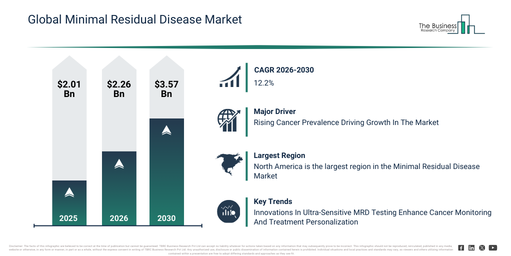
The minimal residual disease market size has experienced rapid expansion in recent years. Projections indicate it will grow from $2.01 billion in 2025 to $2.26 billion in 2026, at a compound annual growth rate (CAGR) of 12.5%. This historical growth can be attributed to a rise in leukemia and lymphoma cases, the increasing utilization of flow cytometry testing, the early adoption of PCR-based MRD detection, an evolving clinical focus on relapse prediction, and the expansion of diagnostic laboratory capabilities.
The minimal residual disease market is projected to experience substantial expansion over the upcoming years. This market is set to reach a value of $3.57 billion by 2030, demonstrating a compound annual growth rate (CAGR) of 12.2%. This anticipated growth during the forecast period is attributable to several factors, including the swift expansion of NGS-based MRD testing, the escalating need for personalized oncology treatments, advancements in ultra-sensitive molecular assays, the broader acceptance of liquid biopsy MRD testing, and increased investment in cancer diagnostics research. Key trends anticipated during this period encompass the incorporation of precision medicine into MRD detection, the integration of AI to boost sensitivity in MRD testing, the broader use of cloud-based data management for MRD monitoring, IoT-enabled connectivity within MRD diagnostic platforms, and the increasing automation and digitalization of laboratory MRD analysis.
Get A Free Sample Report With In-Depth Market Insights:
Minimal Residual Disease Market Growth Backed By Core Demand Fundamentals
The growing incidence of cancer is anticipated to boost the expansion of the minimal residual disease market in the coming years. Cancer refers to a collection of illnesses marked by the uncontrolled multiplication and dispersion of atypical cells throughout the body. This rise in cancer cases stems from factors such as an aging global population, greater exposure to environmental cancer-causing agents, detrimental lifestyle choices, and genetic susceptibilities. The escalating occurrence of cancer fuels the need for accurate MRD testing to identify remaining cancer cells, facilitating prompt intervention and tailored therapies. This consequently enhances the prediction of relapse and improves patient results. Consequently, the growing prevalence of cancer is a key driver for the expansion of the minimal residual disease market.
Minimal Residual Disease Market Segment Analysis Spotlighting Growth Areas
The minimal residual disease market covered in this report is segmented –
1) By Detection Target: Lymphoma, Leukemia, Solid Tumors, Other Detection Targets
2) By Test Technique: Flow Cytometry, Polymerase Chain Reaction (PCR), Next Generation Sequencing (NGS), Other Test Techniques
3) By End-User: Hospitals, Diagnostic Laboratories, Research Institutions
Subsegments:
1) By Lymphoma: Hodgkin Lymphoma, Non-Hodgkin Lymphoma
2) By Leukemia: Acute Lymphoblastic Leukemia, Acute Myeloid Leukemia, Chronic Lymphocytic Leukemia, Chronic Myeloid Leukemia
3) By Solid Tumors: Breast Cancer, Lung Cancer, Colorectal Cancer, Prostate Cancer
4) By Other Detection Targets: Multiple Myeloma, Neuroblastoma, Sarcomas
Minimal Residual Disease Market Growth Trends Reshaping The Competitive Landscape
Leading firms within the minimal residual disease (MRD) market are prioritizing the creation of sophisticated ultra-sensitive assays to improve early diagnosis and patient care. These ultra-sensitive assays are lab-based tests engineered to accurately identify circulating tumor DNA even at remarkably low concentrations, facilitating quicker recognition of cancer recurrence and more effective treatment choices. As an example, Natera, Inc., a US company specializing in cell-free DNA and genetic testing, introduced the Signatera Genome MRD test in April 2025. This test incorporates a tailored, tumor-informed assay derived from a patient’s complete genome sequence and corresponding normal DNA. Utilizing multiplex polymerase chain reaction and next-generation sequencing technology, the test can identify tumor DNA at concentrations as minute as 1 part per million and even lower for research purposes. Its clinical validity has been established across various cancer forms, specifically including breast, colorectal, non-small cell lung, melanoma, and renal cell carcinoma. Signatera Genome helps pinpoint postsurgical patients with an elevated risk of recurrence, provides valuable predictive clinical insights, serves both clinical and research needs, and is covered by Medicare for a wide array of indications, thus supporting more accurate and knowledgeable treatment plans.
Minimal Residual Disease Market Leading Companies: Who Holds The Strongest Market Presence?
Major companies operating in the minimal residual disease market are Thermo Fisher Scientific Inc., LabCorp, Quest Diagnostics Incorporated, Agilent Technologies Inc., Sysmex Corporation, Bio-Rad Laboratories Inc., Qiagen N.V., Natera Inc., Foundation Medicine Inc., NeoGenomics Inc., Guardant Health Inc., Adaptive Biotechnologies Corporation, Invivoscribe Inc., Mission Bio Inc., ArcherDx Inc., Abbott Laboratories, F. Hoffmann-La Roche Ltd., Illumina Inc., Personalis Inc., Asuragen Inc., ARUP Laboratories Inc., Myriad Genetics Inc., Luminex Corporation, EntroGen Inc., 3B BlackBio Biotech India, Bioartis, PerkinElmer Inc.
View The Full Minimal Residual Disease Market Report:
Minimal Residual Disease Market Geographic Spread And Regional Opportunities
North America was the largest region in the minimal residual disease market in 2025. Asia-Pacific is expected to be the fastest-growing region in the forecast period. The regions covered in the minimal residual disease market report are Asia-Pacific, South East Asia, Western Europe, Eastern Europe, North America, South America, Middle East, Africa.
Reach Out To Our Team:
The Business Research Company: https://www.thebusinessresearchcompany.com/
Americas: +1 310-496-7795
Asia: +44 7882 955267 & +91 8897263534
Europe: +44 7882 955267
Email us at: marketing@tbrc.info
Follow us on:
LinkedIn: https://in.linkedin.com/company/the-business-research-company
YouTube: https://www.youtube.com/channel/UC24_fI0rV8cR5DxlCpgmyFQ
Global Market Model: https://www.thebusinessresearchcompany.com/global-market-model
Leave a Reply