Lysosomal Disease Treatment Market Projected at $13.7 Billion by 2029 | Strategic Insights and Forecast Data
Claim your 30% discount on Global Market Reports with code ONLINE30. Limited time only.
How Has the Lysosomal Disease Treatment Market Size Changed, over the years?
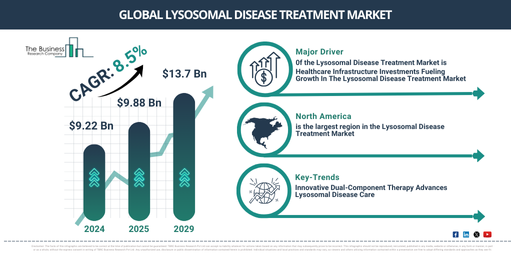
There has been strong growth in the market size of lysosomal disease treatment in the recent past. The market will expand from $9.22 billion in 2024 to $9.88 billion in 2025, with a compound annual growth rate (CAGR) of 7.2%. The previous growth can be credited to advances in therapy methods, better understanding and awareness, an increase in clinical trials and research work, improvements in diagnostic tools, and the establishment of newborn screening initiatives.
How Much Will the Lysosomal Disease Treatment Market Be Worth in 2029?
Expectations are high for strong expansion in the lysosomal disease treatment market over the upcoming years. Market projections predict a growth to “$13.7 billion by the year 2029, which represents a compound annual growth rate (CAGR) of 8.5%. Factors contributing to this projected growth during the forecast period include advancements in gene therapy, ongoing improvements in enzyme replacement therapy (ERT), the launch of new therapeutic modalities, the promotion of enhanced screening and early diagnosis programs, and dedicated investments toward research and development. Key trends for the forecast period are developments in enzyme replacement therapy (ERT), innovations in gene therapy, progress in chaperone therapy, substrate reduction therapy (SRT) advancements and the widening of newborn screening programs.
Download The Free Sample Report Here:
https://www.thebusinessresearchcompany.com/sample.aspx?id=10482&type=smp
Which is the Largest Company in the Lysosomal Disease Treatment Market?
Major companies operating in the lysosomal disease treatment market include Eli Lilly and Company, Takeda Pharmaceutical Company Limited, Sanofi SA, Pfizer Inc., Novartis International AG, Johnson & Johnson Services Inc., Alexion Pharmaceuticals Inc., Amicus Therapeutics Inc., Actelion Pharmaceuticals Ltd., Sigilon Therapeutics Inc., BioMarin Pharmaceutical Inc., Merck & Co Inc., AstraZeneca PLC, Astellas Pharma Inc., Horizon Therapeutics plc, Leadient Biosciences Inc., Orphazyme A/S, Recordati Industria Chimica e Farmaceutica S.p.A., Valerion Therapeutics Llc, Viatris Inc., Chiese Farmaceutici SpA, Genzyme Corporation, Ultragenyx Pharmaceutical Inc., Sangamo Therapeutics Inc., Avrobio Inc., Axovant Gene Therapies Ltd., Regenxbio Inc., Krystal Biotech Inc., Homology Medicines Inc., Orchard Therapeutics plc, Sarepta Therapeutics Inc., Solid Biosciences Inc.
What Are the Main Market Drivers in the Lysosomal Disease Treatment Industry?
The lysosomal disease treatment market is forecasted to expand due to the rise in healthcare infrastructure investments. These investments pertain to the financial resource allocation designated for enhancing, maintaining, and developing healthcare facilities, equipment, and services. In the context of lysosomal disease treatment, more investments in healthcare infrastructure can significantly benefit research progress, overall healthcare effectiveness, and patient outcomes. As reported by The Moscow Times, an online newspaper based in Russia, the federal project of Russia on primary healthcare modernization is planning to allocate 88.8 billion rubles ($910 million) in 2023 and 550 billion rubles ($5.7 billion) for the 2023-25 period. Hence, the increase in healthcare infrastructure investments is fueling the lysosomal disease treatment market’s growth.
Request For A Customized Report:
https://www.thebusinessresearchcompany.com/customise?id=10482&type=smp
How Is the Lysosomal Disease Treatment Market Segments Structured?
The lysosomal disease treatment market covered in this report is segmented –
1) By Disease Type: Mucopolysaccharidosis, Pompe Syndrome, Fabry Diseases, Gaucher’s Disease, Other Disease Types
2) By Therapy: Substrate Reduction Therapy, Stem Cell Therapy, Enzyme Replacement Therapy, Other Therapies
3) By Route Of Administration: Oral, Parenteral, Other Routes Of Administration
4) By End User: Hospitals, Specialty Clinics, Homecare, Other End Users
Subsegments:
1) By Mucopolysaccharidosis: MPS I (Hurler Syndrome), MPS II (Hunter Syndrome), MPS III (Sanfilippo Syndrome), MPS IV (Morquio Syndrome), MPS VI (Maroteaux-Lamy Syndrome), MPS VII (Sly Syndrome)
2) By Pompe Syndrome: Late-Onset Pompe Disease, Infantile-Onset Pompe Disease
3) By Fabry Disease: Classic Fabry Disease, Late-Onset Fabry Disease
4) By Gaucher’s Disease: Type 1 Gaucher Disease, Type 2 Gaucher Disease, Type 3 Gaucher Disease
5) Other Disease Types: Niemann-Pick Disease, Krabbe Disease, Tay-Sachs Disease
What Strategic Trends Are Transforming the Lysosomal Disease Treatment Market?
Dominant entities in the lysosomal disease treatment market are progressing towards the creation of novel approaches like dual-component therapy to boost enzyme replacement and upgrade muscle conditions in patients. Dual-component therapy is an innovative method that blends two different agents or drugs to enhance the overall healing efficacy for a specific health issue. As an example, Amicus Therapeutics, a biotechnology firm from the U.S., unveiled in September 2023 that the U.S. Food and Drug Administration (FDA) had greenlighted Pombiliti (cipaglucosidase alfa-atga) and Opfolda (miglustat) 65 mg capsules. These drugs are dual-component therapies tailored to manage late-onset Pompe disease, a profound lysosomal disorder characterized by glycogen build-up due to enzyme scarcity. This amalgamation bolsters enzyme intake in muscle cells and stabilizes the enzyme within circulation, greatly upgrading muscular strength and lung function in patients that previous treatments failed to help. Clinical studies demonstrate that this ground-breaking method could provide considerable advantages, filling a gap in the treatment of this incapacitating condition.
Access The Full Report Here:
https://www.thebusinessresearchcompany.com/report/lysosomal-disease-treatment-global-market-report
Which Global Regions Offer the Highest Growth in the Lysosomal Disease Treatment Market?
North America was the largest region in the lysosomal disease treatment market in 2024.Europe is expected to be the fastest-growing region in the global lysosomal disease treatment market report during the forecast period. The regions covered in the lysosomal disease treatment market report are Asia-Pacific, Western Europe, Eastern Europe, North America, South America, Middle East, Africa
Purchase The Full Report Today:
https://www.thebusinessresearchcompany.com/purchaseoptions.aspx?id=10482
This Report Delivers Insight On:
1. How big is the lysosomal disease treatment market, and how is it changing globally?
2. Who are the major companies in the lysosomal disease treatment market, and how are they performing?
3. What are the key opportunities and risks in the lysosomal disease treatment market right now?
4. Which products or customer segments are growing the most in the lysosomal disease treatment market?
5. What factors are helping or slowing down the growth of the lysosomal disease treatment market?
About The Business Research Company:
With over 15000+ reports from 27 industries covering 60+ geographies, The Business Research Company has built a reputation for offering comprehensive, data-rich research and insights. Armed with 1,500,000 datasets, the optimistic contribution of in-depth secondary research, and unique insights from industry leaders, you can get the information you need to stay ahead in the game.
Get in touch with us:
The Business Research Company: https://www.thebusinessresearchcompany.com/
Americas +1 3156230293
Asia +44 2071930708
Europe +44 2071930708
Email us at info@tbrc.info
Follow us on:
LinkedIn: https://in.linkedin.com/company/the-business-research-company
YouTube: https://www.youtube.com/channel/UC24_fI0rV8cR5DxlCpgmyFQ
Global Market Model: https://www.thebusinessresearchcompany.com/global-market-model