Constrained Peptide Drugs Industry Valued at $6.13 Billion by 2029 With CAGR of 17% | Size and Share Insights
Claim your 30% discount on Global Market Reports with code ONLINE30. Limited time only.
What Is the Forecast for the Constrained Peptide Drugs Market from 2024 to 2025?
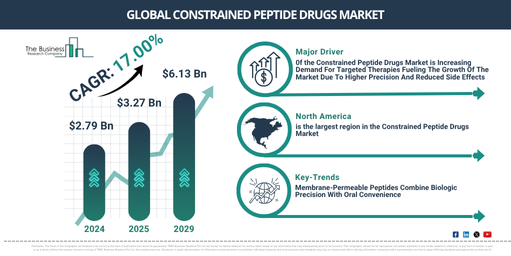
The market size of constrained peptide drugs has seen a swift expansion in the past few years. The market, valued at $2.79 billion in 2024, is expected to escalate to $3.27 billion in 2025, advancing at a compound annual growth rate (CAGR) of 17.3%. The growth observed in the past can be linked to a rise in chronic diseases, an increasing need for targeted therapies, advancements in drug delivery systems, upgrades in peptide stability through chemical alterations, and regulatory backing for innovative treatments.
What Is the Projected Market Size of the Constrained Peptide Drugs Market?
In the coming years, the market size of constrained peptide drugs is predicted to experience swift expansion. Its growth is anticipated to reach $6.13 billion in 2029, with a compound annual growth rate (CAGR) of 17.0%. This growth during the forecast period can be ascribed to the escalating demand for individualized and targeted therapies, improved cellular uptake and binding affinity of constrained peptides, rise in government and private funding dedicated to peptide research, advancement of synthetic constraining methods, as well as the broadening applications in metabolic disorders and oncology. Some prominent trends during the forecast span include progress in solid-phase and microwave-assisted peptide synthesis, the emergence of peptide macrocyclization and stapling techniques, the fusion of artificial intelligence and machine learning in peptide design, the adoption of environmentally friendly chemistry for sustainable peptide production, and the use of cell-penetrating peptides and peptide-protein conjugates.
Download The Free Sample Report Here:
https://www.thebusinessresearchcompany.com/sample.aspx?id=24511&type=smp
Who are the Major Competitors in the Constrained Peptide Drugs Market Outlook?
Major companies operating in the constrained peptide drugs market are AstraZeneca PLC, Novartis AG, Union Chimique Belge S.A. (UCB), CPC Scientific Inc., PeptiDream Inc., Protagonist Therapeutics Inc., Bicycle Therapeutics plc, Zealand Pharma A/S, Bio-Synthesis Inc., Encycle Therapeutics Inc., Circle Pharma Inc., Issar Pharmaceuticals Inc., Aileron Therapeutics Inc., Creative Peptides, Fierce Biotech, Lisata Therapeutics Inc., Pepscan Therapeutics B.V., Phylogica Ltd., Pepticom Ltd, Spexis AG.
What Is Fueling Growth in the Constrained Peptide Drugs Market?
The escalation in the requirement for specific therapies is predicted to boost the progression of the constrained peptide drugs market going forward. Such therapies are distinct medical treatments that directly affect and interrupt the molecular pathways that contribute to the advancement and propagation of diseases. The escalating demand for these therapies is attributed to their superior precision and diminished side effects when contrasted with traditional treatments. These targeted therapies contribute to the development of constrained peptide drugs by centering their efforts on distinct molecular pathways, thereby heightening treatment accuracy. They enhance the effectiveness of drugs and decrease side effects, positioning constrained peptides as perfect candidates for specific intervention in intricate diseases. For instance, the American Society of Gene & Cell Therapy (ASGCT), a non-profit medical and scientific organization based in the US, stated in December 2024 that the Food and Drug Administration (FDA) sanctioned six gene therapy products in 2023, an increase from five approvals in 2022. In consequence, the escalating demand for targeted therapies is fueling growth in the constrained peptide drugs market.
Request For A Customized Report:
https://www.thebusinessresearchcompany.com/customise?id=24511&type=smp
Which Constrained Peptide Drugs Market Segments Are Growing the Fastest?
The constrained peptide drugs market covered in this report is segmented –
1) By Drug Type: Linear Peptides, Cyclic Peptides, Stapled Peptides, Multivalent Peptides
2) By Route Of Administration: Injectable, Intranasal, Transdermal, Oral
3) By Application: Hospital, Institute Of Biology, Other Applications
4) By Distribution Channel: Direct Sales, Third-Party Distributors, Online Pharmacies, Retail Pharmacies
5) By End User: Hospitals, Pharmaceutical Companies, Research Laboratories, Specialty Clinics
Subsegments:
1) By Linear Peptides: Antimicrobial Peptides, Hormonal Peptides, Enzyme Inhibitors, Receptor Agonists
2) By Cyclic Peptides: Natural Cyclic Peptides, Synthetic Cyclic Peptides, Disulfide-Bridged Peptides, Head-To-Tail Cyclized Peptides
3) By Stapled Peptides: Alpha-Helix Stabilized Peptides, Hydrocarbon-Stapled Peptides, Double-Stapled Peptides, Backbone-Stapled Peptides
4) By Multivalent Peptides: Bivalent Peptides, Trivalent Peptides, Tetravalent Peptides, Peptide-Drug Conjugates
Which Industry Trends Are Shaping the Future of the Constrained Peptide Drugs Market?
Leading businesses in the constrained peptide drugs market are concentrating their efforts on creating superior drug delivery systems like oral macrocyclic peptides. This not only increases bioavailability and patient adherence but also addresses conditions previously deemed untreatable. Oral macrocyclic peptides are specialized cyclic peptide-based medicines designed for easy absorption and stability when orally administered rather than injected. As an example, Insamo, a biotech entity from the US, introduced oral cyclic peptides in February 2024. These membrane-permeable, macroscale peptides, suitable for oral intake, merge the precise targeting of biologics with the ease of oral intake. Their production platform utilizes a machine learning-powered molecular design, increased capacity molecular biology, and concurrent synthetic chemistry, enabling the swift identification of preclinical candidates with advantageous pharmacological characteristics, including those targeting challenging drug targets.
Access The Full Report Here:
https://www.thebusinessresearchcompany.com/report/constrained-peptide-drugs-global-market-report
Which Countries Are Leading the Constrained Peptide Drugs Market?
North America was the largest region in the constrained peptide drugs market in 2024. The regions covered in the constrained peptide drugs market report are Asia-Pacific, Western Europe, Eastern Europe, North America, South America, Middle East, Africa.
Purchase The Full Report Today:
https://www.thebusinessresearchcompany.com/purchaseoptions.aspx?id=24511
This Report Delivers Insight On:
1. How big is the constrained peptide drugs market, and how is it changing globally?
2. Who are the major companies in the constrained peptide drugs market, and how are they performing?
3. What are the key opportunities and risks in the constrained peptide drugs market right now?
4. Which products or customer segments are growing the most in the constrained peptide drugs market?
5. What factors are helping or slowing down the growth of the constrained peptide drugs market?
About The Business Research Company:
With over 15000+ reports from 27 industries covering 60+ geographies, The Business Research Company has built a reputation for offering comprehensive, data-rich research and insights. Armed with 1,500,000 datasets, the optimistic contribution of in-depth secondary research, and unique insights from industry leaders, you can get the information you need to stay ahead in the game.
Get in touch with us:
The Business Research Company: https://www.thebusinessresearchcompany.com/
Americas +1 3156230293
Asia +44 2071930708
Europe +44 2071930708
Email us at info@tbrc.info
Follow us on:
LinkedIn: https://in.linkedin.com/company/the-business-research-company
YouTube: https://www.youtube.com/channel/UC24_fI0rV8cR5DxlCpgmyFQ
Global Market Model: https://www.thebusinessresearchcompany.com/global-market-model