Rising Cancer Incidence Acting as a Major Driver for the Cancer Clinical Decision Tools Market
The Business Research Company’s 2026 market reports include new capabilities such as market attractiveness scoring and analysis, total addressable market analysis, company scoring matrix, interactive excel data dashboard, improved supply chain analysis, upcoming startups in the market, and overview of key products, aimed at improving the depth, usability, and strategic value of the insights delivered.
How Large Is The Cancer Clinical Decision Tools Market Projected To Become By 2030 Based On Its 2026 Valuation?
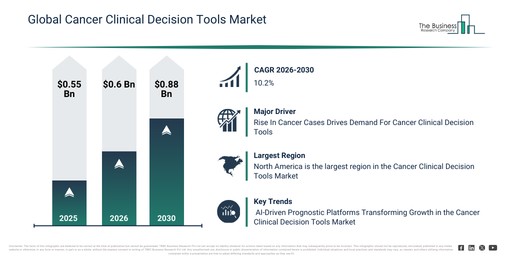
The cancer clinical decision tools market has experienced significant growth in recent times. This market is projected to expand from $0.55 billion in 2025 to $0.6 billion by 2026, exhibiting a compound annual growth rate (CAGR) of 9.0%. Historical growth in this sector is due to factors such as increasing cancer incidence rates, the growing workload for primary care physicians, restricted early diagnostic options in primary care, a heightened focus on the precision of referrals, and the expansion of hospital and clinic facilities.
The cancer clinical decision tools market size is predicted to undergo rapid expansion in the coming years. This market is projected to reach $0.88 billion by 2030, demonstrating a compound annual growth rate (CAGR) of 10.2%. The anticipated growth during this period is largely due to the advancement of AI-driven decision tools, the integration of genomic and risk profiling data, the increasing availability of digital health platforms, a rise in government screening initiatives, and the greater adoption of evidence-based oncology guidelines. Significant trends for the forecast period encompass the escalating use of clinical decision support tools in oncology, a stronger emphasis on early cancer detection and risk stratification, general practitioners’ increasing reliance on symptom checkers and risk calculators, the broadening of guideline-based referral and decision frameworks, and the seamless integration of cancer decision tools into primary care workflows.
Download the Free Sample Report to Explore Key Market Insights:
https://www.thebusinessresearchcompany.com/sample.aspx?id=3463&type=smp
What Major Growth Drivers Are Shaping The Outlook Of The Cancer Clinical Decision Tools Market?
The expanding prevalence of cancer is anticipated to propel the growth of the cancer clinical decision tools market in the foreseeable future. Cancer incidence quantifies the number of newly identified cancer cases within a specific demographic during a particular period, illustrating the disease’s occurrence rate. The increase in cancer incidence is attributed to heightened exposure to risk factors, such as unhealthy lifestyles, which can progressively lead to genetic mutations and anomalous cell development. Cancer clinical decision tools are instrumental in monitoring, forecasting, and managing cancer cases more effectively, facilitating early diagnosis and timely intervention that can influence observed cancer incidence trends. For instance, in October 2025, according to the NHS England, a UK-based publicly funded healthcare system, 354,820 new cancer diagnoses were recorded in 2023, marking an increase of 8,605 from 2022. Therefore, the global surge in cancer incidence rates will elevate the demand for the cancer clinical decision tools market.
What Segment Groups Are Identified Within The Cancer Clinical Decision Tools Market?
The cancer clinical decision tools market covered in this report is segmented –
1) By Type: Risk Assessment Tool(RAT), Qcancer
2) By End-User: Hospital, Clinics
Subsegments:
1) By Risk Assessment Tool (RAT): Family History Assessment, Genetic Testing and Counseling, Lifestyle and Environmental Risk Factors Evaluation
2) By Qcancer: Symptom Checker, Risk Calculator, Guideline-Based Recommendations
What Trends Are Advancing Progress In The Cancer Clinical Decision Tools Market?
Major companies within the cancer clinical decision tools market are increasingly leveraging AI-powered prognostic decision support systems to address the rising demand for more personalized, data-driven oncology care. This demand is fueled by growing cancer incidence, the need for improved risk stratification, and the imperative to optimize treatment pathways. These AI prognostic systems utilize deep-learning models to analyze multimodal data, such as imaging, electronic health records, and clinical biomarkers, enabling them to predict outcomes like survival, recurrence risk, or treatment response with much greater precision than traditional rule-based tools. For example, in February 2025, Onc.AI, a US-based health-tech company, announced that its Serial CTRS (Cancer Treatment Risk Stratification) tool earned FDA Breakthrough Device Designation. This AI tool stratifies non–small cell lung cancer (NSCLC) patients into high- and low-risk mortality categories by analyzing diagnostic imaging scans with a deep-learning algorithm, consequently assisting oncologists in making more informed decisions regarding therapy intensity and follow-up. Serial CTRS’s capability to predict long-term survival outcomes facilitates enhanced patient stratification, more tailored treatment planning, and optimized resource allocation, signifying a major progression from conventional prognostic models that depend on limited clinical parameters.
Which Companies Hold Significant Positions In The Cancer Clinical Decision Tools Market?
Major companies operating in the cancer clinical decision tools market are McKesson Corporation, Philips Healthcare, Siemens Healthineers AG, Elsevier B.V., National Decision Support Company, Cerner Corporation, GE Healthcare, Allscripts Healthcare Solutions Inc., Epic Systems Corporation, RaySearch Laboratories AB, Elekta AB, Varian Medical Systems Inc., Accuray Incorporated, F. Hoffmann-La Roche Ltd., Flatiron Health Inc., Tempus Labs Inc., NantHealth Inc., Syapse Inc., Inspirata Inc., Prognos Health Inc., Deep 6 AI Inc., PathAI Inc.
Read the full cancer clinical decision tools market report here:
https://www.thebusinessresearchcompany.com/report/cancer-clinical-decision-tool-global-market-report
Which Regions Are Projected To Dominate The Cancer Clinical Decision Tools Market In The Coming Years?
North America was the largest region in the cancer clinical decision tools market in 2025. The regions covered in the cancer clinical decision tools market report are Asia-Pacific, South East Asia, Western Europe, Eastern Europe, North America, South America, Middle East, Africa.
Request A Tailored Cancer Clinical Decision Tools Market Research Report For Competitive Advantage:
https://www.thebusinessresearchcompany.com/customise?id=3463&type=smp
Browse Through More Reports Similar to the Global Cancer Clinical Decision Tools Market 2026, By The Business Research Company
Polymerase Chain Reactions Devices Reagents And Uses Market Report 2026
Cardiovascular Monitoring And Diagnostic Devices And Equipment Market Report 2026
Veterinary Diagnostic Equipment Market Report 2026
Get in touch with us:
The Business Research Company: https://www.thebusinessresearchcompany.com/
Americas +1 310-496-7795
Asia +44 7882 955267 & +91 8897263534
Europe +44 7882 955267
Email us at info@tbrc.info
Follow us on:
LinkedIn: https://in.linkedin.com/company/the-business-research-company
YouTube: https://www.youtube.com/channel/UC24_fI0rV8cR5DxlCpgmyFQ
Global Market Model: https://www.thebusinessresearchcompany.com/global-market-model