Category: Healthcare Services

  • Developing Plasticizer-Free Long-Chain Polyamides To Improve Performance And Supply Reliability Is Playing A Role In Shaping The Long-Chain Polyamide  Market

    Developing Plasticizer-Free Long-Chain Polyamides To Improve Performance And Supply Reliability Is Playing A Role In Shaping The Long-Chain Polyamide Market

    The Business Research Company’s 2026 market reports feature enhanced tools like market attractiveness analysis, TAM assessment, and company scoring matrices, along with interactive dashboards, deeper supply chain insights, and startup coverage strengthening the depth, usability, and strategic value of insights.

    How Much Will The Market Value Of The Long-Chain Polyamide Market Grow Between 2026 And 2030?

    The long-chain polyamide market size has experienced significant expansion over recent years. It is anticipated to ascend from $2.47 billion in 2025 to $2.65 billion in 2026, achieving a compound annual growth rate (CAGR) of 7.0%. Historically, this growth has been fueled by factors including the escalating demand for lightweight materials, the increased application of high-performance polymers, the broadening integration into automotive applications, a heightened concentration on fuel efficiency, and the continued innovation of durable plastic components.

    The market for long-chain polyamide is projected to experience robust expansion over the coming years. By 2030, its value is anticipated to reach $3.42 billion, demonstrating a compound annual growth rate (CAGR) of 6.7%. This projected growth is primarily driven by factors such as an increasing need for sustainable, high-performance polymers, a heightened emphasis on electric vehicle components, continuous progress in chemical processing technologies, an escalating demand for lightweight yet strong materials, and expanding investments in innovative materials. Key trends anticipated during this period encompass advancements in producing bio-based polyamides, novel developments in long-chain polymer formulations, the incorporation of high-performance materials into contemporary manufacturing processes, improvements in recycling technologies for engineered plastics, and new approaches in designing lightweight polymers.

    Access Your Free Sample Report For In-Depth Market Analysis:

    https://www.thebusinessresearchcompany.com/sample.aspx?id=30638&type=smp

    Which Major Drivers Are Influencing The Expansion Of The Long-Chain Polyamide Market?

    The long-chain polyamide market is projected to grow as the substitution of metals in engineering parts continues to increase. This substitution involves replacing traditional metallic components with high-performance polymers to achieve benefits such as weight reduction, enhanced corrosion resistance, and improved manufacturing efficiency. The escalating demand for lightweight and cost-efficient materials is driving this rise in metal substitution in engineering parts. Long-chain polyamide supports this trend by offering properties like high strength, durability, and a lightweight nature, thus enabling cost-effective and corrosion-resistant alternatives for mechanical and structural applications. For instance, according to the American Chemistry Council, a US-based trade association, an average automobile contained 429 pounds of plastics and polymer composites in December 2024, accounting for 9.7% of the vehicle’s total weight, with the polypropylene content per vehicle rising from 97 pounds in 2022 to 100 pounds in 2023. Therefore, the increasing substitution of metals in engineering parts is a significant factor driving the expansion of the long-chain polyamide market.

    What Are The Different Segment Types In The Long-Chain Polyamide Market Segment Breakdown?

    The long-chain polyamide market covered in this report is segmented –

    1) By Product Type: PA 12, PA 11, PA 610, PA 612, Other Product Types

    2) By Form: Chips, Powder, Other Forms

    3) By Application: Fuel Lines, Cooler Hoses, Corrugated Tubes, Oil And Gas Transportation, Sensors And Solenoids, Other Applications

    4) By End-User: Automotive, Electrical And Electronics, Consumer Goods, Industrial, Other End-Users

    Subsegments:

    1) By PA 12: Extrusion-Grade PA 12, Injection-Molding-Grade PA 12, Blow-Molding-Grade PA 12, High-Viscosity PA 12, Flame-Retardant PA 12, Reinforced PA 12 (Glass Fiber, Carbon Fiber), Flexible PA 12 Compounds

    2) By PA 11: Bio-Based PA 11 (100% Renewable Feedstock), Injection-Molding-Grade PA 11, Extrusion-Grade PA 11, High-Temperature PA 11, Impact-Modified PA 11, Reinforced PA 11 (Glass Fiber, Mineral Filled)

    3) By PA 610: Extrusion-Grade PA 610, Injection-Molding-Grade PA 610, Heat-Stabilized PA 610, Oil-Resistant PA 610, Lightweight PA 610 Compounds, Reinforced PA 610 (Glass Fiber, Carbon Fiber)

    4) By PA 612: Injection-Molding-Grade PA 612, Extrusion-Grade PA 612, Low-Moisture-Absorption PA 612, High-Fluidity PA 612, Reinforced PA 612 Compounds, Wear-Resistant PA 612 Grades

    5) By Other Product Types: PA 1010, PA 1012, PA 46/PA 410 Blends, Bio-Based Long-Chain Polyamides (Non-PA11), Specialty Copolyamides, Customized Performance LCPA Compounds

    Which Trends Are Shaping The Long-Chain Polyamide Market?

    Major companies operating within the long-chain polyamide materials market are concentrating on developing advanced substances, such as plasticizer-free long-chain polyamides. This initiative aims to enhance thermal performance, improve sustainability, and diminish reliance on imported specialty resins. Plasticizer-free long-chain polyamides are sophisticated nylon materials specifically engineered to offer high flexibility, chemical resistance, and elevated service temperatures without incorporating plasticizing additives, while also enabling a higher bio-based content and fostering more stable domestic supply chains. For example, in April 2024, Nylon Corporation of America Inc., a US-based manufacturer of engineered nylon resin, launched NXTamid L. This proprietary plasticizer-free long-chain polyamide was developed as a direct replacement for PA11 and PA12. The NXTamid L material provides a higher service temperature than PA12, demonstrates equivalent or improved mechanical performance, and allows for customizable formulations. Additionally, it eliminates plasticizers and, in select grades, incorporates bio content exceeding 50%, thereby addressing both sustainability objectives and challenges in supply chains.

    Who Are The Well-Known Companies In The Long-Chain Polyamide Market?

    Major companies operating in the long-chain polyamide market are BASF SE, LG Chem Ltd., Mitsubishi Chemical Group Corporation, Toray Industries Inc., Evonik Industries AG, DuPont de Nemours Inc., Arkema S.A., Nan Ya Plastics Corporation, Ningbo Kingfa Advanced Materials Co. Ltd., Solvay S.A, Huntsman Corporation, Kolon Industries Inc, Ascend Performance Materials LLC, Toyobo Co. Ltd, Sanyo Chemical Industries Ltd., Ensinger GmbH, RadiciGroup S.p.A., Domo Chemicals GmbH, Nylon Corporation of America Inc., UBE Corporation, Shenzhen Esun Industrial Co. Ltd.

    Get The Full Long-Chain Polyamide Market Report:

    https://www.thebusinessresearchcompany.com/report/long-chain-polyamide-market-report

    Which Region Leads The Long-Chain Polyamide Market In Terms Of Market Share?

    North America was the largest region in the long-chain polyamide market in 2025. Asia-Pacific is expected to be the fastest-growing region in the forecast period. The regions covered in the long-chain polyamide market report are Asia-Pacific, South East Asia, Western Europe, Eastern Europe, North America, South America, Middle East, Africa.

    Request A Customized Long-Chain Polyamide Market Report For Competitive Insights:

    https://www.thebusinessresearchcompany.com/customise?id=30638&type=smp

    Browse Through More Reports Similar to the Global Long-Chain Polyamide Market 2026, By The Business Research Company

    Polyacrylamide Market Report 2026

    https://www.thebusinessresearchcompany.com/report/polyacrylamide-global-market-report

    Polyphthalamide Resin Market Report 2026

    https://www.thebusinessresearchcompany.com/report/polyphthalamide-resin-global-market-report

    polylactic acid global market report

    https://www.thebusinessresearchcompany.com/report/polylactic-acid-global-market-report

    Get in touch with us:

    The Business Research Company: https://www.thebusinessresearchcompany.com/

    Americas +1 310-496-7795

    Asia +44 7882 955267 & +91 8897263534

    Europe +44 7882 955267

    Email us at info@tbrc.info

    Follow us on:

    LinkedIn: https://in.linkedin.com/company/the-business-research-company

    YouTube: https://www.youtube.com/channel/UC24_fI0rV8cR5DxlCpgmyFQ

    Global Market Model: https://www.thebusinessresearchcompany.com/global-market-model
  • Growth In The Kidulting Toys  Market Is Being Driven By Surge In Adult Demand For Nostalgic And Collectible Toys Driving Growth Of The Market Due To Increasing Need For Stress Relief

    Growth In The Kidulting Toys Market Is Being Driven By Surge In Adult Demand For Nostalgic And Collectible Toys Driving Growth Of The Market Due To Increasing Need For Stress Relief

    The Business Research Company’s 2026 market reports feature enhanced tools like market attractiveness analysis, TAM assessment, and company scoring matrices, along with interactive dashboards, deeper supply chain insights, and startup coverage strengthening the depth, usability, and strategic value of insights.

    By 2030, What Market Size Is The Kidulting Toys Market Expected To Reach Based On Its 2026 Value?

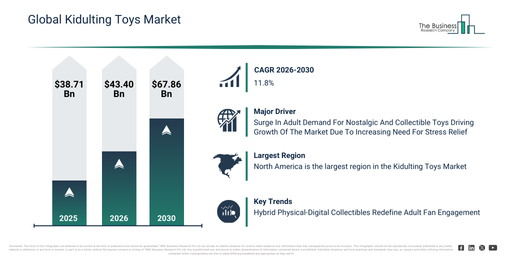
    The kidulting toys market has experienced substantial growth in recent years. This market is projected to expand from $38.71 billion in 2025 to $43.40 billion in 2026, achieving a compound annual growth rate (CAGR) of 12.1%. The historical increase can be ascribed to elements such as rising disposable income, an escalating demand for nostalgia, the growing popularity of pop culture franchises, the broadening of collectible product lines, and the increasing influence of social media.

    The kidulting toys market is projected to experience substantial expansion over the upcoming years. This market is predicted to reach $67.86 billion by 2030, demonstrating a compound annual growth rate (CAGR) of 11.8%. Factors driving this growth during the forecast period include the increasing adoption of online sales, a growing interest in limited-edition collectibles, rising investment in hybrid physical-digital toys, the expansion of licensing and IP partnerships, and the growing demand for stress relief and leisure activities. Key trends anticipated for the forecast period encompass technological advancements in virtual reality (VR) and augmented reality (AR) integration, innovations concerning sustainable and premium materials, the development of personalized customization platforms, ongoing research into mental health-focused product designs, and the integration of gamified retail and unboxing experiences.

    Access Your Free Sample Report For In-Depth Market Analysis:

    https://www.thebusinessresearchcompany.com/sample.aspx?id=30631&type=smp

    Which Drivers Are Supporting The Kidulting Toys Market Growth?

    The Kidulting Toys market is expected to grow, driven by the increasing trend of adults seeking nostalgic and collectible toys. This trend refers to the growing number of adult consumers purchasing and engaging with toys and collectibles that evoke past memories, provide playful experiences, and support mental well-being. The surge in adults seeking nostalgic and collectible toy interests is linked to a growing awareness of stress management and leisure activities. Kidulting toys support adults seeking nostalgic and collectible toys by offering playful, design-driven products that evoke childhood memories while appealing to mature tastes. They enhance consumer engagement by combining nostalgia, creativity, and collectability, which boosts demand among adult buyers. For instance, in September 2023, according to the US-based non-profit trade association Toy Association Inc., 89% of parents surveyed are buying toys for adults, with 43% shopping for their spouse or significant other. Additionally, 53% of men and 48% of millennial parents under 40 reported buying toys for themselves. Consequently, the rising trend of adults seeking nostalgic and collectible toys is propelling the growth of the Kidulting Toys market.

    How Is The Kidulting Toys Market Organized By Segment Classification?

    The kidulting toys market covered in this report is segmented –

    1) By Product Type: Collectible Figures And Statues, Building Sets, Plush And Soft Toys, Games And Puzzles, Model Kits And Vehicles

    2) By Price Point And Quality: Mass-Market Nostalgia, Premium And Limited Edition, Ultra-Premium And Art Objects

    3) By Application: Online Sales, Offline Sales

    4) By End-User Age Group: Young Kidults, Core Kidults, Mature Kidults

    Subsegments:

    1) By Collectible Figures And Statues: Action Figures, Anime Figures, Movie Statues, Video Game Characters, Limited Edition Collectibles

    2) By Building Sets: Construction Kits, Modular Building Sets, Architectural Models, Mechanical Building Sets, Themed Assembly Sets

    3) By Plush And Soft Toys: Character Plush Toys, Customized Soft Toys, Comfort Plush Toys, Premium Fabric Plush Toys, Collectible Plush Series

    4) By Games And Puzzles: Strategy Board Games, Card Games, Jigsaw Puzzles, Brain Teaser Puzzles, Cooperative Games

    5) By Model Kits And Vehicles: Scale Model Kits, Die-Cast Vehicles, Hobby Assembly Kits, Remote Control Models, Replica Vehicle Models

    Which Trends Are Expected To Impact The Kidulting Toys Market?

    Major companies operating within the kidulting toys market are concentrating on developing advanced offerings, such as hybrid physical-digital collectibles. These products aim to boost consumer engagement, enhance feelings of nostalgia, and minimize the divide between traditional collecting and digital ownership. Hybrid physical-digital collectibles are defined as integrated product strategies that combine intricate, tangible action figures with corresponding blockchain-based digital assets, thereby creating a new, interconnected form of fan culture. For example, in February 2024, McFarlane Toys, an action figure company from the US, collaborated with NBCUniversal Products & Experiences, a US-based media and entertainment enterprise, to expand its Movie Maniacs brand. This initiative introduced a new series of highly detailed 6-inch collectible figures inspired by iconic characters from films including The Blues Brothers, The Big Lebowski, and The 40-Year-Old Virgin. A core innovative characteristic is that each physical figure comes paired with a redeemable digital collectible, giving fans the ability to own and display their collections in both the physical and digital realms. This blended approach leverages McFarlane Toys Digital, the company’s new digital platform, to extend its classic brand beyond physical items and forge a fresh, integrated collecting experience for adult enthusiasts.

    Who Are The Industry Participants Involved In The Kidulting Toys Market?

    Major companies operating in the kidulting toys market are Bandai Namco Holdings Inc., Mattel Inc., Hasbro Inc., Spin Master Corp., Tomy Company Ltd., Funko Inc., Dream International Limited, JAKKS Pacific Inc., McFarlane Toys, Playmates Toys Limited, Playmobil, Ravensburger AG, Hot Toys Limited, Kidrobot Inc., Medicom Toy Corporation, Mezco Toyz LLC, Schmidt Spiele GmbH, Good Smile Company Inc., Super7, The LEGO Group, Sideshow Collectibles, Sonny Angel

    Get The Full Kidulting Toys Market Report:

    https://www.thebusinessresearchcompany.com/report/kidulting-toys-market-report

    Which Region Is The Top Contributor To The Kidulting Toys Market By Share?

    North America was the largest region in the kidulting toys market in 2025. Asia-Pacific is expected to be the fastest-growing region in the forecast period. The regions covered in the kidulting toys market report are Asia-Pacific, South East Asia, Western Europe, Eastern Europe, North America, South America, Middle East, Africa.

    Request A Customized Kidulting Toys Market Report For Competitive Insights:

    https://www.thebusinessresearchcompany.com/customise?id=30631&type=smp

    Browse Through More Reports Similar to the Global Kidulting Toys Market 2026, By The Business Research Company

    Wooden Toys Market Report 2026

    https://www.thebusinessresearchcompany.com/report/wooden-toys-global-market-report

    Learning And Education Toys Market Report 2026

    https://www.thebusinessresearchcompany.com/report/learning-and-education-toys-global-market-report

    construction toys global market report

    https://www.thebusinessresearchcompany.com/report/construction-toys-global-market-report

    Get in touch with us:

    The Business Research Company: https://www.thebusinessresearchcompany.com/

    Americas +1 310-496-7795

    Asia +44 7882 955267 & +91 8897263534

    Europe +44 7882 955267

    Email us at info@tbrc.info

    Follow us on:

    LinkedIn: https://in.linkedin.com/company/the-business-research-company

    YouTube: https://www.youtube.com/channel/UC24_fI0rV8cR5DxlCpgmyFQ

    Global Market Model: https://www.thebusinessresearchcompany.com/global-market-model

  • Implantable Brain-Computer Interfaces  Market Outlook Highlighting Key Drivers And Market Evolution

    Implantable Brain-Computer Interfaces Market Outlook Highlighting Key Drivers And Market Evolution

    The Business Research Company’s 2026 market reports feature enhanced tools like market attractiveness analysis, TAM assessment, and company scoring matrices, along with interactive dashboards, deeper supply chain insights, and startup coverage strengthening the depth, usability, and strategic value of insights.

    What Is The Projected Increase In Market Value Of The Implantable Brain-Computer Interfaces Market During 2026–2030?

    The implantable brain–computer interface market has seen swift expansion in recent years. Its valuation is forecast to climb from $1.34 billion in 2025 to $1.53 billion in 2026, demonstrating a compound annual growth rate (CAGR) of 13.6%. The observed growth in earlier periods is linked to an elevated demand for neuroprosthetics, the rising occurrence of neurological disorders, increased adoption of non-invasive brain–computer interfaces, more extensive research funding within neuroscience, and a wider application of brain–computer interfaces in rehabilitation.

    The implantable brain–computer interface market size is projected for substantial expansion in the coming years. This market is anticipated to reach $2.52 billion by 2030, exhibiting a compound annual growth rate (CAGR) of 13.3%. The expansion during the forecast period stems from factors such as the increasing incorporation of artificial intelligence into brain–computer interfaces, a surge in investments directed towards neural interface advancement, greater uptake of minimally invasive brain–computer interface solutions, broadening uses in assistive communication, and a heightened need for brain–controlled robotic systems. Key trends projected for this forecast timeframe encompass progress in neural signal decoding technology, novelties in fully implantable brain–computer interfaces, advancements in wireless brain–computer interface apparatus, dedicated research and development for brain–controlled prosthetics, and enhancements in high-resolution neuroimaging methods.

    Access Your Free Sample Report For In-Depth Market Analysis:

    https://www.thebusinessresearchcompany.com/sample.aspx?id=30618&type=smp

    Which Strong Drivers Are Impacting The Implantable Brain-Computer Interfaces Market Growth?

    Future expansion of the implantable brain-computer interfaces market is anticipated to be driven by the rising incidence of spinal cord injury cases. These injuries involve either traumatic or non-traumatic damage to the spinal cord, which interferes with the brain-body communication and frequently leads to a partial or complete impairment of motor and sensory functions. An increase in spinal cord injury occurrences can be attributed to a greater frequency of falls within older populations, given that seniors are more susceptible to risks from osteoporosis, difficulties with mobility, and accidents at home. Implantable brain-computer interfaces help address the growing number of spinal cord injury cases by converting neural signals from the brain into commands capable of operating assistive devices, wheelchairs, or computers, thereby allowing paralyzed individuals to restore communication skills and autonomy. As an illustration, data from June 2025, provided by NeoMotion Assistive Solutions Private Limited, an India-based producer of assistive mobility devices, indicated that the estimated number of individuals with spinal cord injury in the United States grew from about 302,000 in 2023 to roughly 308,620 in 2024. Consequently, the expanding occurrence of spinal cord injuries is a significant factor in the growth of the implantable brain-computer interfaces market.

    How Is The Implantable Brain-Computer Interfaces Market Categorized Across Its Segment Groups?

    The implantable brain-computer interfaces market covered in this report is segmented –

    1) By Component: Hardware, Software

    2) By Type: Non-invasive Brain–Computer Interfaces, Partially Invasive Brain–Computer Interfaces, Fully Invasive Brain–Computer Interfaces

    3) By Application: Healthcare And Rehabilitation, Communication And Control, Gaming And Entertainment, Smart Home And Automotive Control

    4) By End User: Hospitals And Specialty Clinics, Research Centers And Academic Institutes, Home Care Settings, Other End Users

    Subsegments:

    1) By Hardware: Neural Electrodes, Signal Amplifiers, Data Acquisition Units, Wireless Transmitters, Power Supply Units

    2) By Software: Signal Processing Software, Neural Decoding Software, Data Analysis Software, Control Interface Software, Feedback And Visualization Software

    Which Trends Are Contributing To Changes In The Implantable Brain-Computer Interfaces Market?

    Major companies within the implantable brain-computer interfaces market are focusing on developing technologically advanced products, such as fully implantable, wireless brain-computer interface devices, to re-establish communication capabilities for individuals with severe neurological conditions. Implantable wireless brain-computer interface devices are medical or neurotechnology apparatuses surgically placed in the brain that wirelessly record neural activity and/or stimulate neural circuits, enabling direct communication between the brain and external devices. For instance, in January 2024, Neuralink Corp., a US-based neurotechnology company, launched the Telepathy in a human patient. The device is designed to interpret neural activity and allow individuals with quadriplegia or amyotrophic lateral sclerosis (ALS) to control a computer cursor or keyboard using their thoughts. The system also provides a pathway for restoring lost sensory and motor functions, marking a significant milestone in the clinical application of high-bandwidth brain-machine interfaces for medical rehabilitation.

    Which Firms Are Influencing Competition In The Implantable Brain-Computer Interfaces Market?

    Major companies operating in the implantable brain-computer interfaces market are Medtronic plc, NeuroPace Inc., PINS Medical Co. Ltd., Neurosoft Ltd., Precision Neuroscience Corporation, Onward Medical N.V., NeuroOne Medical Technologies Corporation, Emotiv Systems Inc., NextMind S.A., Neuralink Corp., CorTec GmbH, Microprobes for Life Science Inc., Synchron Inc., Shanghai Rishena Medical Instrument Co. Ltd., Paradromics Inc., SceneRay Corporation Ltd., Blackrock Neurotech LLC, NeuroXess Inc., Inbrain Neuroelectronics S.L., BrainGate Company Inc.

    Get The Full Implantable Brain-Computer Interfaces Market Report:

    https://www.thebusinessresearchcompany.com/report/implantable-brain-computer-interfaces-market-report

    Where Is The Implantable Brain-Computer Interfaces Market Most Concentrated Geographically?

    North America was the largest region in the implantable brain–computer interface market in 2025. Asia-Pacific is expected to be the fastest-growing region in the forecast period. The regions covered in the implantable brain-computer interfaces market report are Asia-Pacific, South East Asia, Western Europe, Eastern Europe, North America, South America, Middle East, Africa.

    Request A Customized Implantable Brain-Computer Interfaces Market Report For Competitive Insights:

    https://www.thebusinessresearchcompany.com/customise?id=30618&type=smp

    Browse Through More Reports Similar to the Global Implantable Brain-Computer Interfaces Market 2026, By The Business Research Company

    Brain Computer Interface Market Report 2026

    https://www.thebusinessresearchcompany.com/report/brain-computer-interface-global-market-report

    Brain And Neuroimaging Devices Market Report 2026

    https://www.thebusinessresearchcompany.com/report/brain-and-neuroimaging-devices-global-market-report

    human machine interface global market report

    https://www.thebusinessresearchcompany.com/report/human-machine-interface-global-market-report

    Get in touch with us:

    The Business Research Company: https://www.thebusinessresearchcompany.com/

    Americas +1 310-496-7795

    Asia +44 7882 955267 & +91 8897263534

    Europe +44 7882 955267

    Email us at info@tbrc.info

    Follow us on:

    LinkedIn: https://in.linkedin.com/company/the-business-research-company

    YouTube: https://www.youtube.com/channel/UC24_fI0rV8cR5DxlCpgmyFQ

    Global Market Model: https://www.thebusinessresearchcompany.com/global-market-model

  • Hospital Command Center Software  Market Analysis Covering Growth Drivers And Future Outlook

    Hospital Command Center Software Market Analysis Covering Growth Drivers And Future Outlook

    The Business Research Company’s 2026 market reports feature enhanced tools like market attractiveness analysis, TAM assessment, and company scoring matrices, along with interactive dashboards, deeper supply chain insights, and startup coverage strengthening the depth, usability, and strategic value of insights.

    How Much Growth In Market Value Is Expected For The Hospital Command Center Software Market Between 2026 And 2030?

    The hospital command center software market has seen rapid expansion in recent years. It is projected to increase from $1.83 billion in 2025 to $2.15 billion in 2026, exhibiting a compound annual growth rate (CAGR) of 17.7%. Historically, this growth can be attributed to the escalating need for real-time hospital visibility, the rising adoption of digital health systems, an increasing demand for patient flow optimization, the expansion of hospital capacity management initiatives, and a greater focus on reducing operational inefficiencies.

    The hospital command center software market is set to experience significant expansion in the coming years, with projections indicating it will reach a value of $4.10 billion in 2030, growing at a compound annual growth rate (CAGR) of 17.4%. This projected growth can be attributed to the increasing integration of AI and predictive analytics, rising investments in hospital automation, the growing demand for scalable cloud-based command centers, the expansion of telehealth and remote monitoring ecosystems, and a greater need for emergency preparedness and rapid response systems. Prominent trends expected during this forecast period include advancements in AI-driven workflow automation technology, innovations in unified hospital command platforms, developments in cloud-native healthcare orchestration tools, expanding research and development in real-time operational analytics, and a broader adoption of interoperability and data integration standards.

    Access Your Free Sample Report For In-Depth Market Analysis:

    https://www.thebusinessresearchcompany.com/sample.aspx?id=30610&type=smp

    What Leading Drivers Are Supporting The Hospital Command Center Software Market Expansion?

    The expanding emphasis on hospital capacity management is projected to fuel the expansion of the hospital command center software market moving ahead. Hospital capacity management involves the strategic planning and operational supervision of hospital resources, including beds and personnel, to effectively satisfy patient requirements. This heightened attention to hospital capacity management stems from rising patient numbers coupled with limited beds, staff, and financial resources, compelling hospitals to optimize their resource utilization for delivering timely, secure, and economical care. Hospital command center software aids hospital capacity management through the centralization of data from diverse departments, offering a comprehensive operational overview that facilitates improved decision-making and resource distribution. For instance, in January 2024, according to the National Health Service (NHS) England, a UK-based publicly funded healthcare system, the organization achieved its target of adding 5,000 permanent core beds by early 2024 against a 2022-23 baseline of 94,500 core beds, reaching an average of 99,750 core beds by the week ending January 21, 2024. Consequently, the advancement in hospital capacity management is propelling the expansion of the hospital command center software market.

    Which Segment Categories Are Included In The Hospital Command Center Software Market Segment Analysis?

    The hospital command center software market covered in this report is segmented –

    1) By Component: Software, Services

    2) By Deployment Mode: On-Premises, Cloud-Based

    3) By Application: Patient Flow Management, Resource Allocation, Bed Management, Emergency Response, Operational Analytics, Other Applications

    4) By End-User: Hospitals, Specialty Clinics, Ambulatory Surgical Centers, Other End-Users

    Subsegments:

    1) By Software: Hospital Information Management Software, Patient Flow Software, Resource Scheduling Software, Bed Management Software, Emergency Response Software, Operational Analytics Software

    2) By Services: Implementation Services, Training And Support Services, Maintenance Services, Cloud Hosting Services, Data Analytics Services, Telehealth Integration Services

    What Emerging Trends Are Seen In The Hospital Command Center Software Market?

    Leading companies within the hospital command center software market are concentrating on creating sophisticated solutions, such as real-time predictive analytics, to elevate operational effectiveness, patient movement, and clinical judgments throughout health systems. Real-time predictive analytics denotes software-powered functionalities that consistently compile and examine current hospital data to anticipate demand, pinpoint areas of congestion, and facilitate proactive operational responses. For example, in October 2024, GE HealthCare Technologies Inc., a US-based medical technology company, unveiled the Hospital Pulse Tile for its Command Center Software. This launch integrates real-time predictive analytics to offer system-wide clarity regarding capacity, staffing levels, patient throughput, and the efficacy of care delivery. The Command Center employs advanced analytics and AI to convert complex hospital data into practical insights, empowering leaders to predict surges, optimize resource deployment, and diminish delays in patient care.

    Who Are The Active Companies Shaping The Hospital Command Center Software Market?

    Major companies operating in the hospital command center software market are Oracle Corporation, GE HealthCare Technologies Inc., Koninklijke Philips N.V., Baxter International Inc., Palantir Technologies Inc., Epic Systems Corporation, Getinge AB, Dedalus Group S.p.A., Ascom Holding AG, Biofourmis Inc., TeleTracking Technologies Inc., Qmatic Group AB, LeanTaaS Inc., CenTrak Inc., Qventus Inc., Spok Holdings Inc., Alcidion Group Limited, Connexall Corporation, Q-nomy Inc., ABOUT Healthcare Inc., Zebra Technologies Corporation

    Get The Full Hospital Command Center Software Market Report:

    https://www.thebusinessresearchcompany.com/report/hospital-command-center-software-market-report

    Which Region Leads The Hospital Command Center Software Market In Terms Of Market Share?

    North America was the largest region in the hospital command center software market in 2025. Asia-Pacific is expected to be the fastest-growing region in the forecast period. The regions covered in the hospital command center software market report are Asia-Pacific, South East Asia, Western Europe, Eastern Europe, North America, South America, Middle East, Africa.

    Request A Customized Hospital Command Center Software Market Report For Competitive Insights:

    https://www.thebusinessresearchcompany.com/customise?id=30610&type=smp

    Browse Through More Reports Similar to the Global Hospital Command Center Software Market 2026, By The Business Research Company

    Hospital Information System Market Report 2026

    https://www.thebusinessresearchcompany.com/report/hospital-information-system-global-market-report

    Medical Software Market Report 2026

    https://www.thebusinessresearchcompany.com/report/medical-software-global-market-report

    healthcare quality management software global market report

    https://www.thebusinessresearchcompany.com/report/healthcare-quality-management-software-global-market-report

    Get in touch with us:

    The Business Research Company: https://www.thebusinessresearchcompany.com/

    Americas +1 310-496-7795

    Asia +44 7882 955267 & +91 8897263534

    Europe +44 7882 955267

    Email us at info@tbrc.info

    Follow us on:

    LinkedIn: https://in.linkedin.com/company/the-business-research-company

    YouTube: https://www.youtube.com/channel/UC24_fI0rV8cR5DxlCpgmyFQ

    Global Market Model: https://www.thebusinessresearchcompany.com/global-market-model
  • Horizontal Leg Flexion Trainer  Market Insights Highlighting Opportunities Supporting Growth To 2030

    Horizontal Leg Flexion Trainer Market Insights Highlighting Opportunities Supporting Growth To 2030

    The Business Research Company’s 2026 market reports feature enhanced tools like market attractiveness analysis, TAM assessment, and company scoring matrices, along with interactive dashboards, deeper supply chain insights, and startup coverage strengthening the depth, usability, and strategic value of insights.

    What Is The Estimated Market Size Of The Horizontal Leg Flexion Trainer Market In 2026, And How Will Its Value Evolve By 2030?

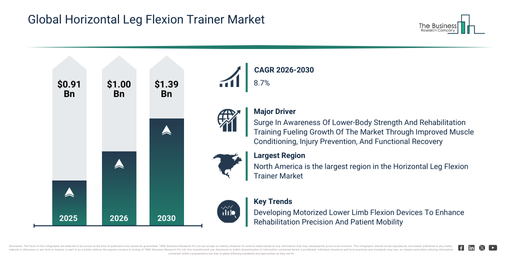
    The horizontal leg flexion trainer market has experienced significant growth in recent times. It is anticipated to expand from $0.91 billion in 2025 to $1.00 billion in 2026, demonstrating a compound annual growth rate (CAGR) of 9.0%. The historical increase can be ascribed to several factors, including the rising demand for fitness equipment in gyms, a burgeoning interest in lower-body strength training, enhanced awareness of injury prevention exercises, the increasing use of rehabilitation machines, and the growing appeal of sports conditioning programs.

    The market for horizontal leg flexion trainers is projected to experience substantial expansion in the coming years. This market is anticipated to reach a valuation of $1.39 billion by 2030, demonstrating a compound annual growth rate (CAGR) of 8.7%. Factors contributing to this growth during the forecast period include the expanding number of gym memberships, a heightened desire for enhanced leg strength, the integration of sophisticated rehabilitation tools, the rise of sports performance training programs, and greater capital expenditure on high-quality fitness machinery. Key developments expected over the forecast horizon involve progress in adjustable resistance technology, improvements in ergonomic machine aesthetics, advancements in durability and material science, novel compact training devices, and innovative tools for professional athletic preparation.

    Access Your Free Sample Report For In-Depth Market Analysis:

    https://www.thebusinessresearchcompany.com/sample.aspx?id=30609&type=smp

    Which Key Factors Are Driving The Horizontal Leg Flexion Trainer Market Growth?

    The expanding recognition of lower-body strength and rehabilitation training is anticipated to propel the horizontal leg flexion trainer market forward. This training involves structured exercises and programs aimed at enhancing the strength, flexibility, and functional recovery of leg muscles, including the quadriceps, hamstrings, and hip flexors. This heightened understanding is fueled by increasing public health initiatives and clinical recommendations that stress the importance of muscle-strengthening activities for injury prevention, improved mobility, and overall physical health. Horizontal leg flexion trainers support this development by providing a controlled, low-impact option for lower-body strengthening and rehabilitation, particularly in clinical, physiotherapy, and specialized fitness settings, aligning with broader exercise guidelines. For instance, in December 2023, according to the U.S. Centers for Disease Control and Prevention (CDC), a U.S.-based government public health authority, 24% of adults met the recommended muscle-strengthening activity guidelines in 2023, up from 21% in 2022—an increase of 3 percentage points, or approximately 14% year-over-year. Thus, the growing awareness surrounding lower-body strength and rehabilitation training is significantly contributing to the expansion of the horizontal leg flexion trainer market.

    How Is The Horizontal Leg Flexion Trainer Market Broken Down By Segment Categories?

    The horizontal leg flexion trainer market covered in this report is segmented –

    1) By Product Type: Standard Horizontal Leg Flexion Trainers, Smart Horizontal Leg Flexion Trainers, Adjustable Horizontal Leg Flexion Trainers

    2) By Distribution Channel: Online Stores, Specialty Stores, Supermarkets Or Hypermarkets, Other Distribution Channels

    3) By Application: Rehabilitation Centers, Fitness Centers, Home Use, Hospitals, Other Applications

    4) By End-User: Adults, Geriatric, Athletes, Other End-Users

    Subsegments:

    1) By Standard Horizontal Leg Flexion Trainers: Plate-loaded trainers, Pin-loaded (selectorized) trainers, Fixed-resistance trainers, Standard gym-grade benches, Basic home-use flexion trainers, Non-digital resistance trainers, Single-function flexion machines

    2) By Smart Horizontal Leg Flexion Trainers: App-connected trainers, Bluetooth-enabled trainers, AI-guided training systems, Smart resistance-adjusting machines, Performance-tracking trainers, Cloud-integrated fitness units, Interactive screen-based trainers

    3) By Adjustable Horizontal Leg Flexion Trainers: Multi-resistance adjustable trainers, Adjustable angle or seat-position trainers, Multi-function strength machines with flexion mode, Manual-adjust resistance models, Hydraulic-adjustable trainers, Commercial-grade adjustable units, Adjustable home-use trainers

    Which Trends Are Guiding The Direction Of The Horizontal Leg Flexion Trainer Market?

    Leading firms in the rehabilitation and therapeutic exercise equipment market are increasingly concentrating on creating motorized solutions for lower limb flexion, encompassing multifunction physiotherapy devices that feature powered leg flexion systems. The design intent behind these solutions is to provide accurate and consistent leg flexion movements, aid in enhancing patient strength and mobility, and lessen the physical burden on therapists during rehabilitation sessions. Specifically, powered leg flexion systems are technological components within rehabilitation equipment that employ electric motors or actuators to execute controlled flexion and extension of the lower limbs, thereby facilitating standardized therapy procedures and reliable treatment provision. An illustrative example is AGILIS, a U.S.-based medical device company, which introduced multifunction physiotherapy tables with powered lower limb flexion systems in January 2025, having received U.S. FDA 510(k)-clearance for clinical application. These devices, intended for postoperative rehabilitation support and enhancing mobility, incorporate 24 Vdc electric motors to ensure consistent powered flexion, provide choices for both manual and electrical adjustments, and permit configurations for linear and rotational lower limb movements to meet specific individualized therapy needs.

    Which Players Are Present In The Horizontal Leg Flexion Trainer Market Space?

    Major companies operating in the horizontal leg flexion trainer market are Johnson Health Tech, Technogym SpA, Life Fitness Inc., Rogue Fitness, Precor Inc., Cybex International, Impulse Health Tech, Matrix Fitness, SportsArt Inc., Shuhua Co. Ltd., Panatta Srl, Body-Solid Inc., TRUE Fitness Technology Inc., HOIST Fitness Systems Inc., BH Fitness, Yanre Fitness, DHZ Fitness GmbH, Nautilus Inc., Unique Gym Equipment Pvt. Ltd., Kraftathlet

    Get The Full Horizontal Leg Flexion Trainer Market Report:

    https://www.thebusinessresearchcompany.com/report/horizontal-leg-flexion-trainer-market-report

    Which Region Leads The Horizontal Leg Flexion Trainer Market In Overall Market Size?

    North America was the largest region in the horizontal leg flexion trainer market in 202. Asia-Pacific is expected to be the fastest-growing region in the forecast period. The regions covered in the horizontal leg flexion trainer market report are Asia-Pacific, South East Asia, Western Europe, Eastern Europe, North America, South America, Middle East, Africa.

    Request A Customized Horizontal Leg Flexion Trainer Market Report For Competitive Insights:

    https://www.thebusinessresearchcompany.com/customise?id=30609&type=smp

    Browse Through More Reports Similar to the Global Horizontal Leg Flexion Trainer Market 2026, By The Business Research Company

    Personal Fitness Trainer Market Report 2026

    https://www.thebusinessresearchcompany.com/report/personal-fitness-trainer-global-market-report

    Foot And Ankle Devices Market Report 2026

    https://www.thebusinessresearchcompany.com/report/foot-and-ankle-devices-global-market-report

    flexion tires global market report

    https://www.thebusinessresearchcompany.com/report/flexion-tires-global-market-report

    Get in touch with us:

    The Business Research Company: https://www.thebusinessresearchcompany.com/

    Americas +1 310-496-7795

    Asia +44 7882 955267 & +91 8897263534

    Europe +44 7882 955267

    Email us at info@tbrc.info

    Follow us on:

    LinkedIn: https://in.linkedin.com/company/the-business-research-company

    YouTube: https://www.youtube.com/channel/UC24_fI0rV8cR5DxlCpgmyFQ

    Global Market Model: https://www.thebusinessresearchcompany.com/global-market-model
  • High-Throughput Slide Scanning-As-A-Service  Market Revenue Growth Forecast To Reach $3.19 Billion By 2030 At 16.4% CAGR

    High-Throughput Slide Scanning-As-A-Service Market Revenue Growth Forecast To Reach $3.19 Billion By 2030 At 16.4% CAGR

    The Business Research Company’s 2026 market reports feature enhanced tools like market attractiveness analysis, TAM assessment, and company scoring matrices, along with interactive dashboards, deeper supply chain insights, and startup coverage strengthening the depth, usability, and strategic value of insights.

    How Much Will The Market Value Of The High-Throughput Slide Scanning-As-A-Service Market Grow Between 2026 And 2030?

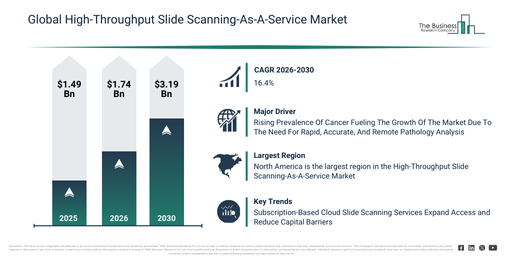
    The high-throughput slide scanning-as-a-service market has seen rapid expansion in recent years. It is anticipated to grow from $1.49 billion in 2025 to $1.74 billion in 2026, achieving a compound annual growth rate (CAGR) of 16.7%. The historical increase in this market can be attributed to several factors: the rising adoption of digital pathology, an escalating demand for high-throughput scanning, increased investment in pharmaceutical research, the broadening of academic and research applications, and the growing integration of AI into pathology workflows.

    The high-throughput slide scanning-as-a-service market is projected to experience substantial expansion over the upcoming years. This market is anticipated to reach a valuation of $3.19 billion by 2030, exhibiting a compound annual growth rate (CAGR) of 16.4%. Factors contributing to this growth during the forecast period include the escalating requirement for remote diagnostics, the increased uptake of telepathology services, the surging demand for multiplexed imaging, the expansion of cloud-based slide platforms, and a heightened emphasis on precision medicine applications. Additionally, key trends shaping the market over the forecast period encompass technological progress in AI-powered image analysis, novel developments in cloud-based digital slide platforms, the evolution of whole slide imaging for high-throughput scanning, significant research breakthroughs in automated pathology workflows, and enhancements in multiplexed fluorescence imaging techniques.

    Access Your Free Sample Report For In-Depth Market Analysis:

    https://www.thebusinessresearchcompany.com/sample.aspx?id=30606&type=smp

    What Key Drivers Are Fueling The Growth Of The High-Throughput Slide Scanning-As-A-Service Market?

    The increasing occurrence of cancer is projected to fuel the expansion of the high-throughput slide scanning-as-a-service market in the future. Cancer is defined by the unchecked proliferation and dissemination of atypical cells, which can harm adjacent tissues and organs without effective intervention. The rise in cancer cases stems from lifestyle factors like unhealthy eating, tobacco use, drinking alcohol, and exposure to environmental contaminants, which heighten the likelihood of developing different types of cancer. High-throughput slide scanning-as-a-service aids in cancer management through the swift digitization of numerous pathology slides, facilitating in-depth analysis and distant expert consultation. This service enhances diagnostic precision and operational speed, allowing for prompt treatment choices and improved results for patients. For example, in October 2025, data from NHS Digital, a UK government organisation, showed 354,820 new cancer diagnoses in England during 2023. This equated to an average of 972 diagnoses daily and marked an increase of 8,605 cases over 2022. Prostate cancer was the most frequently diagnosed, accounting for 58,137 new cases, which signifies a 6% rise in registrations compared to the prior year. Consequently, the growing incidence of cancer is propelling the expansion of the high-throughput slide scanning-as-a-service market.

    How Is The High-Throughput Slide Scanning-As-A-Service Market Organized By Segment Classification?

    The high-throughput slide scanning-as-a-service market covered in this report is segmented –

    1) By Service Type: Brightfield Scanning, Fluorescence Scanning, Multiplexed Imaging, Other Service Types

    2) By Technology: Optical System, Automation Level, Scanning Resolution

    3) By Application: Pathology, Research, Drug Discovery, Clinical Diagnostics, Other Applications

    4) By End User: Hospitals And Clinics, Research Institutes, Pharmaceutical And Biotechnology Companies, Other End Users

    Subsegments:

    1) By Brightfield Scanning: Single Channel Brightfield, Multi-Channel Brightfield, High-Resolution Brightfield

    2) By Fluorescence Scanning: Single Fluorescence Channel, Multi-Fluorescence Channel, High-Sensitivity Fluorescence

    3) By Multiplexed Imaging: Sequential Multiplexing, Simultaneous Multiplexing, High-Plex Imaging

    4) By Other Service Types: Slide Quality Control, Tissue Morphology Analysis, Custom Imaging Services

    What Trends Are Influencing The High-Throughput Slide Scanning-As-A-Service Market?

    Leading companies within the high-throughput slide scanning-as-a-service market are concentrating on creating subscription-based offerings, such as cloud-enabled slide scanning service models. These services aim to provide remote access to high-throughput whole slide imaging, thereby eliminating the need for on-site infrastructure investments. Cloud-enabled slide scanning service models involve outsourcing whole-slide imaging, where glass slides are digitized and securely stored on cloud platforms, facilitating remote viewing, sharing, and analysis without the necessity of on-premise scanners or dedicated IT infrastructure. For example, in March 2023, OptraSCAN Inc., a US-based digital pathology solutions provider, launched OnDemand Digital Pathology. This cloud-enabled slide scanning service model offers subscription-based access to whole slide scanners that can load 15–480 slides and perform rapid scanning. Specifically, it provides access to OptraSCAN whole-slide digital scanners (both brightfield and fluorescence) with a 15–480 slide capacity, capable of scanning a slide in approximately 58 seconds at 40x. The service also includes a high-end workstation preconfigured with workflow software, telepathology tools, and AI analysis modules for IHC, morphology, immunofluorescence, and cytology, complemented by Microsoft Azure–based cloud storage and continuous support.

    Who Are The Industry Participants Involved In The High-Throughput Slide Scanning-As-A-Service Market?

    Major companies operating in the high-throughput slide scanning-as-a-service market are Koninklijke Philips N.V., IQVIA Holdings Inc., Laboratory Corporation of America Holdings, Roche Diagnostics International AG, Iron Mountain Incorporated, WuXi AppTec Co. Ltd., PerkinElmer Inc., Leica Biosystems Nussloch GmbH, Medical Imaging Solutions Pvt. Ltd., Charles River Laboratories International Inc., OptraSCAN Inc., Scopio Labs Inc., Pramana Inc., Molecular Pathology Laboratory Network Inc., 3DHISTECH Ltd., Experimental Pathology Laboratories Inc., Labtron Equipment Ltd., Applied Spectral Imaging Ltd., HistoWiz Inc., iHisto LLC

    Get The Full High-Throughput Slide Scanning-As-A-Service Market Report:

    https://www.thebusinessresearchcompany.com/report/high-throughput-slide-scanning-as-a-service-market-report

    Which Geographic Region Dominates The High-Throughput Slide Scanning-As-A-Service Market?

    North America was the largest region in the high-throughput slide scanning-as-a-service market in 2025. Asia-Pacific is expected to be the fastest-growing region in the forecast period. The regions covered in the high-throughput slide scanning-as-a-service market report are Asia-Pacific, South East Asia, Western Europe, Eastern Europe, North America, South America, Middle East, Africa.

    Request A Customized High-Throughput Slide Scanning-As-A-Service Market Report For Competitive Insights:

    https://www.thebusinessresearchcompany.com/customise?id=30606&type=smp

    Browse Through More Reports Similar to the Global High-Throughput Slide Scanning-As-A-Service Market 2026, By The Business Research Company

    Plasticizers Market Report 2026

    https://www.thebusinessresearchcompany.com/report/plasticizers-global-market-report

    Bio Plasticizers Market Report 2026

    https://www.thebusinessresearchcompany.com/report/bio-plasticizers-global-market-report

    plastic products global market report

    https://www.thebusinessresearchcompany.com/report/plastic-products-global-market-report

    Get in touch with us:

    The Business Research Company: https://www.thebusinessresearchcompany.com/

    Americas +1 310-496-7795

    Asia +44 7882 955267 & +91 8897263534

    Europe +44 7882 955267

    Email us at info@tbrc.info

    Follow us on:

    LinkedIn: https://in.linkedin.com/company/the-business-research-company

    YouTube: https://www.youtube.com/channel/UC24_fI0rV8cR5DxlCpgmyFQ

    Global Market Model: https://www.thebusinessresearchcompany.com/global-market-model

  • Highly Functional Plasticizer  Market Expected To Grow Steadily And Approach $3.37 Billion By 2030

    Highly Functional Plasticizer Market Expected To Grow Steadily And Approach $3.37 Billion By 2030

    The Business Research Company’s 2026 market reports feature enhanced tools like market attractiveness analysis, TAM assessment, and company scoring matrices, along with interactive dashboards, deeper supply chain insights, and startup coverage strengthening the depth, usability, and strategic value of insights.

    What Changes In Market Value Are Expected For The Highly Functional Plasticizer Market Over The 2026–2030 Period?

    The market size for highly functional plasticizers has experienced significant expansion in recent years. It is anticipated to increase from $2.21 billion in 2025 to $2.41 billion in 2026, reflecting a compound annual growth rate (CAGR) of 9.1%. This historical growth can be ascribed to a surge in demand for flexible polymers, the increasing utilization of non-polyvinyl chloride resins, a heightened need for heat resistant materials, the broadening of the automotive and construction sectors, and a growing understanding of environmentally friendly plasticizers.

    The highly functional plasticizer market is projected to experience robust expansion in the coming years. This market is set to reach $3.38 billion by 2030, exhibiting a compound annual growth rate (CAGR) of 8.8%. Several factors are expected to drive this growth during the forecast period, including the increased use of high-performance plasticizers in developing economies, the rising need for lightweight materials across the automotive and aerospace sectors, the growing demand for sustainable and recyclable polymers, the expansion of the electronics and packaging industries, and evolving regulations that favor non-toxic plasticizers. Key trends anticipated during the same period encompass technological progress in polymer compatibility, breakthroughs in bio-based plasticizers, the evolution of high-temperature resistant formulations, advancements in multifunctional additives through research and development, and ongoing enhancements in flow and processing attributes.

    Access Your Free Sample Report For In-Depth Market Analysis:

    https://www.thebusinessresearchcompany.com/sample.aspx?id=30605&type=smp

    Which Drivers Are Supporting The Highly Functional Plasticizer Market Growth?

    The increasing need for lightweight vehicles is anticipated to boost the highly functional plasticizer market in the coming years. Such vehicles are automobiles constructed with lighter substances like aluminum, high-strength steel, carbon fiber, and composites to decrease their total mass. This demand stems from a greater emphasis on fuel economy and lower emissions. Highly functional plasticizers improve lightweight vehicles by enhancing the flexibility, strength, and durability of their polymer parts. These plasticizers allow for reduced material weight while upholding performance, thus contributing to improved fuel efficiency, handling, and overall vehicle effectiveness. As an illustration, in December 2024, data from the American Chemistry Council, a US-based trade association, indicated that an average automobile includes 429 pounds of plastics and polymer composites, making up 9.7% of the vehicle’s total weight, with polypropylene content per vehicle growing from 97 pounds in 2022 to 100 pounds in 2023. Consequently, the rising demand for lightweight vehicles is propelling the expansion of the highly functional plasticizer market. Increased construction activities are predicted to drive the expansion of the highly functional plasticizer market in the future. These activities encompass various actions involved in building, modifying, or removing structures, as well as site preparation. The surge in construction is a result of increasing urbanization, which fuels the need for new residential and commercial developments. Highly functional plasticizers enhance construction efforts by boosting the workability, durability, and strength of concrete and other construction substances. They contribute to greater efficiency and superior quality by facilitating simpler mixing, improved flow, and minimized cracking, thereby supporting quicker and more dependable construction methods. For example, in July 2023, data from the Australian Bureau of Statistics, an Australia-based government organization, showed that the number of dwellings under construction climbed to 240,813 in 2023, an increase from 240,065 in 2022. Thus, the escalating construction activities are propelling the growth of the highly functional plasticizer market.

    Which Segments Define The Highly Functional Plasticizer Market Segment Structure?

    The highly functional plasticizer market covered in this report is segmented –

    1) By Type: Oil Dosage Form, Solid Dosage Form, Liquid Dosage Form, Other Types

    2) By Application: Polyamide, Polyvinyl Chloride, Rubber, Urethane Based Materials, Acrylic Materials, Polyethylene Terephthalate, Polycarbonate, Other Applications

    3) By End User: Automotive, Construction, Electronics, Packaging, Consumer Goods, Industrial Equipment, Other End Users

    Subsegments:

    1) By Oil Dosage Form: Epoxidized Vegetable Oil Plasticizers, Aromatic Oil–Based Plasticizers, Naphthenic Oil–Based Plasticizers, Paraffinic Oil–Based Plasticizers

    2) By Solid Dosage Form: Tablets, Capsules, Granules, Powders

    3) By Liquid Dosage Form: Solutions, Suspensions, Emulsions, Syrups

    4) By Other Types: Gels, Pastes, Patches, Inhalable Formulations

    Which Trends Are Expected To Impact The Highly Functional Plasticizer Market?

    Major companies in the highly functional plasticizer market are concentrating on developing advanced products, such as next-generation high-temperature-resistant plasticizers, to improve thermal stability, decrease volatility, and minimize migration in polymer applications. These next-generation high-temperature resistant plasticizers refer to newer, often bio-based or non-phthalate additives, engineered to provide flexibility and processability in plastics while concurrently reducing toxicity, environmental impact, and migration compared to conventional plasticizers. For instance, in April 2023, Evonik Industries AG, a Germany-based specialty chemicals company, launched ELATUR TM, a high-temperature resistant plasticizer designed for dashboards, car seats, steering wheel trims, and high-temperature cabling. It offers superior thermal performance, extended service life, and enhanced product reliability, also supporting customers through the myFLEXINO® portal for technical information, samples, and application guidance.

    Who Are The Established Players Within The Highly Functional Plasticizer Market?

    Major companies operating in the highly functional plasticizer market are BASF SE, Dow Inc., LG Chem Ltd., Mitsubishi Chemical Corporation, Evonik Industries AG, Kao Corporation, Arkema S.A., Eastman Chemical Company, DIC Corporation, Stepan Company, Toagosei Co. Ltd., SONGWON Industrial Co. Ltd., LANXESS AG, Jiangsu Zhengdan Chemical Industry Co. Ltd., The HallStar Co., KLJ Group, Nishant Organics, Hebei Jingu Plasticizer Co. Ltd., Nayakem Organics Pvt Ltd.

    Get The Full Highly Functional Plasticizer Market Report:

    https://www.thebusinessresearchcompany.com/report/highly-functional-plasticizer-market-report

    Which Region Is The Leading Market For The Highly Functional Plasticizer Market?

    Asia-Pacific was the largest region in the highly functional plasticizer market in 2025. North America is expected to be the fastest-growing region in the forecast period. The regions covered in the highly functional plasticizer market report are Asia-Pacific, South East Asia, Western Europe, Eastern Europe, North America, South America, Middle East, Africa.

    Request A Customized Highly Functional Plasticizer Market Report For Competitive Insights:

    https://www.thebusinessresearchcompany.com/customise?id=30605&type=smp

    Browse Through More Reports Similar to the Global Highly Functional Plasticizer Market 2026, By The Business Research Company

    Whole Slide Imaging Market Report 2026

    https://www.thebusinessresearchcompany.com/report/whole-slide-imaging-global-market-report

    Document Scanning Services Market Report 2026

    https://www.thebusinessresearchcompany.com/report/document-scanning-services-global-market-report

    3D laser scanning services global market report

    https://www.thebusinessresearchcompany.com/report/3d-laser-scanning-services-global-market-report

    Get in touch with us:

    The Business Research Company: https://www.thebusinessresearchcompany.com/

    Americas +1 310-496-7795

    Asia +44 7882 955267 & +91 8897263534

    Europe +44 7882 955267

    Email us at info@tbrc.info

    Follow us on:

    LinkedIn: https://in.linkedin.com/company/the-business-research-company

    YouTube: https://www.youtube.com/channel/UC24_fI0rV8cR5DxlCpgmyFQ

    Global Market Model: https://www.thebusinessresearchcompany.com/global-market-model

  • Health Patch Hydration Sensor  Market Expansion Forecast Reaching $13.54 Billion By 2030 At 16% CAGR

    Health Patch Hydration Sensor Market Expansion Forecast Reaching $13.54 Billion By 2030 At 16% CAGR

    The Business Research Company’s 2026 market reports feature enhanced tools like market attractiveness analysis, TAM assessment, and company scoring matrices, along with interactive dashboards, deeper supply chain insights, and startup coverage strengthening the depth, usability, and strategic value of insights.

    By 2030, What Market Size Is The Health Patch Hydration Sensor Market Expected To Reach Based On Its 2026 Value?

    The health patch hydration sensor market size has expanded rapidly over recent years. It is expected to grow from $6.45 billion in 2025 to $7.50 billion in 2026, reflecting a compound annual growth rate (CAGR) of 16.2%. This past growth can be attributed to an increased awareness of health risks associated with dehydration, the growing acceptance of wearable health technologies, a rise in monitoring for sports and athletic performance, the expansion of personalized wellness tracking, and increasing digitization within healthcare.

    The health patch hydration sensor market is projected for significant expansion in the coming years. This market is anticipated to reach $13.55 billion by 2030, exhibiting a compound annual growth rate (CAGR) of 16.0%. This expansion during the forecast period is driven by factors such as the greater integration of AI and machine learning, increased uptake in remote patient monitoring, the growing emphasis on industrial and occupational safety monitoring, broader applications in military and defense, and intensified research and development efforts in wearable hydration sensors. Key trends expected over the forecast period encompass technological progress in biosensing and microfluidics, novel developments in flexible and stretchable electronics, the evolution of cloud-based analytics platforms, ongoing research and development in integrating multi-biomarker sensors, and advancements in mobile application-driven hydration insights.

    Access Your Free Sample Report For In-Depth Market Analysis:

    https://www.thebusinessresearchcompany.com/sample.aspx?id=30601&type=smp

    What Key Factors Are Affecting The Health Patch Hydration Sensor Market Demand?

    The health patch hydration sensor market is projected to expand due to the increasing integration of remote patient monitoring. Remote patient monitoring involves utilizing digital tools to track and collect medical and other health information from patients, which is then sent electronically to healthcare providers for evaluation and, if needed, guidance and instructions. The uptake of remote patient monitoring is on the rise as healthcare providers and payers increasingly depend on continuous data collected at home to manage chronic conditions more actively, decrease hospital readmissions, and reduce overall healthcare expenditures. Health patch hydration sensors facilitate remote patient monitoring by constantly monitoring hydration levels and transmitting real-time information to medical professionals. These sensors enhance patient care by enabling prompt identification of dehydration risks and supporting timely, individualized interventions. For example, in September 2025, the U.S. Department of Health and Human Services Office of Inspector General (OIG), a US-based government agency, reported that payments for remote patient monitoring amounted to $536 million across Original Medicare, also known as Medicare fee for service, and Medicare Advantage, showing a 31% increase from 2023. Concurrently, close to 1 million Medicare enrollees utilized remote patient monitoring services, reflecting a 27% increase compared with 2023. Consequently, the expanding application of remote patient monitoring is fostering the growth of the health patch hydration sensor market.

    How Is The Health Patch Hydration Sensor Market Segmented Across Different Segment Categories?

    The health patch hydration sensor market covered in this report is segmented –

    1) By Product Type: Wearable Hydration Sensors, Disposable Hydration Patches, Reusable Hydration Patches

    2) By Sensor Technology: Electrochemical, Optical, Bioimpedance, Other Technologies

    3) By Distribution Channel: Online Stores, Pharmacies, Specialty Stores, Other Channels

    4) By Application: Healthcare And Clinical Monitoring, Sports Performance And Athlete Training, Wellness And Fitness Tracking, Remote Patient Management

    5) By End-User: Hospitals And Clinics, Home Care, Athletes, Military Personnel, Other End Users

    Subsegments:

    1) By Wearable Hydration Sensors: Skin-Contact Sensor Units, Smart Hydration Monitoring Bands, Integrated Sweat-Analysis Sensors, Flexible Patch-Based Sensor Modules, Continuous Hydration Tracking Devices

    2) By Disposable Hydration Patches: Single-Use Sweat Measurement Patches, Adhesive Moisture-Sensing Patches, Biodegradable Hydration Monitoring Patches, Pre-Calibrated Disposable Sensor Patches, Short-Duration Wear Hydration Patches

    3) By Reusable Hydration Patches: Rechargeable Hydration Tracking Patches, Washable Sensor-Embedded Patches, Multi-Use Sweat-Analysis Patches, Long-Life Flexible Hydration Patches, Refillable Sensor Cartridge Patches

    What Trends Are Influencing Changes In The Health Patch Hydration Sensor Market?

    Major companies in the health patch hydration sensor market are concentrating on creating sophisticated products, such as advanced sweat-sensing biowearables, equipped with extended battery life and predictive analytics to enhance worker safety in extreme environments. These advanced sweat-sensing biowearables incorporate multiple biosensors to monitor sweat volume loss, electrolyte depletion, skin temperature, and motion. They leverage machine learning algorithms to provide real-time haptic alerts and personalized hydration strategies, thereby preventing dehydration and heat-related illnesses among industrial workforces. For instance, in April 2024, Epicore Biosystems Inc., a US-based digital health company specializing in advanced sweat-sensing wearables, introduced Connected Hydration. This sweat-sensing biowearable is designed to safeguard industrial athletes by delivering real-time insights on fluid and electrolyte intake via a flexible wearable patch and mobile app, incorporating a battery life of over 1,000 hours and a secure cloud engine trained on 420,000 data points. The solution also features intrinsically safe design certification (Class I, Div 2) and seamless data dashboarding to accelerate proactive safety management across the energy, construction, and manufacturing sectors.

    Which Organizations Play A Role In The Health Patch Hydration Sensor Market Landscape?

    Major companies operating in the health patch hydration sensor market are Henkel AG & Co. KGaA, TE Connectivity plc, Covestro AG, The Gatorade Co., Nitto Denko Corporation, Masimo Corporation, Linxens Holding SAS, Scapa Healthcare Limited, Quad Industries Inc., Biotricity Inc., Nix Inc., Mode Sensors, FLOWBIO LTD, Xsensio SA, ZANSORS LLC, Wearoptimo Pty Ltd., hDrop Technologies Inc., GraphWear Technologies, Grapheal SAS, EQUIVITAL LIMITED, GENTAG Inc., Kenzen Inc.

    Get The Full Health Patch Hydration Sensor Market Report:

    https://www.thebusinessresearchcompany.com/report/health-patch-hydration-sensor-market-report

    Where Is The Health Patch Hydration Sensor Market Primarily Concentrated By Region?

    North America was the largest region in the health patch hydration sensor market in 2025. Asia-Pacific is expected to be the fastest-growing region in the forecast period. The regions covered in the health patch hydration sensor market report are Asia-Pacific, South East Asia, Western Europe, Eastern Europe, North America, South America, Middle East, Africa.

    Request A Customized Health Patch Hydration Sensor Market Report For Competitive Insights:

    https://www.thebusinessresearchcompany.com/customise?id=30601&type=smp

    Browse Through More Reports Similar to the Global Health Patch Hydration Sensor Market 2026, By The Business Research Company

    Health Sensors Market Report 2026

    https://www.thebusinessresearchcompany.com/report/health-sensors-global-market-report

    Fluid Sensors Market Report 2026

    https://www.thebusinessresearchcompany.com/report/fluid-sensors-global-market-report

    disposable medical sensors global market report

    https://www.thebusinessresearchcompany.com/report/disposable-medical-sensors-global-market-report

    Get in touch with us:

    The Business Research Company: https://www.thebusinessresearchcompany.com/

    Americas +1 310-496-7795

    Asia +44 7882 955267 & +91 8897263534

    Europe +44 7882 955267

    Email us at info@tbrc.info

    Follow us on:

    LinkedIn: https://in.linkedin.com/company/the-business-research-company

    YouTube: https://www.youtube.com/channel/UC24_fI0rV8cR5DxlCpgmyFQ

    Global Market Model: https://www.thebusinessresearchcompany.com/global-market-model
  • Hand Hygiene Smart Badges With Real-Time Location System (RTLS)  Market Growth Expected To Reach $1.7 Billion By 2030 At 14.7% CAGR

    Hand Hygiene Smart Badges With Real-Time Location System (RTLS) Market Growth Expected To Reach $1.7 Billion By 2030 At 14.7% CAGR

    The Business Research Company’s 2026 market reports feature enhanced tools like market attractiveness analysis, TAM assessment, and company scoring matrices, along with interactive dashboards, deeper supply chain insights, and startup coverage strengthening the depth, usability, and strategic value of insights.

    What Level Of Market Value Growth Is Predicted For The Hand Hygiene Smart Badges With Real-Time Location System (RTLS) Market From 2026 To 2030?

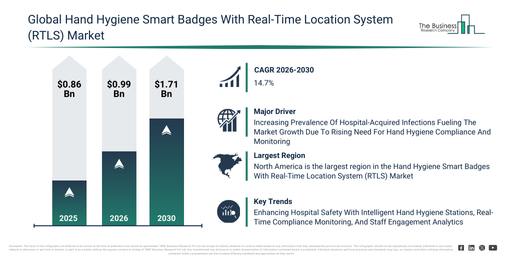
    The market size for hand hygiene smart badges with real-time location system (RTLS) has witnessed significant expansion in recent years. It is anticipated to grow from $0.86 billion in 2025 to $0.99 billion in 2026, exhibiting a compound annual growth rate (CAGR) of 15.0%. The expansion observed in the past can be credited to heightened infection control awareness, the increasing implementation of hospital hygiene protocols, a growing need for real-time compliance tracking, the broader rollout of healthcare digitalization programs, and an intensified emphasis on patient safety regulations.

    The market for hand hygiene smart badges equipped with real-time location systems (RTLS) is set for significant expansion in the coming years. This sector is forecast to expand to $1.71 billion by 2030, demonstrating a compound annual growth rate (CAGR) of 14.7%. The anticipated growth during this period is driven by the increasing integration of RTLS in hygiene monitoring, a rise in investments towards smart healthcare infrastructure, the broader adoption of wearable compliance solutions, a growing necessity for automated infection prevention systems, and the rising demand for data-driven hygiene analytics. Prominent trends throughout the forecast period include technological improvements in wearable hygiene devices, advancements in RTLS communication systems, progress in AI-enabled hygiene monitoring, ongoing research and development in sensor-based compliance tools, and enhancements in smart hospital automation systems.

    Access Your Free Sample Report For In-Depth Market Analysis:

    https://www.thebusinessresearchcompany.com/sample.aspx?id=30598&type=smp

    Which Important Drivers Are Guiding The Hand Hygiene Smart Badges With Real-Time Location System (RTLS) Market Growth?

    The growing occurrence of hospital-acquired infections (HAIs) is anticipated to propel the expansion of the hand hygiene smart badges with real-time location system (RTLS) market. These infections, contracted by patients while receiving care in hospitals or healthcare facilities, pose a substantial risk to patient safety and overall healthcare outcomes. The elevated prevalence of HAIs stems from persistent pathogen transmission in clinical settings and inconsistent hand hygiene practices among healthcare workers. Hand hygiene smart badges with RTLS aid in managing HAIs by providing continuous, automated monitoring of hand hygiene compliance, thereby reducing the spread of infections and enhancing accountability. For instance, in May 2024, the European Centre for Disease Prevention and Control (ECDC), a Sweden-based public health agency, reported that an estimated 4.3 million patients in acute care hospitals acquired at least one healthcare-associated infection during 2022–2023, reflecting a significant burden on healthcare systems. Consequently, the rising prevalence of hospital-acquired infections is driving the growth of the hand hygiene smart badges with real-time location system (RTLS) market.

    What Segment Categories Shape The Hand Hygiene Smart Badges With Real-Time Location System (RTLS) Market Segment Landscape?

    The hand hygiene smart badges with real-time location system (rtls) market covered in this report is segmented –

    1) By Product Type: Wearable Badges, Clip-On Badges, Wristbands, Other Product Types

    2) By Technology: Bluetooth, Radio Frequency Identification, Wi-Fi, Other Technologies

    3) By Distribution Channel: Direct Sales, Distributors, Online Stores, Other Distribution Channels

    4) By Application: Hospitals, Clinics, Long-Term Care Facilities, Laboratories, Other Applications

    5) By End-User: Healthcare Providers, Patients, Visitors, Other End-Users

    Subsegments:

    1) By Wearable Badges: Wrist Worn Badges, Arm Bands, Finger Bands

    2) By Clip-On Badges: Lanyard Clips, Badge Clips, Pocket Clips

    3) By Wristbands: Silicone Wristbands, Fabric Wristbands, Plastic Wristbands

    4) By Other Product Types: Keychain Badges, Badge Holders, Multifunctional Badges

    What Trends Are Influencing The Evolution Of The Hand Hygiene Smart Badges With Real-Time Location System (RTLS) Market?

    Major companies operating in the hand hygiene smart badges with real-time location system (RTLS) market are concentrating on developing sophisticated solutions, such as real-time compliance monitoring and staff engagement tools. These initiatives aim to enhance infection control, boost adherence to hygiene protocols, and provide actionable insights into healthcare workflows. Real-time compliance monitoring and staff engagement tools are defined as integrated systems designed to track hand hygiene behavior across facilities, offer immediate feedback to healthcare workers, and deliver analytics that support continuous improvement and risk reduction. For instance, in July 2024, Kontakt.io Inc., a US-based healthcare technology company, launched a next-generation hand hygiene solution intended to reimagine how hospitals manage compliance and engage staff. This fully cloud-based system, delivered as a managed service, features a patented approach employing the Staff-Safe-enabled Smart Badge 3 wearable to provide gentle, proactive reminders before patient care without disrupting workflow. It also includes compliance gamification via a mobile app and automated dispenser management, allowing for seamless monitoring and maintenance without manual intervention. Additionally, the solution incorporates interaction-based contact tracing and simplified audit reporting, which extends its value to infection prevention teams and aids in reducing operational costs for healthcare systems.

    Who Are The Companies Operating Across The Hand Hygiene Smart Badges With Real-Time Location System (RTLS) Market Value Chain?

    Major companies operating in the hand hygiene smart badges with real-time location system (rtls) market are Cisco Systems Inc., Ecolab Inc., GE Healthcare, Zebra Technologies Corporation, Halma plc, Midmark Corporation, GOJO Industries Inc., Ascom Holding AG, Versus Technology Inc., Vigilant Technologies Inc., CenTrak Inc., AeroScout Inc., Kontakt.io Inc., Elpas Solutions, SwipeSense Inc., AiRISTA Flow Inc., Proventix Systems Inc., Stanley Healthcare, BioVigil Hygiene Technologies Inc., HandGiene Corp.

    Get The Full Hand Hygiene Smart Badges With Real-Time Location System (RTLS) Market Report:

    https://www.thebusinessresearchcompany.com/report/hand-hygiene-smart-badges-with-real-time-location-system-rtls-market-report

    Which Region Holds The Highest Market Share In The Hand Hygiene Smart Badges With Real-Time Location System (RTLS) Market?

    North America was the largest region in the hand hygiene smart badges with real-time location system (RTLS) market in 2025. Asia-Pacific is expected to be the fastest-growing region in the forecast period. The regions covered in the hand hygiene smart badges with real-time location system (rtls) market report are Asia-Pacific, South East Asia, Western Europe, Eastern Europe, North America, South America, Middle East, Africa.

    Request A Customized Hand Hygiene Smart Badges With Real-Time Location System (RTLS) Market Report For Competitive Insights:

    https://www.thebusinessresearchcompany.com/customise?id=30598&type=smp

    Browse Through More Reports Similar to the Global Hand Hygiene Smart Badges With Real-Time Location System (RTLS) Market 2026, By The Business Research Company

    Real Time Location Systems Market Report 2026

    https://www.thebusinessresearchcompany.com/report/real-time-location-systems-global-market-report

    Real Time Location System In Healthcare Market Report 2026

    https://www.thebusinessresearchcompany.com/report/real-time-location-system-in-healthcare-global-market-report

    smart wearables global market report

    https://www.thebusinessresearchcompany.com/report/smart-wearables-global-market-report

    Get in touch with us:

    The Business Research Company: https://www.thebusinessresearchcompany.com/

    Americas +1 310-496-7795

    Asia +44 7882 955267 & +91 8897263534

    Europe +44 7882 955267

    Email us at info@tbrc.info

    Follow us on:

    LinkedIn: https://in.linkedin.com/company/the-business-research-company

    YouTube: https://www.youtube.com/channel/UC24_fI0rV8cR5DxlCpgmyFQ

    Global Market Model: https://www.thebusinessresearchcompany.com/global-market-model

  • The Rise Of Advancing High-Precision Slicing Systems To Boost Throughput And Material Quality Is Influencing The Diamond Wire Saw  Market

    The Rise Of Advancing High-Precision Slicing Systems To Boost Throughput And Material Quality Is Influencing The Diamond Wire Saw Market

    The Business Research Company’s 2026 market reports feature enhanced tools like market attractiveness analysis, TAM assessment, and company scoring matrices, along with interactive dashboards, deeper supply chain insights, and startup coverage strengthening the depth, usability, and strategic value of insights.

    How Much Will The Market Value Of The Diamond Wire Saw Market Grow Between 2026 And 2030?

    The diamond wire saw market has experienced significant expansion over recent years. Its value is projected to increase from $1.58 billion in 2025 to $1.71 billion by 2026, at a compound annual growth rate (CAGR) of 8.3%. This historical development can be ascribed to a heightened demand for photovoltaic wafer cutting, expanding semiconductor production, increased construction and stone processing activities, the wider adoption of precision cutting technologies, and the growing application of diamond wire saws in metal and glass cutting.

    The diamond wire saw market is projected to experience substantial expansion in the coming years, with an anticipated growth to $2.32 billion by 2030, reflecting a compound annual growth rate (CAGR) of 8.0%. This growth during the forecast period is driven by factors such as increased investments in advanced semiconductor and photovoltaic equipment, the expanding use of automated and smart wire saw systems, a greater emphasis on environmentally friendly and sustainable cutting methods, the widening scope of high-precision applications in electronics and aerospace sectors, and the escalating integration of IoT and AI for enhancing process optimization. Key trends expected within this period encompass technological progress in ultra-thin wire diameters, breakthroughs in diamond wire materials and coatings, the creation of automated and CNC-integrated multi-wire saw machines, ongoing research and development aimed at minimizing wire wear and operational expenses, and improvements in real-time monitoring and predictive maintenance through smart sensors.

    Access Your Free Sample Report For In-Depth Market Analysis:

    https://www.thebusinessresearchcompany.com/sample.aspx?id=30570&type=smp

    Which Drivers Are Supporting The Diamond Wire Saw Market Growth?

    The escalating need for semiconductor and photovoltaic wafer cutting is anticipated to drive the expansion of the diamond wire saw market in the coming years. Semiconductor and solar wafer cutting is defined as the process of slicing silicon and other wafer substrates with extreme dimensional precision and minimal surface imperfections, ensuring optimal performance and yield for semiconductor chips and solar cells. The application of this cutting method is increasing due to the rising demand for high-efficiency solar panels and advanced semiconductor devices. Diamond wire saw technology supports semiconductor and solar wafer cutting by enabling accurate, low-kerf slicing that adheres to contemporary wafer quality and efficiency standards. For instance, in October 2025, the International Energy Agency (IEA), a France-based intergovernmental organization, reported that new photovoltaic capacity installations reached a record high in 2024 with annual installations totaling 601 gigawatts, an increase from 465 gigawatts in 2023, pushing the cumulative global photovoltaic capacity beyond 2.2 terawatts by the start of 2025. Therefore, the growing demand for semiconductor and photovoltaic wafer cutting is fueling the growth of the diamond wire saw market. The expansion of mining and mineral processing activities is projected to propel the growth of the diamond wire saw market moving forward. Mining and mineral processing activities involve the extraction, cutting, and treatment of natural resources like metals, stones, and minerals for industrial and commercial purposes. The increase in these activities is attributed to rising global demand for metals and minerals, as well as the expansion of the construction and manufacturing sectors. Diamond wire saws aid mining and mineral processing operations by offering precise, efficient, and cost-effective cutting solutions for hard materials, which helps in reducing waste and improving operational productivity. For example, in April 2025, according to the British Geological Survey, a UK-based government-funded research body, lithium production in 2023 climbed 30% compared to 2022, cobalt production saw an increase of nearly 23%, and global nickel production grew 47% over the last five years. Consequently, the broadening scope of mining and mineral processing activities is driving the growth of the diamond wire saw market.

    How Is The Diamond Wire Saw Market Segmented Across Different Segment Categories?

    The diamond wire saw market covered in this report is segmented –

    1) By Product Type: Continuous Diamond Wire Saw, Multi-Wire Diamond Saw, Fixed And Single-Wire Diamond Saw, Demolition And Quarrying Wire Saw

    2) By Wire Diameter: Below 0.5 mm, 0.5–1 mm, Above 1 mm, Other Wire Diameters

    3) By Application: Semiconductor, Photovoltaic, Stone And Construction, Metal Cutting, Glass Cutting, Other Applications

    4) By End-User: Construction, Mining, Electronics, Automotive, Other End-Users

    Subsegments:

    1) By Continuous Diamond Wire Saw: High Precision Cutting, Stone Processing, Metal Cutting

    2) By Multi-Wire Diamond Saw: Block Cutting, Slab Cutting, Wire Recycling

    3) By Fixed and Single-Wire Diamond Saw: Construction Cutting, Industrial Cutting, Decorative Stone Cutting

    4) By Demolition and Quarrying Wire Saw: Rock Demolition, Concrete Demolition, Quarry Extraction

    Which Trends Are Expected To Impact The Diamond Wire Saw Market?

    Major companies operating in the diamond wire saw market are concentrating on developing sophisticated functionalities, such as vacuum and clamping fixation systems, to enhance throughput, improve cut surface quality, and accommodate a broader spectrum of hard and brittle materials in semiconductor and advanced manufacturing applications. A vacuum and clamping fixation system describes a work-holding arrangement that employs both negative pressure and mechanical clamps in combination to firmly immobilize a workpiece or anatomical structure, distributing forces uniformly for stable, precise processing or treatment while minimizing deformation or slippage. For instance, in August 2025, Jiann Sheng Machinery & Electric Industrial Co. Ltd. (JSEDM), a Taiwan-based precision equipment manufacturer, introduced a Diamond Wire Saw Machine. This advanced system features a multi-size compatible platform engineered for 6-inch, 8-inch, and 12-inch ingots, substantially reducing the necessity for multiple specialized machines. It integrates a vacuum and clamping fixation system and auto-raise functionality, enabling effortless incorporation into automated production lines without extensive manual input. Additionally, it offers a high feed rate and convenient access to cutting fluid, thereby extending tool life and decreasing operational costs for manufacturers in high-tech industries.

    Which Organizations Play A Role In The Diamond Wire Saw Market Landscape?

    Major companies operating in the diamond wire saw market are DISCO Corporation, Tyrolit Group, Henan Huanghe Whirlwind Co. Ltd., Asahi Diamond Industrial Co. Ltd., Precision Surfacing Solutions GmbH Co. KG, Bosun Tools Co. Ltd., WEC Group Ltd., Zhejiang Wanli Tools Group Co. Ltd., Takatori Corporation, Nakamura Choukou Co.Ltd., ILJIN Diamond Co.Ltd., Nanjing Sanchao Advanced Materials Co. Ltd., HCT Co. Ltd., Wellsaw Inc., MTI Corporation, Dellas S.p.A., Logitech Ltd., Komatsu NTC Ltd., Logomatic GmbH, Sunnywell Diamond Technology Co. Ltd., Solga Diamant S.A., Linton Technologies

    Get The Full Diamond Wire Saw Market Report:

    https://www.thebusinessresearchcompany.com/report/diamond-wire-saw-market-report

    Which Region Accounts For The Largest Portion Of The Diamond Wire Saw Market?

    Asia-Pacific was the largest region in the diamond wire saw market in 2025. Asia-Pacific is expected to be the fastest-growing region in the forecast period. The regions covered in the diamond wire saw market report are Asia-Pacific, South East Asia, Western Europe, Eastern Europe, North America, South America, Middle East, Africa.

    Request A Customized Diamond Wire Saw Market Report For Competitive Insights:

    https://www.thebusinessresearchcompany.com/customise?id=30570&type=smp

    Browse Through More Reports Similar to the Global Diamond Wire Saw Market 2026, By The Business Research Company

    Diamond Wall Saw Market Report 2026

    https://www.thebusinessresearchcompany.com/report/diamond-wall-saw-global-market-report

    Diamond Market Report 2026

    https://www.thebusinessresearchcompany.com/report/diamond-global-market-report

    synthetic diamond global market report

    https://www.thebusinessresearchcompany.com/report/synthetic-diamond-global-market-report

    Get in touch with us:

    The Business Research Company: https://www.thebusinessresearchcompany.com/

    Americas +1 310-496-7795

    Asia +44 7882 955267 & +91 8897263534

    Europe +44 7882 955267

    Email us at info@tbrc.info

    Follow us on:

    LinkedIn: https://in.linkedin.com/company/the-business-research-company

    YouTube: https://www.youtube.com/channel/UC24_fI0rV8cR5DxlCpgmyFQ

    Global Market Model: https://www.thebusinessresearchcompany.com/global-market-model