Category: Healthcare Services

  • Fabry disease treatment market forecast (2026–2030)

    Fabry disease treatment market forecast (2026–2030)

    The Business Research Company’s 2026 market reports feature enhanced tools like market attractiveness analysis, TAM assessment, and company scoring matrices, along with interactive dashboards, deeper supply chain insights, and startup coverage strengthening the depth, usability, and strategic value of insights.

    How Much Will The Market Value Of The Fabry Disease Treatment Market Grow Between 2026 And 2030?

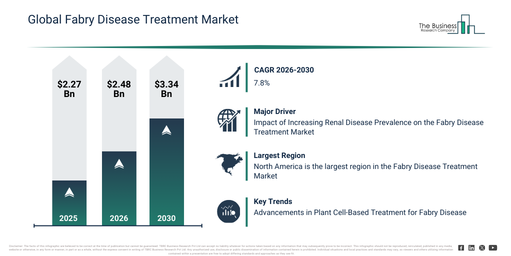
    The fabry disease treatment market has shown robust growth over recent years. Its valuation is projected to expand from $2.27 billion in 2025 to $2.48 billion in 2026, reflecting a compound annual growth rate (CAGR) of 8.8%. This historical expansion can be ascribed to several factors including heightened awareness of rare genetic disorders, the successful approval of enzyme replacement therapies, the broader expansion of genetic testing, an increase in specialty hospitals, and augmented patient advocacy.

    The Fabry disease treatment market is projected to experience substantial expansion in the coming years. This market is anticipated to reach $3.34 billion by 2030, exhibiting a compound annual growth rate (CAGR) of 7.8%. The projected growth during the forecast period is primarily driven by progress in gene therapy, the increasing adoption of personalized medicine, enhancements in newborn screening initiatives, the widening availability of oral therapies, and augmented funding for rare diseases. Key trends anticipated over the forecast period encompass a greater uptake of enzyme replacement therapy, an intensified focus on early genetic diagnosis, the expansion of oral chaperone therapies, an upsurge in research into gene therapy methodologies, and improved patient access to treatments for rare diseases.

    Access Your Free Sample Report For In-Depth Market Analysis:

    https://www.thebusinessresearchcompany.com/report/fabry-disease-treatment-global-market-report

    Which Drivers Are Supporting The Fabry Disease Treatment Market Growth?

    The rising occurrence of renal diseases is projected to boost the expansion of the fabry disease treatment market in the future. Renal diseases, also known as kidney diseases, encompass any conditions that hinder the proper functioning of the kidneys. The incidence of kidney diseases is on the rise due to genetic predispositions, lifestyle choices, environmental factors, and underlying health conditions. Fabry disease originates from the accumulation of globotriaosylceramide (Gb3) in kidney cells, leading to damage and dysfunction, which underscores the critical need for early detection and intervention to prevent kidney complications. For instance, in March 2023, the International Society of Nephrology (ISN), a Belgium-based professional society, reported that approximately 850 million people worldwide lived with chronic kidney disease (CKD), marking an increase compared to prior years. Consequently, the expanding prevalence of renal diseases is fueling the growth of the fabry disease treatment market.

    Which Segment Categories Are Included In The Fabry Disease Treatment Market Segment Analysis?

    The fabry disease treatment market covered in this report is segmented –

    1) By Treatment: Substrate Reduction Therapy, Enzyme Replacement Therapy, Chaperone Treatment, Other Treatments

    2) By Route Of Administration: Oral Route, Intravenous Route

    3) By Disease Severity: Classic Fabry Disease, Late-Onset Fabry Disease

    4) By Distribution Channel: Hospital Pharmacies, Retail Pharmacies, Online Pharmacies

    Subsegments:

    1) By Substrate Reduction Therapy: Migalastat Hydrochloride (Galafold), Other Substrate Reduction Therapies

    2) By Enzyme Replacement Therapy: Agalsidase Beta (Fabrazyme), Agalsidase Alfa (Replagal), Other Enzyme Replacement Therapies

    3) By Chaperone Treatment: Migalastat Hydrochloride (Galafold), Other Chaperone Therapies

    4) By Other Treatments: Gene Therapy, Symptomatic Treatment

    Which Trends Are Expected To Impact The Fabry Disease Treatment Market?

    Leading companies in the Fabry disease treatment market are developing plant cell-based therapies with the aim of boosting therapeutic effectiveness, lowering treatment expenses, and improving patient outcomes through innovative and sustainable methods. Plant cell-based treatment for Fabry disease involves leveraging plant cells to produce enzymes that are deficient in individuals afflicted with the condition. These enzymes, derived from plants, serve as a therapeutic option to substitute the missing or defective enzymes within the body, striving to alleviate symptoms and enhance the health of patients suffering from Fabry disease. For instance, in May 2023, ELFABRIO gained approval, a joint effort by Chiesi Global Rare Diseases, an Italy-based pharmaceutical company, and Protalix BioTherapeutics Inc., an Israel-based pharmaceutical company. ELFABRIO offers an alternative treatment choice for individuals with Fabry disease. It functions as an enzyme replacement therapy (ERT) where the recombinant human a-Galactosidase-A enzyme is generated in plant-cell culture and subsequently modified with PEGylation to significantly extend its half-life. This treatment is designed to reduce administration frequency, improve convenience, and enhance the overall management of Fabry disease symptoms, thereby improving patient quality of life.

    Who Are The Active Companies Shaping The Fabry Disease Treatment Market?

    Major companies operating in the fabry disease treatment market are Sanofi S.A., Takeda Pharmaceutical Company Limited, Ultragenyx Pharmaceutical Inc., Sangamo Therapeutics Inc., Protalix BioTherapeutics, Avrobio Inc., Freeline Therapeutics Holdings PLC, M6P Therapeutics Inc., Yuhan Corporation, Orchard Therapeutics Ltd., Regenxbio Inc., Synlogic Inc., AceLink Therapeutics Inc., Greenovation Biotech GmbH, CANbridge Life Sciences Ltd., Sigilon Therapeutics Inc., BioMarin Pharmaceutical Inc., Sarepta Therapeutics Inc., Daiichi Sankyo Company Ltd., Audentes Therapeutics Inc., Genesis Therapeutics Inc., Idorsia Pharmaceuticals Ltd., JCR Pharmaceuticals Co Ltd., ISU Abxis Co Ltd.

    Get The Full Fabry Disease Treatment Market Report:

    https://www.thebusinessresearchcompany.com/report/fabry-disease-treatment-global-market-report

    Which Region Dominates The Fabry Disease Treatment Market By Market Share?

    North America was the largest region in the fabry disease treatment market in 2025. Asia-Pacific is expected to be the fastest-growing region in the forecast period. The regions covered in the fabry disease treatment market report are Asia-Pacific, South East Asia, Western Europe, Eastern Europe, North America, South America, Middle East, Africa.

    Request A Customized Fabry Disease Treatment Market Report For Competitive Insights:

    https://www.thebusinessresearchcompany.com/report/fabry-disease-treatment-global-market-report

    Browse Through More Reports Similar to the Global Fabry Disease Treatment Market 2026, By The Business Research Company

    Lysosomal Disease Treatment Market Report 2026

    https://www.thebusinessresearchcompany.com/report/lysosomal-disease-treatment-global-market-report

    Plantar Fasciitis Treatment Market Report 2026

    https://www.thebusinessresearchcompany.com/report/plantar-fasciitis-treatment-global-market-report

    Gardner Syndrome Treatment Market Report 2026

    https://www.thebusinessresearchcompany.com/report/gardner-syndrome-treatment-global-market-report

    Get in touch with us:

    The Business Research Company: https://www.thebusinessresearchcompany.com/

    Americas +1 310-496-7795

    Asia +44 7882 955267 & +91 8897263534

    Europe +44 7882 955267

    Email us at info@tbrc.info

    Follow us on:

    LinkedIn: https://in.linkedin.com/company/the-business-research-company

    YouTube: https://www.youtube.com/channel/UC24_fI0rV8cR5DxlCpgmyFQ

    Global Market Model: https://www.thebusinessresearchcompany.com/global-market-model
  • Eyelid scrub market analysis (2026–2030)

    Eyelid scrub market analysis (2026–2030)

    The Business Research Company’s 2026 market reports feature enhanced tools like market attractiveness analysis, TAM assessment, and company scoring matrices, along with interactive dashboards, deeper supply chain insights, and startup coverage strengthening the depth, usability, and strategic value of insights.

    What Changes In Market Value Are Expected For The Eyelid Scrub Market Over The 2026–2030 Period?

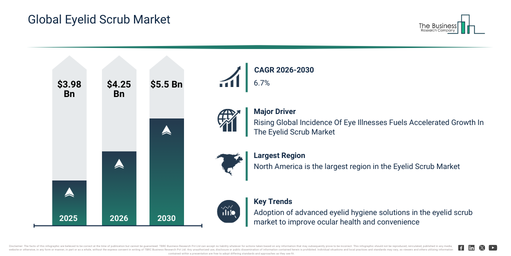
    The eyelid scrub market has experienced robust growth in recent years. This market is projected to expand from $3.98 billion in 2025 to $4.25 billion in 2026, demonstrating a compound annual growth rate (CAGR) of 6.8%. Historically, this expansion has been driven by factors such as the rising incidence of blepharitis, an increase in dry eye conditions, a surge in ophthalmology appointments, the proliferation of retail pharmacies, and heightened consumer understanding.

    The eyelid scrub market size is anticipated to experience robust growth over the next few years. It is projected to expand to $5.5 billion by 2030, demonstrating a compound annual growth rate (CAGR) of 6.7%. This expansion during the forecast period can be attributed to several factors, including the demand for preservative-free formulations, an increase in preventive eye care, the rising aging population, the expansion of online pharmacies, and innovation in eyelid cleansing products. Prominent trends for the forecast period involve rising awareness of eyelid hygiene, growing use in chronic eye conditions, increased demand for medicated eyelid scrubs, expansion of online and retail distribution, and a preference for hypoallergenic and gentle formulations.

    Access Your Free Sample Report For In-Depth Market Analysis:

    https://www.thebusinessresearchcompany.com/report/eyelid-scrub-global-market-report

    What Key Factors Are Affecting The Eyelid Scrub Market Demand?

    The growing incidence of eye conditions is expected to fuel the expansion of the eyelid scrub market in the coming years. Eye illnesses represent a broad spectrum of health issues and disorders that impact the eyes, vision, and overall ocular health. Eyelid scrubs are utilized to manage various eye conditions by removing debris, bacteria, and excess oils from the eyelids, which helps to reduce the risk of inflammation and improve overall eye comfort. For instance, in June 2023, according to the BrightFocus Foundation, a US-based non-profit organization, the global population of glaucoma patients is projected to rise to 111 million by 2040. Therefore, the increasing prevalence of eye illnesses will significantly drive the eyelid scrub market.

    How Is The Eyelid Scrub Market Broken Down By Segment Categories?

    The eyelid scrub market covered in this report is segmented –

    1) By Product: Pre-Moistened Scrubs, Spray Scrubs, Dry Pad Scrubs

    2) By Distribution Channel: Online Pharmacies, Retail Pharmacies, Hospital Pharmacies, Eye Health Clinics

    3) By Application: Allergies, Dry Eyes, Eye Health, Minor Eye Irritation

    Subsegments:

    1) By Pre-Moistened Scrubs: Hypoallergenic Scrubs, Antibacterial Pre-Moistened Scrubs, Medicated Pre-Moistened Scrubs

    2) By Spray Scrubs: Antibacterial Spray Scrubs, Hypoallergenic Spray Scrubs, Soothing Spray Scrubs

    3) By Dry Pad Scrubs: Sensitive Skin Dry Pads, Exfoliating Dry Pads, Medicated Dry Pads

    What Trends Are Influencing Changes In The Eyelid Scrub Market?

    Leading companies in the eyelid scrub market are focusing on developing innovations such as preservative-free lid wipes for daily hygiene, intending to enhance cleaning efficiency, minimize irritation, and improve patient compliance. A preservative-free lid wipe is a pre-moistened pad formulated with gentle cleansing agents, tea tree oil, hyaluronic acid, and chamomile, facilitating the safe and convenient removal of debris, oil, and allergens from the eyelid margin without requiring rinsing, unlike traditional baby shampoo or soap-based cleansers. For example, in October 2024, Myze, a U.S.-based digital eye-care company, launched the Daily Lid Wipe. This product offers individually wrapped, sterile wipes containing antimicrobial and soothing ingredients designed to reduce eyelid inflammation, support barrier health, and enable convenient daily cleaning without irritation.

    Which Players Are Present In The Eyelid Scrub Market Space?

    Major companies operating in the eyelid scrub market are Johnson & Johnson’s, Alcon AG, Bausch & Lomb Incorporated, OCuSOFT Inc., Cliradex, Eye Love (Heyedrate), TheraTears, Avenova, Systane, The Eye Doctor, Bruder Healthcare, Optase, CorneaCare, I-Med Pharma, Lunovus, Noveha, TearRestore, Thea Pharmaceuticals, Zocular, OptiScrub, Blephaclean, Retaine MGD, Ocusoft Lid Wipes

    Get The Full Eyelid Scrub Market Report:

    https://www.thebusinessresearchcompany.com/report/eyelid-scrub-global-market-report

    Which Region Is The Largest In The Eyelid Scrub Market?

    North America was the largest region in the eyelid scrub market in 2025. The regions covered in the eyelid scrub market report are Asia-Pacific, South East Asia, Western Europe, Eastern Europe, North America, South America, Middle East, Africa.

    Request A Customized Eyelid Scrub Market Report For Competitive Insights:

    https://www.thebusinessresearchcompany.com/report/eyelid-scrub-global-market-report

    Browse Through More Reports Similar to the Global Eyelid Scrub Market 2026, By The Business Research Company

    Eyelash Serum Market Report 2026

    https://www.thebusinessresearchcompany.com/report/eyelash-serum-global-market-report

    Dry Eye Products Market Report 2026

    https://www.thebusinessresearchcompany.com/report/dry-eye-products-global-market-report

    Dry Eye Medication Market 2026

    https://www.thebusinessresearchcompany.com/report/dry-eye-medication-market

    Get in touch with us:

    The Business Research Company: https://www.thebusinessresearchcompany.com/

    Americas +1 310-496-7795

    Asia +44 7882 955267 & +91 8897263534

    Europe +44 7882 955267

    Email us at info@tbrc.info

    Follow us on:

    LinkedIn: https://in.linkedin.com/company/the-business-research-company

    YouTube: https://www.youtube.com/channel/UC24_fI0rV8cR5DxlCpgmyFQ

    Global Market Model: https://www.thebusinessresearchcompany.com/global-market-model
  • Eye drops and lubricants market outlook (2026–2030)

    Eye drops and lubricants market outlook (2026–2030)

    The Business Research Company’s 2026 market reports feature enhanced tools like market attractiveness analysis, TAM assessment, and company scoring matrices, along with interactive dashboards, deeper supply chain insights, and startup coverage strengthening the depth, usability, and strategic value of insights.

    By 2030, What Market Size Is The Eye-Drop And Lubricants Market Expected To Reach Based On Its 2026 Value?

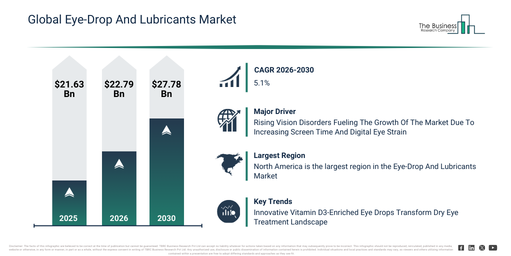
    The eye-drop and lubricants market size has observed substantial growth in recent years. This market is projected to expand from $21.63 billion in 2025 to $22.79 billion in 2026, demonstrating a compound annual growth rate (CAGR) of 5.4%. The historical period’s expansion is due to the escalating incidence of eye disorders, the broadened adoption of self-medication habits, increased consciousness regarding eye hygiene, the proliferation of pharmacy retail networks, and improved availability of ophthalmic products.

    The eye-drop and lubricants market is anticipated to show significant expansion in the coming years. Its value is projected to reach $27.78 billion by 2030, growing at a compound annual growth rate (CAGR) of 5.1%. This projected growth is attributed to factors such as the increasing need for advanced eye care solutions, the broadening scope of online retail distribution, a heightened focus on managing chronic eye conditions, rising acceptance among elderly individuals, and increased investment in ophthalmic research. Dominant trends during the forecast period include a growing demand for preservative-free eye lubricants, the increasing use of multi-dose delivery systems, a wider application of combination eye care therapies, the development of more gel and ointment formulations, and an intensified emphasis on providing extended relief.

    Access Your Free Sample Report For In-Depth Market Analysis:

    https://www.thebusinessresearchcompany.com/report/eye-drop-and-lubricants-global-market-report

    Which Primary Drivers Are Impacting The Eye-Drop And Lubricants Market Growth?

    The increasing occurrence of vision-related issues is anticipated to boost the expansion of the eye-drop and lubricants market in the future. These cases encompass medical conditions, disorders, or problems that impair clear or comfortable vision. The growing incidence of such cases is primarily fueled by increased screen usage, leading to digital eye strain and faster progression of myopia, particularly in younger populations. Eye drops and lubricants mitigate symptoms like dry eye, irritation, and redness associated with these conditions by delivering moisture, easing inflammation, and stabilizing the tear film, thereby improving overall eye comfort and visual acuity. For example, data from October 2024 provided by the Royal National Institute of Blind People, a UK charity assisting visually impaired individuals, forecasts a 29% rise in the number of people with severe sight loss or registered as blind, increasing from 298,000 in 2022 to 379,000 by 2035. Consequently, the increasing prevalence of vision-related issues is propelling the expansion of the eye-drop and lubricant market.

    What Are The Different Segment Types In The Eye-Drop And Lubricants Market Segment Breakdown?

    The eye-drop and lubricants market covered in this report is segmented –

    1) By Type: Antibiotics, Hormones, Artificial Tears, Other Types

    2) By Formulation Type: Liquid, Ointment, Gel, Spray

    3) By Distribution Channel: Online Retail, Pharmacies, Supermarkets Or Hypermarkets, Specialty Stores

    4) By Application: Eye Disease, Eye Care, Other Applications

    5) By End User: Hospitals, Clinics, Homecare, Eyewear Centers

    Subsegments:

    1) By Antibiotics: Broad-Spectrum Antibiotics, Fluoroquinolones, Aminoglycosides, Macrolides

    2) By Hormones: Corticosteroids, Non-Corticosteroid Hormones

    3) By Artificial Tears: Preserved Artificial Tears, Preservative-Free Artificial Tears

    4) By Other Types: Antihistamines, Decongestants, Antiglaucoma Agents, Immunomodulators

    Which Trends Are Shaping Growth In The Eye-Drop And Lubricants Market?

    Major companies operating in the eye-drop and lubricants market are focusing on introducing innovative solutions, such as vitamin D3-enriched lubricating eye drops, to more effectively address dry eye symptoms and meet the growing demand for multifunctional ocular health products. These vitamin D3-enriched lubricating eye drops are ophthalmic solutions formulated with vitamin D3 (cholecalciferol) and moisturizing agents, designed to relieve dry eye symptoms while also providing anti-inflammatory and immune-regulatory benefits. For instance, in May 2024, Entod Pharmaceuticals, an India-based pharmaceutical company, launched vitamin D3-enriched lubricating eye drops, representing a significant advancement in ocular health by offering targeted relief for individuals experiencing dry eye syndrome. This innovative formulation incorporates vitamin D3 into select lubricant eye drop brands, aiming to improve ocular surface health, enhance tear stability, and support corneal wound healing. The product is exclusively available by prescription from healthcare professionals, addressing the widespread issue of vitamin D deficiency in India, which is linked to various eye health problems, including age-related macular degeneration and diabetic retinopathy.

    Who Are The Well-Known Companies In The Eye-Drop And Lubricants Market?

    Major companies operating in the eye-drop and lubricants market are Bayer AG, Sanofi S.A., Novartis AG, Viatris Inc., Teva Pharmaceutical Industries Ltd., Otsuka Pharmaceutical Co. Ltd., Alcon Inc., Bausch + Lomb Incorporated, Santen Pharmaceutical Co. Ltd., Nicox S.A., Scope Ophthalmics Ltd., Lenz Therapeutics Inc., Eyeris Vision Care Pvt. Ltd., Akums Drugs and Pharmaceuticals Ltd., Medtech Products Inc., Rohto Pharmaceutical Co. Ltd, Eyevance Pharmaceuticals LLC, Sun Pharmaceutical Industries Ltd, Johnson & Johnson Vision, Similasan Corporation, Sager Pharma Kft, Cipla Ltd, Ajanta Pharma Ltd, Intas Pharmaceuticals Ltd, FDC Ltd, Alkem Laboratories Ltd, Entod Pharmaceuticals Ltd

    Get The Full Eye-Drop And Lubricants Market Report:

    https://www.thebusinessresearchcompany.com/report/eye-drop-and-lubricants-global-market-report

    Which Region Leads The Eye-Drop And Lubricants Market In Terms Of Market Share?

    North America was the largest region in the eye-drop and lubricants market in 2025. North America is expected to be the fastest-growing region in the forecast period. The regions covered in the eye-drop and lubricants market report are Asia-Pacific, South East Asia, Western Europe, Eastern Europe, North America, South America, Middle East, Africa.

    Request A Customized Eye-Drop And Lubricants Market Report For Competitive Insights:

    https://www.thebusinessresearchcompany.com/report/eye-drop-and-lubricants-global-market-report

    Browse Through More Reports Similar to the Global Eye-Drop And Lubricants Market 2026, By The Business Research Company

    Lubricant Filtration Market Report 2026

    https://www.thebusinessresearchcompany.com/report/lubricant-filtration-global-market-report

    Aviation Lubricants Market Report 2026

    https://www.thebusinessresearchcompany.com/report/aviation-lubricants-global-market-report

    Dry Eye Products Market Report 2026

    https://www.thebusinessresearchcompany.com/report/dry-eye-products-global-market-report

    Get in touch with us:

    The Business Research Company: https://www.thebusinessresearchcompany.com/

    Americas +1 310-496-7795

    Asia +44 7882 955267 & +91 8897263534

    Europe +44 7882 955267

    Email us at info@tbrc.info

    Follow us on:

    LinkedIn: https://in.linkedin.com/company/the-business-research-company

    YouTube: https://www.youtube.com/channel/UC24_fI0rV8cR5DxlCpgmyFQ

    Global Market Model: https://www.thebusinessresearchcompany.com/global-market-model
  • Eye tracking solutions market developments (2026–2030)

    Eye tracking solutions market developments (2026–2030)

    The Business Research Company’s 2026 market reports feature enhanced tools like market attractiveness analysis, TAM assessment, and company scoring matrices, along with interactive dashboards, deeper supply chain insights, and startup coverage strengthening the depth, usability, and strategic value of insights.

    What Is The Anticipated Rise In Market Value Of The Eye Tracking Solutions Market During The Forecast Period?

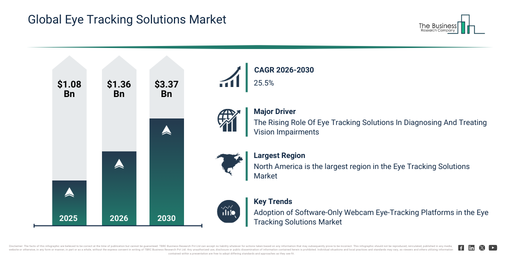
    The eye tracking solutions market size has experienced remarkable growth in recent years. It is projected to expand from $1.08 billion in 2025 to $1.36 billion in 2026, demonstrating a compound annual growth rate (CAGR) of 26.1%. Historically, this growth can be attributed to an increase in digital advertising research, a heightened focus on user experience testing, advancements in eye tracking software, the expansion of academic studies, and an uptick in consumer electronics testing.

    The eye tracking solutions market is set for significant expansion over the next few years. It is forecast to grow to $3.37 billion by 2030, achieving a compound annual growth rate (CAGR) of 25.5%. This growth during the forecast period is fueled by elements such as AI-driven eye tracking analytics, increasing integration into metaverse applications, a rise in its use within neuromarketing, the expansion of cloud platforms, and the development of remote research tools. Major trends expected in this period include a heightened demand for software-based eye tracking analytics, wider application in marketing and consumer research, growing adoption in human-computer interaction studies, increased utilization in gaming and virtual reality, and the incorporation of cloud-based eye tracking platforms.

    Access Your Free Sample Report For In-Depth Market Analysis:

    https://www.thebusinessresearchcompany.com/report/eye-tracking-solutions-global-market-report

    What Significant Factors Are Influencing The Eye Tracking Solutions Market Expansion?

    The increasing need for ophthalmology is anticipated to boost the expansion of the eye tracking solutions market in upcoming years. Ophthalmology is defined as the medical field dedicated to studying the eyes’ structure, operation, and diseases. Within ophthalmology, eye-tracking solutions facilitate the prompt identification of eye conditions, assist in evaluating eye movement for surgical procedures, and provide crucial information for assessing visual focus and cognitive abilities in individuals. As an illustration, data from May 2024 by the Centers for Disease Control and Prevention, a national public health agency based in the US, revealed that 90 million Americans aged over 40 suffer from vision and eye issues. This figure represents over 3 in 5 individuals in that demographic. Projections indicate that by 2050, if no effective interventions are implemented, cataracts are predicted to rise by 87%, glaucoma cases will double, and vision impairment and blindness are expected to increase by 150%. Consequently, the escalating demand for ophthalmology is a key driver for the expansion of the eye tracking solutions market.

    Which Segment Classifications Are Used In The Eye Tracking Solutions Market Segment Analysis?

    The eye tracking solutions market covered in this report is segmented –

    1) By Type: Eye Attached Tracking, Optical Tracking, Electrooculography

    2) By Solution: Hardware, Software

    3) By End-User Industry: Retail And Advertisement Sector, Automotive And Transportation, Media And Entertainment, Aerospace And Defense, Consumer Electronics, Other End-User Industries

    Subsegments:

    1) By Eye Attached Tracking: Wearable Eye Trackers, Smart Glasses

    2) By Optical Tracking: Remote Eye Tracking Systems, Screen-Based Tracking Solutions

    3) By Electrooculography: Fixed Electrode Systems, Mobile Or Portable Electrode Systems

    What Trends Are Affecting The Direction Of The Eye Tracking Solutions Market?

    Major companies operating in the eye tracking solutions market are focusing on developing technological advancements like software-only webcam-based eye-tracking platforms to address the increasing demand for scalable, low-cost attention-computing applications across education, healthcare, and productivity. A software-only webcam eye-tracking platform utilizes AI to infer gaze direction from a user’s standard webcam video feed, distinguishing it from traditional eye trackers that depend on dedicated infrared hardware, thereby enabling eye tracking on almost any device without extra sensors. For instance, in June 2024, Tobii AB, a Sweden-based eye-tracking technology leader, unveiled Tobii Nexus, a software-only integration platform designed for eye-tracking data. This product employs an AI-powered inference engine that translates webcam images into real-time gaze data, performs reliably across different eye shapes and skin tones, and even with glasses or face coverings, while also being optimized for a low computational load. It supports applications in behavioral assessment, such as ADHD and depression; education for insights into student attention; digital collaboration for hands-free interaction; and VR-style 3D experiences on standard desktops.

    Which Firms Are Contributing To The Eye Tracking Solutions Market Ecosystem?

    Major companies operating in the eye tracking solutions market are Fujitsu Limited, ISCAN Inc., Tobii AB, Seeing Machines, Noldus Information Technology BV, Smart Eye AB, SensoMotoric Instruments, BIOPAC Systems Inc., AdHawk Microsystems, iMotions A/S, Mirametrix Inc., LC Technologies, SR Research Ltd., ERGONEERS GmbH, Gazepoint Research Inc., EyeTracking Inc., Pupil Labs GmbH, FOVE Inc., Neuroset Italia S.R.L., SeeTrue Technology LLC, EyeTech Digital Systems Inc., Eyeware Tech SA, CoolTool, The Eye Tribe, Eyegaze Inc., BEQUIPE, Sens-vue

    Get The Full Eye Tracking Solutions Market Report:

    https://www.thebusinessresearchcompany.com/report/eye-tracking-solutions-global-market-report

    Which Region Leads The Eye Tracking Solutions Market In Overall Market Size?

    North America was the largest region in the eye tracking solutions market in 2025. Asia-Pacific is expected to be the fastest-growing region in the forecast period. The regions covered in the eye tracking solutions market report are Asia-Pacific, South East Asia, Western Europe, Eastern Europe, North America, South America, Middle East, Africa.

    Request A Customized Eye Tracking Solutions Market Report For Competitive Insights:

    https://www.thebusinessresearchcompany.com/report/eye-tracking-solutions-global-market-report

    Browse Through More Reports Similar to the Global Eye Tracking Solutions Market 2026, By The Business Research Company

    Eye Testing Equipment Market Report 2026

    https://www.thebusinessresearchcompany.com/report/eye-testing-equipment-global-market-report

    Eye Tracking Market Report 2026

    https://www.thebusinessresearchcompany.com/report/eye-tracking-global-market-report

    3D Eye Tracking Software Market Report 2026

    https://www.thebusinessresearchcompany.com/report/3d-eye-tracking-software-global-market-report

    Get in touch with us:

    The Business Research Company: https://www.thebusinessresearchcompany.com/

    Americas +1 310-496-7795

    Asia +44 7882 955267 & +91 8897263534

    Europe +44 7882 955267

    Email us at info@tbrc.info

    Follow us on:

    LinkedIn: https://in.linkedin.com/company/the-business-research-company

    YouTube: https://www.youtube.com/channel/UC24_fI0rV8cR5DxlCpgmyFQ

    Global Market Model: https://www.thebusinessresearchcompany.com/global-market-model
  • Eye tracking market forecast (2026–2030)

    Eye tracking market forecast (2026–2030)

    The Business Research Company’s 2026 market reports feature enhanced tools like market attractiveness analysis, TAM assessment, and company scoring matrices, along with interactive dashboards, deeper supply chain insights, and startup coverage strengthening the depth, usability, and strategic value of insights.

    How Is The Market Size Of The Eye Tracking Market Expected To Scale Between 2026 And 2030?

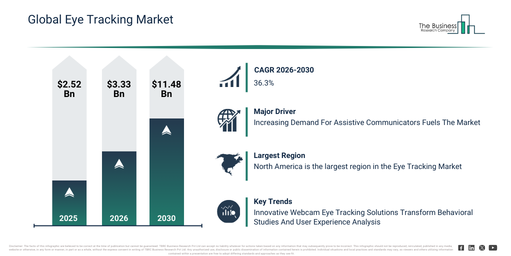
    The eye tracking market size has experienced exponential growth in recent years. It is anticipated to expand from $2.52 billion in 2025 to $3.33 billion in 2026, achieving a compound annual growth rate (CAGR) of 31.9%. The market’s expansion in the historic period can be ascribed to a rise in human-computer interaction studies, increased research funding, the broader application of usability testing, advancements in sensor technologies, and greater academic adoption.

    The eye tracking market is projected to experience rapid expansion over the coming years. This market is anticipated to reach $11.48 billion by 2030, demonstrating a compound annual growth rate (CAGR) of 36.3%. Key factors driving this growth during the forecast period include the incorporation of AI-powered analytics, increasing consumer interest in immersive technologies, the proliferation of autonomous vehicles, wider use in healthcare applications, and innovations in wearable electronics. Significant trends expected within this period encompass its expanding utility in behavioral and cognitive research, broader implementation in automotive safety systems, the development of more wearable eye tracking devices, its growing relevance in healthcare diagnostics, and its seamless integration with virtual and augmented reality.

    Access Your Free Sample Report For In-Depth Market Analysis:

    https://www.thebusinessresearchcompany.com/report/eye-tracking-global-market-report

    Which Important Drivers Are Guiding The Eye Tracking Market Growth?

    The rising need for assistive communicators is projected to drive the eye-tracking market. Assistive communicators are tools that support individuals with communication difficulties by facilitating or enhancing their ability to articulate thoughts, ideas, and necessities. Eye-tracking technology enables users to operate and navigate these communicators by observing their eye movements, thereby offering a more natural and efficient way to communicate. For instance, in January 2024, the World Health Organization (WHO), a Switzerland-based national agency, reported that more than 2.5 billion people globally require one or more assistive products. Additionally, with an aging global population and an increase in noncommunicable diseases, an estimated 3.5 billion people will need assistive technology by 2050. Therefore, the elevated demand for assistive communicators is expected to propel the growth of the eye-tracking market.

    How Is The Eye Tracking Market Organized By Segment Classification?

    The eye tracking market covered in this report is segmented –

    1) By Type: Eye Attached Tracking, Optical Tracking, Electrooculography

    2) By Component: Hardware, Software

    3) By Location: Remote, Mobile

    4) By Application: Healthcare, Retail, Research, Automotive, Consumer Electronics, Other Application

    Subsegments:

    1) By Eye Attached Tracking: Wearable Devices, Head-Mounted Displays (HMDs)

    2) By Optical Tracking: Remote Eye Trackers, Camera-Based Systems, Video-Based Eye Tracking Solutions

    3) By Electrooculography: Contact Electrooculography Devices, Non-Contact Electrooculography Devices, Research-Grade Electrooculography Systems

    What Trends Are Influencing The Evolution Of The Eye Tracking Market?

    Leading companies in the eye-tracking market are concentrating on developing innovative solutions, such as webcam eye-tracking, to achieve a competitive advantage. This technology utilizes a standard webcam or similar camera to monitor and analyze a user’s eye movements and gaze direction in real time. For instance, in June 2024, Tobii AB, a Swedish-based computer software company, launched the Tobii Nexus, a webcam eye tracker. The Tobii Nexus is a cutting-edge webcam eye-tracking solution that provides seamless integration with standard webcams, enabling accurate gaze tracking without the need for specialized hardware. Its unique features encompass real-time eye-tracking capabilities, user-friendly calibration, and compatibility with various software applications, making it ideal for research, accessibility, and user experience analysis.

    Who Are The Industry Participants Involved In The Eye Tracking Market?

    Major companies operating in the eye tracking market are Tobii AB, Varjo, Smart Eye AB, RealEye, Noldus Information Technology, Seeing Machine, Sensomotoric Instruments (SMI), iMotions A/S, NovaSight, Eyegaze Inc., Element Human Ltd., Ergoneers GmbH, Eye Tracking Inc., Gazepoint Research Inc., LC Technologies Inc., 4tiitoo AG, The Eye Tribe, Mirametrix Inc., EyeTech Digital Systems, SR Research, Phoenix Research Labs, GazeHawk, Pupil Labs

    Get The Full Eye Tracking Market Report:

    https://www.thebusinessresearchcompany.com/report/eye-tracking-global-market-report

    Which Region Is The Top Contributor To The Eye Tracking Market By Share?

    North America was the largest region in the eye tracking market in 2025. Asia-Pacific is expected to be the fastest-growing region in the forecast period. The regions covered in the eye tracking market report are Asia-Pacific, South East Asia, Western Europe, Eastern Europe, North America, South America, Middle East, Africa.

    Request A Customized Eye Tracking Market Report For Competitive Insights:

    https://www.thebusinessresearchcompany.com/report/eye-tracking-global-market-report

    Browse Through More Reports Similar to the Global Eye Tracking Market 2026, By The Business Research Company

    Computer Vision Market Report 2026

    https://www.thebusinessresearchcompany.com/report/computer-vision-global-market-report

    Eye Tracking Solutions Market Report 2026

    https://www.thebusinessresearchcompany.com/report/eye-tracking-solutions-global-market-report

    3D Eye Tracking Software Market Report 2026

    https://www.thebusinessresearchcompany.com/report/3d-eye-tracking-software-global-market-report

    Get in touch with us:

    The Business Research Company: https://www.thebusinessresearchcompany.com/

    Americas +1 310-496-7795

    Asia +44 7882 955267 & +91 8897263534

    Europe +44 7882 955267

    Email us at info@tbrc.info

    Follow us on:

    LinkedIn: https://in.linkedin.com/company/the-business-research-company

    YouTube: https://www.youtube.com/channel/UC24_fI0rV8cR5DxlCpgmyFQ

    Global Market Model: https://www.thebusinessresearchcompany.com/global-market-model
  • Eye melanoma market analysis (2026–2030)

    Eye melanoma market analysis (2026–2030)

    The Business Research Company’s 2026 market reports feature enhanced tools like market attractiveness analysis, TAM assessment, and company scoring matrices, along with interactive dashboards, deeper supply chain insights, and startup coverage strengthening the depth, usability, and strategic value of insights.

    What Level Of Market Value Growth Is Predicted For The Eye Melanoma Market From 2026 To 2030?

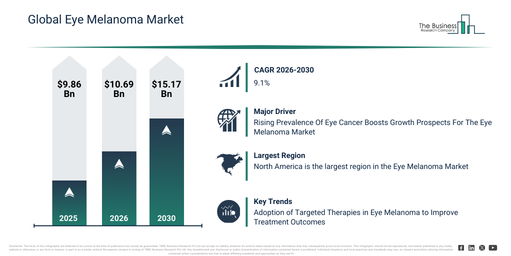
    The eye melanoma market size has experienced strong growth in recent years. It is projected to expand from $9.86 billion in 2025 to $10.69 billion in 2026, achieving a compound annual growth rate (CAGR) of 8.4%. This historical growth can be credited to advancements in ocular imaging technologies, a rise in cancer awareness, the expansion of oncology treatment facilities, enhanced diagnostic capabilities, and improved survival outcomes.

    The eye melanoma market is anticipated to experience robust expansion in the coming years, with its valuation projected to reach $15.17 billion by 2030, exhibiting a compound annual growth rate (CAGR) of 9.1%. This growth during the forecast period can be primarily attributed to the emergence of innovative immunotherapies, the increasing embrace of precision oncology, advancements in genetic testing, heightened investment in research for rare cancers, and enhanced early screening initiatives. Key trends expected during this period involve a heightened emphasis on early cancer detection, the increasing utilization of targeted therapies and immunotherapies, a greater reliance on advanced ocular imaging techniques, the proliferation of specialized oncology centers, and intensified clinical research focused on rare eye cancers.

    Access Your Free Sample Report For In-Depth Market Analysis:

    https://www.thebusinessresearchcompany.com/report/eye-melanoma-global-market-report

    What Major Factors Are Driving The Eye Melanoma Market Forward?

    The escalating occurrence of eye cancer is anticipated to fuel the expansion of the eye melanoma market moving forward. Eye cancer involves the development of anomalous and unrestrained cell proliferation within the structures of the eye. The improved recognition and effective handling of early-stage instances are generating a greater requirement for specialized treatments and interventions, driven by enhanced diagnostic methods, increased awareness, and advancements in therapeutic options. For example, according to the American Cancer Society, a US-based non-profit organization, there were roughly 3,140 new cases of eye and orbital cancers (predominantly melanomas) in 2025, including 1,620 in males and 1,520 in females. Furthermore, approximately 490 deaths resulted from these cancers, comprising 270 males and 220 females. Thus, the growing prevalence of eye cancer is expected to stimulate the growth of the eye melanoma market.

    Which Segments Define The Eye Melanoma Market Segment Structure?

    The eye melanoma market covered in this report is segmented –

    1) By Site: Uvea, Sclera, Retina

    2) By Diagnosis: Imaging, Biopsy, Eye Exam

    3) By Treatment: Surgery, Radiation Therapy, Targeted Therapy, Immunotherapy, Other Treatment

    4) By End User: Hospitals And Clinics, Academic Institutes

    Subsegments:

    1) By Uvea: Choroid Melanoma, Ciliary Body Melanoma, Iris Melanoma

    2) By Sclera: Episcleral Melanoma, Scleral Surface Melanoma, Conjunctival Melanoma

    3) By Retina: Macular Melanoma, Peripheral Retinal Melanoma, Optic Disc Melanoma

    Which Trends Are Impacting The Progress Of The Eye Melanoma Market?

    Leading companies in the eye melanoma market are prioritizing the development of technological innovations, such as protein-kinase C (PKC) inhibitors, to meet the rising demand for effective systemic treatments that also help preserve the eye. PKC inhibitors are small-molecule compounds designed to block PKC enzymes involved in tumor growth, offering a non-surgical alternative to conventional treatments like plaque brachytherapy or enucleation. For example, in March 2025, IDEAYA Biosciences, a US-based precision oncology company, introduced darovasertib, a first-in-class PKC inhibitor specifically for uveal melanoma. This therapy targets PKC isoforms linked to tumor proliferation, with Phase 2 trials showing tumor shrinkage rates of around 82% and eye-preservation rates of 61%. Darovasertib provides a systemic, eye-sparing treatment option for patients eligible for either enucleation or plaque brachytherapy.

    Who Are The Established Players Within The Eye Melanoma Market?

    Major companies operating in the eye melanoma market are Pfizer Inc., Johnson & Johnson, F. Hoffmann-La Roche Ltd, Merck & Co. Inc, AbbVie Inc., Bayer AG, Novartis AG, Bristol-Myers Squibb Company, AstraZeneca PLC, Sanofi S.A., Amgen Inc., Castle Biosciences Inc., IDEAYA Biosciences Inc., Delcath Systems Inc., Immunocore Holdings plc, Aura Biosciences Inc., TriSalus Life Sciences Inc., Replimune Group Inc., Linnaeus Therapeutics, iOnctura, LES LABORATOIRES SERVIER, Immatics NV

    Get The Full Eye Melanoma Market Report:

    https://www.thebusinessresearchcompany.com/report/eye-melanoma-global-market-report

    Which Region Represents The Largest Share Of The Eye Melanoma Market?

    North America was the largest region in the eye melanoma market in 2025. Asia-Pacific is expected to be the fastest-growing region in the forecast period. The regions covered in the eye melanoma market report are Asia-Pacific, South East Asia, Western Europe, Eastern Europe, North America, South America, Middle East, Africa.

    Request A Customized Eye Melanoma Market Report For Competitive Insights:

    https://www.thebusinessresearchcompany.com/report/eye-melanoma-global-market-report

    Browse Through More Reports Similar to the Global Eye Melanoma Market 2026, By The Business Research Company

    Melanoma Therapeutics Market Report 2026

    https://www.thebusinessresearchcompany.com/report/melanoma-therapeutics-global-market-report

    Melanoma Drugs Market Report 2026

    https://www.thebusinessresearchcompany.com/report/melanoma-drugs-global-market-report

    Malignant Melanoma Treatment Market Report 2026

    https://www.thebusinessresearchcompany.com/report/malignant-melanoma-treatment-global-market-report

    Get in touch with us:

    The Business Research Company: https://www.thebusinessresearchcompany.com/

    Americas +1 310-496-7795

    Asia +44 7882 955267 & +91 8897263534

    Europe +44 7882 955267

    Email us at info@tbrc.info

    Follow us on:

    LinkedIn: https://in.linkedin.com/company/the-business-research-company

    YouTube: https://www.youtube.com/channel/UC24_fI0rV8cR5DxlCpgmyFQ

    Global Market Model: https://www.thebusinessresearchcompany.com/global-market-model

  • Eye tracking solutions market developments (2026–2030)

    Eye tracking solutions market developments (2026–2030)

    The Business Research Company’s 2026 market reports feature enhanced tools like market attractiveness analysis, TAM assessment, and company scoring matrices, along with interactive dashboards, deeper supply chain insights, and startup coverage strengthening the depth, usability, and strategic value of insights.

    What Is The Anticipated Rise In Market Value Of The Eye Tracking Solutions Market During The Forecast Period?

    The eye tracking solutions market size has experienced remarkable growth in recent years. It is projected to expand from $1.08 billion in 2025 to $1.36 billion in 2026, demonstrating a compound annual growth rate (CAGR) of 26.1%. Historically, this growth can be attributed to an increase in digital advertising research, a heightened focus on user experience testing, advancements in eye tracking software, the expansion of academic studies, and an uptick in consumer electronics testing.

    The eye tracking solutions market is set for significant expansion over the next few years. It is forecast to grow to $3.37 billion by 2030, achieving a compound annual growth rate (CAGR) of 25.5%. This growth during the forecast period is fueled by elements such as AI-driven eye tracking analytics, increasing integration into metaverse applications, a rise in its use within neuromarketing, the expansion of cloud platforms, and the development of remote research tools. Major trends expected in this period include a heightened demand for software-based eye tracking analytics, wider application in marketing and consumer research, growing adoption in human-computer interaction studies, increased utilization in gaming and virtual reality, and the incorporation of cloud-based eye tracking platforms.

    Access Your Free Sample Report For In-Depth Market Analysis:

    https://www.thebusinessresearchcompany.com/report/eye-tracking-solutions-global-market-report

    What Significant Factors Are Influencing The Eye Tracking Solutions Market Expansion?

    The increasing need for ophthalmology is anticipated to boost the expansion of the eye tracking solutions market in upcoming years. Ophthalmology is defined as the medical field dedicated to studying the eyes’ structure, operation, and diseases. Within ophthalmology, eye-tracking solutions facilitate the prompt identification of eye conditions, assist in evaluating eye movement for surgical procedures, and provide crucial information for assessing visual focus and cognitive abilities in individuals. As an illustration, data from May 2024 by the Centers for Disease Control and Prevention, a national public health agency based in the US, revealed that 90 million Americans aged over 40 suffer from vision and eye issues. This figure represents over 3 in 5 individuals in that demographic. Projections indicate that by 2050, if no effective interventions are implemented, cataracts are predicted to rise by 87%, glaucoma cases will double, and vision impairment and blindness are expected to increase by 150%. Consequently, the escalating demand for ophthalmology is a key driver for the expansion of the eye tracking solutions market.

    Which Segment Classifications Are Used In The Eye Tracking Solutions Market Segment Analysis?

    The eye tracking solutions market covered in this report is segmented –

    1) By Type: Eye Attached Tracking, Optical Tracking, Electrooculography

    2) By Solution: Hardware, Software

    3) By End-User Industry: Retail And Advertisement Sector, Automotive And Transportation, Media And Entertainment, Aerospace And Defense, Consumer Electronics, Other End-User Industries

    Subsegments:

    1) By Eye Attached Tracking: Wearable Eye Trackers, Smart Glasses

    2) By Optical Tracking: Remote Eye Tracking Systems, Screen-Based Tracking Solutions

    3) By Electrooculography: Fixed Electrode Systems, Mobile Or Portable Electrode Systems

    What Trends Are Affecting The Direction Of The Eye Tracking Solutions Market?

    Major companies operating in the eye tracking solutions market are focusing on developing technological advancements like software-only webcam-based eye-tracking platforms to address the increasing demand for scalable, low-cost attention-computing applications across education, healthcare, and productivity. A software-only webcam eye-tracking platform utilizes AI to infer gaze direction from a user’s standard webcam video feed, distinguishing it from traditional eye trackers that depend on dedicated infrared hardware, thereby enabling eye tracking on almost any device without extra sensors. For instance, in June 2024, Tobii AB, a Sweden-based eye-tracking technology leader, unveiled Tobii Nexus, a software-only integration platform designed for eye-tracking data. This product employs an AI-powered inference engine that translates webcam images into real-time gaze data, performs reliably across different eye shapes and skin tones, and even with glasses or face coverings, while also being optimized for a low computational load. It supports applications in behavioral assessment, such as ADHD and depression; education for insights into student attention; digital collaboration for hands-free interaction; and VR-style 3D experiences on standard desktops.

    Which Firms Are Contributing To The Eye Tracking Solutions Market Ecosystem?

    Major companies operating in the eye tracking solutions market are Fujitsu Limited, ISCAN Inc., Tobii AB, Seeing Machines, Noldus Information Technology BV, Smart Eye AB, SensoMotoric Instruments, BIOPAC Systems Inc., AdHawk Microsystems, iMotions A/S, Mirametrix Inc., LC Technologies, SR Research Ltd., ERGONEERS GmbH, Gazepoint Research Inc., EyeTracking Inc., Pupil Labs GmbH, FOVE Inc., Neuroset Italia S.R.L., SeeTrue Technology LLC, EyeTech Digital Systems Inc., Eyeware Tech SA, CoolTool, The Eye Tribe, Eyegaze Inc., BEQUIPE, Sens-vue

    Get The Full Eye Tracking Solutions Market Report:

    https://www.thebusinessresearchcompany.com/report/eye-tracking-solutions-global-market-report

    Which Region Leads The Eye Tracking Solutions Market In Overall Market Size?

    North America was the largest region in the eye tracking solutions market in 2025. Asia-Pacific is expected to be the fastest-growing region in the forecast period. The regions covered in the eye tracking solutions market report are Asia-Pacific, South East Asia, Western Europe, Eastern Europe, North America, South America, Middle East, Africa.

    Request A Customized Eye Tracking Solutions Market Report For Competitive Insights:

    https://www.thebusinessresearchcompany.com/report/eye-tracking-solutions-global-market-report

    Browse Through More Reports Similar to the Global Eye Tracking Solutions Market 2026, By The Business Research Company

    Eye Testing Equipment Market Report 2026

    https://www.thebusinessresearchcompany.com/report/eye-testing-equipment-global-market-report

    Eye Tracking Market Report 2026

    https://www.thebusinessresearchcompany.com/report/eye-tracking-global-market-report

    3D Eye Tracking Software Market Report 2026

    https://www.thebusinessresearchcompany.com/report/3d-eye-tracking-software-global-market-report

    Get in touch with us:

    The Business Research Company: https://www.thebusinessresearchcompany.com/

    Americas +1 310-496-7795

    Asia +44 7882 955267 & +91 8897263534

    Europe +44 7882 955267

    Email us at info@tbrc.info

    Follow us on:

    LinkedIn: https://in.linkedin.com/company/the-business-research-company

    YouTube: https://www.youtube.com/channel/UC24_fI0rV8cR5DxlCpgmyFQ

    Global Market Model: https://www.thebusinessresearchcompany.com/global-market-model
  • Eye tracking market forecast (2026–2030)

    Eye tracking market forecast (2026–2030)

    The Business Research Company’s 2026 market reports feature enhanced tools like market attractiveness analysis, TAM assessment, and company scoring matrices, along with interactive dashboards, deeper supply chain insights, and startup coverage strengthening the depth, usability, and strategic value of insights.

    How Is The Market Size Of The Eye Tracking Market Expected To Scale Between 2026 And 2030?

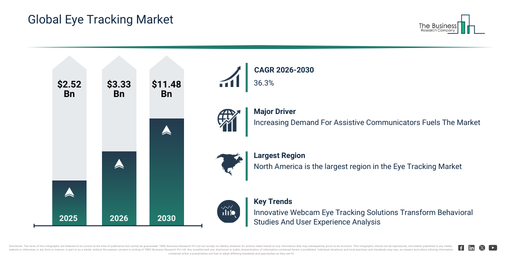
    The eye tracking market size has experienced exponential growth in recent years. It is anticipated to expand from $2.52 billion in 2025 to $3.33 billion in 2026, achieving a compound annual growth rate (CAGR) of 31.9%. The market’s expansion in the historic period can be ascribed to a rise in human-computer interaction studies, increased research funding, the broader application of usability testing, advancements in sensor technologies, and greater academic adoption.

    The eye tracking market is projected to experience rapid expansion over the coming years. This market is anticipated to reach $11.48 billion by 2030, demonstrating a compound annual growth rate (CAGR) of 36.3%. Key factors driving this growth during the forecast period include the incorporation of AI-powered analytics, increasing consumer interest in immersive technologies, the proliferation of autonomous vehicles, wider use in healthcare applications, and innovations in wearable electronics. Significant trends expected within this period encompass its expanding utility in behavioral and cognitive research, broader implementation in automotive safety systems, the development of more wearable eye tracking devices, its growing relevance in healthcare diagnostics, and its seamless integration with virtual and augmented reality.

    Access Your Free Sample Report For In-Depth Market Analysis:

    https://www.thebusinessresearchcompany.com/report/eye-tracking-global-market-report

    Which Important Drivers Are Guiding The Eye Tracking Market Growth?

    The rising need for assistive communicators is projected to drive the eye-tracking market. Assistive communicators are tools that support individuals with communication difficulties by facilitating or enhancing their ability to articulate thoughts, ideas, and necessities. Eye-tracking technology enables users to operate and navigate these communicators by observing their eye movements, thereby offering a more natural and efficient way to communicate. For instance, in January 2024, the World Health Organization (WHO), a Switzerland-based national agency, reported that more than 2.5 billion people globally require one or more assistive products. Additionally, with an aging global population and an increase in noncommunicable diseases, an estimated 3.5 billion people will need assistive technology by 2050. Therefore, the elevated demand for assistive communicators is expected to propel the growth of the eye-tracking market.

    How Is The Eye Tracking Market Organized By Segment Classification?

    The eye tracking market covered in this report is segmented –

    1) By Type: Eye Attached Tracking, Optical Tracking, Electrooculography

    2) By Component: Hardware, Software

    3) By Location: Remote, Mobile

    4) By Application: Healthcare, Retail, Research, Automotive, Consumer Electronics, Other Application

    Subsegments:

    1) By Eye Attached Tracking: Wearable Devices, Head-Mounted Displays (HMDs)

    2) By Optical Tracking: Remote Eye Trackers, Camera-Based Systems, Video-Based Eye Tracking Solutions

    3) By Electrooculography: Contact Electrooculography Devices, Non-Contact Electrooculography Devices, Research-Grade Electrooculography Systems

    What Trends Are Influencing The Evolution Of The Eye Tracking Market?

    Leading companies in the eye-tracking market are concentrating on developing innovative solutions, such as webcam eye-tracking, to achieve a competitive advantage. This technology utilizes a standard webcam or similar camera to monitor and analyze a user’s eye movements and gaze direction in real time. For instance, in June 2024, Tobii AB, a Swedish-based computer software company, launched the Tobii Nexus, a webcam eye tracker. The Tobii Nexus is a cutting-edge webcam eye-tracking solution that provides seamless integration with standard webcams, enabling accurate gaze tracking without the need for specialized hardware. Its unique features encompass real-time eye-tracking capabilities, user-friendly calibration, and compatibility with various software applications, making it ideal for research, accessibility, and user experience analysis.

    Who Are The Industry Participants Involved In The Eye Tracking Market?

    Major companies operating in the eye tracking market are Tobii AB, Varjo, Smart Eye AB, RealEye, Noldus Information Technology, Seeing Machine, Sensomotoric Instruments (SMI), iMotions A/S, NovaSight, Eyegaze Inc., Element Human Ltd., Ergoneers GmbH, Eye Tracking Inc., Gazepoint Research Inc., LC Technologies Inc., 4tiitoo AG, The Eye Tribe, Mirametrix Inc., EyeTech Digital Systems, SR Research, Phoenix Research Labs, GazeHawk, Pupil Labs

    Get The Full Eye Tracking Market Report:

    https://www.thebusinessresearchcompany.com/report/eye-tracking-global-market-report

    Which Region Is The Top Contributor To The Eye Tracking Market By Share?

    North America was the largest region in the eye tracking market in 2025. Asia-Pacific is expected to be the fastest-growing region in the forecast period. The regions covered in the eye tracking market report are Asia-Pacific, South East Asia, Western Europe, Eastern Europe, North America, South America, Middle East, Africa.

    Request A Customized Eye Tracking Market Report For Competitive Insights:

    https://www.thebusinessresearchcompany.com/report/eye-tracking-global-market-report

    Browse Through More Reports Similar to the Global Eye Tracking Market 2026, By The Business Research Company

    Computer Vision Market Report 2026

    https://www.thebusinessresearchcompany.com/report/computer-vision-global-market-report

    Eye Tracking Solutions Market Report 2026

    https://www.thebusinessresearchcompany.com/report/eye-tracking-solutions-global-market-report

    3D Eye Tracking Software Market Report 2026

    https://www.thebusinessresearchcompany.com/report/3d-eye-tracking-software-global-market-report

    Get in touch with us:

    The Business Research Company: https://www.thebusinessresearchcompany.com/

    Americas +1 310-496-7795

    Asia +44 7882 955267 & +91 8897263534

    Europe +44 7882 955267

    Email us at info@tbrc.info

    Follow us on:

    LinkedIn: https://in.linkedin.com/company/the-business-research-company

    YouTube: https://www.youtube.com/channel/UC24_fI0rV8cR5DxlCpgmyFQ

    Global Market Model: https://www.thebusinessresearchcompany.com/global-market-model
  • Eye melanoma market analysis (2026–2030)

    Eye melanoma market analysis (2026–2030)

    The Business Research Company’s 2026 market reports feature enhanced tools like market attractiveness analysis, TAM assessment, and company scoring matrices, along with interactive dashboards, deeper supply chain insights, and startup coverage strengthening the depth, usability, and strategic value of insights.

    What Level Of Market Value Growth Is Predicted For The Eye Melanoma Market From 2026 To 2030?

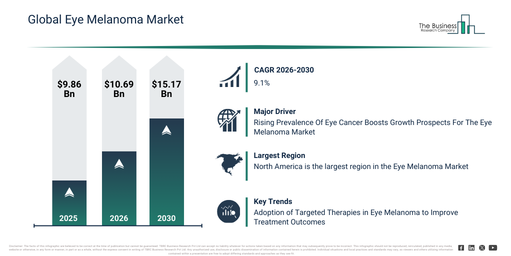
    The eye melanoma market size has experienced strong growth in recent years. It is projected to expand from $9.86 billion in 2025 to $10.69 billion in 2026, achieving a compound annual growth rate (CAGR) of 8.4%. This historical growth can be credited to advancements in ocular imaging technologies, a rise in cancer awareness, the expansion of oncology treatment facilities, enhanced diagnostic capabilities, and improved survival outcomes.

    The eye melanoma market is anticipated to experience robust expansion in the coming years, with its valuation projected to reach $15.17 billion by 2030, exhibiting a compound annual growth rate (CAGR) of 9.1%. This growth during the forecast period can be primarily attributed to the emergence of innovative immunotherapies, the increasing embrace of precision oncology, advancements in genetic testing, heightened investment in research for rare cancers, and enhanced early screening initiatives. Key trends expected during this period involve a heightened emphasis on early cancer detection, the increasing utilization of targeted therapies and immunotherapies, a greater reliance on advanced ocular imaging techniques, the proliferation of specialized oncology centers, and intensified clinical research focused on rare eye cancers.

    Access Your Free Sample Report For In-Depth Market Analysis:

    https://www.thebusinessresearchcompany.com/report/eye-melanoma-global-market-report

    What Major Factors Are Driving The Eye Melanoma Market Forward?

    The escalating occurrence of eye cancer is anticipated to fuel the expansion of the eye melanoma market moving forward. Eye cancer involves the development of anomalous and unrestrained cell proliferation within the structures of the eye. The improved recognition and effective handling of early-stage instances are generating a greater requirement for specialized treatments and interventions, driven by enhanced diagnostic methods, increased awareness, and advancements in therapeutic options. For example, according to the American Cancer Society, a US-based non-profit organization, there were roughly 3,140 new cases of eye and orbital cancers (predominantly melanomas) in 2025, including 1,620 in males and 1,520 in females. Furthermore, approximately 490 deaths resulted from these cancers, comprising 270 males and 220 females. Thus, the growing prevalence of eye cancer is expected to stimulate the growth of the eye melanoma market.

    Which Segments Define The Eye Melanoma Market Segment Structure?

    The eye melanoma market covered in this report is segmented –

    1) By Site: Uvea, Sclera, Retina

    2) By Diagnosis: Imaging, Biopsy, Eye Exam

    3) By Treatment: Surgery, Radiation Therapy, Targeted Therapy, Immunotherapy, Other Treatment

    4) By End User: Hospitals And Clinics, Academic Institutes

    Subsegments:

    1) By Uvea: Choroid Melanoma, Ciliary Body Melanoma, Iris Melanoma

    2) By Sclera: Episcleral Melanoma, Scleral Surface Melanoma, Conjunctival Melanoma

    3) By Retina: Macular Melanoma, Peripheral Retinal Melanoma, Optic Disc Melanoma

    Which Trends Are Impacting The Progress Of The Eye Melanoma Market?

    Leading companies in the eye melanoma market are prioritizing the development of technological innovations, such as protein-kinase C (PKC) inhibitors, to meet the rising demand for effective systemic treatments that also help preserve the eye. PKC inhibitors are small-molecule compounds designed to block PKC enzymes involved in tumor growth, offering a non-surgical alternative to conventional treatments like plaque brachytherapy or enucleation. For example, in March 2025, IDEAYA Biosciences, a US-based precision oncology company, introduced darovasertib, a first-in-class PKC inhibitor specifically for uveal melanoma. This therapy targets PKC isoforms linked to tumor proliferation, with Phase 2 trials showing tumor shrinkage rates of around 82% and eye-preservation rates of 61%. Darovasertib provides a systemic, eye-sparing treatment option for patients eligible for either enucleation or plaque brachytherapy.

    Who Are The Established Players Within The Eye Melanoma Market?

    Major companies operating in the eye melanoma market are Pfizer Inc., Johnson & Johnson, F. Hoffmann-La Roche Ltd, Merck & Co. Inc, AbbVie Inc., Bayer AG, Novartis AG, Bristol-Myers Squibb Company, AstraZeneca PLC, Sanofi S.A., Amgen Inc., Castle Biosciences Inc., IDEAYA Biosciences Inc., Delcath Systems Inc., Immunocore Holdings plc, Aura Biosciences Inc., TriSalus Life Sciences Inc., Replimune Group Inc., Linnaeus Therapeutics, iOnctura, LES LABORATOIRES SERVIER, Immatics NV

    Get The Full Eye Melanoma Market Report:

    https://www.thebusinessresearchcompany.com/report/eye-melanoma-global-market-report

    Which Region Represents The Largest Share Of The Eye Melanoma Market?

    North America was the largest region in the eye melanoma market in 2025. Asia-Pacific is expected to be the fastest-growing region in the forecast period. The regions covered in the eye melanoma market report are Asia-Pacific, South East Asia, Western Europe, Eastern Europe, North America, South America, Middle East, Africa.

    Request A Customized Eye Melanoma Market Report For Competitive Insights:

    https://www.thebusinessresearchcompany.com/report/eye-melanoma-global-market-report

    Browse Through More Reports Similar to the Global Eye Melanoma Market 2026, By The Business Research Company

    Melanoma Therapeutics Market Report 2026

    https://www.thebusinessresearchcompany.com/report/melanoma-therapeutics-global-market-report

    Melanoma Drugs Market Report 2026

    https://www.thebusinessresearchcompany.com/report/melanoma-drugs-global-market-report

    Malignant Melanoma Treatment Market Report 2026

    https://www.thebusinessresearchcompany.com/report/malignant-melanoma-treatment-global-market-report

    Get in touch with us:

    The Business Research Company: https://www.thebusinessresearchcompany.com/

    Americas +1 310-496-7795

    Asia +44 7882 955267 & +91 8897263534

    Europe +44 7882 955267

    Email us at info@tbrc.info

    Follow us on:

    LinkedIn: https://in.linkedin.com/company/the-business-research-company

    YouTube: https://www.youtube.com/channel/UC24_fI0rV8cR5DxlCpgmyFQ

    Global Market Model: https://www.thebusinessresearchcompany.com/global-market-model
  • Coagulation Factor Deficiency Market: Key Drivers and Evolution

    Coagulation Factor Deficiency Market: Key Drivers and Evolution

    The Business Research Company’s 2026 market reports feature enhanced tools like market attractiveness analysis, TAM assessment, and company scoring matrices, along with interactive dashboards, deeper supply chain insights, and startup coverage strengthening the depth, usability, and strategic value of insights.

    How Much Growth In Market Value Is Expected For The Coagulation Factor Deficiency Market Between 2026 And 2030?

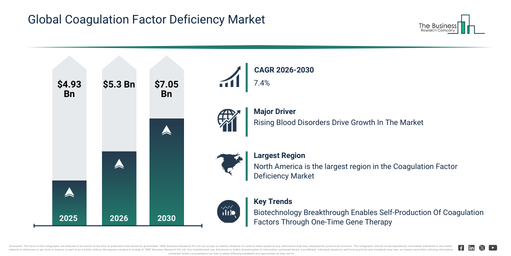
    The coagulation factor deficiency market has demonstrated substantial growth in recent years. It is forecast to expand from $4.93 billion in 2025 to $5.3 billion in 2026, achieving a compound annual growth rate (CAGR) of 7.6%. This historical growth can be attributed to factors like enhanced diagnosis of bleeding disorders, increased accessibility to plasma-derived therapies, the expansion of hemophilia treatment centers, elevated patient awareness initiatives, and the development of specialty healthcare services.

    The coagulation factor deficiency market size is projected to experience substantial growth over the next few years, expanding to $7.05 billion by 2030 with a compound annual growth rate (CAGR) of 7.4%. This projected growth can be attributed to several factors, including advancements in gene therapy development, a rising demand for personalized bleeding disorder treatments, the expansion of home care treatment models, an increasing focus on reducing treatment frequency, and growing investments in rare disease therapeutics. Key trends for the forecast period include the increasing adoption of recombinant coagulation factors, a rising use of gene therapy-based treatments, a growing preference for prophylactic treatment regimens, the expansion of home-based infusion therapies, and an enhanced focus on long-acting factor products.

    Access Your Free Sample Report For In-Depth Market Analysis:

    https://www.thebusinessresearchcompany.com/report/coagulation-factor-deficiency-global-market-report

    Which Major Drivers Are Influencing The Expansion Of The Coagulation Factor Deficiency Market?

    The anticipated rise in cases of blood-related disorders is projected to fuel the expansion of the coagulation factor deficiency market in the future. These disorders encompass various conditions impacting the creation, operation, or makeup of blood cells, platelets, or plasma, resulting in issues like anemia, coagulation difficulties, or immune system weaknesses. The increase in such disorders can be attributed to elements like an aging demographic, genetic tendencies, heightened public awareness, environmental influences, shifts in lifestyle, the increasing prevalence of chronic illnesses, and improvements in diagnostic tools enabling earlier identification. Coagulation factor deficiency treatments assist in handling blood-related disorders by supplying crucial clotting factors necessary to avert or manage profuse bleeding, particularly in conditions such as hemophilia, where the body’s intrinsic capacity to form blood clots is compromised. For example, as reported in September 2024 by the Leukemia and Lymphoma Society, a professional organization in the US, every 3 minutes, an individual in the US receives a diagnosis of leukemia, lymphoma, or myeloma. In 2024, approximately 187,740 individuals are projected to be diagnosed with these cancers, making up 9.4% of the anticipated 2,001,140 new cancer cases across the US. Furthermore, data from May 2024 from the National Health Service (NHS) England, a UK government-funded healthcare provider, indicates that approximately 17,000 people in England are currently living with sickle cell disease, an inherited blood disorder, with about 250 new cases diagnosed annually. Consequently, the rising occurrence of blood-related disorders is propelling the expansion of the coagulation factor deficiency market.

    What Are The Different Segment Types In The Coagulation Factor Deficiency Market Segment Breakdown?

    The coagulation factor deficiency market covered in this report is segmented –

    1) By Product: Recombinant Coagulation Factor Concentrates, Plasma-Derived Coagulation Factor Concentrates, Biologics, Desmopressin, Other Product Types

    2) By Deficiency Type: Haemophilia A, Hemophilia B, Von Willebrand Disease, Factor XI Deficiency, Factor XIII Deficiency, Other Treatment Types

    3) By End Users: Hospitals, Clinics, Home Care, Other End Users

    Subsegments:

    1) By Recombinant Coagulation Factor Concentrates: Recombinant Factor VIII, Recombinant Factor IX, Recombinant Factor VIIa

    2) By Plasma-Derived Coagulation Factor Concentrates: Plasma-Derived Factor VIII, Plasma-Derived Factor IX, Plasma-Derived Factor VII

    3) By Biologics: Monoclonal Antibodies, Gene Therapy Products

    4) By Desmopressin: Intravenous Desmopressin, Intranasal Desmopressin

    5) By Other Product Types: Fresh Frozen Plasma (FFP), Prothrombin Complex Concentrates (PCC)

    Which Trends Are Shaping The Coagulation Factor Deficiency Market?

    Leading companies within the coagulation factor deficiency market are prioritizing the creation of advanced treatments, including single-dose gene therapy. Their aim is to offer sustained or possibly permanent remedies for individuals suffering from bleeding conditions such as hemophilia, thereby lessening the ongoing requirement for clotting factor infusions. A single-administration gene therapy is defined as a medical intervention that entails introducing or modifying genetic material inside a patient’s cells to manage or resolve an illness, with the goal of delivering enduring or permanent treatment outcomes following a sole application. An example occurred in April 2024, when Pfizer Inc., a pharmaceutical and biotechnology firm based in the US, disclosed that the U.S. Food and Drug Administration (FDA) had granted approval for BEQVEZ (fidanacogene elaparvovec-dzkt). This approval is for the management of adults with moderate to severe hemophilia B currently on factor IX (FIX) prophylaxis treatment. This particular therapy is a single-dose adeno-associated virus (AAV)-based gene therapy. Its purpose is to insert a working copy of the FIX gene, which codes for a highly active FIX variant, into the transduced cells. This one-time gene therapy allows individuals with hemophilia B to generate their own FIX, eliminating the need for regular FIX infusions.

    Who Are The Well-Known Companies In The Coagulation Factor Deficiency Market?

    Major companies operating in the coagulation factor deficiency market are Pfizer Inc., Bayer HealthCare Pharmaceuticals, Sanofi Genzyme, Novo Nordisk A/S, Baxter International Inc., CSL Behring LLC, Grifols S.A., Octapharma AG, Takeda Pharmaceutical Company Limited, Swedish Orphan Biovitrum AB, Kedrion Biopharma Inc., Shanghai RAAS Blood Products Co. Ltd., LFB S.A., Biotest AG, BioMarin Pharmaceutical Inc., uniQure, Prothya Biosolutions, Bio Products Laboratory Ltd, Green Cross Corporation, Freeline Therapeutics, Aptevo Therapeutics, Hema Biologics LLC, Generation Bio Co, Intellia Therapeutics Inc.

    Get The Full Coagulation Factor Deficiency Market Report:

    https://www.thebusinessresearchcompany.com/report/coagulation-factor-deficiency-global-market-report

    Which Region Leads The Coagulation Factor Deficiency Market In Overall Market Size?

    North America was the largest region in the coagulation factor deficiency market in 2025. Asia-Pacific is expected to be the fastest-growing region in the forecast period. The regions covered in the coagulation factor deficiency market report are Asia-Pacific, South East Asia, Western Europe, Eastern Europe, North America, South America, Middle East, Africa.

    Request A Customized Coagulation Factor Deficiency Market Report For Competitive Insights:

    https://www.thebusinessresearchcompany.com/report/coagulation-factor-deficiency-global-market-report

    Browse Through More Reports Similar to the Global Coagulation Factor Deficiency Market 2026, By The Business Research Company

    Hemostasis Products Market Report 2026

    https://www.thebusinessresearchcompany.com/report/hemostasis-products-global-market-report

    Coagulation Analyzer Market Report 2026

    https://www.thebusinessresearchcompany.com/report/coagulation-analyzer-global-market-report

    Point Of Care Poc Coagulation Testing Market Report 2026

    https://www.thebusinessresearchcompany.com/report/point-of-care-poc-coagulation-testing-global-market-report

    Get in touch with us:

    The Business Research Company: https://www.thebusinessresearchcompany.com/

    Americas +1 310-496-7795

    Asia +44 7882 955267 & +91 8897263534

    Europe +44 7882 955267

    Email us at info@tbrc.info

    Follow us on:

    LinkedIn: https://in.linkedin.com/company/the-business-research-company

    YouTube: https://www.youtube.com/channel/UC24_fI0rV8cR5DxlCpgmyFQ

    Global Market Model: https://www.thebusinessresearchcompany.com/global-market-model