Category: Medical Equipment

  • Responder Hydration Monitoring Systems Market Analysis Reflecting Expansion Trends And Industry Performance

    Responder Hydration Monitoring Systems Market Analysis Reflecting Expansion Trends And Industry Performance

    The Business Research Company’s 2026 market reports feature advanced enhancements such as market attractiveness analysis, total addressable market evaluation, company benchmarking matrices, interactive Excel dashboards, expanded supply chain intelligence, emerging startup coverage, and detailed product insights, delivering more actionable and strategically valuable research.

    How Is The Responder Hydration Monitoring Systems Market’s Market Value Anticipated To Evolve From 2026 To 2030?

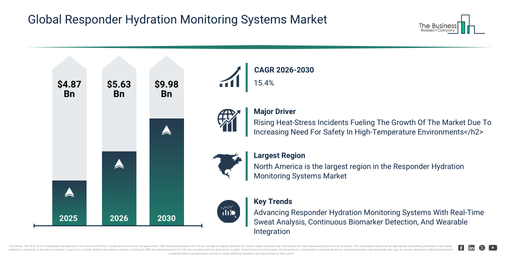
    The responder hydration monitoring systems market has experienced rapid expansion in recent years. This market is projected to increase from $4.87 billion in 2025 to $5.63 billion in 2026, achieving a compound annual growth rate (CAGR) of 15.7%. The growth observed in the historic period stems from the increasing adoption of wearable health devices, growing awareness of hydration and wellness, rising demand from sports and fitness users, expansion of occupational safety initiatives, and increasing use of remote patient monitoring.

    The responder hydration monitoring systems market size is anticipated to undergo significant growth over the upcoming years. It is projected to expand to $9.98 billion by 2030, demonstrating a compound annual growth rate (CAGR) of 15.4%. This anticipated expansion within the forecast period is primarily fueled by the increasing incorporation of hydration sensors into smart wearables, a rising adoption among first responders and industrial workers, a heightened emphasis on preventive healthcare, the expansion of corporate wellness programs, and a growing demand for cloud-based analytics services. Noteworthy trends for the forecast period include technological improvements in hydration sensing, breakthroughs in non-invasive wearable patches, advancements in AI-based hydration analytics, continuous research and development to enhance biosensor accuracy, and the escalating integration of IoT and cloud platforms.

    Download A Free Sample Report For Comprehensive Market Insights:

    https://www.thebusinessresearchcompany.com/sample.aspx?id=30728&type=smp

    Which Core Factors Are Supporting The Expansion Of The Responder Hydration Monitoring Systems Market?

    The anticipated expansion of the responder hydration monitoring systems market is driven by the growing number of heat-stress incidents. These incidents are defined as medical emergencies where the body struggles to regulate its temperature, typically due to extended exposure to high heat or intense physical activity. An uptick in their occurrence is primarily attributable to increasingly common and severe heat conditions, coupled with demanding work-related and emergency operations. Responder hydration monitoring systems are instrumental in reducing heat-stress incidents by continuously monitoring fluid loss, core body temperature, and physiological stress in real time. Such systems enhance responder safety and operational effectiveness through providing early warnings and facilitating prompt actions to avert heat-induced ailments. As an illustration, in July 2024, data from the Korea Disease Control and Prevention Agency (KDCA), a South Korea-based government agency tasked with organ transplant management and disease control, indicated that a total of 2,818 patients suffered from heat-related illnesses, including 32 presumed deaths, in 2023. This figure marked an 80.2% increase compared with 2022, with male patients constituting 77.8% or 2,192 cases and female patients making up 22.2% or 626 cases. Consequently, the escalation of heat-stress incidents is propelling the expansion of the responder hydration monitoring systems market.

    How Are Different Segment Groups Identified Within The Responder Hydration Monitoring Systems Market?

    The responder hydration monitoring systems market covered in this report is segmented –

    1) By Product Type: Wearable Hydration Monitors, Smart Water Bottles, Patch-Based Sensors, Other Products

    2) By Technology: Bioimpedance, Optical Sensors, Electrochemical Sensors, Other Technologies

    3) By Sales / Distribution Channel: Direct Device Sales, B2B Institutional Sales, E-Commerce And Retail Sales

    4) By Application: Military, Firefighters, Emergency Medical Services, Sports And Fitness, Other Applications

    5) By End-User: Individual, Institutional

    Subsegments:

    1) By Wearable Hydration Monitors: Wrist-Worn Hydration Trackers, Chest-Strap Hydration Monitoring Devices, Headband Hydration Sensor Units, Smart Armband Hydration Monitors, Clip-On Hydration Detection Devices

    2) By Smart Water Bottles: Hydration-Tracking Smart Bottles, Temperature-Sensing Smart Bottles, App-Connected Water Intake Bottles, Self-Monitoring Fluid Level Bottles, Sensor-Embedded Hydration Bottles

    3) By Patch-Based Sensors: Sweat-Analysis Hydration Patches, Skin-Adhesive Hydration Sensor Patches, Real-Time Hydration Tracking Patches, Heat-Responsive Hydration Patch Sensors, Flexible Wearable Hydration Patches

    4) By Other Products: Handheld Hydration Testing Devices, Hydration Monitoring Chest Modules, Portable Electrolyte Measurement Tools, Hydration Assessment Field Kits, Multi-Parameter Wearable Sensor Units

    Which Trends Are Contributing To Changes In The Responder Hydration Monitoring Systems Market?

    Key players in the responder hydration monitoring systems market are prioritizing the creation of sophisticated capabilities, including real-time sweat analysis, aimed at enhancing hydration evaluation, tracking electrolyte equilibrium, and providing comprehensive physiological understanding for individuals like first responders, athletes, and elite professionals. This method, known as real-time sweat analysis, involves the ongoing measurement of specific biomarkers found in sweat, such as electrolytes and hydration markers, employing wearable sensors to deliver instant information on a person’s hydration level as conditions evolve. As an illustration, in October 2025, Innovosens AB, a Swedish firm specializing in wearable sensing solutions, introduced HydroSense, an innovative sweat sensor engineered for uninterrupted hydration and electrolyte tracking. The HydroSense system features tiny, skin-adhered sensors that analyze sweat composition continuously, providing practical hydration insights directly to connected wearable technology or mobile apps. This empowers both users and their support personnel to make well-founded decisions regarding fluid and electrolyte replenishment, thereby enhancing performance and mitigating stress linked to heat.

    Who Are The Companies Shaping The Responder Hydration Monitoring Systems Market Landscape?

    Major companies operating in the responder hydration monitoring systems market are GE HealthCare Technologies Inc., Masimo Corporation, Abena A/S, John Wiley & Sons Inc., ResearchGate GmbH, Nix Biosensors Inc., Wearable Technologies AG, BSX Technologies Inc., Mode Sensors Inc., Kenzen Inc., WearOptimo Pty Ltd., GraphWear Technologies Inc., MX3 Diagonistics Inc., DC Rainmaker Inc., Intake Health Inc., Epicore Biosystems Inc, Sixty Inc., HDrop Inc., iHydrate Technologies Inc., Oura Health Oy

    Access The Complete Responder Hydration Monitoring Systems Market Report:

    https://www.thebusinessresearchcompany.com/report/responder-hydration-monitoring-systems-market-report

    Which Region Is The Dominant Market In The Responder Hydration Monitoring Systems Market?

    North America was the largest region in the responder hydration monitoring systems market in 2025. Asia-Pacific is expected to be the fastest-growing region in the forecast period. The regions covered in the responder hydration monitoring systems market report are Asia-Pacific, South East Asia, Western Europe, Eastern Europe, North America, South America, Middle East, Africa.

    Access a Customized Responder Hydration Monitoring Systems Market Report for Deeper Competitive Insights

    https://www.thebusinessresearchcompany.com/sample.aspx?id=30728&type=smp

    Get in touch with us:

    The Business Research Company: https://www.thebusinessresearchcompany.com/

    Americas: +1 310-496-7795

    Asia: +44 7882 955267 & +91 8897263534

    Europe: +44 7882 955267

    Email us at: marketing@tbrc.info

    Follow us on:

    LinkedIn: https://in.linkedin.com/company/the-business-research-company

    YouTube: https://www.youtube.com/channel/UC24_fI0rV8cR5DxlCpgmyFQ

    Global Market Model: https://www.thebusinessresearchcompany.com/global-market-model
  • Global Rescue Airway Devices Market Revenue Expected To Reach $4.48 Billion By 2030

    Global Rescue Airway Devices Market Revenue Expected To Reach $4.48 Billion By 2030

    The Business Research Company’s 2026 market reports feature advanced enhancements such as market attractiveness analysis, total addressable market evaluation, company benchmarking matrices, interactive Excel dashboards, expanded supply chain intelligence, emerging startup coverage, and detailed product insights, delivering more actionable and strategically valuable research.

    By 2030, How Much Growth In Market Size Is Expected For The Rescue Airway Devices Market?

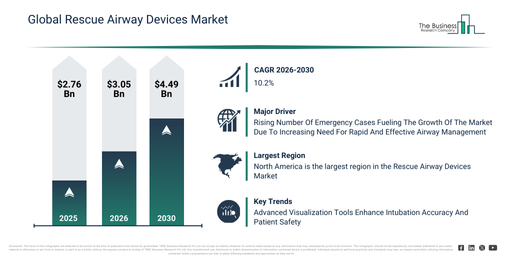
    The rescue airway devices market has experienced rapid expansion in recent years. It is anticipated to expand from $2.76 billion in 2025 to $3.05 billion in 2026, demonstrating a compound annual growth rate (CAGR) of 10.4%. The historical period’s growth can be linked to factors such as increasing mobile connectivity, rising sensor integration, expanding IoT adoption, growing data analytics usage, and increasing indoor positioning demand.

    The rescue airway devices market is poised for rapid expansion over the next few years, with projections indicating it will reach $4.49 billion by 2030, exhibiting a compound annual growth rate (CAGR) of 10.2%. This anticipated growth during the forecast period is largely driven by factors such as the increasing implementation of context-aware automation, the growing need for real-time localization, the ongoing expansion of smart infrastructure, the broadening scope of AI-enabled processing, and the rising adoption of multi-modal sensing. Prominent trends throughout this period encompass advancements in adaptive sensing, innovations in ambient automation, developments in multimodal fusion, extensive research in predictive intelligence, and significant technology upgrades in spatial computing.

    Download A Free Sample Report For Comprehensive Market Insights:

    https://www.thebusinessresearchcompany.com/sample.aspx?id=30727&type=smp

    What Are The Main Drivers Accelerating The Growth Of The Rescue Airway Devices Market?

    The expansion of the rescue airway devices market is anticipated to be fueled by an increasing volume of emergency situations. Such cases encompass critical medical events like vehicular crashes, heart attacks, respiratory distress, and serious injuries demanding immediate life-saving actions. This escalation in emergency cases stems from an uptick in road traffic accidents and violence-related harm among populations that are increasingly urbanized and rely on motorized transport, leading individuals to seek prompt hospital care. Rescue airway devices are instrumental in handling these emergencies, facilitating swift, dependable, and efficient airway management both before and within hospitals, thus ensuring sufficient oxygen supply and lowering the risk of complications during urgent medical attention. For instance, in October 2025, according to the NHS England, a UK-based government health agency, there were around 401,800 admissions to hospital in an emergency via all accident and emergency departments in September 2025, averaging 13,400 people per day, with a further 133,800 emergency admissions that did not come via accident and emergency, averaging 4,500 per day. Consequently, the growing frequency of emergency incidents is propelling the market growth for rescue airway devices.

    What Segment Categories Are Evaluated In The Rescue Airway Devices Market Study?

    The rescue airway devices market covered in this report is segmented –

    1) By Product Type: Supraglottic Airway Devices (SGA), Laryngeal Mask Airways (LMA), Intubating Laryngeal Mask Airways (ILMA), Laryngeal Tubes, I-Gel Airway Devices, Other Product Types

    2) By Material: Silicone, Polyvinyl Chloride (PVC), Thermoplastic Elastomers (TPE), Other Materials

    3) By Anatomical Placement: Simple Adjuncts (Upper Airway), Supraglottic Or Extraglottic Airway Devices (SADs Or EGDs), Infraglottic Or Tracheal Devices (Definitive Airway), Airway Access Or Visualization Tools, Ventilation Or Resuscitation Devices

    4) By End User: Hospitals, Ambulatory Surgery Centers (ASC), Clinics, Emergency Medical Services (EMS) Providers, Military And Government Medical Units, Other End Users

    Subsegments:

    1) By Supraglottic Airway Devices (SGA): First Generation Supraglottic Devices, Second Generation Supraglottic Devices, Reusable Supraglottic Devices, Disposable Supraglottic Devices

    2) By Laryngeal Mask Airways (LMA): Reusable Laryngeal Mask Airways, Disposable Laryngeal Mask Airways, First Generation Laryngeal Mask Airways, Second Generation Laryngeal Mask Airways

    3) By Intubating Laryngeal Mask Airways (ILMA): Reusable Intubating Laryngeal Mask Airways, Disposable Intubating Laryngeal Mask Airways, Silicone Intubating Mask Airways, Polyvinyl Chloride Intubating Mask Airways

    4) By Laryngeal Tubes: Single Lumen Laryngeal Tubes, Dual Lumen Laryngeal Tubes, Reusable Laryngeal Tubes, Disposable Laryngeal Tubes

    5) By I-Gel Airway Devices: Standard I-Gel Airway Devices, Pediatric I-Gel Airway Devices, Adult I-Gel Airway Devices, Disposable I-Gel Airway Devices

    6) By Other Product Types: Pharyngeal Airway Devices, Oropharyngeal Airway Devices, Nasopharyngeal Airway Devices, Cuffed Pharyngeal Airway Devices

    What Trends Are Shaping The Rescue Airway Devices Market Structure?

    Major companies operating in the rescue airway devices market are concentrating on developing sophisticated visual technologies, such as integrated video laryngoscopy systems, to enhance clinician visibility, procedural precision, and patient well-being during airway management in both routine and complex clinical scenarios. Integrated video laryngoscopy solutions are defined as instruments that merge high-resolution video imaging with user-friendly controls and software connectivity, allowing medical professionals to visually guide intubation in real time and effortlessly share imaging data with hospital information systems. For instance, in January 2025, Ambu A/S, a Denmark-based medical technology company, introduced the Ambu SureSight Connect video laryngoscopy solution, specifically designed to facilitate efficient endotracheal intubation in operating rooms and intensive care units. This solution seamlessly connects with Ambu’s digital platforms, including Ambu aView 2 Advance and Ambu aBox 2, thereby streamlining workflows, reducing task complexity, and equipping clinicians with extensive airway visualization capabilities. It stands as the sole airway visualization offering that features a one-lung ventilation solution and incorporates all devices recommended for airway assessment and intubation, thus broadening its utility across clinical settings.

    Which Industry Players Are Present In The Rescue Airway Devices Market?

    Major companies operating in the rescue airway devices market are Medtronic plc, Medline Industries LP, GE HealthCare Technologies Inc., Becton, Dickinson and Company, Olympus Corporation, Smiths Group plc, Drägerwerk AG & Co. KGaA, Teleflex Incorporated, Cook Medical LLC, Nihon Kohden Corporation, Fisher & Paykel Healthcare Corporation Limited, Ambu A/S, Armstrong Medical Ltd., Vyaire Medical Inc., Vygon S.A., Intersurgical Ltd., Mercury Enterprises LLC, SunMed LLC, Verathon Inc., SourceMark LLC

    Access The Complete Rescue Airway Devices Market Report:

    https://www.thebusinessresearchcompany.com/report/rescue-airway-devices-market-report

    Which Area Represents The Largest Portion Of The Rescue Airway Devices Market?

    North America was the largest region in the rescue airway devices market in 2025. Asia-Pacific is expected to be the fastest-growing region in the forecast period. The regions covered in the rescue airway devices market report are Asia-Pacific, South East Asia, Western Europe, Eastern Europe, North America, South America, Middle East, Africa.

    Access a Customized Rescue Airway Devices Market Report for Deeper Competitive Insights

    https://www.thebusinessresearchcompany.com/sample.aspx?id=30727&type=smp

    Get in touch with us:

    The Business Research Company: https://www.thebusinessresearchcompany.com/

    Americas: +1 310-496-7795

    Asia: +44 7882 955267 & +91 8897263534

    Europe: +44 7882 955267

    Email us at: marketing@tbrc.info

    Follow us on:

    LinkedIn: https://in.linkedin.com/company/the-business-research-company

    YouTube: https://www.youtube.com/channel/UC24_fI0rV8cR5DxlCpgmyFQ

    Global Market Model: https://www.thebusinessresearchcompany.com/global-market-model
  • Remote Visualization Workstations Market Insights Exploring Expansion Opportunities Through 2030

    Remote Visualization Workstations Market Insights Exploring Expansion Opportunities Through 2030

    The Business Research Company’s 2026 market reports feature advanced enhancements such as market attractiveness analysis, total addressable market evaluation, company benchmarking matrices, interactive Excel dashboards, expanded supply chain intelligence, emerging startup coverage, and detailed product insights, delivering more actionable and strategically valuable research.

    What Market Value Trend Is Expected For The Remote Visualization Workstations Market From 2026 To 2030?

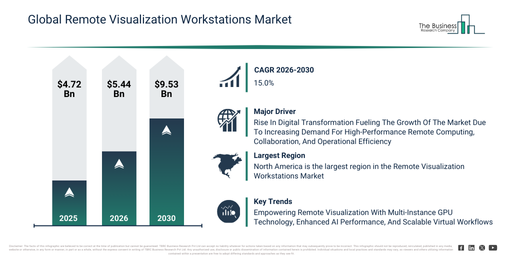
    The market size for remote visualization workstations has experienced rapid expansion in recent years. It is forecast to grow from $4.72 billion in 2025 to $5.44 billion in 2026, achieving a compound annual growth rate (CAGR) of 15.3%. This historical growth can be attributed to the rising adoption of remote work models, an increasing demand for high-performance remote computing solutions, the ongoing digital transformation across industries, the expansion of virtualization and remote desktop infrastructure utilization, and a growing need for secure remote access and collaboration.

    The market for remote visualization workstations is projected to experience swift expansion in the coming years. This market is anticipated to reach $9.53 billion by 2030, exhibiting a compound annual growth rate (CAGR) of 15.0%. This projected growth is driven by several factors, including the increasing need for hybrid and remote work setups, the expanding reach of cloud-based remote visualization platforms, the greater acceptance of AI and machine-learning driven visualization tools, wider market entry into developing economies and overlooked sectors, and a heightened requirement for combined hardware, software, and services in remote visualization solutions. Key trends expected during this period involve technological improvements in graphics processing unit (GPU) and processor performance and graphical capabilities, breakthroughs in the integration of artificial intelligence (AI), machine learning (ML), and advanced analytics, the creation of immersive visualization experiences through augmented reality (AR) and virtual reality (VR) alongside advanced remote collaboration tools, an increase in cloud-based and hybrid deployment methods for visualization workstations, and greater investment in research and development resulting in more scalable, efficient, and secure remote visualization environments.

    Download A Free Sample Report For Comprehensive Market Insights:

    https://www.thebusinessresearchcompany.com/sample.aspx?id=30726&type=smp

    Which Growth Drivers Are Expected To Support The Remote Visualization Workstations Market Forward?

    The expansion of digital transformation is projected to fuel the advancement of the remote visualization workstations market in the future. Digital transformation involves incorporating digital technologies across all business functions to optimize operations, boost value delivery, and facilitate innovation, simultaneously encouraging agile and data-centric approaches. This digital shift is accelerating, driven by the increasing demand to provide quicker, more tailored, and smooth customer experiences essential for maintaining competitiveness. Remote visualization workstations bolster digital transformation by allowing secure, location-independent access to high-performance computing and graphics processing capabilities. These workstations facilitate collaborative workflows, lessen reliance on physical infrastructure, and expedite decision-making in sectors like engineering, healthcare, and media, through enhanced flexibility, scalability, and operational efficiency. As an illustration, in July 2024, the Office for National Statistics, a UK-based government agency, reported that the digital infrastructure program secured a $535 million (£434 million) investment by 2022, followed by a further $907 million (£736 million) designated for the years 2023 to 2025. Consequently, the expanding digital transformation is propelling the growth of the remote visualization workstations market.

    How Is The Remote Visualization Workstations Market Examined Through Segment Analysis?

    The remote visualization workstations market covered in this report is segmented –

    1) By Component: Hardware, Software, Services

    2) By Deployment Mode: On-Premises, Cloud-Based, Hybrid

    3) By Application: Engineering And Design, Medical Imaging, Scientific Research, Media And Entertainment, Oil And Gas, Other Applications

    4) By End-User: Healthcare, Education, Manufacturing, Energy, Media And Entertainment, Research Institutes, Other End-Users

    Subsegments:

    1) By Hardware: Central Processing Unit, Graphics Processing Unit, Memory, Storage, Input Devices, Output Devices

    2) By Software: Virtualization Software, Rendering Software, Simulation Software, Monitoring Software, Collaboration Software

    3) By Services: Installation Services, Maintenance Services, Consulting Services, Training Services, Technical Support Services

    Which Trends Are Supporting The Evolution Of The Remote Visualization Workstations Market?

    Leading companies in the remote visualization workstations market are concentrating on developing advanced hardware and software features, such as Multi-Instance GPU (MIG) technology, to facilitate high-density virtualized graphics, accelerated AI workloads, and responsive remote computing experiences. Multi-Instance GPU (MIG) describes a GPU architecture that divides a single physical GPU into multiple isolated instances, enabling the simultaneous execution of numerous tasks or user sessions with guaranteed performance and resource allocation, making it ideal for distributed visualization, simulation, and AI inference in virtual environments. For instance, in March 2025, NVIDIA Corporation, a US-based provider of accelerated computing, introduced its Blackwell RTX platform for professional workstations and servers, which included support for Multi-Instance GPU (MIG) configurations. This technology allows enterprises to run several remote visualization sessions and agentic AI workflows concurrently from a single GPU, thereby enhancing utilization efficiency and delivering consistent performance for designers, engineers, and content creators who work with complex 3D visuals or large datasets. By integrating Multi-Instance GPU technology into its RTX-powered workstations and servers, NVIDIA enables organizations to effectively virtualize high-end graphics and AI workloads, reduce infrastructure costs, and support flexible distributed work environments across sectors like media and entertainment, engineering, and scientific research.

    Which Organizations Are Involved In The Remote Visualization Workstations Market?

    Major companies operating in the remote visualization workstations market are Amazon Web Services Inc., Google LLC, Microsoft Corporation, Dell Technologies Inc., Lenovo Group Limited, Intel Corporation, HP Inc., NVIDIA Corporation, Fujitsu Limited, Atos SE, Super Micro Computer Inc., CoreWeave Inc., Red Hat Inc., Penguin Solutions Inc., Recently Published, Scale Computing Inc., Cirrascale Cloud Services LLC, Puget Systems Inc., BOXX Technologies Inc., NoMachine S.à r.l.

    Access The Complete Remote Visualization Workstations Market Report:

    https://www.thebusinessresearchcompany.com/report/remote-visualization-workstations-market-report

    Which Region Commands The Largest Share Of The Remote Visualization Workstations Market?

    North America was the largest region in the remote visualization workstations market in 2025. Asia-Pacific is expected to be the fastest-growing region in the forecast period. The regions covered in the remote visualization workstations market report are Asia-Pacific, South East Asia, Western Europe, Eastern Europe, North America, South America, Middle East, Africa.

    Access a Customized Remote Visualization Workstations Market Report for Deeper Competitive Insights

    https://www.thebusinessresearchcompany.com/sample.aspx?id=30726&type=smp

    Get in touch with us:

    The Business Research Company: https://www.thebusinessresearchcompany.com/

    Americas: +1 310-496-7795

    Asia: +44 7882 955267 & +91 8897263534

    Europe: +44 7882 955267

    Email us at: marketing@tbrc.info

    Follow us on:

    LinkedIn: https://in.linkedin.com/company/the-business-research-company

    YouTube: https://www.youtube.com/channel/UC24_fI0rV8cR5DxlCpgmyFQ

    Global Market Model: https://www.thebusinessresearchcompany.com/global-market-model
  • Remote Patient Monitoring Market Developments Influencing Industry Expansion Through 2030

    Remote Patient Monitoring Market Developments Influencing Industry Expansion Through 2030

    The Business Research Company’s 2026 market reports feature advanced enhancements such as market attractiveness analysis, total addressable market evaluation, company benchmarking matrices, interactive Excel dashboards, expanded supply chain intelligence, emerging startup coverage, and detailed product insights, delivering more actionable and strategically valuable research.

    How Does The Forecasted Market Size Of The Remote Patient Monitoring Market Compare Between 2026 And 2030?

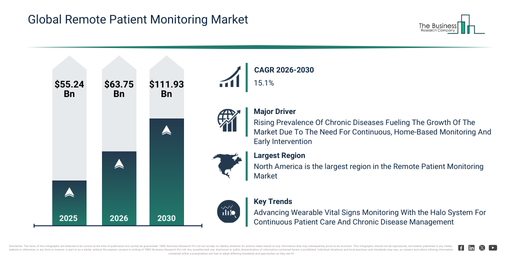
    The remote patient monitoring market has seen substantial growth in recent years. Its valuation is projected to increase from $55.24 billion in 2025 to $63.75 billion in 2026, reflecting a compound annual growth rate (CAGR) of 15.4%. This historical expansion can be linked to the escalating incidence of chronic illnesses, the expanding elderly demographic, the rising call for in-home medical care, the broader acceptance of telehealth services, and an increased commitment to decreasing hospital readmission rates.

    The remote patient monitoring market size is anticipated to undergo substantial growth in the next few years. It is projected to expand to $111.93 billion by 2030, achieving a compound annual growth rate (CAGR) of 15.1%. This expansion during the forecast period can be attributed to the rising incidence of chronic and lifestyle-related diseases, an increasing need for home healthcare services, growing patient recognition of remote monitoring advantages, a global rise in healthcare expenditure, and an intensified focus on value-based and outcome-driven care. Noteworthy trends for the forecast period include advancements in wearable sensor technologies, innovations in remote monitoring platforms and software, developments in integrating remote patient data with electronic health records, research and development in predictive analytics for patient surveillance, and progress in artificial intelligence-driven clinical decision support.

    Download A Free Sample Report For Comprehensive Market Insights:

    https://www.thebusinessresearchcompany.com/sample.aspx?id=30725&type=smp

    What Influential Factors Are Boosting The Remote Patient Monitoring Market Demand?

    The increasing incidence of chronic diseases is anticipated to drive the expansion of the remote patient monitoring market moving forward. These conditions, such as hypertension, diabetes, and cardiovascular disorders, are long-term health issues that demand continuous observation and ongoing management. The rising prevalence of chronic diseases is attributed to aging populations combined with widespread unhealthy lifestyle choices, including physical inactivity, poor nutrition, tobacco use, and excessive alcohol consumption, which collectively contribute to long-term risks like obesity, hypertension, and diabetes. Remote patient monitoring supports chronic disease management by continuously tracking patients’ vital signs, symptoms, and treatment adherence from their homes. This technology enhances patient outcomes by facilitating the early detection of complications, prompt interventions, and personalized adjustments to care. For instance, in June 2024, the National Health Service, a UK-based government department, reported that 3,615,330 individuals registered with a general practitioner (GP) were diagnosed with non-diabetic hyperglycemia or pre-diabetes (a condition with elevated blood sugar levels, not high enough to be classified as diabetes) in 2023, marking an 18% increase from 3,065,825 cases in 2022. Consequently, the growing prevalence of chronic diseases is a key factor propelling the growth of the remote patient monitoring market.

    Which Segment Groups Define The Remote Patient Monitoring Market Landscape?

    The remote patient monitoring market covered in this report is segmented –

    1) By Component: Devices, Services, Software

    2) By Application: Chronic Disease Management, Post-Acute Care Monitoring, Preventive Care And Wellness, Home Health Monitoring, Rehabilitation Monitoring

    3) By End User: Hospitals, Clinics, Home Healthcare Providers, Ambulatory Care Centers, Long-Term Care Facilities

    Subsegments:

    1) By Devices: Remote Monitoring Sensors, Wearable Health Trackers, Blood Pressure Monitors, Blood Glucose Monitors, Pulse Oximetry Devices, Electrocardiogram Devices, Temperature Monitoring Devices, Smart Scales, Multi-Parameter Monitoring Devices

    2) By Services: Installation Services, Maintenance Services, Training Services, Technical Support Services, Remote Monitoring Services, Data Management Services, Consultation Services

    3) By Software: Patient Data Management Software, Clinical Decision Support Software, Remote Monitoring Platforms, Mobile Health Applications, Cloud-Based Analytics Software, Alert And Notification Software, Electronic Health Record Integration Software

    What Trends Are Affecting The Growth Of The Remote Patient Monitoring Market?

    Major companies operating in the remote patient monitoring market are concentrating on developing advanced remote monitoring products to enhance patient care, improve clinical decision-making, and expand access to medical-grade data. Remote vital signs monitoring systems refer to wearable devices that continuously and accurately track key physiological parameters for use in clinical, emergency, and home settings. For instance, in May 2024, Sempulse Corporation, a US-based medical device manufacturer, launched the FDA 510(k)-cleared Halo Vital Signs Monitoring System, a miniature wearable device that integrates with the LiveCharts mobile app and the Command Cloud platform for centralized data visualization and management. The solution includes features such as a reusable design for both home and clinical use, cloud-based data analytics for prioritizing patient care, and continuous monitoring of vital signs even during patient activity.

    Who Are The Firms Contributing To The Remote Patient Monitoring Market Ecosystem?

    Major companies operating in the remote patient monitoring market are Siemens AG, Abbott Laboratories, Medtronic plc, Koninklijke Philips N.V., GE HealthCare Technologies Inc., Boston Scientific Corporation, Baxter International Inc., Roche Diagnostics, Omron Corporation, Shenzhen Mindray Bio-Medical Electronics Co. Ltd., ResMed Inc., Dräger Medical, Dexcom Inc., Teladoc Health Inc., Nihon Kohden Corporation, OSI Systems Inc, Biofourmis Inc., Masimo Corp., VitalConnect Inc., Guangdong Transtek Medical Electronics Co. Ltd.

    Access The Complete Remote Patient Monitoring Market Report:

    https://www.thebusinessresearchcompany.com/report/remote-patient-monitoring-market-report

    Which Region Accounts For The Highest Share Of The Remote Patient Monitoring Market?

    North America was the largest region in the remote patient monitoring market in 2025. Asia-Pacific is expected to be the fastest-growing region in the forecast period. The regions covered in the remote patient monitoring market report are Asia-Pacific, South East Asia, Western Europe, Eastern Europe, North America, South America, Middle East, Africa.

    Access a Customized Remote Patient Monitoring Market Report for Deeper Competitive Insights

    https://www.thebusinessresearchcompany.com/sample.aspx?id=30725&type=smp

    Get in touch with us:

    The Business Research Company: https://www.thebusinessresearchcompany.com/

    Americas: +1 310-496-7795

    Asia: +44 7882 955267 & +91 8897263534

    Europe: +44 7882 955267

    Email us at: marketing@tbrc.info

    Follow us on:

    LinkedIn: https://in.linkedin.com/company/the-business-research-company

    YouTube: https://www.youtube.com/channel/UC24_fI0rV8cR5DxlCpgmyFQ

    Global Market Model: https://www.thebusinessresearchcompany.com/global-market-model
  • Radiation Therapy Planning Artificial Intelligence (AI) Market Industry Analysis Covering Trends, Drivers, And Future Outlook

    Radiation Therapy Planning Artificial Intelligence (AI) Market Industry Analysis Covering Trends, Drivers, And Future Outlook

    The Business Research Company’s 2026 market reports feature advanced enhancements such as market attractiveness analysis, total addressable market evaluation, company benchmarking matrices, interactive Excel dashboards, expanded supply chain intelligence, emerging startup coverage, and detailed product insights, delivering more actionable and strategically valuable research.

    How Is The Market Value Of The Radiation Therapy Planning Artificial Intelligence (AI) Market Projected To Expand During 2026–2030?

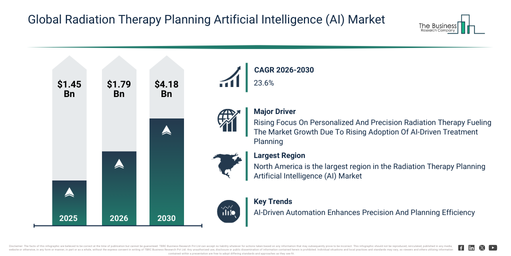
    The radiation therapy planning artificial intelligence (AI) market size has undergone significant expansion in recent years. It is anticipated to grow from $1.45 billion in 2025 to $1.79 billion in 2026, exhibiting a compound annual growth rate (CAGR) of 23.9%. The market’s past growth is attributable to the increasing adoption of AI-based radiotherapy solutions, a rising demand for personalized cancer treatment, the growing utilization of automation in radiation planning, the expansion of oncology centers across developed regions, and an intensified focus on enhancing treatment accuracy.

    The radiation therapy planning artificial intelligence (AI) market size is projected to experience significant expansion in the coming years. By 2030, it is expected to reach $4.18 billion, growing at a compound annual growth rate (CAGR) of 23.6%. This anticipated growth during the forecast period is fueled by the increasing integration of cloud-based AI platforms, greater investment in healthcare digitalization, a rising demand for multi-cancer AI planning tools, an expansion of research and development in oncology AI, and increased adoption in emerging markets. Prominent trends observed in this period include technological advancements in AI-driven contouring and dose calculation, innovations in cloud-based radiation therapy platforms, the development of predictive modeling for treatment outcomes, ongoing research and development in adaptive radiotherapy, and technological enhancements in workflow automation and quality assurance.

    Download A Free Sample Report For Comprehensive Market Insights:

    https://www.thebusinessresearchcompany.com/sample.aspx?id=30718&type=smp

    What Market Drivers Are Helping Shape The Radiation Therapy Planning Artificial Intelligence (AI) Market Expansion?

    The increasing emphasis on personalized and precision radiation therapy is anticipated to fuel the expansion of the radiation therapy planning artificial intelligence (AI) market in the future. This type of therapy involves customizing radiation dosage, delivery techniques, and overall treatment planning specifically to an individual patient’s unique tumor characteristics and anatomical structure. Clinicians are increasingly focusing on personalized and precision radiation therapy to maximize tumor control while simultaneously minimizing damage to surrounding healthy tissue, which they achieve by tailoring the dose, targeting, and timing to each patient’s specific tumor biology and anatomy. Radiation therapy planning AI supports this by providing automated tools capable of generating optimized, patient-specific treatment plans more rapidly and consistently than traditional manual methods. For instance, an announcement from the Department for Health and Social Care, a UK government department, in May 2024, stated that all National Health Service radiotherapy departments across England were allocated artificial intelligence technology through £15.5 million in government funding. This technology automatically reviews scans to differentiate between cancerous cells and healthy organs 2.5 times faster than previous methods, thereby showcasing the increasing adoption of precision radiotherapy techniques. Thus, the heightened focus on personalized and precision radiation therapy is a key driver for the growth of the radiation therapy planning artificial intelligence (AI) market.

    Which Segment-Based Categories Are Covered In The Radiation Therapy Planning Artificial Intelligence (AI) Market?

    The radiation therapy planning artificial intelligence (AI) market covered in this report is segmented –

    1) By Component: Software, Hardware, Services

    2) By Technology: Machine Learning (ML), Deep Learning (DL), Knowledge-Based Planning (KBP)

    3) By Deployment Mode: On-Premises, Cloud-Based

    4) By Application: Breast Cancer, Lung Cancer, Prostate Cancer, Head And Neck Cancer, Other Applications

    5) By End-User: Hospitals, Cancer Treatment Centers, Research Institutes, Other End-Users

    Subsegments:

    1) By Software: Automated Contouring Software, Dose Prediction Software, Plan Optimization Software, Quality Assurance Software, Outcome Analytics Software

    2) By Hardware: Graphics Processing Unit Servers, High Performance Computing Clusters, Dedicated Workstation Hardware, Edge Computing Devices

    3) By Services: Implementation And Integration Services, Training And Support Services, Data Management Services, Clinical Validation Services

    Which Trends Are Expected To Shape The Radiation Therapy Planning Artificial Intelligence (AI) Market?

    Leading companies in the radiation therapy planning artificial intelligence (AI) market are prioritizing the creation of advanced solutions, including AI-powered automation and integrated instruments, with the aim of increasing precision, boosting clinical efficiency, and cutting down manual planning duration. These AI-driven automation and integrated tools refer to intricate algorithms that simplify complex treatment planning procedures, thereby reducing user input and variability. As an illustration, in July 2024, RaySearch Laboratories AB, a medical technology firm situated in Sweden, unveiled its RayStation 2024B treatment planning system. This comprehensive platform is equipped with sophisticated AI-based auto-contouring and a new Proton Monte Carlo dose calculation engine to deliver exceptional accuracy. It incorporates automated features for adaptive therapy and plan optimization, allowing for seamless integration of MR-Linac workflows and streamlined proton beam therapy planning without requiring significant manual effort. Additionally, it includes enhanced scripting and module integration, which expands the system’s versatility and diminishes operational complexities for oncology clinics and research establishments.

    Which Companies Form The Competitive Landscape Of The Radiation Therapy Planning Artificial Intelligence (AI) Market?

    Major companies operating in the radiation therapy planning artificial intelligence (AI) market are Philips Healthcare, Siemens Healthineers AG, Elekta AB, Brainlab SE, Accuray Incorporated, RaySearch Laboratories AB, GE HealthCare, MVision AI, Spectra Medical India Pvt. Ltd., Coexya, LAP GmbH Laser Applikationen, Radformation Inc., TheraPanacea, DOSIsoft SA, Siris Medical Inc., Prowess Inc., Manteia Medical Technologies, Oncora Medical Inc., Adaptiiv Medical Technologies Inc., ViewRay Systems Inc., Pvmed Inc., Doctors App, Mirada Medical Ltd., Vision RT Ltd.

    Access The Complete Radiation Therapy Planning Artificial Intelligence (AI) Market Report:

    https://www.thebusinessresearchcompany.com/report/radiation-therapy-planning-artificial-intelligence-ai-market-report

    Which Region Stands As The Largest Contributor To The Radiation Therapy Planning Artificial Intelligence (AI) Market?

    North America was the largest region in the radiation therapy planning artificial intelligence (AI) market in 2025. Asia-Pacific is expected to be the fastest-growing region in the forecast period. The regions covered in the radiation therapy planning artificial intelligence (AI) market report are Asia-Pacific, South East Asia, Western Europe, Eastern Europe, North America, South America, Middle East, Africa.

    Access a Customized Radiation Therapy Planning Artificial Intelligence (AI) Market Report for Deeper Competitive Insights

    https://www.thebusinessresearchcompany.com/sample.aspx?id=30718&type=smp

    Get in touch with us:

    The Business Research Company: https://www.thebusinessresearchcompany.com/

    Americas: +1 310-496-7795

    Asia: +44 7882 955267 & +91 8897263534

    Europe: +44 7882 955267

    Email us at: marketing@tbrc.info

    Follow us on:

    LinkedIn: https://in.linkedin.com/company/the-business-research-company

    YouTube: https://www.youtube.com/channel/UC24_fI0rV8cR5DxlCpgmyFQ

    Global Market Model: https://www.thebusinessresearchcompany.com/global-market-model
  • Portable Full Digital Color Ultrasound Diagnosis System Market Growth Forecast With Analysis Of Industry Progress Through 2030

    Portable Full Digital Color Ultrasound Diagnosis System Market Growth Forecast With Analysis Of Industry Progress Through 2030

    The Business Research Company’s 2026 market reports feature advanced enhancements such as market attractiveness analysis, total addressable market evaluation, company benchmarking matrices, interactive Excel dashboards, expanded supply chain intelligence, emerging startup coverage, and detailed product insights, delivering more actionable and strategically valuable research.

    What Is The Expected Market Value Outlook For The Portable Full Digital Color Ultrasound Diagnosis System Market Through 2030?

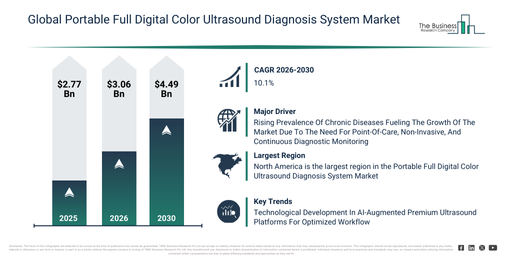
    The market size for portable full digital color ultrasound diagnosis systems has seen rapid expansion in recent years. It is projected to increase from $2.77 billion in 2025 to $3.06 billion in 2026, growing at a compound annual growth rate (CAGR) of 10.3%. The factors contributing to this historical growth include a rise in diagnostic adoption, increased utilization of portable devices, a growing burden of chronic diseases, expanding demand for point-of-care solutions, and heightened healthcare digitization.

    The market for portable full digital color ultrasound diagnosis systems is projected to experience significant expansion in the next few years. It is anticipated to grow to $4.49 billion by 2030, with a compound annual growth rate (CAGR) of 10.1%. This growth throughout the forecast period is driven by the increasing availability of remote healthcare, a rising demand for mobile imaging, enhanced investment in medical devices, broader adoption of real-time imaging solutions, and the growing necessity for quick diagnostic results. Prominent trends expected in this period include technological advancements, innovations in imaging, developments in software, increased research and development initiatives, and the modernization of digital workflows.

    Download A Free Sample Report For Comprehensive Market Insights:

    https://www.thebusinessresearchcompany.com/sample.aspx?id=30707&type=smp

    What Important Drivers Are Powering The Portable Full Digital Color Ultrasound Diagnosis System Market Growth?

    The increasing incidence of chronic diseases is anticipated to propel the expansion of the portable full digital color ultrasound diagnosis system market moving forward. Chronic conditions are long-term medical states that tend to persist and frequently demand ongoing management or treatment, such as diabetes, heart ailments, arthritis, asthma, and numerous autoimmune disorders. The growth in the occurrence of chronic diseases is attributable to sedentary lifestyles, stemming from a lack of physical activity, and prolonged exposure to environmental and behavioral risk factors. Portable full digital color ultrasound diagnosis systems support patients with chronic diseases by enabling swift, precise, and non-invasive monitoring of organs and blood flow directly at the point of care, thereby enhancing early detection, improving treatment decisions, and supporting long-term disease management. For instance, in April 2025, the NHS Confederation, a UK-based national association, estimated that by 2035, 17% of the UK population might be living with four or more chronic conditions. Consequently, the rising prevalence of chronic diseases is a significant driver for the portable full digital color ultrasound diagnosis system market.

    What Segment Types Are Included In The Portable Full Digital Color Ultrasound Diagnosis System Market Analysis?

    The portable full digital color ultrasound diagnosis system market covered in this report is segmented –

    1) By Device Type: Portable Ultrasound System, Handheld Ultrasound System, Laptop-Based Ultrasound System, Tablet-Based Ultrasound System

    2) By Imaging Modality: Color Ultrasound Imaging, Color Doppler Ultrasound Imaging, Full Digital Ultrasound Imaging, Real Time Ultrasound Imaging

    3) By Technology: Digital Beamforming Technology, Color Doppler Imaging Systems, Three Dimensional (3D) And Four Dimensional (4D) Ultrasound Imaging, Artificial Intelligence (AI) Enhanced Systems

    4) By Application: Cardiology Imaging, Obstetrics And Gynecology Imaging, Musculoskeletal Imaging, Radiology Imaging, Urology Imaging, Gastroenterology Imaging, Emergency Care Imaging

    5) By End User: Hospitals And Clinics, Diagnostic Imaging Centers, Ambulatory Surgical Centers, Point-Of-Care Settings, Veterinary Hospitals And Clinics

    Subsegments:

    1) By Portable Ultrasound System: Compact Portable Device, Mobile Portable Device, Wireless Portable Device

    2) By Handheld Ultrasound System: Single Probe Handheld Device, Dual Probe Handheld Device, Multi Probe Handheld Device

    3) By Laptop-Based Ultrasound System: Standard Laptop Integrated Device, Advanced Laptop Imaging Device, High Performance Laptop Diagnostic Device

    4) By Tablet-Based Ultrasound System: Touchscreen Tablet Imaging Device, Detachable Tablet Diagnostic Device, Hybrid Tablet Ultrasound Device

    Which Trends Are Affecting The Portable Full Digital Color Ultrasound Diagnosis System Market Framework?

    Major companies operating in the portable full digital color ultrasound diagnosis system market are concentrating on developing advanced products, such as artificial intelligence-integrated ultrasound systems, with the goal of improving diagnostic efficiency, enhancing the operator’s experience, and achieving better clinical outcomes. Artificial intelligence-integrated ultrasound systems are considered premium imaging devices that leverage native AI-based application management to automate processes, accelerate analysis speed, and provide support for sophisticated clinical solutions. For example, in January 2023, Esaote S.p.A., an Italy-based biomedical company, released the MyLab X90. This new premium ultrasound system incorporates a refreshed XCrystal probe family and an exclusive dual-layer eLed monitor from Barco, which together ensure exceptional on-screen image display with very high contrast resolution, significantly surpassing other product lines. It also features native AI-based application management and advanced ergonomic solutions, facilitating the seamless optimization of daily workflows and expanding data analysis capabilities without compromising diagnostic confidence. Furthermore, its design deliberately focuses on automation to boost the usability and accessibility of advanced technologies in routine clinical practice, aiming to revolutionize both the operator experience and patient care within healthcare systems.

    Which Firms Are Competing In The Portable Full Digital Color Ultrasound Diagnosis System Market?

    Major companies operating in the portable full digital color ultrasound diagnosis system market are General Electric Company, Siemens Healthineers AG, FUJIFILM Holdings Corporation, Koninklijke Philips N.V., Konica Minolta Inc., Canon Medical Systems Corporation, Samsung Medison Co. Ltd., SonoScape Medical Corp., Esaote S.p.A., Edan Instruments Inc., Butterfly Network Inc., Chison Medical Imaging Co. Ltd., Clarius Mobile Health Corp., Terason Ultrasound Inc., BenQ Medical Devices Co. Ltd., Mindray Medical International Limited, Healcerion Co. Ltd., Wuhan Youcare Technology Co. Ltd., ZONARE Medical Systems Inc., Mobisante Inc.

    Access The Complete Portable Full Digital Color Ultrasound Diagnosis System Market Report:

    https://www.thebusinessresearchcompany.com/report/portable-full-digital-color-ultrasound-diagnosis-system-market-report

    Which Region Holds The Largest Share In The Portable Full Digital Color Ultrasound Diagnosis System Market?

    North America was the largest region in the portable full digital color ultrasound diagnosis system in 2025. Asia-Pacific is expected to be the fastest-growing region in the forecast period. The regions covered in the portable full digital color ultrasound diagnosis system market report are Asia-Pacific, South East Asia, Western Europe, Eastern Europe, North America, South America, Middle East, Africa.

    Access a Customized Portable Full Digital Color Ultrasound Diagnosis System Market Report for Deeper Competitive Insights

    https://www.thebusinessresearchcompany.com/sample.aspx?id=30707&type=smp

    Get in touch with us:

    The Business Research Company: https://www.thebusinessresearchcompany.com/

    Americas: +1 310-496-7795

    Asia: +44 7882 955267 & +91 8897263534

    Europe: +44 7882 955267

    Email us at: marketing@tbrc.info

    Follow us on:

    LinkedIn: https://in.linkedin.com/company/the-business-research-company

    YouTube: https://www.youtube.com/channel/UC24_fI0rV8cR5DxlCpgmyFQ

    Global Market Model: https://www.thebusinessresearchcompany.com/global-market-model
  • Global Polyolefin Plastomer (POP) Market Forecast Highlighting Expansion And Competitive Dynamics

    Global Polyolefin Plastomer (POP) Market Forecast Highlighting Expansion And Competitive Dynamics

    The Business Research Company’s 2026 market reports feature advanced enhancements such as market attractiveness analysis, total addressable market evaluation, company benchmarking matrices, interactive Excel dashboards, expanded supply chain intelligence, emerging startup coverage, and detailed product insights, delivering more actionable and strategically valuable research.

    How Will The Market Value Of The Polyolefin Plastomer (POP) Market Increase Between 2026 And 2030?

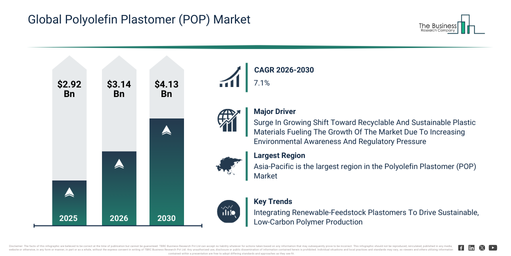
    The polyolefin plastomer (POP) market has experienced robust growth in recent years. Its size is forecast to increase from $2.92 billion in 2025 to $3.14 billion in 2026, exhibiting a compound annual growth rate (CAGR) of 7.4%. This historical expansion can be attributed to several factors, including the rising utilization of flexible packaging materials, an escalating demand for lightweight automotive components, increased consumption of high-performance polymer films, a widening array of applications in medical and hygiene products, and the growing adoption of sustainable plastomer solutions.

    The polyolefin plastomer (POP) market is projected to experience robust expansion over the coming years, reaching $4.13 billion by 2030, demonstrating a compound annual growth rate (CAGR) of 7.1%. This anticipated growth is driven by several factors, including an increasing move towards recyclable packaging, a surge in demand for soft-touch consumer products, the greater application of plastomers in solar and renewable energy, increased investment in advanced film processing, and a rising preference for high-clarity packaging films. Key trends expected during this period involve technological progress in polymer catalyst systems, breakthroughs in film processing and extrusion techniques, the evolution of recyclable and bio-based plastomers, ongoing research and development in high-performance elastomer blends, and advancements in medical-grade polymer uses.

    Download A Free Sample Report For Comprehensive Market Insights:

    https://www.thebusinessresearchcompany.com/sample.aspx?id=30706&type=smp

    Which Major Factors Are Contributing To The Development Of The Polyolefin Plastomer (POP) Market?

    The polyolefin plastomer market is anticipated to expand due to the increasing adoption of recyclable and sustainable plastic materials. These materials are polymer solutions engineered to minimize environmental harm through enhanced recyclability, a reduced carbon footprint, and improved material efficiency, all while maintaining their performance qualities. The growing demand for sustainable plastics stems from manufacturers and brand owners’ efforts to curb plastic waste and foster a circular economy. Polyolefin plastomers play a crucial role in supporting these recyclable and sustainable plastic materials by providing flexible, robust, and lightweight options that boast excellent recyclability and alignment with circular economy principles, making them ideal for applications in packaging, automotive, and consumer goods. For instance, data from HM Revenue & Customs, a UK government agency, revealed that plastic packaging containing 30% or more recycled content rose from 1,289 thousand tonnes to 1,394 thousand tonnes between 2022 and 2023. Consequently, the increasing move towards recyclable and sustainable plastic materials is propelling the growth of the polyolefin plastomer market. The expansion of construction and infrastructure applications is projected to boost the polyolefin plastomer market, driven by an escalating need for durable and flexible materials. These applications encompass the utilization of materials in building, renovation projects, and significant infrastructure developments such as roads, bridges, pipelines, and commercial constructions. Polyolefin plastomers are valuable in these areas, providing improved flexibility, resistance to impact, sealability, and longevity, rendering them suitable for items like roofing membranes, waterproofing systems, pipes, and insulation materials. As an illustration, the Office for National Statistics, a UK government statistical authority, reported in November 2024 that the value of new construction work in Great Britain saw a 4.2% increase in 2023 compared to 2022, reaching approximately $176,567 million (£139,029 million). This reflected a year-on-year growth of about $7,147 million (£5,628 million), supported by a 2.1% rise in private new work and a more significant 10.2% expansion in public new work. Consequently, the surge in construction and infrastructure applications is a key factor propelling the growth of the polyolefin plastomer market.

    Which Segment Divisions Form The Structure Of The Polyolefin Plastomer (POP) Market?

    The polyolefin plastomer (pop) market covered in this report is segmented –

    1) By Product Type: Ethylene-Based POP, Propylene-Based POP

    2) By Processing Method: Injection Molding, Blow Molding, Extrusion, Other Processing Methods

    3) By Applications: Food Packaging, Medical And Health, Home And Personal Care, Hot Melt Adhesive, Other Applications

    4) By End-User Industry: Packaging, Automotive, Healthcare, Building And Construction, Other End-User Industries

    Subsegments:

    1) By Ethylene-Based POP: Linear Low-Density Ethylene, Very Low-Density Ethylene, Metallocene-Catalyzed Ethylene

    2) By Propylene-Based POP: Random Propylene Copolymer, Block Propylene Copolymer, Specialty Propylene Grades

    What Trends Are Influencing The Polyolefin Plastomer (POP) Market?

    Leading companies in the polyolefin plastomers market are concentrating on innovative products, such as ISCC-plus certified circular plastomers, to decrease carbon exposure and ensure stable raw-material sourcing. ISCC-plus certified circular plastomers utilize a mass-balance chain of custody, allowing producers to attribute renewable feedstock to finished resins without requiring changes to processing lines. For instance, in May 2023, Borealis GmbH, an Austria-based polyolefins company, unveiled the Bornewables Queo line of plastomers and elastomers. This ISCC PLUS-certified renewable feedstock delivers seamless compatibility with existing processing and film structures, and significantly reduces the product’s carbon footprint compared to fossil-derived alternatives. This launch represents a substantial technological advance by extending renewable-feedstock solutions into high-performance plastomers, effectively connecting sustainable sourcing with industrial-scale polymer production. It provides a scalable, efficient strategy for lowering carbon impact and maintaining operational consistency in polyolefin manufacturing.

    Who Are The Major Companies Operating In The Polyolefin Plastomer (POP) Market?

    Major companies operating in the polyolefin plastomer (pop) market are Sinopec Group, Exxon Mobil Corporation, Shell Plc, Dow Inc., LyondellBasell Industries N.V., Hanwha Group, LG Chem Ltd., Wanhua Chemical Group Co. Ltd., Sumitomo Chemical Co. Ltd., Westlake Chemical Corporation, Mitsui Chemicals Inc., Versalis S.p.A., Avient Corporation, Borealis AG, SK Geo Centric, RTP Company Inc., Americhem, Sekisui Voltek LLC, SABIC, SK Functional Polymer, Chemate Group

    Access The Complete Polyolefin Plastomer (POP) Market Report:

    https://www.thebusinessresearchcompany.com/report/polyolefin-plastomer-pop-market-report

    Which Region Is The Dominant Market In The Polyolefin Plastomer (POP) Market?

    Asia-Pacific was the largest region in the polyolefin plastomer (POP) market in 2025. Asia-Pacific is expected to be the fastest-growing region in the forecast period. The regions covered in the polyolefin plastomer (pop) market report are Asia-Pacific, South East Asia, Western Europe, Eastern Europe, North America, South America, Middle East, Africa.

    Access a Customized Polyolefin Plastomer (POP) Market Report for Deeper Competitive Insights

    https://www.thebusinessresearchcompany.com/sample.aspx?id=30706&type=smp

    Get in touch with us:

    The Business Research Company: https://www.thebusinessresearchcompany.com/

    Americas: +1 310-496-7795

    Asia: +44 7882 955267 & +91 8897263534

    Europe: +44 7882 955267

    Email us at: marketing@tbrc.info

    Follow us on:

    LinkedIn: https://in.linkedin.com/company/the-business-research-company

    YouTube: https://www.youtube.com/channel/UC24_fI0rV8cR5DxlCpgmyFQ

    Global Market Model: https://www.thebusinessresearchcompany.com/global-market-model
  • Point Source Carbon Capture Machine Market Projected To Surpass $14.3 Billion By 2030 At 17.3% CAGR

    Point Source Carbon Capture Machine Market Projected To Surpass $14.3 Billion By 2030 At 17.3% CAGR

    The Business Research Company’s 2026 market reports feature advanced enhancements such as market attractiveness analysis, total addressable market evaluation, company benchmarking matrices, interactive Excel dashboards, expanded supply chain intelligence, emerging startup coverage, and detailed product insights, delivering more actionable and strategically valuable research.

    What Is The Estimated Growth In Market Size Of The Point Source Carbon Capture Machine Market During 2026–2030?

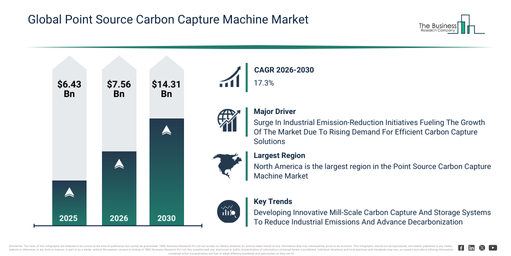
    The point source carbon capture market has seen a rapid increase in size over recent years. Its size is anticipated to climb from $6.43 billion in 2025 to $7.56 billion in 2026, progressing at a compound annual growth rate (CAGR) of 17.6%. Driving this growth historically were elements including a surge in industrial emissions, an escalating demand for emission reduction systems, broader uptake in power generation plants, greater utilization in cement manufacturing, and enhanced deployment within chemical processing plants.

    The point source carbon capture market is anticipated to experience substantial growth in the upcoming years. It is projected to expand to $14.31 billion by 2030, demonstrating a compound annual growth rate (CAGR) of 17.3%. This expansion during the forecast period is driven by factors such as increasing government incentives for emission control, broader implementation of carbon pricing, stronger corporate sustainability commitments, growing adoption in steel production facilities, and rising investment in large-scale carbon capture projects. Significant trends expected in this period include advancements in solvent regeneration technologies, innovations in membrane separation systems, progress in metal-organic framework-based capture materials, extensive research and development in high-efficiency sorbent formulations, and the integration of automation into capture unit operations.

    Download A Free Sample Report For Comprehensive Market Insights:

    https://www.thebusinessresearchcompany.com/sample.aspx?id=30702&type=smp

    Which Core Factors Are Supporting The Expansion Of The Point Source Carbon Capture Machine Market?

    The escalating demand for curtailing industrial facility emissions is anticipated to drive the expansion of the point source carbon capture machine market moving ahead. Decreasing industrial emissions involves lessening the discharge of carbon dioxide (CO₂) and other greenhouse gases from manufacturing locations like power plants, cement plants, and steel factories, aiming to alleviate climate change. The imperative to diminish industrial emissions is growing because governments are strengthening climate policies and carbon taxes, concurrently with investors and local communities urging businesses to lower pollution, safeguard public health, and fulfill net-zero pledges. The point source carbon capture machine aids in lowering industrial emissions by offering technology that captures CO₂ where it originates, thereby assisting facilities in meeting emission targets and lessening their ecological footprint. For example, in March 2024, the UK Department for Business, Energy and Industrial Strategy, a government body based in the UK, provisionally estimated industrial sector greenhouse gas emissions at 52.8 million tonnes of carbon dioxide equivalent in 2023, marking an 8.0% (4.6 million tonnes) reduction from 2022, primarily attributable to decreased fuel use within the iron and steel sector. Consequently, the escalating requirement to diminish industrial facility emissions is propelling the expansion of the point source carbon capture machine market.

    What Segment Categories Are Evaluated In The Point Source Carbon Capture Machine Market Study?

    The point source carbon capture machine market covered in this report is segmented –

    1) By Product Type: Carbon Capture Machines, Absorption Towers, Filtration Units, Sorbent Cartridges, Pressure Vessels, Heat Exchangers, Compressor Systems

    2) By Capture Capacity: Small-Scale Capture Systems, Medium-Scale Capture Systems, Large-Scale Capture Systems

    3) By End-Use Industry: Power Generation, Cement Industry, Steel And Metals, Chemicals And Petrochemicals, Oil And Gas, Waste-To-Energy, Pulp And Paper

    Subsegments:

    1) By Carbon Capture Machines: Pre-Combustion Capture Machines, Post-Combustion Capture Machines, Oxy-Fuel Combustion Capture Machines

    2) By Absorption Towers: Packed Bed Absorption Towers, Plate Column Absorption Towers, Spray Tower Absorption Units

    3) By Filtration Units: Membrane Filtration Units, Electrostatic Filtration Units, Ceramic Filtration Units

    4) By Sorbent Cartridges: Solid Sorbent Cartridges, Liquid Sorbent Cartridges, Regenerable Sorbent Cartridges

    5) By Pressure Vessels: High-Pressure Storage Vessels, Medium-Pressure Storage Vessels, Low-Pressure Storage Vessels

    6) By Heat Exchangers: Shell And Tube Heat Exchangers, Plate Heat Exchangers, Air-Cooled Heat Exchangers

    7) By Compressor Systems: Centrifugal Compressor Systems, Reciprocating Compressor Systems, Screw Compressor Systems

    What Trends Are Influencing The Future Of The Point Source Carbon Capture Machine Market?

    Leading companies within the point source carbon capture market are concentrating on creating innovative carbon capture systems, like mill-scale capture and storage technologies, to lower emissions, improve sustainability, and contribute to industrial decarbonization. Mill-scale capture and storage systems are designed to intercept CO₂ emissions directly at manufacturing locations, allowing for either their reintegration into production processes or permanent storage, while also assessing operational integration and scalability. For example, in August 2025, Packaging Corporation of America (PCA), a US-based packaging manufacturer, commenced a carbon capture and storage pilot project at one of its mills. This pilot system captures process emissions, evaluates its performance under real-world conditions, and generates valuable insights for future expansion. This initiative marks a considerable technological stride, demonstrating practical CO₂ reduction at a facility level, connecting preliminary trials with prospects for large-scale deployment, and presenting a scalable, efficient option for industrial carbon management.

    Who Are The Companies Shaping The Point Source Carbon Capture Machine Market Landscape?

    Major companies operating in the point source carbon capture machine market are Shell PLC, Honeywell International Inc., General Electric, Schlumberger Ltd., Linde PLC, Air Liquide, Baker Hughes Co., Halliburton, Fluor Corporation, Saipem, Air Products and Chemicals Inc., Dakota Gasification Co., Svante Technologies Inc., Carbon Clean Solutions Ltd., Climeworks AG, Mitsubishi Heavy Industries Ltd., Carbon Engineering Ltd., Calix Limited, Aker Carbon Capture ASA, Capsol Technologies ASA

    Access The Complete Point Source Carbon Capture Machine Market Report:

    https://www.thebusinessresearchcompany.com/report/point-source-carbon-capture-machine-market-report

    Which Region Commands The Largest Share Of The Point Source Carbon Capture Machine Market?

    North America was the largest region in the point source carbon capture market in 2025. Asia-Pacific is expected to be the fastest-growing region in the forecast period. The regions covered in the point source carbon capture machine market report are Asia-Pacific, South East Asia, Western Europe, Eastern Europe, North America, South America, Middle East, Africa.

    Access a Customized Point Source Carbon Capture Machine Market Report for Deeper Competitive Insights

    https://www.thebusinessresearchcompany.com/sample.aspx?id=30702&type=smp

    Get in touch with us:

    The Business Research Company: https://www.thebusinessresearchcompany.com/

    Americas: +1 310-496-7795

    Asia: +44 7882 955267 & +91 8897263534

    Europe: +44 7882 955267

    Email us at: marketing@tbrc.info

    Follow us on:

    LinkedIn: https://in.linkedin.com/company/the-business-research-company

    YouTube: https://www.youtube.com/channel/UC24_fI0rV8cR5DxlCpgmyFQ

    Global Market Model: https://www.thebusinessresearchcompany.com/global-market-model
  • One To One Platform For Online English Foreign Teachers Market Forecast Through 2030 Featuring Industry Drivers And Opportunities

    One To One Platform For Online English Foreign Teachers Market Forecast Through 2030 Featuring Industry Drivers And Opportunities

    The Business Research Company’s 2026 market reports feature advanced enhancements such as market attractiveness analysis, total addressable market evaluation, company benchmarking matrices, interactive Excel dashboards, expanded supply chain intelligence, emerging startup coverage, and detailed product insights, delivering more actionable and strategically valuable research.

    What Market Value Expansion Is Expected For The One To One Platform For Online English Foreign Teachers Market Over The Forecast Period?

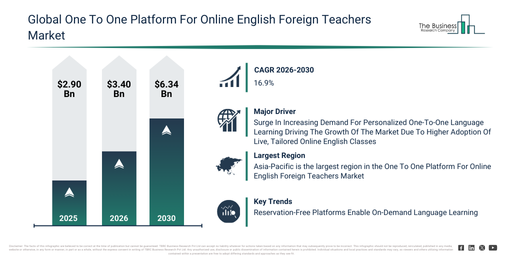
    The market for one-to-one platforms for online English foreign teachers has experienced rapid growth in recent years. This sector is expected to expand from $2.90 billion in 2025 to $3.40 billion in 2026, reflecting a compound annual growth rate (CAGR) of 17.2%. The significant increase observed in the past can be attributed to several factors, including the rising adoption of remote learning, the growing accessibility of high-speed internet, an increased demand for flexible tutoring options, the broadening English language requirements driven by globalization, and the widespread acceptance of digital learning platforms.

    The one-to-one platform for online english foreign teachers market size is anticipated to experience rapid expansion over the coming years. It is set to reach $6.34 billion by 2030, demonstrating a compound annual growth rate (CAGR) of 16.9%. This projected growth throughout the forecast period can be attributed to an increasing preference for personalized language learning, a rise in enrollments from corporate learners, the widening application of AI-powered tutor matching, an expanding demand for certified foreign English teachers, and the growing adoption of subscription-based learning models. Prominent trends expected in this period include ongoing advancements in AI-driven teaching assistants, the continued development of adaptive learning engines, technological innovations impacting virtual classrooms, dedicated research and development in real-time language assessment, and improvements in automated content creation tools.

    Download A Free Sample Report For Comprehensive Market Insights:

    https://www.thebusinessresearchcompany.com/sample.aspx?id=30684&type=smp

    What Are The Main Drivers Accelerating The Growth Of The One To One Platform For Online English Foreign Teachers Market?

    The one-to-one platform for online English foreign teachers market is anticipated to expand due to the escalating need for personalized one to one language learning. This form of learning involves customized online English instruction designed to adapt lesson content, pace, feedback, and scheduling according to individual learner requirements and objectives. Learners increasingly seek such tailored educational experiences because conventional classroom environments often fail to match diverse proficiency levels and learning styles. These one-to-one platforms facilitate personalized one to one language learning by enabling direct interaction with native or foreign English teachers who modify lesson plans and areas of focus based on student performance. For instance, in September 2024, data from the British Council, a UK-based executive non-departmental public body, indicated that in England, most parents support learning a modern foreign language at secondary school, with 68% favoring it as compulsory, 69% recognizing its benefits for their child, 49% expressing regret for not learning another language themselves, and 64% encouraging their child to study Spanish. Consequently, the growing demand for personalized one to one language learning is a key factor driving the expansion of the one-to-one platform for online English foreign teachers market. The increasing demand for native and certified tutors is projected to boost the growth of the one-to-one platform for online English foreign teachers market in the coming period. Native and certified tutors are defined as educators possessing verified credentials, strong language proficiency, and specialized expertise in delivering structured instruction to students. This rising demand stems from a growing preference for high-quality and personalized language learning experiences. One-to-one platforms for online English foreign teachers enhance remote educational ecosystems by connecting students directly with these qualified native and certified tutors. This connection improves language acquisition through personalized, real-time teaching, thereby increasing learning efficiency and student engagement. For example, in December 2023, the Department for Education, a UK-based government agency, reported that a total of 1.5 million tutoring courses were delivered during the 2023-24 academic year. Therefore, the escalating need for native and certified tutors is a significant driver behind the expansion of the one-to-one platform for online English foreign teachers market.

    How Is The One To One Platform For Online English Foreign Teachers Market Examined Through Segment Analysis?

    The one to one platform for online english foreign teachers market covered in this report is segmented –

    1) By Learning Preference: One-on-One Lessons, Group Classes, Hybrid Learning (Online And Offline), Flexible Scheduling (On-Demand Learning)

    2) By Business Model: Commission-Based Model, Subscription-Based Model, Freemium Model, Hybrid Model

    3) By Purpose Of Learning: Academic Achievement, Professional Development, Travel And Migration, Personal Interest

    4) By Age Group: Children (Ages 5–12), Teenagers (Ages 13–19), Young Adults (Ages 20–35), Adults (Ages 36–60), Seniors (Ages 60+)

    5) By User Type: Individual Learners, Corporate Clients, Educational Institutions, Governmental Organizations

    Subsegments:

    1) By One-On-One Lessons: Structured Curriculum-Based Lessons, Conversational Practice Sessions, Goal-Specific Intensive Coaching, Flexible Topic-Based Lessons

    2) By Group Classes: Small Group Conversation Clubs, Themed Workshop Sessions, Exam Preparation Group Classes, Corporate Team Training Sessions

    3) By Hybrid Learning (Online And Offline): Blended Online And In-Person Programs, Flipped Classroom Models, Supplemental Online Practice Modules, Integrated Learning Management Systems

    4) By Flexible Scheduling (On-Demand Learning): Instant On-Demand Tutoring, Advance Booked Flexible Slots, Subscription-Based Credit Systems, Artificial Intelligence-Powered Practice Anytime Features

    Which Trends Are Contributing To Changes In The One To One Platform For Online English Foreign Teachers Market?

    Leading companies in the one-to-one platform market for online English foreign teachers are concentrating on expanding digital learning, specifically through reservation-free online English conversation platforms. This initiative aims to enhance accessibility, boost learner flexibility, and foster equitable language education across diverse geographical regions. These reservation-free platforms enable students to access unlimited one-on-one lessons with native-speaking tutors on demand via smartphones and other digital devices, thereby eliminating scheduling conflicts and geographical obstacles to language acquisition. For instance, in May 2025, Native Camp Inc., a Japan-based EdTech company, launched its English conversation platform Native Camp in Brazil. This platform is a globally proven service, relied upon by over 3 million users worldwide, offering unlimited one-on-one English lessons with native-speaking tutors. It features a system that does not require reservations and allows for instant lesson starts, facilitating continuous learning during short daily breaks without prior booking. It also includes a 7-day free trial, making high-quality English education more accessible and reducing initial expenses for new learners in the Brazilian market.

    Which Industry Players Are Present In The One To One Platform For Online English Foreign Teachers Market?

    Major companies operating in the one to one platform for online english foreign teachers market are EF Education First Ltd., Verbling Inc., Berlitz Corporation, Open English LLC, Preply Inc., Learnlight Global SA, PalFish Education Technology Co. Ltd., TutorABC Inc., Lingoda GmbH, AmazingTalker Inc., Engoo LLC, Cambly Inc., italki HK Limited, iTutorGroup Inc., NativeCamp Inc., SkimaTalk Inc., Rype Inc., GoGoKid Inc., Classgap SL, Qkids Teacher, English Ninjas Inc.

    Access The Complete One To One Platform For Online English Foreign Teachers Market Report:

    https://www.thebusinessresearchcompany.com/report/one-to-one-platform-for-online-english-foreign-teachers-market-report

    Which Region Accounts For The Highest Share Of The One To One Platform For Online English Foreign Teachers Market?

    Asia-Pacific was the largest region in the one to one platform for online english foreign teachers market in 2025. Asia-Pacific is expected to be the fastest-growing region in the forecast period. The regions covered in the one to one platform for online english foreign teachers market report are Asia-Pacific, South East Asia, Western Europe, Eastern Europe, North America, South America, Middle East, Africa.

    Access a Customized One To One Platform For Online English Foreign Teachers Market Report for Deeper Competitive Insights

    https://www.thebusinessresearchcompany.com/sample.aspx?id=30684&type=smp

    Get in touch with us:

    The Business Research Company: https://www.thebusinessresearchcompany.com/

    Americas: +1 310-496-7795

    Asia: +44 7882 955267 & +91 8897263534

    Europe: +44 7882 955267

    Email us at: marketing@tbrc.info

    Follow us on:

    LinkedIn: https://in.linkedin.com/company/the-business-research-company

    YouTube: https://www.youtube.com/channel/UC24_fI0rV8cR5DxlCpgmyFQ

    Global Market Model: https://www.thebusinessresearchcompany.com/global-market-model
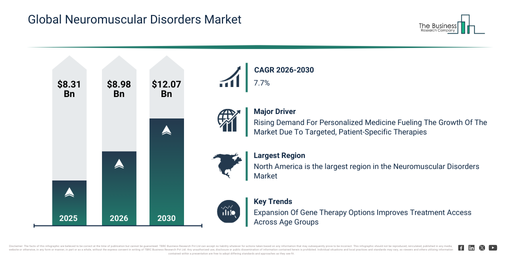
  • The Neuromuscular Disorders Market Is Advancing With Support From Rising Demand For Personalized Medicine Fueling The Growth Of The Market Due To Targeted, Patient-Specific Therapies

    The Neuromuscular Disorders Market Is Advancing With Support From Rising Demand For Personalized Medicine Fueling The Growth Of The Market Due To Targeted, Patient-Specific Therapies

    The Business Research Company’s 2026 market reports feature advanced enhancements such as market attractiveness analysis, total addressable market evaluation, company benchmarking matrices, interactive Excel dashboards, expanded supply chain intelligence, emerging startup coverage, and detailed product insights, delivering more actionable and strategically valuable research.

    How Is The Neuromuscular Disorders Market’s Market Value Anticipated To Evolve From 2026 To 2030?

    The market size for neuromuscular disorders has experienced significant growth over recent years. Projections indicate a rise from $8.31 billion in 2025 to $8.98 billion in 2026, demonstrating a compound annual growth rate (CAGR) of 8.0%. This historical expansion is primarily due to factors such as the increasing prevalence of genetic neuromuscular conditions, greater awareness regarding early diagnosis and available treatment options, a heightened demand for effective therapies targeting rare disorders, increased research efforts in areas like muscular dystrophy and ALS, and the expanding implementation of advanced diagnostic technologies.

    The neuromuscular disorders market size is projected to experience substantial growth in the coming years, with its value expected to reach $12.07 billion by 2030, expanding at a compound annual growth rate (CAGR) of 7.7%. This expansion during the forecast period is primarily driven by rising patient advocacy and support group activities, an increasing demand for biologics and gene therapies, greater recognition of neuromuscular disorders in pediatric cases, growing government initiatives focused on rare disease management, and an enhanced emphasis on home-based care and rehabilitation services. Key trends anticipated in this period include advancements in gene-editing technologies for targeted therapies, innovation in RNA-based treatment platforms, the integration of AI for more rapid neuromuscular diagnosis, progress in stem-cell-based regenerative treatments, and new developments in wearable devices for continuous patient monitoring.

    Download A Free Sample Report For Comprehensive Market Insights:

    https://www.thebusinessresearchcompany.com/sample.aspx?id=30678&type=smp

    Which Drivers Are Advancing The Neuromuscular Disorders Market Growth?

    The increasing need for personalized medicine is projected to stimulate the expansion of the neuromuscular disorders market in the future. This medical approach focuses on customizing treatments for individual patients, considering their unique genetic, environmental, and lifestyle elements to achieve the best possible outcomes and enhance patient care. Growth in genomic technologies, allowing for accurate identification of genetic variations and personalized treatment development, is fueling the rise in demand for personalized medicine. It improves the management of neuromuscular disorders by customizing therapies according to each patient’s specific genetic, molecular, and physiological characteristics. This approach leads to better patient results through targeted interventions, maximizing effectiveness, and reducing unwanted side effects. For example, in February 2024, the Personalized Medicine Coalition (PMC), a US-based nonprofit organization, reported that the U.S. Food and Drug Administration (FDA) authorized 26 novel personalized medicines in 2023, marking a considerable rise from the 12 approved in 2022. Consequently, the escalating demand for personalized medicine is a key factor propelling the expansion of the neuromuscular disorders market.

    How Is Segment Classification Applied In The Neuromuscular Disorders Market?

    The neuromuscular disorders market covered in this report is segmented –

    1) By Disease Type: Spinal Muscular Atrophy (SMA), Amyotrophic Lateral Sclerosis (ALS), Duchenne Muscular Dystrophy (DMD), Myasthenia Gravis, Other Muscular Dystrophies

    2) By Product Type: Pharmaceuticals, Biologics, Diagnostic Tools, Assistive Devices

    3) By Route of Administration: Oral, Injectable, Other Route of Administrations

    4) By Treatment: Gene Therapy, Drug Therapy, RNA-Based Therapy, Enzyme Replacement Therapy, Physical Therapy And Rehabilitation, Respiratory Care

    Subsegments:

    1) By Spinal Muscular Atrophy: SMA Type 1, SMA Type 2, SMA Type 3, SMA Type 4, SMA with Respiratory Distress (SMARD)

    2) By Amyotrophic Lateral Sclerosis: Sporadic ALS, Familial ALS, Limb-Onset ALS, Bulbar-Onset ALS, Respiratory-Onset ALS

    3) By Duchenne Muscular Dystrophy: Early-Onset DMD, Late-Onset DMD, Exon Deletion Mutations, Exon Duplication Mutations, Point Mutations

    4) By Myasthenia Gravis: Generalized Myasthenia Gravis, Ocular Myasthenia Gravis, Seropositive MG, MuSK-Positive MG, Seronegative MG

    5) By Other Muscular Dystrophies: Becker Muscular Dystrophy (BMD), Limb-Girdle Muscular Dystrophy (LGMD), Facioscapulohumeral Muscular Dystrophy (FSHD), Congenital Muscular Dystrophies, Myotonic Dystrophy

    What Trends Are Affecting The Growth Of The Neuromuscular Disorders Market?

    Leading companies operating within the neuromuscular disorders market are concentrating on creating innovative therapies, such as gene replacement treatments, to address the foundational genetic causes of conditions like Duchenne muscular dystrophy and spinal muscular atrophy. Gene replacement therapy involves engineered biological agents designed to introduce functional copies of defective genes, aiming to restore or improve muscle function in patients with inherited neuromuscular conditions, thereby presenting a potential single-dose solution that could lessen the requirement for ongoing chronic treatment. For instance, in November 2025, Novartis, a Switzerland-based pharmaceuticals company, obtained approval from the US Food and Drug Administration (FDA) for Itvisma (onasemnogeneabeparvovec-brve). This product represents the initial and sole gene replacement therapy approved for treating children two years of age and older, teenagers, and adults diagnosed with spinal muscular atrophy (SMA) who possess a confirmed mutation in the survival motor neurone 1 (SMN1) gene. Itvisma is specifically formulated to address the genetic root cause of SMA with a singular, consistent dosage that does not necessitate adjustments based on body weight or age. By substituting the SMN1 gene, Itvisma has the potential to improve motor function, which may subsequently reduce the need for long-term medication traditionally used in conjunction with other existing treatments for this patient group.

    Which Key Players Are Active In The Neuromuscular Disorders Market?

    Major companies operating in the neuromuscular disorders market are AbbVie Inc., Novartis AG, Takeda Pharmaceutical Company Limited, The Trustees of the University of Pennsylvania, Biogen Inc., Sarepta Therapeutics Inc., argenx SE, PTC Therapeutics Inc., Catalyst Pharmaceuticals Inc., Mayo Clinic Laboratories, Fulgent Genetics Inc., Dyne Therapeutics Inc., The Regents of the University of California, GeneDx LLC, PepGen Inc., Centogene N.V., Scholar Rock Holding Corporation, Solid Biosciences Inc., Vita Therapeutics Inc., NMD Pharma A/S, Cytokinetics Incorporated, Sudo Biosciences Inc.

    Access The Complete Neuromuscular Disorders Market Report:

    https://www.thebusinessresearchcompany.com/report/neuromuscular-disorders-market-report

    Which Region Leads The Neuromuscular Disorders Market By Size?

    North America was the largest region in the neuromuscular disorders market in 2025. Asia-Pacific is expected to be the fastest-growing region in the forecast period. The regions covered in the neuromuscular disorders market report are Asia-Pacific, South East Asia, Western Europe, Eastern Europe, North America, South America, Middle East, Africa.

    Access a Customized Neuromuscular Disorders Market Report for Deeper Competitive Insights

    https://www.thebusinessresearchcompany.com/sample.aspx?id=30678&type=smp

    Get in touch with us:

    The Business Research Company: https://www.thebusinessresearchcompany.com/

    Americas: +1 310-496-7795

    Asia: +44 7882 955267 & +91 8897263534

    Europe: +44 7882 955267

    Email us at: marketing@tbrc.info

    Follow us on:

    LinkedIn: https://in.linkedin.com/company/the-business-research-company

    YouTube: https://www.youtube.com/channel/UC24_fI0rV8cR5DxlCpgmyFQ

    Global Market Model: https://www.thebusinessresearchcompany.com/global-market-model