Category: Medical Equipment

  • Automated Drug Compounding Systems Sector Forecast Shows Robust Momentum, Climbing to $3.28 Billion With 12% CAGR

    Automated Drug Compounding Systems Sector Forecast Shows Robust Momentum, Climbing to $3.28 Billion With 12% CAGR

    Uncover key drivers, emerging technologies, and competitive movements shaping the automated drug compounding systems market from 2026–2035 with trusted insights from The Business Research Company

    What was the valuation of the Automated Drug Compounding Systems Market in 2026, and what figure is it projected to hit by 2030?

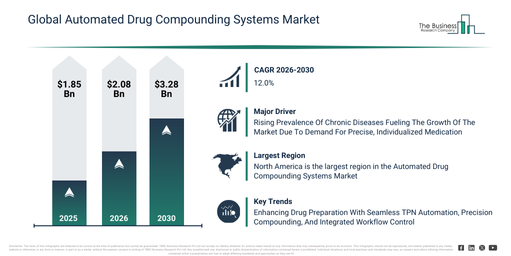
    The automated drug compounding systems market size has demonstrated rapid expansion in recent years. It is anticipated to grow from $1.85 billion in 2025 to $2.08 billion in 2026, at a compound annual growth rate (CAGR) of 12.3%. This historical growth can be ascribed to the increasing integration of automated systems within hospital pharmacies, the growing necessity to minimize medication errors, a heightened focus on sterile and accurate drug preparation, the increasing workload burden on pharmacy staff, and the rising demand for efficient compounding processes that save time.

    The automated drug compounding systems market is projected to experience swift expansion over the coming years, reaching a valuation of $3.28 billion by 2030, demonstrating a compound annual growth rate (CAGR) of 12.0%. This anticipated growth during the forecast period is fueled by several factors, including heightened investment in healthcare automation, greater incorporation of software and automation tools, the escalating demand for standardization in drug compounding, an increased emphasis on minimizing contamination risks, expanded hospital expenditure on automation infrastructure, and the urgent requirement for enhanced operational efficiency within pharmacies. Key trends expected during this period encompass developments in robotic-assisted drug compounding technologies, novel approaches to software integration for pharmacy management, the incorporation of artificial intelligence to reduce errors in compounding procedures, enhancements in real-time monitoring and quality control mechanisms, and breakthroughs in automated sterile compounding methods.

    Access Your Free Sample Report for In-Depth Market Insights:

    https://www.thebusinessresearchcompany.com/sample.aspx?id=30527&type=smp

    Which Drivers Are Affecting Market Participation In The Automated Drug Compounding Systems Market?

    The expanding occurrence of chronic illnesses is anticipated to boost the future expansion of the automated drug compounding systems market. These are enduring health conditions, like diabetes, heart disease, and arthritis, which typically develop gradually and necessitate continuous medical care and lifestyle adjustments to manage symptoms and avert complications. Their rise is primarily linked to unhealthy lifestyle choices, such as poor diet, lack of physical activity, and smoking, which elevate the likelihood of conditions including diabetes, heart disease, and obesity. Automated drug compounding systems assist in managing chronic diseases by accurately preparing personalized medications for individual patient requirements. They enhance the precision and uniformity of treatment, thereby minimizing errors and improving long-term therapeutic results. For example, in June 2024, data from the National Health Service, a UK-based government department, indicated that 3,615,330 individuals registered with a general practitioner (GP) had been diagnosed with non-diabetic hyperglycemia or pre-diabetes (a condition characterized by elevated blood sugar levels, insufficient for a diabetes diagnosis) in 2023. This represented an 18% surge from 3,065,825 cases recorded in 2022. Consequently, the growing incidence of chronic diseases is propelling the expansion of the automated drug compounding systems market. The scarcity of trained pharmacy personnel is projected to drive the future growth of the automated drug compounding systems market. This refers to the restricted availability of qualified pharmacists and technicians who can safely prepare and dispense medications within hospitals, clinics, and compounding pharmacies. The increase in this shortage stems from rising patient numbers and the expanding incidence of chronic diseases, which demand meticulous pharmaceutical care. Automated drug compounding systems lessen the dependency on skilled pharmacy staff by facilitating the accurate, consistent, and efficient preparation of medications with minimal human involvement, thereby decreasing errors and the workload for pharmacy personnel. For instance, in August 2024, the National Center for Health Workforce Studies, a US-based health workforce research organization, projected a deficit of 4,980 pharmacists over the ensuing 15 years until 2036. Simultaneously, the general demand for pharmacists is anticipated to increase by 3% from 2022 to 2032, which, combined with decreasing application trends, raises significant concerns. Consequently, the insufficient number of skilled pharmacy staff is stimulating the growth of the automated drug compounding systems market.

    What Segment Categories Are Covered In The Automated Drug Compounding Systems Market?

    The automated drug compounding systems market covered in this report is segmented –

    1) By Product: Robotic Compounding Systems, Automated Liquid Compounding Systems, Tablet And Capsule Dispensers, Injectable Compounding Robots, IV Admixture Systems, Oral Liquid Compounding Systems

    2) By Component: Equipment, Software, Consumables, Services

    3) By Technology: Robotic-Based Systems, Semi-Automated Systems, Gravimetric Dosing Systems, Volumetric Dosing Systems, Hybrid Dosing Systems

    4) By End-User: Hospitals, Clinics, Retail Pharmacies, Compounding Pharmacies, Pharmaceutical Manufacturers

    Subsegments:

    1) By Robotic Compounding Systems: Fully Automated Sterile Compounding Robots, Hazardous Drug Compounding Robots, Non-Hazardous Drug Compounding Robots, High-Throughput Pharmacy Robots, Closed-System Robotic Compounding Units

    2) By Automated Liquid Compounding Systems: Large-Volume Parenteral (LVP) Compounding Systems, Small-Volume Parenteral (SVP) Compounding Systems, Multi-Drug Liquid Compounding Units, Volumetric And Gravimetric Liquid Compounding Systems, Pediatric Liquid Dosing Compounding Systems

    3) By Tablet and Capsule Dispensers: Automated Tablet Counting Dispensers, Unit-Dose Packaging Systems, Multi-Dose Blister Dispensing Units, Capsule Filling and Dispensing Systems, High-Speed Pharmacy Dispensing Robots

    4) By Injectable Compounding Robots: Chemotherapy Drug Compounding Robots, TPN (Total Parenteral Nutrition) Compounding Robots, High-Precision Syringe Preparation Robots, Sterile Injectable Filling Robots, Hazardous Injectable Handling Systems

    5) By IV Admixture Systems: Automated IV Bag Filling Systems, IV Nutrition (TPN) Admixture Systems, IV Antibiotic Admixture Devices, Pharmacy Cleanroom IV Automation Units, Closed-System IV Compounding Systems

    6) By Oral Liquid Compounding Systems: Pediatric Oral Liquid Compounding Machines, Flavoring & Suspension Mixing Systems, Multi-Ingredient Oral Liquid Compounding Units, Gravimetric Oral Solution Compounding Systems, Low-Volume Oral Dosing Compounding Systems

    Which Trends Are Shaping Activity Within The Automated Drug Compounding Systems Market?

    Leading companies within the automated drug compounding systems market are concentrating on creating sophisticated systems, such as total parenteral nutrition (TPN) automation systems, aimed at boosting the precision, safety, and operational speed in producing tailored intravenous formulations. A total parenteral nutrition (TPN) automation system is defined as a compounding platform that not only manages the automated blending and dispensing of total parenteral nutrition (TPN) solutions but also incorporates prescription verification and workflow management features to minimize human error and guarantee aseptic, superior quality preparation. For example, in May 2025, MediServ Co. Ltd., introduced the APEX TPN Compounding System in Riyadh, marking a fresh epoch of exactness and automation for parenteral nutrition processes. The system, presented alongside its EasyComp integration software, improves the total parenteral nutrition (TPN) procedure by connecting validated prescriptions directly to sterile, precise compounding, thereby simplifying pharmacy tasks and decreasing manual efforts.

    Which Major Industry Participants Are Leading The Automated Drug Compounding Systems Market Growth?

    Major companies operating in the automated drug compounding systems market are Becton Dickinson and Company, Baxter International Inc., B. Braun Melsungen AG, Fresenius Kabi AG, ICU Medical Inc., Omnicell Inc., Eckert & Ziegler SE, Swisslog Healthcare AG, EQUASHIELD Medical Ltd., Trasis S.A., Loccioni Group S.p.A., ARxIUM Inc., Comecer S.p.A., Tema Sinergie S.p.A., Epic Medical Pte. Ltd., IBA Radiopharma Solutions S.A., Steriline S.r.l., Elysia-Raytest GmbH, Curifylabs OY, Kapsam Health Solutions Pvt. Ltd.

    Access The Complete Report For Deeper Market Insights:

    https://www.thebusinessresearchcompany.com/report/automated-drug-compounding-systems-market-report

    Which Region Is Expected To Experience The Fastest Growth In The Automated Drug Compounding Systems Market?

    North America was the largest region in the automated drug compounding Systems market in 2025. Asia-Pacific is expected to be the fastest-growing region in the forecast period. The regions covered in the automated drug compounding systems market report are Asia-Pacific, South East Asia, Western Europe, Eastern Europe, North America, South America, Middle East, Africa.

    Request Your Customized Automated Drug Compounding Systems Market Research Report for Competitive Advantage:

    https://www.thebusinessresearchcompany.com/customise?id=30527&type=smp

    Browse Through More Reports Similar to the Global Automated Drug Compounding Systems Market 2026, By The Business Research Company

    Automated Compounding Devices Market Report 2026

    https://www.thebusinessresearchcompany.com/report/automated-compounding-devices-global-market-report

    Lab Automation In Drug Discovery Market Report 2026

    https://www.thebusinessresearchcompany.com/report/lab-automation-in-drug-discovery-global-market-report

    drug formulation global market report

    https://www.thebusinessresearchcompany.com/report/drug-formulation-global-market-report

    Get in touch with us:

    The Business Research Company: https://www.thebusinessresearchcompany.com/

    Americas +1 310-496-7795

    Asia +44 7882 955267 & +91 8897263534

    Europe +44 7882 955267

    Email us at marketing@tbrc.info

    Follow us on:

    LinkedIn: https://in.linkedin.com/company/the-business-research-company

    YouTube: https://www.youtube.com/channel/UC24_fI0rV8cR5DxlCpgmyFQ

    Global Market Model: https://www.thebusinessresearchcompany.com/global-market-model
  • Augmented Reality Market Anticipated to Record Steady Gains, Advancing to $560.22 Billion by 2030

    Augmented Reality Market Anticipated to Record Steady Gains, Advancing to $560.22 Billion by 2030

    Uncover key drivers, emerging technologies, and competitive movements shaping the augmented reality market from 2026–2035 with trusted insights from The Business Research Company

    What are the forecasted starting (2026) and ending (2030) market sizes for the Augmented Reality Market?

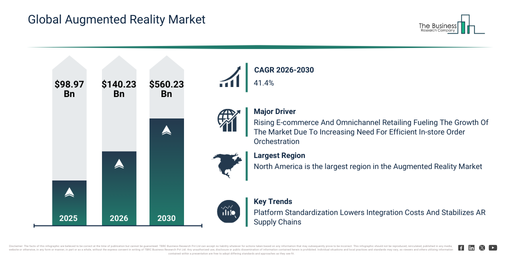
    The augmented reality market has experienced significant expansion in recent years. This market is projected to grow from $98.97 billion in 2025 to $140.23 billion in 2026, achieving a compound annual growth rate (CAGR) of 41.7%. The historical growth of this market can be attributed to factors like the increasing adoption of mobile augmented reality technology, rising investment by major technology companies, the expanding use of augmented reality in industrial and manufacturing operations, the proliferation of immersive gaming and entertainment applications, and the growing deployment of augmented reality in healthcare procedures.

    The augmented reality market size is anticipated to undergo significant expansion in the coming years. It is projected to reach $560.23 billion in 2030, exhibiting a compound annual growth rate (CAGR) of 41.4%. This growth during the forecast period is propelled by the escalating demand for real-time augmented reality assistance, the increasing incorporation of augmented reality into remote maintenance operations, a rising embrace of augmented reality-enabled training and simulation, the broadening application of augmented reality in automotive heads-up displays, and its greater utilization in education and virtual learning settings. Prominent trends for the forecast period encompass improvements in augmented reality optics and display technology, innovations in spatial computing interaction frameworks, advancements in artificial intelligence-driven augmented reality content generation, ongoing research and development into lightweight wearable augmented reality devices, and progress in three-dimensional object tracking and mapping.

    Access Your Free Sample Report for In-Depth Market Insights:

    https://www.thebusinessresearchcompany.com/sample.aspx?id=30526&type=smp

    What Drivers Are Supporting Technological Adoption In The Augmented Reality Market?

    The increasing embrace of e-commerce and omnichannel retailing is anticipated to fuel the expansion of the augmented reality market in the future. These retailing strategies involve combining online and brick-and-mortar channels, enabling customers to effortlessly explore, acquire, and collect products via websites, mobile applications, and physical outlets. This surge in adoption stems from consumers’ growing desire for convenient, round-the-clock shopping experiences and uniform interactions across various platforms like online shops, mobile applications, and physical locations. E-commerce and omnichannel retailing bolster augmented reality by incorporating engaging digital experiences, allowing customers to preview products across both digital and physical platforms. These approaches boost customer involvement and trust in purchases through interactive and smooth shopping processes. For example, in January 2025, data from the UK Office for National Statistics, a UK-based government agency, indicated that online expenditure values in Great Britain for December 2024 had increased by 1.7% compared to December 2023, demonstrating an annual rise in internet retail channel spending. Consequently, the expansion of e-commerce and omnichannel retailing is stimulating demand within the augmented reality market.

    Which Segments Are Contributing To The Growth Of The Augmented Reality Market?

    The augmented reality market covered in this report is segmented –

    1) By Component: Hardware, Software, Services

    2) By Display: Head-Mounted Display, Smart Glass, Cinema Display Glasses, Extended Reality (XR) Glasses, Head-Up Display (HUD), Handheld Devices

    3) By Application: Remote Assistance And Maintenance, Product Visualisation And Configuration, Navigation And Mapping, Social And Communication Filters, Other Applications

    4) By End Use Industry: Information Technology And Telecommunications, Healthcare And Life Sciences, Manufacturing, Automotive, Retail And Electronic Commerce, Education, Real Estate, Defense And Security, Media And Entertainment, Logistics And Transportation

    Subsegments:

    1) By Hardware: Augmented Reality Head Mounted Displays, Augmented Reality Smart Glasses, Augmented Reality Depth Sensing Cameras, Augmented Reality Sensors, Augmented Reality Input Devices, Augmented Reality Projection Systems

    2) By Software: Augmented Reality Development Platforms, Augmented Reality Content Management Software, Augmented Reality Simulation Software, Augmented Reality Tracking And Mapping Software, Augmented Reality Visualization Software, Augmented Reality Analytics Software

    3) By Services: Augmented Reality Integration Services, Augmented Reality Deployment Services, Augmented Reality Maintenance Services, Augmented Reality Content Creation Services, Augmented Reality Consulting Services, Augmented Reality Training Services

    Which Trends Are Influencing The Development Of The Augmented Reality Market?

    Leading companies in the augmented reality sector are increasingly focusing on advancing platform standardization, such as implementing OpenXR-based application frameworks. This strategic move aims to cut down development expenses, shorten deployment timelines, and ease constraints on hardware supply. OpenXR-based application frameworks are defined as software structures built on the OpenXR standard, enabling developers to create virtual reality (VR) and augmented reality (AR) applications that are compatible across multiple platforms. For example, in April 2024, The Khronos Group Inc., a US-based industry consortium dedicated to open standards, introduced OpenXR 1.1, an updated cross-platform standard designed to accelerate the widespread adoption of AR and mixed reality. This update brought expanded standardized input and interaction profiles, refined runtime conformance requirements to reduce device-specific issues, and bolstered support for enterprise deployment scenarios across both headsets and mobile devices. By standardizing these development frameworks, companies can achieve more efficient integration, more consistent supply chain planning, and enhanced pricing consistency throughout the AR ecosystem.

    Who Are The Prominent Global Companies Shaping The Augmented Reality Market Landscape?

    Major companies operating in the augmented reality market are Apple Inc., Google LLC, Microsoft Corporation, Samsung Electronics, Meta Platforms Inc., Sony Group Corporation, Lenovo Group Ltd., Xiaomi Corporation, Qualcomm Technologies Inc., Snap Inc., Unity Technologies Inc., PTC Inc., Magic Leap Inc., Niantic Inc., HTC Corporation, EON Reality, Kopin Corporation, UlptraLeap, RealWear Inc., Scope AR, Blippar Ltd., Vuzix Corporation, Wikitude GmbH, Optinvent SA, Atheer Inc.

    Access The Complete Report For Deeper Market Insights:

    https://www.thebusinessresearchcompany.com/report/augmented-reality-market-report

    Which Geographic Areas Are Emerging As Strong Markets For The Augmented Reality Market?

    North America was the largest region in the augmented reality market in 2025. Aisa-Pacific is expected to be the fastest-growing region in the forecast period. The regions covered in the augmented reality market report are Asia-Pacific, South East Asia, Western Europe, Eastern Europe, North America, South America, Middle East, Africa.

    Request Your Customized Augmented Reality Market Research Report for Competitive Advantage:

    https://www.thebusinessresearchcompany.com/customise?id=30526&type=smp

    Browse Through More Reports Similar to the Global Augmented Reality Market 2026, By The Business Research Company

    Augmented Reality Software Market Report 2026

    https://www.thebusinessresearchcompany.com/report/augmented-reality-software-global-market-report

    Augmented Reality Devices Market Report 2026

    https://www.thebusinessresearchcompany.com/report/augmented-reality-devices-global-market-report

    augmented industrial reality global market report

    https://www.thebusinessresearchcompany.com/report/augmented-industrial-reality-global-market-report

    Get in touch with us:

    The Business Research Company: https://www.thebusinessresearchcompany.com/

    Americas +1 310-496-7795

    Asia +44 7882 955267 & +91 8897263534

    Europe +44 7882 955267

    Email us at marketing@tbrc.info

    Follow us on:

    LinkedIn: https://in.linkedin.com/company/the-business-research-company

    YouTube: https://www.youtube.com/channel/UC24_fI0rV8cR5DxlCpgmyFQ

    Global Market Model: https://www.thebusinessresearchcompany.com/global-market-model
  • Artificial Intelligence (AI)-Driven Web Scraping Industry Poised for Rapid Growth, Forecast to Touch $23.7 Billion by 2030 at 23.5% CAGR

    Artificial Intelligence (AI)-Driven Web Scraping Industry Poised for Rapid Growth, Forecast to Touch $23.7 Billion by 2030 at 23.5% CAGR

    Uncover key drivers, emerging technologies, and competitive movements shaping the artificial intelligence (ai)-driven web scraping market from 2026–2035 with trusted insights from The Business Research Company

    What upper market value could the Artificial Intelligence (AI)-Driven Web Scraping Market reach by 2030 starting from 2026 levels?

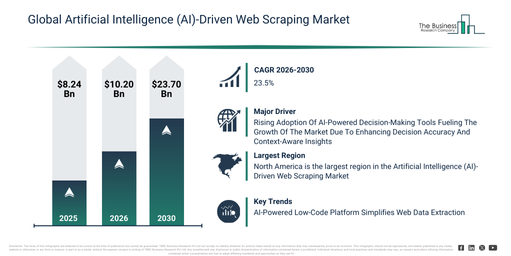
    The artificial intelligence (AI)-driven web scraping market has witnessed significant growth in recent years. This market is projected to expand from $8.24 billion in 2025 to $10.20 billion in 2026, achieving a compound annual growth rate (CAGR) of 23.8%. Historically, this expansion has been fueled by factors such as the increasing volumes of digital data, a rise in e-commerce activity, growing demand for competitive intelligence, the proliferation of cloud-based scraping solutions, and wider adoption across numerous sectors.

    The artificial intelligence (AI)-driven web scraping market is poised for significant expansion in the coming years. It is projected to reach $23.70 billion in 2030, showing a compound annual growth rate (CAGR) of 23.5%. This anticipated growth during the forecast period is fueled by factors such as a heightened need for real-time business insights, increased adoption of artificial intelligence and machine learning technologies, a growing requirement for adaptable pricing and market oversight, the proliferation of no-code/low-code scraping platforms, and rising demand from small and medium-sized businesses. Key trends foreseen during this period include technological breakthroughs in artificial intelligence (AI) and machine learning, progress in automated data extraction tools, evolution of cloud-native and scalable scraping solutions, ongoing research and development in anti-bot evasion and proxy networks, and greater integration with real-time analytical and decision-support systems.

    Access Your Free Sample Report for In-Depth Market Insights:

    https://www.thebusinessresearchcompany.com/sample.aspx?id=30524&type=smp

    Which Drivers Are Influencing Long-Term Growth In The Artificial Intelligence (AI)-Driven Web Scraping Market?

    The increasing use of AI-powered decision-making tools is anticipated to fuel the expansion of the artificial intelligence (AI)-driven web scraping market in the future. These tools are software systems leveraging artificial intelligence, including machine learning and predictive analytics, to automate and improve business insights and decisions. This growing adoption stems from heightened enterprise digitalization and the necessity for strategic decisions informed by data. Artificial intelligence (AI)-driven web scraping boosts AI-powered decision-making tools by automatically gathering and organizing vast amounts of real-time data from various online platforms. It enhances analytical precision and promptness by supplying machine learning models with current insights, thereby facilitating quicker, data-informed strategic choices. For example, data released by Eurostat, the European Union’s statistical office based in Luxembourg, in January 2025 showed that 13.5% of businesses employing 10 or more people utilized AI technologies in 2024, an increase from 8.0% in 2023, representing a 5.5 percentage-point rise. Consequently, the increased uptake of AI-powered decision-making tools is propelling the expansion of the artificial intelligence (AI)-driven web scraping market.

    How Is The Artificial Intelligence (AI)-Driven Web Scraping Market Divided Into Segments?

    The artificial intelligence (AI)-driven web scraping market covered in this report is segmented –

    1) By Scraping Type: Static Web Scraping, Dynamic Web Scraping, Application Programming Interface Scraping, Image And Text Recognition

    2) By Deployment Type: On-Premises, Cloud, Hybrid

    3) By Organization Size: Small Enterprises, Medium Enterprises, Large Enterprises

    4) By Application: Price Monitoring, Market Intelligence, Lead Generation, Data Mining

    5) By Industry Vertical: E-Commerce, Financial Services, Healthcare, Manufacturing, Retail, Technology

    Subsegments:

    1) By Static Web Scraping: Manual Static Page Extraction, Automated Static Content Parsing, Hypertext Markup Language Structure Based Extraction, File Based Static Data Retrieval, Script Driven Static Data Collection

    2) By Dynamic Web Scraping: Browser Automation Extraction, Java Script Rendered Content Extraction, Interactive Page Element Extraction, Form Submission Based Extraction, Dynamic Hypertext Markup Language Content Parsing

    3) By Application Programming Interface Scraping: Public Application Programming Interface Data Extraction, Private Application Programming Interface Data Extraction, Rest Application Programming Interface Based Data Collection, Graph Query Language Application Programming Interface Based Extraction, Automated Application Programming Interface Response Parsing

    4) By Image And Text Recognition: Optical Character Recognition Based Data Extraction, Image Pattern Recognition Extraction, Document Image Data Capture, Visual Content Based Data Identification, Text Recognition From Multimedia Content

    What Trends Are Expected To Impact The Competitive Landscape Of The Artificial Intelligence (AI)-Driven Web Scraping Market?

    Leading companies within the artificial intelligence (AI)-driven web scraping market are concentrating on developing sophisticated platforms, such as AI-powered low-code tools, to boost efficiency, enhance accessibility, and reduce both technical barriers and development time. These AI-powered low-code tools are defined as platforms that employ artificial intelligence to automate the extraction and structuring of web data based on natural language descriptions, thereby eliminating the need for manual coding. For instance, in July 2025, Oxylabs.io, a Lithuania-based web-intelligence and proxy services company, introduced AI Studio. This new suite of AI-powered tools is designed to simplify the process of finding, collecting, and obtaining ready-to-use web data through natural language prompts. It features AI-Crawler and AI-Scraper functionalities, which enable seamless data extraction from multiple or single pages without requiring operator intervention. The suite also incorporates tools like Browser Agent for dynamic interactions and AI-Search for web queries, thereby extending the platform’s utility and reducing operational complexity for developers, product teams, and data analysts.

    Which Key Players Are Driving Competition In The Artificial Intelligence (AI)-Driven Web Scraping Market?

    Major companies operating in the artificial intelligence (AI)-driven web scraping market are Tungsten Automation, Hangzhou Duosuan Technology Co. Ltd., Oxylabs UAB, Bright Data Ltd., Zyte Ltd., Grepsr Pvt. Ltd., Apify Technologies s.r.o., Octopus Data Inc., Octoparse Co. Ltd., SerpApi LLC, ParseHub Inc., Diffbot Technologies Corp., Browse AI Inc., The Phantombuster Company, Scraping Robotics Inc., Scrapfly, DataHen Canada Inc., Datahut, ZenRows Inc., Smartproxy LLC

    Access The Complete Report For Deeper Market Insights:

    https://www.thebusinessresearchcompany.com/report/artificial-intelligence-ai-driven-web-scraping-market-report

    Which Region Is Projected To Lead The Artificial Intelligence (AI)-Driven Web Scraping Market During The Forecast Period?

    North America was the largest region in the artificial intelligence (AI)-driven web scraping market in 2025. Asia-Pacific is expected to be the fastest-growing region in the forecast period. The regions covered in the artificial intelligence (AI)-driven web scraping market report are Asia-Pacific, South East Asia, Western Europe, Eastern Europe, North America, South America, Middle East, Africa.

    Request Your Customized Artificial Intelligence (AI)-Driven Web Scraping Market Research Report for Competitive Advantage:

    https://www.thebusinessresearchcompany.com/customise?id=30524&type=smp

    Browse Through More Reports Similar to the Global Artificial Intelligence (AI)-Driven Web Scraping Market 2026, By The Business Research Company

    Artificial Intelligence Ai Enabled E Commerce Solutions Market Report 2026

    https://www.thebusinessresearchcompany.com/report/artificial-intelligence-ai-enabled-e-commerce-solutions-global-market-report

    Content Intelligence Market Report 2026

    https://www.thebusinessresearchcompany.com/report/content-intelligence-global-market-report

    artificial intelligence ai content generation global market report

    https://www.thebusinessresearchcompany.com/report/artificial-intelligence-ai-content-generation-global-market-report

    Get in touch with us:

    The Business Research Company: https://www.thebusinessresearchcompany.com/

    Americas +1 310-496-7795

    Asia +44 7882 955267 & +91 8897263534

    Europe +44 7882 955267

    Email us at marketing@tbrc.info

    Follow us on:

    LinkedIn: https://in.linkedin.com/company/the-business-research-company

    YouTube: https://www.youtube.com/channel/UC24_fI0rV8cR5DxlCpgmyFQ

    Global Market Model: https://www.thebusinessresearchcompany.com/global-market-model
  • Artificial Intelligence (AI)-Driven Hospital Supply Waste Monitor Market Performance Outlook 2026–2030: Revenue to Hit $4.13 Billion at 19.3% CAGR

    Artificial Intelligence (AI)-Driven Hospital Supply Waste Monitor Market Performance Outlook 2026–2030: Revenue to Hit $4.13 Billion at 19.3% CAGR

    Uncover key drivers, emerging technologies, and competitive movements shaping the artificial intelligence (ai)-driven hospital supply waste monitor market from 2026–2035 with trusted insights from The Business Research Company

    What level of CAGR-driven expansion is anticipated in the Artificial Intelligence (AI)-Driven Hospital Supply Waste Monitor Market between 2026 and 2030?

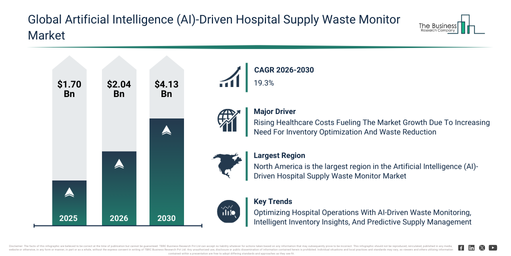
    The artificial intelligence (AI)-driven hospital supply waste monitor market has witnessed rapid expansion in recent years. This market is set to increase from $1.70 billion in 2025 to $2.04 billion in 2026, exhibiting a compound annual growth rate (CAGR) of 19.6%. The historical growth of this market can be attributed to several factors including the increasing adoption of AI in healthcare operations, the growing need to reduce medical supply waste, a rising focus on cost optimization in hospitals, the expansion of predictive analytics usage, and the increasing implementation of inventory monitoring solutions.

    The artificial intelligence (AI)-driven hospital supply waste monitor market size is projected to experience substantial growth over the coming years. This market is anticipated to reach **$4.13 billion in 2030, exhibiting a compound annual growth rate (CAGR) of 19.3%**. Factors contributing to this expansion during the forecast period include increased investments in healthcare IT infrastructure, the expanding integration of AI with hospital management systems, greater uptake of cloud-based supply monitoring platforms, the broadening of remote monitoring and smart inventory systems, and a heightened focus on sustainability and waste reduction. Key developments expected in this period encompass technological advancements in machine learning and AI models, breakthroughs in real-time inventory tracking devices, ongoing research and development in predictive analytics aimed at waste reduction, the creation of automated reporting and dashboard solutions, and improvements in interoperable healthcare IT and inventory systems.

    Access Your Free Sample Report for In-Depth Market Insights:

    https://www.thebusinessresearchcompany.com/sample.aspx?id=30522&type=smp

    What Drivers Are Affecting Demand-Supply Dynamics In The Artificial Intelligence (AI)-Driven Hospital Supply Waste Monitor Market?

    The increasing expenses within healthcare are anticipated to drive expansion in the artificial intelligence (AI)-driven hospital supply waste monitor market in the future. These escalating healthcare costs denote a continuous rise in expenditures necessary for providing medical care and running hospital operations, encompassing personnel, equipment, and medical provisions, thus imposing financial strain on healthcare infrastructures. This increase in healthcare spending primarily stems from an aging demographic that necessitates more extensive medical interventions for long-term ailments like heart disease and diabetes. The AI-driven hospital supply waste monitor assists in managing healthcare costs by minimizing superfluous supply wastage, streamlining inventory quantities, and enabling providers to manage total spending effectively. As an illustration, data from June 2025 by the Centers for Medicare and Medicaid Services (CMS), a US governmental body overseeing health expenditures, showed that in 2023, spending on hospital care surged by 10.4% to $1.52 trillion, and overall national health spending expanded by 7.5% to $4.9 trillion when contrasted with figures from 2022. Consequently, the escalation in healthcare expenses is fueling the expansion of the artificial intelligence (AI)-driven hospital supply waste monitor market.

    What Segments Are Included Within The Artificial Intelligence (AI)-Driven Hospital Supply Waste Monitor Market?

    The artificial intelligence (AI)-driven hospital supply waste monitor market covered in this report is segmented –

    1) By Component: Software, Hardware, Services

    2) By Deployment Mode: On-Premises, Cloud-Based

    3) By Application: Inventory Management, Waste Tracking, Cost Reduction, Compliance Monitoring, Other Applications

    4) By End-User: Hospitals, Clinics, Ambulatory Surgical Centers, Other End-Users

    Subsegments:

    1) By Software: Electronic Health Record Integration, Predictive Analytics Platforms, Risk Scoring Systems, Clinical Decision Support Tools

    2) By Hardware: Servers, Sensors, Monitoring Devices, Data Storage Devices

    3) By Services: Data Analytics Services, Predictive Modeling Services, Integration And Deployment Services, Training And Support Services, Monitoring And Reporting Services

    Which Trends Are Guiding The Evolution Of The Artificial Intelligence (AI)-Driven Hospital Supply Waste Monitor Market?

    Companies leading in the artificial intelligence (AI)-driven hospital supply waste monitor market are prioritizing the creation of advanced technology, such as predictive usage and waste reduction analytics, to improve supply chain transparency, decrease waste, and lower operational costs in healthcare settings. Predictive usage and waste reduction analytics are AI systems that examine historical and real-time data to project inventory needs, pinpoint consumption patterns, and automatically notify staff of potential overstock or waste situations, enabling more intelligent procurement and effective resource distribution. For instance, in April 2024, SmartPAR.AI Inc., a US-based healthtech software provider, introduced an AI-driven solution designed to revolutionize hospital inventory management and cut down on product waste. The platform employs machine learning, predictive usage and waste reduction analytics to monitor available supplies, forecast future consumption, and detect discrepancies that might lead to waste.

    Who Are The Top-Performing Companies In The Artificial Intelligence (AI)-Driven Hospital Supply Waste Monitor Market In Recent Years?

    Major companies operating in the artificial intelligence (AI)-driven hospital supply waste monitor market are Cardinal Health Inc., Oracle Corporation, Becton Dickinson and Company, Owens & Minor Inc., Arvato AG, Zebra Technologies Corporation, Getinge AB, Palantir Technologies Inc., Omnicell Inc., Manhattan Associates Inc., Symplr Inc., Global Healthcare Exchange LLC, Tecsys Inc., Terso Solutions Inc., LogiTag Systems Ltd., Spikewell Inc., Softlabs Group Inc., Stanley Healthcare, Z5 Inventory Inc., IDENTI Medical Ltd.

    Access The Complete Report For Deeper Market Insights:

    https://www.thebusinessresearchcompany.com/report/artificial-intelligence-ai-driven-hospital-supply-waste-monitor-market-report

    Which Region Currently Holds The Largest Share Of The Artificial Intelligence (AI)-Driven Hospital Supply Waste Monitor Market?

    North America was the largest region in the artificial intelligence (AI)-driven hospital supply waste monitor market in 2025. Asia-Pacific is expected to be the fastest-growing region in the forecast period. The regions covered in the artificial intelligence (AI)-driven hospital supply waste monitor market report are Asia-Pacific, South East Asia, Western Europe, Eastern Europe, North America, South America, Middle East, Africa.

    Request Your Customized Artificial Intelligence (AI)-Driven Hospital Supply Waste Monitor Market Research Report for Competitive Advantage:

    https://www.thebusinessresearchcompany.com/customise?id=30522&type=smp

    Browse Through More Reports Similar to the Global Artificial Intelligence (AI)-Driven Hospital Supply Waste Monitor Market 2026, By The Business Research Company

    Hazardous Waste Handling Automation Market Report 2026

    https://www.thebusinessresearchcompany.com/report/hazardous-waste-handling-automation-global-market-report

    Medical Waste Management Market Report 2026

    https://www.thebusinessresearchcompany.com/report/medical-waste-management-global-market-report

    waste management software global market report

    https://www.thebusinessresearchcompany.com/report/waste-management-software-global-market-report

    Get in touch with us:

    The Business Research Company: https://www.thebusinessresearchcompany.com/

    Americas +1 310-496-7795

    Asia +44 7882 955267 & +91 8897263534

    Europe +44 7882 955267

    Email us at marketing@tbrc.info

    Follow us on:

    LinkedIn: https://in.linkedin.com/company/the-business-research-company

    YouTube: https://www.youtube.com/channel/UC24_fI0rV8cR5DxlCpgmyFQ

    Global Market Model: https://www.thebusinessresearchcompany.com/global-market-model
  • Artificial Intelligence (AI) In Energy Distribution Market 2026–2030: Emerging Trends and Forecast Opportunities

    Artificial Intelligence (AI) In Energy Distribution Market 2026–2030: Emerging Trends and Forecast Opportunities

    Uncover key drivers, emerging technologies, and competitive movements shaping the artificial intelligence (ai) in energy distribution market from 2026–2035 with trusted insights from The Business Research Company

    Starting from its 2026 valuation, what market size is the Artificial Intelligence (AI) In Energy Distribution Market expected to reach by 2030?

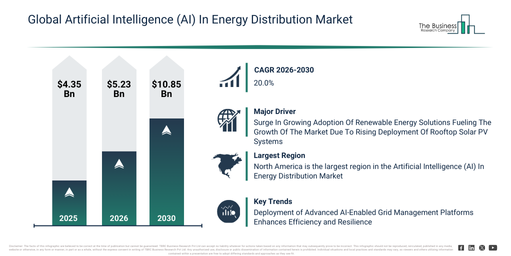
    The artificial intelligence (AI) in energy distribution (ED) market has observed rapid expansion in recent years. Its valuation is anticipated to climb from $4.35 billion in 2025 to $5.23 billion in 2026, achieving a compound annual growth rate (CAGR) of 20.3%. The historical growth of this market can be ascribed to the increasing uptake of smart grid technologies, a rising need for efficient energy management, the expanding deployment of predictive maintenance within distribution networks, broader integration of renewable energy sources, and an enhanced focus on mitigating operational losses and outages.

    The artificial intelligence (AI) in energy distribution (ED) market is projected to experience substantial expansion over the upcoming years. It is forecast to reach a valuation of $10.85 billion by 2030, exhibiting a compound annual growth rate (CAGR) of 20.0%. This projected expansion during the forecast period is driven by several factors, including the increasing incorporation of AI for monitoring energy in real time, a rise in the uptake of automated demand response systems, expanding investments in intelligent energy distribution infrastructure, broader grid modernization and digitalization efforts, and an increase in the implementation of advanced analytics for optimizing energy usage. Key developments anticipated during this period encompass technology-led advancements in grid automation, progress in AI-powered predictive and prescriptive analytics, enhancements in real-time energy monitoring and control solutions, increased research and development focused on renewable energy integration, and novel approaches to automated and intelligent distribution network management.

    Access Your Free Sample Report for In-Depth Market Insights:

    https://www.thebusinessresearchcompany.com/sample.aspx?id=30509&type=smp

    What Drivers Are Driving Adoption Within The Artificial Intelligence (AI) In Energy Distribution Market?

    The increasing implementation of renewable energy solutions is anticipated to stimulate expansion in the artificial intelligence (AI) in energy distribution (ED) market in the future. This adoption of renewable energy signifies the broader utilization of clean and sustainable power sources, particularly solar, wind, and other forms of non-fossil electricity generation, to satisfy increasing power requirements. The rise in renewable energy uptake is a direct result of enhanced global governmental and private sector endeavors to diminish greenhouse gas emissions, meet climate objectives, and foster widespread sustainable energy availability. Artificial intelligence (AI) in energy distribution (ED) facilitates the integration of renewable energy solutions by enhancing grid management, predicting energy demand, and seamlessly incorporating diverse renewable sources. It boosts operational efficiency and dependability by enabling instantaneous decision-making, minimizing energy wastage, and allowing for the smooth inclusion of solar, wind, and other sustainable resources. For instance, in June 2024, figures from the Department for Energy Security and Net Zero, a UK government department, revealed that in the first quarter of 2024, renewable electricity generation saw an increase of 3.7% to 39.2 TWh, primarily driven by onshore wind. This elevated renewables’ portion of total generation to 50.9% and expanded installed capacity by 2.5 GW compared to the first quarter of 2023. Consequently, the expanding deployment of renewable energy solutions is propelling the development of the artificial intelligence (AI) in energy distribution (ED) market.

    How Is The Artificial Intelligence (AI) In Energy Distribution Market Organized Into Various Segments?

    The artificial intelligence (AI) in energy distribution market covered in this report is segmented –

    1) By Component: Solutions, Services, Other Components

    2) By Deployment: Cloud-Based Deployment, On-Premises Deployment, Other Deployment Modes

    3) By End Use: Industrial, Commercial, Residential, Other End Users

    4) By Application: Smart Grid Management, Predictive Maintenance And Equipment Monitoring, Energy Demand Forecasting, Renewable Energy Integration, Other Applications

    Subsegments:

    1) By Solutions: Grid Management Solutions, Fault Detection Solutions, Demand Forecasting Solutions, Energy Optimization Solutions

    2) By Services: Consulting Services, Integration Services, Maintenance Services, Training and Support Services

    3) By Other Components: Data Storage Units, Communication Modules, Sensors and Meters, Network Infrastructure Components

    Which Innovation Trends Are Advancing Developments Within The Artificial Intelligence (AI) In Energy Distribution Market?

    Leading firms within the artificial intelligence (AI) in energy distribution (ED) market are concentrating on creating sophisticated platforms, including advanced AI-enabled grid management platforms, with the aim of enhancing grid planning, operational processes, and asset oversight. These AI-enabled grid management platforms denote comprehensive software systems that leverage artificial intelligence for real-time monitoring, forecasting, and optimization of electricity generation, transmission, and distribution, thereby fostering a more efficient, resilient, and sustainable power network. As an illustration, in November 2025, Schneider Electric SE, a France-based energy management technology company, introduced its One Digital Grid Platform, which incorporates AI functionalities for providing real-time estimates for outage restoration. This platform is a modular, AI-powered solution for utilities, integrating asset management, operational activities, and strategic planning, thereby facilitating innovation without requiring costly infrastructure upgrades. Furthermore, it provides integrated technologies designed to boost dependability, enhance productivity, and refine customer engagements.

    Who Are The Core Companies Influencing Trends In The Artificial Intelligence (AI) In Energy Distribution Market?

    Major companies operating in the artificial intelligence (AI) in energy distribution market are Siemens Aktiengesellschaft, Honeywell International Inc., ABB Ltd, Atos SE, Alpiq Holding AG, Stem Inc., Fluentgrid Limited, Gridware Inc., AutoGrid Systems Inc., Energi Mine Ltd, AppOrchid Inc, Verdigris Technologies Inc., Gridcog Ltd, Octopus Energy Group Ltd, Tibo Energy B.V., reLi Energy GmbH, Podero GmbH, DaisyChain Energy Inc., Tewke Ltd, Volto Technologies Inc., Irasus Technologies Private Limited, Dotnitron Technologies Private Limited

    Access The Complete Report For Deeper Market Insights:

    https://www.thebusinessresearchcompany.com/report/artificial-intelligence-ai-in-energy-distribution-market-report

    Which Regions Are Projected To Dominate The Artificial Intelligence (AI) In Energy Distribution Market In The Coming Years?

    North America was the largest region in the artificial intelligence (AI) in energy distribution (ED) market in 2025. Asia-Pacific is expected to be the fastest-growing region in the forecast period. The regions covered in the artificial intelligence (AI) in energy distribution market report are Asia-Pacific, South East Asia, Western Europe, Eastern Europe, North America, South America, Middle East, Africa.

    Request Your Customized Artificial Intelligence (AI) In Energy Distribution Market Research Report for Competitive Advantage:

    https://www.thebusinessresearchcompany.com/customise?id=30509&type=smp

    Browse Through More Reports Similar to the Global Artificial Intelligence (AI) In Energy Distribution Market 2026, By The Business Research Company

    Artificial Intelligence Ai In Energy And Power Market Report 2026

    https://www.thebusinessresearchcompany.com/report/artificial-intelligence-ai-in-energy-and-power-global-market-report

    Ai In Energy Market Report 2026

    https://www.thebusinessresearchcompany.com/report/ai-in-energy-global-market-report

    artificial intelligence ai engineering global market report

    https://www.thebusinessresearchcompany.com/report/artificial-intelligence-ai-engineering-global-market-report

    Get in touch with us:

    The Business Research Company: https://www.thebusinessresearchcompany.com/

    Americas +1 310-496-7795

    Asia +44 7882 955267 & +91 8897263534

    Europe +44 7882 955267

    Email us at marketing@tbrc.info

    Follow us on:

    LinkedIn: https://in.linkedin.com/company/the-business-research-company

    YouTube: https://www.youtube.com/channel/UC24_fI0rV8cR5DxlCpgmyFQ

    Global Market Model: https://www.thebusinessresearchcompany.com/global-market-model
  • Global Artificial Intelligence (AI) Image Upscaling Chip Market Forecast 2026–2035: Long-Term Growth Insights

    Global Artificial Intelligence (AI) Image Upscaling Chip Market Forecast 2026–2035: Long-Term Growth Insights

    Uncover key drivers, emerging technologies, and competitive movements shaping the artificial intelligence (ai) image upscaling chip market from 2026–2035 with trusted insights from The Business Research Company

    Across 2026–2030, what is the expected market valuation path of the Artificial Intelligence (AI) Image Upscaling Chip Market?

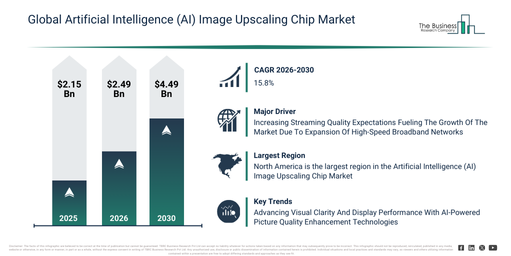
    The artificial intelligence (AI) image upscaling chips market has seen substantial growth in recent years. This market is projected to expand from $2.15 billion in 2025 to $2.49 billion by 2026, achieving a compound annual growth rate (CAGR) of 16.2%. The historical growth can be linked to the increasing use of high-resolution displays, the growing adoption of AI-enabled smartphones and cameras, the proliferation of media and entertainment streaming services, heightened demand for video surveillance applications, and the rising penetration of the gaming and AR/VR markets.

    The artificial intelligence (AI) image upscaling chips market size is anticipated to experience substantial growth over the coming years, reaching $4.49 billion by 2030 with a compound annual growth rate (CAGR) of 15.8%. This projected expansion is driven by factors such as the increasing integration of SoC-based AI upscaling modules, the rising adoption of edge AI processing, the broadening of automotive infotainment and ADAS systems, a surge in industrial imaging and machine vision applications, and enhanced investment in semiconductor research and development for AI hardware. Key trends for this period encompass advancements in deep learning-based super-resolution algorithms, the incorporation of AI upscaling into SoCs and GPUs, the development of low-power, high-efficiency chips, innovations in multi-modal image enhancement, and research focused on neural network compression and optimization.

    Access Your Free Sample Report for In-Depth Market Insights:

    https://www.thebusinessresearchcompany.com/sample.aspx?id=30507&type=smp

    Which Drivers Are Supporting The Rise Of The Artificial Intelligence (AI) Image Upscaling Chip Market?

    The rising expectations for streaming quality are projected to propel the growth of the artificial intelligence (AI) image upscaling chip market moving forward. These streaming quality expectations signify the consumer need for high-definition, buffer-free, and engaging video content across a range of devices. As consumers grow accustomed to high-resolution large screens and immersive formats, their streaming quality expectations are increasing, leading to a demand for sharper visuals, smoother playback, and richer audio as standard features. AI image upscaling chips support these streaming quality expectations by enhancing lower-resolution content to near-native high definition, thereby ensuring sharper visuals on large screens. They also improve playback consistency by minimizing visual artifacts and optimizing frame clarity in real time, delivering a smoother and more immersive viewing experience. For example, in September 2023, according to the Office of Communications, a UK-based statutory regulator for communications services, in March 2023, 73% of Netflix videos were reliably delivered in ultra high definition, an increase from 69% in March 2022, while 22% were streamed in high definition and only 4% in standard definition. Consequently, the increasing streaming quality expectations are driving the growth of the artificial intelligence (AI) image upscaling chip market.

    What Segments Are Identified Within The Structure Of The Artificial Intelligence (AI) Image Upscaling Chip Market?

    The artificial intelligence (AI) image upscaling chip market covered in this report is segmented –

    1) By Chip Type: Application-Specific Integrated Circuit, Field-Programmable Gate Array, Graphics Processing Unit, System On Chip, Other Chip Types

    2) By Technology: Super-Resolution, Deep Learning, Edge Artificial Intelligence, Other Technologies

    3) By Application: Consumer Electronics, Automotive, Healthcare, Industrial, Media And Entertainment, Other Applications

    4) By End-User: Original Equipment Manufacturers, Aftermarket, Other End-Users

    Subsegments:

    1) By Application-Specific Integrated Circuit: Neural Network Accelerator, Dedicated Upscaling Processor, Hardware-Based Image Enhancement Engine, Low-Power Upscaling Chip, Integrated Upscaling Module

    2) By Field-Programmable Gate Array: Reconfigurable Neural Processor, Custom Upscaling Accelerator, Edge AI Upscaling Module, Programmable Image Enhancement Chip, Low-Latency Upscaling Processor

    3) By Graphics Processing Unit: Artificial Intelligence-Enhanced Graphics Processor, Deep Learning Upscaling Engine, High-Resolution Video Processor, Real-Time Image Enhancement Graphics Processing Unit, Multi-Core Upscaling Processor

    4) By System On Chip: Integrated Artificial Intelligence Upscaling SoC, Mobile Device Upscaling Chip, Edge Artificial Intelligence System On Chip Module, High-Performance Video Upscaling System On Chip, Low-Power Integrated Upscaling Module

    5) By Other Chip Types: Hybrid Upscaling Processor, Research And Development Prototype Chip, Experimental Neural Upscaling Module, Custom Edge AI Chip, Specialized Imaging Processor

    Which Competitive Trends Are Impacting The Structure Of The Artificial Intelligence (AI) Image Upscaling Chip Market?

    Leading companies in the artificial intelligence (AI) image upscaling chip market are concentrating on developing advanced solutions, such as AI-driven picture quality enhancement technologies, to provide clearer visuals, improved color fidelity, and immersive viewing experiences across consumer electronics. These AI-powered picture quality enhancement technologies refer to artificial intelligence-based algorithms embedded at the chip level that intelligently boost resolution, reduce noise, sharpen contrast, and optimize brightness in real time, adapting to content and display characteristics. For instance, in January 2025, MediaTek Inc., a Taiwan-based fabless semiconductor company, introduced MiraVision Pro. This suite of AI-powered technologies, making its debut on the Pentonic 800 smart TV chipset, features AI-Super Resolution 3.0 for seamless scaling across resolutions, 500K-zone AI-Contrast 2.0 for precise HDR quality, and AI-based On-Screen-Display upscaling to enhance user interface clarity beyond standard 4K, all powered by an integrated neural processing unit to deliver cinematic-grade visuals. MiraVision Pro integrates AI-powered picture quality enhancement technologies that dynamically analyze video frames to upscale lower-resolution content while preserving fine details and natural textures. This launch enables device manufacturers to offer premium, high-definition viewing experiences without increasing power consumption or hardware complexity.

    Which Major Industry Participants Are Leading The Artificial Intelligence (AI) Image Upscaling Chip Market Growth?

    Major companies operating in the artificial intelligence (AI) image upscaling chip market are Apple Inc., Samsung Electronics Co. Ltd., Intel Corporation, Qualcomm Incorporated, NVIDIA Corporation, MediaTek Inc., Realtek Semiconductor Corp., Synopsys Inc., Cadence Design Systems Inc., Novatek Microelectronics Corp., Socionext Inc., Magnachip Semiconductor Corporation, Ambarella Inc., Rockchip Electronics Co. Ltd., CEVA Inc., HiSilicon (Shanghai) Technologies Co. Ltd., Amlogic Inc., Pixelworks Inc., Axera Semiconductor Co. Ltd., Advanced Micro Devices Inc., Black Sesame Technologies Inc., Hailo Technologies Ltd.

    Access The Complete Report For Deeper Market Insights:

    https://www.thebusinessresearchcompany.com/report/artificial-intelligence-ai-image-upscaling-chip-market-report

    Which Region Is Expected To Experience The Fastest Growth In The Artificial Intelligence (AI) Image Upscaling Chip Market?

    North America was the largest region in the artificial intelligence (AI) image upscaling chips market in 2025. Asia-Pacific is expected to be the fastest-growing region in the forecast period. The regions covered in the artificial intelligence (AI) image upscaling chip market report are Asia-Pacific, South East Asia, Western Europe, Eastern Europe, North America, South America, Middle East, Africa.

    Request Your Customized Artificial Intelligence (AI) Image Upscaling Chip Market Research Report for Competitive Advantage:

    https://www.thebusinessresearchcompany.com/customise?id=30507&type=smp

    Browse Through More Reports Similar to the Global Artificial Intelligence (AI) Image Upscaling Chip Market 2026, By The Business Research Company

    Artificial Intelligence Ai Image Generator Market Report 2026

    https://www.thebusinessresearchcompany.com/report/artificial-intelligence-ai-image-generator-global-market-report

    Artificial Intelligence Chip Market Report 2026

    https://www.thebusinessresearchcompany.com/report/artificial-intelligence-chip-global-market-report

    artificial intelligence AI chipsets global market report

    https://www.thebusinessresearchcompany.com/report/artificial-intelligence-ai-chipsets-global-market-report

    Get in touch with us:

    The Business Research Company: https://www.thebusinessresearchcompany.com/

    Americas +1 310-496-7795

    Asia +44 7882 955267 & +91 8897263534

    Europe +44 7882 955267

    Email us at marketing@tbrc.info

    Follow us on:

    LinkedIn: https://in.linkedin.com/company/the-business-research-company

    YouTube: https://www.youtube.com/channel/UC24_fI0rV8cR5DxlCpgmyFQ

    Global Market Model: https://www.thebusinessresearchcompany.com/global-market-model
  • Artificial Intelligence (AI) Arrhythmia Burden Analytics Market 2026–2030: Forecasting Business Opportunities Ahead

    Artificial Intelligence (AI) Arrhythmia Burden Analytics Market 2026–2030: Forecasting Business Opportunities Ahead

    Uncover key drivers, emerging technologies, and competitive movements shaping the artificial intelligence (ai) arrhythmia burden analytics market from 2026–2035 with trusted insights from The Business Research Company

    What size range is anticipated for the Artificial Intelligence (AI) Arrhythmia Burden Analytics Market from 2026 to 2030?

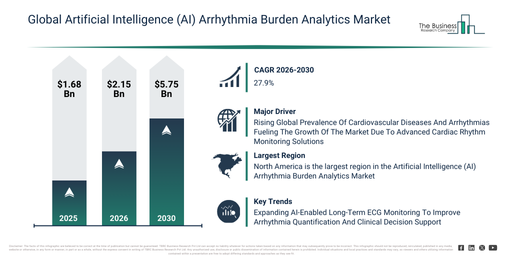
    The artificial intelligence (AI) arrhythmia burden analytics market has experienced substantial growth in its size during recent years. It will grow from $1.68 billion in 2025 to $2.15 billion in 2026 at a compound annual growth rate (CAGR) of 28.2%. The expansion observed during the past period stems from several factors, including the increasing incidence of cardiovascular diseases, wider embrace of wearable ECG monitors, heightened need for prompt arrhythmia detection, the broadening scope of remote patient monitoring platforms, and increased capital flow into digital health infrastructure.

    The artificial intelligence (AI) arrhythmia burden analytics market is projected to undergo substantial growth in the next few years. It is anticipated to reach $5.75 billion in 2030, exhibiting a compound annual growth rate (CAGR) of 27.9%. This expansion during the forecast period is driven by the increasing integration of AI within healthcare IT systems, a growing emphasis on predictive and personalized cardiac care, the rising adoption of cloud-based AI deployment, the continued expansion of AI research and development, and enhanced regulatory support for AI-driven medical devices. Key trends for the forecast period include innovation in predictive algorithms, advancements in cloud-based deployment, the integration of technology with wearable devices, investment in data analytics platforms, and the development of AI-enabled diagnostic software.

    Access Your Free Sample Report for In-Depth Market Insights:

    https://www.thebusinessresearchcompany.com/sample.aspx?id=30503&type=smp

    What Drivers Are Affecting Demand In The Artificial Intelligence (AI) Arrhythmia Burden Analytics Market?

    The increasing worldwide incidence of cardiovascular diseases and arrhythmias is anticipated to propel the expansion of the artificial intelligence (AI) arrhythmia burden analytics market moving forward. Cardiovascular diseases and arrhythmias refer to the rising number of individuals globally affected by heart and blood vessel disorders, including irregular heart rhythms such as atrial fibrillation, which are significant causes of death and disability worldwide. This rise in prevalence is attributed to aging populations and heightened exposure to risk factors like hypertension, obesity, and diabetes, all of which elevate the likelihood of developing arrhythmias. Artificial intelligence (AI) arrhythmia burden analytics assists in addressing cardiovascular diseases and arrhythmias through continuous, precise examination of cardiac rhythm data, thereby enhancing the early detection and management of arrhythmic events. For instance, in August 2025, data from the Centers for Disease Control and Prevention, a public health agency located in Switzerland, indicated that 90% of the nation’s 4.9 trillion dollars in annual health care spending is linked to individuals with chronic and mental health conditions, with more than 84,000 Americans dying each year from heart disease or stroke, and the costs associated with cardiovascular diseases are projected to reach roughly 2 trillion dollars by 2050. Hence, the increasing global prevalence of cardiovascular diseases and arrhythmias is a primary factor driving the growth of the artificial intelligence (AI) arrhythmia burden analytics market.

    Which Segments Are Gaining Traction In The Artificial Intelligence (AI) Arrhythmia Burden Analytics Market?

    The artificial intelligence (AI) arrhythmia burden analytics market covered in this report is segmented –

    1) By Component: Software, Hardware, Services

    2) By Technology: Machine Learning (ML), Deep Learning (DL), Natural Language Processing (NLP)

    3) By Deployment Mode: On-Premises, Cloud-Based

    4) By Application: Arrhythmia Detection, Burden Quantification, Predictive Risk Assessment, Treatment Efficacy Monitoring, Clinical Decision Support

    5) By End-User: Healthcare Providers, Diagnostic Centers, Academic And Research Institutes, Other End-Users

    Subsegments:

    1) By Software: Data Management, Predictive Analytics, Visualization Tools, Reporting Platforms, Algorithm Development

    2) By Hardware: Monitoring Devices, Wearable Sensors, Data Storage Units, Processing Units, Connectivity Modules

    3) By Services: Consulting Services, Implementation Services, Maintenance And Support, Training Services, Cloud Hosting Services

    What Industry Trends Are Transforming The Artificial Intelligence (AI) Arrhythmia Burden Analytics Market?

    Key companies active in the artificial intelligence (AI) arrhythmia burden analytics market are concentrating on developing sophisticated offerings, such as AI-driven arrhythmia detection systems, to elevate diagnostic accuracy, improve patient adherence, and lessen the chance of misdiagnosis and subsequent retesting. AI-powered arrhythmia detection systems involve advanced algorithms within cardiac monitors that automatically process continuous electrocardiogram (ECG) data to pinpoint and categorize irregular heart rhythms with clinical exactness. For example, in May 2025, iRhythm Technologies, a digital health firm based in the US, introduced the Zio ECG Recording and Analysis System in Japan. This is a prescription-only, extended continuous monitoring solution that incorporates a deep-learned artificial intelligence (AI) algorithm approved by Japan’s Pharmaceuticals and Medical Devices Agency (PMDA). It comprises a patch-style monitor worn for up to 14 days and an analysis service delivering comprehensive reports, which facilitates the smooth identification of 13 arrhythmia types without significant inconvenience to the patient. Moreover, it features certified clinical review and is linked with a strong diagnostic yield and minimal retesting rates, thus boosting clinical efficiency for healthcare professionals.

    Who Are The Prominent Global Companies Shaping The Artificial Intelligence (AI) Arrhythmia Burden Analytics Market Landscape?

    Major companies operating in the artificial intelligence (AI) arrhythmia burden analytics market are Medtronic plc, Koninklijke Philips N.V., GE HealthCare Technologies Inc., Boston Scientific Corporation, iRhythm Technologies Inc., Bittium Corporation, Cardiac Rhythm Management, AliveCor Inc., VivaLNK Inc., Biotricity Inc., InfoBionic Inc., Cardiac Insight Inc., Cortrium ApS, Eko Health Inc., CardioComm Solutions Inc., Medi-Lynx Cardiac Monitoring LLC, QT Medical Inc., Wearable Sensors Ltd., HeartVista Inc., iCardiac Technologies Inc.

    Access The Complete Report For Deeper Market Insights:

    https://www.thebusinessresearchcompany.com/report/artificial-intelligence-ai-arrhythmia-burden-analytics-market-report

    Which Geographic Areas Are Emerging As Strong Markets For The Artificial Intelligence (AI) Arrhythmia Burden Analytics Market?

    North America was the largest region in the artificial intelligence (AI) arrhythmia burden analytics market in 2025. Asia-Pacific is expected to be the fastest-growing region in the forecast period. The regions covered in the artificial intelligence (AI) arrhythmia burden analytics market report are Asia-Pacific, South East Asia, Western Europe, Eastern Europe, North America, South America, Middle East, Africa.

    Request Your Customized Artificial Intelligence (AI) Arrhythmia Burden Analytics Market Research Report for Competitive Advantage:

    https://www.thebusinessresearchcompany.com/customise?id=30503&type=smp

    Browse Through More Reports Similar to the Global Artificial Intelligence (AI) Arrhythmia Burden Analytics Market 2026, By The Business Research Company

    Cardiac Ai Monitoring And Diagnostics Market Report 2026

    https://www.thebusinessresearchcompany.com/report/cardiac-ai-monitoring-and-diagnostics-global-market-report

    Arrhythmia Market Report 2026

    https://www.thebusinessresearchcompany.com/report/arrhythmia-global-market-report

    arrhythmia monitoring devices global market report

    https://www.thebusinessresearchcompany.com/report/arrhythmia-monitoring-devices-global-market-report

    Get in touch with us:

    The Business Research Company: https://www.thebusinessresearchcompany.com/

    Americas +1 310-496-7795

    Asia +44 7882 955267 & +91 8897263534

    Europe +44 7882 955267

    Email us at marketing@tbrc.info

    Follow us on:

    LinkedIn: https://in.linkedin.com/company/the-business-research-company

    YouTube: https://www.youtube.com/channel/UC24_fI0rV8cR5DxlCpgmyFQ

    Global Market Model: https://www.thebusinessresearchcompany.com/global-market-model

  • 4D Radiotherapy Equipment Market 2026–2030: Forecast, Innovation, and Competitive Trends

    4D Radiotherapy Equipment Market 2026–2030: Forecast, Innovation, and Competitive Trends

    Uncover key drivers, emerging technologies, and competitive movements shaping the 4d radiotherapy equipment market from 2026–2035 with trusted insights from The Business Research Company

    What market expansion outlook does the 4D Radiotherapy Equipment Market show for the 2026–2030 period?

    Significant growth has been observed in the 4D radiotherapy equipment market size over recent years. This market is projected to expand from $1.91 billion in 2025 to $2.09 billion in 2026, exhibiting a compound annual growth rate (CAGR) of 9.6%. Historically, this expansion can be linked to factors such as an increasing demand for motion-adaptive radiation therapy, the growing adoption of advanced imaging systems, a rising focus on minimizing treatment errors, the expanding use of real-time patient monitoring, and an increasing preference for high-precision radiotherapy.

    The 4D radiotherapy equipment market is anticipated to experience robust expansion over the coming years, reaching $2.99 billion in 2030 with a compound annual growth rate (CAGR) of 9.3%. This projected growth stems from factors such as increasing investment in advanced radiotherapy technologies, the rising uptake of 4D treatment systems, a growing need for precise tumor-tracking methods, the broadened integration of AI-powered motion management, and an escalating demand for customized radiation therapy. Key developments expected during this period involve technological progress in motion-synchronized radiotherapy systems, novel real-time imaging functionalities, advancements in adaptive treatment delivery platforms, continuous research and development in tumor-tracking technologies, and improvements in imaging-guided radiotherapy solutions.

    Access Your Free Sample Report for In-Depth Market Insights:

    https://www.thebusinessresearchcompany.com/sample.aspx?id=30492&type=smp

    What Drivers Are Shaping The Development Of The 4D Radiotherapy Equipment Market?

    The increasing occurrence of cancer is projected to stimulate the expansion of the 4D radiotherapy equipment market in the future. Cancer, a condition marked by the uncontrolled proliferation and dissemination of abnormal cells, can harm surrounding tissues and organs if not properly addressed. The escalating incidence of cancer is attributed to lifestyle factors such as inadequate nutrition, smoking, alcohol intake, and exposure to environmental contaminants, which heighten the likelihood of developing various cancers. 4D radiotherapy technology aids in cancer management by providing exceptionally precise, motion-adaptive radiation treatments that account for tumor motion during respiration. This enhances patient results by optimizing tumor targeting, reducing harm to healthy tissues, and boosting treatment efficacy. For example, NHS Digital, a UK government body, reported in October 2025 that England saw 354,820 new cancer diagnoses in 2023, averaging 972 daily diagnoses and marking an increase of 8,605 cases from 2022; prostate cancer was the most frequently diagnosed at 58,137 new cases, showing a 6% rise in registrations year-over-year. Consequently, the growing prevalence of cancer is propelling the demand for the 4D radiotherapy equipment market. The increasing expenditure on healthcare is anticipated to foster the expansion of the 4D radiotherapy equipment market moving ahead. Healthcare spending in developing economies involves financial allocations by governmental bodies, private organizations, and medical service providers aimed at enhancing medical infrastructure, availability of advanced therapies, and patient care. This expenditure is growing in emerging markets as expanding middle-class demographics achieve greater incomes and extended lifespans, consequently boosting the need for superior medical services, hospital facilities, and insurance schemes. 4D radiotherapy equipment supports this development by offering accurate, image-guided radiation therapy that considers tumor movement, thereby enhancing treatment results and lessening harm to adjacent healthy tissue. For instance, Statistics Austria, the national statistical office, reported in June 2025 that Austria’s total healthcare spending reached approximately $61.6 billion (€57 billion) in 2024, funded by both public and private sectors, marking an increase of about $4.6 billion (€4.25 billion) from the prior year, with healthcare’s share of gross domestic product climbing from 11.2% in 2023 to 11.8% in 2024. Thus, the escalating healthcare spending in emerging markets is stimulating the growth of the 4D radiotherapy equipment market.

    Which Segments Are Contributing To The Growth Of The 4D Radiotherapy Equipment Market?

    The 4D radiotherapy equipment market covered in this report is segmented –

    1) By Product Type Or Component: 4D Gating/RT Systems, Linear Accelerators (LINACs), 4D Imaging Modalities, SGRT Systems, Treatment Planning Software

    2) By Motion Management Technique: Respiratory Gating, Real-Time Tumor Tracking, Breath-Hold Techniques, Adaptive Radiotherapy (ART)

    3) By Application: Lung Cancer, Liver Cancers, Pancreatic Cancer, Breast Cancer, Lymphoma, Other Cancers

    4) By End User: Hospitals, Cancer Treatment Centers, Specialty Radiotherapy Clinics, Research Institutions

    Subsegments:

    1) By 4D Gating / RT Systems: Respiratory Gating Systems, Real-Time Tumor Tracking Systems, Motion Management Platforms, Adaptive Radiation Delivery Systems

    2) By Linear Accelerators: Standard Linear Accelerators, Image Guided Linear Accelerators, Motion Compensated Linear Accelerators, Stereotactic Body Radiation Therapy Linear Accelerators

    3) By 4D Imaging Modalities: Four Dimensional Computed Tomography, Four Dimensional Magnetic Resonance Imaging, Four Dimensional Positron Emission Tomography, Four Dimensional Cone Beam Computed Tomography

    4) By SGRT Systems: Surface Guided Patient Positioning Systems, Optical Surface Monitoring Systems, Real-Time Surface Tracking Systems, Motion Compensated Surface Imaging Systems

    5) By Treatment Planning Software: Motion Adaptive Planning Software, Dose Calculation Software, Image Fusion Planning Software, Tumor Contouring And Delineation Software

    How Are New Market Trends Shaping The Landscape Of The 4D Radiotherapy Equipment Market?

    Leading companies operating within the 4D radiotherapy equipment market are prioritizing the development of high-definition imaging systems, specifically AI-powered CT-Linac platforms, to enhance treatment precision, facilitate real-time plan adjustments, and boost workflow efficiency. AI-powered CT-Linac platforms refer to integrated computed tomography–linear accelerator systems that leverage artificial intelligence for high-definition imaging, adaptive treatment planning, and real-time dose adjustment, aiming to deliver exceptionally precise and personalized radiation therapy for cancer patients. For example, in May 2024, Elekta AB, a medical technology company based in Sweden, introduced Elekta Evo, a CT-Linac featuring AI-enhanced imaging and both online and offline adaptive radiotherapy capabilities. This system empowers clinicians to visualize target anatomy with clarity and modify radiation delivery during each session to account for patient movement and anatomical shifts. This launch signifies a substantial technological advancement by integrating highly precise imaging and adaptive therapy into everyday clinical workflows, connecting conventional radiotherapy with AI-driven adaptive 4D planning, and offering clinicians a scalable, efficient solution for better patient outcomes.

    Who Are The Top-Performing Companies In The 4D Radiotherapy Equipment Market In Recent Years?

    Major companies operating in the 4D radiotherapy equipment market are Hitachi Ltd., Siemens Healthineers AG, GE HealthCare Technologies Inc., Koninklijke Philips N.V., Varian Medical Systems Inc., Elekta AB, Shanghai United Imaging Healthcare Co. Ltd., Accuray Incorporated, Brainlab AG, Canon Medical Systems Corporation, RefleXion Medical, Vision RT Ltd., C-Rad AB, MVision AI Ltd., Anzai Medical Co. Ltd., ViewRay Technologies Inc., DYN’R Medical Systems, Ion Beam Applications SA (IBA SA)

    Access The Complete Report For Deeper Market Insights:

    https://www.thebusinessresearchcompany.com/report/4d-radiotherapy-equipment-market-report

    Which Region Currently Holds The Largest Share Of The 4D Radiotherapy Equipment Market?

    North America was the largest region in the 4D radiotherapy equipment market in 2025. Asia-Pacific is expected to be the fastest-growing region in the forecast period. The regions covered in the 4D radiotherapy equipment market report are Asia-Pacific, South East Asia, Western Europe, Eastern Europe, North America, South America, Middle East, Africa.

    Request Your Customized 4D Radiotherapy Equipment Market Research Report for Competitive Advantage:

    https://www.thebusinessresearchcompany.com/customise?id=30492&type=smp

    Browse Through More Reports Similar to the Global 4D Radiotherapy Equipment Market 2026, By The Business Research Company

    Radiotherapy Devices Market Report 2026

    https://www.thebusinessresearchcompany.com/report/radiotherapy-devices-global-market-report

    Single Dose Radiotherapy Services Market Report 2026

    https://www.thebusinessresearchcompany.com/report/single-dose-radiotherapy-services-global-market-report

    radiosurgery and radiotherapy robotics global market report

    https://www.thebusinessresearchcompany.com/report/radiosurgery-and-radiotherapy-robotics-global-market-report

    Get in touch with us:

    The Business Research Company: https://www.thebusinessresearchcompany.com/

    Americas +1 310-496-7795

    Asia +44 7882 955267 & +91 8897263534

    Europe +44 7882 955267

    Email us at marketing@tbrc.info

    Follow us on:

    LinkedIn: https://in.linkedin.com/company/the-business-research-company

    YouTube: https://www.youtube.com/channel/UC24_fI0rV8cR5DxlCpgmyFQ

    Global Market Model: https://www.thebusinessresearchcompany.com/global-market-model
  • 3D Neuroscience Market Forecast 2026–2035: Data Trends and Industry Insights

    3D Neuroscience Market Forecast 2026–2035: Data Trends and Industry Insights

    Uncover key drivers, emerging technologies, and competitive movements shaping the 3d neuroscience market from 2026–2035 with trusted insights from The Business Research Company

    What level of growth is expected in the 3D Neuroscience Market between 2026 and 2030?

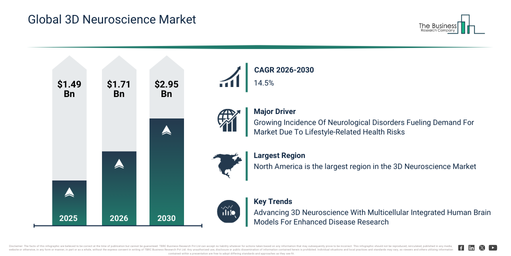
    The three-dimensional (3D) neuroscience market has seen rapid expansion in recent years. Its size is expected to increase from $1.49 billion in 2025 to $1.71 billion in 2026, exhibiting a compound annual growth rate (CAGR) of 14.8%. Historically, this growth can be attributed to several factors, including the increasing adoption of 3D brain modeling techniques, a rising demand for advanced neurological research tools, expanded use in drug discovery and neuropharmacology, the development of imaging and visualization technologies, and an intensified focus on understanding complex neural networks.

    The three-dimensional (3D) neuroscience market is anticipated to experience substantial expansion over the coming years. Its valuation is projected to reach $2.95 billion by 2030, exhibiting a compound annual growth rate (CAGR) of 14.5%. This growth throughout the forecast period can be linked to the increasing incorporation of 3D models with artificial intelligence (AI) analytics, a rise in investment in personalized neuroscience research, greater use in disease modeling and therapeutic development, the widening availability of high-resolution imaging and data acquisition platforms, and an elevated need for predictive and translational neuroscience studies. Key developments expected during this period involve technological innovations in 3D neural tissue modeling, progress in AI-powered data analysis, advancements in organoid and lab-grown neural systems, increased research and development in imaging and simulation platforms, and breakthroughs in integrated neuroscience modeling and visualization tools.

    Access Your Free Sample Report for In-Depth Market Insights:

    https://www.thebusinessresearchcompany.com/sample.aspx?id=30491&type=smp

    Which Drivers Are Expected To Impact The 3D Neuroscience Market During The Forecast Period?

    The expanding occurrence of neurological conditions is anticipated to boost the development of the 3D neuroscience market in the future. These disorders represent health issues impacting the brain, spinal cord, and nerves, thereby disturbing typical nervous system operations and resulting in deficiencies across movement, cognition, sensation, behavior, or general bodily regulation. The rising incidence of neurological disorders stems from detrimental lifestyle practices, such as inadequate diet, lack of physical activity, smoking, excessive drinking, and persistent stress. 3D neuroscience improves comprehension of brain structure and function, facilitating more accurate diagnoses and tailored therapies for individuals suffering from neurological conditions. As an illustration, in April 2024, data from the National Institutes of Health (NIH), a US-based government agency, indicated that approximately 6.9 million Americans aged 65 and above are presently afflicted with Alzheimer’s dementia, with this number forecasted to almost double, reaching 13.8 million by 2060. Consequently, the growing occurrence of neurological conditions fuels the 3D neuroscience market.

    How Is The 3D Neuroscience Market Divided Into Segments?

    The 3D neuroscience market covered in this report is segmented –

    1) By Component: Instruments And Consumables, Software And Services

    2) By Technology: Brain Imaging, Neuro-Microscopy, Electrophysiology, Neurophotonic Analysis, Other Technologies

    3) By Scale Of Analysis: Macro-Scale Connectomics (MSC), Meso-Scale Connectomics (MeSC), Micro-Scale Connectomics (MiSC), Nanoscale Or Synaptic Analysis (NSA)

    4) By Application: Disease Modeling And Drug Discovery, Brain Mapping And Connectomics, Developmental Neuroscience, Diagnostics And Surgical Planning

    5) By End-User: Hospitals, Diagnostic Laboratories, Research and Academic Institutes, Other End-Users

    Subsegments:

    1) By Instruments And Consumables: Imaging Devices, Microelectrodes, Sensors, Reagents, Laboratory Consumables

    2) By Software And Services: Data Analysis Software, Visualization Software, Modeling And Simulation Software, Technical Support Services, Training And Consultation Services

    Which Trends Are Expected To Influence The 3D Neuroscience Market In The Upcoming Years?

    Leading companies in the 3D neuroscience market are focusing on the development of advanced 3D human brain tissue platforms, such as multicellular integrated brain models, aiming to improve disease modeling, accelerate drug testing, and yield more physiologically relevant outcomes. Multicellular integrated brain models are laboratory-grown three-dimensional constructs derived from induced pluripotent stem cells that incorporate multiple primary brain cell types, thereby allowing for detailed study of cellular interactions, pathology, and drug responses. As an illustration, in November 2025, Massachusetts Institute of Technology (MIT), a US-based research institution, introduced Multicellular Integrated Brains (miBrains), which is a customizable 3D human brain tissue system. This platform integrates six major brain cell types, supports genetic engineering for individualized disease studies, and offers scalability for large-scale research projects, thus enhancing the availability and utility of complex in vitro models for neuroscience research.

    Which Leading Companies Dominate The 3D Neuroscience Market Share?

    Major companies operating in the 3D neuroscience market are Siemens Healthineers AG, Merck KGaA, Koninklijke Philips N.V., GE Healthcare Technologies Inc., Corning Incorporated, Bruker Corporation, STEMCELL Technologies Inc., Greiner Bio-One International GmbH, American Type Culture Collection, Cellink AB, Aspect Biosystems Ltd., InSphero AG, Axion BioSystems Inc., Emulate Inc., Mimetas B.V., NeuroNexus Technologies Inc., Tessara Therapeutics Inc., TheWell Bioscience Inc., Kirkstall Ltd., Pelobiotech GmbH, 3D Biotek LLC, Mightex Systems Inc., Advanced BioMatrix Inc.

    Access The Complete Report For Deeper Market Insights:

    https://www.thebusinessresearchcompany.com/report/3d-neuroscience-market-report

    How Does The 3D Neuroscience Market Perform Across Major Global Regions?

    North America was the largest region in the three dimensional (3D) neuroscience market in 2025. Asia-Pacific is expected to be the fastest-growing region in the forecast period. The regions covered in the 3D neuroscience market report are Asia-Pacific, South East Asia, Western Europe, Eastern Europe, North America, South America, Middle East, Africa.

    Request Your Customized 3D Neuroscience Market Research Report for Competitive Advantage:

    https://www.thebusinessresearchcompany.com/customise?id=30491&type=smp

    Browse Through More Reports Similar to the Global 3D Neuroscience Market 2026, By The Business Research Company

    Neuroscience Market Report 2026

    https://www.thebusinessresearchcompany.com/report/neuroscience-global-market-report

    3D Imaging Market Report 2026

    https://www.thebusinessresearchcompany.com/report/3d-imaging-global-market-report

    3D animation global market report

    https://www.thebusinessresearchcompany.com/report/3d-animation-global-market-report

    Get in touch with us:

    The Business Research Company: https://www.thebusinessresearchcompany.com/

    Americas +1 310-496-7795

    Asia +44 7882 955267 & +91 8897263534

    Europe +44 7882 955267

    Email us at marketing@tbrc.info

    Follow us on:

    LinkedIn: https://in.linkedin.com/company/the-business-research-company

    YouTube: https://www.youtube.com/channel/UC24_fI0rV8cR5DxlCpgmyFQ

    Global Market Model: https://www.thebusinessresearchcompany.com/global-market-model

  • 3D Digital X-Ray Systems Market Outlook 2026–2030: Key Business Drivers and Trends

    3D Digital X-Ray Systems Market Outlook 2026–2030: Key Business Drivers and Trends

    Uncover key drivers, emerging technologies, and competitive movements shaping the 3d digital x-ray systems market from 2026–2035 with trusted insights from The Business Research Company

    How much is the 3D Digital X-Ray Systems Market valued at in 2026, and what valuation is forecast for 2030?

    The 3D digital X-Ray systems market size has demonstrated robust growth in recent years. It is projected to expand from $6.05 billion in 2025 to $6.53 billion in 2026, at a compound annual growth rate (CAGR) of 8.1%. The market’s historical growth can be attributed to several factors, including heightened demand for sophisticated diagnostic imaging, a greater incidence of chronic and orthopedic conditions, wider acceptance of digital radiography, expanded application of 3D imaging in dental care, improved understanding of the importance of early disease detection, a move towards less invasive diagnostic methods, enhanced integration of imaging within outpatient settings, escalating healthcare spending, the increased availability of portable 3D x-ray devices, and a stronger inclination towards highly accurate diagnostics.

    The 3D digital X-Ray systems market is projected for substantial expansion in the coming years, with its valuation reaching $8.81 billion by 2030, driven by a compound annual growth rate (CAGR) of 7.8%. This anticipated growth during the forecast period is fueled by several factors, including the increasing integration of digital radiography, a heightened demand for precise 3D imaging, the expanding need for tools for early diagnosis, greater investment in imaging advancements, ongoing hospital modernization efforts, the expanded application of imaging in managing chronic diseases, a move towards automated radiology solutions, the increasing embrace of tele-radiology, a preference for imaging options with lower radiation doses, and the wider deployment of portable digital x-ray devices. Key trends expected during this period involve enhancements in high-resolution 3D imaging technology, progress in low-dose radiation solutions, improvements in portable 3D x-ray equipment, breakthroughs in AI-powered diagnostic instruments, innovations in automated image optimization, development of digital workflow platforms, integration with cloud storage, incorporation into hospital digital frameworks, the convergence of 3D imaging with robotics, and the development of more economical digital radiography solutions.

    Access Your Free Sample Report for In-Depth Market Insights:

    https://www.thebusinessresearchcompany.com/sample.aspx?id=30490&type=smp

    What Drivers Are Influencing The Growth Of The 3D Digital X-Ray Systems Market?

    The increasing need for high-resolution diagnostic imaging is anticipated to drive the expansion of the 3D Digital X-Ray Systems market in the future. This type of imaging encompasses medical technologies that produce precise, clear images of internal body structures, thereby facilitating accurate diagnoses and effective clinical choices. The demand for high-resolution diagnostic imaging is increasing because healthcare providers are broadening their services to allow for earlier detection of complex illnesses, better patient care, and improved diagnostic effectiveness. 3D Digital X-Ray Systems facilitate high-resolution diagnostic imaging by offering advanced solutions that provide excellent image clarity, enhance diagnostic precision, and optimize patient flow in clinical environments. For example, data from March 2024 released by the Australian Institute of Health and Welfare (AIHW), an Australian government health agency, revealed that nearly 2 in 5 Australians (39%) utilized more than 27 million Medicare-subsidised diagnostic imaging services. The number of imaging services per 100 individuals grew from 103 in 2022–23 to 106 in 2023–24, indicating a consistent annual increase and expanded adoption of advanced imaging techniques. Consequently, the growing requirement for high-resolution diagnostic imaging is fueling the expansion of the 3D Digital X-Ray Systems market.

    What Segments Are Included Within The 3D Digital X-Ray Systems Market?

    The 3D digital x-ray systems market covered in this report is segmented –

    1) By Product Type: Stationary 3D Digital X-Ray Systems, Portable 3D Digital X-Ray Systems, Mobile 3D Digital X-Ray Systems

    2) By Detector Type: Flat Panel Detectors, Charge-Coupled Devices (CCD), Image Intensifier Detectors, Computed Radiography (CR) Systems, Line-Scanning Detectors

    3) By Technology: Computed Tomography (CT) Systems, Digital Radiography (DR) Systems, Fluoroscopy Systems, X-Ray Systems With Dual Energy, Portable X-Ray Systems

    4) By Application: Orthopedics, Dental Imaging, Oncology, Pediatric Imaging, Cardiology

    5) By End-User: Hospitals, Diagnostic Imaging Centers, Outpatient Surgery Centers, Research Institutions, Veterinary Clinics

    Subsegments:

    1) By Stationary 3D Digital X-Ray Systems: Fixed-Room 3D Imaging Systems, Hospital Radiology Department Systems, High-Capacity 3D X-Ray Units, Floor-Mounted 3D X-Ray Systems, Ceiling-Mounted 3D X-Ray Systems, Advanced Diagnostic 3D Systems, Large-Format 3D Orthopedic Imaging Units

    2) By Portable 3D Digital X-Ray Systems: Handheld 3D X-Ray Devices, Backpack-Style Portable 3D Systems, Battery-Powered Portable 3D X-Ray Units, Emergency Or Trauma Portable 3D Systems, Field-Use Portable 3D Devices, Compact Point-Of-Care 3D X-Ray Units

    3) By Mobile 3D Digital X-Ray Systems: Cart-Based Mobile 3D X-Ray Systems, Motorized Mobile 3D Systems, Mobile 3D C-Arm Units, ICU Or Mobile Ward 3D Imaging Systems, Mobile Surgical 3D X-Ray Units, Mobile Diagnostic Screening Units

    What Trends Are Driving The Growth Trajectory Of The 3D Digital X-Ray Systems Market?

    Leading companies in the 3D digital X-ray systems market are concentrating on creating clinical imaging solutions, including multi-purpose 3D dental imaging platforms, to improve diagnostic accuracy, support treatment planning, and optimize surgical workflows. These platforms are technologies utilized for capturing volumetric images, planning interventions, and facilitating precise clinical decision-making in dental and oral surgery practices. For example, in September 2024, Dental Imaging Technologies Corporation (DEXIS), a US-based dental imaging technology company, introduced the ORTHOPANTOMOGRAPH OP 3D EX. This 3D X-ray platform features adaptable field of view options, sophisticated imaging software for chairside treatment planning, and integrated tools for generating surgical guides swiftly within practice settings. It is specifically designed for general practitioners aiming to enhance their diagnostic capabilities with 3D imaging, supporting a variety of clinical indications with a broad spectrum of field of view sizes.

    Who Are The Major Companies Operating In The 3D Digital X-Ray Systems Market?

    Major companies operating in the 3D digital x-ray systems market are Siemens Healthineers AG, Fujifilm Holdings Corporation, Koninklijke Philips N.V., GE HealthCare Technologies Inc., Mindray Medical International Limited, Dentsply Sirona Inc., Shimadzu Corporation, Canon Medical Systems Corporation, Acteon Group Ltd., United Imaging Healthcare Co. Ltd., Hamamatsu Photonics K.K., Agfa-Gevaert Group, Carestream Health Inc., Samsung Medison Co. Ltd., Analogic Corporation, Planmed Oy, Vatech Co. Ltd., Carestream Dental LLC, Ziehm Imaging GmbH, EOS Imaging S.A.

    Access The Complete Report For Deeper Market Insights:

    https://www.thebusinessresearchcompany.com/report/3d-digital-x-ray-systems-market-report

    Which Region Is Anticipated To See The Fastest Growth In The 3D Digital X-Ray Systems Market?

    North America was the largest region in the 3D digital X-Ray systems market in 2025. Asia-Pacific is expected to be the fastest-growing region in the forecast period. The regions covered in the 3D digital x-ray systems market report are Asia-Pacific, South East Asia, Western Europe, Eastern Europe, North America, South America, Middle East, Africa.

    Request Your Customized 3D Digital X-Ray Systems Market Research Report for Competitive Advantage:

    https://www.thebusinessresearchcompany.com/customise?id=30490&type=smp

    Browse Through More Reports Similar to the Global 3D Digital X-Ray Systems Market 2026, By The Business Research Company

    Digital Xray Devices Market Report 2026

    https://www.thebusinessresearchcompany.com/report/digital-xray-devices-global-market-report

    X Ray Systems Devices And Equipment Market Report 2026

    https://www.thebusinessresearchcompany.com/report/x-ray-systems-devices-and-equipment-global-market-report

    medical x ray equipment and imaging software global market report

    https://www.thebusinessresearchcompany.com/report/medical-x-ray-equipment-and-imaging-software-global-market-report

    Get in touch with us:

    The Business Research Company: https://www.thebusinessresearchcompany.com/

    Americas +1 310-496-7795

    Asia +44 7882 955267 & +91 8897263534

    Europe +44 7882 955267

    Email us at marketing@tbrc.info

    Follow us on:

    LinkedIn: https://in.linkedin.com/company/the-business-research-company

    YouTube: https://www.youtube.com/channel/UC24_fI0rV8cR5DxlCpgmyFQ

    Global Market Model: https://www.thebusinessresearchcompany.com/global-market-model