Long-Read Sequencing Market Growth Outlook Reveals A CAGR Of 26.5% And A Market Value Of $3.74 Billion By 2030
Delivering more actionable and strategically valuable research, The Business Research Company’s 2026 market reports feature market attractiveness analysis, total addressable market evaluation, company benchmarking matrices, interactive Excel dashboards, expanded supply chain intelligence, emerging startup coverage, and detailed product insights.
The long-read sequencing market has witnessed remarkable growth recently, driven by advancements in genomic technologies and increasing research demands. As this sector continues to evolve, it is expected to expand significantly in the coming years. Below, we explore the market size, key drivers, segmentation, trending innovations, leading players, and geographic outlook shaping the future of long-read sequencing.
Rapid Growth and Expanding Market Size of Long-Read Sequencing
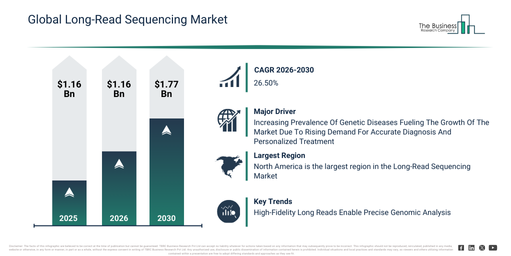
The long-read sequencing market has seen exponential growth, increasing from $1.15 billion in 2025 to $1.46 billion in 2026, reflecting a strong compound annual growth rate (CAGR) of 26.8%. This surge is largely due to the limitations of short-read sequencing, advancements in nanopore technology, expanding genomics research, demand for precise genome assembly, and increased funding within the life sciences sector. Looking ahead, the market is projected to reach $3.74 billion by 2030, maintaining a CAGR of 26.5%. Growth factors during this period include wider clinical adoption, decreased sequencing costs, integration with AI-powered analysis tools, expansion in oncology diagnostics, and population genomics development. Key trends are centered on the broader use of long-read technologies, enhanced detection of structural variants, the rise of hybrid sequencing methods, growth in rare disease genomics, and applications in complex genome assembly.
Download A Free Sample Report For Comprehensive Market Insights:
https://www.thebusinessresearchcompany.com/sample.aspx?id=28259&type=smp
Genetic Disease Prevalence as a Major Growth Driver in Long-Read Sequencing
A key factor propelling the long-read sequencing market is the increasing occurrence of genetic disorders. These conditions, caused by DNA mutations or inherited changes, affect various aspects of health and development. Growing awareness combined with better diagnostic technologies has led to earlier and more accurate identification of genetic diseases. Long-read sequencing offers a comprehensive genomic view, making it especially useful for diagnosing complex and rare disorders by detecting structural variations and mutations often missed by other methods.
Improved Patient Outcomes Fueling Market Demand
By reducing uncertainty in diagnosis and enhancing personalized treatment plans, long-read sequencing supports improved clinical decision-making. For example, data from October 2024 by the UK-based Cystic Fibrosis Trust showed that the number of people living with cystic fibrosis rose from 11,148 in 2022 to 11,318 in 2023. Such increases in genetic disease prevalence underscore the rising need for advanced sequencing solutions, driving demand in this market.
Access The Complete Long-Read Sequencing Market Report:
https://www.thebusinessresearchcompany.com/report/long-read-sequencing-global-market-report
Breaking Down the Long-Read Sequencing Market Structure
The market is segmented across several key categories for a detailed understanding:
1) Product and Service Types: Instruments or platforms, consumables and reagents, services and software.
2) Workflow Stages: Pre-sequencing, sequencing, and data analysis.
3) Technology Platforms: Single Molecule Real-Time (SMRT) High-Fidelity (HiFi) sequencing, synthetic long-read or linked-read technologies, hybrid approaches, and other emerging methods.
4) Applications: Human genomics and rare disease diagnostics, oncology and liquid biopsy, metagenomics and microbiome studies, transcriptomics, agricultural genomics including plant and animal breeding, among others.
5) End Users: Academic and research institutions, hospitals and clinics, pharmaceutical and biotechnology companies, and other sectors.
Further subcategories include specific instruments like SMRT sequencers and nanopore sequencers; consumables such as library preparation kits, sample prep kits, and sequencing kits; as well as services covering sequencing operations, data analysis, and bioinformatics software.
Innovations and Trends Accelerating Long-Read Sequencing Capabilities
Leading companies in this field are focusing on breakthrough developments to improve sequencing accuracy and detection of complex genetic variations. High-fidelity (HiFi) reads, which combine long read lengths with minimal error rates, are at the forefront of these advancements, allowing researchers to identify intricate genetic variants with greater precision.
For instance, in November 2024, Pacific Biosciences of California Inc. introduced the Vega system—its first benchtop long-read sequencer aimed at providing faster, accessible genomic analysis. This compact and affordable instrument delivers highly accurate HiFi data with 99.9% read accuracy and supports diverse applications such as RNA sequencing, targeted sequencing, and small genome analysis. Vega also features onboard computing and user-friendly operation, making advanced sequencing more attainable for many laboratories.
Key Players Driving Competition in the Long-Read Sequencing Industry
The competitive landscape includes major industry players such as Thermo Fisher Scientific Inc., Agilent Technologies Inc., Revvity Inc., Bio-Rad Laboratories Inc., BGI Genomics Co. Ltd., Novogene Co. Ltd., Takara Bio Inc., Oxford Nanopore Technologies plc, Pacific Biosciences of California Inc., New England Biolabs Inc., Roche Sequencing Solutions Inc., The Garvan Institute, Element Biosciences Inc., Eurofins Genomics, CD Genomics, BaseClear B.V, France Génomique, GrandOmics Biosciences Co. Ltd., Future Genomics Technologies B.V., and MicrobesNG. These companies are continually advancing technologies to capture more market share and meet growing customer demands.
Regional Insights Highlighting Market Leadership and Growth Areas
In 2025, North America held the largest share of the long-read sequencing market, reflecting strong research infrastructure and funding support. Meanwhile, the Asia-Pacific region is expected to experience the fastest growth throughout the forecast period, driven by increasing investment in genomics research, expanding healthcare infrastructure, and rising demand for advanced diagnostics. The market report covers critical regions including Asia-Pacific, South East Asia, Western Europe, Eastern Europe, North America, South America, the Middle East, and Africa, offering a broad perspective on global market dynamics.
Get in touch with us:
The Business Research Company: https://www.thebusinessresearchcompany.com/
Americas: +1 310-496-7795
Asia: +44 7882 955267 & +91 8897263534
Europe: +44 7882 955267
Email us at: marketing@tbrc.info
Follow us on:
LinkedIn: https://in.linkedin.com/company/the-business-research-company
YouTube: https://www.youtube.com/channel/UC24_fI0rV8cR5DxlCpgmyFQ
Global Market Model: https://www.thebusinessresearchcompany.com/global-market-model