Medical Batteries Market Opportunities Are Emerging Beyond Traditional Growth Areas
Through market attractiveness analysis, total addressable market evaluation, company benchmarking matrices, interactive Excel dashboards, expanded supply chain intelligence, emerging startup coverage, and detailed product insights, The Business Research Company’s 2026 market reports provide more actionable and strategically valuable research.
The medical batteries market is witnessing significant growth, driven by technological advancements and increasing demand from the healthcare sector. As medical devices become more sophisticated and widespread, the need for reliable, long-lasting power sources intensifies. This overview examines the current market size, growth drivers, key players, emerging trends, and regional prospects shaping the future of medical batteries.
Medical Batteries Market Size and Growth Projections
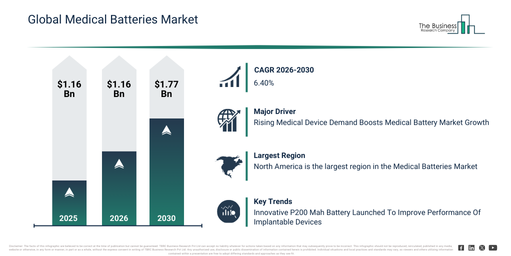
The medical batteries market has shown strong momentum recently, with its value expected to rise from $1.87 billion in 2025 to $1.99 billion in 2026, marking a compound annual growth rate (CAGR) of 6.8%. This past growth is mainly due to reliance on traditional alkaline and zinc-air batteries, limited battery life in implantable devices, growing adoption of home healthcare, expansion of healthcare facilities, and increased demand for portable medical monitoring equipment. Looking ahead, the market is projected to reach $2.56 billion by 2030, growing at a CAGR of 6.4%. This anticipated expansion is fueled by advancements in lithium-ion and lithium polymer batteries, rising use of wearable medical devices, growth in implantable cardiac and neurological devices, heightened focus on battery safety and biocompatibility, along with integration of Internet of Things (IoT) technology in medical equipment. Key trends expected to influence the market include demand for high-energy-density batteries, greater adoption of rechargeable and long-lasting batteries, expansion of implantable device applications, and stronger regulatory compliance measures.
Download A Free Sample Report For Comprehensive Market Insights:
https://www.thebusinessresearchcompany.com/sample.aspx?id=19568&type=smp
Factors Supporting the Growth of the Medical Batteries Market
The increasing need for medical devices is a primary factor propelling the medical batteries market forward. Medical devices, which include instruments and machines used to diagnose, treat, or monitor health conditions, are in greater demand due to aging populations, rising chronic illnesses, and ongoing healthcare technological advancements worldwide. Batteries play a crucial role in powering a wide range of these devices, ensuring reliable functioning for patient monitoring systems, diagnostic tools, and life-saving equipment. Illustrating this, in March 2025, the China-based manufacturer Large Battery reported that over 90% of FDA-approved medical devices rely on medical-grade batteries that comply with stringent safety standards. Certifications such as UL2054 and IEC 60086 have helped reduce safety incidents and battery malfunctions by approximately 25%, reinforcing the importance of quality in driving market growth.
Breakdown of Medical Batteries Market Segments
This market is divided into several key categories to better understand its scope and applications:
1) Battery Type: including Lithium-Ion Batteries, Lithium Primary Batteries, Nickel-Metal Hydride (NiMH) Batteries, Nickel-Cadmium (NiCd) Batteries, Zinc-Based Batteries, and other types.
2) Application: segmented into Implantable Medical Devices, Non-Implantable Medical Devices, and Portable and Wearable Medical Devices.
3) End-User: covering Hospitals and Clinics, Home Healthcare Settings, Ambulatory Surgical Centers, Diagnostic Centers, and Medical Device Manufacturers.
Further subcategories provide detailed breakdowns within battery types, such as Lithium-Ion variants like Lithium Cobalt Oxide (LCO), Lithium Iron Phosphate (LFP), Lithium Manganese Oxide (LMO), Lithium Nickel Manganese Cobalt Oxide (NMC), Lithium Nickel Cobalt Aluminum Oxide (NCA), and Lithium Polymer (LiPo). Lithium Primary Batteries include Lithium Iodine, Lithium Silver Vanadium Oxide (Li/SVO), and Lithium Carbon Monofluoride (Li/CFx). NiMH batteries are divided into standard and low self-discharge types, while NiCd batteries are categorized as vented or sealed. Zinc-based batteries include Zinc-Air and Zinc-Carbon variants, and other types feature Silver-Oxide, Alkaline, and Lead-Acid batteries.
Access The Complete Medical Batteries Market Report:
https://www.thebusinessresearchcompany.com/report/medical-batteries-global-market-report
Emerging Trends Impacting Medical Battery Demand
Innovations in lithium-ion medical batteries are reshaping the market by enhancing device performance, safety, and reliability. These batteries are specially designed to power critical medical equipment such as portable oxygen concentrators, insulin pumps, and various diagnostic and therapeutic devices requiring stable and dependable energy sources. For example, in September 2023, US-based medtech manufacturer Resonetics introduced the Contego P200 mAh primary battery. This implantable lithium/carbon monofluoride (Li-CFx) battery is a lightweight, miniature D-shaped cell delivering high energy density and low self-discharge, ideal for implantable devices with low to medium pulse power requirements. The battery features a hermetically sealed titanium casing, thermal shutdown separator for safety, weighs only 1.75 grams, and measures 21.3 mm × 9.5 mm × 4.4 mm. With a nominal voltage of 2.8V, it is available off-the-shelf or with custom pin configurations and is produced in an ISO 13485-certified facility. The Contego P200 bridges a capacity gap between other Resonetics cells, offering greater design flexibility for applications such as neuromodulation, monitoring, and sleep apnea. Resonetics’ medical power division benefits from over 25 years of specialized expertise in implantable power systems.
Key Players Influencing the Medical Batteries Market
The competitive landscape of the medical batteries industry features several prominent companies driving innovation and growth. Leading names include TotalEnergies SE, Panasonic Corporation, 3M Company, Merck KGaA, Texas Instruments Incorporated, STMicroelectronics NV, Murata Manufacturing Co. Ltd, EnerSys Inc., Energizer Holdings Inc., Renata AG SA, VARTA Microbattery GmbH, Vitec Group PLC, EaglePicher Technologies LLC, Ultralife Corporation, Probo Medical LLC, Camelion Battery Co. Ltd., Maxim Integrated Products Inc., Tadiran Batteries Ltd., Blue Spark Technologies Inc., and KAYO Battery Company Limited. These organizations contribute to advancing battery technology, expanding product lines, and meeting evolving medical device power requirements.
Regional Medical Batteries Market Overview
In 2025, North America led the medical batteries market in terms of size, reflecting the region’s advanced healthcare infrastructure and early technology adoption. However, the Asia-Pacific region is expected to experience the fastest growth during the forecast period. This dynamic growth is driven by increasing healthcare investments, a rising number of medical device manufacturers, and expanding patient populations. Other geographic areas covered in the market analysis include South East Asia, Western Europe, Eastern Europe, South America, the Middle East, and Africa, providing a comprehensive view of global market opportunities and trends.
Get in touch with us:
The Business Research Company: https://www.thebusinessresearchcompany.com/
Americas: +1 310-496-7795
Asia: +44 7882 955267 & +91 8897263534
Europe: +44 7882 955267
Email us at: marketing@tbrc.info
Follow us on:
LinkedIn: https://in.linkedin.com/company/the-business-research-company
YouTube: https://www.youtube.com/channel/UC24_fI0rV8cR5DxlCpgmyFQ
Global Market Model: https://www.thebusinessresearchcompany.com/global-market-model