Built to provide research that’s more actionable and strategically valuable, The Business Research Company’s 2026 market reports include market attractiveness analysis, total addressable market sizing, company benchmarking matrices, interactive Excel dashboards, broader supply chain intelligence, emerging startup tracking, and in-depth product insights.
Motion Stimulation Therapy Market Set To Climb From $2.13 Billion In 2026 To $2.89 Billion By 2030
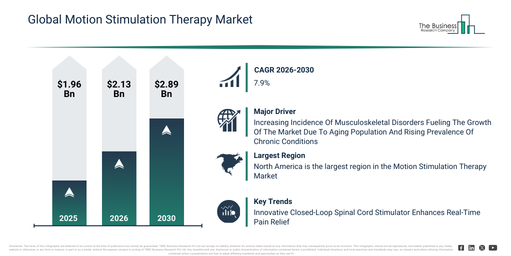
The motion stimulation therapy market size has experienced significant expansion in recent years. It is projected to increase from $1.96 billion in 2025 to $2.13 billion in 2026, advancing at a compound annual growth rate (CAGR) of 8.7%. This growth in prior periods can be attributed to the rising prevalence of musculoskeletal disorders, increasing rehabilitation needs for aging populations, growing clinical acceptance of motion-based therapies, expansion of physical therapy infrastructure, and the availability of advanced therapeutic devices.
The motion stimulation therapy market is anticipated to experience substantial expansion in the coming years, reaching a valuation of $2.89 billion by 2030, exhibiting a compound annual growth rate (CAGR) of 7.9%. This projected growth is driven by several factors, including a rising need for individualized rehabilitation approaches, the increasing implementation of remote and home-based therapeutic options, the broadening scope of neurological disorder treatment initiatives, the expanding incorporation of AI-powered therapy optimization, and greater healthcare spending on rehabilitation technologies. Key trends expected during this forecast period encompass the wider adoption of robotic-assisted motion therapy devices, the increasing integration of sensor-based motion feedback systems, the growing application of customized rehabilitation protocols, the expansion of therapy solutions designed for home use, and a heightened emphasis on outcomes related to neuromuscular recovery.
Get A Free Sample Report With In-Depth Market Insights:
Motion Stimulation Therapy Market Demand Drivers Opening New Revenue Streams
The rising occurrence of musculoskeletal disorders is projected to propel the expansion of the motion stimulation therapy market moving forward. Musculoskeletal disorders are conditions affecting muscles, bones, joints, tendons, and ligaments, causing discomfort or hindering movement. The increased prevalence of these disorders is linked to the global aging population, as individuals naturally encounter joint degeneration and reduced bone density over time. Motion stimulation therapy enhances the management of musculoskeletal disorders by promoting improved mobility and alleviating pain. It delivers targeted stimulation to affected regions, supporting faster healing and better patient outcomes. Therefore, the growing incidence of musculoskeletal disorders is driving the growth of the motion stimulation therapy market.
Motion Stimulation Therapy Market Segment Performance And Emerging Opportunities
The motion stimulation therapy market covered in this report is segmented –
1) By Therapy Type: Functional Neuromuscular Motion Stimulation Therapy, Peripheral Motion Stimulation Therapy, Deep Brain Motion Stimulation Therapy, Therapeutic Electrical Motion Stimulation Therapy
2) By Applications: Neurological Rehabilitation, Pain Management, Musculoskeletal Rehabilitation, Cardiovascular Diseases, Post-Surgical Rehabilitation, Others Applications
3) By End User: Hospitals, Specialty Clinics, Other End Users
Subsegments:
1) By Functional Neuromuscular Motion Stimulation Therapy: Muscle Activation, Nerve Stimulation, Reflex Enhancement
2) By Peripheral Motion Stimulation Therapy: Limb Motion Stimulation, Joint Motion Stimulation, Soft Tissue Motion Stimulation
3) By Deep Brain Motion Stimulation Therapy: Subthalamic Nucleus Stimulation, Globus Pallidus Stimulation, Thalamic Stimulation
4) By Therapeutic Electrical Motion Stimulation Therapy: Transcutaneous Electrical Nerve Stimulation, Functional Electrical Stimulation, Neuromuscular Electrical Stimulation
Motion Stimulation Therapy Market Trends Powering Strategic Industry Growth
Key companies in the motion stimulation therapy market are concentrating on developing innovative offerings, such as closed-loop spinal cord stimulators, to enhance real-time pain management and improve patient outcomes. Closed-loop spinal cord stimulators are advanced medical instruments that constantly monitor nerve signals and autonomously modify stimulation levels to deliver personalized and effective pain relief.
Motion Stimulation Therapy Market Key Players: Which Companies Lead Industry Competition?
Major companies operating in the motion stimulation therapy market are Abbott Laboratories, Boston Scientific Corporation, Medtronic plc, Ottobock SE & Co. KGaA, Nevro Corporation, Zynex Medical Inc., BTL Industries Inc., Onward Medical Inc., Enraf-Nonius B.V., Hocoma AG, Tyromotion GmbH, Ekso Bionics Holdings Inc., Mettler Electronics Corporation, Bioness Inc., Restorative Therapies Inc., ARPwave Therapy, Innovative Neurotronics Inc., St. Jude Medical Inc., Technomed Electronics Co Ltd., LivaNova PLC, NeuroMetrix Inc., EMS Physio Ltd., Chattanooga Group
View The Full Motion Stimulation Therapy Market Report:
Motion Stimulation Therapy Market Geographic Landscape: Which Region Leads Industry Growth?
North America was the largest region in the motion simulation therapy market in 2025. The regions covered in the motion stimulation therapy market report are Asia-Pacific, South East Asia, Western Europe, Eastern Europe, North America, South America, Middle East, Africa.
Reach Out To Our Team:
The Business Research Company: https://www.thebusinessresearchcompany.com/
Americas: +1 310-496-7795
Asia: +44 7882 955267 & +91 8897263534
Europe: +44 7882 955267
Email us at: marketing@tbrc.info
Follow us on:
LinkedIn: https://in.linkedin.com/company/the-business-research-company
YouTube: https://www.youtube.com/channel/UC24_fI0rV8cR5DxlCpgmyFQ
Global Market Model: https://www.thebusinessresearchcompany.com/global-market-model
Leave a Reply