Blog

  • Artificial Intelligence (AI)-Enhanced Medication Adherence Sensor Market Forecast To Reach $4.75 Billion By 2030: Key Growth Drivers And Industry Trends

    Artificial Intelligence (AI)-Enhanced Medication Adherence Sensor Market Forecast To Reach $4.75 Billion By 2030: Key Growth Drivers And Industry Trends

    Built to provide research that’s more actionable and strategically valuable, The Business Research Company’s 2026 market reports include market attractiveness analysis, total addressable market sizing, company benchmarking matrices, interactive Excel dashboards, broader supply chain intelligence, emerging startup tracking, and in-depth product insights.

    Artificial Intelligence (AI)-Enhanced Medication Adherence Sensor Market CAGR Outlook And Future Development

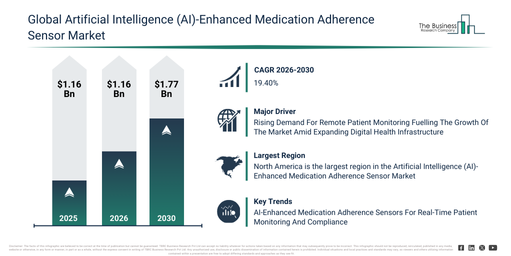
    The artificial intelligence (AI)-enhanced medication adherence sensor market size has seen substantial growth in recent years. It is anticipated to increase from $1.96 billion in 2025 to $2.34 billion in 2026, exhibiting a compound annual growth rate (CAGR) of 19.7%. This historical expansion can be attributed to issues such as medication non-adherence, the rise in chronic diseases, the adoption of digital health solutions, the necessity for clinical trial monitoring, and innovations in wearable sensors.

    The artificial intelligence (AI)-enhanced medication adherence sensor market is expected to undergo significant expansion in the coming years. Its valuation is predicted to reach $4.75 billion by 2030, exhibiting a compound annual growth rate (CAGR) of 19.4%. This anticipated growth throughout the forecast period can be attributed to the rise of remote patient monitoring, AI-driven adherence analytics, the implementation of value-based care models, the increasing elderly population, and the digitization of pharmaceutical trials. Major developments anticipated during this timeframe include real-time medication monitoring, compliance tools for chronic diseases, continued advancements in remote patient monitoring, improved elderly medication management, and enhanced clinical trial adherence tracking.

    Get A Free Sample Report With In-Depth Market Insights:

    https://thebusinessresearchcompany.com/sample_request?id=69107578&type=smp&name=Artificial%20Intelligence%20%28AI%29-Enhanced%20Medication%20Adherence%20Sensor%20Market%20Report%202026&utm_source=Blogs&utm_medium=Paid&utm_campaign=Sep_PR

    Artificial Intelligence (AI)-Enhanced Medication Adherence Sensor Market Industry Drivers: What’s Behind The Revenue Growth?

    The increasing need for remote patient monitoring is projected to drive the expansion of the artificial intelligence (AI)-enhanced medication adherence sensor market in the future. Remote patient monitoring (RPM) involves using connected digital technologies to gather and transmit patients’ health data from locations outside hospitals and clinics, enabling medical professionals to monitor and manage conditions in real time. The swift growth of remote patient monitoring is attributed to rising investments by healthcare systems in digital health infrastructure, which has accelerated the integration of connected monitoring technologies into patient care. AI-enhanced medication adherence sensors track medication intake continuously and transmit adherence data to healthcare providers, facilitating timely interventions and reducing missed doses, while also allowing clinicians to remotely oversee treatment compliance and patient health. For instance, in April 2025, information from the Parliamentary Office of Science and Technology, a UK-based non-partisan office of the UK Parliament, showed that in March 2025, England had 12,825 virtual ward beds, which equates to 20 beds per 100,000 GP-registered individuals, with an occupancy of 76.2% accommodating 9,767 patients. Therefore, the growing demand for remote patient monitoring is fueling the growth of the artificial intelligence (AI)-enhanced medication adherence sensor market.

    Artificial Intelligence (AI)-Enhanced Medication Adherence Sensor Market Segment Trends And Revenue Contributors

    The artificial intelligence (ai)-enhanced medication adherence sensor market covered in this report is segmented –

    1) By Product Type: Wearable Sensors, Ingestible Sensors, Smart Pill Bottles, Smart Packaging

    2) By Technology: Artificial Intelligence (AI) Algorithms, Internet Of Things (IoT) Integration, Cloud-Based Solutions, Mobile Applications, Other Technologies

    3) By Distribution Channel: Online, Offline

    4) By Application: Chronic Disease Management, Elderly Care, Clinical Trials, Home Healthcare, Other Applications

    5) By End-User: Patients, Healthcare Providers, Pharmaceutical Companies, Other End-Users

    Subsegments:

    1) By Wearable Sensors: Smart Wristbands, Adhesive Patches, Smartwatches, Clothing-Embedded Sensors, Arm Bands

    2) By Ingestible Sensors: Sensor-Embedded Pills, Biocompatible Capsules, Digestive Monitoring Sensors, pH Tracking Sensors, Temperature-Sensing Capsules

    3) By Smart Pill Bottles: Bluetooth-Enabled Pill Bottles, Reminder-Integrated Bottles, Dose-Tracking Bottles, Automatic Dispensing Bottles, Sensor-Activated Bottles

    4) By Smart Packaging: Blister Pack Sensors, Smart Labels, Pressure-Sensitive Packaging, Temperature-Monitoring Packaging, Tamper-Evident Smart Packs

    #Artificial Intelligence (AI)-Enhanced Medication Adherence Sensor Market Growth Trends: What’s Shaping The Future Outlook?

    Major companies operating in the artificial intelligence (AI)-enhanced medication adherence sensor market are concentrating on creating user-friendly tools, such as smart pill bottle-based medication adherence systems, to simplify patient oversight, improve medication compliance, and facilitate effortless data sharing with healthcare providers. These smart pill bottle systems actively track patients’ medication consumption in real time and record adherence data, simultaneously sending alerts and reminders to ensure timely dosing and provide actionable insights to medical professionals. As an illustration, in June 2024, PatchRx, a US-based digital health technology company, introduced PatchRx Connect. This solution functions as a straightforward integration tool that directly embeds real-time medication adherence data into existing care management platforms. It empowers clinical teams to gain immediate insight into patients’ medication-taking behaviors without disrupting workflows or the patient experience. The system consists of a smart pill bottle cap (PatchCap) for tracking medication usage, a cellular gateway that streams data securely without needing WiFi or a mobile app, and a Connect API that allows providers to view adherence metrics within their own software. This integration is crucial for enhancing treatment outcomes and reducing costs by enabling prompt clinical interventions based on actual adherence data.

    Artificial Intelligence (AI)-Enhanced Medication Adherence Sensor Market Top Companies Driving Competitive Growth

    Major companies operating in the artificial intelligence (ai)-enhanced medication adherence sensor market are AiCure Inc., AdhereTech Inc., AARDEX Group Ltd., EtectRx Inc., Proteus Digital Health, Adherium Limited, Wisepill Technologies Proprietary Ltd., SMRxT Inc., Amiko Digital Health Limited, MedMinder Systems Inc., Spencer Health Solutions Inc., iZafe Group AB, Evalan B.V., Mango Health, DoseSmart, CarePredict, Catalia Health, Sentrian, MedAdherence, Pilloxa

    View The Full Artificial Intelligence (AI)-Enhanced Medication Adherence Sensor Market Report:

    https://thebusinessresearchcompany.com/report/artificial-intelligence-ai-enhanced-medication-adherence-sensor-global-market-report?utm_source=Blogs&utm_medium=Paid&utm_campaign=Sep_PR

    Artificial Intelligence (AI)-Enhanced Medication Adherence Sensor Market Global Footprint: Which Region Leads The Market?

    North America was the largest region in the artificial intelligence (AI)-enhanced medication adherence sensor market in 2025. The regions covered in the artificial intelligence (AI)-enhanced medication adherence sensor market report are Asia-Pacific, South East Asia, Western Europe, Eastern Europe, North America, South America, Middle East, Africa.

    Reach Out To Our Team:

    The Business Research Company: https://www.thebusinessresearchcompany.com/

    Americas: +1 310-496-7795

    Asia: +44 7882 955267 & +91 8897263534

    Europe: +44 7882 955267

    Email us at: marketing@tbrc.info

    Follow us on:

    LinkedIn: https://in.linkedin.com/company/the-business-research-company

    YouTube: https://www.youtube.com/channel/UC24_fI0rV8cR5DxlCpgmyFQ

    Global Market Model: https://www.thebusinessresearchcompany.com/global-market-model
  • Artificial Intelligence (AI)-Driven Tele-Dermatoscope Market Research 2026: Market Size, Trends, Segments And Growth Forecast

    Artificial Intelligence (AI)-Driven Tele-Dermatoscope Market Research 2026: Market Size, Trends, Segments And Growth Forecast

    Backed by market attractiveness analysis, total addressable market sizing, company benchmarking matrices, interactive Excel dashboards, wider supply chain intelligence, emerging startup coverage, and detailed product-level insights, The Business Research Company’s 2026 market reports are designed to offer research that is more actionable and strategically valuable than ever.

    Artificial Intelligence (AI)-Driven Tele-Dermatoscope Market Set To Climb From $1.94 Billion In 2026 To $5.19 Billion By 2030

    The artificial intelligence (ai)-driven tele-dermatoscope market size has experienced exponential growth in recent years. It is anticipated to expand from $1.51 billion in 2025 to $1.94 billion in 2026, achieving a compound annual growth rate (CAGR) of 28.2%. The historical increase in this market can be attributed to the rising incidence of skin disorders, the demand for remote dermatology solutions, advancements in imaging sensors, the early adoption of AI in dermatology, and the growth of telemedicine platforms.

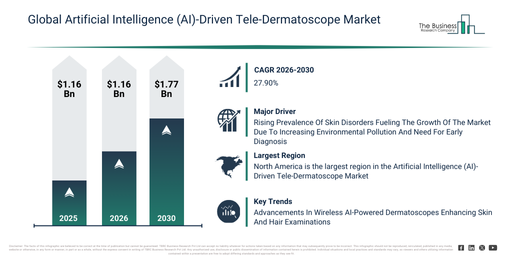
    The artificial intelligence (AI)-driven tele-dermatoscope market is projected to experience substantial expansion over the upcoming years. It is anticipated to reach a valuation of $5.19 billion by 2030, exhibiting a compound annual growth rate (CAGR) of 27.9%. This projected growth during the forecast timeframe is primarily driven by factors such as the rising acceptance of tele-dermatology, its integration with AI analytics, the approval of skin imaging devices by regulatory bodies, the proliferation of cloud-based dermatology platforms, and enhanced public understanding regarding the early detection of skin cancer. Key trends anticipated within this period encompass remote evaluation of skin lesions, automated methods for detecting skin cancer, the development of mobile dermatology applications, management of dermatology data through cloud platforms, and seamless integration with broader telemedicine systems.

    Get A Free Sample Report With In-Depth Market Insights:

    https://thebusinessresearchcompany.com/sample_request?id=70479459&type=smp&name=Artificial%20Intelligence%20%28AI%29-Driven%20Tele-Dermatoscope%20Market%20Report%202026&utm_source=Blogs&utm_medium=Paid&utm_campaign=Sep_PR

    Artificial Intelligence (AI)-Driven Tele-Dermatoscope Market Growth Factors: What’s Supporting Expansion?

    The expanding occurrence of skin conditions is anticipated to fuel the expansion of the artificial intelligence (AI)-driven tele-dermatoscope market in the future. These conditions disrupt the skin’s typical structure or operation, manifesting symptoms like redness, itching, scaling, or lesions. A primary contributor to the increase in skin disorders is heightened environmental pollution, as airborne detrimental pollutants and chemicals can harm the skin’s defensive barrier, causing irritation, allergic responses, and persistent skin issues. Artificial intelligence (AI)-driven tele-dermatoscopes offer assistance in managing skin disorders by rapidly and precisely examining high-resolution skin images using sophisticated algorithms, facilitating early detection and diagnosis without the necessity of an in-person visit to a dermatologist. For illustration, in January 2025, data from the American Cancer Society, a professional organization located in the US, projects that the US will encounter approximately 105,000 new melanoma cases and about 8,400 associated deaths in 2025. Consequently, the rising occurrence of skin conditions is a key factor propelling the expansion of the artificial intelligence (AI)-driven tele-dermatoscope market.

    Artificial Intelligence (AI)-Driven Tele-Dermatoscope Market Segment Analysis Spotlighting Growth Areas

    The artificial intelligence (ai)-driven tele-dermatoscope market covered in this report is segmented –

    1) By Product: Handheld Tele-Dermatoscopes, Desktop Tele-Dermatoscopes, Smartphone-Integrated Tele-Dermatoscopes

    2) By Technology: Machine Learning, Deep Learning, Computer Vision, Other Technologies

    3) By Distribution Channel: Online, Offline

    4) By Application: Skin Cancer Detection, Lesion Tracking, General Dermatology, Other Applications

    5) By End User: Hospitals And Clinics, Diagnostic Centers, Research Institutes, Homecare Settings, Other End Users

    Subsegments:

    1) By Handheld Tele-Dermatoscopes: USB-Connected Digital Dermatoscopes, Wireless Digital Dermatoscopes, Smartphone-Compatible Dermatoscopes

    2) By Desktop Tele-Dermatoscopes: Table-Top Dermatoscopes, Trolley-Mounted Dermatoscopes

    3) By Smartphone-Integrated Tele-Dermatoscopes: Clip-On Attachments, Integrated Systems

    Artificial Intelligence (AI)-Driven Tele-Dermatoscope Market Industry Trends: What’s Reshaping Demand?

    Leading companies within the artificial intelligence (AI)-driven tele-dermatoscope sector are prioritizing the creation of sophisticated tools, including wireless digital dermatoscopes, to enhance user mobility and ease of use. These wireless digital dermatoscopes are portable devices capable of acquiring comprehensive skin images and transmitting them wirelessly to computers or mobile platforms for distant analysis and diagnosis of skin conditions. An illustration of this trend is the launch in March 2024 by FotoFinder Systems, a German producer of skin imaging equipment, of skeen. This innovative wireless digital dermatoscope, complete with cloud storage, was developed to transform skin and hair examinations through cutting-edge technology and artificial intelligence (AI). It establishes a new benchmark in the fields of dermoscopy and trichoscopy by facilitating rapid, precise, and effortless image acquisition and retention on a fully compliant cloud infrastructure. The device features a high-resolution camera and a magnetically affixed optical system, offering 20x or 40x magnification for clear viewing of skin and hair structures in both polarized and non-polarized settings. A completely wireless operational process is provided by the device, eliminating the necessity for external smartphones, tablets, or additional adapters. Skeen, a product of FotoFinder Systems, incorporates sophisticated AI capabilities, such as the AIMEE assistant, designed to aid medical professionals in evaluating skin lesions by supplying an AI-derived score from a clinically validated deep-learning model.

    Artificial Intelligence (AI)-Driven Tele-Dermatoscope Market Leading Players And Competitive Positioning

    Major companies operating in the artificial intelligence (ai)-driven tele-dermatoscope market are Heine Optotechnik GmbH & Co. KG, Digital Diagnostics, FotoFinder Systems GmbH, Epiphany Dermatology PA, Canfield Scientific Inc., MetaOptima Technology Inc., Base Plus Limited, Skin Analytics, DermaSensor Inc., SkinVision, First Derm, Pixience, VERISKIN INC, Skinive B.V., Miiskin, DermaDetect, Triage Technologies Inc., SkinIO LLC, DermEngine, MoleScope, Stratum Biosciences

    View The Full Artificial Intelligence (AI)-Driven Tele-Dermatoscope Market Report:

    https://thebusinessresearchcompany.com/report/artificial-intelligence-ai-driven-tele-dermatoscope-global-market-report?utm_source=Blogs&utm_medium=Paid&utm_campaign=Sep_PR

    Artificial Intelligence (AI)-Driven Tele-Dermatoscope Market Regional Split: Which Areas Are Fueling Growth?

    North America was the largest region in the artificial intelligence (AI)-driven tele-dermatoscope market in 2025. Asia-Pacific is expected to be the fastest-growing region in the forecast period. The regions covered in the artificial intelligence (AI)-driven tele-dermatoscope market report are Asia-Pacific, South East Asia, Western Europe, Eastern Europe, North America, South America, Middle East, Africa.

    Reach Out To Our Team:

    The Business Research Company: https://www.thebusinessresearchcompany.com/

    Americas: +1 310-496-7795

    Asia: +44 7882 955267 & +91 8897263534

    Europe: +44 7882 955267

    Email us at: marketing@tbrc.info

    Follow us on:

    LinkedIn: https://in.linkedin.com/company/the-business-research-company

    YouTube: https://www.youtube.com/channel/UC24_fI0rV8cR5DxlCpgmyFQ

    Global Market Model: https://www.thebusinessresearchcompany.com/global-market-model
  • Artificial Intelligence (AI)-Driven Augmented Reality (AR) Surgical Telementoring Market Forecast 2026: Market Size, Competitive Landscape And Growth Drivers

    Artificial Intelligence (AI)-Driven Augmented Reality (AR) Surgical Telementoring Market Forecast 2026: Market Size, Competitive Landscape And Growth Drivers

    Featuring market attractiveness scoring, total addressable market sizing, company benchmarking matrices, interactive Excel dashboards, deeper supply chain intelligence, emerging startup tracking, and granular product-level insights, The Business Research Company’s 2026 market reports are built to deliver research that is both more actionable and more strategically valuable.

    Artificial Intelligence (AI)-Driven Augmented Reality (AR) Surgical Telementoring Market Forecast: Value Set To Climb From $2.2 Billion To $5.88 Billion

    The artificial intelligence (AI)-driven augmented reality (AR) surgical telementoring market has seen significant expansion over recent years. It is projected to grow from $1.71 billion in 2025 to $2.2 billion in 2026, achieving a compound annual growth rate (CAGR) of 28.2%. Historically, this market’s growth can be attributed to factors like a shortage of skilled surgeons, the increasing adoption of telemedicine, a high demand for surgical training, advancements in connectivity, and the implementation of pilot telementoring programs.

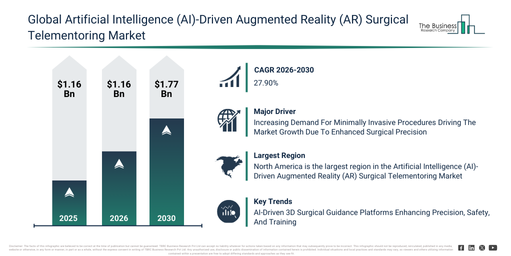
    The market for artificial intelligence (ai)-driven augmented reality (ar) surgical telementoring is projected to experience substantial growth in the foreseeable future. Its value is anticipated to climb to $5.88 billion by the year 2030, achieving a compound annual growth rate (CAGR) of 27.9%. The expansion over the forecast period is propelled by factors such as 5G network expansion, the embrace of AI-guided surgery, global surgical education initiatives, improved rural healthcare access, and the rising demand for complex surgeries. Significant trends anticipated for the forecast timeframe include remote surgical collaboration, real-time surgical visualization, improved access to specialists in remote areas, precision surgery guidance, and advancements in surgical training.

    Get A Free Sample Report With In-Depth Market Insights:

    https://thebusinessresearchcompany.com/sample_request?id=94389727&type=smp&name=Artificial%20Intelligence%20%28AI%29-Driven%20Augmented%20Reality%20%28AR%29%20Surgical%20Telementoring%20Market%20Report%202026&utm_source=Blogs&utm_medium=Paid&utm_campaign=Sep_PR

    Artificial Intelligence (AI)-Driven Augmented Reality (AR) Surgical Telementoring Market Demand Drivers: What’s Powering Industry Growth?

    The escalating need for less intrusive medical procedures is anticipated to fuel the expansion of the artificial intelligence (AI)-driven augmented reality (AR) surgical telementoring market moving forward. These minimally invasive techniques are surgical methods utilizing small incisions and specialized tools to lessen trauma, discomfort, and recovery duration compared to conventional open surgery. The increasing desire for such procedures is due to an aging population that increasingly requires surgical interventions while seeking quicker recovery and shorter hospital stays. Advanced minimally invasive surgical approaches necessitate complex guidance systems that leverage AI and AR technologies to deliver real-time visualization and remote expert mentorship during intricate operations, thereby enhancing surgical precision, reducing errors, and improving patient outcomes. For instance, in April 2025, the British Association of Aesthetic Plastic Surgeons, a UK-based surgical organization, stated that cosmetic surgical procedures saw a 5% increase between 2023 and 2024, totaling 27,462 procedures performed in 2024. Thus, the growing demand for minimally invasive procedures is stimulating the growth of the artificial intelligence (AI)-driven augmented reality (AR) surgical telementoring market.

    Artificial Intelligence (AI)-Driven Augmented Reality (AR) Surgical Telementoring Market Segment Performance And Emerging Opportunities

    The artificial intelligence (ai)-driven augmented reality (ar) surgical telementoring market covered in this report is segmented –

    1) By Component: Hardware, Software, Services

    2) By Deployment Mode: On-Premises, Cloud-Based

    3) By Application: General Surgery, Orthopedic Surgery, Neurosurgery, Cardiovascular Surgery, Other Applications

    4) By End-User: Hospitals, Ambulatory Surgical Centers, Specialty Clinics, Other End-Users

    Subsegments:

    1) By Hardware: Surgical Imaging Cameras, Depth Sensing Modules, Optical Tracking Systems, Electromagnetic Tracking Systems, Head Mounted Displays, Three Dimensional Monitors, Spatial Computing Sensors, Graphics Processing Unit Accelerators

    2) By Software: Real Time Computer Vision Algorithms, Three Dimensional Reconstruction Engines, Spatial Registration And Mapping, Annotation And Telestration Tools, Streaming And Telepresence Platform, Workflow Orchestration And Case Management

    3) By Services: Site Assessment And Readiness Planning, Installation And Commissioning, Clinical Workflow Design And Optimization, Staff Training And Credentialing Support, Remote Proctoring Program Setup

    Artificial Intelligence (AI)-Driven Augmented Reality (AR) Surgical Telementoring Market Innovation Trends: What Developments Are Reshaping The Industry?

    Leading companies operating within the artificial intelligence (AI)-driven augmented reality (AR) surgical telementoring market are prioritizing the development of advanced offerings, such as real-time 3D surgical guidance platforms, to enhance surgical precision, minimize radiation exposure, and improve training capabilities. These real-time 3D surgical guidance platforms leverage AI and AR technologies to present surgeons with dynamic, segmented views of patient anatomy during procedures, enabling them to make well-informed decisions and assess surgical success instantly. For instance, in April 2025, Proprio, a US-based AI-powered surgical technology firm, unveiled its Paradigm platform, featuring AI-guided visualization and data-driven insights. This platform integrates multimodal data, including CT, MRI, and operative plans, to provide real-time 3D anatomical mapping, much like Google Maps for surgery. Paradigm adapts to changes within the patient’s body, supplying surgeons with tools and insights to improve outcomes. Across the initial 50 surgeries conducted with Paradigm, surgical teams successfully placed hundreds of implants with positive results in a variety of challenging operations, from scoliosis to collapsed discs. On average, the use of Paradigm decreased the requirement for radiation-based imaging by 10 times, as both highly skilled surgeons and newer residents utilized the technology to navigate complex body structures safely and swiftly to accomplish their objectives.

    Artificial Intelligence (AI)-Driven Augmented Reality (AR) Surgical Telementoring Market Competitive Overview And Top Companies

    Major companies operating in the artificial intelligence (ai)-driven augmented reality (ar) surgical telementoring market are Microsoft Corporation, Johnson & Johnson, Medtronic plc, Siemens Healthineers AG, Stryker Corporation, Koninklijke Philips NV, Intuitive Surgical Inc, Olympus Corporation, Karl Storz SE & Co KG, Osso VR Inc, Augmedics Ltd, VirtaMed AG, Surgical Theater Inc, Medivis Inc, Vuzix Corporation, XACT Robotics Inc, FundamentalVR Ltd, SentiAR Inc, EchoPixel Inc, VSI HoloMedicine.

    View The Full Artificial Intelligence (AI)-Driven Augmented Reality (AR) Surgical Telementoring Market Report:

    https://thebusinessresearchcompany.com/report/artificial-intelligence-ai-driven-augmented-reality-ar-surgical-telementoring-global-market-report?utm_source=Blogs&utm_medium=Paid&utm_campaign=Sep_PR

    Artificial Intelligence (AI)-Driven Augmented Reality (AR) Surgical Telementoring Market Top Region: Where Does Most Revenue Come From?

    North America was the largest region in the artificial intelligence (AI)-driven augmented reality (AR) surgical telementoring market in 2025. The regions covered in the artificial intelligence (AI)-driven augmented reality (ar) surgical telementoring market report are Asia-Pacific, South East Asia, Western Europe, Eastern Europe, North America, South America, Middle East, Africa.

    Reach Out To Our Team:

    The Business Research Company: https://www.thebusinessresearchcompany.com/

    Americas: +1 310-496-7795

    Asia: +44 7882 955267 & +91 8897263534

    Europe: +44 7882 955267

    Email us at: marketing@tbrc.info

    Follow us on:

    LinkedIn: https://in.linkedin.com/company/the-business-research-company

    YouTube: https://www.youtube.com/channel/UC24_fI0rV8cR5DxlCpgmyFQ

    Global Market Model: https://www.thebusinessresearchcompany.com/global-market-model
  • Artificial Intelligence (AI)-Based Orthopedic Imaging Market Size In 2026: Regional Growth, Key Segments And Future Outlook

    Artificial Intelligence (AI)-Based Orthopedic Imaging Market Size In 2026: Regional Growth, Key Segments And Future Outlook

    Built to provide research that’s more actionable and strategically valuable, The Business Research Company’s 2026 market reports include market attractiveness analysis, total addressable market sizing, company benchmarking matrices, interactive Excel dashboards, broader supply chain intelligence, emerging startup tracking, and in-depth product insights.

    Artificial Intelligence (AI)-Based Orthopedic Imaging Market Revenue Growth On Track For A 34.1% CAGR Through 2030

    The artificial intelligence (AI)-based orthopedic imaging market has experienced substantial expansion in recent years. It will grow from $2.2 billion in 2025 to $2.95 billion in 2026 at a compound annual growth rate (CAGR) of 34.4%. The historical increase in this market can be attributed to factors such as the increasing prevalence of orthopedic disorders, a rising number of imaging centers, the adoption of digital radiography, early AI integration in imaging, and the development of hospital IT infrastructure.

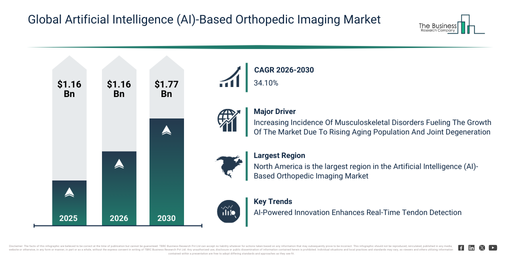
    The artificial intelligence (ai)-based orthopedic imaging market size is expected to experience substantial growth in the next few years. It is projected to expand to $9.56 billion by 2030, achieving a compound annual growth rate (CAGR) of 34.1%. This projected growth can be attributed to several factors, including the increasing demand for personalized orthopedic care, its integration with predictive analytics, the expansion of cloud-based imaging solutions, the growing adoption of AI-driven diagnostics, and the rise in minimally invasive orthopedic procedures. Major trends expected during this period involve AI-assisted fracture detection, advanced predictive orthopedic analytics, cloud-based imaging platforms, integration with hospital PACS systems, and automated bone density analysis.

    Get A Free Sample Report With In-Depth Market Insights:

    https://thebusinessresearchcompany.com/sample_request?id=13264017&type=smp&name=Artificial%20Intelligence%20%28AI%29-Based%20Orthopedic%20Imaging%20Market%20Report%202026&utm_source=Blogs&utm_medium=Paid&utm_campaign=Sep_PR

    Artificial Intelligence (AI)-Based Orthopedic Imaging Market Growth Drivers: What’s Behind The Acceleration?

    The rising occurrence of musculoskeletal disorders is anticipated to stimulate the expansion of the artificial intelligence (AI)-based orthopedic imaging market in the future. Musculoskeletal disorders are conditions that impact muscles, bones, joints, tendons, and ligaments, causing pain or impairing movement. The increase in these disorders stems from an aging population, as individuals naturally experience joint degeneration and a reduction in bone density over time. Artificial intelligence (AI)-based orthopedic imaging assists in the diagnosis of musculoskeletal disorders by offering precise image analysis, allowing for the early detection of abnormalities. It also diminishes diagnostic inaccuracies through automated interpretation, thereby improving clinical efficiency and supporting personalized treatment strategies. For instance, in January 2024, data from the Office for Health Improvement and Disparities, a UK-based government department, indicated that the prevalence of self-reported long-term musculoskeletal (MSK) conditions among people aged 16 and over was 18.4% in 2023, an increase from 17.6% in 2022. Therefore, the escalating incidence of musculoskeletal disorders is a primary driver for the growth of the artificial intelligence (AI)-based orthopedic imaging market.

    Artificial Intelligence (AI)-Based Orthopedic Imaging Market Segment Landscape And Growth Outlook

    The artificial intelligence (ai)-based orthopedic imaging market covered in this report is segmented –

    1) By Component: Software, Hardware, Services

    2) By Modality: X-Ray, Computed Tomography (CT), Magnetic Resonance Imaging (MRI), Other Modalities

    3) By Deployment Mode: On-Premises, Cloud-Based

    4) By Application: Fracture Detection, Bone Age Assessment, Joint Disease Diagnosis, Bone Tumor Detection, Other Applications

    Subsegments:

    1) By Software: Image Analysis And Processing Software, Visualization And Detection Software, Workflow Management Software, Diagnostic And Predictive Analytics Software, Machine Learning And Deep Learning Algorithms

    2) By Hardware: Imaging Systems, AI-Integrated Imaging Devices, Graphics Processing Units (GPUs) Or Processing Units, Workstations And Servers, Data Storage Systems

    3) By Services: Installation And Integration Services, Training And Education Services, Consulting Services, Maintenance And Support Services, Cloud-Based Artificial Intelligence (AI) Services

    Artificial Intelligence (AI)-Based Orthopedic Imaging Market Trends: What’s Defining The Industry’s Next Phase?

    Leading companies in the artificial intelligence (AI)-based orthopedic imaging market are concentrating on developing sophisticated solutions, such as advanced AI models, to enhance diagnosis, streamline workflows, and support personalized care. Advanced AI models refer to intricate algorithms that analyze medical images to detect abnormalities, automate interpretation, and aid in personalized treatment. For instance, in February 2023, Clarius Mobile Health, a Canada-based medical imaging company, received US Food and Drug Administration (FDA) 510(k) clearance for its Clarius musculoskeletal (MSK) AI model. This model is designed to automatically identify and measure tendons in the foot, ankle, and knee using AI, and it will be compatible with the Clarius L7 HD3 and L15 HD3 handheld ultrasound scanners. This innovation aims to simplify musculoskeletal ultrasound by assisting clinicians in real-time tendon detection, labeling, and measurement, thereby improving workflow, standardizing measurements, and reducing interobserver variability. This AI-enhanced scanner makes high-definition imaging more accessible and user-friendly, enabling faster, more accurate patient care.

    Artificial Intelligence (AI)-Based Orthopedic Imaging Market Competitive Landscape: Which Companies Lead The Industry?

    Major companies operating in the artificial intelligence (ai)-based orthopedic imaging market are United Imaging Intelligence Co. Ltd., Carestream Health Inc., Brainlab AG, Materialise NV, Aidoc Medical Ltd., Qure.ai Technologies Private Limited, Clarius Mobile Health Corp., Quibim S.L., RSIP Vision Ltd., GLEAMER SAS, Nano-X Imaging Ltd., CurveBeam AI Inc., AZmed SAS, VUNO Inc., Radiobotics ApS, PeekMed – Peek Health S.A., ImageBiopsy Lab GmbH, Synapsica Healthcare Pvt. Ltd., Oxipit UAB, Milvue SAS, Raylytic Software GmbH

    View The Full Artificial Intelligence (AI)-Based Orthopedic Imaging Market Report:

    https://thebusinessresearchcompany.com/report/artificial-intelligence-ai-based-orthopedic-imaging-global-market-report?utm_source=Blogs&utm_medium=Paid&utm_campaign=Sep_PR

    Artificial Intelligence (AI)-Based Orthopedic Imaging Market Regional Breakdown: Where Is Demand Concentrated?

    North America was the largest region in the artificial intelligence (AI)-based orthopedic imaging market in 2025. Asia-Pacific is expected to be the fastest-growing region in the forecast period. The regions covered in the artificial intelligence (AI)-based orthopedic imaging market report are Asia-Pacific, South East Asia, Western Europe, Eastern Europe, North America, South America, Middle East, Africa.

    Reach Out To Our Team:

    The Business Research Company: https://www.thebusinessresearchcompany.com/

    Americas: +1 310-496-7795

    Asia: +44 7882 955267 & +91 8897263534

    Europe: +44 7882 955267

    Email us at: marketing@tbrc.info

    Follow us on:

    LinkedIn: https://in.linkedin.com/company/the-business-research-company

    YouTube: https://www.youtube.com/channel/UC24_fI0rV8cR5DxlCpgmyFQ

    Global Market Model: https://www.thebusinessresearchcompany.com/global-market-model
  • Artificial Intelligence (AI)-Based Caries Detection Market Growth Forecast Through 2030: Market Size And Trends In 2026

    Artificial Intelligence (AI)-Based Caries Detection Market Growth Forecast Through 2030: Market Size And Trends In 2026

    Backed by market attractiveness analysis, total addressable market sizing, company benchmarking matrices, interactive Excel dashboards, wider supply chain intelligence, emerging startup coverage, and detailed product-level insights, The Business Research Company’s 2026 market reports are designed to offer research that is more actionable and strategically valuable than ever.

    Artificial Intelligence (AI)-Based Caries Detection Market Value Growth And Long-Term Outlook

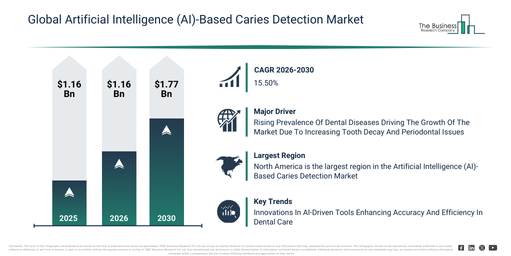
    The artificial intelligence (ai)-based caries detection market size has seen rapid expansion in recent years. It is forecast to grow from $0.62 billion in 2025 to $0.72 billion in 2026, exhibiting a compound annual growth rate (CAGR) of 15.8%. The historical growth of this market can be attributed to the increasing adoption of digital imaging in dentistry, a rising prevalence of dental caries, advancements in AI algorithms for image analysis, greater awareness of preventive dental care, and the availability of affordable dental imaging devices.

    The artificial intelligence (AI)-based caries detection market is anticipated to experience substantial growth in the upcoming years. It is projected to expand to $1.29 billion by 2030, achieving a compound annual growth rate (CAGR) of 15.5%. This expansion during the forecast period is fueled by the broadening of tele-dentistry services, the integration of AI with cloud-based dental platforms, the creation of portable intraoral imaging devices, increasing investment in AI-powered healthcare solutions, and a growing demand for personalized dental treatments. Prominent trends expected in this period include AI-driven diagnostic accuracy, the use of predictive analytics for early detection, remote dental monitoring capabilities, the integration of imaging and AI software, and advancements in personalized treatment planning.

    Get A Free Sample Report With In-Depth Market Insights:

    https://thebusinessresearchcompany.com/sample_request?id=95749486&type=smp&name=Artificial%20Intelligence%20%28AI%29-Based%20Caries%20Detection%20Market%20Report%202026&utm_source=Blogs&utm_medium=Paid&utm_campaign=Sep_PR

    Artificial Intelligence (AI)-Based Caries Detection Market Growth Factors Behind Sustained Expansion

    The expanding prevalence of dental ailments is projected to boost the artificial intelligence (AI)-based caries detection market in the future. These oral disorders affect teeth, gums, or nearby tissues, potentially leading to discomfort, infection, or impaired oral function. The surge in dental diseases stems from greater intake of sugary and processed foods, which foster tooth decay and gum issues by nourishing detrimental oral bacteria. AI-based caries detection aids in addressing dental diseases by precisely detecting tooth decay early, thus facilitating timely intervention and lessening the likelihood of serious complications. For instance, in September 2023, according to the National Institutes of Health (NIH), a US-based federal agency, approximately 62.06% of older adults are expected to experience tooth decay, while around 54.57% are likely to suffer from periodontal disease by 2050. Consequently, the rising burden of dental diseases is a key driver for the artificial intelligence (AI)-based caries detection market.

    Artificial Intelligence (AI)-Based Caries Detection Market Breakdown By Product Type And Application

    The artificial intelligence (ai)-based caries detection market covered in this report is segmented –

    1) By Product: Software, Hardware, Services

    2) By Deployment Mode: On-Premises, Cloud-Based

    3) By Application: Hospitals, Dental Clinics, Academic And Research Institutes, Other Applications

    4) By End User: General Dentists, Pediatric Dentists, Orthodontists, Other End Users

    Subsegments:

    1) By Software: Diagnostic Software, Imaging Analysis Software, Data Management Software, Predictive Analytics Software, Cloud-Based Software Solutions

    2) By Hardware: Intraoral Cameras, Digital X-Ray Machines, Optical Coherence Tomography (OCT) Devices, Near-Infrared (NIR) Imaging Devices, Laser Fluorescence Devices

    3) By Services: Remote Diagnostic Services, Software As A Service (SaaS), Maintenance And Support Services, Training And Consultation Services, Data Storage And Management Services

    Artificial Intelligence (AI)-Based Caries Detection Market Industry Trends Fueling Future Revenue Growth

    Leading firms within the artificial intelligence (AI)-based caries detection market are concentrating on creating novel solutions, including sophisticated clinical enhancers, designed to optimize clinical processes, conserve time, and minimize the potential for human error. These advanced clinical enhancers represent inventive instruments or technologies that improve the accuracy, efficiency, and overall results of medical treatment. An example of this is the introduction of the Caries 3.0 model by VideaHealth, a US-based dental technology company, in January 2025. The Caries 3.0 model incorporates an advanced clinical enhancer, which boosts precision by filtering out potential false positives, considering factors such as caries size, tooth location, and other vital clinical elements. Furthermore, it boasts extensive patient applicability, being the sole FDA-cleared AI model capable of detecting caries in patients aged 3 and older through bitewing and periapical X-rays. This model also facilitates improved patient communication via enhanced visualizations, simplifying the explanation of conditions and fostering greater acceptance of treatment. Such innovations empower dental practices to deliver accurate, evidence-backed care while maintaining technological leadership.

    Artificial Intelligence (AI)-Based Caries Detection Market Competitive Landscape: Who Leads The Industry?

    Major companies operating in the artificial intelligence (ai)-based caries detection market are Dentsply Sirona, Straumann AG, Envista, Planmeca Oy, 3Shape Inc., Dexis Corp., Acteon Group, Carestream Dental LLC, Vatech Co. Ltd., RapidAI, Pearl Inc., Overjet, Videa Health, Dentomo, CranioCatch, Denti.AI Technology Inc., Diagnocat Inc., Genoray Co. Ltd., Manchester Imaging Ltd., Owandy Radiology, Tab32

    View The Full Artificial Intelligence (AI)-Based Caries Detection Market Report:

    https://thebusinessresearchcompany.com/report/artificial-intelligence-ai-based-caries-detection-global-market-report?utm_source=Blogs&utm_medium=Paid&utm_campaign=Sep_PR

    Artificial Intelligence (AI)-Based Caries Detection Market Geographic Landscape: Which Region Dominates Industry Growth?

    North America was the largest region in the artificial intelligence (AI)-based caries detection market in 2025. Asia-Pacific is expected to be the fastest-growing region in the forecast period. The regions covered in the artificial intelligence (AI)-based caries detection market report are Asia-Pacific, South East Asia, Western Europe, Eastern Europe, North America, South America, Middle East, Africa.

    Reach Out To Our Team:

    The Business Research Company: https://www.thebusinessresearchcompany.com/

    Americas: +1 310-496-7795

    Asia: +44 7882 955267 & +91 8897263534

    Europe: +44 7882 955267

    Email us at: marketing@tbrc.info

    Follow us on:

    LinkedIn: https://in.linkedin.com/company/the-business-research-company

    YouTube: https://www.youtube.com/channel/UC24_fI0rV8cR5DxlCpgmyFQ

    Global Market Model: https://www.thebusinessresearchcompany.com/global-market-model
  • Artificial Intelligence (AI) Powered Remote Electrocardiogram (ECG) Monitoring Market Analysis: $1.94 Billion Market Size In 2026 And Future Growth Prospects

    Artificial Intelligence (AI) Powered Remote Electrocardiogram (ECG) Monitoring Market Analysis: $1.94 Billion Market Size In 2026 And Future Growth Prospects

    Featuring market attractiveness scoring, total addressable market sizing, company benchmarking matrices, interactive Excel dashboards, deeper supply chain intelligence, emerging startup tracking, and granular product-level insights, The Business Research Company’s 2026 market reports are built to deliver research that is both more actionable and more strategically valuable.

    Artificial Intelligence (AI) Powered Remote Electrocardiogram (ECG) Monitoring Market Poised To Hit $4.01 Billion By 2030 With A 19.9% CAGR

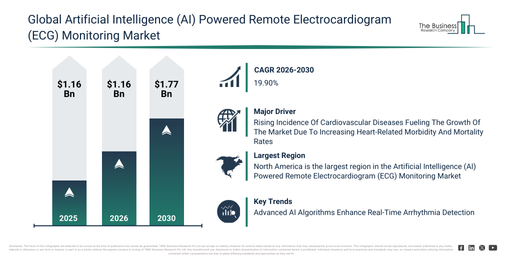
    The artificial intelligence (ai) powered remote electrocardiogram (ecg) monitoring market size has experienced significant expansion in recent years. This market is projected to grow from $1.61 billion in 2025 to $1.94 billion in 2026, achieving a compound annual growth rate (CAGR) of 20.2%. The historical growth can be linked to an increasing prevalence of cardiovascular diseases, the adoption of wearable ecg devices, a demand for continuous heart monitoring, the integration of AI in cardiac diagnostics, and the expansion of telehealth platforms.

    The artificial intelligence (ai) powered remote electrocardiogram (ecg) monitoring market is projected to experience swift expansion over the coming years. It is set to reach $4.01 billion in 2030 at a compound annual growth rate (CAGR) of 19.9%. This anticipated growth is driven by several factors, including the creation of cloud-based ECG monitoring platforms, the incorporation of predictive analytics for arrhythmia detection, the broadening of remote patient monitoring offerings, increased investment in portable and wearable ECG devices, and their rising utilization in both homecare and ambulatory environments. Key trends anticipated during this period encompass remote cardiac monitoring, AI-driven arrhythmia detection, advanced predictive cardiovascular analytics, cloud-integrated ECG platforms, and the provision of real-time heart health insights.

    Get A Free Sample Report With In-Depth Market Insights:

    https://thebusinessresearchcompany.com/sample_request?id=47336580&type=smp&name=Artificial%20Intelligence%20%28AI%29%20Powered%20Remote%20Electrocardiogram%20%28ECG%29%20Monitoring%20Market%20Report%202026&utm_source=Blogs&utm_medium=Paid&utm_campaign=Sep_PR

    Artificial Intelligence (AI) Powered Remote Electrocardiogram (ECG) Monitoring Market Demand Drivers Opening New Revenue Streams

    An increasing occurrence of cardiovascular diseases is projected to drive the expansion of the artificial intelligence (AI) powered remote electrocardiogram (ECG) monitoring market in the future. These conditions encompass a range of ailments impacting the heart and blood vessels, such as coronary artery disease, heart failure, and stroke. The increase in cardiovascular diseases stems from poor dietary choices, where overindulgence in processed foods and fats results in elevated cholesterol, thereby heightening cardiac risks. The artificial intelligence (AI) powered remote electrocardiogram (ECG) monitoring system assists in managing cardiovascular diseases through continuous, real-time analysis of heart rhythms. This technology facilitates earlier detection of irregularities, allows for prompt medical interventions, and improves patient surveillance from distant sites, contributing to improved long-term cardiac health results. For example, data from October 2024, provided by the Centers for Disease Control, a US-based government agency, indicated that in 2023, around 919,032 people succumbed to cardiovascular disease, representing 1 in every 3 deaths. Consequently, the escalating prevalence of cardiovascular diseases is fueling the expansion of the artificial intelligence (AI) powered remote electrocardiogram (ECG) monitoring market.

    Artificial Intelligence (AI) Powered Remote Electrocardiogram (ECG) Monitoring Market Segment Analysis And Revenue Potential

    The artificial intelligence (ai) powered remote electrocardiogram (ecg) monitoring market covered in this report is segmented –

    1) By Component: Hardware, Software, Services

    2) By Deployment Mode: Cloud-Based, On-Premises

    3) By End-User: Hospitals And Clinics, Ambulatory Surgical Centers, Homecare Settings, Research Institutes, Other End User

    Subsegments:

    1) By Hardware: Wearable Devices, Electrocardiogram Machines, Sensors And Electrodes, Mobile Devices

    2) By Software: Data Analytics Platforms, Artificial Intelligence Algorithms, Cloud-Based Monitoring Solutions, Mobile Applications

    3) By Services: Remote Patient Monitoring, Technical Support And Maintenance, Training And Consultation, Data Management Services

    Artificial Intelligence (AI) Powered Remote Electrocardiogram (ECG) Monitoring Market Trends Powering Strategic Industry Growth

    Leading enterprises within the artificial intelligence (AI)-powered remote electrocardiogram (ECG) monitoring market are concentrating on creating sophisticated offerings, particularly AI-driven arrhythmia detection tools. This strategic direction aims to elevate diagnostic precision, improve patient health results, and decrease medical expenditures. These AI-driven arrhythmia detection tools represent systems leveraging artificial intelligence for the automated analysis of ECG data, facilitating the identification of irregular heart rhythms. Such capabilities allow for prompt diagnosis, instantaneous notifications, and enhanced heart health management. As an illustration, BIOTRONIK, a medical technology firm based in Germany, introduced the BIOMONITOR IV insertable cardiac monitor in April 2024. This device incorporates artificial intelligence capabilities, specifically engineered to enhance the detection of arrhythmias and optimize patient care. The BIOMONITOR IV features sophisticated AI algorithms that conduct real-time analysis of cardiac signals, precisely identifying clinically significant arrhythmias while simultaneously reducing occurrences of false positives. Furthermore, the BioMonitor IV ICM integrates automated rhythm classification and adaptive monitoring functions, which permit anticipatory medical interventions and customized treatment strategies, thereby eliminating the necessity for clinicians to manually review data.

    Artificial Intelligence (AI) Powered Remote Electrocardiogram (ECG) Monitoring Market Company Landscape And Competitive Strategy

    Major companies operating in the artificial intelligence (ai) powered remote electrocardiogram (ecg) monitoring market are Koninklijke Philips N.V., GE Healthcare, Masimo Corporation, Biotronik SE & Co. KG, Nihon Kohden Corporation, iRhythm Technologies Inc., Biofourmis Pte. Ltd., BioSerenity Inc., Withings SA, Eko Devices Inc., AliveCor Inc., Compumedics Limited, Anumana Inc., Electrical Geodesics Inc. (EGI), InfoBionic Inc., Neurable Inc., Cardiomatics Sp. z o.o., IDOVEN S.L., Zeto Inc., NextGen Neuro Inc.

    View The Full Artificial Intelligence (AI) Powered Remote Electrocardiogram (ECG) Monitoring Market Report:

    https://thebusinessresearchcompany.com/report/artificial-intelligence-ai-powered-remote-electrocardiogram-ecg-monitoring-global-market-report?utm_source=Blogs&utm_medium=Paid&utm_campaign=Sep_PR

    Artificial Intelligence (AI) Powered Remote Electrocardiogram (ECG) Monitoring Market Largest Region: Which Geography Holds The Highest Market Share?

    North America was the largest region in the artificial intelligence (AI) powered remote electrocardiogram (ECG) monitoring market in 2025. Asia-Pacific is expected to be the fastest-growing region in the forecast period. The regions covered in the artificial intelligence (AI) powered remote electrocardiogram (ecg) monitoring market report are Asia-Pacific, South East Asia, Western Europe, Eastern Europe, North America, South America, Middle East, Africa.

    Reach Out To Our Team:

    The Business Research Company: https://www.thebusinessresearchcompany.com/

    Americas: +1 310-496-7795

    Asia: +44 7882 955267 & +91 8897263534

    Europe: +44 7882 955267

    Email us at: marketing@tbrc.info

    Follow us on:

    LinkedIn: https://in.linkedin.com/company/the-business-research-company

    YouTube: https://www.youtube.com/channel/UC24_fI0rV8cR5DxlCpgmyFQ

    Global Market Model: https://www.thebusinessresearchcompany.com/global-market-model
  • Artificial Intelligence (AI) Otoscopic Image Triaging Platform Market 2026 Market Size And Growth Forecast: Key Trends To Watch

    Artificial Intelligence (AI) Otoscopic Image Triaging Platform Market 2026 Market Size And Growth Forecast: Key Trends To Watch

    Built to provide research that’s more actionable and strategically valuable, The Business Research Company’s 2026 market reports include market attractiveness analysis, total addressable market sizing, company benchmarking matrices, interactive Excel dashboards, broader supply chain intelligence, emerging startup tracking, and in-depth product insights.

    Artificial Intelligence (AI) Otoscopic Image Triaging Platform Market Size And Revenue Outlook Through 2030

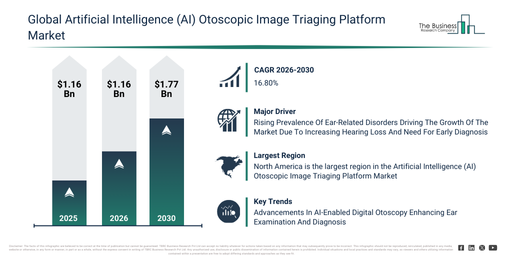
    The artificial intelligence (ai) otoscopic image triaging platform market has experienced significant growth in recent years. This market is expected to expand from $0.64 billion in 2025 to $0.75 billion in 2026, achieving a compound annual growth rate (CAGR) of 17.1%. Historically, this expansion has been propelled by the increased adoption of digital otoscopes, the surge in telemedicine services, the growing prevalence of ear infections, the demand for efficient ENT diagnostics, and advancements in imaging sensors.

    The artificial intelligence (AI) otoscopic image triaging platform market is projected to experience substantial expansion in the coming years. This market is expected to achieve a value of $1.4 billion by 2030, progressing at a compound annual growth rate (CAGR) of 16.8%. The growth anticipated during this period is driven by the integration of AI with portable otoscopes, the expansion of cloud-based triaging platforms, the development of predictive diagnostic algorithms, investments in remote ENT monitoring solutions, and the increasing adoption within primary care and telehealth. Noteworthy trends for the forecast duration encompass automated ear image classification, AI-powered workflow optimization, remote otoscopy solutions, cloud-based image analysis, and prioritized case triage.

    Get A Free Sample Report With In-Depth Market Insights:

    https://thebusinessresearchcompany.com/sample_request?id=26370668&type=smp&name=Artificial%20Intelligence%20%28AI%29%20Otoscopic%20Image%20Triaging%20Platform%20Market%20Report%202026&utm_source=Blogs&utm_medium=Paid&utm_campaign=Sep_PR

    Artificial Intelligence (AI) Otoscopic Image Triaging Platform Market Growth Backed By Core Demand Fundamentals

    The increasing prevalence of ear-related disorders is anticipated to propel the expansion of the artificial intelligence (AI) otoscopic image triaging platform market in the future. These disorders represent conditions that disrupt the ear’s normal functioning, impacting hearing, balance, or overall ear health. A surge in exposure to loud noise is fueling the rise of ear-related disorders, as extended or repeated exposure to intense sounds can damage the delicate structures within the inner ear, leading to hearing loss and issues with balance. Artificial intelligence (AI) otoscopic image triaging platforms assist in managing ear-related disorders by swiftly and accurately analyzing ear images to pinpoint abnormalities, thereby enabling early diagnosis, timely prioritization of urgent cases, and more effective treatment planning. For instance, in February 2025, the World Health Organization (WHO), a Switzerland-based intergovernmental organization, estimated that around 2.5 billion people will experience some level of hearing loss by 2050, with over 700 million individuals needing hearing rehabilitation. Consequently, the escalating burden of ear-related disorders is driving the growth of the artificial intelligence (AI) otoscopic image triaging platform market.

    Artificial Intelligence (AI) Otoscopic Image Triaging Platform Market Segmentation And Category Overview

    The artificial intelligence (ai) otoscopic image triaging platform market covered in this report is segmented –

    1) By Component: Software, Hardware, Services

    2) By Deployment Mode: Cloud-Based, On-Premises

    3) By Application: Telemedicine, Primary Care, ENT Clinics, Hospitals, Research And Academic Institutes, Other Applications

    Subsegments:

    1) By Software: AI Algorithms, Image Analysis Tools, Diagnostic Support Systems, Workflow Management Solutions, Cloud-Based Platforms

    2) By Hardware: Digital Otoscopes, Imaging Sensors And Detectors, Workstations And Displays, AI-Enhanced Imaging Devices

    3) By Services: Implementation And Integration Services, Training And Maintenance Services, Consulting Services, Data Management Services, Technical Support Services

    Artificial Intelligence (AI) Otoscopic Image Triaging Platform Market Growth Trends Reshaping The Competitive Landscape

    Major companies operating in the artificial intelligence (AI) otoscopic image triaging platform market are concentrating on creating sophisticated solutions, such as digital otoscopes, to facilitate easier documentation and remote medical advice. Digital otoscopes function as electronic instruments that deliver sharp images or video footage of the ear canal and eardrum, aiding in precise examination and diagnosis. For instance, in February 2025, JEDMED, a US-based medical instrument firm, in collaboration with Otologic Tech, another US-based entity specializing in AI-driven digital otoscopy, introduced an AI-enabled digital otoscope. This device integrates effortlessly with Otologic Technologies’ platform to provide medical professionals with automated diagnostic assistance. It offers real-time analysis for conditions of the middle ear, thereby improving clinical decision-making. By transforming captured video into a single, high-quality still image, it streamlines the examination and review process. Furthermore, it provides a probabilistic assessment indicating whether an ear is healthy or afflicted, enabling quicker and more informed treatment choices.

    Artificial Intelligence (AI) Otoscopic Image Triaging Platform Market Key Players Shaping Industry Direction

    Major companies operating in the artificial intelligence (ai) otoscopic image triaging platform market are TytoCare Ltd, Digital Diagnostics Inc, Tympa Health Technologies, hearX, Otologic Technologies, OtoNexus Medical Technologies Inc, Siemens Healthineers AG, Philips Healthcare, Folio3 Software Inc, Aidoc Medical Ltd, Ajackus, DeepTek, CARPL AI, Zebra Medical Vision, Enlitic, VUNO Inc, CellScope, PhotoniCare, Otovation, Cupris Health, Aural Analytics, Earscan, Otoharmonics, ResApp Health

    View The Full Artificial Intelligence (AI) Otoscopic Image Triaging Platform Market Report:

    https://thebusinessresearchcompany.com/report/artificial-intelligence-ai-otoscopic-image-triaging-platform-global-market-report?utm_source=Blogs&utm_medium=Paid&utm_campaign=Sep_PR

    Artificial Intelligence (AI) Otoscopic Image Triaging Platform Market Regional Analysis: Which Region Leads By Revenue?

    North America was the largest region in the artificial intelligence (AI) otoscopic image triaging platform market in 2025. Asia-Pacific is expected to be the fastest-growing region in the forecast period. The regions covered in the artificial intelligence (AI) otoscopic image triaging platform market report are Asia-Pacific, South East Asia, Western Europe, Eastern Europe, North America, South America, Middle East, Africa.

    Reach Out To Our Team:

    The Business Research Company: https://www.thebusinessresearchcompany.com/

    Americas: +1 310-496-7795

    Asia: +44 7882 955267 & +91 8897263534

    Europe: +44 7882 955267

    Email us at: marketing@tbrc.info

    Follow us on:

    LinkedIn: https://in.linkedin.com/company/the-business-research-company

    YouTube: https://www.youtube.com/channel/UC24_fI0rV8cR5DxlCpgmyFQ

    Global Market Model: https://www.thebusinessresearchcompany.com/global-market-model
  • Artificial Intelligence (AI) Optical Coherence Tomography (OCT) Market Size Forecast: How The Industry Is Expected To Grow From 2026 To 2030

    Artificial Intelligence (AI) Optical Coherence Tomography (OCT) Market Size Forecast: How The Industry Is Expected To Grow From 2026 To 2030

    Backed by market attractiveness analysis, total addressable market sizing, company benchmarking matrices, interactive Excel dashboards, wider supply chain intelligence, emerging startup coverage, and detailed product-level insights, The Business Research Company’s 2026 market reports are designed to offer research that is more actionable and strategically valuable than ever.

    Artificial Intelligence (AI) Optical Coherence Tomography (OCT) Market Growth From $2.32 Billion In 2026 To $3.63 Billion By 2030 At A CAGR Of 11.9%

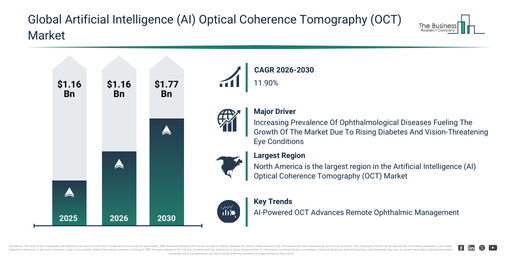
    The artificial intelligence (AI) optical coherence tomography (OCT) market has witnessed substantial growth in recent years. This market is projected to expand from $2.06 billion in 2025 to $2.32 billion in 2026, exhibiting a compound annual growth rate (CAGR) of 12.2%. Historically, this expansion has been propelled by factors including the increasing adoption of OCT in ophthalmology, the escalating demand for early disease detection, continuous advancements in retinal imaging devices, the rising prevalence of eye disorders, and the integration of digital imaging technologies.

    The artificial intelligence (ai) optical coherence tomography (oct) market size is anticipated to experience swift expansion over the next few years. It will grow to $3.63 billion in 2030 at a compound annual growth rate (CAGR) of 11.9%. This projected growth during the forecast period is driven by the integration of AI with portable OCT devices, the proliferation of cloud-based ophthalmic platforms, the development of real-time diagnostic algorithms, increasing investments in tele-ophthalmology, and the escalating demand for personalized eye care solutions. Significant trends expected in this period include AI-assisted retinal imaging, automated disease detection, predictive ophthalmic analysis, cloud-based OCT platforms, and high-resolution image interpretation.

    Get A Free Sample Report With In-Depth Market Insights:

    https://thebusinessresearchcompany.com/sample_request?id=66523774&type=smp&name=Artificial%20Intelligence%20%28AI%29%20Optical%20Coherence%20Tomography%20%28OCT%29%20Market%20Report%202026&utm_source=Blogs&utm_medium=Paid&utm_campaign=Sep_PR

    Artificial Intelligence (AI) Optical Coherence Tomography (OCT) Market Growth Catalysts And Demand Drivers

    The artificial intelligence (AI) optical coherence tomography (OCT) market is anticipated to grow as a result of the rising prevalence of ophthalmological diseases. These diseases encompass various disorders and conditions that impact the eyes and visual system, potentially affecting vision, ocular structure, or overall eye health. The increase in ophthalmological diseases is attributed to the growing incidence of diabetes, which causes damage to retinal blood vessels and results in conditions that threaten vision. Artificial intelligence (AI) optical coherence tomography (OCT) assists in diagnosing ophthalmological diseases by providing high-resolution retinal imaging, making it exceptionally suitable for the early identification and continuous observation of eye conditions. This technology also reduces diagnostic time by performing automated analysis of retinal scans, thereby enhancing clinical efficiency and patient care. For instance, in May 2024, the Centers for Disease Control and Prevention (CDC), a US-based public health agency, indicated that over 3 million individuals were affected by glaucoma, with projections suggesting this number could reach 6.3 million by 2050. Consequently, the increasing occurrence of ophthalmological diseases is a key factor propelling the expansion of the artificial intelligence (AI) optical coherence tomography (OCT) market.

    Artificial Intelligence (AI) Optical Coherence Tomography (OCT) Market Segment Outlook: Which Categories Are Growing Fastest?

    The artificial intelligence (ai) optical coherence tomography (oct) market covered in this report is segmented –

    1) By Type: Table Type, Portable

    2) By Technology: Time Domain Optical Coherence Tomography, Spectral Domain Optical Coherence Tomography, Swept Source Optical Coherence Tomography

    3) By Application: Hospitals, Clinic, Other Applications

    Subsegments:

    1) By Table Type: Spectral-Domain Optical Coherence Tomography (SD-OCT), Time-Domain Optical Coherence Tomography (TD-OCT), Swept-Source Optical Coherence Tomography (SS-OCT), Full-Field Optical Coherence Tomography, Doppler Optical Coherence Tomography

    2) By Portable: Handheld Optical Coherence Tomography, Smartphone Or Tablet-Based Optical Coherence Tomography, Point-Of-Care Optical Coherence Tomography Devices, Compact Or Bedside Optical Coherence Tomography Units, Wearable Optical Coherence Tomography

    Artificial Intelligence (AI) Optical Coherence Tomography (OCT) Market Trends Shaping Long-Term Demand

    Leading companies within the artificial intelligence (AI) optical coherence tomography (OCT) market are concentrating on creating advanced offerings, such as at-home optical coherence tomography (OCT) devices, to improve diagnostic precision, facilitate remote oversight, and streamline ophthalmic operations. At-home optical coherence tomography (OCT) devices are portable instruments that enable patients to perform retinal scans from their homes, allowing for the remote tracking of eye conditions. An illustration of this trend is seen in May 2024, when Notal Vision Inc., a US-based healthcare firm, secured de novo authorization from the US Food and Drug Administration (FDA) for its artificial intelligence (AI)-powered SCANLY Home OCT device. This marks the first self-operated retinal imaging device designed for monitoring wet age-related macular degeneration (AMD) in older adults. It utilizes spectral-domain optical coherence tomography (OCT) and the AI-driven Notal OCT analyzer (NOA) to detect and quantify retinal biomarkers, providing high-resolution remote monitoring capabilities between clinic visits. Images from this device are transmitted securely to the Notal Health cloud for assessment by physicians, and SCANLY is supported by current procedural terminology (CPT) billing codes.

    Artificial Intelligence (AI) Optical Coherence Tomography (OCT) Market Competitive Analysis Of Leading Industry Participants

    Major companies operating in the artificial intelligence (ai) optical coherence tomography (oct) market are Abbott Laboratories, Canon Inc., Carl Zeiss AG, Excelitas Technologies Corp., Topcon Corporation, Thorlabs Inc., Santec Holdings Corporation, Notal Vision Inc., Optopol Technology Sp. z o.o., BigVision Tech Inc., Shenzhen Certainn Technology Co. Ltd., Conavi Medical Inc., Wasatch Photonics Inc., RSIP Vision Ltd., Visionix Ltd., Altris AI Ltd., NIDEK Co. Ltd., Perimeter Medical Imaging AI Inc., Michelson Diagnostics Ltd., Artelus Private Limited

    View The Full Artificial Intelligence (AI) Optical Coherence Tomography (OCT) Market Report:

    https://thebusinessresearchcompany.com/report/artificial-intelligence-ai-optical-coherence-tomography-oct-global-market-report?utm_source=Blogs&utm_medium=Paid&utm_campaign=Sep_PR

    Artificial Intelligence (AI) Optical Coherence Tomography (OCT) Market Geographic Distribution And Regional Opportunities

    North America was the largest region in the artificial intelligence (AI) optical coherence tomography (OCT) market in 2025. Asia-Pacific is expected to be the fastest-growing region in the forecast period. The regions covered in the artificial intelligence (AI) optical coherence tomography (oct) market report are Asia-Pacific, South East Asia, Western Europe, Eastern Europe, North America, South America, Middle East, Africa.

    Reach Out To Our Team:

    The Business Research Company: https://www.thebusinessresearchcompany.com/

    Americas: +1 310-496-7795

    Asia: +44 7882 955267 & +91 8897263534

    Europe: +44 7882 955267

    Email us at: marketing@tbrc.info

    Follow us on:

    LinkedIn: https://in.linkedin.com/company/the-business-research-company

    YouTube: https://www.youtube.com/channel/UC24_fI0rV8cR5DxlCpgmyFQ

    Global Market Model: https://www.thebusinessresearchcompany.com/global-market-model
  • Artificial Intelligence (AI) In In Vitro Diagnostics (IVD) Market Reaches $7.01 Billion In 2026: Forecast And Growth Opportunities

    Artificial Intelligence (AI) In In Vitro Diagnostics (IVD) Market Reaches $7.01 Billion In 2026: Forecast And Growth Opportunities

    Featuring market attractiveness scoring, total addressable market sizing, company benchmarking matrices, interactive Excel dashboards, deeper supply chain intelligence, emerging startup tracking, and granular product-level insights, The Business Research Company’s 2026 market reports are built to deliver research that is both more actionable and more strategically valuable.

    Artificial Intelligence (AI) In In Vitro Diagnostics (IVD) Market Expansion Outlook: What Revenue Opportunities Are Ahead?

    The artificial intelligence (AI) in in vitro diagnostics (IVD) market has experienced rapid expansion over recent years. It is projected to expand from $3.04 billion in 2025 to $3.6 billion in 2026, achieving a compound annual growth rate (CAGR) of 18.4%. This historical growth can be linked to several factors, including an increased need for precise diagnostics, the expansion of laboratory infrastructure, a higher incidence of chronic diseases, the integration of digital diagnostic tools, and progress in biomarker research.

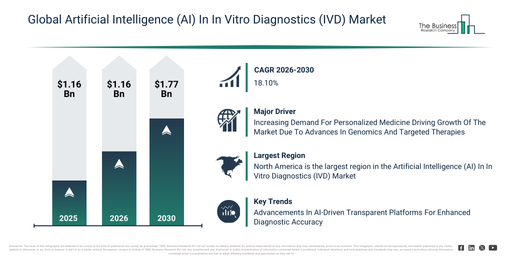
    The artificial intelligence (AI) in in vitro diagnostics (IVD) market is anticipated to undergo significant expansion in the coming years. It is projected to increase to $7.01 billion in 2030, demonstrating a compound annual growth rate (CAGR) of 18.1%. This projected growth is driven by factors such as the expansion of cloud-based diagnostic platforms, the integration of AI with genomics, the development of point-of-care AI diagnostics, increasing investments in personalized medicine, and a heightened demand for rapid and cost-effective testing. Significant trends expected during this forecast period include AI-enabled laboratory automation, predictive disease diagnostics, data-driven test interpretation, cloud-based diagnostic platforms, and personalized patient profiling.

    Get A Free Sample Report With In-Depth Market Insights:

    https://thebusinessresearchcompany.com/sample_request?id=15542871&type=smp&name=Artificial%20Intelligence%20%28AI%29%20In%20In%20Vitro%20Diagnostics%20%28IVD%29%20Market%20Report%202026&utm_source=Blogs&utm_medium=Paid&utm_campaign=Sep_PR

    Artificial Intelligence (AI) In In Vitro Diagnostics (IVD) Market Opportunity Drivers: What’s Unlocking New Revenue Potential?

    The surging demand for personalized medicine is poised to fuel the expansion of the artificial intelligence (AI) in in vitro diagnostics (IVD) market moving forward. Personalized medicine is a healthcare framework that customizes prevention, diagnosis, and treatment based on an individual’s genetic profile, lifestyle, and environment. The prevalence of personalized medicine is growing as progress in genomic data and sequencing technologies allows for more accurate, targeted, and effective treatments tailored to individual patients. Artificial intelligence (AI) in in vitro diagnostics (IVD) supports personalized medicine by analyzing complex diagnostic data to pinpoint patient-specific disease patterns, facilitating precise, timely, and customized treatment decisions. For instance, in February 2024, according to the Personalized Medicine Coalition, a US-based non-profit organization, in 2023, the FDA approved 16 new personalized treatments for rare disease patients, an increase from six in 2022. The newly approved personalized treatments for 2023 also included seven cancer drugs and three for other diseases and conditions. Therefore, the escalating demand for personalized medicine is stimulating the growth of the artificial intelligence (AI) in in vitro diagnostics (IVD) market.

    Artificial Intelligence (AI) In In Vitro Diagnostics (IVD) Market Segment Landscape: Which Areas Lead Development?

    The artificial intelligence (ai) in in vitro diagnostics (ivd) market covered in this report is segmented –

    1) By Component: Software, Hardware, Services

    2) By Technology: Machine Learning, Natural Language Processing, Computer Vision, Robotics Process Automation, Deep Learning

    3) By Deployment Model: Cloud-Based, On-Premise, Hybrid

    4) By Application: Diagnostic Imaging, Laboratory Testing, Pathology, Genomics, Personalized Medicine

    5) By End User: Hospitals And Clinics, Diagnostic Laboratories, Research Institutes, Pharmaceutical Companies, Medical Device Manufacturers

    Subsegments:

    1) By Software: Diagnostic Algorithms, Data Analytics Platforms, Decision Support Systems

    2) By Hardware: Laboratory Instruments, Imaging Devices, Point-Of-Care Devices

    3) By Services: Consulting And Implementation, Maintenance And Support, Training And Education

    Artificial Intelligence (AI) In In Vitro Diagnostics (IVD) Market Innovation Trends Shaping Future Development

    Leading companies in the artificial intelligence (AI) in in vitro diagnostics (IVD) market are concentrating on developing advanced solutions, such as CE-IVDR-certified transparent AI platforms, to improve diagnostic accuracy, streamline workflows, and support personalized patient care. A CE-IVDR-certified transparent AI platform refers to an AI system for in vitro diagnostics that complies with EU regulatory standards and offers clear, auditable, and understandable decision-making. For example, in May 2025, Diagnostics.ai, a UK-based diagnostic testing company, introduced PCR.AI, an intelligent solution designed to accelerate and enhance PCR diagnostics. This system automates and speeds up the interpretation of real-time PCR diagnostics with over 99.9% accuracy. It provides transparency by clearly demonstrating how each result is obtained, thereby ensuring regulatory compliance and strengthening clinical trust. This significantly boosts laboratory efficiency, minimizes errors, and facilitates smooth regulatory adherence for molecular diagnostics.

    Artificial Intelligence (AI) In In Vitro Diagnostics (IVD) Market Leading Companies And Competitive Benchmarking

    Major companies operating in the artificial intelligence (ai) in in vitro diagnostics (ivd) market are Roche Diagnostics GmbH, Thermo Fisher Scientific Inc., Abbott Laboratories, Danaher Corporation, Siemens Healthineers AG, Illumina Inc., Hologic Inc., Sysmex Corporation, QIAGEN N.V., Tempus Labs Inc., BillionToOne Inc., PathAI Inc., Proscia Inc., Indica Labs Inc., Visiopharm A/S, aetherAI Co. Ltd., Ibex Medical Analytics Ltd., Mindpeak GmbH, OncoHost Ltd., Qritive, Aiforia Technologies Oyj

    View The Full Artificial Intelligence (AI) In In Vitro Diagnostics (IVD) Market Report:

    https://thebusinessresearchcompany.com/report/artificial-intelligence-ai-in-in-vitro-diagnostics-ivd-global-market-report?utm_source=Blogs&utm_medium=Paid&utm_campaign=Sep_PR

    Artificial Intelligence (AI) In In Vitro Diagnostics (IVD) Market Largest Region By Revenue And Market Share

    North America was the largest region in the artificial intelligence (AI) in in vitro diagnostics (IVD) market in 2025. Asia-Pacific is expected to be the fastest-growing region in the forecast period. The regions covered in the artificial intelligence (AI) in in vitro diagnostics (ivd) market report are Asia-Pacific, South East Asia, Western Europe, Eastern Europe, North America, South America, Middle East, Africa.

    Reach Out To Our Team:

    The Business Research Company: https://www.thebusinessresearchcompany.com/

    Americas: +1 310-496-7795

    Asia: +44 7882 955267 & +91 8897263534

    Europe: +44 7882 955267

    Email us at: marketing@tbrc.info

    Follow us on:

    LinkedIn: https://in.linkedin.com/company/the-business-research-company

    YouTube: https://www.youtube.com/channel/UC24_fI0rV8cR5DxlCpgmyFQ

    Global Market Model: https://www.thebusinessresearchcompany.com/global-market-model
  • Artificial Intelligence (AI) In Endoscopy Market Growth In 2026: Market Size, Key Drivers And Future Outlook

    Artificial Intelligence (AI) In Endoscopy Market Growth In 2026: Market Size, Key Drivers And Future Outlook

    Built to provide research that’s more actionable and strategically valuable, The Business Research Company’s 2026 market reports include market attractiveness analysis, total addressable market sizing, company benchmarking matrices, interactive Excel dashboards, broader supply chain intelligence, emerging startup tracking, and in-depth product insights.

    Artificial Intelligence (AI) In Endoscopy Market Growth Potential: How Will Market Size Shift Through 2030?

    The artificial intelligence (ai) in endoscopy market has experienced substantial expansion in recent years. Projections indicate its growth from $13.52 billion in 2025 to $17.34 billion in 2026, demonstrating a compound annual growth rate (CAGR) of 28.3%. This historical growth can be attributed to several factors including the rising prevalence of gastrointestinal and colorectal diseases, the limitations inherent in conventional endoscopic interpretation, an increase in endoscopy procedure volumes, growing awareness concerning early cancer detection, and the adoption of digital endoscopy platforms.

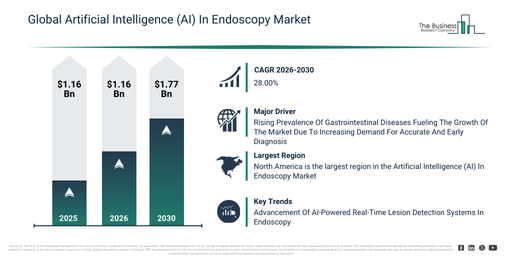
    The artificial intelligence (AI) in endoscopy market is projected to experience rapid expansion in the coming years. This market is anticipated to reach a valuation of $46.53 billion by 2030, demonstrating a compound annual growth rate (CAGR) of 28.0%. Key factors driving this projected growth include significant progress in machine learning algorithms for medical imaging, a rise in funding for AI-powered healthcare solutions, the proliferation of minimally invasive diagnostic methods, wider adoption of clinical decision support systems, and favorable regulatory environments for AI medical devices. Prominent trends expected during this period involve the increasing use of real-time lesion detection during endoscopic examinations, enhanced integration of AI software into current endoscopic systems, a heightened need for better diagnostic precision and fewer missed lesions, the expansion of AI-supported training and simulation in endoscopy, and an increased emphasis on procedural standardization and workflow optimization.

    Get A Free Sample Report With In-Depth Market Insights:

    https://thebusinessresearchcompany.com/sample_request?id=24440419&type=smp&name=Artificial%20Intelligence%20%28AI%29%20In%20Endoscopy%20Market%20Report%202026&utm_source=Blogs&utm_medium=Paid&utm_campaign=Sep_PR

    Artificial Intelligence (AI) In Endoscopy Market Growth Momentum: What Factors Are Shaping Demand?

    The increasing occurrence of gastrointestinal conditions is projected to boost the expansion of the artificial intelligence (AI) in endoscopy market in the coming years. These gastrointestinal diseases encompass various ailments impacting the digestive system, resulting in symptoms such as abdominal discomfort, distension, and changes in bowel habits. The rise in these conditions stems from greater intake of ultra-processed foods, which disrupt the gut microbiota and contribute to ongoing inflammation and digestive problems. Artificial intelligence (AI) in endoscopy enhances the identification of gastrointestinal diseases through precise real-time image analysis for abnormality detection. This technology facilitates prompt intervention, reduces diagnostic inaccuracies, and improves results for patients. For example, in December 2023, data from the IBD Registry, a non-profit organization based in the UK, showed that in 2023, individuals with inflammatory bowel disease (IBD) joining the registry increased to over 5,300, marking a growth of more than 3,000 compared to 2022. Consequently, the growing prevalence of gastrointestinal diseases is propelling the artificial intelligence (AI) in endoscopy market.

    Artificial Intelligence (AI) In Endoscopy Market Segments: Where Is Growth Concentrated?

    The artificial intelligence (ai) in endoscopy market covered in this report is segmented –

    1) By Product Type: Artificial Intelligence-Driven Imaging Systems, Artificial Intelligence-Powered Endoscopic Equipment, Wearable Endoscopy Devices, Consumables Used In Artificial Intelligence Endoscopy, Software Solutions For Artificial Intelligence Integration

    2) By Functionality: Image Capture And Processing, Data Management, Enhanced Visualization, Real-Time Decision Support, Training And Simulation Systems

    3) By Application: Gastrointestinal Endoscopy, Respiratory Endoscopy, Urological Endoscopy, Pancreatic Endoscopy, Neurological Endoscopy

    4) By End-User: Hospitals, Endoscopy Centers, Outpatient Surgical Centers, Research Institutions, Specialized Clinics

    Subsegments:

    1) By Artificial Intelligence-Driven Imaging Systems: High Definition Imaging Platforms, Three-Dimensional (3D) Visualization Systems, Fluorescence-Based Imaging Devices, Low Light Sensitivity Imaging Systems, Contrast-Enhanced Endoscopic Imaging Systems

    2) By Artificial Intelligence-Powered Endoscopic Equipment: Flexible Endoscopic Systems With Artificial Intelligence Integration, Rigid Endoscopic Systems With Artificial Intelligence Support, Capsule-Based Endoscopic Devices With Smart Processing, Robotic Assisted Endoscopic Instrumentation, Navigation-Enabled Endoscopic Equipment With Artificial Intelligence

    3) By Wearable Endoscopy Devices: Swallowable Capsule Endoscopy Units, Sensor Integrated Wearable Endoscopy Devices, Wireless Data Enabled Endoscopic Monitoring Devices, Artificial Intelligence-Based Wearable Imaging Systems, Miniature High Resolution Endoscopic Cameras

    4) By Consumables Used In Artificial Intelligence Endoscopy: Biopsy Forceps Compatible With Artificial Intelligence Systems, Single Use Endoscopic Protective Sheaths, Medical-Grade Contrast Media For Enhanced Imaging, Artificial Intelligence Compatible Irrigation Tubing, Disposable Accessories For Visualization And Sampling

    5) By Software Solutions For Artificial Intelligence Integration: Real-Time Lesion Detection Software Modules, Computer-Aided Diagnostic Imaging Platforms, Cloud-Based Endoscopic Data Management Systems, Image Segmentation And Classification Software Tools, Data Visualization And Automated Reporting Interfaces

    Artificial Intelligence (AI) In Endoscopy Market Trends Redefining Industry Growth

    Major companies in the artificial intelligence in endoscopy market are prioritizing the development of advanced technological solutions, such as AI-powered real-time lesion detection systems, to refine clinical decision-making in gastrointestinal examinations. These AI-powered real-time lesion detection systems are sophisticated software tools that continuously analyze live endoscopic video feeds, precisely identifying and highlighting suspicious lesions, including polyps and tumors, throughout endoscopic procedures. For example, in August 2024, Ainex Corporation, a medical technology company based in Singapore, introduced the Endoscopy AI system with the goal of improving the real-time detection and diagnosis of gastrointestinal abnormalities during endoscopic procedures. This system integrates advanced machine learning algorithms to pinpoint gastrointestinal lesions instantly during both upper and lower endoscopy. It significantly enhances diagnostic accuracy, reduces instances of false positives, and improves the visualization of mucosal abnormalities. The product is engineered to streamline clinical workflows, decrease procedure duration, and facilitate the early detection of gastrointestinal cancers and other related conditions.

    Artificial Intelligence (AI) In Endoscopy Market Industry Leaders And Competitive Landscape

    Major companies operating in the artificial intelligence (ai) in endoscopy market are Medtronic plc, Fujifilm Holdings Corporation, Olympus Corporation, Iterative Health, CapsoVision Inc, EndoSoft Inc, Mauna Kea Technologies SA, LPixel Inc, Sky Engine Limited, Endovision Limited, BioCam Sp z o o, MAIA Labs Inc, Magentiq Eye Ltd, EndoSurg AI Inc, iEndoscopic GmbH, Intelliscopes LLC, Odin Vision, Wision AI, NEC Corporation Medical AI, Shanghai Wision AI Co Ltd, Shanghai Ankon Technologies Co Ltd, Fujifilm Medical AI Solutions

    View The Full Artificial Intelligence (AI) In Endoscopy Market Report:

    https://thebusinessresearchcompany.com/report/artificial-intelligence-ai-in-endoscopy-global-market-report?utm_source=Blogs&utm_medium=Paid&utm_campaign=Sep_PR

    Artificial Intelligence (AI) In Endoscopy Market Regional Analysis And Leading Geography

    North America was the largest region in the artificial intelligence (AI) in endoscopy market in 2025. Asia-Pacific is expected to be the fastest-growing region in the forecast period. The regions covered in the artificial intelligence (AI) in endoscopy market report are Asia-Pacific, South East Asia, Western Europe, Eastern Europe, North America, South America, Middle East, Africa.

    Reach Out To Our Team:

    The Business Research Company: https://www.thebusinessresearchcompany.com/

    Americas: +1 310-496-7795

    Asia: +44 7882 955267 & +91 8897263534

    Europe: +44 7882 955267

    Email us at: marketing@tbrc.info

    Follow us on:

    LinkedIn: https://in.linkedin.com/company/the-business-research-company

    YouTube: https://www.youtube.com/channel/UC24_fI0rV8cR5DxlCpgmyFQ

    Global Market Model: https://www.thebusinessresearchcompany.com/global-market-model