Spine Implants Market Growth Outlook Reveals A CAGR Of 5.5% And A Market Value Of $15.64 Billion By 2030
Through market attractiveness analysis, total addressable market evaluation, company benchmarking matrices, interactive Excel dashboards, expanded supply chain intelligence, emerging startup coverage, and detailed product insights, The Business Research Company’s 2026 market reports provide more actionable and strategically valuable research.
The spine implants sector has experienced substantial growth in recent years, driven by advancements in medical technology and increasing patient needs. As demand for spinal treatments rises worldwide, this market is poised for continued expansion through 2030. Let’s explore the current market size, growth factors, key segments, industry trends, and regional dynamics shaping this important healthcare field.
Spine Implants Market Size and Projected Growth Through 2030
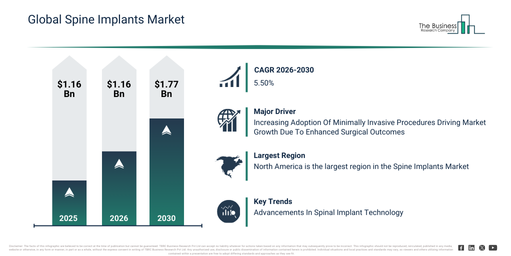
The spine implants market has seen strong performance recently, with its value expected to rise from $11.95 billion in 2025 to $12.62 billion in 2026, marking a compound annual growth rate (CAGR) of 5.6%. This growth to date reflects factors such as the increasing prevalence of degenerative spine conditions, higher rates of surgical interventions, the expansion of specialized spine hospitals, improved access to implant materials, and the growing preference for spinal fusion surgeries. Over the coming years, the market is projected to reach $15.65 billion by 2030, maintaining a steady CAGR of 5.5%. This anticipated growth is driven by a rising demand for patient-specific implants, wider adoption of minimally invasive spine procedures, expansion of biologics-based solutions, greater emphasis on faster patient recovery, and ongoing innovations in implant design. Emerging trends include the use of motion preservation devices, advanced spinal fusion implants, biologic materials in surgery, minimally invasive implant technologies, and a focus on long-lasting implant durability.
Download A Free Sample Report For Comprehensive Market Insights:
https://www.thebusinessresearchcompany.com/sample.aspx?id=3279&type=smp
Factors Fueling Expansion in the Spine Implants Market
One significant contributor to the market’s growth is the increasing use of minimally invasive procedures in spine surgery. These techniques involve small incisions, precision instruments, and advanced imaging methods to perform surgeries with minimal disruption to surrounding tissues. The benefits to patients include reduced pain after surgery, shorter hospital stays, and quicker recoveries compared to traditional open surgeries. As a result, minimally invasive approaches are becoming more common within spine implant procedures.
For example, in January 2025, Intuitive Surgical, a U.S.-based medical technology firm, reported that the number of da Vinci robotic-assisted surgeries worldwide grew by approximately 18% in the fourth quarter of 2024 compared to the same period in 2023. The company also noted a 17% increase in full-year procedures for 2024 over 2023 and expects an additional 13% to 16% rise in 2025. This surge in minimally invasive robotic-assisted surgeries clearly supports the expanding spine implants market.
Detailed Segmentation and Revenue Potential in the Spine Implants Industry
This market is segmented by various factors to provide a comprehensive view:
1) By Product Type: Spinal Fusion Devices, Non-Fusion/Motion Preservation Devices, Vertebral Compression Fracture (VCF) Treatment Devices, Spinal Bone Stimulators, and Spine Biologics
2) By Procedure: Open Surgery vs. Minimally Invasive Surgery (MIS)
3) By Material: Metallic, Polymeric, and Ceramic materials
4) By End User: Hospitals, Specialty Orthopedic and Spine Centers, Ambulatory Surgical Centers
Within these categories, subsegments include Interbody Fusion Cages, Pedicle Screws and Rods, Bone Grafts and Substitutes under spinal fusion devices; Artificial Discs, Dynamic Stabilization Devices, and Interspinous Spacers for motion preservation; Kyphoplasty Balloons and Vertebroplasty Kits for VCF treatment; Electrical and Ultrasound Bone Stimulators; and bone graft materials, growth factors, and stem cell products under spine biologics.
Access The Complete Spine Implants Market Report:
https://www.thebusinessresearchcompany.com/report/spine-implants-global-market-report
Innovations and Trends Transforming the Spine Implants Market
Leading companies in the spine implants sector are focusing on developing innovative products that support minimally invasive approaches while improving patient outcomes. For example, vertebral compression fracture repair systems are designed to relieve pain, restore vertebral height, and facilitate faster recovery through less invasive techniques such as vertebroplasty and kyphoplasty.
In January 2024, Accelus, a U.S.-based surgical instrument and implant provider, introduced the Linesider Modular-Cortical System for spinal implant procedures. This technology stands out because it allows surgeons to place screw shanks early during surgery, enhancing procedural efficiency. It also offers modular components like tulips and rods for customizable constructs and is available in open modular and cortical modular sets to suit different surgical methods.
Top Companies Shaping the Direction of the Spine Implants Market
The spine implants market is influenced by major players including Medtronic, Johnson & Johnson, Stryker, NuVasive, Zimmer Biomet, Orthofix, SeaSpine, Atlas Surgical, Auxein Medical, Sharma Spine Medical, Teijin Nakashima Medical, Seikagaku, Anatomics, NZOA, Tianjin Walkman Biomaterials, Sunan Zimede, Smith & Nephew, aap Implantate AG, Orthopaedic & Spine Development (OSD), Waldemar Link, Amplitude SAS, Precision Medical Technologies, Baltic Implants, Beznoska Company Ltd, SpineGuard, Integra Life Sciences, B. Braun, Benvenue Medical, DePuy Synthes, Globus Medical, Aesculap, Alphatec Spine, Neoortho, NOVAX DMA, Spine Argentina, SAI, Shaarani Group, SASpine, EliteSurgical, and TiTaMED. These organizations drive innovation, expand market reach, and set industry standards.
Geographical Footprint and Regional Market Leadership in Spine Implants
In 2025, North America was the largest market for spine implants, followed by Western Europe holding the second position. The spine implants market report covers key regions including Asia-Pacific, South East Asia, Western Europe, Eastern Europe, North America, South America, the Middle East, and Africa, offering insights into the global distribution and growth patterns of the industry.
Get in touch with us:
The Business Research Company: https://www.thebusinessresearchcompany.com/
Americas: +1 310-496-7795
Asia: +44 7882 955267 & +91 8897263534
Europe: +44 7882 955267
Email us at: marketing@tbrc.info
Follow us on:
LinkedIn: https://in.linkedin.com/company/the-business-research-company
YouTube: https://www.youtube.com/channel/UC24_fI0rV8cR5DxlCpgmyFQ
Global Market Model: https://www.thebusinessresearchcompany.com/global-market-model