Backed by market attractiveness analysis, total addressable market sizing, company benchmarking matrices, interactive Excel dashboards, wider supply chain intelligence, emerging startup coverage, and detailed product-level insights, The Business Research Company’s 2026 market reports are designed to offer research that is more actionable and strategically valuable than ever.
Synthetic Biology Market Size Outlook: How Quickly Will Revenue Expand Through 2030?
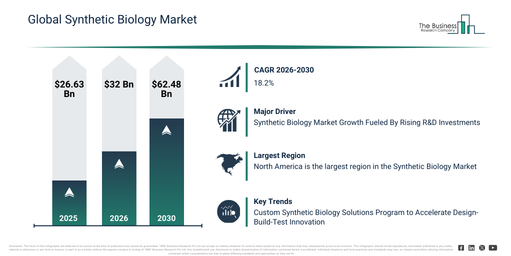
The synthetic biology market has experienced substantial expansion in recent years. Its size is projected to increase from $26.63 billion in 2025 to $32 billion in 2026, with a compound annual growth rate (CAGR) of 20.2%. The market’s historical growth can be ascribed to advancements in genetic engineering techniques, an increase in academic and industrial research funding, improved access to sequencing technologies, the initial commercialization of synthetic organisms, and enhanced collaboration between academia and industry.
The synthetic biology market size is anticipated to experience substantial growth in the coming years. It is projected to reach $62.48 billion by 2030, demonstrating a compound annual growth rate (CAGR) of 18.2%. This expansion during the forecast period can be attributed to augmented investments in bio-manufacturing, escalating demand for sustainable chemicals and fuels, the broadening of synthetic biology applications within healthcare, an accelerating integration of AI-driven biological design, and enhanced regulatory clarity for engineered organisms. Prominent trends throughout this projection timeframe include the increasing adoption of CRISPR-based gene editing, a surge in the utilization of bioinformatics-driven design tools, the enlargement of synthetic gene construction platforms, an intensified focus on sustainable bio-based production, and greater automation in biological engineering workflows.
Get A Free Sample Report With In-Depth Market Insights:
Synthetic Biology Market Growth Drivers: What’s Behind The Acceleration?
Increased research and development (R&D) investment is poised to drive the expansion of the synthetic biology market. R&D encompasses the systematic process of creating new knowledge, technologies, or products through investigation, experimentation, and innovation, aiming to enhance existing offerings or develop novel ones. This surge in R&D funding is attributed to heightened competition, the imperative for innovation, technological advancements, and the need for businesses to adapt to changing consumer demands and market dynamics. Specifically, investment in research and development for synthetic biology is vital to advance its capacity for generating sustainable solutions in areas such as healthcare, agriculture, and environmental management by engineering biological systems and organisms for precise applications. The escalating investment in research and development is fueling the growth of the synthetic biology market.
Synthetic Biology Market Segment Analysis: What Are The Core Market Categories?
The synthetic biology market covered in this report is segmented –
1) By Technology: Nucleotide Synthesis And Sequencing, Bioinformatics, Microfluidics, Genetic Engineering
2) By Product Type: Oligonucleotides, Enzymes, Cloning And Assembly Kits, Xeno-Nucleic Acids (XNA), Chassis Organism
3) By Application: Pharmaceuticals And Diagnostics, Chemicals, Biofuels, Bioplastics, Other Application
Subsegments:
1) By Nucleotide Synthesis And Sequencing: DNA Synthesis Technologies, Next-Generation Sequencing (NGS), Sanger Sequencing
2) By Bioinformatics: Software Tools For Genomic Data Analysis, Databases For Gene/Protein Information, Algorithms For Gene Editing And Design
3) By Microfluidics: Lab-On-A-Chip Technologies, Microfluidic Devices For Biological Assays, Applications In Drug Discovery And Diagnostics
4) By Genetic Engineering: CRISPR/Cas9 Technology, Recombinant DNA Technology, Synthetic Gene Construction And Assembly
Synthetic Biology Market Trends Redefining Industry Growth
Leading companies in the synthetic biology market are prioritizing the creation of innovative products, such as custom solutions programs for design-build-test cycles, designed to expedite specialized synthetic biology projects. A custom solutions program represents a personalized service where clients can directly collaborate with experts to design, build, and test synthetic DNA constructs, moving beyond reliance on standard catalog items. For example, in June 2025, Integrated DNA Technologies (IDT), a U.S.-based biotechnology company, introduced its Synthetic Biology Custom Solutions Program. This high-end manufacturing service offers customers access to IDT’s in-house scientists and engineers to work on tailored projects, encompassing everything from complex genes to non-standard DNA fragments. Key features include a dedicated team supporting design-build-test workflows, custom manufacturing conducted in IDT’s 25,000-sq-ft synthetic biology facility, a broad acceptance of project types (e.g., high-yield non-standard gene fragments, genes >5 kb, multi-site cloning), and enhanced turnaround times achieved by removing rigid high-throughput constraints. This program equips synthetic biology innovators to iterate more rapidly and address bottlenecks in their research and development.
Synthetic Biology Market Top Companies Driving Competitive Growth
Major companies operating in the synthetic biology market are Thermo Fisher Scientific Inc, Danaher Corporation, Eurofins Scientific, Merck KGaA, Novozymes A/S, Agilent Technologies, New England Biolabs Inc, Precigen Inc, Amyris, Inc, Genscript Biotech Corporation, Codex Genetics, Cathay Biotech, Bota Biosciences, Bluepha, Spiber, OriCiro Genomics Inc, Provectus Algae, Puraffinity, Royal DSM NV, Colorifix, Phytoform Labs, Desktop Genetics, NanoSyrinx, Pulmobiotics S.L, EnginZyme, Chain Biotech, Nuclera Nucleics, Biosynthetics GmbH, Entelechon GmbH, Sloning BioTechnology GmbH, Prokarium Ltd, Synbio, Captor Therapeutics, Gero.ai, ARNA Genomics, Solvo Omixon, Soft flow, Algenol, Genomatica, Integrated DNA Technologies, Sana Biotechnology, Impossible Foods, Apeel Sciences, Twist Bioscience, Synlogic, Zymergen Inc, Ginkgo Bioworks, Codexis, Arzeda Corporation, Synthetic Genomics, Conagen, Dupont, Oxitec Ltd, Sentebiolab, GEEN Biotechnology Inc, Genbiotek Biosistem Laboratory Ltd
View The Full Synthetic Biology Market Report:
Synthetic Biology Market Regional Breakdown: Where Is Demand Concentrated?
North America was the largest region in the synthetic biology market in 2025. Western Europe was the second largest region in the global synthetic biology market share. The regions covered in the synthetic biology market report are Asia-Pacific, South East Asia, Western Europe, Eastern Europe, North America, South America, Middle East, Africa.
Reach Out To Our Team:
The Business Research Company: https://www.thebusinessresearchcompany.com/
Americas: +1 310-496-7795
Asia: +44 7882 955267 & +91 8897263534
Europe: +44 7882 955267
Email us at: marketing@tbrc.info
Follow us on:
LinkedIn: https://in.linkedin.com/company/the-business-research-company
YouTube: https://www.youtube.com/channel/UC24_fI0rV8cR5DxlCpgmyFQ
Global Market Model: https://www.thebusinessresearchcompany.com/global-market-model
Leave a Reply