Month: May 2026

  • Interactive Patient Care Systems Market 2026–2030: Forecasting Business Opportunities Ahead

    Interactive Patient Care Systems Market 2026–2030: Forecasting Business Opportunities Ahead

    Uncover key drivers, emerging technologies, and competitive movements shaping the interactive patient care systems market from 2026–2035 with trusted insights from The Business Research Company

    What size range is anticipated for the Interactive Patient Care Systems Market from 2026 to 2030?

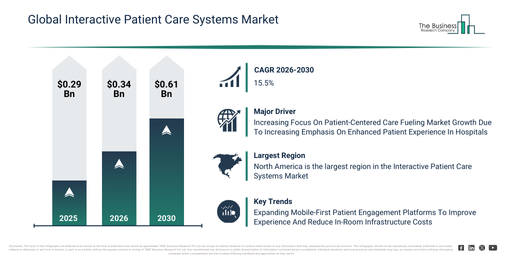
    The interactive patient care systems market size has experienced significant expansion in recent years. It will grow from $0.29 billion in 2025 to $0.34 billion in 2026 at a compound annual growth rate (CAGR) of 15.8%. The historical increase can be attributed to factors such as the growing adoption of digital health platforms, increased investment in patient engagement solutions, the rising integration of bedside terminals and mobile applications, the expansion of telehealth services, and an escalating focus on clinical workflow optimization.

    The interactive patient care systems market is anticipated to experience substantial expansion over the upcoming years. By 2030, this market is projected to reach $0.61 billion, expanding at a compound annual growth rate of 15.5%. This projected growth during the forecast period is fueled by several factors, including the escalating development of AI-driven analytics for tailored care, advancements in cloud-based patient engagement platforms, increased investment in remote patient monitoring tools, the proliferation of interactive kiosks and self-service terminals, and improved software interoperability and integration capabilities. Key trends expected throughout the forecast timeframe encompass breakthroughs in mobile care applications, enhancements in telehealth and virtual consultation platforms, the creation of integrated clinical workflow solutions, technological improvements in content management and educational modules, and ongoing research and development into hybrid deployment models and scalable interactive patient care systems.

    Access Your Free Sample Report for In-Depth Market Insights:

    https://www.thebusinessresearchcompany.com/sample.aspx?id=30625&type=smp

    What Drivers Are Affecting Demand In The Interactive Patient Care Systems Market?

    The growing emphasis on patient-centered care is anticipated to drive the expansion of the interactive patient care systems market. Patient-centered care refers to healthcare delivery that respects and caters to individual patient preferences, needs, and values, ensuring that these values guide clinical decisions and the provision of care. This heightened focus on patient-centered care is due to hospitals and health systems making patient experience a strategic priority to improve quality outcomes, patient satisfaction, and their institutional reputation. Interactive patient care systems support patient-centered care and improve the patient experience in hospitals by enabling real-time communication, personalized education, and engagement tools at the bedside, thereby boosting patient experience and workflow efficiency. For instance, in November 2025, Chief Healthcare Executive, a US-based healthcare leadership publication, noted that in 2023, 49% of hospital executives identified improving patient experience as their foremost strategic priority, an increase from 36% in 2023, indicating a 36% rise compared to previous years. Therefore, the increasing focus on patient-centered care is a key factor propelling the growth of the interactive patient care systems market.

    Which Segment Groups Are Influencing The Interactive Patient Care Systems Market?

    The interactive patient care systems market covered in this report is segmented –

    1) By Component: Hardware, Software, Services

    2) By Product Type: Bedside Terminals, Interactive Displays, Patient Monitoring Devices, Mobile Care Applications, In-Room Entertainment Systems, Other Product Types

    3) By Deployment Mode: On-Premises, Cloud-Based, Hybrid Deployment Models

    4) By Application: Patient Education, Entertainment, Communication, Medication Management, Other Applications

    5) By End-User: Hospitals, Clinics, Ambulatory Surgical Centers, Long-Term Care Centers, Other End-Users

    Subsegments:

    1) By Hardware: Bedside Terminals, Interactive Displays, Patient Monitoring Devices, Mobile Care Applications, In Room Entertainment Systems, Other Product Types

    2) By Software: Patient Education, Entertainment, Communication, Medication Management, Other Applications

    3) By Services: Implementation Support, Training And Education, Maintenance And Support, Consulting Services, Integration Services

    How Are Emerging Trends Affecting The Progression Of The Interactive Patient Care Systems Market?

    Leading companies within the interactive patient care systems market are prioritizing the creation of engagement applications, such as mobile-first patient engagement platforms, to boost patient involvement, streamline care communication, and decrease reliance on dedicated bedside hardware. Mobile-first patient engagement platforms are cloud-based digital solutions that empower patients to access care data, educational materials, service requests, and communication tools directly through their personal mobile devices while admitted to a hospital. For example, in February 2024, Oneview Healthcare PLC, an Ireland-based healthcare technology company, introduced MyStay Mobile, a software-as-a-service patient engagement platform developed to extend interactive care offerings beyond traditional in-room terminals. This mobile-first engagement platform allows patients to access customized stay details, order food, submit service requests, and offer immediate feedback using their personal smartphones without needing to install an application. It also integrates with hospital electronic health record systems and supports content delivery in multiple languages, enabling healthcare providers to improve patient experience while lowering capital and maintenance costs linked to bedside hardware deployment.

    Who Are The Primary Competitors In The Global Interactive Patient Care Systems Market?

    Major companies operating in the interactive patient care systems market are Epic Systems Corporation, Advantech Co. Ltd., Barco NV, HCI Group Inc., Vocera Communications Inc., PatientPoint Inc., Medhost Inc., CipherHealth Inc., Lincor Solutions Ltd., Sentrics, Aceso Interactive Inc., Aiva Health Inc., SONIFI Health Inc., BEWATEC ConnectedCare GmbH, GetWellNetwork Inc., Oneview Healthcare PLC, PDI Communications Inc., eVideon Inc., Onyx Healthcare Inc., ClinicAll

    Access The Complete Report For Deeper Market Insights:

    https://www.thebusinessresearchcompany.com/report/interactive-patient-care-systems-market-report

    Which Global Regions Are Shaping The Competitive Landscape Of The Interactive Patient Care Systems Market?

    North America was the largest region in the interactive patient care systems market in 2025. Asia-Pacific is expected to be the fastest-growing region in the forecast period. The regions covered in the interactive patient care systems market report are Asia-Pacific, South East Asia, Western Europe, Eastern Europe, North America, South America, Middle East, Africa.

    Request Your Customized Interactive Patient Care Systems Market Research Report for Competitive Advantage:

    https://www.thebusinessresearchcompany.com/customise?id=30625&type=smp

    Browse Through More Reports Similar to the Global Interactive Patient Care Systems Market 2026, By The Business Research Company

    Integrated Patient Care Systems Market Report 2026

    https://www.thebusinessresearchcompany.com/report/integrated-patient-care-systems-global-market-report

    Patient Simulators Market Report 2026

    https://www.thebusinessresearchcompany.com/report/patient-simulators-global-market-report

    healthcare information system global market report

    https://www.thebusinessresearchcompany.com/report/healthcare-information-system-global-market-report

    Get in touch with us:

    The Business Research Company: https://www.thebusinessresearchcompany.com/

    Americas +1 310-496-7795

    Asia +44 7882 955267 & +91 8897263534

    Europe +44 7882 955267

    Email us at marketing@tbrc.info

    Follow us on:

    LinkedIn: https://in.linkedin.com/company/the-business-research-company

    YouTube: https://www.youtube.com/channel/UC24_fI0rV8cR5DxlCpgmyFQ

    Global Market Model: https://www.thebusinessresearchcompany.com/global-market-model
  • Global Intelligent Medical Guidance and Navigation System Market Report 2026–2035: Key Forecasts and Growth Areas

    Global Intelligent Medical Guidance and Navigation System Market Report 2026–2035: Key Forecasts and Growth Areas

    Uncover key drivers, emerging technologies, and competitive movements shaping the intelligent medical guidance and navigation system market from 2026–2035 with trusted insights from The Business Research Company

    How is the Intelligent Medical Guidance and Navigation System Market size predicted to change over the forecast window of 2026–2035?

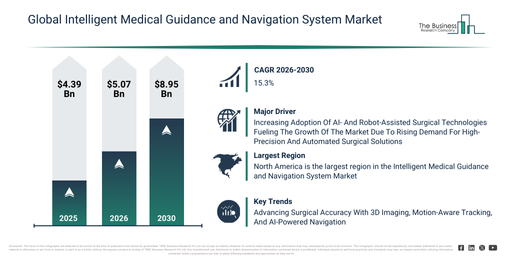
    The intelligent medical guidance and navigation system market has experienced substantial expansion in recent years. This market is projected to expand from $4.39 billion in 2025 to $5.07 billion in 2026, demonstrating a compound annual growth rate (CAGR) of 15.6%. The historical growth can be linked to factors such as the increasing adoption of medical imaging technologies, a rising demand for minimally invasive procedures, the growth in hospital digitalization, the early integration of artificial intelligence in clinical workflows, and the expansion of surgical navigation solutions.

    The market for intelligent medical guidance and navigation systems is projected for rapid expansion over the coming years, reaching $8.95 billion by 2030, driven by a compound annual growth rate (CAGR) of 15.3%. This anticipated growth during the forecast period is fueled by factors such as the increasing demand for precision medicine, the wider implementation of artificial intelligence-powered clinical support systems, greater capital expenditure on smart operating environments, a heightened emphasis on sustainable and carbon-neutral hospital facilities, and the quicker uptake of real-time patient monitoring. Key developments expected over the forecast horizon encompass the convergence of artificial intelligence with multimodal imaging, the rise of robotics-assisted navigation, the proliferation of cloud-based platforms for clinical decision-making, the expanded application of digital twins in healthcare strategic planning, and a move towards medical systems that are energy-efficient and carbon-free.

    Access Your Free Sample Report for In-Depth Market Insights:

    https://www.thebusinessresearchcompany.com/sample.aspx?id=30624&type=smp

    Which Drivers Are Contributing To The Expansion Of The Intelligent Medical Guidance and Navigation System Market?

    The expanding implementation of robot-assisted surgical technologies is anticipated to drive the advancement of the intelligent medical guidance and navigation system market in the coming years. Artificial intelligence (AI) and robot-assisted surgical technologies refer to sophisticated systems that utilize AI and robotic mechanisms to aid surgeons in performing intricate operations with enhanced precision, control, and effectiveness. The uptake of Artificial intelligence (AI) and robot-assisted surgical technologies is on the rise as hospitals strive for superior surgical precision, lower complication rates, and quicker patient recovery through minimally invasive, digitally guided procedures. The intelligent medical guidance and navigation system supports robot-assisted surgical technologies by offering real-time surgical navigation, automated instrument guidance, and decision-support functions that optimize procedural accuracy. For instance, in November 2024, data from the Private Healthcare Information Network, a UK-based government-mandated organisation, indicated that roughly 22,700 robot-assisted procedures were carried out in the first quarter of 2024. This marked a substantial 45% increase when compared to the first quarter of 2023, and a 12% rise from the last quarter of 2023. Therefore, the heightened adoption of robot-assisted surgical technologies is a significant force behind the growth of the intelligent medical guidance and navigation system market.

    What Segment Classifications Make Up The Intelligent Medical Guidance and Navigation System Market?

    The intelligent medical guidance and navigation system market covered in this report is segmented –

    1) By Component Or Product Type: Hardware, Software, Service

    2) By Technology: Robotics, Computer Vision, Artificial Intelligence, Augmented Reality, Navigation Software

    3) By Application: Surgical Navigation, Radiation Therapy, Diagnostic Imaging, Orthopedic Guidance, Neurological Guidance

    4) By End Use: Hospitals, Ambulatory Surgery Centers, Diagnostic Centers, Research Institutions

    Subsegments:

    1) By Hardware: Imaging Sensors, Tracking Sensors, Navigation Consoles, Robotic Arms, Display Monitors

    2) By Software: Imaging Analysis Software, Navigation Planning Software, Intraoperative Guidance Software, Workflow Integration Software, Data Management Software

    3) By Service: Installation Service, Maintenance Service, Training Service, Upgradation Service, Technical Support Service

    Which Innovation Trends Are Advancing Developments Within The Intelligent Medical Guidance and Navigation System Market?

    Leading firms within the intelligent medical guidance and navigation system market are concentrating on creating sophisticated technologies, including 3D imaging and motion-aware tracking, with the goal of boosting precision during operations, minimizing mistakes, and bettering surgical results. This technology, encompassing 3D imaging and motion-aware tracking, involves combining three-dimensional views with continuous monitoring of surgical tools and patient body structures. This allows systems to adapt responsively to movement and offer precise direction throughout surgical interventions. As an illustration, in October 2025, Zeta Surgical Inc., a US-based medical technology firm focused on AI-driven surgical solutions, obtained FDA 510(k) clearance for its AI-powered TMS Navigation System. The system integrates 3D imaging and motion-aware tracking to provide instantaneous guidance during intricate surgical operations, thereby enabling surgeons to operate with increased spatial understanding and accuracy. Such a system facilitates safer, more effective surgeries and plays a part in enhancing patient recovery.

    Which Key Market Players Are Investing In Expansion And Innovation Within The Intelligent Medical Guidance and Navigation System Market?

    Major companies operating in the intelligent medical guidance and navigation system market are Johnson & Johnson, Medtronic Plc, Siemens Healthineers AG, Stryker Corporation, Koninklijke Philips N.V., GE Healthcare Technologies Inc., Smith & Nephew Plc, B. Braun Melsungen AG, Zimmer Biomet Holdings Inc., Intuitive Surgical, Olympus Corporation, Karl Storz SE & Co. KG, Brainlab AG, Amplitude Surgical, Northern Digital Inc., Augmedics, Synaptive Medical Inc., Proprio, Fiagon GmbH, Surgical Theater LLC, Orthofix Medical Inc., Naviswiss AG, SurgicEye GmbH

    Access The Complete Report For Deeper Market Insights:

    https://www.thebusinessresearchcompany.com/report/intelligent-medical-guidance-and-navigation-system-market-report

    Which Regions Are Poised For Strategic Growth In The Intelligent Medical Guidance and Navigation System Market?

    North America was the largest region in the intelligent medical guidance and navigation systems market in 2025. Asia-Pacific is expected to be the fastest-growing region in the forecast period. The regions covered in the intelligent medical guidance and navigation system market report are Asia-Pacific, South East Asia, Western Europe, Eastern Europe, North America, South America, Middle East, Africa.

    Request Your Customized Intelligent Medical Guidance and Navigation System Market Research Report for Competitive Advantage:

    https://www.thebusinessresearchcompany.com/customise?id=30624&type=smp

    Browse Through More Reports Similar to the Global Intelligent Medical Guidance and Navigation System Market 2026, By The Business Research Company

    Navigation System Market Report 2026

    https://www.thebusinessresearchcompany.com/report/navigation-system-global-market-report

    Healthcare Navigation Platform Market Report 2026

    https://www.thebusinessresearchcompany.com/report/healthcare-navigation-platform-global-market-report

    surgical navigation systems global market report

    https://www.thebusinessresearchcompany.com/report/surgical-navigation-systems-global-market-report

    Get in touch with us:

    The Business Research Company: https://www.thebusinessresearchcompany.com/

    Americas +1 310-496-7795

    Asia +44 7882 955267 & +91 8897263534

    Europe +44 7882 955267

    Email us at marketing@tbrc.info

    Follow us on:

    LinkedIn: https://in.linkedin.com/company/the-business-research-company

    YouTube: https://www.youtube.com/channel/UC24_fI0rV8cR5DxlCpgmyFQ

    Global Market Model: https://www.thebusinessresearchcompany.com/global-market-model

  • Insulated Shippers Market 2026–2030: Forecast, Innovation, and Competitive Trends

    Insulated Shippers Market 2026–2030: Forecast, Innovation, and Competitive Trends

    Uncover key drivers, emerging technologies, and competitive movements shaping the insulated shippers market from 2026–2035 with trusted insights from The Business Research Company

    What market expansion outlook does the Insulated Shippers Market show for the 2026–2030 period?

    The size of the insulated shippers market has experienced rapid expansion in recent years. It is projected to grow from $9.74 billion in 2025 to $10.80 billion in 2026, demonstrating a compound annual growth rate (CAGR) of 10.9%. This historical growth can be attributed to factors such as the escalating demand for temperature-sensitive pharmaceuticals, the increasing adoption of cold chain logistics, a rise in the use of expanded polystyrene and polyurethane insulated packaging, the expansion of global food and beverage distribution networks, and an enhanced regulatory focus on temperature-controlled shipping.

    The insulated shippers market is projected to experience substantial expansion in the coming years, with its valuation set to reach $16.18 billion by 2030, exhibiting a compound annual growth rate (CAGR) of 10.6%. This anticipated growth during the forecast period is primarily driven by factors such as the expanding requirement for biologics and specialty pharmaceuticals, the rising volume of perishable food shipments through e-commerce, the heightened interest in reusable insulated packaging, the proliferation of sophisticated cold chain infrastructure, and the greater uptake of high-performance insulation materials. Key trends anticipated over the forecast period encompass technological progress in thermal packaging systems, novel approaches to smart temperature monitoring solutions, the evolution of sustainable and reusable insulated shipper designs, ongoing research and development into vacuum insulated panels and phase-change materials, and improvements in modular and customizable insulated packaging solutions.

    Access Your Free Sample Report for In-Depth Market Insights:

    https://www.thebusinessresearchcompany.com/sample.aspx?id=30623&type=smp

    What Drivers Are Shaping The Development Of The Insulated Shippers Market?

    The elevated volume of fresh food transportation is projected to drive the expansion of the insulated shippers market in the coming years. This involves moving perishable agricultural products, such as fruits, vegetables, meat, and dairy, from producers to consumers while maintaining specific temperature conditions to preserve their freshness. The increase in fresh food transport stems from growing consumer demand for convenient home delivery of fresh produce and refrigerated items via e-commerce grocery platforms and rapid delivery services. Insulated shippers facilitate this rise by ensuring precise temperature control, which keeps perishable products safe and of high quality during transit. For instance, in January 2025, data from the United States Department of Agriculture (USDA), a US-based federal executive department, indicated that United States truck shipments of fresh produce reached 11.21 million tons in the second quarter of 2024, representing a 14% rise compared with the same quarter in 2023. Thus, the growing fresh food transport sector is a key driver for the insulated shippers market’s growth.

    What Segment Types Are Examined In The Insulated Shippers Market?

    The insulated shippers market covered in this report is segmented –

    1) By Product Type: Panel Shippers, Envelope Shippers, Box Shippers, Other Product Types

    2) By Material: Expanded Polystyrene (EPS), Polyurethane, Vacuum Insulated Panels, Other Materials

    3) By Distribution Channel: Direct Sales, Distributors, Online Retail

    4) By Application: Pharmaceuticals, Food And Beverages, Chemicals, Other Applications

    5) By End-User: Healthcare, Food Service, E-Commerce, Other End-Users

    Subsegments:

    1) By Panel Shippers: Single Wall Construction, Double Wall Construction, Multi-Layered Composite Construction

    2) By Envelope Shippers: Bubble Insulated Mailers, Foam Lined Padded Mailers, Reflective Foil Insulated Mailers

    3) By Box Shippers: Single-Use Corrugated Boxes, Reusable Plastic Containers, Insulated Dividers And Liners

    4) By Other Product Types: Insulated Totes And Bags, Hard-Sided Insulated Cases, Custom Molded Foam Containers

    Which Competitive Trends Are Impacting The Structure Of The Insulated Shippers Market?

    Leading companies in the insulated shippers market are concentrating on developing environmentally friendly packaging solutions, such as curbside-recyclable parcel shippers, with the aim of enhancing thermal efficiency, operational effectiveness, and minimizing environmental impact. These recyclable cold chain shippers combine robust insulation with quickly renewable, single-use materials to safeguard product integrity while allowing for straightforward disposal and recycling. For instance, in May 2025, Cold Chain Technologies LLC, a US-based supplier of temperature-controlled packaging, launched its CCT TRUEtemp Naturals shipper. This product offers a cost-effective, single-use solution that addresses customer demands for reliable cold chain performance and supports corporate sustainability targets. Qualified according to the ISTA 7E RFG profile, the system maintains conditions of 2–8 °C for as long as 48 hours. Available in extra small, small, medium, and large formats, it supports various payload requirements and is particularly well-suited for drug sampling programs, wholesale distribution, and overnight domestic shipments.

    Who Are The Core Companies Influencing Trends In The Insulated Shippers Market?

    Major companies operating in the insulated shippers market are DS Smith PLC, Sonoco ThermoSafe, Sealed Air Corporation, Tower Cold Chain Solutions Limited, Ranpak Holdings Corp., CSafe Global, Cryoport Systems LLC, Cold Chain Technologies (CCT), Envirotainer AB, FEURER Group GmbH, TemperPack Technologies Inc., Peli BioThermal LLC, Cryopak Industries Inc., Polar Tech Industries Inc., Nordic Cold Chain Solutions, DGP Intelsius Limited, Inmark Packaging, Topa Thermal Packaging B.V., Sofrigam SA, Chill-Pak, Tempack Packaging Solutions S.L.

    Access The Complete Report For Deeper Market Insights:

    https://www.thebusinessresearchcompany.com/report/insulated-shippers-market-report

    Which Regions Are Projected To Dominate The Insulated Shippers Market In The Coming Years?

    North America was the largest region in the insulated shippers market in 2025. Asia-Pacific is expected to be the fastest-growing region in the forecast period. The regions covered in the insulated shippers market report are Asia-Pacific, South East Asia, Western Europe, Eastern Europe, North America, South America, Middle East, Africa.

    Request Your Customized Insulated Shippers Market Research Report for Competitive Advantage:

    https://www.thebusinessresearchcompany.com/customise?id=30623&type=smp

    Browse Through More Reports Similar to the Global Insulated Shippers Market 2026, By The Business Research Company

    Insulated Shipping Packaging Market Report 2026

    https://www.thebusinessresearchcompany.com/report/insulated-shipping-packaging-global-market-report

    Insulation Products Market Report 2026

    https://www.thebusinessresearchcompany.com/report/insulation-products-global-market-report

    aircraft insulation global market report

    https://www.thebusinessresearchcompany.com/report/aircraft-insulation-global-market-report

    Get in touch with us:

    The Business Research Company: https://www.thebusinessresearchcompany.com/

    Americas +1 310-496-7795

    Asia +44 7882 955267 & +91 8897263534

    Europe +44 7882 955267

    Email us at marketing@tbrc.info

    Follow us on:

    LinkedIn: https://in.linkedin.com/company/the-business-research-company

    YouTube: https://www.youtube.com/channel/UC24_fI0rV8cR5DxlCpgmyFQ

    Global Market Model: https://www.thebusinessresearchcompany.com/global-market-model
  • Implantable Brain-Computer Interfaces Market Forecast 2026–2035: Data Trends and Industry Insights

    Implantable Brain-Computer Interfaces Market Forecast 2026–2035: Data Trends and Industry Insights

    Uncover key drivers, emerging technologies, and competitive movements shaping the implantable brain-computer interfaces market from 2026–2035 with trusted insights from The Business Research Company

    What level of growth is expected in the Implantable Brain-Computer Interfaces Market between 2026 and 2030?

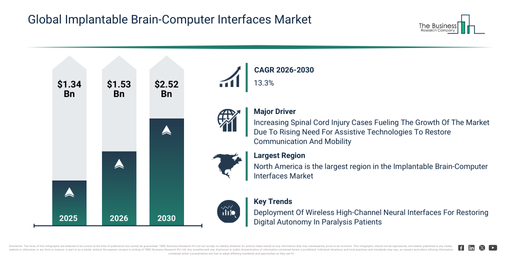
    The implantable brain–computer interface market size has seen swift expansion over recent years. This market is set to increase from $1.34 billion in 2025 to $1.53 billion in 2026, registering a compound annual growth rate (CAGR) of 13.6%. The historical growth of this market can be attributed to several factors including a heightened demand for neuroprosthetics, the rising occurrence of neurological disorders, increased uptake of non-invasive brain–computer interfaces, a surge in research funding for neuroscience, and the broader deployment of brain–computer interfaces in rehabilitation.

    The implantable brain–computer interface market is poised for significant expansion in the next few years. It is predicted to attain a value of $2.52 billion by 2030, growing at a compound annual growth rate (CAGR) of 13.3%. This expansion during the forecast period can be attributed to the increasing incorporation of artificial intelligence into brain–computer interfaces, rising financial commitments to neural interface innovation, a growing preference for minimally invasive brain–computer interfaces, an increase in assistive communication applications, and a heightened demand for robotic systems controlled by brain signals. Prominent developments expected in the forecast period include advancements in neural signal decoding technology, innovations in fully implantable brain–computer interfaces, the evolution of wireless brain–computer interface devices, continued research and development in brain–controlled prosthetics, and improvements in high-resolution neuroimaging techniques.

    Access Your Free Sample Report for In-Depth Market Insights:

    https://www.thebusinessresearchcompany.com/sample.aspx?id=30618&type=smp

    Which Drivers Are Expected To Impact The Implantable Brain-Computer Interfaces Market During The Forecast Period?

    A rise in spinal cord injury incidents is projected to drive the expansion of the implantable brain-computer interfaces market going forward. Spinal cord injuries involve damage, whether from trauma or other causes, to the spinal cord, leading to impaired communication between the brain and the rest of the body, frequently causing partial or total loss of motor and sensory capabilities. This increase in spinal cord injuries stems from more frequent falls among older demographics, given their elevated susceptibility to osteoporosis, difficulties with mobility, and domestic mishaps. Implantable brain-computer interfaces assist with the growing number of spinal cord injury cases by converting brain signals into commands for controlling assistive technology, such as wheelchairs or computers, thereby allowing paralyzed individuals to restore communication skills and autonomy. An example supporting this is the data from NeoMotion Assistive Solutions Private Limited, an India-based manufacturer of assistive mobility devices, which stated in June 2025 that the estimated prevalence of individuals living with spinal cord injury in the United States increased from around 302,000 in 2023 to approximately 308,620 in 2024. Consequently, the escalating number of spinal cord injury cases is fueling the expansion of the implantable brain-computer interfaces market.

    Which Segments Are Driving Activity In The Implantable Brain-Computer Interfaces Market?

    The implantable brain-computer interfaces market covered in this report is segmented –

    1) By Component: Hardware, Software

    2) By Type: Non-invasive Brain–Computer Interfaces, Partially Invasive Brain–Computer Interfaces, Fully Invasive Brain–Computer Interfaces

    3) By Application: Healthcare And Rehabilitation, Communication And Control, Gaming And Entertainment, Smart Home And Automotive Control

    4) By End User: Hospitals And Specialty Clinics, Research Centers And Academic Institutes, Home Care Settings, Other End Users

    Subsegments:

    1) By Hardware: Neural Electrodes, Signal Amplifiers, Data Acquisition Units, Wireless Transmitters, Power Supply Units

    2) By Software: Signal Processing Software, Neural Decoding Software, Data Analysis Software, Control Interface Software, Feedback And Visualization Software

    What Industry Trends Are Transforming The Implantable Brain-Computer Interfaces Market?

    Leading companies in the implantable brain-computer interfaces market are concentrating on developing technologically advanced products, such as fully implantable, wireless brain-computer interface devices, with the goal of restoring communication capabilities for individuals experiencing severe neurological conditions. These implantable wireless brain-computer interface devices are defined as medical or neurotechnology tools surgically embedded within the brain that wirelessly record neural activity and/or stimulate neural circuits, enabling direct communication between the brain and external apparatus. For instance, in January 2024, Neuralink Corp., a US-based neurotechnology company, introduced the Telepathy into a human patient. This device is engineered to interpret neural activity, empowering individuals with quadriplegia or amyotrophic lateral sclerosis (ALS) to control a computer cursor or keyboard using their thoughts. The system additionally provides a pathway for restoring lost sensory and motor functions, marking a significant milestone in the clinical application of high-bandwidth brain-machine interfaces for medical rehabilitation.

    Which Major Industry Participants Are Leading The Implantable Brain-Computer Interfaces Market Growth?

    Major companies operating in the implantable brain-computer interfaces market are Medtronic plc, NeuroPace Inc., PINS Medical Co. Ltd., Neurosoft Ltd., Precision Neuroscience Corporation, Onward Medical N.V., NeuroOne Medical Technologies Corporation, Emotiv Systems Inc., NextMind S.A., Neuralink Corp., CorTec GmbH, Microprobes for Life Science Inc., Synchron Inc., Shanghai Rishena Medical Instrument Co. Ltd., Paradromics Inc., SceneRay Corporation Ltd., Blackrock Neurotech LLC, NeuroXess Inc., Inbrain Neuroelectronics S.L., BrainGate Company Inc.

    Access The Complete Report For Deeper Market Insights:

    https://www.thebusinessresearchcompany.com/report/implantable-brain-computer-interfaces-market-report

    Which Region Is Expected To Experience The Fastest Growth In The Implantable Brain-Computer Interfaces Market?

    North America was the largest region in the implantable brain–computer interface market in 2025. Asia-Pacific is expected to be the fastest-growing region in the forecast period. The regions covered in the implantable brain-computer interfaces market report are Asia-Pacific, South East Asia, Western Europe, Eastern Europe, North America, South America, Middle East, Africa.

    Request Your Customized Implantable Brain-Computer Interfaces Market Research Report for Competitive Advantage:

    https://www.thebusinessresearchcompany.com/customise?id=30618&type=smp

    Browse Through More Reports Similar to the Global Implantable Brain-Computer Interfaces Market 2026, By The Business Research Company

    Brain Computer Interface Market Report 2026

    https://www.thebusinessresearchcompany.com/report/brain-computer-interface-global-market-report

    Brain And Neuroimaging Devices Market Report 2026

    https://www.thebusinessresearchcompany.com/report/brain-and-neuroimaging-devices-global-market-report

    human machine interface global market report

    https://www.thebusinessresearchcompany.com/report/human-machine-interface-global-market-report

    Get in touch with us:

    The Business Research Company: https://www.thebusinessresearchcompany.com/

    Americas +1 310-496-7795

    Asia +44 7882 955267 & +91 8897263534

    Europe +44 7882 955267

    Email us at marketing@tbrc.info

    Follow us on:

    LinkedIn: https://in.linkedin.com/company/the-business-research-company

    YouTube: https://www.youtube.com/channel/UC24_fI0rV8cR5DxlCpgmyFQ

    Global Market Model: https://www.thebusinessresearchcompany.com/global-market-model
  • Immersive Virtual Stores Market Outlook 2026–2030: Key Business Drivers and Trends

    Immersive Virtual Stores Market Outlook 2026–2030: Key Business Drivers and Trends

    Uncover key drivers, emerging technologies, and competitive movements shaping the immersive virtual stores market from 2026–2035 with trusted insights from The Business Research Company

    How much is the Immersive Virtual Stores Market valued at in 2026, and what valuation is forecast for 2030?

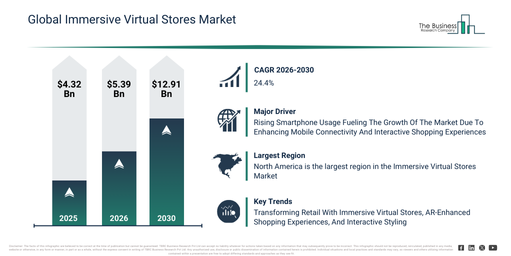
    The market size for immersive virtual stores has witnessed significant expansion in recent years. It is projected to increase from $4.32 billion in 2025 to $5.39 billion in 2026, at a compound annual growth rate (CAGR) of 24.7%. The growth observed in the past can be attributed to a rising demand for interactive online shopping experiences, the growing adoption of augmented reality tools within retail, an increase in the use of three-dimensional product visualization, the global expansion of e-commerce platforms, and a heightened focus from retailers on digital customer engagement.

    The immersive virtual stores market is set for substantial growth over the next few years. It is anticipated to expand to $12.91 billion in 2030, achieving a compound annual growth rate (CAGR) of 24.4%. This projected expansion is driven by the increasing incorporation of virtual reality commerce into omnichannel strategies, a surge in the adoption of cloud-based immersive store platforms, a rising demand for tailored and engaging digital shopping experiences, the expansion of virtual real estate and showroom applications, and greater retailer investment in experiential digital branding. Notable trends during this period include technological advancements in real-time three-dimensional rendering, innovations in artificial intelligence-enabled virtual try-on systems, developments in web-based immersive environments, research and developments in spatial computing and mixed reality, and improvements in three-dimensional content creation pipelines.

    Access Your Free Sample Report for In-Depth Market Insights:

    https://www.thebusinessresearchcompany.com/sample.aspx?id=30617&type=smp

    What Drivers Are Influencing The Growth Of The Immersive Virtual Stores Market?

    The immersive virtual stores market is expected to expand moving forward, driven by the increasing use of smartphones. Smartphones are defined as advanced mobile devices that offer internet connectivity, app functionality, and real-time communication. The rise in smartphone usage is attributed to the rapid growth of mobile internet connectivity, which allows consumers to access online platforms and shop globally from any location at any time. Smartphones enhance immersive virtual stores by providing a portable and interactive platform for both augmented reality and virtual reality shopping experiences. This improves customer engagement and convenience by enabling immediate product visualization, customized recommendations, and seamless online purchasing regardless of where the customer is. For instance, in November 2024, Eurostat, the Luxembourg-based official statistical office of the European Union (EU), reported that in 2023, about 89% of EU residents aged 16–74 residing in cities used their smartphones to access the internet, compared to 86% in towns and suburbs and 82% in rural areas. Therefore, the growing penetration of smartphones is a significant catalyst for the growth of the immersive virtual stores market.

    How Is The Immersive Virtual Stores Market Organized Into Various Segments?

    The immersive virtual stores market covered in this report is segmented –

    1) By Technology Platform: Virtual Reality Based Stores, Augmented Reality Based Stores, Mixed Reality Based Stores, Web-Based Three Dimensional Stores

    2) By Deployment Mode: Cloud-Based, On-Premises

    3) By Application: Retail And E-commerce, Fashion And Apparel, Real Estate, Other Applications

    5) By End User: Retailers, Electronic Commerce Companies, Fashion Brands, Real Estate Companies, Consumer Electronics Companies, Other End Users

    Subsegments:

    1) By Virtual Reality Based Stores: Headset Dependent Full Immersion Stores, Social Virtual Reality Platform Stores, Controller Based Navigation Stores, Room Scale Interactive Stores

    2) By Augmented Reality Based Stores: Marker Based Augmented Reality Stores, Markerless Augmented Reality Stores, Projection Based Augmented Reality Stores, Mobile Application Augmented Reality Stores

    3) By Mixed Reality Based Stores: Holographic Device Enabled Stores, Spatial Computing Platform Stores, Interactive Blended Reality Stores, Wearable Display Integrated Stores

    4) By Web-Based Three Dimensional Stores: Browser Rendered Three Dimensional Stores, Game Engine Powered Web Stores, E-Commerce Platform Integrated Three Dimensional Stores, No Download Instant Access Stores

    What Trends Are Reshaping The Dynamics Of The Immersive Virtual Stores Market?

    Leading companies in the immersive virtual stores market are focusing on developing advanced technologies, such as AR-powered virtual closet environments, to boost customer engagement, improve digital shopping experiences, and bridge the gap between physical and online retail. These immersive AR-enabled virtual closet environments utilize augmented reality and spatial computing platforms, allowing users to explore products in realistic 3D spaces, interact with merchandise intuitively, and experience highly lifelike visuals that replicate in-store browsing digitally. For instance, in February 2024, J.Crew Group Inc., a US-based fashion retailer, launched the J.Crew Virtual Closet app on Apple Vision Pro, bringing an AR-driven virtual closet experience to spatial computing devices. This experience enables users to browse and mix-and-match clothing in a hyper-realistic 3D setting, examine textures and materials at high magnification, and interact with stylists via SharePlay during FaceTime calls. This AR-enhanced virtual store not only enriches product discovery but also facilitates personalized styling and social shopping features that extend beyond traditional e-commerce.

    Who Are The Prominent Global Companies Shaping The Immersive Virtual Stores Market Landscape?

    Major companies operating in the immersive virtual stores market are Alibaba Group Holding Limited, Roblox Corporation, Unity Software Inc., HTC Corporation, Flexsin Technologies Pvt. Ltd., Vection Technologies Ltd., Trigma Solutions Inc., Decentraland Foundation, iCreative Technologies Pvt. Ltd., Esferasoft Solutions Pvt. Ltd., Pixelette Technologies Pvt. Ltd., Innowise Group, ByondXR Ltd., Emperia Ltd., rooom GmbH, KiXR Ltd., Digital Agents Interactive Inc., GlamAR Inc., VB Metaverse Ltd., Obsess Inc., Arimars Technologies Pvt. Ltd.

    Access The Complete Report For Deeper Market Insights:

    https://www.thebusinessresearchcompany.com/report/immersive-virtual-stores-market-report

    Which Geographic Areas Are Emerging As Strong Markets For The Immersive Virtual Stores Market?

    North America was the largest region in the immersive virtual stores market in 2025. Asia-Pacific is expected to be the fastest-growing region in the forecast period. The regions covered in the immersive virtual stores market report are Asia-Pacific, South East Asia, Western Europe, Eastern Europe, North America, South America, Middle East, Africa.

    Request Your Customized Immersive Virtual Stores Market Research Report for Competitive Advantage:

    https://www.thebusinessresearchcompany.com/customise?id=30617&type=smp

    Browse Through More Reports Similar to the Global Immersive Virtual Stores Market 2026, By The Business Research Company

    Virtual Reality Shopping Market Report 2026

    https://www.thebusinessresearchcompany.com/report/virtual-reality-shopping-global-market-report

    Immersive Technology Market Report 2026

    https://www.thebusinessresearchcompany.com/report/immersive-technology-global-market-report

    virtual data room global market report

    https://www.thebusinessresearchcompany.com/report/virtual-data-room-global-market-report

    Get in touch with us:

    The Business Research Company: https://www.thebusinessresearchcompany.com/

    Americas +1 310-496-7795

    Asia +44 7882 955267 & +91 8897263534

    Europe +44 7882 955267

    Email us at marketing@tbrc.info

    Follow us on:

    LinkedIn: https://in.linkedin.com/company/the-business-research-company

    YouTube: https://www.youtube.com/channel/UC24_fI0rV8cR5DxlCpgmyFQ

    Global Market Model: https://www.thebusinessresearchcompany.com/global-market-model
  • Human Behavior Tool Global Forecast: Market to Scale Up to $3.67 Billion by 2030 at 8.2% CAGR

    Human Behavior Tool Global Forecast: Market to Scale Up to $3.67 Billion by 2030 at 8.2% CAGR

    Uncover key drivers, emerging technologies, and competitive movements shaping the human behavior tool market from 2026–2035 with trusted insights from The Business Research Company

    By how much is the Human Behavior Tool Market expected to grow between 2026 and 2030?

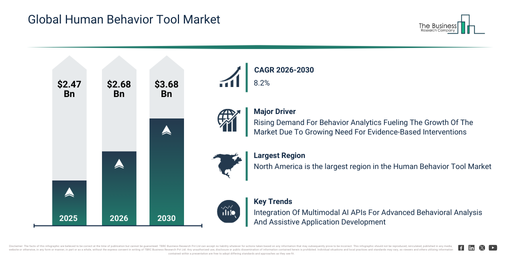
    The human behavior tool market size has demonstrated significant growth in recent years. This market is anticipated to expand from $2.47 billion in 2025 to $2.68 billion in 2026, achieving a compound annual growth rate (CAGR) of 8.5%. The historical growth of this market can be attributed to several factors including an increasing demand for behavioral analytics, a growing focus on employee productivity, the rising adoption of sentiment and emotion analysis tools, the expanding use of user behavior tracking in enterprises, and an increasing need for predictive decision-making.

    The human behavior tool market size is anticipated to experience substantial expansion over the upcoming years. It is projected to reach $3.68 billion by 2030, demonstrating a compound annual growth rate (CAGR) of 8.2%. This projected growth stems from several factors, including the increasing integration of AI and machine learning into behavior analysis, the rising adoption of real-time monitoring platforms, a growing demand for cognitive assessment and predictive modeling, the expanding deployment of cloud-based behavior analytics solutions, and an increasing focus on data-driven human performance optimization. Prominent trends throughout this period are expected to include technological advancements in AI-powered behavioral insights, innovations within predictive modeling platforms, developments in real-time emotion and sentiment analysis, continuous research and development in cognitive assessment algorithms, and further progress in integrated human behavior analytics ecosystems.

    Access Your Free Sample Report for In-Depth Market Insights:

    https://www.thebusinessresearchcompany.com/sample.aspx?id=30614&type=smp

    Which Drivers Are Influencing Market Acceleration In The Human Behavior Tool Market?

    The increasing need for behavior analytics is anticipated to boost the expansion of the human behavior tool market in the future. Behavior analytics involves the structured application of data to comprehend, foresee, and impact human activities and interactions across different settings. The heightened demand for these analytical methods stems from the rising requirement for data-informed choices in areas like healthcare, education, and business administration, aiming for better results and greater efficiency. Human behavior tools facilitate behavior analytics by supplying the necessary software and technological framework to precisely gather, visualize, and analyze intricate behavioral data. As an illustration, in February 2025, the Behavior Analyst Certification Board (BACB), a US-based nonprofit entity, reported that the demand for assistant behavior analysts within the United States saw a 131% rise in 2024 compared to 2023. Consequently, the increased demand for behavior analytics is fueling the development of the human behavior tool market.

    What Segments Are Identified Within The Structure Of The Human Behavior Tool Market?

    The human behavior tool market covered in this report is segmented –

    1) By Component: Software, Services, Hardware

    2) By Deployment Mode: Cloud-Based Or Software as a Service (SaaS), On-Premises

    3) By Technology: Artificial Intelligence, Machine Learning, Data Analytics, Biometrics

    4) By Application Or Use Case: Cybersecurity And Fraud Detection, Customer Experience (CX) And Marketing Optimization, Human Resources (HR) And Talent Management, Psychological Or Clinical Assessment, Education And Training

    5) By End-User Industry: Retail And E-commerce, Banking, Financial Services And Insurance (BFSI), Healthcare And Life Sciences, Technology And Media, Education, Government And Public Sector, Manufacturing, Other Corporate Enterprises

    Subsegments:

    1) By Software: Behavioral Analytics Platforms, Emotion Recognition Software, User Interaction Monitoring Tools, Predictive Behavior Modeling Systems, Real Time Decision Analysis Solutions

    2) By Services: Implementation And Integration Services, Training And Support Services, Consulting And Behavioral Strategy Services, Managed Behavior Analysis Services, Maintenance And Optimization Services

    3) By Hardware: Sensor Enabled Behavior Tracking Devices, Biometric Monitoring Equipment, Wearable Interaction Measurement Tools, Environmental Behavior Capture Units, Cognitive Response Detection Devices

    How Are New Market Trends Shaping The Landscape Of The Human Behavior Tool Market?

    Major companies engaged in the human behavior tool market are prioritizing the development of cutting-edge models, such as multimodal AI application programming interfaces (APIs), to enable more advanced interpretation of behavior and provide enhanced assistive capabilities. Multimodal AI application programming interfaces (APIs) empower developers to create applications that can process and comprehend multiple forms of data, including text, images, and audio, allowing for the analysis of real-world visual cues, evaluation of emotional context, and performance of intricate assistive tasks for users with diverse needs. As an illustration, in November 2023, OpenAI, a US-based artificial intelligence (AI) research organization, launched GPT-4 Turbo with Vision API at its initial DevDay. This platform allows developers to integrate visual analysis functions directly into their applications, enabling the AI to generate captions for images, conduct detailed analysis of real-world scenes, and read documents containing figures. The solution also introduced the Assistants API, which facilitates the creation of specialized AI agents capable of following precise instructions, employing tools, and maintaining persistent memory to support long-term behavioral interactions.

    Which Key Players Are Driving Competition In The Human Behavior Tool Market?

    Major companies operating in the human behavior tool market are International Business Machines Corporation, Qualtrics International Inc., SHL Group Limited, Gallup Inc., Culture Amp Pty Ltd., Predictive Index LLC, HireVue Inc., NeuroLeadership Institute Inc., Hogan Assessment Systems Inc., NeuroSky Inc., Cogito Corporation, Crystal Knows Inc., Neuro-Insight Pty Ltd., Plum.io Inc., iMotions A/S, Sensum Technologies Pvt. Ltd., Humantic AI Inc., Receptiviti Inc., Behavioral Signals Technologies Ltd., Plum Analytics Canada Inc., Emotional Intelligence Appraisal LLC, Finding Mastery Inc.

    Access The Complete Report For Deeper Market Insights:

    https://www.thebusinessresearchcompany.com/report/human-behavior-tool-market-report

    Which Region Is Projected To Lead The Human Behavior Tool Market During The Forecast Period?

    North America was the largest region in the human behaviour tool market in 2025. Asia-Pacific is expected to be the fastest-growing region in the forecast period. The regions covered in the human behavior tool market report are Asia-Pacific, South East Asia, Western Europe, Eastern Europe, North America, South America, Middle East, Africa.

    Request Your Customized Human Behavior Tool Market Research Report for Competitive Advantage:

    https://www.thebusinessresearchcompany.com/customise?id=30614&type=smp

    Browse Through More Reports Similar to the Global Human Behavior Tool Market 2026, By The Business Research Company

    Behavioral Health Software Market Report 2026

    https://www.thebusinessresearchcompany.com/report/behavioral-health-software-global-market-report

    Behavioral And Mental Health Software Market Report 2026

    https://www.thebusinessresearchcompany.com/report/behavioral-and-mental-health-software-global-market-report

    behavioral biometrics global market report

    https://www.thebusinessresearchcompany.com/report/behavioral-biometrics-global-market-report

    Get in touch with us:

    The Business Research Company: https://www.thebusinessresearchcompany.com/

    Americas +1 310-496-7795

    Asia +44 7882 955267 & +91 8897263534

    Europe +44 7882 955267

    Email us at marketing@tbrc.info

    Follow us on:

    LinkedIn: https://in.linkedin.com/company/the-business-research-company

    YouTube: https://www.youtube.com/channel/UC24_fI0rV8cR5DxlCpgmyFQ

    Global Market Model: https://www.thebusinessresearchcompany.com/global-market-model
  • Hospital Command Center Software Market Future Outlook: Strong Growth Expected Toward $4.09 Billion by 2030

    Hospital Command Center Software Market Future Outlook: Strong Growth Expected Toward $4.09 Billion by 2030

    Uncover key drivers, emerging technologies, and competitive movements shaping the hospital command center software market from 2026–2035 with trusted insights from The Business Research Company

    What is the estimated market size of the Hospital Command Center Software Market by the end of 2030?

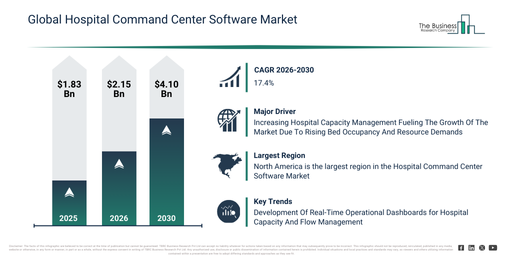
    The hospital command center software market has seen substantial growth recently. It is anticipated to increase from $1.83 billion in 2025 to $2.15 billion in 2026, reflecting a compound annual growth rate (CAGR) of 17.7%. This historical growth can be attributed to several factors, including the increasing need for real-time hospital visibility, the growing adoption of digital health systems, a rising demand for patient flow optimization, the expansion of hospital capacity management initiatives, and a greater emphasis on reducing operational inefficiencies.

    The hospital command center software market is poised for substantial expansion in the coming years, with projections indicating a rise to $4.10 billion by 2030, exhibiting a compound annual growth rate (CAGR) of 17.4%. This anticipated growth during the forecast period is primarily fueled by the increasing integration of artificial intelligence and predictive analytics, growing investments in hospital automation, the escalating demand for scalable cloud-based command centers, the expansion of telehealth and remote monitoring ecosystems, and the urgent requirement for emergency preparedness and rapid response systems. Concurrently, major trends shaping this period include technological advancements in AI-driven workflow automation, innovations within unified hospital command platforms, the development of cloud-native healthcare orchestration tools, increasing research and development in real-time operational analytics, and a greater adoption of interoperability and data integration standards.

    Access Your Free Sample Report for In-Depth Market Insights:

    https://www.thebusinessresearchcompany.com/sample.aspx?id=30610&type=smp

    What Drivers Are Shaping Future Opportunities In The Hospital Command Center Software Market?

    A growing emphasis on hospital capacity management is anticipated to drive expansion in the hospital command center software market moving forward. This management involves the strategic planning and operational supervision of hospital resources, including beds and personnel, to efficiently accommodate patient demand. The heightened attention to hospital capacity management stems from increasing patient numbers alongside limited beds, staff, and budgets, compelling hospitals to optimize resource utilization for consistent, secure, and economical care. Hospital command center software aids this by consolidating data from diverse departments, offering a comprehensive operational overview that facilitates improved decision-making and resource distribution. For example, in January 2024, the National Health Service (NHS) England, a UK-based publicly funded healthcare system, reported meeting its objective of adding 5,000 permanent core beds by early 2024, surpassing a 2022-23 baseline of 94,500 core beds, and attaining an average of 99,750 core beds by the week ending January 21, 2024. Consequently, the expansion of hospital capacity management is fueling the growth of the hospital command center software market.

    Which Segments Are Gaining Traction In The Hospital Command Center Software Market?

    The hospital command center software market covered in this report is segmented –

    1) By Component: Software, Services

    2) By Deployment Mode: On-Premises, Cloud-Based

    3) By Application: Patient Flow Management, Resource Allocation, Bed Management, Emergency Response, Operational Analytics, Other Applications

    4) By End-User: Hospitals, Specialty Clinics, Ambulatory Surgical Centers, Other End-Users

    Subsegments:

    1) By Software: Hospital Information Management Software, Patient Flow Software, Resource Scheduling Software, Bed Management Software, Emergency Response Software, Operational Analytics Software

    2) By Services: Implementation Services, Training And Support Services, Maintenance Services, Cloud Hosting Services, Data Analytics Services, Telehealth Integration Services

    Which Trends Are Expected To Influence The Hospital Command Center Software Market In The Upcoming Years?

    Leading companies in the hospital command center software market are concentrating on developing advanced solutions, such as real-time predictive analytics, to enhance operational efficiency, patient flow, and clinical decision-making across health systems. Real-time predictive analytics involves software-driven functionalities that continuously collect and analyze live hospital data to forecast demand, identify constraints, and enable proactive operational interventions. For instance, in October 2024, GE HealthCare Technologies Inc., a US-based medical technology company, unveiled the Hospital Pulse Tile for its Command Center Software. This introduction integrates real-time predictive analytics to provide system-wide insight into capacity, staffing, patient throughput, and care delivery performance. The Command Center utilizes advanced analytics and AI to convert complex hospital data into actionable intelligence, allowing leaders to anticipate surges, optimize resource allocation, and lessen delays in care.

    Who Are The Top-Performing Companies In The Hospital Command Center Software Market In Recent Years?

    Major companies operating in the hospital command center software market are Oracle Corporation, GE HealthCare Technologies Inc., Koninklijke Philips N.V., Baxter International Inc., Palantir Technologies Inc., Epic Systems Corporation, Getinge AB, Dedalus Group S.p.A., Ascom Holding AG, Biofourmis Inc., TeleTracking Technologies Inc., Qmatic Group AB, LeanTaaS Inc., CenTrak Inc., Qventus Inc., Spok Holdings Inc., Alcidion Group Limited, Connexall Corporation, Q-nomy Inc., ABOUT Healthcare Inc., Zebra Technologies Corporation

    Access The Complete Report For Deeper Market Insights:

    https://www.thebusinessresearchcompany.com/report/hospital-command-center-software-market-report

    Which Region Currently Holds The Largest Share Of The Hospital Command Center Software Market?

    North America was the largest region in the hospital command center software market in 2025. Asia-Pacific is expected to be the fastest-growing region in the forecast period. The regions covered in the hospital command center software market report are Asia-Pacific, South East Asia, Western Europe, Eastern Europe, North America, South America, Middle East, Africa.

    Request Your Customized Hospital Command Center Software Market Research Report for Competitive Advantage:

    https://www.thebusinessresearchcompany.com/customise?id=30610&type=smp

    Browse Through More Reports Similar to the Global Hospital Command Center Software Market 2026, By The Business Research Company

    Hospital Information System Market Report 2026

    https://www.thebusinessresearchcompany.com/report/hospital-information-system-global-market-report

    Medical Software Market Report 2026

    https://www.thebusinessresearchcompany.com/report/medical-software-global-market-report

    healthcare quality management software global market report

    https://www.thebusinessresearchcompany.com/report/healthcare-quality-management-software-global-market-report

    Get in touch with us:

    The Business Research Company: https://www.thebusinessresearchcompany.com/

    Americas +1 310-496-7795

    Asia +44 7882 955267 & +91 8897263534

    Europe +44 7882 955267

    Email us at marketing@tbrc.info

    Follow us on:

    LinkedIn: https://in.linkedin.com/company/the-business-research-company

    YouTube: https://www.youtube.com/channel/UC24_fI0rV8cR5DxlCpgmyFQ

    Global Market Model: https://www.thebusinessresearchcompany.com/global-market-model
  • Revenue of the Horizontal Leg Flexion Trainer Market Predicted to Achieve $1.39 Billion by 2030, Driven by 8.7% CAGR

    Revenue of the Horizontal Leg Flexion Trainer Market Predicted to Achieve $1.39 Billion by 2030, Driven by 8.7% CAGR

    Uncover key drivers, emerging technologies, and competitive movements shaping the horizontal leg flexion trainer market from 2026–2035 with trusted insights from The Business Research Company

    What was the valuation of the Horizontal Leg Flexion Trainer Market in 2026, and what figure is it projected to hit by 2030?

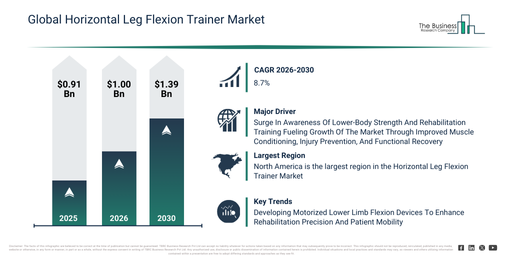
    The horizontal leg flexion trainer market has demonstrated robust expansion in recent years. It is anticipated to increase from $0.91 billion in 2025 to $1.00 billion in 2026, achieving a compound annual growth rate (CAGR) of 9.0%. This historical expansion can be ascribed to several factors, including the increasing demand for fitness equipment in gyms, a rising interest in lower-body strength training, an expanding awareness of injury prevention exercises, the growing adoption of rehabilitation machines, and the increasing popularity of sports conditioning programs.

    The market for horizontal leg flexion trainers is anticipated to demonstrate robust growth over the next few years. It is projected to expand to $1.39 billion in 2030, at a compound annual growth rate (CAGR) of 8.7%. The expansion foreseen for this period can be attributed to the increasing prevalence of gym memberships, a rising preference for improving leg strength, the integration of advanced rehabilitation equipment, the development of sports performance training, and higher investments in premium fitness machines. Noteworthy trends during this forecast period include advancements in adjustable resistance technology, improvements in ergonomic machine design, progress in durability and material engineering, new developments in compact training equipment, and innovations in professional athletic training tools.

    Access Your Free Sample Report for In-Depth Market Insights:

    https://www.thebusinessresearchcompany.com/sample.aspx?id=30609&type=smp

    Which Drivers Are Affecting Market Participation In The Horizontal Leg Flexion Trainer Market?

    The increasing understanding regarding the importance of lower-body strength and rehabilitation training is projected to fuel the expansion of the horizontal leg flexion trainer market in the future. This training involves structured exercises and programs specifically designed to enhance the strength, flexibility, and functional recovery of leg muscles, such as the quadriceps, hamstrings, and hip flexors. This heightened awareness stems from a rise in public health campaigns and medical recommendations highlighting the significance of muscle-strengthening activities for preventing injuries, boosting mobility, and promoting general physical well-being. Horizontal leg flexion trainers facilitate this trend by providing a controlled, low-impact option suitable for lower-body strengthening and rehabilitation, especially within clinical, physiotherapy, and specialized fitness environments, consistent with wider exercise guidelines. As an illustration, data from December 2023, reported by the U.S. Centers for Disease Control and Prevention (CDC), a U.S.-based government public health authority, indicated that 24% of adults fulfilled the recommended muscle-strengthening activity guidelines in 2023. This marks an increase from 21% in 2022, representing a rise of 3 percentage points, or approximately 14% year-on-year. Consequently, the increased understanding and importance placed on lower-body strength and rehabilitation training is propelling the expansion of the horizontal leg flexion trainer market.

    What Segment Categories Are Covered In The Horizontal Leg Flexion Trainer Market?

    The horizontal leg flexion trainer market covered in this report is segmented –

    1) By Product Type: Standard Horizontal Leg Flexion Trainers, Smart Horizontal Leg Flexion Trainers, Adjustable Horizontal Leg Flexion Trainers

    2) By Distribution Channel: Online Stores, Specialty Stores, Supermarkets Or Hypermarkets, Other Distribution Channels

    3) By Application: Rehabilitation Centers, Fitness Centers, Home Use, Hospitals, Other Applications

    4) By End-User: Adults, Geriatric, Athletes, Other End-Users

    Subsegments:

    1) By Standard Horizontal Leg Flexion Trainers: Plate-loaded trainers, Pin-loaded (selectorized) trainers, Fixed-resistance trainers, Standard gym-grade benches, Basic home-use flexion trainers, Non-digital resistance trainers, Single-function flexion machines

    2) By Smart Horizontal Leg Flexion Trainers: App-connected trainers, Bluetooth-enabled trainers, AI-guided training systems, Smart resistance-adjusting machines, Performance-tracking trainers, Cloud-integrated fitness units, Interactive screen-based trainers

    3) By Adjustable Horizontal Leg Flexion Trainers: Multi-resistance adjustable trainers, Adjustable angle or seat-position trainers, Multi-function strength machines with flexion mode, Manual-adjust resistance models, Hydraulic-adjustable trainers, Commercial-grade adjustable units, Adjustable home-use trainers

    What Trends Are Driving The Growth Trajectory Of The Horizontal Leg Flexion Trainer Market?

    Major companies within the rehabilitation and therapeutic exercise equipment market are increasingly concentrating on the development of motorized solutions for lower limb flexion, encompassing multifunction physiotherapy devices that incorporate powered leg flexion systems. These advanced solutions are engineered to deliver exact and consistent leg flexion movements, fostering enhancements in patient strength and mobility, concurrently alleviating physical exertion for therapists during rehabilitation sessions. Powered leg flexion systems denote technological components in rehabilitation equipment that employ electric motors or actuators to execute regulated flexion and extension movements of the lower limbs, thereby facilitating standardized therapy protocols and uniform treatment delivery. For instance, in January 2025, AGILIS, a medical device company based in the U.S., unveiled multifunction physiotherapy tables featuring powered lower limb flexion systems, which have received U.S. FDA 510(k)-clearance for use in clinical settings. Designed to aid postoperative rehabilitation and improve mobility, these devices incorporate 24 Vdc electric motors to ensure consistent powered flexion, provide both manual and electrical adjustment options, and permit configurations for linear and rotational lower limb movements to meet individual therapy requirements.

    Which Leading Companies Dominate The Horizontal Leg Flexion Trainer Market Share?

    Major companies operating in the horizontal leg flexion trainer market are Johnson Health Tech, Technogym SpA, Life Fitness Inc., Rogue Fitness, Precor Inc., Cybex International, Impulse Health Tech, Matrix Fitness, SportsArt Inc., Shuhua Co. Ltd., Panatta Srl, Body-Solid Inc., TRUE Fitness Technology Inc., HOIST Fitness Systems Inc., BH Fitness, Yanre Fitness, DHZ Fitness GmbH, Nautilus Inc., Unique Gym Equipment Pvt. Ltd., Kraftathlet

    Access The Complete Report For Deeper Market Insights:

    https://www.thebusinessresearchcompany.com/report/horizontal-leg-flexion-trainer-market-report

    How Does The Horizontal Leg Flexion Trainer Market Perform Across Major Global Regions?

    North America was the largest region in the horizontal leg flexion trainer market in 202. Asia-Pacific is expected to be the fastest-growing region in the forecast period. The regions covered in the horizontal leg flexion trainer market report are Asia-Pacific, South East Asia, Western Europe, Eastern Europe, North America, South America, Middle East, Africa.

    Request Your Customized Horizontal Leg Flexion Trainer Market Research Report for Competitive Advantage:

    https://www.thebusinessresearchcompany.com/customise?id=30609&type=smp

    Browse Through More Reports Similar to the Global Horizontal Leg Flexion Trainer Market 2026, By The Business Research Company

    Personal Fitness Trainer Market Report 2026

    https://www.thebusinessresearchcompany.com/report/personal-fitness-trainer-global-market-report

    Foot And Ankle Devices Market Report 2026

    https://www.thebusinessresearchcompany.com/report/foot-and-ankle-devices-global-market-report

    flexion tires global market report

    https://www.thebusinessresearchcompany.com/report/flexion-tires-global-market-report

    Get in touch with us:

    The Business Research Company: https://www.thebusinessresearchcompany.com/

    Americas +1 310-496-7795

    Asia +44 7882 955267 & +91 8897263534

    Europe +44 7882 955267

    Email us at marketing@tbrc.info

    Follow us on:

    LinkedIn: https://in.linkedin.com/company/the-business-research-company

    YouTube: https://www.youtube.com/channel/UC24_fI0rV8cR5DxlCpgmyFQ

    Global Market Model: https://www.thebusinessresearchcompany.com/global-market-model
  • Home Spirometry With Bluetooth Integration Sector Forecast Shows Robust Momentum, Climbing to $2.85 Billion With 11.9% CAGR

    Home Spirometry With Bluetooth Integration Sector Forecast Shows Robust Momentum, Climbing to $2.85 Billion With 11.9% CAGR

    Uncover key drivers, emerging technologies, and competitive movements shaping the home spirometry with bluetooth integration market from 2026–2035 with trusted insights from The Business Research Company

    What are the forecasted starting (2026) and ending (2030) market sizes for the Home Spirometry With Bluetooth Integration Market?

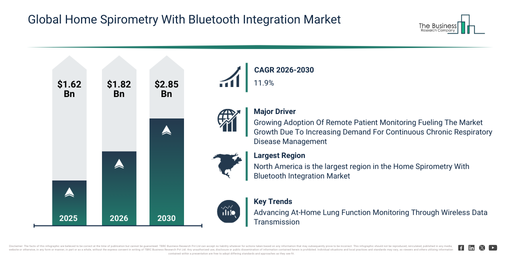
    The market for home spirometry with bluetooth integration has demonstrated rapid expansion in recent years. This sector is forecast to increase from $1.62 billion in 2025 to $1.82 billion in 2026, achieving a compound annual growth rate (CAGR) of 12.1%. The growth observed in prior periods can be attributed to several factors, including the rising incidence of respiratory diseases, the growing adoption of home-based healthcare devices, increased public awareness concerning lung health surveillance, the expanded utilization of portable spirometers, and the enhanced integration of wireless health monitoring systems.

    The market for home spirometry featuring Bluetooth integration is projected to experience substantial expansion over the upcoming years. Its valuation is anticipated to reach $2.85 billion by 2030, demonstrating a compound annual growth rate (CAGR) of 11.9%. This expansion during the prediction period is largely due to factors such as the increasing need for remote patient observation, the wider acceptance of medical devices equipped with Bluetooth, the enhanced incorporation of AI and predictive analytics in managing respiratory conditions, the broader implementation of cloud-based health data platforms, and a heightened focus on telehealth solutions centered around the patient. Key developments expected throughout this period encompass technological progress in Bluetooth-enabled spirometry devices, breakthroughs in AI-powered respiratory analytics, enhancements in cloud-based systems for patient monitoring, ongoing research and development efforts in portable diagnostic tools, and improvements in the integration and reporting of real-time health data.

    Access Your Free Sample Report for In-Depth Market Insights:

    https://www.thebusinessresearchcompany.com/sample.aspx?id=30608&type=smp

    What Drivers Are Supporting Technological Adoption In The Home Spirometry With Bluetooth Integration Market?

    The expanding utilization of remote patient monitoring is projected to stimulate the growth of the home spirometry with Bluetooth integration market moving forward. Remote patient monitoring involves the deployment of connected medical devices and digital platforms to collect, transmit, and analyze patient health data outside conventional clinical environments, thereby supporting the continuous management of chronic conditions. The uptake of remote patient monitoring is increasing due to the rising prevalence of chronic respiratory diseases, as continuous oversight helps in managing symptoms and preventing hospitalizations. Home spirometry with Bluetooth integration facilitates remote patient monitoring by enabling patients to track lung function from home and directly transmit data to healthcare providers. This enhances disease management and patient outcomes by allowing for the early detection of respiratory issues and timely intervention. For instance, a December 2025 report by Intuition Labs, a US-based healthcare technology company, reveals that nearly 50 million Americans are already using some form of remote patient monitoring device. Additionally, 80% of Americans hold a favorable view towards integrating remote patient monitoring into medical care, and by 2025, it is expected that over 71 million Americans, representing 26% of the population, will be utilizing some form of remote patient monitoring service. Consequently, the increasing adoption of remote patient monitoring is propelling the expansion of the home spirometry with Bluetooth integration market.

    Which Segments Are Contributing To The Growth Of The Home Spirometry With Bluetooth Integration Market?

    The home spirometry with bluetooth integration market covered in this report is segmented –

    1) By Product Type: Handheld Spirometers, Tabletop Spirometers, Wearable Spirometers

    2) By Connectivity: Bluetooth, Wi-Fi, Universal Serial Bus (USB)

    3) By Distribution Channel: Online, Offline

    4) By Application: Chronic Obstructive Pulmonary Disease (COPD), Asthma, Cystic Fibrosis, Other Applications

    5) By End-User: Hospitals And Clinics, Homecare Settings, Diagnostic Centers, Other End-Users

    Subsegments:

    1) By Handheld Spirometers: Portable Lung Function Measurement Devices, Battery Operated Spirometry Units, Compact Home Monitoring Spirometers, Bluetooth Enabled Handheld Spirometers, Real Time Data Transmission Spirometry Devices

    2) By Tabletop Spirometers: Desktop Pulmonary Function Testing Units, Clinical Grade Tabletop Spirometry Devices, Multi Parameter Respiratory Assessment Systems, Bluetooth Integrated Desktop Spirometers, High Accuracy Stationary Spirometry Units

    3) By Wearable Spirometers: Continuous Respiratory Monitoring Devices, Smart Wrist Or Chest Mounted Spirometers, Bluetooth Connected Wearable Spirometry Units, Daily Activity Integrated Respiratory Monitors, Lightweight Home Use Wearable Spirometers

    What Upcoming Trends Are Likely To Define The Future Path Of The Home Spirometry With Bluetooth Integration Market?

    Leading firms within the home spirometry with Bluetooth integration market are concentrating on creating sophisticated offerings, particularly bluetooth-enabled spirometers, aimed at improving lung function tracking from home, simplifying data gathering, and facilitating remote clinical supervision. These bluetooth-enabled spirometers are devices designed to measure various respiratory indicators, such as airflow and lung volume, and then wirelessly relay this information to mobile phones, tablets, or cloud-based systems, allowing patients and medical professionals to access it in real time. An example illustrating this trend is Clario, a clinical technology company based in the US, which obtained FDA 510(k) clearance in June 2024 for its SpiroSphere system, featuring integration with a wireless ECG device. This particular system enables concurrent monitoring of both spirometry and cardiac data, facilitates automatic data transmission using Bluetooth, and provides real-time tracking capabilities via its mobile applications. Such functionalities aid in precise remote health monitoring, contribute to the prompt identification of respiratory problems, and support streamlined clinical workflow management. This marks a notable progression in at-home respiratory healthcare, bringing together ease of use, integrated data capabilities, and dependable clinical performance.

    Who Are The Major Companies Operating In The Home Spirometry With Bluetooth Integration Market?

    Major companies operating in the home spirometry with bluetooth integration market are Contec Medical Systems Co. Ltd., Vyaire Medical Inc., Schiller AG, Vitalograph Ltd., COSMED S.r.l., SDI Diagnostics Inc., NDD Medizintechnik AG, Futuremed America Inc., NuvoAir AB, Cohero Health Inc., Smiths Medical International Ltd., Sibelmed S.L.U., Uscom Ltd., e-LinkCare Meditech Co. Ltd., CMI Health Inc., Medikro Oy, Icen Technology Co. Ltd., HealthUp S.A., Fukuda Sangyo Co. Ltd., Smart Respiratory Products Ltd.

    Access The Complete Report For Deeper Market Insights:

    https://www.thebusinessresearchcompany.com/report/home-spirometry-with-bluetooth-integration-market-report

    Which Region Is Anticipated To See The Fastest Growth In The Home Spirometry With Bluetooth Integration Market?

    North America was the largest region in the home spirometry with bluetooth integration market in 2025. Asia-Pacific is expected to be the fastest-growing region in the forecast period. The regions covered in the home spirometry with bluetooth integration market report are Asia-Pacific, South East Asia, Western Europe, Eastern Europe, North America, South America, Middle East, Africa.

    Request Your Customized Home Spirometry With Bluetooth Integration Market Research Report for Competitive Advantage:

    https://www.thebusinessresearchcompany.com/customise?id=30608&type=smp

    Browse Through More Reports Similar to the Global Home Spirometry With Bluetooth Integration Market 2026, By The Business Research Company

    Spirometer Market Report 2026

    https://www.thebusinessresearchcompany.com/report/spirometer-global-market-report

    Respiratory Monitoring Devices Market Report 2026

    https://www.thebusinessresearchcompany.com/report/respiratory-monitoring-devices-global-market-report

    distance health technology global market report

    https://www.thebusinessresearchcompany.com/report/distance-health-technology-global-market-report

    Get in touch with us:

    The Business Research Company: https://www.thebusinessresearchcompany.com/

    Americas +1 310-496-7795

    Asia +44 7882 955267 & +91 8897263534

    Europe +44 7882 955267

    Email us at marketing@tbrc.info

    Follow us on:

    LinkedIn: https://in.linkedin.com/company/the-business-research-company

    YouTube: https://www.youtube.com/channel/UC24_fI0rV8cR5DxlCpgmyFQ

    Global Market Model: https://www.thebusinessresearchcompany.com/global-market-model
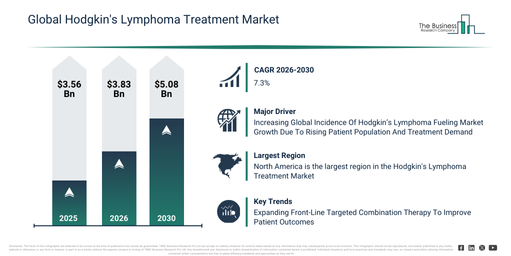
  • Hodgkin’s Lymphoma Treatment Market Anticipated to Record Steady Gains, Advancing to $5.07 Billion by 2030

    Hodgkin’s Lymphoma Treatment Market Anticipated to Record Steady Gains, Advancing to $5.07 Billion by 2030

    Uncover key drivers, emerging technologies, and competitive movements shaping the hodgkin’s lymphoma treatment market from 2026–2035 with trusted insights from The Business Research Company

    What upper market value could the Hodgkin’s Lymphoma Treatment Market reach by 2030 starting from 2026 levels?

    The hodgkin’s lymphoma treatment market has experienced robust expansion in recent years. It is anticipated to grow from $3.56 billion in 2025 to $3.83 billion in 2026, demonstrating a compound annual growth rate (CAGR) of 7.6%. This historical upward trend can be attributed to several factors including a higher incidence of hodgkin’s lymphoma, improved awareness and early diagnostic capabilities, the increasing adoption of chemotherapy and radiation therapy, the expansion of oncology healthcare infrastructure, and rising government funding dedicated to cancer research.

    The hodgkin’s lymphoma treatment market size anticipates significant expansion over the coming years. It will grow to $5.08 billion in 2030 at a compound annual growth rate (CAGR) of 7.3%. This projected growth during the forecast period is due to factors such as increased uptake of immunotherapy and targeted therapies, wider access to stem cell transplantation, a growing inclination among patients for customized treatments, the expansion of oncology facilities in developing regions, and enhanced insurance coverage alongside reimbursement assistance. Key developments expected during this period involve technological progress in diagnostic imaging, breakthroughs in immunotherapy and targeted therapeutic approaches, advancements in less invasive treatment modalities, ongoing research and development in stem cell transplantation, and the incorporation of digital health solutions and telemedicine for post-treatment monitoring.

    Access Your Free Sample Report for In-Depth Market Insights:

    https://www.thebusinessresearchcompany.com/sample.aspx?id=30607&type=smp

    Which Drivers Are Influencing Long-Term Growth In The Hodgkin’s Lymphoma Treatment Market?

    The future expansion of the Hodgkin’s lymphoma treatment market is anticipated to be fueled by the rising occurrence of Hodgkin’s lymphoma. This condition, Hodgkin’s lymphoma, is a malignancy of the lymphatic system marked by unusual Reed–Sternberg cells found in lymph nodes, typically impacting B-lymphocytes, and often manifests through symptoms like painless enlarged glands, fever, night sweats, and weight loss. The growing prevalence of Hodgkin’s lymphoma is attributed to increased exposure to various risk factors, including smoking, obesity, and hypertension, alongside evolving socioeconomic circumstances across numerous regions, leading to a higher frequency of the disease over time. Treatments for Hodgkin’s lymphoma are instrumental in managing the disease by targeting and eradicating cancerous lymphocytes via methods such as chemotherapy, radiation, or immunotherapy. These interventions enhance patient prognosis by slowing disease progression, achieving remission, and improving overall survival rates. For example, projections from the American Cancer Society, a US-based nonprofit organization, indicate that in October 2025, Hodgkin lymphoma in the United States is projected to total approximately 8,720 new cases, comprising 4,840 in males and 3,880 in females, and around 1,150 fatalities, consisting of 720 males and 430 females. Consequently, the escalating incidence of Hodgkin’s lymphoma is a key factor propelling the expansion of the Hodgkin’s lymphoma treatment market.

    How Is The Hodgkin’s Lymphoma Treatment Market Divided Into Segments?

    The hodgkin’s lymphoma treatment market covered in this report is segmented –

    1) By Type of Treatment: Chemotherapy, Radiation Therapy, Targeted Therapy, Immunotherapy

    2) By Disease Type: Classical Hodgkin Lymphoma (CHL), Nodular Lymphocyte-Predominant Hodgkin Lymphoma (NLPHL)

    3) By Treatment Stage: Early-Stage, Advanced-Stage, Relapsed

    4) By Stem Cell Transplantation: Autologous Stem Cell Transplant, Allogeneic Stem Cell Transplant

    5) By End-Use: Hospitals, Specialty Clinics, Cancer Centers, Ambulatory Care Centers, Home Healthcare Services

    Subsegments:

    1) By Chemotherapy: Combination Chemotherapy, Single Agent Chemotherapy, High Dose Chemotherapy with Stem Cell Transplantation

    2) By Radiation Therapy: External Beam Radiation Therapy, Proton Beam Radiation Therapy, Intensity Modulated Radiation Therapy

    3) By Targeted Therapy: Monoclonal Antibody Therapy, Antibody Drug Conjugate Therapy, Small Molecule Inhibitor Therapy

    4) By Immunotherapy: Immune Checkpoint Inhibitor Therapy, Chimeric Antigen Receptor T Cell Therapy, Cytokine Based Immunotherapy

    Which Trends Are Shaping Activity Within The Hodgkin’s Lymphoma Treatment Market?

    Leading companies in the Hodgkin’s lymphoma treatment market are concentrating on developing advanced treatments, including front-line targeted combination therapies. Their aim is to enhance treatment effectiveness, reduce treatment-related morbidity, and expand initial treatment options for individuals with advanced stages of the disease. These front-line targeted combination therapies involve the concurrent application of two or more precision medicines as the primary treatment. This strategy is designed to simultaneously target multiple disease-driving pathways, thereby improving response rates and delaying the onset of resistance in newly diagnosed patients. For example, in June 2025, Takeda, a pharmaceutical firm based in Japan, secured European Commission approval for ADCETRIS when used in combination with etoposide, cyclophosphamide, doxorubicin, dacarbazine, and dexamethasone (ECADD). This approval is for adults diagnosed with Stage IIb with risk factors, Stage III, or Stage IV Hodgkin lymphoma. The decision was based on results from the Phase 3 HD21 trial, which revealed superior safety and non-inferior progression-free survival compared to standard eBEACOPP chemotherapy. This particular front-line targeted combination therapy is characterized by a targeted ADC backbone, a chemotherapy-optimized regimen designed to lower acute toxicity, and expanded indications into frontline treatment, marking a significant advancement in Hodgkin’s lymphoma care.

    Which Major Firms Are Strengthening Their Position In The Hodgkin’s Lymphoma Treatment Market?

    Major companies operating in the hodgkin’s lymphoma treatment market are F. Hoffmann-La Roche Ltd., Merck & Co. Inc., Pfizer Inc., Novartis AG, AstraZeneca plc, Bristol-Myers Squibb Company, Takeda Pharmaceutical Company Limited, Gilead Sciences Inc., Ono Pharmaceutical Co. Ltd., Jiangsu Hengrui Medicine Co. Ltd., Seagen Inc., Zhejiang Hisun Pharmaceutical Co. Ltd., BeiGene Ltd., Innovent Biologics Inc., HUTCHMED (China) Limited, Aurigene Discovery Technologies Limited, ADC Therapeutics SA, CStone Pharmaceuticals, Emcure Pharmaceuticals Ltd., Sorrento Therapeutics Inc.

    Access The Complete Report For Deeper Market Insights:

    https://www.thebusinessresearchcompany.com/report/hodgkins-lymphoma-treatment-market-report

    Which Region Shows The Strongest Potential For Future Expansion In The Hodgkin’s Lymphoma Treatment Market?

    North America was the largest region in the hodgkin’s lymphoma treatment market in 2025. Asia-Pacific is expected to be the fastest-growing region in the forecast period. The regions covered in the hodgkin’s lymphoma treatment market report are Asia-Pacific, South East Asia, Western Europe, Eastern Europe, North America, South America, Middle East, Africa.

    Request Your Customized Hodgkin’s Lymphoma Treatment Market Research Report for Competitive Advantage:

    https://www.thebusinessresearchcompany.com/customise?id=30607&type=smp

    Browse Through More Reports Similar to the Global Hodgkin’s Lymphoma Treatment Market 2026, By The Business Research Company

    Non Hodgkin Lymphoma Nhl Market Report 2026

    https://www.thebusinessresearchcompany.com/report/non-hodgkin-lymphoma-nhl-global-market-report

    Non Hodgkin Lymphoma Nhl Market Report 2026

    https://www.thebusinessresearchcompany.com/report/non-hodgkin-lymphoma-nhl-global-market-report

    emphysema global market report

    https://www.thebusinessresearchcompany.com/report/emphysema-global-market-report

    Get in touch with us:

    The Business Research Company: https://www.thebusinessresearchcompany.com/

    Americas +1 310-496-7795

    Asia +44 7882 955267 & +91 8897263534

    Europe +44 7882 955267

    Email us at marketing@tbrc.info

    Follow us on:

    LinkedIn: https://in.linkedin.com/company/the-business-research-company

    YouTube: https://www.youtube.com/channel/UC24_fI0rV8cR5DxlCpgmyFQ

    Global Market Model: https://www.thebusinessresearchcompany.com/global-market-model