Hereditary Genetic Testing Market Growth To $40.12 Billion By 2030: What’s Driving The Expansion?
Built to provide research that’s more actionable and strategically valuable, The Business Research Company’s 2026 market reports include market attractiveness analysis, total addressable market sizing, company benchmarking matrices, interactive Excel dashboards, broader supply chain intelligence, emerging startup tracking, and in-depth product insights.
Hereditary Genetic Testing Market Size Outlook: How Quickly Will Revenue Expand Through 2030?
The hereditary genetic testing market has experienced rapid expansion in recent years. This market is projected to increase from $23.88 billion in 2025 to $26.56 billion in 2026, achieving a compound annual growth rate (CAGR) of 11.2%. Historically, the growth of this market can be attributed to several factors, including the increasing prevalence of hereditary disorders, the growing clinical adoption of molecular diagnostics, the expansion of diagnostic laboratories, rising awareness of genetic diseases, and the availability of basic genetic testing technologies.
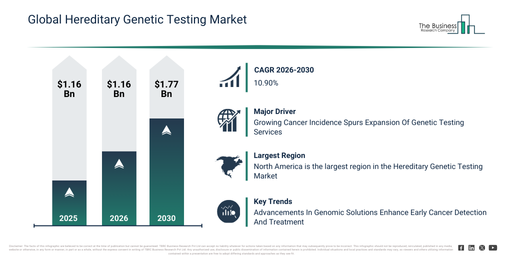
The hereditary genetic testing market is expected to witness significant expansion over the next few years, with its valuation projected to reach $40.12 billion in 2030, growing at a compound annual growth rate (CAGR) of 10.9%. This anticipated growth throughout the forecast period stems from advancements in next-generation sequencing technologies, an escalating demand for personalized medicine, the broadening scope of pharmacogenomic applications, increased healthcare spending on preventive care, and the wider integration of genetic counseling services. Noteworthy trends anticipated during this period include a rising adoption of preventive and predictive genetic testing, a growing need for early cancer risk assessment, the expansion of direct-to-consumer genetic testing services, an increase in prenatal and newborn genetic screening, and heightened awareness of inherited cardiovascular and rare diseases.
Get A Free Sample Report With In-Depth Market Insights:
Hereditary Genetic Testing Market Expansion Drivers: What’s Shaping Future Growth?
The rising incidence of cancer is set to drive the growth of the hereditary genetic testing market moving forward. Cancer describes a range of conditions defined by uncontrolled cell division that can invade or spread to other areas of the body. The increasing occurrence of cancer can be linked to factors such as an aging demographic, evolving lifestyles, environmental contaminants, genetic predispositions, and enhanced diagnostic techniques. Hereditary genetic testing assists in cancer prevention by identifying genetic mutations connected to elevated risk, allowing for early detection and specific preventive approaches. For instance, in August 2024, the Macmillan Cancer Support, a UK-based organization, reported that in 2024, more than 3 million people in the UK are living with cancer. This figure is projected to increase to 3.5 million by 2025, 4 million by 2030, and 5.3 million by 2040. Therefore, the expanding prevalence of cancer is fueling the growth of the hereditary genetic testing market.
Hereditary Genetic Testing Market Segment Analysis: What Are The Core Market Categories?
The hereditary genetic testing market covered in this report is segmented –
1) By Type: Predictive And Presymptomatic Testing, Carrier Testing, Prenatal And Newborn Testing, Diagnostic Testing, Pharmacogenomic Testing, Other Types
2) By Technology: Cytogenetic Testing, Biochemical Testing, Molecular Testing
3) By Clinical Application: Cancer Genetic Testing, Cardiovascular Genetic Testing, Neurological Genetic Testing, Rare Diseases Genetic Testing
4) By End User: Hospitals And Clinics, Diagnostic Laboratories, Research Institutes, Direct To Consumer (DTC) Genetic Testing Companies
Subsegments:
1) By Predictive And Presymptomatic Testing: Genetic Testing For Disease Risk Prediction, Testing For Inherited Cancer Risks, Cardiovascular Disease Risk Testing, Neurodegenerative Disease Risk Testing
2) By Carrier Testing: Testing For Inherited Genetic Disorders, Genetic Screening For Autosomal Recessive Diseases, Testing For Carrier Status Of Inherited Conditions
3) By Prenatal and Newborn Testing: Non-Invasive Prenatal Testing (NIPT), Amniocentesis and Chorionic Villus Sampling (CVS), Newborn Screening For Genetic Disorders, Preconception Genetic Screening
4) By Diagnostic Testing: Genetic Testing For Confirming Suspected Genetic Disorders, Testing For Inherited Syndromes And Congenital Diseases, Diagnostic Testing For Cancer And Tumor Profiling
5) By Pharmacogenomic Testing: Genetic Testing For Drug Response And Efficacy, Testing For Drug Sensitivities And Side Effects, Personalized Medicine And Treatment Optimization
6) By Other Types: Genetic Testing For Wellness And Lifestyle, Genetic Testing For Ancestry And Genealogy, Research-Oriented Genetic Testing
Hereditary Genetic Testing Market Strategic Trends: What Defines The Next Growth Phase?
Companies operating prominently in the hereditary genetic testing market are prioritizing the development of advanced genomic solutions, such as multi-cancer multigene panels, to improve early disease detection and offer more personalized treatment options. These multi-cancer multigene panels are diagnostic tools designed to simultaneously analyze multiple genes to identify genetic mutations linked to various types of cancer, thereby assisting in prompt diagnosis and customized therapies. For example, in February 2024, Exact Sciences Corporation, a US-based provider of cancer screening and diagnostic tests, introduced the Riskguard hereditary cancer test. The Riskguard test generates a personalized report on both gene-specific and familial cancer risks for 10 common cancers, requiring only a simple blood or saliva sample. It helps individuals understand their cancer risk, informs decisions regarding screening and treatment plans, and enables the assessment of family risks. Moreover, it aids in tailoring treatment for patients already diagnosed with cancer and refines risk stratification for those with a family history of cancer by pinpointing actionable gene variants.
Hereditary Genetic Testing Market Competitive Overview And Top Companies
Major companies operating in the hereditary genetic testing market are F. Hoffmann‑La Roche Ltd., Abbott Laboratories, Laboratory Corporation of America Holdings, Quest Diagnostics Incorporated, Eurofins Scientific SE, Hologic Inc., Exact Sciences Corporation, Fulgent Genetics Inc., BioReference Laboratories Inc., BGI Group, Invitae Corporation, Color Health Inc., MedGenome Inc., Devyser AB, Mapmygenome India Ltd., Igenomix S.L.P., Myriad Genetics Inc., Natera Inc., Ambry Genetics Corporation, GeneDx LLC, Centogene N.V., CooperSurgical Inc., Sema4
View The Full Hereditary Genetic Testing Market Report:
Hereditary Genetic Testing Market Top Region: Where Does Most Revenue Come From?
North America was the largest region in the hereditary genetic testing market in 2025 and it is expected to be the fastest-growing region in the forecast period. The regions covered in the hereditary genetic testing market report are Asia-Pacific, South East Asia, Western Europe, Eastern Europe, North America, South America, Middle East, Africa.
Reach Out To Our Team:
The Business Research Company: https://www.thebusinessresearchcompany.com/
Americas: +1 310-496-7795
Asia: +44 7882 955267 & +91 8897263534
Europe: +44 7882 955267
Email us at: marketing@tbrc.info
Follow us on:
LinkedIn: https://in.linkedin.com/company/the-business-research-company
YouTube: https://www.youtube.com/channel/UC24_fI0rV8cR5DxlCpgmyFQ
Global Market Model: https://www.thebusinessresearchcompany.com/global-market-model