Category: Medical Equipment

  • Sports Psychology Services Market Future Outlook: Strong Growth Expected Toward $3.42 Billion by 2030

    Sports Psychology Services Market Future Outlook: Strong Growth Expected Toward $3.42 Billion by 2030

    Uncover key drivers, emerging technologies, and competitive movements shaping the sports psychology services market from 2026–2035 with trusted insights from The Business Research Company

    What are the forecasted starting (2026) and ending (2030) market sizes for the Sports Psychology Services Market?

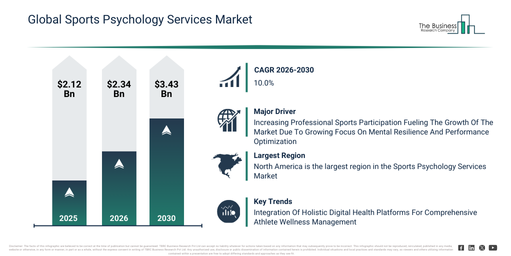
    The market size for sports psychology services has experienced swift expansion over recent years. Projections indicate its expansion from $2.12 billion in 2025 to $2.34 billion in 2026, demonstrating a compound annual growth rate (CAGR) of 10.3%. Historically, this growth can be ascribed to factors such as a heightened understanding of athlete mental well-being, an increased emphasis on improving performance, the wider uptake of sports counseling initiatives, greater involvement in competitive sports, and a surging need for stress and anxiety management solutions for athletes.

    The sports psychology services market is projected to experience substantial growth over the next few years. It is forecast to achieve a size of $3.43 billion in 2030, demonstrating a compound annual growth rate (CAGR) of 10.0%. This expansion in the forecast period can be attributed to the increasing integration of digital mental training tools, the wider adoption of personalized psychological coaching, a rising demand for data-driven performance assessments, the expanding use of virtual and remote therapy platforms, and a growing emphasis on holistic athlete well-being. Key trends for the forecast period include technology advancements in digital mental training platforms, innovations in AI-supported performance psychology tools, developments in biofeedback and neurofeedback systems, ongoing research and development in cognitive performance enhancement methods, and progress in immersive VR-based mental conditioning tools.

    Access Your Free Sample Report for In-Depth Market Insights:

    https://www.thebusinessresearchcompany.com/sample.aspx?id=30762&type=smp

    What Drivers Are Supporting Technological Adoption In The Sports Psychology Services Market?

    The expanding involvement in professional sports is projected to advance the growth of the sports psychology services market in the coming years. This participation signifies individuals pursuing organized athletic endeavors as their main profession, which includes intensive training and competition at top-tier levels. The surge in professional sports participation stems from greater media exposure and profitable sponsorship agreements, drawing in more athletes with promises of financial security and international recognition. Sports psychology services bolster professional sports participation by delivering mental conditioning techniques aimed at improving concentration, handling competitive pressure, and fostering consistent performance. For example, in August 2024, the Bureau of Labor Statistics, a US-based federal government agency, indicated that the employment of athletes and sports competitors in the United States is anticipated to increase by 5% from 2024 to 2034. Hence, the rise in professional sports participation is a key factor propelling the expansion of the sports psychology services market.

    Which Segments Are Contributing To The Growth Of The Sports Psychology Services Market?

    The sports psychology services market covered in this report is segmented –

    1) By Service Type: Performance Enhancement, Counseling, Mental Skills Training, Rehabilitation, Other Service Types

    2) By Delivery Mode: In-Person, Online Or Telehealth

    3) By Provider Type: Independent Sports Psychologists, Sports Psychology Clinics, Sports Performance Centers, University And Institutional Providers, Multidisciplinary Wellness Centers

    4) By Application: Individual Athletes, Teams, Coaches, Other Applications

    5) By End-User: Professional Sports, Amateur Sports, Educational Institutions, Other End-Users

    Subsegments:

    1) By Performance Enhancement: Goal Setting And Achievement Planning, Focus And Concentration Improvement Sessions, Competitive Strategy Development Programs, Reaction Time And Agility Training, Motivation And Confidence Building Programs

    2) By Counseling: Stress And Anxiety Management Counseling, Career Transition And Retirement Counseling, Personal Development And Self Awareness Sessions, Team Dynamics And Interpersonal Counseling, Emotional Resilience Support Programs

    3) By Mental Skills Training: Visualization And Imagery Training Programs, Attention And Concentration Enhancement Sessions, Cognitive Behavioral Techniques For Athletes, Mindfulness And Relaxation Skill Development, Performance Anxiety Reduction Programs

    4) By Rehabilitation: Post Injury Psychological Recovery Sessions, Rehabilitation Motivation And Support Programs, Mental Recovery Planning For Athletes, Coping Strategy Development For Injured Athletes, Resilience And Confidence Restoration Programs

    5) By Other Service Types: Nutritional Psychology Counseling Sessions, Sleep And Recovery Optimization Programs, Stress Management Workshops For Teams, Sports Related Trauma Counseling, Integrative Mental Health Enhancement Programs

    What Trends Are Reshaping The Dynamics Of The Sports Psychology Services Market?

    Leading companies within the sports psychology services market are concentrating on developing advanced solutions, such as integrated digital health platforms, to deliver comprehensive assistance for the psychological and physical welfare of athletes. These integrated digital health platforms are extensive software systems that consolidate various digital health services and tools into a single interface, facilitating the collection, organization, analysis, and sharing of health data among patients, providers, and different care environments. As an illustration, in October 2023, CaringWire LLC, a US-based digital health platform provider, collaborated with the U.S. Council for Athletes’ Health (USCAH) to introduce Holistic Athlete Health Solutions (HAHS). This platform links athletes with telehealth providers and presents self-guided online courses and webinars covering subjects pertinent to sports health, general wellness, and mental fortitude. The solution is built to merge effortlessly into existing athletic department initiatives, offering round-the-clock access to support addressing the physical, mental, and emotional requirements of contemporary athletes.

    Who Are The Top-Performing Companies In The Sports Psychology Services Market In Recent Years?

    Major companies operating in the sports psychology services market are California Baptist University (CBU), United States Olympic & Paralympic Committee, Conscious Mind Solutions, Discovery Sport & Performance Lab, ORKA Performance, Premier Sport Psychology, Performance in Mind, Jo Hopkins Consulting, KPEX Consulting, Flourish & Thrive, Grow Wellness Group, SportPsych Consulting, Athlete Mind Performance (AMP), The Performance Pursuit Consulting, Head In The Game, Pete Jackson Sport Psychology, Focus Perform, Clark Performance Consulting, University of Wisconsin–Green Bay, Nudge Sports, Tacomi Training Solutions Pvt. Ltd.

    Access The Complete Report For Deeper Market Insights:

    https://www.thebusinessresearchcompany.com/report/sports-psychology-services-market-report

    Which Region Currently Holds The Largest Share Of The Sports Psychology Services Market?

    North America was the largest region in the sports psychology services market in 2025. Asia-Pacific is expected to be the fastest-growing region in the forecast period. The regions covered in the sports psychology services market report are Asia-Pacific, South East Asia, Western Europe, Eastern Europe, North America, South America, Middle East, Africa.

    Request Your Customized Sports Psychology Services Market Research Report for Competitive Advantage:

    https://www.thebusinessresearchcompany.com/customise?id=30762&type=smp

    Browse Through More Reports Similar to the Global Sports Psychology Services Market 2026, By The Business Research Company

    Sports Coaching Platforms Market Report 2026

    https://www.thebusinessresearchcompany.com/report/sports-coaching-platforms-global-market-report

    Sports Medicine Market Report 2026

    https://www.thebusinessresearchcompany.com/report/sports-medicine-global-market-report

    marine and ports construction global market report

    https://www.thebusinessresearchcompany.com/report/marine-and-ports-construction-global-market-report

    Get in touch with us:

    The Business Research Company: https://www.thebusinessresearchcompany.com/

    Americas +1 310-496-7795

    Asia +44 7882 955267 & +91 8897263534

    Europe +44 7882 955267

    Email us at marketing@tbrc.info

    Follow us on:

    LinkedIn: https://in.linkedin.com/company/the-business-research-company

    YouTube: https://www.youtube.com/channel/UC24_fI0rV8cR5DxlCpgmyFQ

    Global Market Model: https://www.thebusinessresearchcompany.com/global-market-model

  • Space Intelligence Services Sector Forecast Shows Robust Momentum, Climbing to $17.25 Billion With 13.7% CAGR

    Space Intelligence Services Sector Forecast Shows Robust Momentum, Climbing to $17.25 Billion With 13.7% CAGR

    Uncover key drivers, emerging technologies, and competitive movements shaping the space intelligence services market from 2026–2035 with trusted insights from The Business Research Company

    What level of CAGR-driven expansion is anticipated in the Space Intelligence Services Market between 2026 and 2030?

    The space intelligence services market has seen substantial growth recently. It is forecast to expand from $9.06 billion in 2025 to $10.32 billion in 2026, exhibiting a compound annual growth rate (CAGR) of 14.0%. This past growth can be ascribed to several factors, including an escalating demand for satellite-based monitoring, the wider adoption of geospatial analytics in defense activities, an increasing necessity for environmental and climate oversight, the proliferation of commercial earth observation constellations, and the expanded application of remote sensing for agricultural insights.

    The space intelligence services market size is projected for significant expansion over the next few years, reaching **$17.26 billion in 2030 at a compound annual growth rate (CAGR) of 13.7%**. This anticipated growth during the forecast period is driven by factors such as the increasing demand for high-frequency imaging and rapid revisit capabilities, the growing integration of artificial intelligence into space intelligence workflows, the rising need for precision agriculture and resource optimization, the broadening of security and border surveillance applications, and the heightened commercial adoption of space-based risk assessment tools. Furthermore, major trends in the forecast period encompass technology advancements in high-resolution imaging sensors, innovations in artificial intelligence-driven geospatial analytics, developments in cloud-based intelligence delivery platforms, ongoing research and developments in multi-sensor fusion techniques, and progress in hyperspectral and radar satellite systems.

    Access Your Free Sample Report for In-Depth Market Insights:

    https://www.thebusinessresearchcompany.com/sample.aspx?id=30759&type=smp

    What Drivers Are Affecting Demand-Supply Dynamics In The Space Intelligence Services Market?

    Increased funding into space exploration is projected to boost the expansion of the space intelligence services market in the future. Space exploration entails the investigation and study of outer space utilizing both crewed and uncrewed spacecraft, satellites, and advanced technologies. The growing investment in this area is fueled by escalated geopolitical competition as countries strive for strategic dominance and technological superiority in space. Investments in space exploration enhance space intelligence services by expanding satellite capabilities, advanced sensors, and data-gathering technologies. These improvements lead to better situational awareness and decision-making by providing more accurate, real-time information regarding space activities, orbital objects, and environmental conditions. For instance, in September 2023, Novaspace, a France-based space governance provider, noted that government spending on space exploration reached $27 billion in 2024 and is anticipated to grow to almost $31 billion by 2034. Therefore, the expanding investments in space exploration are propelling the advancement of the space intelligence services market.

    What Segments Are Included Within The Space Intelligence Services Market?

    The space intelligence services market covered in this report is segmented –

    1) By Service Type: Satellite Imaging, Geospatial Analytics, Data Processing, Remote Sensing, Other Service Types

    2) By Platform: Satellites, Unmanned Aerial Vehicles (UAVs), Ground Stations, Other Platforms

    3) By Application: Defense And Security, Agriculture, Environmental Monitoring, Urban Planning, Disaster Management, Other Applications

    4) By End-User: Government, Commercial, Military, Other End-Users

    Subsegments:

    1) By Satellite Imaging: Very High Resolution Optical Imagery, Medium Resolution Multispectral Imagery, Synthetic Aperture Radar Imagery, Hyperspectral and Thermal Imagery, Video from Space

    2) By Geospatial Analytics: Change Detection and Monitoring, Feature Extraction and Classification, Measurements and Modeling, Predictive Analytics and Forecasting, Visualization and Reporting

    3) By Data Processing: Image Correction and Enhancement, Data Fusion and Integration, Cloud Storage and Management, Automated Processing Pipelines, Quality Assurance and Validation

    4) By Remote Sensing: Land Cover and Land Use Mapping, Maritime Domain Awareness, Environmental Parameter Monitoring, Disaster Impact Assessment, Infrastructure Health Monitoring

    5) By Other Service Types: Consulting and Solution Design, Data Acquisition Planning, Training and Capacity Building, Intelligence Report Subscription, Custom Application Development

    Which Trends Are Expected To Influence The Space Intelligence Services Market In The Upcoming Years?

    Leading companies in the space intelligence services market are concentrating on developing advanced solutions, such as flexible spectrum collection options, to enhance the accessibility, precision, and adaptability of RF signal monitoring and analysis. Flexible spectrum collection options refer to the capacity to capture and analyze radio frequency data across multiple bands and configurations, enabling operators to tailor data acquisition to diverse mission needs, maximize coverage, and adjust to changing signal environments. For instance, in September 2023, Hawkeye 360 Inc., a US-based space analytics company, unveiled the RFIQ product, which offers industry-leading flexible spectrum collection capabilities to provide deeper insights into RF activity. The product allows users to monitor a wide array of radio spectrum bands with adjustable collection parameters, supporting both tactical and strategic applications in communications, defense, and maritime domains. By utilizing flexible spectrum collection, the solution empowers analysts to efficiently capture and interpret RF signals in real time, thereby improving situational awareness and decision-making capabilities.

    Who Are The Major Companies Operating In The Space Intelligence Services Market?

    Major companies operating in the space intelligence services market are Maxar Technologies Inc., ICEYE Ltd., Planet Labs PBC, EarthDaily Analytics Inc., Spire Global Inc., BlackSky Technology Inc., LeoLabs Inc., Capella Space Corp., Synspective Inc., GHGSat Inc., SpaceKnow Inc., HawkEye 360 Inc., Kayrros SAS, Satellogic Inc., Slingshot Aerospace Inc., Albedo Space Inc., Umbra Lab Inc., Kleos Space SA, Unseenlabs SAS, SkyWatch Space Applications Inc., Privateer Space Inc.

    Access The Complete Report For Deeper Market Insights:

    https://www.thebusinessresearchcompany.com/report/space-intelligence-services-market-report

    Which Region Is Anticipated To See The Fastest Growth In The Space Intelligence Services Market?

    North America was the largest region in the space intelligence services market in 2025. Asia-Pacific is expected to be the fastest-growing region in the forecast period. The regions covered in the space intelligence services market report are Asia-Pacific, South East Asia, Western Europe, Eastern Europe, North America, South America, Middle East, Africa.

    Request Your Customized Space Intelligence Services Market Research Report for Competitive Advantage:

    https://www.thebusinessresearchcompany.com/customise?id=30759&type=smp

    Browse Through More Reports Similar to the Global Space Intelligence Services Market 2026, By The Business Research Company

    Artificial Intelligence Services Market Report 2026

    https://www.thebusinessresearchcompany.com/report/artificial-intelligence-services-global-market-report

    Space Launch Services Market Report 2026

    https://www.thebusinessresearchcompany.com/report/space-launch-services-global-market-report

    space technology spacetech global market report

    https://www.thebusinessresearchcompany.com/report/space-technology-spacetech-global-market-report

    Get in touch with us:

    The Business Research Company: https://www.thebusinessresearchcompany.com/

    Americas +1 310-496-7795

    Asia +44 7882 955267 & +91 8897263534

    Europe +44 7882 955267

    Email us at marketing@tbrc.info

    Follow us on:

    LinkedIn: https://in.linkedin.com/company/the-business-research-company

    YouTube: https://www.youtube.com/channel/UC24_fI0rV8cR5DxlCpgmyFQ

    Global Market Model: https://www.thebusinessresearchcompany.com/global-market-model

  • Smart Oximetry Devices Market Anticipated to Record Steady Gains, Advancing to $4.81 Billion by 2030

    Smart Oximetry Devices Market Anticipated to Record Steady Gains, Advancing to $4.81 Billion by 2030

    Uncover key drivers, emerging technologies, and competitive movements shaping the smart oximetry devices market from 2026–2035 with trusted insights from The Business Research Company

    What long-term size projections exist for the Smart Oximetry Devices Market covering 2026–2035?

    The smart oximetry devices market size has experienced significant growth in recent years. This market is expected to increase from $3.07 billion in 2025 to $3.37 billion in 2026, achieving a compound annual growth rate (CAGR) of 9.6%. Historically, its growth can be linked to factors such as early adoption in hospitals, clinical validation of spo2 monitoring, integration with bedside monitors, regulatory approvals for pulse oximeters, and the expansion of critical care infrastructure.

    The market for smart oximetry devices is anticipated to experience substantial expansion over the coming years. Its valuation is projected to reach $4.81 billion by 2030, exhibiting a compound annual growth rate (CAGR) of 9.3%. This projected growth stems from factors such as the increasing incidence of respiratory illnesses, the expanding adoption of remote patient monitoring solutions, a rising need for home healthcare equipment, the broadened scope of telehealth services, and a growing elderly demographic. Key developments expected during this forecast period encompass technological improvements in sensor precision, novel creations in wearable oximetry products, advancements in wireless and Bluetooth connectivity, ongoing research and development in multi-parameter monitoring systems, and progress in AI-driven data analysis.

    Access Your Free Sample Report for In-Depth Market Insights:

    https://www.thebusinessresearchcompany.com/sample.aspx?id=30751&type=smp

    Which Drivers Are Impacting The Competitive Landscape Of The Smart Oximetry Devices Market?

    The smart oximetry devices market is anticipated to expand due to the increasing integration of remote patient monitoring. Remote patient monitoring (RPM) involves leveraging digital tools to gather medical and health data from individuals, subsequently transmitting it electronically to healthcare professionals for evaluation, and if required, for guidance and advice. The uptake of RPM is increasing because healthcare providers and payers are more frequently depending on ongoing home-based data to proactively manage chronic conditions, decrease re-hospitalizations, and reduce total healthcare expenditures. Smart oximetry devices aid remote patient monitoring by constantly measuring blood oxygen levels and sending real-time information directly to healthcare providers. These devices enhance patient care through early detection of hypoxia, facilitating prompt interventions, and improving the management of chronic respiratory and cardiovascular ailments. For example, in September 2025, data from the U.S. Department of Health and Human Services Office of Inspector General (OIG), a US-based government agency, showed that remote patient monitoring payments totaled $536 million across Original Medicare, also known as Medicare fee for service, and Medicare Advantage. This indicated a 31% rise from 2023, with approximately 1 million Medicare enrollees utilizing remote patient monitoring services, marking a 27% increase over 2023. Consequently, the expanding utilization of remote patient monitoring is fueling the expansion of the smart oximetry devices market.

    What Leading Segments Are Studied In The Smart Oximetry Devices Market?

    The smart oximetry devices market covered in this report is segmented –

    1) By Product Type: Fingertip Oximeters, Handheld Oximeters, Wrist-Worn Oximeters, Tabletop Or Bedside Oximeters, Other Produt Types

    2) By Technology: Conventional, Bluetooth-Enabled, Wi-Fi Enabled

    3) By Distribution Channel: Online, Offline

    4) By End-User: Hospitals And Clinics, Homecare Settings, Ambulatory Surgical Centers, Others

    Subsegments:

    1) By Fingertip Oximeters: Basic Fingertip Oximeters, Rechargeable Fingertip Oximeters, Bluetooth-Enabled Fingertip Oximeters

    2) By Handheld Oximeters: Portable Handheld Oximeters, Multi-Parameter Handheld Oximeters, Clinical-Grade Handheld Oximeters

    3) By Wrist-Worn Oximeters: Fitness Wrist-Worn Oximeters, Medical Wrist-Worn Oximeters, Continuous Monitoring Wrist-Worn Oximeters

    4) By Tabletop Or Bedside Oximeters: Standard Bedside Oximeters, Advanced Monitoring Bedside Oximeters, Multi-Parameter Bedside Oximeters

    5) By Other Produt Types: Pediatric Oximeters, Veterinary Oximeters, Specialty Application Oximeters

    What Trends Are Driving The Growth Trajectory Of The Smart Oximetry Devices Market?

    Key companies operating in the smart oximetry devices market are concentrating on developing advanced monitoring solutions, such as cellular-enabled pulse oximeters, to offer clinicians secure, real-time SpO2 and pulse rate data for proactive care. Cellular-enabled pulse oximeters refer to pulse oximetry devices that feature built-in cellular connectivity, enabling them to transmit oxygen saturation (SpO2) and pulse rate data directly to healthcare providers or cloud platforms instantaneously. As an example, in August 2024, Prevounce Health, a US-based provider of remote care management, launched the Pylo OX1-LTE pulse oximeter. This is a clinically validated, cellular-enabled pulse oximeter providing roaming 5G/4G LTE connectivity with a 2G fallback, highly accurate SpO2 and pulse rate measurements, and a bright OLED display for clear readings. The Pylo OX1-LTE also ensures secure data transmission directly to remote monitoring platforms and is compatible with third-party health software to support large-scale remote patient monitoring programs.

    Which Major Firms Are Strengthening Their Position In The Smart Oximetry Devices Market?

    Major companies operating in the smart oximetry devices market are Medtronic plc, GE HealthCare Technologies Inc., Koninklijke Philips N.V., Shenzhen Mindray Bio-Medical Electronics Co. Ltd., Masimo Corporation, Nihon Kohden Corporation, Lepu Medical Technology Co. Ltd., Contec Medical Systems Co. Ltd., Beurer GmbH, Heal Force Bio-Meditech Holdings Ltd., Edan Instruments Inc., Biolight Meditech Co. Ltd., Omron Healthcare Co. Ltd., Nonin Medical Inc., Viatom Technology Co. Ltd., A&D Company Limited, iHealth Labs Inc., Smiths Medical International Ltd., Wellue Health Inc., Creative Medical Technology Co. Ltd., Berry Global Healthcare, Oxitone Medical Ltd., Movano Health Inc., ChoiceMMed America Corp.

    Access The Complete Report For Deeper Market Insights:

    https://www.thebusinessresearchcompany.com/report/smart-oximetry-devices-market-report

    Which Region Shows The Strongest Potential For Future Expansion In The Smart Oximetry Devices Market?

    North America was the largest region in the smart oximetry devices market in 2025. Asia-Pacific is expected to be the fastest-growing region in the forecast period. The regions covered in the smart oximetry devices market report are Asia-Pacific, South East Asia, Western Europe, Eastern Europe, North America, South America, Middle East, Africa.

    Request Your Customized Smart Oximetry Devices Market Research Report for Competitive Advantage:

    https://www.thebusinessresearchcompany.com/customise?id=30751&type=smp

    Browse Through More Reports Similar to the Global Smart Oximetry Devices Market 2026, By The Business Research Company

    Pulse Oximeter Market Report 2026

    https://www.thebusinessresearchcompany.com/report/pulse-oximeter-global-market-report

    Home Health Monitoring Devices Market Report 2026

    https://www.thebusinessresearchcompany.com/report/home-health-monitoring-devices-global-market-report

    respiratory monitoring devices global market report

    https://www.thebusinessresearchcompany.com/report/respiratory-monitoring-devices-global-market-report

    Get in touch with us:

    The Business Research Company: https://www.thebusinessresearchcompany.com/

    Americas +1 310-496-7795

    Asia +44 7882 955267 & +91 8897263534

    Europe +44 7882 955267

    Email us at marketing@tbrc.info

    Follow us on:

    LinkedIn: https://in.linkedin.com/company/the-business-research-company

    YouTube: https://www.youtube.com/channel/UC24_fI0rV8cR5DxlCpgmyFQ

    Global Market Model: https://www.thebusinessresearchcompany.com/global-market-model

  • Smart Mattress Sensor Industry Poised for Rapid Growth, Forecast to Touch $4.43 Billion by 2030 at 19.3% CAGR

    Smart Mattress Sensor Industry Poised for Rapid Growth, Forecast to Touch $4.43 Billion by 2030 at 19.3% CAGR

    Uncover key drivers, emerging technologies, and competitive movements shaping the smart mattress sensor market from 2026–2035 with trusted insights from The Business Research Company

    What total market size is anticipated for the Smart Mattress Sensor Market in 2030?

    The smart mattress sensor market size has experienced rapid growth in recent years. This market is projected to expand from $1.83 billion in 2025 to $2.19 billion in 2026, exhibiting a compound annual growth rate (CAGR) of 19.5%. The historical growth of the market can be ascribed to a heightened awareness of sleep health, the increasing adoption of wearable and sleep monitoring devices, a rising demand for comfortable and supportive mattresses, the expanding integration of smart home technology, and a greater focus on personalized sleep solutions.

    The smart mattress sensor market is projected to experience substantial expansion in the coming years. This market is set to reach a valuation of $4.43 billion by 2030, exhibiting a compound annual growth rate (CAGR) of 19.3%. The anticipated growth during this period stems from several factors, including the increasing uptake of AI-powered sleep tracking, the greater integration of IoT-enabled mattress sensors, the escalating need for real-time sleep quality oversight, the wider deployment of cloud-based health data platforms, and a heightened focus on preventive health and overall wellness. Key trends characterizing the forecast period encompass technological progress in sensor precision and responsiveness, breakthroughs in AI-driven sleep analytics, evolution in connected mattress and bedding ecosystems, ongoing research and development in non-intrusive monitoring solutions, and progress in predictive and tailored sleep optimization.

    Access Your Free Sample Report for In-Depth Market Insights:

    https://www.thebusinessresearchcompany.com/sample.aspx?id=30750&type=smp

    What Drivers Are Influencing Production Trends In The Smart Mattress Sensor Market?

    The growing incidence of sleep disorders is projected to boost the expansion of the smart mattress sensor market in the forthcoming period. Sleep disorders are health conditions that compromise sleep quality, duration, or timing, encompassing insomnia and sleep-related breathing disorders, and they are linked to unfavorable physical, cognitive, and cardiovascular outcomes. The increasing occurrence of sleep disorders is attributable to rising obesity rates and an aging demographic, both of which contribute to a higher frequency of conditions such as sleep-disordered breathing. The smart mattress sensor aids in reducing sleep disorders by observing sleep patterns, body movements, and vital signs to deliver customized insights and recommendations. It enhances sleep quality and overall health by allowing for prompt detection of disturbances and supporting focused interventions. For instance, in March 2024, data from the National Sleep Foundation, a US-based non-profit sleep health organization, showed that adults reporting inadequate sleep quality rose from 35% in 2023 to 38% in 2024, signaling a notable increase in sleep-related health problems that necessitate ongoing monitoring solutions. Thus, the escalating prevalence of sleep disorders is stimulating the growth of the smart mattress sensor market.

    Which Segment Groups Are Influencing The Smart Mattress Sensor Market?

    The smart mattress sensor market covered in this report is segmented –

    1) By Product Type: Pressure Sensors, Motion Sensors, Temperature Sensors, Multi-Sensor Systems, Other Product Types

    2) By Connectivity: Wired, Wireless

    3) By Distribution Channel: Online Retail, Specialty Stores, Direct Sales, Other Distribution Channels

    4) By End-User: Individual, Commercial, Healthcare, Hospitality, Other End-Users

    Subsegments:

    1) By Pressure Sensors: Mattress Pressure Mapping Units, Sleep Posture Detection Sensors, Weight Distribution Monitoring Devices, Bed Occupancy Detection Modules, High Sensitivity Pressure Tracking Systems

    2) By Motion Sensors: Sleep Movement Tracking Devices, Restlessness And Activity Monitoring Units, Micro Motion Detection Modules, Body Rotation Tracking Sensors, Nighttime Motion Analysis Systems

    3) By Temperature Sensors: Bed Temperature Monitoring Units, Skin Contact Temperature Detection Sensors, Climate Adjustable Sensor Modules, Thermal Comfort Tracking Devices, Smart Heat Regulation Sensors

    4) By Multi-Sensor Systems: Integrated Sleep Monitoring Modules, Combined Pressure And Motion Detection Units, Multi Parameter Sleep Analysis Systems, Comprehensive Bed Sensor Platforms, Advanced Sleep Behavior Tracking Devices

    5) By Other Product Types: Smart Humidity Monitoring Sensors, Biometric Sleep Tracking Devices, Sound And Vibration Detection Modules, Smart Bedding Integration Sensors, Innovative Sleep Environment Monitoring Units

    What Upcoming Trends Are Likely To Define The Future Path Of The Smart Mattress Sensor Market?

    Key players within the smart mattress sensor market are concentrating on creating sophisticated solutions, such as multi-sensor sleep monitoring systems. These systems aim to monitor sleep patterns, physical movements, and vital signs, offering practical recommendations for enhancing sleep quality and promoting preventive wellness. Such multi-sensor sleep monitoring systems involve integrated technologies that consistently gather physiological and environmental data, encompassing heart rate, respiratory rate, body position, and how pressure is distributed across the mattress, all for the purpose of assessing sleep quality and identifying deviations. An illustrative example is from November 2023, when De Rucci Healthy Sleep Co. Ltd., a sleep technology firm based in China, introduced its DeRUCCI T11 Pro Smart Mattress. This particular mattress incorporates multi-sensor sleep monitoring, equipped with 23 AI-powered sensors and 18 adaptable support units. It can track body position and physiological data in real-time, analyze sleep quality, and adjust comfort dynamically. These capabilities provide users with customized sleep insights, preliminary alerts for potential health concerns, and enhanced comfort, thereby representing a substantial leap forward in managing sleep health through the integration of accurate monitoring, AI-driven analysis, and responsive mattress technology.

    Who Are The Primary Competitors In The Global Smart Mattress Sensor Market?

    Major companies operating in the smart mattress sensor market are Xiaomi Corporation, Nokia, Koninklijke Philips N.V., Tempur Sealy International Inc., Serta Simmons Bedding LLC, Hilding Anders International AB, Saatva Inc., Sleep Number Corporation, Casper Sleep Inc., Silentnight Group Limited, DeRUCCI International Holdings Limited, Kingsdown Inc., Withings SAS, Bosch Sensortec GmbH, Eight Sleep Inc., Sleepace Technology Co. Ltd., Responsive Surface Technology Inc., Emfit Ltd., RestOn Sleep Technology Pvt. Ltd., Slairzz Inc.

    Access The Complete Report For Deeper Market Insights:

    https://www.thebusinessresearchcompany.com/report/smart-mattress-sensor-market-report

    Which Global Regions Are Shaping The Competitive Landscape Of The Smart Mattress Sensor Market?

    North America was the largest region in the smart mattress sensor market in 2025. Asia-Pacific is expected to be the fastest-growing region in the forecast period. The regions covered in the smart mattress sensor market report are Asia-Pacific, South East Asia, Western Europe, Eastern Europe, North America, South America, Middle East, Africa.

    Request Your Customized Smart Mattress Sensor Market Research Report for Competitive Advantage:

    https://www.thebusinessresearchcompany.com/customise?id=30750&type=smp

    Browse Through More Reports Similar to the Global Smart Mattress Sensor Market 2026, By The Business Research Company

    Smart Sensor Market Report 2026

    https://www.thebusinessresearchcompany.com/report/smart-sensor-global-market-report

    Smart Bed Market Report 2026

    https://www.thebusinessresearchcompany.com/report/smart-bed-global-market-report

    bed monitoring system and baby monitoring system global market report

    https://www.thebusinessresearchcompany.com/report/bed-monitoring-system-and-baby-monitoring-system-global-market-report

    Get in touch with us:

    The Business Research Company: https://www.thebusinessresearchcompany.com/

    Americas +1 310-496-7795

    Asia +44 7882 955267 & +91 8897263534

    Europe +44 7882 955267

    Email us at marketing@tbrc.info

    Follow us on:

    LinkedIn: https://in.linkedin.com/company/the-business-research-company

    YouTube: https://www.youtube.com/channel/UC24_fI0rV8cR5DxlCpgmyFQ

    Global Market Model: https://www.thebusinessresearchcompany.com/global-market-model

  • Smart Hospital Heating, Ventilation, And Air Conditioning (HVAC) Market Performance Outlook 2026–2030: Revenue to Hit $12.8 Billion at 15.6% CAGR

    Smart Hospital Heating, Ventilation, And Air Conditioning (HVAC) Market Performance Outlook 2026–2030: Revenue to Hit $12.8 Billion at 15.6% CAGR

    Uncover key drivers, emerging technologies, and competitive movements shaping the smart hospital heating, ventilation, and air conditioning (hvac) market from 2026–2035 with trusted insights from The Business Research Company

    What is the expected shift in the Smart Hospital Heating, Ventilation, And Air Conditioning (HVAC) Market’s size between 2026 and 2030?

    The smart hospital heating, ventilation, and air conditioning (HVAC) market has seen significant expansion in recent years. This market is expected to expand from $6.19 billion in 2025 to $7.18 billion in 2026, achieving a compound annual growth rate (CAGR) of 15.9%. The growth observed in prior periods is attributable to factors such as the increasing construction of new hospitals and healthcare facilities, a growing demand for patient-focused care environments, an escalating emphasis on reducing operational costs in hospitals, heightened healthcare investments from both public and private sectors, and the increasing necessity for dependable climate control within critical care zones.

    The smart hospital heating, ventilation, and air conditioning (HVAC) market is anticipated to experience substantial expansion over the next few years. It is projected to achieve a market size of $12.81 billion in 2030, growing at a compound annual growth rate (CAGR) of 15.6%. This projected growth can be attributed to factors such as increasing hospital infrastructure development, a greater emphasis on indoor air quality within healthcare facilities, the growing demand for infection control environments, rising healthcare expenditure, and an increasing awareness of patient comfort needs. Significant trends expected during this forecast period include advancements in smart heating, ventilation, and air conditioning control systems; innovations in sensor-based indoor air quality monitoring; developments in artificial intelligence-driven building management systems; ongoing research and development in energy-efficient heating, ventilation, and air conditioning designs; and progress in predictive maintenance for hospital heating, ventilation, and air conditioning systems.

    Access Your Free Sample Report for In-Depth Market Insights:

    https://www.thebusinessresearchcompany.com/sample.aspx?id=30749&type=smp

    Which Drivers Are Shaping Strategic Decisions In The Smart Hospital Heating, Ventilation, And Air Conditioning (HVAC) Market?

    A growing emphasis on infection control and meeting air quality standards is anticipated to drive the expansion of the smart hospital heating, ventilation, and air conditioning (HVAC) market in the future. These measures, infection control and air quality compliance, involve establishing environmental controls like proper ventilation, filtration, and air handling protocols within healthcare environments. Their purpose is to minimize the spread of airborne pathogens and fulfill necessary safety regulations. The significance of infection control and air quality compliance is increasing as healthcare systems globally intensify their initiatives to prevent hospital-acquired infections and protect both patients and healthcare personnel. Smart hospital HVAC systems contribute to infection control and air quality compliance by optimizing parameters such as ventilation rates, pressure differentials, and the effectiveness of filtration. This leads to enhanced indoor air quality while simultaneously maintaining energy efficiency. For example, in November 2024, the Center for Infectious Disease Research and Policy, a US-based infectious disease research center, reported that US acute care hospitals experienced a 15% decline in central line-associated bloodstream infections and an 11% drop in catheter-associated urinary tract infections during 2023 when compared to 2022. This improvement indicates strengthened infection control strategies, including better environmental controls like HVAC systems. Consequently, the heightened attention to infection control and air quality compliance is a key factor propelling the expansion of the smart hospital heating, ventilation, and air conditioning (HVAC) market.

    What Segment Classifications Make Up The Smart Hospital Heating, Ventilation, And Air Conditioning (HVAC) Market?

    The smart hospital heating, ventilation, and air conditioning (hvac) market covered in this report is segmented –

    1) By Component: Heating Equipment, Ventilation Equipment, Air Conditioning Equipment, Control Systems, Services

    2) By Technology: Internet Of Things (IoT)-Enabled Heating, Ventilation, And Air Conditioning (HVAC), Artificial Intelligence (AI)-Based Heating, Ventilation, And Air Conditioning (HVAC), Cloud-Based Heating, Ventilation, And Air Conditioning (HVAC), Traditional Heating, Ventilation, And Air Conditioning (HVAC)

    3) By Application: Patient Rooms, Operating Theaters, Intensive Care Units (ICUs), Laboratories, Pharmacies, Administrative Areas, Other Applications

    4) By End User: Public Hospitals, Private Hospitals, Specialty Hospitals

    Subsegments:

    1) By Heating Equipment: Boilers, Heat Pumps, Radiant Heaters, Electric Heaters, Gas Fired Heaters

    2) By Ventilation Equipment: Air Handling Units, Energy Recovery Ventilators, Exhaust Fans, Supply Fans, Terminal Units

    3) By Air Conditioning Equipment: Chiller Systems, Packaged Air Conditioners, Split Air Conditioning Units, Variable Refrigerant Flow Systems, Rooftop Air Conditioning Units

    4) By Control Systems: Building Management Systems, Smart Thermostat Systems, Variable Frequency Drive Controllers, Zonal Control Modules, Automated Monitoring Sensors

    5) By Services: Installation Services, Maintenance Services, Repair Services, System Upgrade Services, Energy Optimization Services

    Which Trends Are Shaping Activity Within The Smart Hospital Heating, Ventilation, And Air Conditioning (HVAC) Market?

    Leading companies active in the smart hospital heating, ventilation, and air conditioning (HVAC) market are concentrating on developing sophisticated systems, such as building automation platforms, to enhance energy efficiency, improve indoor air quality, and sustain precise environmental control in critical care zones. A building automation system is defined as an integrated hardware and software framework that monitors and automatically manages building functions like heating, ventilation, air conditioning, lighting, and security, thereby optimizing comfort, energy efficiency, and operational performance. For instance, in September 2024, Johnson Controls Inc., a U.S.-based building technology and controls firm, launched Metasys 14.0. This updated building automation system delivers next-generation analytics dashboards, improved network efficiency, support for up to 800 IP devices, and enhanced energy management tools designed to assist facility managers in reducing energy waste while upholding environmental conditions crucial for healthcare facilities. The release of Metasys 14.0 introduces turnkey energy-management dashboards and HVAC applications aligned with ASHRAE Guideline 36, providing building operators with quick, out-of-the-box tools to visualize consumption, decrease energy waste, and boost equipment performance, concurrently supporting decarbonization goals.

    Which Key Market Players Are Investing In Expansion And Innovation Within The Smart Hospital Heating, Ventilation, And Air Conditioning (HVAC) Market?

    Major companies operating in the smart hospital heating, ventilation, and air conditioning (hvac) market are Siemens AG, LG Electronics Inc., Mitsubishi Electric Corporation, Honeywell International Inc., ABB Ltd., Carrier Global Corporation, Trane Technologies, Emerson Electric Co., Taikisha Ltd., Lindab Group AB, Systemair AB, Swegon Group AB, TROX GmbH, Ruskin Company, Johnson Controls International, Delta Controls Inc., KMC Controls, Bosch Thermotechnology, Vibro-Acoustics, Airflow Developments Ltd., Alerton, Kieback&Peter Co.

    Access The Complete Report For Deeper Market Insights:

    https://www.thebusinessresearchcompany.com/report/smart-hospital-heating-ventilation-and-air-conditioning-hvac-market-report

    Which Regions Are Poised For Strategic Growth In The Smart Hospital Heating, Ventilation, And Air Conditioning (HVAC) Market?

    North America was the largest region in the smart hospital heating, ventilation, and air conditioning (HVAC) market in 2025. Asia-Pacific is expected to be the fastest-growing region in the forecast period. The regions covered in the smart hospital heating, ventilation, and air conditioning (hvac) market report are Asia-Pacific, South East Asia, Western Europe, Eastern Europe, North America, South America, Middle East, Africa.

    Request Your Customized Smart Hospital Heating, Ventilation, And Air Conditioning (HVAC) Market Research Report for Competitive Advantage:

    https://www.thebusinessresearchcompany.com/customise?id=30749&type=smp

    Browse Through More Reports Similar to the Global Smart Hospital Heating, Ventilation, And Air Conditioning (HVAC) Market 2026, By The Business Research Company

    Ventilation Heating Airconditioning And Commercial Refrigeration Equipment Market Report 2026

    https://www.thebusinessresearchcompany.com/report/ventilation-heating-airconditioning-and-commercial-refrigeration-equipment-global-market-report

    Smart Air Conditioners Market Report 2026

    https://www.thebusinessresearchcompany.com/report/smart-air-conditioners-global-market-report

    heating equipment except warm air furnaces global market report

    https://www.thebusinessresearchcompany.com/report/heating-equipment-except-warm-air-furnaces-global-market-report

    Get in touch with us:

    The Business Research Company: https://www.thebusinessresearchcompany.com/

    Americas +1 310-496-7795

    Asia +44 7882 955267 & +91 8897263534

    Europe +44 7882 955267

    Email us at marketing@tbrc.info

    Follow us on:

    LinkedIn: https://in.linkedin.com/company/the-business-research-company

    YouTube: https://www.youtube.com/channel/UC24_fI0rV8cR5DxlCpgmyFQ

    Global Market Model: https://www.thebusinessresearchcompany.com/global-market-model
  • Global Smart Hospital Command Center Market Set for Strong Expansion, Reaching $6.27 Billion With 21.6% CAGR by 2030

    Global Smart Hospital Command Center Market Set for Strong Expansion, Reaching $6.27 Billion With 21.6% CAGR by 2030

    Uncover key drivers, emerging technologies, and competitive movements shaping the smart hospital command center market from 2026–2035 with trusted insights from The Business Research Company

    What growth pattern is forecast for the Smart Hospital Command Center Market size between 2026 and 2035?

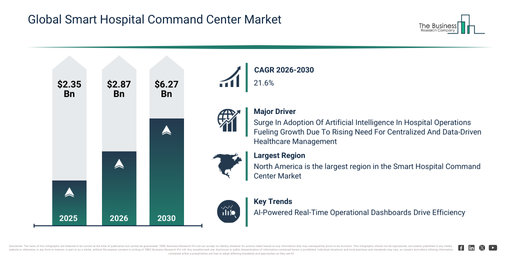
    The smart hospital command center market has experienced substantial growth in its size over recent years. This market is projected to expand from $2.35 billion in 2025 to $2.87 billion in 2026, achieving a compound annual growth rate (CAGR) of 21.9%. The historical growth can be attributed to several factors including increasing hospital digitalization, a growing demand for real-time operational visibility, a rising focus on patient safety and quality improvement, the expanding adoption of data analytics in healthcare, and an increasing need for coordinated emergency response.

    The smart hospital command center market is anticipated to undergo substantial expansion in the coming years, with its valuation predicted to reach $6.27 billion by 2030, demonstrating a compound annual growth rate (CAGR) of 21.6%. This projected growth is driven by the increasing integration of artificial intelligence into hospital operations, a rise in investments towards smart healthcare infrastructure, and the growing demand for predictive analytics to manage patient flow. Additionally, the widespread adoption of connected medical devices and a heightened emphasis on operational efficiency and resource optimization contribute significantly to this growth. Major trends expected during this period include technological progress in real-time monitoring platforms, new developments in artificial intelligence-powered decision support systems, the creation of integrated hospital automation solutions, ongoing research and advancements in digital health analytics, and innovations related to digital twin-based hospital operations management.

    Access Your Free Sample Report for In-Depth Market Insights:

    https://www.thebusinessresearchcompany.com/sample.aspx?id=30748&type=smp

    Which Drivers Are Impacting Market Performance In The Smart Hospital Command Center Market?

    The swift adoption of artificial intelligence (AI) within hospital operations is anticipated to drive the expansion of the smart hospital command center market moving ahead. AI in hospital operations involves employing machine learning algorithms and automation to streamline administrative functions like scheduling, staffing, inventory control, and resource distribution, which improves efficiency and lowers operational expenses. The implementation of artificial intelligence (AI) in hospital operations is increasing because of a rising need to optimize intricate administrative and operational processes. Smart hospital command centers facilitate AI in hospital operations by utilizing real-time data integration and predictive analytics, which improves responsiveness across various hospital services. As an example, in September 2025, data from the Assistant Secretary for Technology Policy, a US government agency, indicated that in 2024, 71% of hospitals stated they were using predictive AI linked with their electronic health records (EHR), a rise from 66% in 2023, meaning approximately 7 out of 10 hospitals reported using predictive AI in 2024. Consequently, the swift incorporation of artificial intelligence (AI) into hospital operations is fueling the expansion of the smart hospital command center market.

    What Segment Types Are Examined In The Smart Hospital Command Center Market?

    The smart hospital command center market covered in this report is segmented –

    1) By Component: Software, Hardware, Services

    2) By Deployment Mode: On-Premises, Cloud-Based

    3) By Application: Patient Flow Management, Resource Allocation, Clinical Operations, Asset Management, Communication And Coordination, Others

    4) By End User: Large Hospitals, Medium Hospitals, Small Hospitals

    Subsegments:

    1) By Software: Real-Time Analytics Platforms, Hospital Workflow Automation Systems, Patient Flow Management Software, Digital Communication And Coordination Tools, Integrated Dashboard And Visualization Software, Clinical Decision Support Solutions, Resource Allocation Optimization Software

    2) By Hardware: Centralized Monitoring Systems, Internet Of Things Enabled Devices, Servers And Data Storage Units, Networking And Connectivity Equipment, Control Room Display Panels, Sensor Based Tracking Devices, Integrated Command Center Consoles

    3) By Services: Implementation And Integration Services, Training And Education Services, Maintenance And Technical Support Services, Consulting And Workflow Optimization Services, System Upgradation And Enhancement Services, Remote Monitoring And Management Services, Customization And Configuration Services

    Which Trends Are Influencing The Development Of The Smart Hospital Command Center Market?

    Leading companies in the smart hospital command center market are focusing on developing advanced solutions, such as real-time predictive analytics, to enhance operational efficiency, patient flow, and clinical decision-making throughout health systems. Real-time predictive analytics refers to software-driven capabilities that continuously aggregate and analyze live hospital data to forecast demand, identify bottlenecks, and enable proactive operational interventions. For instance, in October 2024, GE HealthCare Technologies Inc., a US-based medical technology company, launched the Hospital Pulse Tile for its Command Center Software. This introduction integrates real-time predictive analytics to provide system-wide visibility into capacity, staffing, patient throughput, and care delivery performance. The Command Center utilizes advanced analytics and AI to transform intricate hospital data into actionable insights, allowing leaders to anticipate surges, optimize resource utilization, and reduce delays in care.

    Who Are The Core Companies Influencing Trends In The Smart Hospital Command Center Market?

    Major companies operating in the smart hospital command center market are IBM Corporation, Oracle Corporation, Honeywell International Inc., Siemens Healthineers AG, Koninklijke Philips N.V., GE HealthCare Technologies Inc., Palantir Technologies Inc., Huron Consulting Group Inc., Dedalus Group, Allscripts Healthcare Solutions Inc., Everbridge Inc., Ascom Ltd., Care Logistics LLC, Spok Holdings Inc., TeleTracking Technologies Inc., LeanTaaS Inc., Qventus Inc., Connexall, Pointcore, Epic Systems Corporation

    Access The Complete Report For Deeper Market Insights:

    https://www.thebusinessresearchcompany.com/report/smart-hospital-command-center-market-report

    Which Regions Are Projected To Dominate The Smart Hospital Command Center Market In The Coming Years?

    North America was the largest region in the smart hospital command center market in 2025. Asia-Pacific is expected to be the fastest-growing region in the forecast period. The regions covered in the smart hospital command center market report are Asia-Pacific, South East Asia, Western Europe, Eastern Europe, North America, South America, Middle East, Africa.

    Request Your Customized Smart Hospital Command Center Market Research Report for Competitive Advantage:

    https://www.thebusinessresearchcompany.com/customise?id=30748&type=smp

    Browse Through More Reports Similar to the Global Smart Hospital Command Center Market 2026, By The Business Research Company

    Smart Hospital Market Report 2026

    https://www.thebusinessresearchcompany.com/report/smart-hospital-global-market-report

    Hospital Information System Market Report 2026

    https://www.thebusinessresearchcompany.com/report/hospital-information-system-global-market-report

    facility management services global market report

    https://www.thebusinessresearchcompany.com/report/facility-management-services-global-market-report

    Get in touch with us:

    The Business Research Company: https://www.thebusinessresearchcompany.com/

    Americas +1 310-496-7795

    Asia +44 7882 955267 & +91 8897263534

    Europe +44 7882 955267

    Email us at marketing@tbrc.info

    Follow us on:

    LinkedIn: https://in.linkedin.com/company/the-business-research-company

    YouTube: https://www.youtube.com/channel/UC24_fI0rV8cR5DxlCpgmyFQ

    Global Market Model: https://www.thebusinessresearchcompany.com/global-market-model
  • Smart Home Market Forecast 2026–2035: How to Leverage Market Growth

    Smart Home Market Forecast 2026–2035: How to Leverage Market Growth

    Uncover key drivers, emerging technologies, and competitive movements shaping the smart home market from 2026–2035 with trusted insights from The Business Research Company

    Starting from its 2026 valuation, what market size is the Smart Home Market expected to reach by 2030?

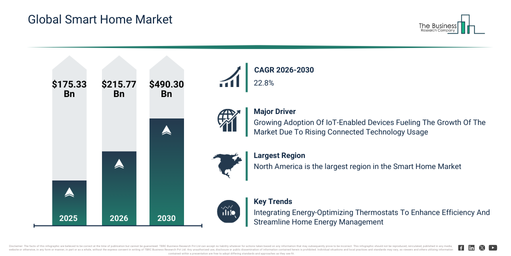
    The smart home market has demonstrated exponential growth over recent years. Its value is forecast to rise from $175.33 billion in 2025 to $215.77 billion in 2026, driven by a compound annual growth rate (CAGR) of 23.1%. This historical surge can be linked to factors such as the increasing adoption of IoT devices, rising consumer demand for home automation, growing awareness about energy efficiency, expanding use of smart security systems, and increasing penetration of smartphones and mobile applications.

    The smart home market size is anticipated to undergo substantial expansion over the upcoming years. It is projected to reach $490.30 billion by 2030, exhibiting a compound annual growth rate (CAGR) of 22.8%. This expansion throughout the forecast period is propelled by factors such as increased investment in smart home infrastructure, enhanced integration of AI and machine learning, wider adoption of voice-controlled devices, growing demand for retrofit solutions, and a greater emphasis on sustainable and energy-efficient solutions. Furthermore, key developments anticipated during this period involve technological advancements in AI-driven automation, innovations in Matter protocol interoperability, progress in 5G and edge computing integration, exploration into sustainable home solutions, and improvements in predictive maintenance and smart appliance management.

    Access Your Free Sample Report for In-Depth Market Insights:

    https://www.thebusinessresearchcompany.com/sample.aspx?id=30746&type=smp

    What Drivers Are Driving Adoption Within The Smart Home Market?

    The increasing use of Internet of Things (IoT)-enabled devices is anticipated to drive the expansion of the smart home market. These devices are electronic gadgets featuring sensors, software, and network connectivity, facilitating data collection and communication with other systems for remote monitoring and automated functions. Organizations are increasingly adopting IoT-enabled devices to acquire real-time data and automation, aiming to optimize operations, lower expenses, and enhance decision-making across various sectors including homes, cities, and industries. The smart home environment accommodates IoT-enabled devices by incorporating their capabilities into aspects like climate control, security systems, lighting, and household appliances, thereby boosting convenience, efficiency, and energy management. For example, as reported by IoT Analytics, a Germany-based research firm specializing in IoT market insights, in September 2024, the count of connected IoT devices hit 16.6 billion in 2023, marking a 15% rise from 14.4 billion in 2022. Consequently, the expanding deployment of Internet of Things (IoT)-enabled devices is propelling the growth of the smart home market.

    How Is The Smart Home Market Organized Into Various Segments?

    The smart home market covered in this report is segmented –

    1) By Type: Audio Equipment, Video Devices, Gaming Consoles

    2) By Device Type: Safety And Security Access Control, Home Appliances, Heating, Ventilation And Air Conditioning, Lighting Control, Smart Entertainment Devices, Smart Kitchen Appliances, Other Device Types

    3) By Protocol: Wired, Wireless

    4) By Sales Channel: Direct-To-Consumer (DTC) Or Online, Retail, Professional Or System Integrators

    5) By Application: Retrofit, New Construction

    Subsegments:

    1) By Audio Equipment: Smart Speakers, Wireless Home Audio Systems, Sound Bars, Multi Room Audio Devices, Home Theater Audio Systems

    2) By Video Devices: Smart Televisions, Streaming Media Players, Projectors, Video Casting Devices, Smart Display Screens

    3) By Gaming Consoles: Home Gaming Consoles, Portable Gaming Consoles, Virtual Reality Gaming Devices, Motion Sensing Gaming Devices, Cloud Based Gaming Consoles

    Which Trends Are Guiding The Evolution Of The Smart Home Market?

    Major companies within the smart home market are concentrating on developing solutions for energy optimization, such as integrated smart thermostats, with the goal of improving home energy efficiency, decreasing electricity costs, and enhancing automated climate control. Integrated smart thermostats are defined as connected devices that intelligently manage heating and cooling, synchronize with energy storage or backup systems, and adjust based on occupancy patterns to optimize energy consumption. For example, in May 2025, Generac Holdings Inc., a US-based energy technology company, unveiled the ecobee by Generac Smart Thermostat Enhanced with Home Energy Management. This particular integrated smart thermostat incorporates occupancy-based climate adjustment, allows integration with PWRcell solar battery storage to reduce grid dependence, and provides seamless coordination with Generac Home Standby Generators to ensure comfort during power outages.

    Who Are The Prominent Global Companies Shaping The Smart Home Market Landscape?

    Major companies operating in the smart home market are Amazon.com Inc., Apple Inc., Samsung Electronics Co. Ltd., Robert Bosch GmbH, LG Electronics Inc., Schneider Electric SE, Xiaomi Corporation, Honeywell International Inc., ABB Ltd., Legrand SA, Signify N.V., TP-Link Technologies Co. Ltd., Somfy SA, Anker Innovations Technology Co. Ltd., Lutron Electronics Co. Inc., Control4 Corporation, iRobot Corporation, Aqara, ecobee Inc., Tuya Inc., Nanoleaf Ltd., Eve Systems GmbH

    Access The Complete Report For Deeper Market Insights:

    https://www.thebusinessresearchcompany.com/report/smart-home-market-report

    Which Geographic Areas Are Emerging As Strong Markets For The Smart Home Market?

    North America was the largest region in the smart home market in 2025. Asia-Pacific is expected to be the fastest-growing region in the forecast period. The regions covered in the smart home market report are Asia-Pacific, South East Asia, Western Europe, Eastern Europe, North America, South America, Middle East, Africa.

    Request Your Customized Smart Home Market Research Report for Competitive Advantage:

    https://www.thebusinessresearchcompany.com/customise?id=30746&type=smp

    Browse Through More Reports Similar to the Global Smart Home Market 2026, By The Business Research Company

    Smart Homes Market 2026

    https://www.thebusinessresearchcompany.com/report/smart-homes-market

    Smart Home Devices Market Report 2026

    https://www.thebusinessresearchcompany.com/report/smart-home-devices-global-market-report

    smart home security systems global market report

    https://www.thebusinessresearchcompany.com/report/smart-home-security-systems-global-market-report

    Get in touch with us:

    The Business Research Company: https://www.thebusinessresearchcompany.com/

    Americas +1 310-496-7795

    Asia +44 7882 955267 & +91 8897263534

    Europe +44 7882 955267

    Email us at marketing@tbrc.info

    Follow us on:

    LinkedIn: https://in.linkedin.com/company/the-business-research-company

    YouTube: https://www.youtube.com/channel/UC24_fI0rV8cR5DxlCpgmyFQ

    Global Market Model: https://www.thebusinessresearchcompany.com/global-market-model

  • Global Sleep Disorder Market 2026–2030: Forecast Insights for Business Planning

    Global Sleep Disorder Market 2026–2030: Forecast Insights for Business Planning

    Uncover key drivers, emerging technologies, and competitive movements shaping the sleep disorder market from 2026–2035 with trusted insights from The Business Research Company

    Across 2026–2030, what is the expected market valuation path of the Sleep Disorder Market?

    The sleep disorder market size has experienced significant growth in recent years. This market is expected to increase from $33.32 billion in 2025 to $38.23 billion in 2026, achieving a compound annual growth rate (CAGR) of 14.7%. Factors contributing to its historical growth include greater awareness of sleep health, an increase in the prevalence of insomnia and sleep apnea, wider adoption of sleep diagnostic services, a growing geriatric population, escalating stress and lifestyle-induced sleep issues, and the rising utilization of smartphones and wearable devices for sleep tracking.

    The sleep disorder market is projected for significant expansion in the coming years. This market is anticipated to reach $65.51 billion in 2030, demonstrating a compound annual growth rate (CAGR) of 14.4%. This projected growth is primarily driven by factors such as the increasing availability of telemedicine for sleep disorders, the growing use of wearable sleep trackers, the rise in at-home diagnostic testing, the development of cognitive behavioral therapy applications, and enhanced government efforts to promote sleep health awareness. Key trends expected during this period involve improvements in wearable sleep monitoring devices, progress in home-based sleep diagnostic tools, developments in AI-powered sleep analysis, novel non-invasive treatments for sleep apnea, new approaches in telemedicine for sleep consultations, and advancements in cognitive behavioral therapy applications.

    Access Your Free Sample Report for In-Depth Market Insights:

    https://www.thebusinessresearchcompany.com/sample.aspx?id=30744&type=smp

    Which Drivers Are Supporting The Rise Of The Sleep Disorder Market?

    Future expansion in the sleep disorder market is anticipated, driven by escalating levels of stress and anxiety. These levels denote the extent of psychological stress and excessive concern present among people, frequently stemming from environmental, societal, or economic factors. A rise in stress and anxiety is observed, particularly fueled by work-related demands such as increased workloads, stringent deadlines, and employment uncertainty for workers. Elevated stress and anxiety contribute to sleep disorders by interfering with regular sleep cycles and making it harder to initiate or maintain sleep. This, in turn, deteriorates overall health by hindering restorative sleep, which can result in tiredness, reduced cognitive function, and an elevated susceptibility to long-term illnesses. As an illustration, figures from May 2024 by the American Psychiatric Association (APA), a professional body in the U.S., indicated that 43% of U.S. adults reported higher anxiety levels in 2024 compared to the prior year, marking an increase from 37% in 2023 and 32% in 2022. Consequently, the expanding presence of stress and anxiety is propelling the expansion of the sleep disorder market.

    What Segments Are Identified Within The Structure Of The Sleep Disorder Market?

    The sleep disorder market covered in this report is segmented –

    1) By Disorder Type: Insomnia, Sleep Apnea, Restless Legs Syndrome, Narcolepsy, Circadian Rhythm Disorders

    2) By Treatment: Cognitive Behavioral Therapy, Medication Therapy, Psychiatric Treatment, Behavioral Treatment

    3) By Diagnostic Method: Polysomnography, Home Sleep Testing, Actigraphy, Sleep Diaries, Questionnaires and Screening

    4) By Distribution Channel: Retail Pharmacies, Online Sales, Hospital Pharmacies

    5) By End-User: Hospitals And Sleep Centers, Home Care Settings, Academic

    Subsegments:

    1) By Insomnia: Acute Insomnia, Chronic Insomnia, Onset Insomnia, Maintenance Insomnia, Behavioral Insomnia, Medication-Induced Insomnia

    2) By Sleep Apnea: Obstructive Sleep Apnea, Central Sleep Apnea, Complex Sleep Apnea Syndrome, Mild Sleep Apnea, Moderate Sleep Apnea, Severe Sleep Apnea, Pediatric Sleep Apnea, Treatment-Resistant Sleep Apnea

    3) By Restless Legs Syndrome: Primary Restless Legs Syndrome, Secondary Restless Legs Syndrome, Mild Restless Legs Syndrome, Moderate Restless Legs Syndrome, Severe Restless Legs Syndrome, Intermittent Restless Legs Syndrome, Chronic Persistent Restless Legs Syndrome

    4) By Narcolepsy: Narcolepsy Type 1, Narcolepsy Type 2, Idiopathic Hypersomnia, Pediatric Narcolepsy, Treatment-Resistant Narcolepsy, Secondary Narcolepsy

    5) By Circadian Rhythm Disorders: Delayed Sleep Phase Disorder, Advanced Sleep Phase Disorder, Shift Work Sleep Disorder, Jet Lag Disorder, Irregular Sleep-Wake Rhythm Disorder, Non-24-Hour Sleep-Wake Disorder

    What Trends Are Projected To Support The Growth Of The Sleep Disorder Market?

    Leading companies within the sleep disorder market are concentrating on developing sophisticated therapeutic technologies, such as electrical vestibular nerve stimulation (VeNS) methods. These innovations aim to offer non-pharmacological treatment alternatives, thereby improving sleep quality, normalizing circadian rhythms, and assisting individuals suffering from chronic insomnia. The electrical vestibular nerve stimulation (VeNS) method is characterized as a non-invasive therapeutic technique that works by sending low-level electrical pulses to the vestibular nerve, a critical neural pathway, to affect brain areas responsible for sleep regulation, all without requiring surgical intervention or medication. A notable example is Neurovalens Ltd., a health-tech company based in the UK, which introduced Modius Sleep in October 2024. This FDA-cleared, non-invasive device specifically addresses chronic insomnia through the application of electrical vestibular nerve stimulation (VeNS). This medical device, styled as a headset, is intended for use for approximately 30 minutes every evening. It transmits safe electrical pulses to the vestibular nerve, which in turn influences the hypothalamus and brainstem regions that manage circadian rhythm and sleep patterns, ultimately enabling users to achieve sleep more rapidly and sustain it for longer durations.

    Which Key Players Are Driving Competition In The Sleep Disorder Market?

    Major companies operating in the sleep disorder market are Johnson & Johnson, Merck & Co. Inc., Pfizer Inc., Sanofi S.A., GlaxoSmithKline plc, Eli Lilly and Company, Takeda Pharmaceutical Company Limited, Teva Pharmaceutical Industries Ltd., Otsuka Holdings Co. Ltd., Biogen Inc., Union Chimique Belge S.A., Sun Pharmaceutical Industries Ltd., Eisai Co. Ltd., Jazz Pharmaceuticals plc, Aurobindo Pharma Ltd., Dr. Reddy’s Laboratories Limited, H. Lundbeck A/S, Sumitomo Pharma Co. Ltd., Neurocrine Biosciences Inc., Harmony Biosciences Holdings Inc., Vanda Pharmaceuticals Inc.

    Access The Complete Report For Deeper Market Insights:

    https://www.thebusinessresearchcompany.com/report/sleep-disorder-market-report

    Which Region Is Projected To Lead The Sleep Disorder Market During The Forecast Period?

    North America was the largest region in the sleep disorder market in 2025. Asia-Pacific is expected to be the fastest-growing region in the forecast period. The regions covered in the sleep disorder market report are Asia-Pacific, South East Asia, Western Europe, Eastern Europe, North America, South America, Middle East, Africa.

    Request Your Customized Sleep Disorder Market Research Report for Competitive Advantage:

    https://www.thebusinessresearchcompany.com/customise?id=30744&type=smp

    Browse Through More Reports Similar to the Global Sleep Disorder Market 2026, By The Business Research Company

    Insomnia Market Report 2026

    https://www.thebusinessresearchcompany.com/report/insomnia-global-market-report

    Sleeping Aids Market Report 2026

    https://www.thebusinessresearchcompany.com/report/sleeping-aids-global-market-report

    sleep testing services global market report

    https://www.thebusinessresearchcompany.com/report/sleep-testing-services-global-market-report

    Get in touch with us:

    The Business Research Company: https://www.thebusinessresearchcompany.com/

    Americas +1 310-496-7795

    Asia +44 7882 955267 & +91 8897263534

    Europe +44 7882 955267

    Email us at marketing@tbrc.info

    Follow us on:

    LinkedIn: https://in.linkedin.com/company/the-business-research-company

    YouTube: https://www.youtube.com/channel/UC24_fI0rV8cR5DxlCpgmyFQ

    Global Market Model: https://www.thebusinessresearchcompany.com/global-market-model
  • Single Use Medical Devices Market 2026–2030: Emerging Trends and Forecast Opportunities

    Single Use Medical Devices Market 2026–2030: Emerging Trends and Forecast Opportunities

    Uncover key drivers, emerging technologies, and competitive movements shaping the single use medical devices market from 2026–2035 with trusted insights from The Business Research Company

    How is the Single Use Medical Devices Market size predicted to change over the forecast window of 2026–2035?

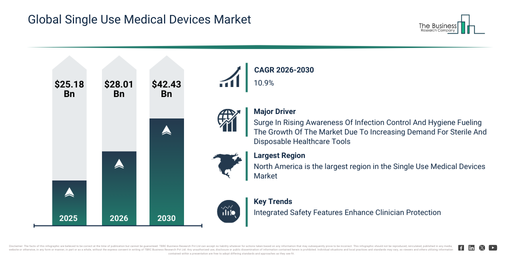
    The single-use medical devices market size has shown rapid expansion over recent years. Its value is expected to rise from $25.18 billion in 2025 to $28.01 billion in 2026, demonstrating a compound annual growth rate (CAGR) of 11.2%. The historical increase in this market can be linked to factors such as a heightened demand for infection control, an increasing number of surgical procedures worldwide, a rising prevalence of chronic conditions, more hospital admissions and emergency cases, and the growing adoption of disposable equipment for safety.

    The single-use medical devices market is projected for substantial expansion over the coming years. This market is anticipated to reach **$42.43 billion by 2030**, exhibiting a compound annual growth rate (CAGR) of **10.9%**. Key factors driving this growth during the forecast period include progress in biodegradable material technology, developments in intelligent disposable devices, the incorporation of automation into production processes, enhancements in sterile barrier packaging, and novel lightweight designs. Significant trends anticipated within this period encompass improvements in biodegradable disposable materials, breakthroughs in smart single-use devices, increased integration of automation in manufacturing, refined sterile packaging technology, and inventive lightweight device designs.

    Access Your Free Sample Report for In-Depth Market Insights:

    https://www.thebusinessresearchcompany.com/sample.aspx?id=30742&type=smp

    Which Drivers Are Contributing To The Expansion Of The Single Use Medical Devices Market?

    The increasing understanding of infection control and hygiene is projected to drive the expansion of the single-use medical devices market in the future. Effective infection control and hygiene practices are crucial in healthcare settings for preventing hospital-acquired infections (HAIs) and cross-contamination, which can lead to longer hospital stays, higher treatment expenses, and increased morbidity and mortality. This heightened awareness of infection control and hygiene is largely propelled by more stringent regulatory guidelines that prioritize patient safety and the avoidance of hospital-acquired infections. The single-use medical devices market supports this trend by providing sterile, disposable instruments that minimize the risk of contamination and ensure adherence to hygiene standards. For example, in May 2023, the World Health Organization (WHO), a Switzerland-based United Nations (UN) specialized agency, stated that approximately 1 in 10 patients in acute care hospitals acquires at least one healthcare-associated infection (HAI) during their stay, with rates notably higher in low and middle income countries compared to high income ones, indicating a widespread risk of infection in clinical environments. Thus, the growing recognition of infection prevention and hygiene is fostering the adoption of single-use medical devices across hospitals and clinics.

    What Segment Categories Are Covered In The Single Use Medical Devices Market?

    The single use medical devices market covered in this report is segmented –

    1) By Product Type: Syringes, Catheters, Surgical Instruments, Diagnostic Devices, Other Product Types

    2) By Material: Plastic, Metal, Glass, Other Materials

    3) By Application: Hospitals, Clinics, Ambulatory Surgical Centers, Home Healthcare, Other Applications

    4) By End-User: Healthcare Providers, Diagnostic Centers, Other End-Users

    Subsegments:

    1) By Syringes: Insulin Syringes, Tuberculin Syringes, Prefilled Syringes, Safety Syringes, Oral Syringes, Auto-Disable Syringes

    2) By Catheters: Intravenous (IV) Catheters, Urinary (Foley) Catheters, Central Venous Catheters, Peripheral Arterial Catheters, Dialysis Catheters, Cardiovascular (Angiography) Catheters

    3) By Surgical Instruments: Disposable Scalpels, Disposable Forceps, Disposable Scissors, Disposable Needle Holders, Disposable Retractors, Disposable Trocar Sets

    4) By Diagnostic Devices: Blood Glucose Test Strips, Rapid Diagnostic Test Kits, Single-Use Endoscopic Accessories, Specimen Collection Swabs, Disposable ECG Electrodes, Disposable Ultrasound Probe Covers

    5) By Other Product Types: Infusion Sets, Wound Dressings, Gloves And Gowns, Suction And Drainage Sets, Oxygen Masks And Cannulas, Disposable Dental Supplies

    What Long-Term Trends Are Expected To Shape The Future Of The Single Use Medical Devices Market?

    Leading companies in the single-use medical devices market are concentrating on developing innovative solutions, such as blood control safety IV catheters that incorporate automatic pathogen exposure mitigation and vessel entry confirmation, to gain a competitive edge. Blood control safety IV catheters are single-use intravenous (IV) devices specifically designed to minimize blood exposure and prevent needlestick injuries during their insertion and use. For example, in May 2024, MedSource Labs, a US-based medical device company, introduced the ClearSafe Comfort and TrueSafe Comfort Blood Control Safety IV Catheters. These new products feature active blood control check valve technology to significantly reduce the risk of bloodborne pathogen exposure, a translucent flashback chamber for accurate vessel entry confirmation, and an ergonomic non-slip grip for easier handling. This advancement improves procedural safety and efficiency but could potentially raise procurement costs and necessitate training for optimal use.

    Which Leading Companies Dominate The Single Use Medical Devices Market Share?

    Major companies operating in the single use medical devices market are Cardinal Health Inc., Medtronic plc, 3M Health Care, Medline Industries LP, Fresenius Medical Care AG, Becton Dickinson and Company, Boston Scientific Corporation, Baxter International Inc., Shandong Weigao Group Medical Polymer Company Limited, B. Braun Melsungen Aktiengesellschaft, Terumo Corporation, Nipro Corporation, Coloplast A/S, Teleflex Incorporated, West Pharmaceutical Services Inc., Paul Hartmann Aktiengesellschaft, ConvaTec Group plc, Ambu A/S, Mercator Medical S.A., Bio-Med HealthCare Products Pvt. Ltd., HLL Lifecare Limited

    Access The Complete Report For Deeper Market Insights:

    https://www.thebusinessresearchcompany.com/report/single-use-medical-devices-market-report

    How Does The Single Use Medical Devices Market Perform Across Major Global Regions?

    North America was the largest region in the single use medical devices market in 2025. Asia-Pacific is expected to be the fastest-growing region in the forecast period. The regions covered in the single use medical devices market report are Asia-Pacific, South East Asia, Western Europe, Eastern Europe, North America, South America, Middle East, Africa.

    Request Your Customized Single Use Medical Devices Market Research Report for Competitive Advantage:

    https://www.thebusinessresearchcompany.com/customise?id=30742&type=smp

    Browse Through More Reports Similar to the Global Single Use Medical Devices Market 2026, By The Business Research Company

    Portable Medical Devices Market Report 2026

    https://www.thebusinessresearchcompany.com/report/portable-medical-devices-global-market-report

    Medical Device Technologies Market Report 2026

    https://www.thebusinessresearchcompany.com/report/medical-device-technologies-global-market-report

    medical device security global market report

    https://www.thebusinessresearchcompany.com/report/medical-device-security-global-market-report

    Get in touch with us:

    The Business Research Company: https://www.thebusinessresearchcompany.com/

    Americas +1 310-496-7795

    Asia +44 7882 955267 & +91 8897263534

    Europe +44 7882 955267

    Email us at marketing@tbrc.info

    Follow us on:

    LinkedIn: https://in.linkedin.com/company/the-business-research-company

    YouTube: https://www.youtube.com/channel/UC24_fI0rV8cR5DxlCpgmyFQ

    Global Market Model: https://www.thebusinessresearchcompany.com/global-market-model
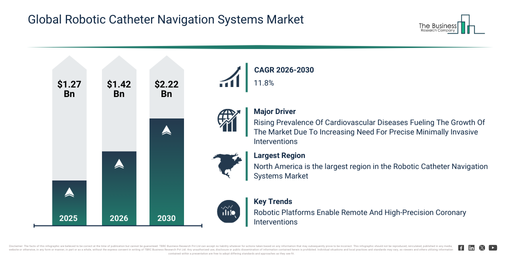
  • Robotic Catheter Navigation Systems Market 2026–2030: Forecasting Business Opportunities Ahead

    Robotic Catheter Navigation Systems Market 2026–2030: Forecasting Business Opportunities Ahead

    Uncover key drivers, emerging technologies, and competitive movements shaping the robotic catheter navigation systems market from 2026–2035 with trusted insights from The Business Research Company

    What level of growth is expected in the Robotic Catheter Navigation Systems Market between 2026 and 2030?

    The market for robotic catheter navigation systems has seen rapid expansion in recent years. It is projected to increase from $1.27 billion in 2025 to $1.42 billion in 2026, achieving a compound annual growth rate (CAGR) of 12.0%. This historical rise can be ascribed to several factors, including the increasing occurrence of cardiovascular diseases, a growing need for minimally invasive medical procedures, the expanding use of robotic-assisted surgeries, the establishment of more cardiac catheterization labs, and an upward trend in healthcare expenditure.

    The robotic catheter navigation systems market is projected to experience substantial expansion in the coming years, with an anticipated valuation of $2.22 billion by 2030, exhibiting a compound annual growth rate (CAGR) of 11.8%. Factors contributing to this growth during the forecast period include a heightened emphasis on precision medicine, the growing embrace of hybrid robotic systems, increased spending on research and development, the broadening of applications in neurovascular interventions, and a stronger patient inclination towards quicker recovery times. Key developments expected over the forecast period encompass ongoing advancements in robotic navigation technology, the integration of this technology with imaging and mapping systems, significant innovations in catheter design and materials, intensified research and development efforts in AI and machine learning, and the incorporation of robotic systems into telemedicine platforms.

    Access Your Free Sample Report for In-Depth Market Insights:

    https://www.thebusinessresearchcompany.com/sample.aspx?id=30731&type=smp

    Which Drivers Are Expected To Impact The Robotic Catheter Navigation Systems Market During The Forecast Period?

    The increasing occurrence of cardiovascular diseases is projected to drive the expansion of the robotic catheter navigation systems market going forward. These conditions, which affect the heart and blood vessels, include ailments like heart attacks, strokes, and elevated blood pressure. The rise in cardiovascular diseases is linked to unhealthy lifestyle choices such as poor nutrition, insufficient physical activity, and smoking. Robotic catheter navigation systems play a crucial role in managing cardiovascular diseases by enabling precise, minimally invasive navigation within blood vessels during both diagnostic and interventional medical procedures. They enhance patient outcomes by boosting procedural accuracy, minimizing complications, and reducing recovery durations. For instance, in October 2024, the Centers for Disease Control, a US-based government agency, reported that in 2023, around 919,032 individuals died from cardiovascular disease, making up 1 in every 3 deaths. Therefore, the growing prevalence of cardiovascular diseases is a primary catalyst for the growth of the robotic catheter navigation systems market.

    How Is The Robotic Catheter Navigation Systems Market Divided Into Segments?

    The robotic catheter navigation systems market covered in this report is segmented –

    1) By Product Type: Magnetic Navigation Systems, Electromechanical Navigation Systems, Other Product Types

    2) By Application: Cardiology, Neurology, Urology, Gastroenterology, Other Application

    3) By End-User: Hospitals, Ambulatory Surgical Centers, Specialty Clinics, Other End-Users

    Subsegments:

    1) By Magnetic Navigation Systems: Magnetic Field Generators, Catheter Steering Units, Imaging And Visualization Tools, Navigation Software Platforms, Sensor Modules

    2) By Electromechanical Navigation Systems: Motorized Catheter Devices, Control Consoles, Imaging Integration Modules, Position Sensors, Monitoring Software

    3) By Other Product Types: Accessories And Consumables, Support And Maintenance Tools, Data Management Software, Calibration Equipment, Connectivity Modules

    How Are Emerging Trends Affecting The Progression Of The Robotic Catheter Navigation Systems Market?

    Major companies within the robotic catheter navigation systems market are concentrating on developing advanced solutions, such as robotic platforms equipped with integrated control command units, to enhance procedural precision and safety in interventional cardiology. These robotic platforms with integrated control command units enable physicians to operate coronary angioplasty devices remotely from a shielded cockpit, significantly reducing radiation exposure for the medical team while simultaneously boosting the stability and accuracy of catheter positioning through robotic assistance, which facilitates complex vascular interventions with millimeter-level precision. For instance, in May 2023, ROBOCATH SAS, a France-based medical robotics company designing smart solutions for cardiovascular treatments, launched its R-One+ robotic platform. This particular robotic platform, featuring integrated control command units, is designed to conduct coronary angioplasties by allowing cardiologists to operate devices from a control room or cath lab cockpit, incorporating improved hand gesture controls and better ergonomic conditions. The solution additionally offers enhanced visibility through radioscopy and hemodynamic monitoring screens to accelerate the adoption of robotic percutaneous coronary interventions (PCI) and ensure safer working environments for healthcare professionals.

    Which Major Firms Are Strengthening Their Position In The Robotic Catheter Navigation Systems Market?

    Major companies operating in the robotic catheter navigation systems market are Johnson & Johnson., Abbott Laboratories, Medtronic plc., Siemens Healthineers Inc, Boston Scientific Corporation, Intuitive Surgical, Terumo Corporation, Springer Nature Link, Biotronik SE & Co. KG, LivaNova PLC, MicroPort Scientific Corporation, ClearPoint Neuro Inc, Imricor Medical Systems Inc., Stereotaxis Inc., Acutus Medical Inc., John Wiley & Sons Inc., Arxiv, Auris Health, Catheter Precision Inc., Robocath S.A.

    Access The Complete Report For Deeper Market Insights:

    https://www.thebusinessresearchcompany.com/report/robotic-catheter-navigation-systems-market-report

    Which Region Shows The Strongest Potential For Future Expansion In The Robotic Catheter Navigation Systems Market?

    North America was the largest region in the robotic catheter navigation systems market in 2025. Asia-Pacific is expected to be the fastest-growing region in the forecast period. The regions covered in the robotic catheter navigation systems market report are Asia-Pacific, South East Asia, Western Europe, Eastern Europe, North America, South America, Middle East, Africa.

    Request Your Customized Robotic Catheter Navigation Systems Market Research Report for Competitive Advantage:

    https://www.thebusinessresearchcompany.com/customise?id=30731&type=smp

    Browse Through More Reports Similar to the Global Robotic Catheter Navigation Systems Market 2026, By The Business Research Company

    Catheters Market Report 2026

    https://www.thebusinessresearchcompany.com/report/catheters-global-market-report

    Deflectable Catheters Market Report 2026

    https://www.thebusinessresearchcompany.com/report/deflectable-catheters-global-market-report

    surgical navigation systems global market report

    https://www.thebusinessresearchcompany.com/report/surgical-navigation-systems-global-market-report

    Get in touch with us:

    The Business Research Company: https://www.thebusinessresearchcompany.com/

    Americas +1 310-496-7795

    Asia +44 7882 955267 & +91 8897263534

    Europe +44 7882 955267

    Email us at marketing@tbrc.info

    Follow us on:

    LinkedIn: https://in.linkedin.com/company/the-business-research-company

    YouTube: https://www.youtube.com/channel/UC24_fI0rV8cR5DxlCpgmyFQ

    Global Market Model: https://www.thebusinessresearchcompany.com/global-market-model