Category: Medical Equipment

  • Global Intelligent Medical Guidance and Navigation System Market Report 2026–2035: Key Forecasts and Growth Areas

    Global Intelligent Medical Guidance and Navigation System Market Report 2026–2035: Key Forecasts and Growth Areas

    Uncover key drivers, emerging technologies, and competitive movements shaping the intelligent medical guidance and navigation system market from 2026–2035 with trusted insights from The Business Research Company

    How is the Intelligent Medical Guidance and Navigation System Market size predicted to change over the forecast window of 2026–2035?

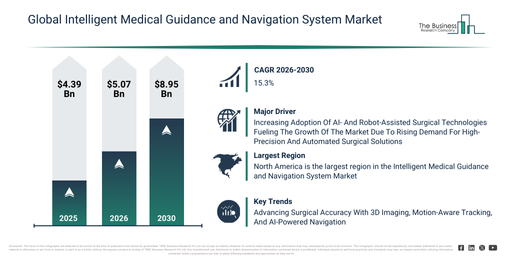
    The intelligent medical guidance and navigation system market has experienced substantial expansion in recent years. This market is projected to expand from $4.39 billion in 2025 to $5.07 billion in 2026, demonstrating a compound annual growth rate (CAGR) of 15.6%. The historical growth can be linked to factors such as the increasing adoption of medical imaging technologies, a rising demand for minimally invasive procedures, the growth in hospital digitalization, the early integration of artificial intelligence in clinical workflows, and the expansion of surgical navigation solutions.

    The market for intelligent medical guidance and navigation systems is projected for rapid expansion over the coming years, reaching $8.95 billion by 2030, driven by a compound annual growth rate (CAGR) of 15.3%. This anticipated growth during the forecast period is fueled by factors such as the increasing demand for precision medicine, the wider implementation of artificial intelligence-powered clinical support systems, greater capital expenditure on smart operating environments, a heightened emphasis on sustainable and carbon-neutral hospital facilities, and the quicker uptake of real-time patient monitoring. Key developments expected over the forecast horizon encompass the convergence of artificial intelligence with multimodal imaging, the rise of robotics-assisted navigation, the proliferation of cloud-based platforms for clinical decision-making, the expanded application of digital twins in healthcare strategic planning, and a move towards medical systems that are energy-efficient and carbon-free.

    Access Your Free Sample Report for In-Depth Market Insights:

    https://www.thebusinessresearchcompany.com/sample.aspx?id=30624&type=smp

    Which Drivers Are Contributing To The Expansion Of The Intelligent Medical Guidance and Navigation System Market?

    The expanding implementation of robot-assisted surgical technologies is anticipated to drive the advancement of the intelligent medical guidance and navigation system market in the coming years. Artificial intelligence (AI) and robot-assisted surgical technologies refer to sophisticated systems that utilize AI and robotic mechanisms to aid surgeons in performing intricate operations with enhanced precision, control, and effectiveness. The uptake of Artificial intelligence (AI) and robot-assisted surgical technologies is on the rise as hospitals strive for superior surgical precision, lower complication rates, and quicker patient recovery through minimally invasive, digitally guided procedures. The intelligent medical guidance and navigation system supports robot-assisted surgical technologies by offering real-time surgical navigation, automated instrument guidance, and decision-support functions that optimize procedural accuracy. For instance, in November 2024, data from the Private Healthcare Information Network, a UK-based government-mandated organisation, indicated that roughly 22,700 robot-assisted procedures were carried out in the first quarter of 2024. This marked a substantial 45% increase when compared to the first quarter of 2023, and a 12% rise from the last quarter of 2023. Therefore, the heightened adoption of robot-assisted surgical technologies is a significant force behind the growth of the intelligent medical guidance and navigation system market.

    What Segment Classifications Make Up The Intelligent Medical Guidance and Navigation System Market?

    The intelligent medical guidance and navigation system market covered in this report is segmented –

    1) By Component Or Product Type: Hardware, Software, Service

    2) By Technology: Robotics, Computer Vision, Artificial Intelligence, Augmented Reality, Navigation Software

    3) By Application: Surgical Navigation, Radiation Therapy, Diagnostic Imaging, Orthopedic Guidance, Neurological Guidance

    4) By End Use: Hospitals, Ambulatory Surgery Centers, Diagnostic Centers, Research Institutions

    Subsegments:

    1) By Hardware: Imaging Sensors, Tracking Sensors, Navigation Consoles, Robotic Arms, Display Monitors

    2) By Software: Imaging Analysis Software, Navigation Planning Software, Intraoperative Guidance Software, Workflow Integration Software, Data Management Software

    3) By Service: Installation Service, Maintenance Service, Training Service, Upgradation Service, Technical Support Service

    Which Innovation Trends Are Advancing Developments Within The Intelligent Medical Guidance and Navigation System Market?

    Leading firms within the intelligent medical guidance and navigation system market are concentrating on creating sophisticated technologies, including 3D imaging and motion-aware tracking, with the goal of boosting precision during operations, minimizing mistakes, and bettering surgical results. This technology, encompassing 3D imaging and motion-aware tracking, involves combining three-dimensional views with continuous monitoring of surgical tools and patient body structures. This allows systems to adapt responsively to movement and offer precise direction throughout surgical interventions. As an illustration, in October 2025, Zeta Surgical Inc., a US-based medical technology firm focused on AI-driven surgical solutions, obtained FDA 510(k) clearance for its AI-powered TMS Navigation System. The system integrates 3D imaging and motion-aware tracking to provide instantaneous guidance during intricate surgical operations, thereby enabling surgeons to operate with increased spatial understanding and accuracy. Such a system facilitates safer, more effective surgeries and plays a part in enhancing patient recovery.

    Which Key Market Players Are Investing In Expansion And Innovation Within The Intelligent Medical Guidance and Navigation System Market?

    Major companies operating in the intelligent medical guidance and navigation system market are Johnson & Johnson, Medtronic Plc, Siemens Healthineers AG, Stryker Corporation, Koninklijke Philips N.V., GE Healthcare Technologies Inc., Smith & Nephew Plc, B. Braun Melsungen AG, Zimmer Biomet Holdings Inc., Intuitive Surgical, Olympus Corporation, Karl Storz SE & Co. KG, Brainlab AG, Amplitude Surgical, Northern Digital Inc., Augmedics, Synaptive Medical Inc., Proprio, Fiagon GmbH, Surgical Theater LLC, Orthofix Medical Inc., Naviswiss AG, SurgicEye GmbH

    Access The Complete Report For Deeper Market Insights:

    https://www.thebusinessresearchcompany.com/report/intelligent-medical-guidance-and-navigation-system-market-report

    Which Regions Are Poised For Strategic Growth In The Intelligent Medical Guidance and Navigation System Market?

    North America was the largest region in the intelligent medical guidance and navigation systems market in 2025. Asia-Pacific is expected to be the fastest-growing region in the forecast period. The regions covered in the intelligent medical guidance and navigation system market report are Asia-Pacific, South East Asia, Western Europe, Eastern Europe, North America, South America, Middle East, Africa.

    Request Your Customized Intelligent Medical Guidance and Navigation System Market Research Report for Competitive Advantage:

    https://www.thebusinessresearchcompany.com/customise?id=30624&type=smp

    Browse Through More Reports Similar to the Global Intelligent Medical Guidance and Navigation System Market 2026, By The Business Research Company

    Navigation System Market Report 2026

    https://www.thebusinessresearchcompany.com/report/navigation-system-global-market-report

    Healthcare Navigation Platform Market Report 2026

    https://www.thebusinessresearchcompany.com/report/healthcare-navigation-platform-global-market-report

    surgical navigation systems global market report

    https://www.thebusinessresearchcompany.com/report/surgical-navigation-systems-global-market-report

    Get in touch with us:

    The Business Research Company: https://www.thebusinessresearchcompany.com/

    Americas +1 310-496-7795

    Asia +44 7882 955267 & +91 8897263534

    Europe +44 7882 955267

    Email us at marketing@tbrc.info

    Follow us on:

    LinkedIn: https://in.linkedin.com/company/the-business-research-company

    YouTube: https://www.youtube.com/channel/UC24_fI0rV8cR5DxlCpgmyFQ

    Global Market Model: https://www.thebusinessresearchcompany.com/global-market-model
  • Insulated Shippers Market 2026–2030: Forecast, Innovation, and Competitive Trends

    Insulated Shippers Market 2026–2030: Forecast, Innovation, and Competitive Trends

    Uncover key drivers, emerging technologies, and competitive movements shaping the insulated shippers market from 2026–2035 with trusted insights from The Business Research Company

    What market expansion outlook does the Insulated Shippers Market show for the 2026–2030 period?

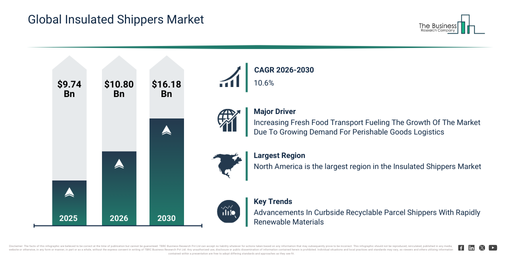
    The size of the insulated shippers market has experienced rapid expansion in recent years. It is projected to grow from $9.74 billion in 2025 to $10.80 billion in 2026, demonstrating a compound annual growth rate (CAGR) of 10.9%. This historical growth can be attributed to factors such as the escalating demand for temperature-sensitive pharmaceuticals, the increasing adoption of cold chain logistics, a rise in the use of expanded polystyrene and polyurethane insulated packaging, the expansion of global food and beverage distribution networks, and an enhanced regulatory focus on temperature-controlled shipping.

    The insulated shippers market is projected to experience substantial expansion in the coming years, with its valuation set to reach $16.18 billion by 2030, exhibiting a compound annual growth rate (CAGR) of 10.6%. This anticipated growth during the forecast period is primarily driven by factors such as the expanding requirement for biologics and specialty pharmaceuticals, the rising volume of perishable food shipments through e-commerce, the heightened interest in reusable insulated packaging, the proliferation of sophisticated cold chain infrastructure, and the greater uptake of high-performance insulation materials. Key trends anticipated over the forecast period encompass technological progress in thermal packaging systems, novel approaches to smart temperature monitoring solutions, the evolution of sustainable and reusable insulated shipper designs, ongoing research and development into vacuum insulated panels and phase-change materials, and improvements in modular and customizable insulated packaging solutions.

    Access Your Free Sample Report for In-Depth Market Insights:

    https://www.thebusinessresearchcompany.com/sample.aspx?id=30623&type=smp

    What Drivers Are Shaping The Development Of The Insulated Shippers Market?

    The elevated volume of fresh food transportation is projected to drive the expansion of the insulated shippers market in the coming years. This involves moving perishable agricultural products, such as fruits, vegetables, meat, and dairy, from producers to consumers while maintaining specific temperature conditions to preserve their freshness. The increase in fresh food transport stems from growing consumer demand for convenient home delivery of fresh produce and refrigerated items via e-commerce grocery platforms and rapid delivery services. Insulated shippers facilitate this rise by ensuring precise temperature control, which keeps perishable products safe and of high quality during transit. For instance, in January 2025, data from the United States Department of Agriculture (USDA), a US-based federal executive department, indicated that United States truck shipments of fresh produce reached 11.21 million tons in the second quarter of 2024, representing a 14% rise compared with the same quarter in 2023. Thus, the growing fresh food transport sector is a key driver for the insulated shippers market’s growth.

    What Segment Types Are Examined In The Insulated Shippers Market?

    The insulated shippers market covered in this report is segmented –

    1) By Product Type: Panel Shippers, Envelope Shippers, Box Shippers, Other Product Types

    2) By Material: Expanded Polystyrene (EPS), Polyurethane, Vacuum Insulated Panels, Other Materials

    3) By Distribution Channel: Direct Sales, Distributors, Online Retail

    4) By Application: Pharmaceuticals, Food And Beverages, Chemicals, Other Applications

    5) By End-User: Healthcare, Food Service, E-Commerce, Other End-Users

    Subsegments:

    1) By Panel Shippers: Single Wall Construction, Double Wall Construction, Multi-Layered Composite Construction

    2) By Envelope Shippers: Bubble Insulated Mailers, Foam Lined Padded Mailers, Reflective Foil Insulated Mailers

    3) By Box Shippers: Single-Use Corrugated Boxes, Reusable Plastic Containers, Insulated Dividers And Liners

    4) By Other Product Types: Insulated Totes And Bags, Hard-Sided Insulated Cases, Custom Molded Foam Containers

    Which Competitive Trends Are Impacting The Structure Of The Insulated Shippers Market?

    Leading companies in the insulated shippers market are concentrating on developing environmentally friendly packaging solutions, such as curbside-recyclable parcel shippers, with the aim of enhancing thermal efficiency, operational effectiveness, and minimizing environmental impact. These recyclable cold chain shippers combine robust insulation with quickly renewable, single-use materials to safeguard product integrity while allowing for straightforward disposal and recycling. For instance, in May 2025, Cold Chain Technologies LLC, a US-based supplier of temperature-controlled packaging, launched its CCT TRUEtemp Naturals shipper. This product offers a cost-effective, single-use solution that addresses customer demands for reliable cold chain performance and supports corporate sustainability targets. Qualified according to the ISTA 7E RFG profile, the system maintains conditions of 2–8 °C for as long as 48 hours. Available in extra small, small, medium, and large formats, it supports various payload requirements and is particularly well-suited for drug sampling programs, wholesale distribution, and overnight domestic shipments.

    Who Are The Core Companies Influencing Trends In The Insulated Shippers Market?

    Major companies operating in the insulated shippers market are DS Smith PLC, Sonoco ThermoSafe, Sealed Air Corporation, Tower Cold Chain Solutions Limited, Ranpak Holdings Corp., CSafe Global, Cryoport Systems LLC, Cold Chain Technologies (CCT), Envirotainer AB, FEURER Group GmbH, TemperPack Technologies Inc., Peli BioThermal LLC, Cryopak Industries Inc., Polar Tech Industries Inc., Nordic Cold Chain Solutions, DGP Intelsius Limited, Inmark Packaging, Topa Thermal Packaging B.V., Sofrigam SA, Chill-Pak, Tempack Packaging Solutions S.L.

    Access The Complete Report For Deeper Market Insights:

    https://www.thebusinessresearchcompany.com/report/insulated-shippers-market-report

    Which Regions Are Projected To Dominate The Insulated Shippers Market In The Coming Years?

    North America was the largest region in the insulated shippers market in 2025. Asia-Pacific is expected to be the fastest-growing region in the forecast period. The regions covered in the insulated shippers market report are Asia-Pacific, South East Asia, Western Europe, Eastern Europe, North America, South America, Middle East, Africa.

    Request Your Customized Insulated Shippers Market Research Report for Competitive Advantage:

    https://www.thebusinessresearchcompany.com/customise?id=30623&type=smp

    Browse Through More Reports Similar to the Global Insulated Shippers Market 2026, By The Business Research Company

    Insulated Shipping Packaging Market Report 2026

    https://www.thebusinessresearchcompany.com/report/insulated-shipping-packaging-global-market-report

    Insulation Products Market Report 2026

    https://www.thebusinessresearchcompany.com/report/insulation-products-global-market-report

    aircraft insulation global market report

    https://www.thebusinessresearchcompany.com/report/aircraft-insulation-global-market-report

    Get in touch with us:

    The Business Research Company: https://www.thebusinessresearchcompany.com/

    Americas +1 310-496-7795

    Asia +44 7882 955267 & +91 8897263534

    Europe +44 7882 955267

    Email us at marketing@tbrc.info

    Follow us on:

    LinkedIn: https://in.linkedin.com/company/the-business-research-company

    YouTube: https://www.youtube.com/channel/UC24_fI0rV8cR5DxlCpgmyFQ

    Global Market Model: https://www.thebusinessresearchcompany.com/global-market-model
  • Immersive Virtual Stores Market Outlook 2026–2030: Key Business Drivers and Trends

    Immersive Virtual Stores Market Outlook 2026–2030: Key Business Drivers and Trends

    Uncover key drivers, emerging technologies, and competitive movements shaping the immersive virtual stores market from 2026–2035 with trusted insights from The Business Research Company

    How much is the Immersive Virtual Stores Market valued at in 2026, and what valuation is forecast for 2030?

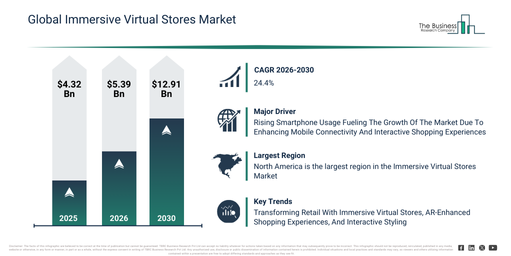
    The market size for immersive virtual stores has witnessed significant expansion in recent years. It is projected to increase from $4.32 billion in 2025 to $5.39 billion in 2026, at a compound annual growth rate (CAGR) of 24.7%. The growth observed in the past can be attributed to a rising demand for interactive online shopping experiences, the growing adoption of augmented reality tools within retail, an increase in the use of three-dimensional product visualization, the global expansion of e-commerce platforms, and a heightened focus from retailers on digital customer engagement.

    The immersive virtual stores market is set for substantial growth over the next few years. It is anticipated to expand to $12.91 billion in 2030, achieving a compound annual growth rate (CAGR) of 24.4%. This projected expansion is driven by the increasing incorporation of virtual reality commerce into omnichannel strategies, a surge in the adoption of cloud-based immersive store platforms, a rising demand for tailored and engaging digital shopping experiences, the expansion of virtual real estate and showroom applications, and greater retailer investment in experiential digital branding. Notable trends during this period include technological advancements in real-time three-dimensional rendering, innovations in artificial intelligence-enabled virtual try-on systems, developments in web-based immersive environments, research and developments in spatial computing and mixed reality, and improvements in three-dimensional content creation pipelines.

    Access Your Free Sample Report for In-Depth Market Insights:

    https://www.thebusinessresearchcompany.com/sample.aspx?id=30617&type=smp

    What Drivers Are Influencing The Growth Of The Immersive Virtual Stores Market?

    The immersive virtual stores market is expected to expand moving forward, driven by the increasing use of smartphones. Smartphones are defined as advanced mobile devices that offer internet connectivity, app functionality, and real-time communication. The rise in smartphone usage is attributed to the rapid growth of mobile internet connectivity, which allows consumers to access online platforms and shop globally from any location at any time. Smartphones enhance immersive virtual stores by providing a portable and interactive platform for both augmented reality and virtual reality shopping experiences. This improves customer engagement and convenience by enabling immediate product visualization, customized recommendations, and seamless online purchasing regardless of where the customer is. For instance, in November 2024, Eurostat, the Luxembourg-based official statistical office of the European Union (EU), reported that in 2023, about 89% of EU residents aged 16–74 residing in cities used their smartphones to access the internet, compared to 86% in towns and suburbs and 82% in rural areas. Therefore, the growing penetration of smartphones is a significant catalyst for the growth of the immersive virtual stores market.

    How Is The Immersive Virtual Stores Market Organized Into Various Segments?

    The immersive virtual stores market covered in this report is segmented –

    1) By Technology Platform: Virtual Reality Based Stores, Augmented Reality Based Stores, Mixed Reality Based Stores, Web-Based Three Dimensional Stores

    2) By Deployment Mode: Cloud-Based, On-Premises

    3) By Application: Retail And E-commerce, Fashion And Apparel, Real Estate, Other Applications

    5) By End User: Retailers, Electronic Commerce Companies, Fashion Brands, Real Estate Companies, Consumer Electronics Companies, Other End Users

    Subsegments:

    1) By Virtual Reality Based Stores: Headset Dependent Full Immersion Stores, Social Virtual Reality Platform Stores, Controller Based Navigation Stores, Room Scale Interactive Stores

    2) By Augmented Reality Based Stores: Marker Based Augmented Reality Stores, Markerless Augmented Reality Stores, Projection Based Augmented Reality Stores, Mobile Application Augmented Reality Stores

    3) By Mixed Reality Based Stores: Holographic Device Enabled Stores, Spatial Computing Platform Stores, Interactive Blended Reality Stores, Wearable Display Integrated Stores

    4) By Web-Based Three Dimensional Stores: Browser Rendered Three Dimensional Stores, Game Engine Powered Web Stores, E-Commerce Platform Integrated Three Dimensional Stores, No Download Instant Access Stores

    What Trends Are Reshaping The Dynamics Of The Immersive Virtual Stores Market?

    Leading companies in the immersive virtual stores market are focusing on developing advanced technologies, such as AR-powered virtual closet environments, to boost customer engagement, improve digital shopping experiences, and bridge the gap between physical and online retail. These immersive AR-enabled virtual closet environments utilize augmented reality and spatial computing platforms, allowing users to explore products in realistic 3D spaces, interact with merchandise intuitively, and experience highly lifelike visuals that replicate in-store browsing digitally. For instance, in February 2024, J.Crew Group Inc., a US-based fashion retailer, launched the J.Crew Virtual Closet app on Apple Vision Pro, bringing an AR-driven virtual closet experience to spatial computing devices. This experience enables users to browse and mix-and-match clothing in a hyper-realistic 3D setting, examine textures and materials at high magnification, and interact with stylists via SharePlay during FaceTime calls. This AR-enhanced virtual store not only enriches product discovery but also facilitates personalized styling and social shopping features that extend beyond traditional e-commerce.

    Who Are The Prominent Global Companies Shaping The Immersive Virtual Stores Market Landscape?

    Major companies operating in the immersive virtual stores market are Alibaba Group Holding Limited, Roblox Corporation, Unity Software Inc., HTC Corporation, Flexsin Technologies Pvt. Ltd., Vection Technologies Ltd., Trigma Solutions Inc., Decentraland Foundation, iCreative Technologies Pvt. Ltd., Esferasoft Solutions Pvt. Ltd., Pixelette Technologies Pvt. Ltd., Innowise Group, ByondXR Ltd., Emperia Ltd., rooom GmbH, KiXR Ltd., Digital Agents Interactive Inc., GlamAR Inc., VB Metaverse Ltd., Obsess Inc., Arimars Technologies Pvt. Ltd.

    Access The Complete Report For Deeper Market Insights:

    https://www.thebusinessresearchcompany.com/report/immersive-virtual-stores-market-report

    Which Geographic Areas Are Emerging As Strong Markets For The Immersive Virtual Stores Market?

    North America was the largest region in the immersive virtual stores market in 2025. Asia-Pacific is expected to be the fastest-growing region in the forecast period. The regions covered in the immersive virtual stores market report are Asia-Pacific, South East Asia, Western Europe, Eastern Europe, North America, South America, Middle East, Africa.

    Request Your Customized Immersive Virtual Stores Market Research Report for Competitive Advantage:

    https://www.thebusinessresearchcompany.com/customise?id=30617&type=smp

    Browse Through More Reports Similar to the Global Immersive Virtual Stores Market 2026, By The Business Research Company

    Virtual Reality Shopping Market Report 2026

    https://www.thebusinessresearchcompany.com/report/virtual-reality-shopping-global-market-report

    Immersive Technology Market Report 2026

    https://www.thebusinessresearchcompany.com/report/immersive-technology-global-market-report

    virtual data room global market report

    https://www.thebusinessresearchcompany.com/report/virtual-data-room-global-market-report

    Get in touch with us:

    The Business Research Company: https://www.thebusinessresearchcompany.com/

    Americas +1 310-496-7795

    Asia +44 7882 955267 & +91 8897263534

    Europe +44 7882 955267

    Email us at marketing@tbrc.info

    Follow us on:

    LinkedIn: https://in.linkedin.com/company/the-business-research-company

    YouTube: https://www.youtube.com/channel/UC24_fI0rV8cR5DxlCpgmyFQ

    Global Market Model: https://www.thebusinessresearchcompany.com/global-market-model
  • Home Spirometry With Bluetooth Integration Sector Forecast Shows Robust Momentum, Climbing to $2.85 Billion With 11.9% CAGR

    Home Spirometry With Bluetooth Integration Sector Forecast Shows Robust Momentum, Climbing to $2.85 Billion With 11.9% CAGR

    Uncover key drivers, emerging technologies, and competitive movements shaping the home spirometry with bluetooth integration market from 2026–2035 with trusted insights from The Business Research Company

    What are the forecasted starting (2026) and ending (2030) market sizes for the Home Spirometry With Bluetooth Integration Market?

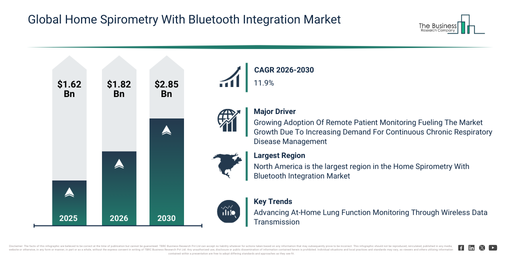
    The market for home spirometry with bluetooth integration has demonstrated rapid expansion in recent years. This sector is forecast to increase from $1.62 billion in 2025 to $1.82 billion in 2026, achieving a compound annual growth rate (CAGR) of 12.1%. The growth observed in prior periods can be attributed to several factors, including the rising incidence of respiratory diseases, the growing adoption of home-based healthcare devices, increased public awareness concerning lung health surveillance, the expanded utilization of portable spirometers, and the enhanced integration of wireless health monitoring systems.

    The market for home spirometry featuring Bluetooth integration is projected to experience substantial expansion over the upcoming years. Its valuation is anticipated to reach $2.85 billion by 2030, demonstrating a compound annual growth rate (CAGR) of 11.9%. This expansion during the prediction period is largely due to factors such as the increasing need for remote patient observation, the wider acceptance of medical devices equipped with Bluetooth, the enhanced incorporation of AI and predictive analytics in managing respiratory conditions, the broader implementation of cloud-based health data platforms, and a heightened focus on telehealth solutions centered around the patient. Key developments expected throughout this period encompass technological progress in Bluetooth-enabled spirometry devices, breakthroughs in AI-powered respiratory analytics, enhancements in cloud-based systems for patient monitoring, ongoing research and development efforts in portable diagnostic tools, and improvements in the integration and reporting of real-time health data.

    Access Your Free Sample Report for In-Depth Market Insights:

    https://www.thebusinessresearchcompany.com/sample.aspx?id=30608&type=smp

    What Drivers Are Supporting Technological Adoption In The Home Spirometry With Bluetooth Integration Market?

    The expanding utilization of remote patient monitoring is projected to stimulate the growth of the home spirometry with Bluetooth integration market moving forward. Remote patient monitoring involves the deployment of connected medical devices and digital platforms to collect, transmit, and analyze patient health data outside conventional clinical environments, thereby supporting the continuous management of chronic conditions. The uptake of remote patient monitoring is increasing due to the rising prevalence of chronic respiratory diseases, as continuous oversight helps in managing symptoms and preventing hospitalizations. Home spirometry with Bluetooth integration facilitates remote patient monitoring by enabling patients to track lung function from home and directly transmit data to healthcare providers. This enhances disease management and patient outcomes by allowing for the early detection of respiratory issues and timely intervention. For instance, a December 2025 report by Intuition Labs, a US-based healthcare technology company, reveals that nearly 50 million Americans are already using some form of remote patient monitoring device. Additionally, 80% of Americans hold a favorable view towards integrating remote patient monitoring into medical care, and by 2025, it is expected that over 71 million Americans, representing 26% of the population, will be utilizing some form of remote patient monitoring service. Consequently, the increasing adoption of remote patient monitoring is propelling the expansion of the home spirometry with Bluetooth integration market.

    Which Segments Are Contributing To The Growth Of The Home Spirometry With Bluetooth Integration Market?

    The home spirometry with bluetooth integration market covered in this report is segmented –

    1) By Product Type: Handheld Spirometers, Tabletop Spirometers, Wearable Spirometers

    2) By Connectivity: Bluetooth, Wi-Fi, Universal Serial Bus (USB)

    3) By Distribution Channel: Online, Offline

    4) By Application: Chronic Obstructive Pulmonary Disease (COPD), Asthma, Cystic Fibrosis, Other Applications

    5) By End-User: Hospitals And Clinics, Homecare Settings, Diagnostic Centers, Other End-Users

    Subsegments:

    1) By Handheld Spirometers: Portable Lung Function Measurement Devices, Battery Operated Spirometry Units, Compact Home Monitoring Spirometers, Bluetooth Enabled Handheld Spirometers, Real Time Data Transmission Spirometry Devices

    2) By Tabletop Spirometers: Desktop Pulmonary Function Testing Units, Clinical Grade Tabletop Spirometry Devices, Multi Parameter Respiratory Assessment Systems, Bluetooth Integrated Desktop Spirometers, High Accuracy Stationary Spirometry Units

    3) By Wearable Spirometers: Continuous Respiratory Monitoring Devices, Smart Wrist Or Chest Mounted Spirometers, Bluetooth Connected Wearable Spirometry Units, Daily Activity Integrated Respiratory Monitors, Lightweight Home Use Wearable Spirometers

    What Upcoming Trends Are Likely To Define The Future Path Of The Home Spirometry With Bluetooth Integration Market?

    Leading firms within the home spirometry with Bluetooth integration market are concentrating on creating sophisticated offerings, particularly bluetooth-enabled spirometers, aimed at improving lung function tracking from home, simplifying data gathering, and facilitating remote clinical supervision. These bluetooth-enabled spirometers are devices designed to measure various respiratory indicators, such as airflow and lung volume, and then wirelessly relay this information to mobile phones, tablets, or cloud-based systems, allowing patients and medical professionals to access it in real time. An example illustrating this trend is Clario, a clinical technology company based in the US, which obtained FDA 510(k) clearance in June 2024 for its SpiroSphere system, featuring integration with a wireless ECG device. This particular system enables concurrent monitoring of both spirometry and cardiac data, facilitates automatic data transmission using Bluetooth, and provides real-time tracking capabilities via its mobile applications. Such functionalities aid in precise remote health monitoring, contribute to the prompt identification of respiratory problems, and support streamlined clinical workflow management. This marks a notable progression in at-home respiratory healthcare, bringing together ease of use, integrated data capabilities, and dependable clinical performance.

    Who Are The Major Companies Operating In The Home Spirometry With Bluetooth Integration Market?

    Major companies operating in the home spirometry with bluetooth integration market are Contec Medical Systems Co. Ltd., Vyaire Medical Inc., Schiller AG, Vitalograph Ltd., COSMED S.r.l., SDI Diagnostics Inc., NDD Medizintechnik AG, Futuremed America Inc., NuvoAir AB, Cohero Health Inc., Smiths Medical International Ltd., Sibelmed S.L.U., Uscom Ltd., e-LinkCare Meditech Co. Ltd., CMI Health Inc., Medikro Oy, Icen Technology Co. Ltd., HealthUp S.A., Fukuda Sangyo Co. Ltd., Smart Respiratory Products Ltd.

    Access The Complete Report For Deeper Market Insights:

    https://www.thebusinessresearchcompany.com/report/home-spirometry-with-bluetooth-integration-market-report

    Which Region Is Anticipated To See The Fastest Growth In The Home Spirometry With Bluetooth Integration Market?

    North America was the largest region in the home spirometry with bluetooth integration market in 2025. Asia-Pacific is expected to be the fastest-growing region in the forecast period. The regions covered in the home spirometry with bluetooth integration market report are Asia-Pacific, South East Asia, Western Europe, Eastern Europe, North America, South America, Middle East, Africa.

    Request Your Customized Home Spirometry With Bluetooth Integration Market Research Report for Competitive Advantage:

    https://www.thebusinessresearchcompany.com/customise?id=30608&type=smp

    Browse Through More Reports Similar to the Global Home Spirometry With Bluetooth Integration Market 2026, By The Business Research Company

    Spirometer Market Report 2026

    https://www.thebusinessresearchcompany.com/report/spirometer-global-market-report

    Respiratory Monitoring Devices Market Report 2026

    https://www.thebusinessresearchcompany.com/report/respiratory-monitoring-devices-global-market-report

    distance health technology global market report

    https://www.thebusinessresearchcompany.com/report/distance-health-technology-global-market-report

    Get in touch with us:

    The Business Research Company: https://www.thebusinessresearchcompany.com/

    Americas +1 310-496-7795

    Asia +44 7882 955267 & +91 8897263534

    Europe +44 7882 955267

    Email us at marketing@tbrc.info

    Follow us on:

    LinkedIn: https://in.linkedin.com/company/the-business-research-company

    YouTube: https://www.youtube.com/channel/UC24_fI0rV8cR5DxlCpgmyFQ

    Global Market Model: https://www.thebusinessresearchcompany.com/global-market-model
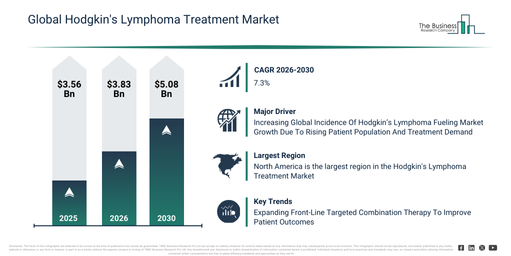
  • Hodgkin’s Lymphoma Treatment Market Anticipated to Record Steady Gains, Advancing to $5.07 Billion by 2030

    Hodgkin’s Lymphoma Treatment Market Anticipated to Record Steady Gains, Advancing to $5.07 Billion by 2030

    Uncover key drivers, emerging technologies, and competitive movements shaping the hodgkin’s lymphoma treatment market from 2026–2035 with trusted insights from The Business Research Company

    What upper market value could the Hodgkin’s Lymphoma Treatment Market reach by 2030 starting from 2026 levels?

    The hodgkin’s lymphoma treatment market has experienced robust expansion in recent years. It is anticipated to grow from $3.56 billion in 2025 to $3.83 billion in 2026, demonstrating a compound annual growth rate (CAGR) of 7.6%. This historical upward trend can be attributed to several factors including a higher incidence of hodgkin’s lymphoma, improved awareness and early diagnostic capabilities, the increasing adoption of chemotherapy and radiation therapy, the expansion of oncology healthcare infrastructure, and rising government funding dedicated to cancer research.

    The hodgkin’s lymphoma treatment market size anticipates significant expansion over the coming years. It will grow to $5.08 billion in 2030 at a compound annual growth rate (CAGR) of 7.3%. This projected growth during the forecast period is due to factors such as increased uptake of immunotherapy and targeted therapies, wider access to stem cell transplantation, a growing inclination among patients for customized treatments, the expansion of oncology facilities in developing regions, and enhanced insurance coverage alongside reimbursement assistance. Key developments expected during this period involve technological progress in diagnostic imaging, breakthroughs in immunotherapy and targeted therapeutic approaches, advancements in less invasive treatment modalities, ongoing research and development in stem cell transplantation, and the incorporation of digital health solutions and telemedicine for post-treatment monitoring.

    Access Your Free Sample Report for In-Depth Market Insights:

    https://www.thebusinessresearchcompany.com/sample.aspx?id=30607&type=smp

    Which Drivers Are Influencing Long-Term Growth In The Hodgkin’s Lymphoma Treatment Market?

    The future expansion of the Hodgkin’s lymphoma treatment market is anticipated to be fueled by the rising occurrence of Hodgkin’s lymphoma. This condition, Hodgkin’s lymphoma, is a malignancy of the lymphatic system marked by unusual Reed–Sternberg cells found in lymph nodes, typically impacting B-lymphocytes, and often manifests through symptoms like painless enlarged glands, fever, night sweats, and weight loss. The growing prevalence of Hodgkin’s lymphoma is attributed to increased exposure to various risk factors, including smoking, obesity, and hypertension, alongside evolving socioeconomic circumstances across numerous regions, leading to a higher frequency of the disease over time. Treatments for Hodgkin’s lymphoma are instrumental in managing the disease by targeting and eradicating cancerous lymphocytes via methods such as chemotherapy, radiation, or immunotherapy. These interventions enhance patient prognosis by slowing disease progression, achieving remission, and improving overall survival rates. For example, projections from the American Cancer Society, a US-based nonprofit organization, indicate that in October 2025, Hodgkin lymphoma in the United States is projected to total approximately 8,720 new cases, comprising 4,840 in males and 3,880 in females, and around 1,150 fatalities, consisting of 720 males and 430 females. Consequently, the escalating incidence of Hodgkin’s lymphoma is a key factor propelling the expansion of the Hodgkin’s lymphoma treatment market.

    How Is The Hodgkin’s Lymphoma Treatment Market Divided Into Segments?

    The hodgkin’s lymphoma treatment market covered in this report is segmented –

    1) By Type of Treatment: Chemotherapy, Radiation Therapy, Targeted Therapy, Immunotherapy

    2) By Disease Type: Classical Hodgkin Lymphoma (CHL), Nodular Lymphocyte-Predominant Hodgkin Lymphoma (NLPHL)

    3) By Treatment Stage: Early-Stage, Advanced-Stage, Relapsed

    4) By Stem Cell Transplantation: Autologous Stem Cell Transplant, Allogeneic Stem Cell Transplant

    5) By End-Use: Hospitals, Specialty Clinics, Cancer Centers, Ambulatory Care Centers, Home Healthcare Services

    Subsegments:

    1) By Chemotherapy: Combination Chemotherapy, Single Agent Chemotherapy, High Dose Chemotherapy with Stem Cell Transplantation

    2) By Radiation Therapy: External Beam Radiation Therapy, Proton Beam Radiation Therapy, Intensity Modulated Radiation Therapy

    3) By Targeted Therapy: Monoclonal Antibody Therapy, Antibody Drug Conjugate Therapy, Small Molecule Inhibitor Therapy

    4) By Immunotherapy: Immune Checkpoint Inhibitor Therapy, Chimeric Antigen Receptor T Cell Therapy, Cytokine Based Immunotherapy

    Which Trends Are Shaping Activity Within The Hodgkin’s Lymphoma Treatment Market?

    Leading companies in the Hodgkin’s lymphoma treatment market are concentrating on developing advanced treatments, including front-line targeted combination therapies. Their aim is to enhance treatment effectiveness, reduce treatment-related morbidity, and expand initial treatment options for individuals with advanced stages of the disease. These front-line targeted combination therapies involve the concurrent application of two or more precision medicines as the primary treatment. This strategy is designed to simultaneously target multiple disease-driving pathways, thereby improving response rates and delaying the onset of resistance in newly diagnosed patients. For example, in June 2025, Takeda, a pharmaceutical firm based in Japan, secured European Commission approval for ADCETRIS when used in combination with etoposide, cyclophosphamide, doxorubicin, dacarbazine, and dexamethasone (ECADD). This approval is for adults diagnosed with Stage IIb with risk factors, Stage III, or Stage IV Hodgkin lymphoma. The decision was based on results from the Phase 3 HD21 trial, which revealed superior safety and non-inferior progression-free survival compared to standard eBEACOPP chemotherapy. This particular front-line targeted combination therapy is characterized by a targeted ADC backbone, a chemotherapy-optimized regimen designed to lower acute toxicity, and expanded indications into frontline treatment, marking a significant advancement in Hodgkin’s lymphoma care.

    Which Major Firms Are Strengthening Their Position In The Hodgkin’s Lymphoma Treatment Market?

    Major companies operating in the hodgkin’s lymphoma treatment market are F. Hoffmann-La Roche Ltd., Merck & Co. Inc., Pfizer Inc., Novartis AG, AstraZeneca plc, Bristol-Myers Squibb Company, Takeda Pharmaceutical Company Limited, Gilead Sciences Inc., Ono Pharmaceutical Co. Ltd., Jiangsu Hengrui Medicine Co. Ltd., Seagen Inc., Zhejiang Hisun Pharmaceutical Co. Ltd., BeiGene Ltd., Innovent Biologics Inc., HUTCHMED (China) Limited, Aurigene Discovery Technologies Limited, ADC Therapeutics SA, CStone Pharmaceuticals, Emcure Pharmaceuticals Ltd., Sorrento Therapeutics Inc.

    Access The Complete Report For Deeper Market Insights:

    https://www.thebusinessresearchcompany.com/report/hodgkins-lymphoma-treatment-market-report

    Which Region Shows The Strongest Potential For Future Expansion In The Hodgkin’s Lymphoma Treatment Market?

    North America was the largest region in the hodgkin’s lymphoma treatment market in 2025. Asia-Pacific is expected to be the fastest-growing region in the forecast period. The regions covered in the hodgkin’s lymphoma treatment market report are Asia-Pacific, South East Asia, Western Europe, Eastern Europe, North America, South America, Middle East, Africa.

    Request Your Customized Hodgkin’s Lymphoma Treatment Market Research Report for Competitive Advantage:

    https://www.thebusinessresearchcompany.com/customise?id=30607&type=smp

    Browse Through More Reports Similar to the Global Hodgkin’s Lymphoma Treatment Market 2026, By The Business Research Company

    Non Hodgkin Lymphoma Nhl Market Report 2026

    https://www.thebusinessresearchcompany.com/report/non-hodgkin-lymphoma-nhl-global-market-report

    Non Hodgkin Lymphoma Nhl Market Report 2026

    https://www.thebusinessresearchcompany.com/report/non-hodgkin-lymphoma-nhl-global-market-report

    emphysema global market report

    https://www.thebusinessresearchcompany.com/report/emphysema-global-market-report

    Get in touch with us:

    The Business Research Company: https://www.thebusinessresearchcompany.com/

    Americas +1 310-496-7795

    Asia +44 7882 955267 & +91 8897263534

    Europe +44 7882 955267

    Email us at marketing@tbrc.info

    Follow us on:

    LinkedIn: https://in.linkedin.com/company/the-business-research-company

    YouTube: https://www.youtube.com/channel/UC24_fI0rV8cR5DxlCpgmyFQ

    Global Market Model: https://www.thebusinessresearchcompany.com/global-market-model
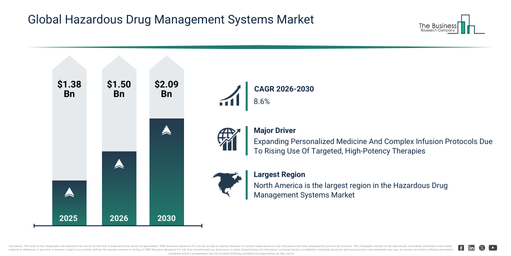
  • Hazardous Drug Management Systems Market Growth Projection: Expected to Surpass $2.09 Billion by 2030 at 8.6% CAGR

    Hazardous Drug Management Systems Market Growth Projection: Expected to Surpass $2.09 Billion by 2030 at 8.6% CAGR

    Uncover key drivers, emerging technologies, and competitive movements shaping the hazardous drug management systems market from 2026–2035 with trusted insights from The Business Research Company

    What is the expected shift in the Hazardous Drug Management Systems Market’s size between 2026 and 2030?

    The hazardous drug management systems market size has demonstrated significant growth in recent years. It is projected to expand from $1.38 billion in 2025 to $1.50 billion in 2026, at a compound annual growth rate (CAGR) of 8.9%. Factors contributing to its historical growth include an increased focus on the safety of healthcare workers, greater awareness of risks associated with hazardous drug exposure, the rising adoption of compliance-driven safety protocols, the expansion of hospital and pharmacy automation, and the growing enforcement of occupational safety guidelines.

    The hazardous drug management systems market is projected to experience substantial expansion in the coming years. This market is forecast to reach $2.09 billion by 2030, exhibiting a compound annual growth rate (CAGR) of 8.6%. The anticipated growth during this period stems from factors such as the increasing adoption of closed system drug transfer technologies, a heightened demand for automated handling of hazardous drugs, increased investment in oncology safety infrastructure, broadening regulatory compliance needs within healthcare settings, and a greater emphasis on preventing workplace contamination. Key trends expected over the forecast horizon encompass technological innovations in closed system transfer devices, progress in robotic and automated compounding safety solutions, the evolution of real-time contamination monitoring systems, increasing research and development into exposure prevention technologies, and novel integrated hazardous drug tracking and reporting systems.

    Access Your Free Sample Report for In-Depth Market Insights:

    https://www.thebusinessresearchcompany.com/sample.aspx?id=30600&type=smp

    Which Drivers Are Shaping Strategic Decisions In The Hazardous Drug Management Systems Market?

    The increasing adoption of personalized medicine and intricate infusion protocols is anticipated to stimulate the future expansion of the hazardous drug management systems market. Personalized medicine involves customizing medical treatments, encompassing drug choices and dosage, to suit specific patient attributes like genetics, biomarkers, and disease profiles. This growth in personalized medicine stems from the rising approval and clinical implementation of targeted therapies that necessitate highly individualized intravenous dosing and preparation. Hazardous drug management systems facilitate personalized medicine by guaranteeing the secure preparation, handling, and administration of potent and targeted therapies, thereby safeguarding healthcare personnel and enabling accurate, patient-specific care. For example, data from November 2025, provided by the US-based nonprofit Personalized Medicine Coalition, indicates that the US Food and Drug Administration authorized 18 new personalized medicines in 2024, representing over 25% of all new drug approvals. This followed 20 personalized medicine approvals in 2023, many of which demanded custom IV preparation. Consequently, the broadened application of personalized medicine and complex infusion protocols is propelling the hazardous drug management systems market’s growth.

    What Segment Classifications Make Up The Hazardous Drug Management Systems Market?

    The hazardous drug management systems market covered in this report is segmented –

    1) By Product Type: Closed System Transfer Devices, Drug Compounding Systems, Drug Storage And Transport Systems, Personal Protective Equipment, Other Product Types

    2) By Deployment Mode: On Premises, Cloud Based, Hybrid

    3) By Drug Type: Antineoplastic Drugs, Non Antineoplastic Hazardous Drugs, Reproductive Risk Only Drugs

    4) By Workflow Stage: Drug Procurement And Storage, Drug Preparation And Compounding, Drug Dispensing And Transportation, Drug Administration, Waste Handling And Disposal, Environmental Monitoring And Decontamination, Personnel Safety And Compliance Management

    5) By End User: Healthcare Providers, Pharmaceutical Companies, Research Institutes, Other End Users

    Subsegments:

    1) By Closed System Transfer Devices: Needle Free Connectors, Bag Spike Systems, Luer Lock Adapters, Vial Adapters

    2) By Drug Compounding Systems: Automated Compounding Devices, Manual Compounding Devices, Isolator Systems, Compounding Enclosures

    3) By Drug Storage And Transport Systems: Refrigerated Storage Units, Temperature Controlled Transport Carts, Lockable Cabinets, Portable Containment Units

    4) By Personal Protective Equipment:Gloves, Gowns, Respirators, Eye Protection

    5) By Other Product Types: Spill Containment Kits, Decontamination Systems, Waste Disposal Containers, Cleaning Supplies

    Which Major Industry Participants Are Leading The Hazardous Drug Management Systems Market Growth?

    Major companies operating in the hazardous drug management systems market are Particle Measuring Systems Inc., Baker Hughes Company, Becton Dickinson and Company, Baxter International Inc., B. Braun Melsungen AG, Terumo Corporation, West Pharmaceutical Services Inc., ICU Medical Inc., Esco Healthcare, JMS Co. Ltd., Vygon SA, CODAN Medizinische Geräte GmbH & Co. KG, NuAire Inc., Equashield LLC, Labconco Corporation, Germfree Laboratories Inc., Sentry Air Systems Inc., Simplivia Healthcare Ltd., Mecart Cleanrooms, Corvida Medical Inc.

    Access The Complete Report For Deeper Market Insights:

    https://www.thebusinessresearchcompany.com/report/hazardous-drug-management-systems-market-report

    Which Region Is Expected To Experience The Fastest Growth In The Hazardous Drug Management Systems Market?

    North America was the largest region in the hazardous drug management systems market in 2025. Asia-Pacific is expected to be the fastest-growing region in the forecast period. The regions covered in the hazardous drug management systems market report are Asia-Pacific, South East Asia, Western Europe, Eastern Europe, North America, South America, Middle East, Africa.

    Request Your Customized Hazardous Drug Management Systems Market Research Report for Competitive Advantage:

    https://www.thebusinessresearchcompany.com/customise?id=30600&type=smp

    Browse Through More Reports Similar to the Global Hazardous Drug Management Systems Market 2026, By The Business Research Company

    Medication Management System Market Report 2026

    https://www.thebusinessresearchcompany.com/report/medication-management-system-global-market-report

    Pharmacy Management System Market Report 2026

    https://www.thebusinessresearchcompany.com/report/pharmacy-management-system-global-market-report

    drug discovery services global market report

    https://www.thebusinessresearchcompany.com/report/drug-discovery-services-global-market-report

    Get in touch with us:

    The Business Research Company: https://www.thebusinessresearchcompany.com/

    Americas +1 310-496-7795

    Asia +44 7882 955267 & +91 8897263534

    Europe +44 7882 955267

    Email us at marketing@tbrc.info

    Follow us on:

    LinkedIn: https://in.linkedin.com/company/the-business-research-company

    YouTube: https://www.youtube.com/channel/UC24_fI0rV8cR5DxlCpgmyFQ

    Global Market Model: https://www.thebusinessresearchcompany.com/global-market-model

  • Hand Hygiene Stations Market Forecast 2026–2035: How to Leverage Market Growth

    Hand Hygiene Stations Market Forecast 2026–2035: How to Leverage Market Growth

    Uncover key drivers, emerging technologies, and competitive movements shaping the hand hygiene stations market from 2026–2035 with trusted insights from The Business Research Company

    What growth pattern is forecast for the Hand Hygiene Stations Market size between 2026 and 2035?

    The hand hygiene stations market has experienced rapid expansion in recent years. Its valuation is predicted to climb from $2.29 billion in 2025 to $2.55 billion in 2026, exhibiting a compound annual growth rate (CAGR) of 11.6%. This historical growth can be ascribed to factors such as increased public consciousness about hand hygiene, the wider adoption of automatic dispensers, escalating demand in healthcare facilities, the build-out of commercial and educational infrastructure, and a sharpened focus on infection prevention.

    The market for hand hygiene stations is projected to experience substantial expansion in the coming years. Its valuation is set to reach $3.92 billion by 2030, driven by a compound annual growth rate (CAGR) of 11.4%. This anticipated growth during the forecast timeframe stems from factors such as the increasing uptake of touchless and intelligent hygiene stations, expanding investments in sanitation infrastructure, a surge in demand for portable and wall-mounted devices, the broadening of hygiene compliance programs, and a marked increase in the deployment of sensor-activated dispensers. Key trends identified for this period encompass technological progress in automatic dispensers, novel developments in touchless and smart systems, the creation of environmentally friendly and refillable units, ongoing research and development into high-capacity sanitizer stations, and improvements in digital monitoring and usage tracking.

    Access Your Free Sample Report for In-Depth Market Insights:

    https://www.thebusinessresearchcompany.com/sample.aspx?id=30599&type=smp

    Which Drivers Are Impacting Market Performance In The Hand Hygiene Stations Market?

    The hand hygiene stations market is anticipated to grow with the increasing incorporation of automated, sensor-driven hand hygiene solutions. These solutions refer to electronic dispensers featuring motion sensors, badge-based tracking, and compliance analytics, providing real-time oversight and feedback on hand hygiene practices. The rising adoption of these solutions is driven by a greater emphasis from healthcare systems and public health authorities on achieving measurable, consistent hand hygiene to reduce healthcare-associated infections and improve patient safety. Hand hygiene stations support automated, sensor-driven solutions by integrating advanced technologies that enable accurate tracking, management, and reporting of hygiene behavior in clinical and public settings. For instance, in September 2024, according to The Leapfrog Group, a US-based nonprofit organization, the usage of electronic hand hygiene monitoring systems in U.S. hospitals increased to 10% by 2023, demonstrating a doubling in the uptake of sensor-enabled compliance tools. Therefore, the expanding adoption of automated, sensor-driven solutions is a key driver for the growth of the hand hygiene stations market.

    What Segment Types Are Examined In The Hand Hygiene Stations Market?

    The hand hygiene stations market covered in this report is segmented –

    1) By Product Type: Automatic Hand Sanitizer Dispensers, Manual Hand Sanitizer Dispensers, Touchless Hand Hygiene Stations, Wall-Mounted Hand Sanitizer Units, Portable Hand Hygiene Stations, Hand Sanitizer Kiosks

    2) By Portability And Installation: Permanent And Fixed Stations, Portable And Temporary Stations

    3) By Technology: Sensor-Activated Dispensers, Manual Dispensers, Smart And Connected Dispensers

    4) By Distribution Channel: Direct Sales From Manufacturers, Distributors And Wholesalers, Online Retail And E Commerce, Specialized Medical And Janitorial Suppliers

    5) By End User: Healthcare Facilities And Hospitals, Corporate Offices And Commercial Buildings, Educational Institutions, Hospitality And Food Service Establishments, Retail Stores And Shopping Malls

    Subsegments:

    1) By Automatic Hand Sanitizer Dispensers: Sensor-Activated Models, Foot-Pedal Models, Countertop Models, Rechargeable Battery Models, Large-Capacity Models

    2) By Manual Hand Sanitizer Dispensers: Lever-Operated Models, Push-Button Models, Countertop Manual Models, Wall-Mounted Manual Models, Refillable Cartridge Models

    3) By Touchless Hand Hygiene Stations: Infrared Sensor Stations, Ultrasonic Sensor Stations, Foot-Activated Touchless Stations, Fully Automated Hygiene Booths, Motion-Activated Stations

    4) By Wall-Mounted Hand Sanitizer Units: Plastic Wall-Mounted Units, Stainless Steel Wall-Mounted Units, Refillable Wall-Mounted Units, Lockable Wall-Mounted Units, Compact Wall-Mounted Units

    5) By Portable Hand Hygiene Stations: Mobile Stand Units, Outdoor Portable Stations, Battery-Powered Portable Stations, Foldable Portable Units, High-Capacity Portable Stations

    6) By Hand Sanitizer Kiosks: Digital Display Kiosks, Temperature Screening Kiosks, Advertising Panel Kiosks, Automated Refill Kiosks, Free-Standing Kiosks

    Which Trends Are Influencing The Performance And Direction Of The Hand Hygiene Stations Market?

    Key players in the hand hygiene stations market are prioritizing the creation of advanced systems, such as real-time compliance tracking and staff involvement tools, to enhance infection control, boost adherence to hygiene protocols, and offer practical insights into healthcare operations. Real-time compliance monitoring and staff engagement tools describe integrated platforms that observe hand hygiene practices across facilities, provide instant feedback to healthcare personnel, and supply analytics to support continuous refinement and risk reduction. For instance, in July 2024, Kontakt.io Inc., a US-based healthcare technology firm, unveiled a next-generation hand hygiene solution aimed at reinventing how hospitals manage compliance and engage their workforce. This system is entirely cloud-based, provided as a managed service, and features a patented technique utilizing the Staff-Safe-enabled Smart Badge 3 wearable to issue gentle, proactive reminders before patient interaction without interrupting workflows. It also incorporates compliance gamification via a mobile application and automated dispenser management, allowing for seamless monitoring and upkeep without manual intervention. Additionally, it integrates interaction-based contact tracing and simplified audit reporting, thereby expanding the solution’s benefit to infection prevention teams and contributing to reduced operational expenditures for healthcare systems.

    Who Are The Prominent Global Companies Shaping The Hand Hygiene Stations Market Landscape?

    Major companies operating in the hand hygiene stations market are GOJO Industries Inc., American Specialties Inc., Hagleitner Hygiene International GmbH, Bobrick Washroom Equipment Inc., Frontmatec Group A/S, Kutol Products Company Inc., Dolphy India Pvt. Ltd., Elpress AB, NIEROS Group d.o.o., Hokwang Industries Co. Ltd., Technocrat Enterprises, Nexgen Machines Pvt. Ltd., Mohn GmbH, Meritech Systems LLC, Heim-EDT GmbH, Technsys Cleanroom Solutions Pvt. Ltd., Delta Pyramax Co. Ltd., SMIXIN AG, Sanair Systems Pvt. Ltd., Wone Hygiene Systems Pvt. Ltd.

    Access The Complete Report For Deeper Market Insights:

    https://www.thebusinessresearchcompany.com/report/hand-hygiene-stations-market-report

    Which Geographic Areas Are Emerging As Strong Markets For The Hand Hygiene Stations Market?

    North America was the largest region in the hand hygiene stations market in 2025. Asia-Pacific is expected to be the fastest-growing region in the forecast period. The regions covered in the hand hygiene stations market report are Asia-Pacific, South East Asia, Western Europe, Eastern Europe, North America, South America, Middle East, Africa.

    Request Your Customized Hand Hygiene Stations Market Research Report for Competitive Advantage:

    https://www.thebusinessresearchcompany.com/customise?id=30599&type=smp

    Browse Through More Reports Similar to the Global Hand Hygiene Stations Market 2026, By The Business Research Company

    Hand Sanitizers Market Report 2026

    https://www.thebusinessresearchcompany.com/report/hand-sanitizers-global-market-report

    Hand Sanitizer Dispenser Market Report 2026

    https://www.thebusinessresearchcompany.com/report/hand-sanitizer-dispenser-global-market-report

    hand wash global market report

    https://www.thebusinessresearchcompany.com/report/hand-wash-global-market-report

    Get in touch with us:

    The Business Research Company: https://www.thebusinessresearchcompany.com/

    Americas +1 310-496-7795

    Asia +44 7882 955267 & +91 8897263534

    Europe +44 7882 955267

    Email us at marketing@tbrc.info

    Follow us on:

    LinkedIn: https://in.linkedin.com/company/the-business-research-company

    YouTube: https://www.youtube.com/channel/UC24_fI0rV8cR5DxlCpgmyFQ

    Global Market Model: https://www.thebusinessresearchcompany.com/global-market-model

  • Green-Pharma Solvent Systems Market Outlook 2026–2035: Growth Drivers and Industry Forecast

    Green-Pharma Solvent Systems Market Outlook 2026–2035: Growth Drivers and Industry Forecast

    Uncover key drivers, emerging technologies, and competitive movements shaping the green-pharma solvent systems market from 2026–2035 with trusted insights from The Business Research Company

    Starting from its 2026 valuation, what market size is the Green-Pharma Solvent Systems Market expected to reach by 2030?

    The green pharma solvent systems market size has experienced considerable growth in recent years. It is projected to expand from $3.20 billion in 2025 to $3.60 billion in 2026, at a compound annual growth rate (CAGR) of 12.6%. The historical surge can be attributed to an escalating demand for eco-friendly solvents, the rising adoption of green chemistry, stricter environmental regulations, the expansion of pharmaceutical manufacturing, and an increasing awareness of sustainable processes.

    The market for green pharma solvent systems is projected to experience substantial expansion over the upcoming years. By 2030, this market is anticipated to reach $5.74 billion, demonstrating a compound annual growth rate (CAGR) of 12.3%. This anticipated growth during the projection period stems from several factors, including heightened investment in environmentally friendly technologies, a rising demand for non-toxic solvents, increased research efforts in sustainable pharmaceutical procedures, the broadening of biopharmaceutical manufacturing, and a surge in governmental encouragement for sustainable alternatives. Key trends expected over the forecast horizon encompass progress in solvent system technologies, breakthroughs in biodegradable solvents, improvements in solvent recycling methodologies, ongoing research and development in environmentally sound extraction techniques, and enhancements in process streamlining and effectiveness.

    Access Your Free Sample Report for In-Depth Market Insights:

    https://www.thebusinessresearchcompany.com/sample.aspx?id=30597&type=smp

    What Drivers Are Driving Adoption Within The Green-Pharma Solvent Systems Market?

    The increasing regulatory mandates aimed at reducing the presence of harmful and toxic solvents are set to boost the expansion of the green-pharma solvent systems market in the coming years. These regulations encompass legally binding directives from governments and international bodies, compelling pharmaceutical producers to limit or replace dangerous chemical substances to safeguard both human health and the environment. This escalation in regulatory scrutiny stems from revisions that decrease permissible levels of hazardous solvents and broaden the roster of restricted chemicals. Green-pharma solvent systems offer a solution to these regulatory pressures by providing safer, eco-conscious alternatives for pharmaceutical manufacturing, thereby decreasing the reliance on toxic and hazardous solvents. They enhance adherence to regulations and promote sustainability while mitigating health and environmental risks linked with conventional solvent usage. For example, the European Commission, a Belgium-based regulatory authority, stated in June 2025 that N, N-dimethylacetamide (DMAC) and 1-ethylpyrrolidin-2-one (NEP) will not be allowed on the market as standalone substances or in mixtures at concentrations equal to or exceeding 0.3% after 23 December 2026. This is unless manufacturers, importers, and downstream users incorporate into their chemical safety reports and safety data sheets derived no effect levels of 13 milligrams per cubic meter for long term inhalation exposure and 1.8 milligrams per kilogram body weight per day for long term dermal exposure of workers. Consequently, the rising regulatory imperative to minimize the use of toxic and hazardous solvents is fueling the growth of the green-pharma solvent systems market.

    How Is The Green-Pharma Solvent Systems Market Organized Into Various Segments?

    The green-pharma solvent systems market covered in this report is segmented –

    1) By Product Type: Bio-Based Solvents, Water-Based Solvents, Supercritical Fluid Solvents, Ionic Liquids, Other Product Types

    2) By Function: Reaction Medium, Extraction Solvent, Formulation Or Blending Agent

    3) By Application: Synthesis Or Process Chemistry, Formulation And Drug Product Manufacturing, Analytical And Chromatography, Extraction And Purification, Cleaning And Degreasing

    4) By End-User: Pharmaceutical Companies, Contract Manufacturing Organizations, Research Institutes, Other End-Users

    Subsegments:

    1) By Bio-Based Solvents: Ethanol, Lactic Acid, Glycerol, Terpene-Based Solvents, Other Bio-Based Solvents

    2) By Water-Based Solvents: Aqueous Alcohol, Aqueous Acetone, Aqueous Ethyl Lactate, Aqueous Glycol, Other Water-Based Solvents

    3) By Supercritical Fluid Solvents: Supercritical Carbon Dioxide, Supercritical Nitrous Oxide, Supercritical Water, Supercritical Methanol, Other Supercritical Fluid Solvents

    4) By Ionic Liquids: Imidazolium-Based, Pyridinium-Based, Ammonium-Based, Phosphonium-Based, Other Ionic Liquids

    5) By Other Product Types: Hydrocarbon Solvents, Ester Solvents, Ketone Solvents, Chlorinated Solvents, Other Specialty Solvents

    Which Market Trends Are Opening Growth Opportunities In The Green-Pharma Solvent Systems Market?

    Leading companies operating in the green-pharma solvent systems market are concentrating on creating sophisticated solutions, like carbon-neutral portfolios, to enhance sustainability, improve environmental performance, and decrease carbon emissions. Such portfolios represent product ranges where greenhouse gas emissions throughout their complete lifecycle are quantified, minimized wherever feasible, and any residual emissions are balanced through investments in certified carbon offset initiatives. An example of this is Solvay SA, a specialty chemicals company from Belgium, which introduced its Augeo carbon-neutral portfolio in January 2024. This portfolio comprises a selection of bio-based, readily biodegradable solvents with certified carbon neutrality, designed to lessen the environmental footprint of cleaning and air care products. Among its offerings is Solsys® Bio Etac, an ethyl acetate derived entirely from renewable resources, specifically sugarcane-derived ethanol. Intended for applications in air care, domestic, and institutional cleaning, it facilitates a reduced carbon footprint for final products while maintaining uncompromised performance.

    Who Are The Top-Performing Companies In The Green-Pharma Solvent Systems Market In Recent Years?

    Major companies operating in the green-pharma solvent systems market are Cargill Incorporated, BASF SE, Merck KGaA, Dow Chemical Company, Eastman Chemical Company, Evonik Industries AG, Croda International Plc, Arkema S.A., Wacker Chemie AG, Clariant AG, Solvay S.A., Corbion N.V., InKemia Green Chemicals Inc, GF Biochemicals S.p.A., Vertec BioSolvents Inc., Soysolv Biosolvents LLC, AstroBio Green Solvent Solutions

    Access The Complete Report For Deeper Market Insights:

    https://www.thebusinessresearchcompany.com/report/green-pharma-solvent-systems-market-report

    Which Region Currently Holds The Largest Share Of The Green-Pharma Solvent Systems Market?

    North America was the largest region in the green pharma solvent systems market in 2025. Asia-Pacific is expected to be the fastest-growing region in the forecast period. The regions covered in the green-pharma solvent systems market report are Asia-Pacific, South East Asia, Western Europe, Eastern Europe, North America, South America, Middle East, Africa.

    Request Your Customized Green-Pharma Solvent Systems Market Research Report for Competitive Advantage:

    https://www.thebusinessresearchcompany.com/customise?id=30597&type=smp

    Browse Through More Reports Similar to the Global Green-Pharma Solvent Systems Market 2026, By The Business Research Company

    Green Solvents Market Report 2026

    https://www.thebusinessresearchcompany.com/report/green-solvents-global-market-report

    Solvents Market Report 2026

    https://www.thebusinessresearchcompany.com/report/solvents-global-market-report

    aprotic solvents global market report

    https://www.thebusinessresearchcompany.com/report/aprotic-solvents-global-market-report

    Get in touch with us:

    The Business Research Company: https://www.thebusinessresearchcompany.com/

    Americas +1 310-496-7795

    Asia +44 7882 955267 & +91 8897263534

    Europe +44 7882 955267

    Email us at marketing@tbrc.info

    Follow us on:

    LinkedIn: https://in.linkedin.com/company/the-business-research-company

    YouTube: https://www.youtube.com/channel/UC24_fI0rV8cR5DxlCpgmyFQ

    Global Market Model: https://www.thebusinessresearchcompany.com/global-market-model

  • Global Fin Field-Effect Transistor (FinFET) 3D Transistors Market Forecast 2026–2035: Long-Term Growth Insights

    Global Fin Field-Effect Transistor (FinFET) 3D Transistors Market Forecast 2026–2035: Long-Term Growth Insights

    Uncover key drivers, emerging technologies, and competitive movements shaping the fin field-effect transistor (finfet) 3d transistors market from 2026–2035 with trusted insights from The Business Research Company

    What size range is anticipated for the Fin Field-Effect Transistor (FinFET) 3D Transistors Market from 2026 to 2030?

    The finfet 3d transistors market has experienced substantial expansion in recent times. Its value is projected to increase from $14.56 billion in 2025 to $16.90 billion in 2026, demonstrating a compound annual growth rate (CAGR) of 16.1%. This historical expansion is primarily due to several factors, including the escalating demand for high-performance computing, the increasing requirement for power-efficient semiconductor devices, the heightened desire for miniaturization in consumer electronics, the widespread embrace of advanced process nodes, and the surging need within automotive electronics.

    The finfet 3d transistors market size is anticipated to undergo swift growth in the upcoming years. It is projected to expand to **$30.35 billion in 2030, demonstrating a compound annual growth rate (CAGR) of 15.8%.** This anticipated rise during the forecast period is propelled by factors such as the increasing integration of 5G and subsequent wireless technologies, the growing application of artificial intelligence and machine learning, heightened investment in advanced process node technologies, the expansion of industrial automation and IoT applications, and greater government and private sector funding in semiconductor manufacturing. Noteworthy trends throughout the forecast timeframe include advancements in 3D transistor architecture, innovations in multi-gate finfet design, technological progress for sub-7nm process nodes, substantial investment in semiconductor fabrication facilities, and the creation of energy-efficient logic and memory chips.

    Access Your Free Sample Report for In-Depth Market Insights:

    https://www.thebusinessresearchcompany.com/sample.aspx?id=30592&type=smp

    What Drivers Are Affecting Demand In The Fin Field-Effect Transistor (FinFET) 3D Transistors Market?

    The market for fin field-effect transistor (FinFET) 3D transistors is anticipated to expand due to the growing need for high-performance, low-power semiconductor devices utilizing advanced process nodes. These semiconductor devices are integrated circuit parts built to provide faster computing capabilities with reduced energy use, which is especially vital for modern computing and mobile uses at leading-edge technology nodes. The need for high-performance, low-power semiconductor devices is growing because businesses and individuals increasingly seek quicker processing and extended battery life for applications like artificial intelligence, data centers, and upcoming mobile platforms. FinFET 3D transistors facilitate high-performance, low-power semiconductor devices through features such as enhanced electrostatic control, lower power leakage, and better switching performance, allowing semiconductor producers to effectively scale devices at advanced nodes. As an example, in June 2025, Semiconductor Equipment and Materials International (SEMI), a US-based semiconductor industry association, reported that global semiconductor manufacturing capacity for 7 nm and below is forecast to rise by approximately 69 % by 2028, addressing the intense demand for advanced chips fueled by AI and associated technologies. Consequently, the escalating need for high-performance, low-power semiconductor devices at advanced process nodes is propelling the expansion of the fin field-effect transistor (FinFET) 3D transistors market.

    Which Segments Are Gaining Traction In The Fin Field-Effect Transistor (FinFET) 3D Transistors Market?

    The fin field-effect transistor (finfet) 3d transistors market covered in this report is segmented –

    1) By Product: Central Processing Unit, Field Programmable Gate Array, Graphics Processing Unit, System On Chip, Memory Devices, Microprocessors, Logic Processors, Semiconductor Wafers, Integrated Circuits

    2) By Service: Design Services, Fabrication Services, Testing And Validation Services, Research And Development Services, Consultation Services, Maintenance Services, Integration Services

    3) By Process Node: 5nm, 7nm, 10nm, 14nm

    4) By Technology: Silicon FinFET, III-V FinFET, SOI FinFET, Multi-gate FinFET

    5) By Application: Smartphones, Computers And Tablets, Wearables, Automotive

    Subsegments:

    1) By Central Processing Unit: High Performance Central Processing Unit, Energy Efficient Central Processing Unit, Multicore Central Processing Unit, Server Grade Central Processing Unit, Embedded Central Processing Unit

    2) By Field Programmable Gate Array: Low Power Field Programmable Gate Array, High Density Field Programmable Gate Array, System Level Field Programmable Gate Array, Reconfigurable Field Programmable Gate Array, Embedded Field Programmable Gate Array

    3) By Graphics Processing Unit: Discrete Graphics Processing Unit, Integrated Graphics Processing Unit, High Performance Graphics Processing Unit, Mobile Graphics Processing Unit, Workstation Graphics Processing Unit

    4) By System On Chip: Application Specific System On Chip, Mobile System On Chip, Automotive System On Chip, Industrial System On Chip, Consumer Electronics System On Chip

    5) By Memory Devices: Dynamic Random Access Memory Device, Static Random Access Memory Device, Flash Memory Device, Nonvolatile Memory Device, High Bandwidth Memory Device

    6) By Microprocessors: General Purpose Microprocessor, Embedded Microprocessor, High Performance Microprocessor, Low Power Microprocessor, Server Grade Microprocessor

    7) By Logic Processors: Programmable Logic Processor, Custom Logic Processor, Discrete Logic Processor, Integrated Logic Processor, High Speed Logic Processor

    8) By Semiconductor Wafers: Silicon Semiconductor Wafer, Compound Semiconductor Wafer, Silicon On Insulator Semiconductor Wafer, Polished Semiconductor Wafer, Epitaxial Semiconductor Wafer

    9) By Integrated Circuits: Analog Integrated Circuit, Digital Integrated Circuit, Mixed Signal Integrated Circuit, Radio Frequency Integrated Circuit, Power Management Integrated Circuit

    Which Innovation Trends Are Advancing Developments Within The Fin Field-Effect Transistor (FinFET) 3D Transistors Market?

    Leading companies within the fin field-effect transistor (FinFET) 3D transistors market are prioritizing the development of initiatives designed to broaden access to advanced semiconductor design. These initiatives include offering extensive IC design learning experiences, with the aim of fostering the next generation of engineers and accelerating innovation across the industry. An IC design learning experience provides structured educational entry to real-world design tools, process design kits (PDKs), and silicon prototyping services, enabling students and researchers to acquire practical expertise with cutting-edge transistor technology and develop skills relevant to modern integrated circuit (IC) development. As an illustration, in February 2023, Taiwan Semiconductor Manufacturing Company Limited (TSMC), a Taiwan-based semiconductor foundry, launched the TSMC University FinFET Program. This program is intended to deliver widespread educational access to its industry-leading FinFET technology. Through this initiative, universities, students, and academic researchers can access the FinFET process design kit for 16 nm technology, and they can also utilize multi-project wafer (MPW) services for both 16 nm and 7 nm silicon to expedite research and prototype development. The program also provides design collateral, tutorial cases, training materials, and instructional resources, guiding learners from conventional transistor concepts to an advanced FinFET design experience.

    Who Are The Major Companies Operating In The Fin Field-Effect Transistor (FinFET) 3D Transistors Market?

    Major companies operating in the fin field-effect transistor (finfet) 3d transistors market are Apple Inc., Samsung Electronics Co. Ltd., Taiwan Semiconductor Manufacturing Company (TSMC) Ltd., Intel Corporation, Broadcom Inc., Qualcomm Incorporated, ASML Holding, NVIDIA Corporation, Applied Materials, Advanced Micro Devices (AMD) Inc., MediaTek Inc., Tokyo Electron (TEL) Ltd., KLA Corporation, GlobalFoundries Inc., United Microelectronics Corporation (UMC), Semiconductor Manufacturing International Corporation, Synopsys Inc., Marvell Technology Inc., Cadence Design Systems Inc., Lam Research Corp., SCREEN Semiconductor Solutions Co. Ltd., Arm Ltd., Imagination Technologies Ltd.

    Access The Complete Report For Deeper Market Insights:

    https://www.thebusinessresearchcompany.com/report/fin-field-effect-transistor-finfet-3d-transistors-market-report

    Which Region Is Anticipated To See The Fastest Growth In The Fin Field-Effect Transistor (FinFET) 3D Transistors Market?

    North America was the largest region in the finfet 3d transistors market in 2025. Asia-Pacific is expected to be the fastest-growing region in the forecast period. The regions covered in the fin field-effect transistor (finfet) 3d transistors market report are Asia-Pacific, South East Asia, Western Europe, Eastern Europe, North America, South America, Middle East, Africa.

    Request Your Customized Fin Field-Effect Transistor (FinFET) 3D Transistors Market Research Report for Competitive Advantage:

    https://www.thebusinessresearchcompany.com/customise?id=30592&type=smp

    Browse Through More Reports Similar to the Global Fin Field-Effect Transistor (FinFET) 3D Transistors Market 2026, By The Business Research Company

    Fin Field Effect Transistor Finfet Technology Market Report 2026

    https://www.thebusinessresearchcompany.com/report/fin-field-effect-transistor-finfet-technology-global-market-report

    Three Dimensional 3D Integrated Circuits Ic Market Report 2026

    https://www.thebusinessresearchcompany.com/report/three-dimensional-3d-integrated-circuits-ic-global-market-report

    silicon carbide sic metal oxide semiconductor field effect transistor mosfet global market report

    https://www.thebusinessresearchcompany.com/report/silicon-carbide-sic-metal-oxide-semiconductor-field-effect-transistor-mosfet-global-market-report

    Get in touch with us:

    The Business Research Company: https://www.thebusinessresearchcompany.com/

    Americas +1 310-496-7795

    Asia +44 7882 955267 & +91 8897263534

    Europe +44 7882 955267

    Email us at marketing@tbrc.info

    Follow us on:

    LinkedIn: https://in.linkedin.com/company/the-business-research-company

    YouTube: https://www.youtube.com/channel/UC24_fI0rV8cR5DxlCpgmyFQ

    Global Market Model: https://www.thebusinessresearchcompany.com/global-market-model
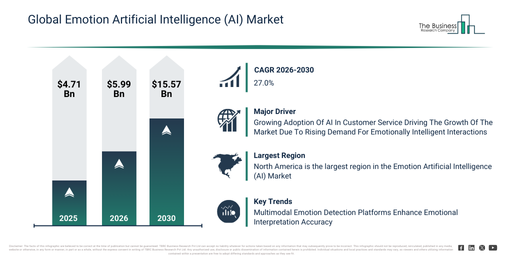
  • Emotion Artificial Intelligence (AI) Market 2026–2030: Forecasting Business Opportunities Ahead

    Emotion Artificial Intelligence (AI) Market 2026–2030: Forecasting Business Opportunities Ahead

    Uncover key drivers, emerging technologies, and competitive movements shaping the emotion artificial intelligence (ai) market from 2026–2035 with trusted insights from The Business Research Company

    How is the Emotion Artificial Intelligence (AI) Market size predicted to change over the forecast window of 2026–2035?

    The emotion artificial intelligence market size has experienced substantial growth in recent years. It is anticipated to expand from $4.71 billion in 2025 to $5.99 billion in 2026, exhibiting a compound annual growth rate (CAGR) of 27.2%. This historical growth can be linked to factors such as the increasing adoption of customer behavior analytics, the rising integration of emotion recognition in marketing campaigns, the growing deployment of biometric sensors for user experience analysis, the expansion of artificial intelligence in security and surveillance, and the increasing utilization of emotion analytics in healthcare monitoring.

    The emotion artificial intelligence market is projected to experience substantial expansion in the coming years, reaching $15.57 billion in 2030 at a compound annual growth rate (CAGR) of 27.0%. This anticipated growth, spanning the forecast period, is driven by factors such as the increasing need for tailored digital customer interactions, greater corporate spending on affective computing solutions, the wider use of emotion recognition in self-driving cars, the broader application of emotion AI in human resources and hiring, and the increasing adoption of AI-powered emotional learning tools in education. Key trends during this projection period involve technological improvements in multimodal emotion sensing systems, breakthroughs in deep learning-based emotion recognition algorithms, progress in facial micro-expression detection models, ongoing research and development in voice sentiment and tone analysis engines, and enhancements in real-time wearable emotion recognition devices.

    Access Your Free Sample Report for In-Depth Market Insights:

    https://www.thebusinessresearchcompany.com/sample.aspx?id=30586&type=smp

    Which Drivers Are Contributing To The Expansion Of The Emotion Artificial Intelligence (AI) Market?

    The future expansion of the emotion artificial intelligence (AI) market is anticipated to be driven by the increasing integration of AI in customer service. AI in customer service involves leveraging artificial intelligence tools such as chatbots, virtual assistants, and automated support mechanisms to improve customer engagements, optimize service workflows, and offer tailored solutions. This surge in AI adoption in customer service stems from heightened consumer demand for swift, customized, and emotionally intelligent responses across various digital platforms. Emotion AI facilitates this adoption by empowering systems to identify, comprehend, and react to human emotions, consequently boosting customer satisfaction, fostering engagement, and building loyalty. An illustrative example comes from April 2025, when the Stanford Institute for Human-Centered Artificial Intelligence, a US-based artificial intelligence research institute, reported that U.S. private artificial intelligence investment increased to $109.1 billion. Globally, generative artificial intelligence drew $33.9 billion, marking an 18.7% rise from 2023, and the percentage of organizations utilizing artificial intelligence reached 78% in 2024, an increase from 55% in 2023. Consequently, the expanding use of AI in customer service is propelling the growth of the emotion artificial intelligence (AI) market.

    What Segment Categories Are Covered In The Emotion Artificial Intelligence (AI) Market?

    The emotion artificial intelligence (AI) market covered in this report is segmented –

    1) By Component: Software, Hardware, Services

    2) By Technology: Facial Recognition, Speech Recognition, Biosensing, Machine Learning, Natural Language Processing

    3) By Application: Human Resources And Recruitment, Driver Safety And Monitoring, Mental Health And Well-Being Monitoring, Personal Assistants And Virtual Agents, Marketing, Sales, And Advertising, Customer Experience Management

    4) By End-User: Banking, Financial Services And Insurance (BFSI), Healthcare, Retail, Automotive, Information Technology (IT) And Telecommunications, Media And Entertainment

    Subsegments:

    1) By Software: Facial Expression Recognition Software, Voice Emotion Recognition Software, Text Sentiment Analysis Software, Behavioral Analytics Software, Physiological Signal Analysis Software

    2) By Hardware: Emotion Detection Cameras, Microphones For Emotion Recognition, Wearable Sensors, Eye Tracking Devices, Physiological Monitoring Devices

    3) By Services: Consulting And Implementation Services, Data Annotation And Training Services, System Integration Services, Maintenance And Support Services, Analytics And Reporting Services

    Which Competitive Trends Are Impacting The Structure Of The Emotion Artificial Intelligence (AI) Market?

    Leading companies in the emotion artificial intelligence (AI) market are concentrating on developing innovative products, such as foundational voice-to-voice models, with the goal of elevating conversational quality, strengthening emotional intelligence, and decreasing unnatural interactions along with user dissatisfaction. Foundational voice-to-voice models describe advanced AI systems designed to participate in swift, fluent, and emotionally perceptive spoken conversations. For instance, in September 2024, Hume AI Inc., a US-based artificial intelligence company, introduced EVI 2. This represents a novel voice-to-voice foundation model capable of remarkably human-like dialogues with response times under a second. It incorporates an intricate understanding of a user’s tone of voice and the capacity to create a broad spectrum of tones, personalities, and speaking styles, thereby allowing for seamless and adaptive interaction that avoids a robotic feel. Additionally, it integrates a new, secure voice modulation system and has been trained for emotional intelligence, expanding its usefulness across various applications and ensuring its responses are aligned with user well-being.

    Which Major Firms Are Strengthening Their Position In The Emotion Artificial Intelligence (AI) Market?

    Major companies operating in the emotion artificial intelligence (AI) market are NICE Ltd., Uniphore Software Systems, Imentiv Inc., Entropik Technologies Pvt. Ltd., Smart Eye AB, Hume AI Inc., Imotions Inc., Realeyes, Beyond Emotion GmbH, audEERING GmbH, Emteq Labs Ltd., BeEmotion.ai, MorphCast Inc., Emaww, Kairos AR Inc., Vokaturi, Empath Inc., Behavioral Signals, Emotibot Technology (Shanghai) Co. Ltd., Eyeris Technologies Inc., MoodMe Co., Emotionise

    Access The Complete Report For Deeper Market Insights:

    https://www.thebusinessresearchcompany.com/report/emotion-artificial-intelligence-ai-market-report

    Which Region Shows The Strongest Potential For Future Expansion In The Emotion Artificial Intelligence (AI) Market?

    North America was the largest region in the emotion artificial intelligence market in 2025. Asia-Pacific is expected to be the fastest-growing region in the forecast period. The regions covered in the emotion artificial intelligence (AI) market report are Asia-Pacific, South East Asia, Western Europe, Eastern Europe, North America, South America, Middle East, Africa.

    Request Your Customized Emotion Artificial Intelligence (AI) Market Research Report for Competitive Advantage:

    https://www.thebusinessresearchcompany.com/customise?id=30586&type=smp

    Browse Through More Reports Similar to the Global Emotion Artificial Intelligence (AI) Market 2026, By The Business Research Company

    Emotional Ai Market Report 2026

    https://www.thebusinessresearchcompany.com/report/emotional-ai-global-market-report

    Artificial Intelligence In Emotion Recognition Market Report 2026

    https://www.thebusinessresearchcompany.com/report/artificial-intelligence-in-emotion-recognition-global-market-report

    affective computing global market report

    https://www.thebusinessresearchcompany.com/report/affective-computing-global-market-report

    Get in touch with us:

    The Business Research Company: https://www.thebusinessresearchcompany.com/

    Americas +1 310-496-7795

    Asia +44 7882 955267 & +91 8897263534

    Europe +44 7882 955267

    Email us at marketing@tbrc.info

    Follow us on:

    LinkedIn: https://in.linkedin.com/company/the-business-research-company

    YouTube: https://www.youtube.com/channel/UC24_fI0rV8cR5DxlCpgmyFQ

    Global Market Model: https://www.thebusinessresearchcompany.com/global-market-model