Environmental Allergy Monitoring Market Forecast To 2030: Starting From $1.36 Billion In 2026
Featuring market attractiveness scoring, total addressable market sizing, company benchmarking matrices, interactive Excel dashboards, deeper supply chain intelligence, emerging startup tracking, and granular product-level insights, The Business Research Company’s 2026 market reports are built to deliver research that is both more actionable and more strategically valuable.
Environmental Allergy Monitoring Market Size Outlook: How Quickly Will Revenue Expand Through 2030?
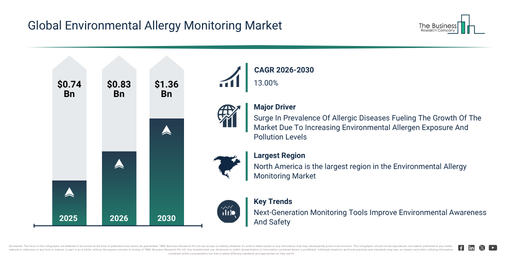
The environmental allergy monitoring market has experienced significant expansion in recent years. This market is projected to grow from $0.74 billion in 2025 to $0.83 billion in 2026, showing a compound annual growth rate (CAGR) of 12.7%. The market’s historical growth was driven by factors such as basic manual pollen count reporting systems, limited awareness of environmental allergy triggers, the growth of basic air quality monitoring stations, the expansion of respiratory health surveillance programs, and the early adoption of digital weather forecasting tools.
The environmental allergy monitoring market size is poised for significant expansion over the coming years. Its value is projected to grow to $1.36 billion by 2030, demonstrating a compound annual growth rate (CAGR) of 13.0%. This anticipated growth during the forecast period can be attributed to several factors, including the integration of AI-based allergen prediction models, the rising global incidence of respiratory allergies, the expansion of smart city environmental monitoring networks, an increasing demand for personalized health risk alerts, and the proliferation of IoT-enabled wearable health monitoring devices. Key trends expected in this period encompass hyperlocal allergen forecasting systems, wearable environmental exposure tracking devices, smart home integrated allergy alert systems, predictive air quality health risk modeling, and real-time urban pollution and allergen mapping platforms.
Get A Free Sample Report With In-Depth Market Insights:
Environmental Allergy Monitoring Market Industry Drivers: What’s Behind The Revenue Growth?
The increasing incidence of allergic conditions is projected to propel the expansion of the environmental allergy monitoring market moving forward. Allergic diseases are characterized as immune system disorders where the body reacts excessively to typically harmless environmental substances, such as pollen, dust, or specific foods. The occurrence of allergic diseases is escalating due to heightened exposure to environmental pollutants and allergens, which subsequently amplify immune sensitivity among populations. Environmental allergy monitoring supports the management of allergic diseases by enabling the real-time detection and tracking of environmental allergens like pollen, dust, and pollutants, thereby assisting individuals and healthcare providers in managing exposure and mitigating allergy-related health risks. For instance, in January 2026, as per the Centers for Disease Control and Prevention, a US-based public health agency, in 2024, 31.7% of adults were diagnosed with a seasonal allergy, eczema, or food allergy. This contrasts with lower historical levels, with 25.2% reporting seasonal allergies, 7.7% reporting eczema, and 6.7% reporting food allergies. Therefore, the growing prevalence of allergic diseases is driving the growth of the environmental allergy monitoring market.
Environmental Allergy Monitoring Market Segment Landscape And Growth Outlook
The environmental allergy monitoring market covered in this report is segmented –
1) By Type: Wearable Pollen Monitors, Internet Of Things Air Allergen Sensors, Real Time Air Quality Platforms
2) By Allergen Type: Pollen Allergens, Dust Mites, Mold Spores, Pet Dander, Air Pollutants, Other Allergen Types
3) By Distribution Channel: Direct Sales, Online Retail, Offline Retail, System Integrators And Solution Providers
4) By Application: Outdoor Pollen Monitoring, Indoor Allergen Tracking, Workplace Allergy Risk, Smart Home Allergy Alerts
5) By End User: Government Agencies, Healthcare Providers And Payers, Employers And Facility Managers, Consumers And Individuals, Universities And Research Institutes
Subsegments:
1) By Wearable Pollen Monitors: Personal Wearable Pollen Detection Devices, Clip On Pollen Monitoring Devices, Wrist Based Pollen Monitoring Devices, Portable Handheld Pollen Monitoring Devices, Smart Clothing Integrated Pollen Sensors
2) By Internet Of Things Air Allergen Sensors: Indoor Air Allergen Monitoring Sensors, Outdoor Air Allergen Monitoring Sensors, Smart Home Integrated Allergen Sensors, Industrial Air Allergen Detection Sensors, Wireless Connected Allergen Sensor Networks
3) By Real Time Air Quality Platforms: Cloud Based Air Quality Monitoring Platforms, Mobile Application Based Air Quality Platforms, Web Based Air Quality Analytics Platforms, Integrated Environmental Data Visualization Platforms, Predictive Air Quality Forecasting Platforms
#Environmental Allergy Monitoring Market Growth Trends: What’s Shaping The Future Outlook?
Key companies in the environmental allergy monitoring market are concentrating on creating sophisticated solutions, particularly AI-powered real-time air quality sensors. These innovations aim to improve the identification of airborne allergens, offer hyper-localized insights, enable individuals to make well-informed choices, and back citizen science endeavors. AI-powered real-time air quality sensors are instruments that employ artificial intelligence to automatically detect, categorize, and report airborne particles such as pollen, mold, and dust as they occur. For example, in November 2024, Pollen Sense LLC, a US-based air quality monitoring company, unveiled its APS400 sensor for consumer use. The APS400 leverages imaging and AI technologies to continuously sample and classify airborne particles, delivering real-time allergen data accessible via the ParticleSense app. This sensor is engineered for both indoor and outdoor settings, providing hyperlocal air quality insights, seamless app integration, and intuitive visualization, assisting allergy sufferers in managing their exposure and contributing to a broader automated monitoring network.
Environmental Allergy Monitoring Market Leading Companies And Competitive Benchmarking
Major companies operating in the environmental allergy monitoring market are Samsung Electronics Co. Ltd., Siemens AG, Thermo Fisher Scientific Inc., Honeywell International Inc., ABB Ltd., Merck KGaA, Danaher Corporation, Agilent Technologies Inc., AMETEK Inc., Sartorius AG, Waters Corporation, HORIBA Ltd., Sensirion AG, ACOEM Group, Bosch Sensortec GmbH, IQAir AG, Airthings ASA, Awair Inc., Kaiterra Inc., Clarity Movement Co. Inc.
View The Full Environmental Allergy Monitoring Market Report:
Environmental Allergy Monitoring Market Largest Region By Revenue And Market Share
North America was the largest region in the environmental allergy monitoring market in 2025. Asia-Pacific is expected to be the fastest-growing region in the forecast period. The regions covered in the environmental allergy monitoring market report are Asia-Pacific, South East Asia, Western Europe, Eastern Europe, North America, South America, Middle East and Africa.
Reach Out To Our Team:
The Business Research Company: https://www.thebusinessresearchcompany.com/
Americas: +1 310-496-7795
Asia: +44 7882 955267 & +91 8897263534
Europe: +44 7882 955267
Email us at: marketing@tbrc.info
Follow us on:
LinkedIn: https://in.linkedin.com/company/the-business-research-company
YouTube: https://www.youtube.com/channel/UC24_fI0rV8cR5DxlCpgmyFQ
Global Market Model: https://www.thebusinessresearchcompany.com/global-market-model