Blog

  • Automated Peritoneal Dialysis Market Forecast 2026: Market Size, Competitive Landscape And Growth Drivers

    Automated Peritoneal Dialysis Market Forecast 2026: Market Size, Competitive Landscape And Growth Drivers

    Featuring market attractiveness scoring, total addressable market sizing, company benchmarking matrices, interactive Excel dashboards, deeper supply chain intelligence, emerging startup tracking, and granular product-level insights, The Business Research Company’s 2026 market reports are built to deliver research that is both more actionable and more strategically valuable.

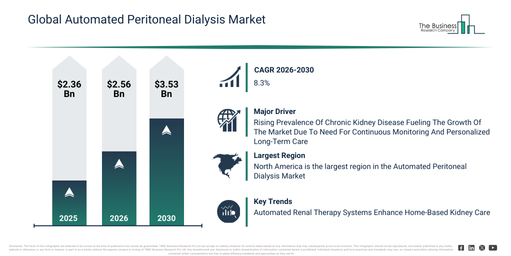
    Automated Peritoneal Dialysis Market Set To Climb From $2.56 Billion In 2026 To $3.53 Billion By 2030

    The automated peritoneal dialysis market size has experienced robust growth in recent years. It is forecast to increase from $2.36 billion in 2025 to $2.56 billion in 2026, achieving a compound annual growth rate (CAGR) of 8.7%. This historic expansion can be attributed to the rising prevalence of chronic kidney disease, growing demand for home-based dialysis, increasing adoption of automated peritoneal dialysis, a rising geriatric population prone to renal complications, and the expansion of patient awareness and education about APD.

    The automated peritoneal dialysis market is projected to experience substantial expansion over the coming years, reaching $3.53 billion by 2030, driven by a compound annual growth rate (CAGR) of 8.3%. This growth during the forecast period is largely due to factors such as a heightened emphasis on patient-centric approaches, the increasing uptake of hybrid and portable APD systems, greater investments in research and development, the expansion of home dialysis initiatives in developing regions, and rising healthcare spending alongside supportive reimbursement policies. Key developments anticipated within this timeframe encompass improvements in automated cycler technology, the incorporation of telehealth and remote monitoring capabilities, innovations in disposable kits and consumables, ongoing research and development into biocompatible PD solutions, and the integration of data analytics and AI for optimizing treatment.

    Get A Free Sample Report With In-Depth Market Insights:

    https://thebusinessresearchcompany.com/sample_request?id=86417296&type=smp&name=Automated%20Peritoneal%20Dialysis%20Market%20Report%202026&utm_source=Blogs&utm_medium=Paid&utm_campaign=Oct_PR

    Automated Peritoneal Dialysis Market Growth Factors Behind Sustained Expansion

    The increasing incidence of chronic kidney disease is anticipated to boost the automated peritoneal dialysis market’s expansion. Chronic kidney disease is a prolonged ailment where the kidneys fail to function optimally, leading to a buildup of waste and fluids within the body. The growing occurrence of diabetes and high blood pressure is a primary factor behind this rise, as these ailments progressively harm kidney blood vessels and compromise the organs’ filtering capability. Automated peritoneal dialysis plays a crucial role in managing chronic kidney disease by providing accurate, pre-programmed dialysis treatments with minimal human involvement, frequently performed while the patient sleeps. This method enhances patient results by ensuring consistent treatment, lessening the load on caregivers, and promoting a better standard of living through adaptable home-based care. For instance, in June 2023, Kidney Research UK, a non-profit organization based in the United Kingdom, reported that approximately 7.2 million individuals in the United Kingdom were afflicted with chronic kidney disease, representing over 10% of the population. Of these, 3.25 million were in advanced stages and 3.9 million were in early stages, with projections indicating an increase to 7.61 million affected individuals by 2033. Consequently, the expanding prevalence of chronic kidney disease is propelling the growth of the automated peritoneal dialysis market.

    Automated Peritoneal Dialysis Market Segment Trends And Revenue Contributors

    The automated peritoneal dialysis market covered in this report is segmented –

    1) By Product Type: Cyclers, Peritoneal Dialysis Solutions, Accessories

    2) By Disease Type: End-Stage Renal Disease (ESRD), Chronic Kidney Disease (CKD)

    3) By Application: Treatment, Training And Education, Research And Development

    4) By End-User: Hospitals, Clinics, Home Care Settings

    Subsegments:

    1) By Cyclers: Home Use Cycler Devices, Portable Cycler Devices, Continuous Ambulatory Compatible Cyclers, Touchscreen Enabled Cyclers, Remote Monitoring Enabled Cyclers

    2) By Peritoneal Dialysis Solutions: Glucose Based Solutions, Icodextrin Based Solutions, Amino Acid Based Solutions, Low Glucose Degradation Solutions, Neutral Ph Balanced Solutions

    3) By Accessories: Transfer Sets, Catheter Sets, Tubing And Connectors, Drain Bags, Solution Warmers

    Automated Peritoneal Dialysis Market Industry Trends Fueling Future Revenue Growth

    Leading firms in the automated peritoneal dialysis market are prioritizing the development of advanced renal therapy solutions, including automated peritoneal dialysis (APD) systems, designed to enhance patient outcomes, ease caregiver responsibilities, and facilitate home-based kidney care. Such an automated peritoneal dialysis system is a machine that performs dialysis exchanges automatically, typically overnight, by precisely managing fluid inflow and outflow based on programmed treatment prescriptions, thereby offering greater convenience, safety, and adherence than manual dialysis. For instance, in May 2025, US-based medical device company By Onyks Inc. obtained FDA 510(k) clearance for its X1 automated peritoneal dialysis (APD) cycler, engineered to revolutionize chronic kidney disease management. This automated peritoneal dialysis system incorporates user-friendly automation with accurate control over dwell times, fluid volumes, and treatment cycles, enabling individualized therapy plans while reducing patient and caregiver effort. This product launch highlights the growing embrace of connected, automated dialysis technologies that facilitate efficient treatment delivery in both clinical settings and at home.

    Automated Peritoneal Dialysis Market Leading Companies And Competitive Benchmarking

    Major companies operating in the automated peritoneal dialysis market are Fresenius Medical Care, Asahi Kasei Medical Co. Ltd., Toray Industries, Baxter International, DaVita Inc., Terumo Corporation, Diaverum AB, WEGO Blood Purification, Satellite Healthcare, JMS Co. Ltd., Zhejiang Tiancheng Medical Technology Co. Ltd, Kawasumi Laboratories Inc., Weigao Group, Mitra Industries Pvt. Ltd., Infomed Fluids S.r.l., Debiotech, Medionics International Inc, Renax Biomedical Tech Co. Ltd., Shenzhen Shenkang Medtech Co. Ltd., Newsol Technologies Inc., Shenzhen Landwind Industry Co. Ltd

    View The Full Automated Peritoneal Dialysis Market Report:

    https://thebusinessresearchcompany.com/report/automated-peritoneal-dialysis-market-report?utm_source=Blogs&utm_medium=Paid&utm_campaign=Oct_PR

    Automated Peritoneal Dialysis Market Largest Region By Revenue And Market Share

    North America was the largest region in the automated peritoneal dialysis market in 2025. Asia-Pacific is expected to be the fastest-growing region in the forecast period. The regions covered in the automated peritoneal dialysis market report are Asia-Pacific, South East Asia, Western Europe, Eastern Europe, North America, South America, Middle East, Africa.

    Reach Out To Our Team:

    The Business Research Company: https://www.thebusinessresearchcompany.com/

    Americas: +1 310-496-7795

    Asia: +44 7882 955267 & +91 8897263534

    Europe: +44 7882 955267

    Email us at: marketing@tbrc.info

    Follow us on:

    LinkedIn: https://in.linkedin.com/company/the-business-research-company

    YouTube: https://www.youtube.com/channel/UC24_fI0rV8cR5DxlCpgmyFQ

    Global Market Model: https://www.thebusinessresearchcompany.com/global-market-model
  • Automated Drug Compounding Systems Market Size In 2026: Regional Growth, Key Segments And Future Outlook

    Automated Drug Compounding Systems Market Size In 2026: Regional Growth, Key Segments And Future Outlook

    Built to provide research that’s more actionable and strategically valuable, The Business Research Company’s 2026 market reports include market attractiveness analysis, total addressable market sizing, company benchmarking matrices, interactive Excel dashboards, broader supply chain intelligence, emerging startup tracking, and in-depth product insights.

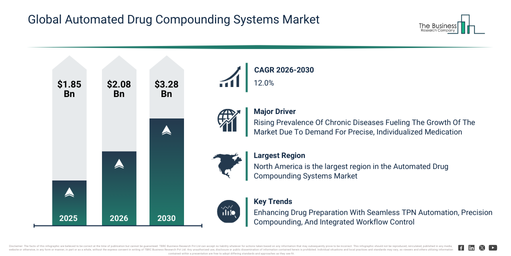
    Automated Drug Compounding Systems Market Forecast: Value Set To Climb From $2.08 Billion To $3.28 Billion

    The automated drug compounding systems market has seen considerable growth in recent years. It is projected to expand from $1.85 billion in 2025 to $2.08 billion in 2026, reflecting a compound annual growth rate (CAGR) of 12.3%. The historical drivers of this expansion include the increasing deployment of automated systems in hospital pharmacies, the heightened necessity to minimize medication errors, a stronger emphasis on sterile and precise drug preparation, the increasing workload for pharmacy staff, and the rising demand for more efficient compounding processes.

    The automated drug compounding systems market is projected to experience swift expansion over the coming years, with its size anticipated to reach $3.28 billion by 2030, driven by a compound annual growth rate (CAGR) of 12.0%. This growth during the forecast period is primarily attributed to increasing investment in healthcare automation, greater integration of software and automation tools, a rising demand for standardization in drug compounding, an elevated focus on minimizing contamination risks, higher hospital spending on automation infrastructure, and the growing need for enhanced operational efficiency in pharmacies. Key trends foreseen in this period include advancements in robotic-assisted drug compounding technologies, innovations in software integration for pharmacy management, the incorporation of AI for error reduction in compounding processes, improvements in real-time monitoring and quality control systems, and novel developments in automated sterile compounding techniques.

    Get A Free Sample Report With In-Depth Market Insights:

    https://thebusinessresearchcompany.com/sample_request?id=40326211&type=smp&name=Automated%20Drug%20Compounding%20Systems%20Market%20Report%202026&utm_source=Blogs&utm_medium=Paid&utm_campaign=Oct_PR

    Automated Drug Compounding Systems Market Demand Drivers Opening New Revenue Streams

    The growing occurrence of chronic diseases is projected to drive the expansion of the automated drug compounding systems market in the future. These conditions, which are long-term health issues that progress gradually, like diabetes, heart disease, and arthritis, often demand continuous medical care and lifestyle adjustments. Unhealthy habits such as poor diet, lack of physical activity, and smoking contribute significantly to the increase in chronic diseases, raising the risk of conditions including diabetes, heart disease, and obesity. Automated systems assist in managing chronic diseases by precisely creating personalized medications tailored to individual patient needs, thereby enhancing treatment accuracy and consistency, minimizing errors, and improving long-term therapeutic results. For example, in June 2024, the National Health Service, a UK-based government department, reported that 3,615,330 individuals registered with a general practitioner (GP) were diagnosed with non-diabetic hyperglycemia or pre-diabetes in 2023, representing an 18% increase from 3,065,825 cases in 2022. Consequently, the rising prevalence of chronic diseases is a key factor propelling the growth of the automated drug compounding systems market. The scarcity of skilled pharmacy personnel is anticipated to fuel the growth of the automated drug compounding systems market moving forward. This shortage signifies a limited availability of proficient pharmacists and technicians capable of safely preparing and dispensing medications across various healthcare settings. The rise in this deficit stems from increasing patient demands and the growing incidence of chronic diseases, which necessitate precise pharmaceutical care. Automated drug compounding systems mitigate the reliance on skilled pharmacy staff by enabling accurate, consistent, and efficient medication preparation with minimal human input, thereby decreasing errors and reducing the workload for pharmacy personnel. For instance, in August 2024, according to the National Center for Health Workforce Studies, a US-based health workforce research organization, projections indicate a shortage of 4,980 pharmacists over the next 15 years through 2036, while overall demand for pharmacists is expected to grow 3% from 2022 to 2032, raising concerns amid declining application trends. Thus, the lack of skilled pharmacy staff is a significant factor driving the expansion of the automated drug compounding systems market.

    Automated Drug Compounding Systems Market Segment Analysis Spotlighting Growth Areas

    The automated drug compounding systems market covered in this report is segmented –

    1) By Product: Robotic Compounding Systems, Automated Liquid Compounding Systems, Tablet And Capsule Dispensers, Injectable Compounding Robots, IV Admixture Systems, Oral Liquid Compounding Systems

    2) By Component: Equipment, Software, Consumables, Services

    3) By Technology: Robotic-Based Systems, Semi-Automated Systems, Gravimetric Dosing Systems, Volumetric Dosing Systems, Hybrid Dosing Systems

    4) By End-User: Hospitals, Clinics, Retail Pharmacies, Compounding Pharmacies, Pharmaceutical Manufacturers

    Subsegments:

    1) By Robotic Compounding Systems: Fully Automated Sterile Compounding Robots, Hazardous Drug Compounding Robots, Non-Hazardous Drug Compounding Robots, High-Throughput Pharmacy Robots, Closed-System Robotic Compounding Units

    2) By Automated Liquid Compounding Systems: Large-Volume Parenteral (LVP) Compounding Systems, Small-Volume Parenteral (SVP) Compounding Systems, Multi-Drug Liquid Compounding Units, Volumetric And Gravimetric Liquid Compounding Systems, Pediatric Liquid Dosing Compounding Systems

    3) By Tablet and Capsule Dispensers: Automated Tablet Counting Dispensers, Unit-Dose Packaging Systems, Multi-Dose Blister Dispensing Units, Capsule Filling and Dispensing Systems, High-Speed Pharmacy Dispensing Robots

    4) By Injectable Compounding Robots: Chemotherapy Drug Compounding Robots, TPN (Total Parenteral Nutrition) Compounding Robots, High-Precision Syringe Preparation Robots, Sterile Injectable Filling Robots, Hazardous Injectable Handling Systems

    5) By IV Admixture Systems: Automated IV Bag Filling Systems, IV Nutrition (TPN) Admixture Systems, IV Antibiotic Admixture Devices, Pharmacy Cleanroom IV Automation Units, Closed-System IV Compounding Systems

    6) By Oral Liquid Compounding Systems: Pediatric Oral Liquid Compounding Machines, Flavoring & Suspension Mixing Systems, Multi-Ingredient Oral Liquid Compounding Units, Gravimetric Oral Solution Compounding Systems, Low-Volume Oral Dosing Compounding Systems

    Automated Drug Compounding Systems Market Trends Powering Strategic Industry Growth

    Leading enterprises within the automated drug compounding systems market are concentrating on creating sophisticated solutions, such as total parenteral nutrition (TPN) automation systems, aiming to enhance the precision, security, and operational effectiveness in crafting individualized intravenous preparations. Specifically, a total parenteral nutrition (TPN) automation system functions as a compounding platform that not only automates the blending and dispensing of total parenteral nutrition (TPN) solutions but also incorporates tools for prescription validation and workflow oversight to minimize human errors and guarantee sterile, superior-quality preparation. As an illustration, in May 2025, MediServ Co. Ltd. introduced the APEX TPN Compounding System in Riyadh, marking the beginning of a novel period of exactitude and automation for parenteral nutrition processes. This system, demonstrated with its EasyComp integration software, improves the total parenteral nutrition (TPN) procedure by connecting validated prescriptions directly to sterile, precise compounding, thereby streamlining pharmacy activities and decreasing manual workloads.

    Automated Drug Compounding Systems Market Industry Leaders And Competitive Landscape

    Major companies operating in the automated drug compounding systems market are Becton Dickinson and Company, Baxter International Inc., B. Braun Melsungen AG, Fresenius Kabi AG, ICU Medical Inc., Omnicell Inc., Eckert & Ziegler SE, Swisslog Healthcare AG, EQUASHIELD Medical Ltd., Trasis S.A., Loccioni Group S.p.A., ARxIUM Inc., Comecer S.p.A., Tema Sinergie S.p.A., Epic Medical Pte. Ltd., IBA Radiopharma Solutions S.A., Steriline S.r.l., Elysia-Raytest GmbH, Curifylabs OY, Kapsam Health Solutions Pvt. Ltd.

    View The Full Automated Drug Compounding Systems Market Report:

    https://thebusinessresearchcompany.com/report/automated-drug-compounding-systems-market-report?utm_source=Blogs&utm_medium=Paid&utm_campaign=Oct_PR

    Automated Drug Compounding Systems Market Regional Analysis And Leading Geography

    North America was the largest region in the automated drug compounding Systems market in 2025. Asia-Pacific is expected to be the fastest-growing region in the forecast period. The regions covered in the automated drug compounding systems market report are Asia-Pacific, South East Asia, Western Europe, Eastern Europe, North America, South America, Middle East, Africa.

    Reach Out To Our Team:

    The Business Research Company: https://www.thebusinessresearchcompany.com/

    Americas: +1 310-496-7795

    Asia: +44 7882 955267 & +91 8897263534

    Europe: +44 7882 955267

    Email us at: marketing@tbrc.info

    Follow us on:

    LinkedIn: https://in.linkedin.com/company/the-business-research-company

    YouTube: https://www.youtube.com/channel/UC24_fI0rV8cR5DxlCpgmyFQ

    Global Market Model: https://www.thebusinessresearchcompany.com/global-market-model
  • Artificial Intelligence (AI)-Powered Surgical Workflow Analytics Devices Market Analysis: $1.94 Billion Market Size In 2026 And Future Growth Prospects

    Artificial Intelligence (AI)-Powered Surgical Workflow Analytics Devices Market Analysis: $1.94 Billion Market Size In 2026 And Future Growth Prospects

    Featuring market attractiveness scoring, total addressable market sizing, company benchmarking matrices, interactive Excel dashboards, deeper supply chain intelligence, emerging startup tracking, and granular product-level insights, The Business Research Company’s 2026 market reports are built to deliver research that is both more actionable and more strategically valuable.

    Artificial Intelligence (AI)-Powered Surgical Workflow Analytics Devices Market Value Growth And Long-Term Outlook

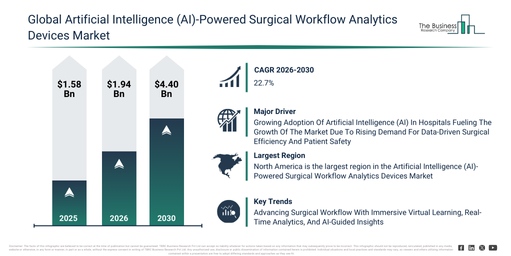
    The market size for artificial intelligence (AI)-powered surgical workflow analytics devices has experienced rapid expansion in recent years. This market is projected to expand from $1.58 billion in 2025 to $1.94 billion in 2026, demonstrating a compound annual growth rate (CAGR) of 23.0%. Several factors contributed to this historical growth, including the rising adoption of minimally invasive surgeries, increased healthcare spending on digital transformation, the growing incorporation of AI in robotic surgery systems, a heightened emphasis on operational efficiency within hospitals, and an increase in collaborations between technology and medtech companies.

    The artificial intelligence (AI)-powered surgical workflow analytics devices market is projected to experience rapid expansion over the coming years. Its value is anticipated to reach $4.40 billion by 2030, exhibiting a compound annual growth rate (CAGR) of 22.7%. This expansion during the projection period stems from factors such as heightened demand for real-time surgical workflow enhancement, increased use of predictive analytics in surgical operations, a greater imperative for combining hardware and software systems, the proliferation of cloud-based deployment methods, and increased funding for digital health advancements and smart hospital endeavors. Key developments expected in this forecast timeframe encompass breakthroughs in real-time surgical analytics platforms, progress in AI-powered decision support tools, the incorporation of technology into robotic and minimally invasive surgical techniques, the creation of compatible solutions for existing hospital IT infrastructure, and allocation of resources into expert services for AI deployment.

    Get A Free Sample Report With In-Depth Market Insights:

    https://thebusinessresearchcompany.com/sample_request?id=82838025&type=smp&name=Artificial%20Intelligence%20%28AI%29-Powered%20Surgical%20Workflow%20Analytics%20Devices%20Market%20Report%202026&utm_source=Blogs&utm_medium=Paid&utm_campaign=Oct_PR

    Artificial Intelligence (AI)-Powered Surgical Workflow Analytics Devices Market Growth Catalysts And Demand Drivers

    The increasing integration of artificial intelligence (AI) within hospitals is anticipated to fuel the expansion of the AI-powered surgical workflow analytics devices market moving forward. This adoption involves the expanded deployment of AI-driven tools for clinical data analysis, streamlining hospital processes, and assisting in decisions across diagnostics, therapies, and surgeries. The uptake of AI in healthcare facilities is driven by its capacity to automate administrative functions such as scheduling, billing, and record keeping, thereby lessening staff burden and inaccuracies, and allowing greater concentration on patient care. AI-powered surgical workflow analytics devices complement AI initiatives in hospitals by examining live surgical data, pinpointing operational bottlenecks, forecasting risks, and facilitating data-backed enhancements in operating room effectiveness and patient safety. For example, data from September 2025 by the US government’s Assistant Secretary for Technology Policy indicated that in 2024, 71% of hospitals utilized predictive AI integrated with electronic health records (EHR), marking an increase from 66% in 2023, with approximately 7 in 10 hospitals reporting predictive AI use in 2024. Consequently, the expanding use of artificial intelligence (AI) in hospitals is a key factor propelling the growth of the AI-powered surgical workflow analytics devices market.

    Artificial Intelligence (AI)-Powered Surgical Workflow Analytics Devices Market Segment Landscape And Growth Outlook

    The artificial intelligence (AI)-powered surgical workflow analytics devices market covered in this report is segmented –

    1) By Component: Hardware, Software, Services

    2) By Deployment Mode: On-Premises, Cloud-Based

    3) By Application: Preoperative Planning, Intraoperative Guidance, Postoperative Analysis, Workflow Optimization, Other Applications

    4) By End-User: Hospitals, Ambulatory Surgical Centers, Specialty Clinics, Other End-Users

    Subsegments:

    1) By Hardware: Surgical Robots, Imaging Devices, Monitoring Equipment, Sensors, Data Storage Devices

    2) By Software: Workflow Management Software, Predictive Analytics Software, Visualization Software, Data Integration Software, Performance Optimization Software

    3) By Services: Installation And Implementation Services, Maintenance And Support Services, Training And Education Services, Consulting Services, Data Analysis And Reporting Services

    Artificial Intelligence (AI)-Powered Surgical Workflow Analytics Devices Market Trends Shaping Long-Term Demand

    Key companies operating in the artificial intelligence (AI)-powered surgical workflow analytics devices market are prioritizing the development of advanced solutions, including immersive virtual learning environments, to elevate surgical planning, team training, and intraoperative performance. An immersive virtual learning environment represents a simulated, interactive digital space where clinicians can engage with real-world procedural scenarios, receive contextual guidance, and practice complex techniques in a risk-free setting, thereby improving both learning outcomes and procedural proficiency. For instance, in April 2024, Medtronic plc, a US-based medical technology company, unveiled 14 new Performance Insights algorithms, incorporating new Live Stream technology and AI analysis capabilities for laparoscopic and robotic-assisted procedures. This solution integrates immersive virtual learning environments that enable surgical teams to access AI-guided visualization, performance feedback, and procedural analytics during training and live operations. These environments utilize real-time data and artificial intelligence to generate dynamic simulations of patient anatomy and surgical workflows, assisting clinicians in refining techniques and anticipating clinical needs.

    Artificial Intelligence (AI)-Powered Surgical Workflow Analytics Devices Market Top Companies Driving Competitive Growth

    Major companies operating in the artificial intelligence (AI)-powered surgical workflow analytics devices market are Medtronic Plc, Johnson & Johnson, Koninklijke Philips N.V., Olympus Corporation, Caresyntax GmbH, Proximie Ltd., Surgical Theater Inc., Surgical Safety Technologies Inc., RSIP Vision Ltd., Surgical Directions Inc., Activ Surgical Inc., Leap Rail Inc., Livedata Inc., Omnimed Inc., Theator Inc., Intuitive Surgical Inc., Copient Health Inc., Pixee Medical SAS, Moon Surgical Inc., ExplORer Surgical Corp.

    View The Full Artificial Intelligence (AI)-Powered Surgical Workflow Analytics Devices Market Report:

    https://thebusinessresearchcompany.com/report/artificial-intelligence-ai-powered-surgical-workflow-analytics-devices-market-report?utm_source=Blogs&utm_medium=Paid&utm_campaign=Oct_PR

    Artificial Intelligence (AI)-Powered Surgical Workflow Analytics Devices Market Global Footprint: Which Region Leads The Industry?

    North America was the largest region in the artificial intelligence (AI)-powered surgical workflow analytics devices market in 2025. Asia-Pacific is expected to be the fastest-growing region in the forecast period. The regions covered in the artificial intelligence (AI)-powered surgical workflow analytics devices market report are Asia-Pacific, South East Asia, Western Europe, Eastern Europe, North America, South America, Middle East, Africa.

    Reach Out To Our Team:

    The Business Research Company: https://www.thebusinessresearchcompany.com/

    Americas: +1 310-496-7795

    Asia: +44 7882 955267 & +91 8897263534

    Europe: +44 7882 955267

    Email us at: marketing@tbrc.info

    Follow us on:

    LinkedIn: https://in.linkedin.com/company/the-business-research-company

    YouTube: https://www.youtube.com/channel/UC24_fI0rV8cR5DxlCpgmyFQ

    Global Market Model: https://www.thebusinessresearchcompany.com/global-market-model
  • Artificial Intelligence (AI)-Driven Retinal Screening Device Market Size Forecast: How The Industry Is Expected To Grow From 2026 To 2030

    Artificial Intelligence (AI)-Driven Retinal Screening Device Market Size Forecast: How The Industry Is Expected To Grow From 2026 To 2030

    Backed by market attractiveness analysis, total addressable market sizing, company benchmarking matrices, interactive Excel dashboards, wider supply chain intelligence, emerging startup coverage, and detailed product-level insights, The Business Research Company’s 2026 market reports are designed to offer research that is more actionable and strategically valuable than ever.

    Artificial Intelligence (AI)-Driven Retinal Screening Device Market Size And Revenue Outlook Through 2030

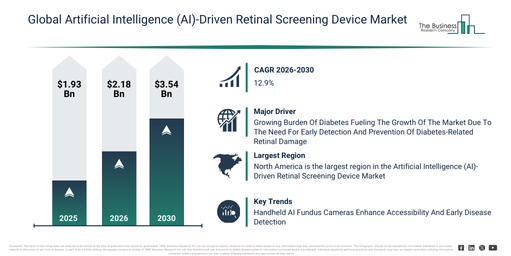
    The artificial intelligence (AI)-driven retinal screening device market size has experienced significant expansion in recent years. Its value is projected to rise from $1.93 billion in 2025 to $2.18 billion in 2026, at a compound annual growth rate (CAGR) of 13.1%. Historically, this growth has been driven by the greater adoption of artificial intelligence (AI)-enabled ophthalmic diagnostics, a growing incidence of diabetic retinopathy, an elevated demand for early retinal disease detection, the enhanced integration of digital health screening programs, and an escalating healthcare focus on preventive eye care.

    The artificial intelligence (AI)-driven retinal screening device market is poised for significant expansion in the coming years, projected to reach $3.54 billion in 2030, exhibiting a compound annual growth rate (CAGR) of 12.9%. This anticipated growth during the forecast period stems from factors such as the increasing adoption of autonomous AI-based screening systems, the wider deployment of point-of-care retinal devices, enhanced government backing for digital eye screening initiatives, the broader incorporation of AI tools in teleophthalmology, and a rising need for quick and affordable retinal assessment solutions. Key trends defining this period involve progress in AI algorithms for interpreting retinal images, novel developments in edge-computing retinal screening devices, technological improvements that enhance image acquisition quality, ongoing research and development into multimodal platforms for detecting eye diseases, and advancements in cloud-based AI screening workflows.

    Get A Free Sample Report With In-Depth Market Insights:

    https://thebusinessresearchcompany.com/sample_request?id=92434941&type=smp&name=Artificial%20Intelligence%20%28AI%29-Driven%20Retinal%20Screening%20Device%20Market%20Report%202026&utm_source=Blogs&utm_medium=Paid&utm_campaign=Oct_PR

    Artificial Intelligence (AI)-Driven Retinal Screening Device Market Growth Momentum: What Factors Are Shaping Demand?

    The increasing prevalence of diabetes is anticipated to fuel the expansion of the AI-driven retinal screening device market in the coming years. Diabetes, a long-term metabolic condition marked by consistently elevated blood glucose, progressively harms blood vessels, including those in the retina, making it a primary cause of avoidable vision loss globally. The heightened burden of diabetes stems from an aging global population and evolving lifestyles, which have led to increased obesity and reduced physical activity in both developed and developing regions. AI-driven retinal screening devices are crucial for diabetes management by facilitating the early identification of diabetes-related retinal damage, broadening screening availability, and aiding prompt clinical action to avert visual impairment. For example, in April 2025, the International Diabetes Federation, a Belgium-based global health organization, reported that around 589 million adults aged 20–79 were living with diabetes globally in 2024, with forecasts suggesting this figure could reach 853 million by 2050, representing a substantial increase over prior decades. Consequently, the mounting worldwide diabetes burden is propelling the growth of the AI-Driven Retinal Screening Device market.

    Artificial Intelligence (AI)-Driven Retinal Screening Device Market Segment Analysis And Revenue Potential

    The artificial intelligence (AI)-driven retinal screening device market covered in this report is segmented –

    1) By Component: Hardware, Software, Services

    2) By Technology: Fundus Image-Based Artificial Intelligence (AI), Optical Coherence Tomography (OCT)-Based Artificial Intelligence (AI), Multi-Modal Artificial Intelligence (AI), Machine Learning (ML), Deep Learning (DL), Natural Language Processing (NLP)

    3) By Deployment: Cloud-Based, On-Premise

    4) By Application: Diabetic Retinopathy, Age-Related Macular Degeneration, Glaucoma, Cataract, Other Applications

    5) By End-User: Hospitals, Ophthalmology Clinics, Mobile Clinics Or Rural Camps, Diagnostic Centers, Research And Academia, Telemedicine Providers

    Subsegments:

    1) By Hardware: Imaging Devices, Sensor Modules, Display Units, Storage Devices

    2) By Software: Image Processing Software, Diagnostic Analysis Software, Data Management Software, Reporting And Visualization Software

    3) By Services: Installation And Setup, Maintenance And Support, Training And Education, Consulting Services

    Artificial Intelligence (AI)-Driven Retinal Screening Device Market Trends Redefining Industry Growth

    Companies operating in the artificial intelligence (AI)-driven retinal screening device market are primarily focusing on developing advanced offerings, such as handheld AI fundus cameras, to enhance accessibility, accelerate diagnostic processes, and facilitate earlier disease detection. These handheld AI fundus cameras are defined as portable imaging devices that utilize artificial intelligence for the automated analysis of retinal images to identify signs of disease. For instance, in May 2024, Optomed USA Inc., a US-based medical technology company, introduced the Optomed Aurora AEYE. This product represents the first FDA-cleared, handheld AI fundus camera specifically for the detection of more than mild diabetic retinopathy. The device integrates automatic, AI-based image analysis to provide immediate screening results at the point of care, thereby enabling clinical decision support without requiring the presence of a specialist. Its battery-operated and highly portable nature is engineered to expand access to vital sight-saving screenings across primary care, endocrinology, and other non-specialist environments.

    Artificial Intelligence (AI)-Driven Retinal Screening Device Market Competitive Overview And Top Companies

    Major companies operating in the artificial intelligence (AI)-driven retinal screening device market are Carl Zeiss Meditec AG, Topcon Corporation, Canon Medical Systems Corporation, Bosch Healthcare Solutions GmbH, Heidelberg Engineering GmbH, Shenzhen Sibionics Technology Co. Ltd., Digital Diagnostics Inc., Optomed Plc, Optain Health Inc., NIDEK Co. Ltd., Airdoc Technology Co. Ltd., Identifeye Health Ltd., Kowa Company Ltd., RetinaLyze System A/S, EyRIS Pte. Ltd., Eyenuk Inc., EYRIS Pte. Ltd., VUNO Inc., Eyenuk Inc., AEYE Health Inc.

    View The Full Artificial Intelligence (AI)-Driven Retinal Screening Device Market Report:

    https://thebusinessresearchcompany.com/report/artificial-intelligence-ai-driven-retinal-screening-device-market-report?utm_source=Blogs&utm_medium=Paid&utm_campaign=Oct_PR

    Artificial Intelligence (AI)-Driven Retinal Screening Device Market Leading Geography: Which Region Contributes The Most Revenue?

    North America was the largest region in the artificial intelligence (AI)-driven retinal screening device market in 2025. Asia-Pacific is expected to be the fastest-growing region in the forecast period. The regions covered in the artificial intelligence (AI)-driven retinal screening device market report are Asia-Pacific, South East Asia, Western Europe, Eastern Europe, North America, South America, Middle East, Africa.

    Reach Out To Our Team:

    The Business Research Company: https://www.thebusinessresearchcompany.com/

    Americas: +1 310-496-7795

    Asia: +44 7882 955267 & +91 8897263534

    Europe: +44 7882 955267

    Email us at: marketing@tbrc.info

    Follow us on:

    LinkedIn: https://in.linkedin.com/company/the-business-research-company

    YouTube: https://www.youtube.com/channel/UC24_fI0rV8cR5DxlCpgmyFQ

    Global Market Model: https://www.thebusinessresearchcompany.com/global-market-model
  • Artificial Intelligence (AI)-Driven Hospital Supply Waste Monitor Market Reaches $4.13 Billion In 2026: Forecast And Growth Opportunities

    Artificial Intelligence (AI)-Driven Hospital Supply Waste Monitor Market Reaches $4.13 Billion In 2026: Forecast And Growth Opportunities

    Featuring market attractiveness scoring, total addressable market sizing, company benchmarking matrices, interactive Excel dashboards, deeper supply chain intelligence, emerging startup tracking, and granular product-level insights, The Business Research Company’s 2026 market reports are built to deliver research that is both more actionable and more strategically valuable.

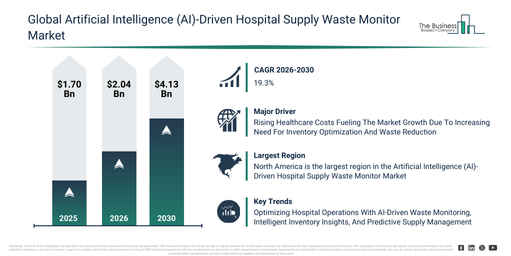
    Artificial Intelligence (AI)-Driven Hospital Supply Waste Monitor Market Growth From $2.04 Billion In 2026 To $4.13 Billion By 2030 At A CAGR Of 19.3%

    The artificial intelligence (AI)-driven hospital supply waste monitor market size has seen substantial growth recently. This market is expected to expand from $1.70 billion in 2025 to $2.04 billion in 2026, achieving a compound annual growth rate (CAGR) of 19.6%. Historically, this growth has been fueled by the increasing integration of AI into healthcare operations, the growing necessity to reduce medical supply waste, an amplified focus on cost optimization in hospitals, the wider use of predictive analytics, and the rising adoption of inventory monitoring solutions.

    The artificial intelligence (AI)-driven hospital supply waste monitor market is projected for substantial expansion over the coming years. This market is set to reach $4.13 billion in 2030, exhibiting a compound annual growth rate (CAGR) of 19.3%. This anticipated growth during the forecast period is fueled by several factors, including increasing investments in healthcare IT infrastructure, the rising integration of AI within hospital management systems, the greater adoption of cloud-based platforms for supply monitoring, the expansion of remote monitoring and intelligent inventory systems, and a growing focus on sustainability and waste reduction initiatives. Key trends characterizing this period involve technological advancements in machine learning and AI models, pioneering developments in real-time inventory tracking devices, intensive research and development in predictive analytics to minimize waste, the creation of automated reporting and dashboard solutions, and improvements in interoperable healthcare IT and inventory systems.

    Get A Free Sample Report With In-Depth Market Insights:

    https://thebusinessresearchcompany.com/sample_request?id=46322702&type=smp&name=Artificial%20Intelligence%20%28AI%29-Driven%20Hospital%20Supply%20Waste%20Monitor%20Market%20Report%202026&utm_source=Blogs&utm_medium=Paid&utm_campaign=Oct_PR

    Artificial Intelligence (AI)-Driven Hospital Supply Waste Monitor Market Expansion Drivers: What’s Shaping Future Growth?

    The escalating expenses in healthcare are projected to significantly boost the expansion of the artificial intelligence (AI)-driven hospital supply waste monitor market in the coming years. This increase in healthcare costs signifies the continuous rise in financial outlays necessary for providing medical services and managing hospital operations, encompassing personnel, equipment, and medical consumables, which subsequently burdens healthcare systems financially. A primary factor contributing to this increase is the demographic shift towards an aging population, which necessitates more intensive medical interventions for prevalent chronic illnesses like heart disease and diabetes. The artificial intelligence (AI)-driven hospital supply waste monitor plays a crucial role in managing healthcare expenditures by minimizing superfluous supply wastage, enhancing inventory management, and assisting providers in regulating their total spending. For example, reports from June 2025 by the Centers for Medicare and Medicaid Services (CMS), a US-based government health expenditure authority, revealed that in 2023, spending on hospital care surged by 10.4% to $1.52 trillion, and overall national health expenditures climbed by 7.5% to $4.9 trillion when compared to figures from 2022. Consequently, the escalating healthcare costs are serving as a major impetus for the growth of the artificial intelligence (AI)-driven hospital supply waste monitor market.

    Artificial Intelligence (AI)-Driven Hospital Supply Waste Monitor Market Segmentation And Category Overview

    The artificial intelligence (AI)-driven hospital supply waste monitor market covered in this report is segmented –

    1) By Component: Software, Hardware, Services

    2) By Deployment Mode: On-Premises, Cloud-Based

    3) By Application: Inventory Management, Waste Tracking, Cost Reduction, Compliance Monitoring, Other Applications

    4) By End-User: Hospitals, Clinics, Ambulatory Surgical Centers, Other End-Users

    Subsegments:

    1) By Software: Electronic Health Record Integration, Predictive Analytics Platforms, Risk Scoring Systems, Clinical Decision Support Tools

    2) By Hardware: Servers, Sensors, Monitoring Devices, Data Storage Devices

    3) By Services: Data Analytics Services, Predictive Modeling Services, Integration And Deployment Services, Training And Support Services, Monitoring And Reporting Services

    Artificial Intelligence (AI)-Driven Hospital Supply Waste Monitor Market Strategic Trends: What Defines The Next Growth Phase?

    Leading companies operating within the artificial intelligence (AI)-driven hospital supply waste monitor market are prioritizing the development of advanced technology, such as predictive usage and waste reduction analytics. This focus aims to enhance supply chain visibility, minimize waste, and decrease operational costs across healthcare facilities. Predictive usage and waste reduction analytics refer to artificial intelligence systems designed to analyze historical and real-time data to accurately forecast inventory needs, identify consumption patterns, and automatically alert staff to potential overstock or waste situations, thereby enabling smarter procurement and more efficient resource allocation. For instance, in April 2024, SmartPAR.AI Inc., a US-based healthtech software provider, launched an AI-driven solution specifically created to transform hospital inventory management and reduce product waste. This platform incorporates machine learning, predictive usage, and waste reduction analytics to monitor current supplies, forecast future demand, and identify discrepancies that could lead to waste.

    Artificial Intelligence (AI)-Driven Hospital Supply Waste Monitor Market Competitive Landscape: Which Companies Lead The Industry?

    Major companies operating in the artificial intelligence (AI)-driven hospital supply waste monitor market are Cardinal Health Inc., Oracle Corporation, Becton Dickinson and Company, Owens & Minor Inc., Arvato AG, Zebra Technologies Corporation, Getinge AB, Palantir Technologies Inc., Omnicell Inc., Manhattan Associates Inc., Symplr Inc., Global Healthcare Exchange LLC, Tecsys Inc., Terso Solutions Inc., LogiTag Systems Ltd., Spikewell Inc., Softlabs Group Inc., Stanley Healthcare, Z5 Inventory Inc., IDENTI Medical Ltd.

    View The Full Artificial Intelligence (AI)-Driven Hospital Supply Waste Monitor Market Report:

    https://thebusinessresearchcompany.com/report/artificial-intelligence-ai-driven-hospital-supply-waste-monitor-market-report?utm_source=Blogs&utm_medium=Paid&utm_campaign=Oct_PR

    Artificial Intelligence (AI)-Driven Hospital Supply Waste Monitor Market Regional Outlook: Where Is Opportunity Concentrated?

    North America was the largest region in the artificial intelligence (AI)-driven hospital supply waste monitor market in 2025. Asia-Pacific is expected to be the fastest-growing region in the forecast period. The regions covered in the artificial intelligence (AI)-driven hospital supply waste monitor market report are Asia-Pacific, South East Asia, Western Europe, Eastern Europe, North America, South America, Middle East, Africa.

    Reach Out To Our Team:

    The Business Research Company: https://www.thebusinessresearchcompany.com/

    Americas: +1 310-496-7795

    Asia: +44 7882 955267 & +91 8897263534

    Europe: +44 7882 955267

    Email us at: marketing@tbrc.info

    Follow us on:

    LinkedIn: https://in.linkedin.com/company/the-business-research-company

    YouTube: https://www.youtube.com/channel/UC24_fI0rV8cR5DxlCpgmyFQ

    Global Market Model: https://www.thebusinessresearchcompany.com/global-market-model
  • Artificial Intelligence (AI)-Driven Hospital Readmission Predictor Market Growth In 2026: Market Size, Key Drivers And Future Outlook

    Artificial Intelligence (AI)-Driven Hospital Readmission Predictor Market Growth In 2026: Market Size, Key Drivers And Future Outlook

    Built to provide research that’s more actionable and strategically valuable, The Business Research Company’s 2026 market reports include market attractiveness analysis, total addressable market sizing, company benchmarking matrices, interactive Excel dashboards, broader supply chain intelligence, emerging startup tracking, and in-depth product insights.

    Artificial Intelligence (AI)-Driven Hospital Readmission Predictor Market Expansion Outlook: What Revenue Opportunities Are Ahead?

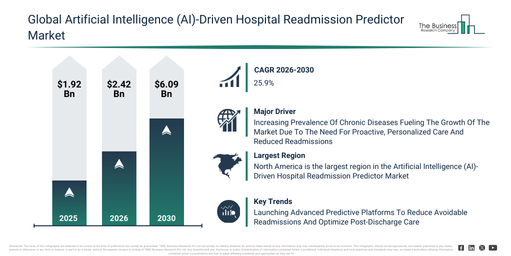
    The artificial intelligence (AI)-driven hospital readmission predictor market has seen substantial growth in recent years. This market is projected to expand from $1.92 billion in 2025 to $2.42 billion in 2026, achieving a compound annual growth rate (CAGR) of 26.2%. Historically, this expansion has been driven by several factors including the increasing adoption of AI in healthcare, a growing demand to reduce hospital readmissions, the rising availability of electronic health records, the broader use of predictive analytics, and an increasing focus on patient outcomes.

    The market for artificial intelligence (AI)-driven hospital readmission predictors is projected to experience substantial growth in the coming years. This market is anticipated to reach $6.09 billion by 2030, exhibiting a compound annual growth rate (CAGR) of 25.9%. Key factors contributing to this expansion during the forecast period include increased investments in healthcare information technology infrastructure, enhanced integration of clinical decision support systems, wider adoption of cloud-based analytics platforms, the broadening of remote patient monitoring tools, and a heightened focus on value-based care models. Significant trends observed over the forecast period encompass technological advancements in machine learning models, breakthroughs in real-time patient monitoring, ongoing research and development in natural language processing, the creation of explainable AI specifically for healthcare applications, and improvements in interoperable healthcare IT systems.

    Get A Free Sample Report With In-Depth Market Insights:

    https://thebusinessresearchcompany.com/sample_request?id=69754376&type=smp&name=Artificial%20Intelligence%20%28AI%29-Driven%20Hospital%20Readmission%20Predictor%20Market%20Report%202026&utm_source=Blogs&utm_medium=Paid&utm_campaign=Oct_PR

    Artificial Intelligence (AI)-Driven Hospital Readmission Predictor Market Development Factors: What’s Supporting Demand?

    The rising occurrence of chronic conditions is anticipated to fuel expansion in the artificial intelligence (AI)-driven hospital readmission predictor market. These are enduring medical ailments, including diabetes, heart disease, and arthritis, that typically advance gradually and necessitate continuous healthcare and lifestyle adjustments to manage indicators and avert adverse events. Their escalation is predominantly linked to detrimental lifestyle choices such as inadequate nutrition, lack of physical activity, and tobacco use, contributing to a higher likelihood of conditions like diabetes, heart disease, and obesity. Artificial intelligence (AI)-driven hospital readmission predictors assist in managing chronic illnesses by examining patient information to pinpoint individuals prone to re-hospitalization. These tools enhance patient results through facilitating early interventions, tailored care strategies, and prompt follow-up, thereby preventing complications and shortening hospital durations. For example, data from June 2024, released by the National Health Service, a UK government department, showed that 3,615,330 individuals registered with a general practitioner (GP) had a diagnosis of non-diabetic hyperglycemia or pre-diabetes (a state with elevated blood sugar, insufficient for a diabetes classification) in 2023. This represented an 18% rise from 3,065,825 cases recorded in 2022. Consequently, the expanding incidence of chronic diseases is fueling the development of the artificial intelligence (AI)-driven hospital readmission predictor market.

    Artificial Intelligence (AI)-Driven Hospital Readmission Predictor Market Segment Outlook: Which Categories Are Growing Fastest?

    The artificial intelligence (AI)-driven hospital readmission predictor market covered in this report is segmented –

    1) By Component: Software, Hardware, Services

    2) By Deployment Mode: On-Premises, Cloud

    3) By Application: Patient Risk Assessment, Care Management, Clinical Decision Support, Population Health Management, Other Applications

    4) By End-User: Hospitals, Clinics, Ambulatory Surgical Centers, Other End-Users

    Subsegments:

    1) By Software: Electronic Health Record Integration, Predictive Analytics Platforms, Risk Scoring Systems, Clinical Decision Support Tools

    2) By Hardware: Servers, Sensors, Monitoring Devices, Data Storage Devices

    3) By Services: Data Analytics Services, Predictive Modeling Services, Integration And Deployment Services, Training And Support Services, Monitoring And Reporting Services

    Artificial Intelligence (AI)-Driven Hospital Readmission Predictor Market Transformation Trends: What Innovations Are Driving Change?

    Leading companies in the artificial intelligence (AI)-driven hospital readmission predictor market are concentrating on developing advanced solutions, such as sophisticated predictive modeling, to pinpoint high-risk patients, enable early interventions, and optimize care following discharge. Advanced predictive modeling entails utilizing complex statistical algorithms and machine learning techniques on historical and real-time data to uncover intricate patterns and generate highly accurate forecasts of future outcomes. For instance, in July 2025, Innovaccer Inc., a US-based healthcare AI company, unveiled its AI-Powered Readmissions Management Solution, which integrates advanced predictive modeling to identify avoidable readmissions across Medicare, Medicaid, and uninsured populations. The platform also provides unified 360-degree patient views, agentic AI tools like Care Management Copilot and Pre-Call Coordinator Agent for workflow automation, and benchmark intelligence to aid proactive intervention planning. This solution assists healthcare providers in reducing readmission rates, improving resource allocation, and enhancing overall patient outcomes.

    Artificial Intelligence (AI)-Driven Hospital Readmission Predictor Market Competitive Landscape: Who Leads The Industry?

    Major companies operating in the artificial intelligence (AI)-driven hospital readmission predictor market are Oracle Corporation, Siemens Healthineers AG, Cognizant Technology Solutions Corp., Epic Systems Corporation, SAS Institute Inc., Veradigm Inc., Merative LLP, Health Catalyst Inc., Lumeris Inc., Innovaccer Inc., Optum Inc., H2O.ai Inc., Healthfirst Inc., Qventus Inc., Lightbeam Health Solutions Inc., HealthEC LLC, Collective Medical Technologies Inc., CarePredict Inc., HBI Solutions Inc., CloudMedx

    View The Full Artificial Intelligence (AI)-Driven Hospital Readmission Predictor Market Report:

    https://thebusinessresearchcompany.com/report/artificial-intelligence-ai-driven-hospital-readmission-predictor-market-report?utm_source=Blogs&utm_medium=Paid&utm_campaign=Oct_PR

    Artificial Intelligence (AI)-Driven Hospital Readmission Predictor Market Geographic Landscape: Which Region Leads Industry Growth?

    North America was the largest region in the artificial intelligence (AI)-driven hospital readmission predictor market in 2025. Asia-Pacific is expected to be the fastest-growing region in the forecast period. The regions covered in the artificial intelligence (AI)-driven hospital readmission predictor market report are Asia-Pacific, South East Asia, Western Europe, Eastern Europe, North America, South America, Middle East, Africa.

    Reach Out To Our Team:

    The Business Research Company: https://www.thebusinessresearchcompany.com/

    Americas: +1 310-496-7795

    Asia: +44 7882 955267 & +91 8897263534

    Europe: +44 7882 955267

    Email us at: marketing@tbrc.info

    Follow us on:

    LinkedIn: https://in.linkedin.com/company/the-business-research-company

    YouTube: https://www.youtube.com/channel/UC24_fI0rV8cR5DxlCpgmyFQ

    Global Market Model: https://www.thebusinessresearchcompany.com/global-market-model
  • Artificial Intelligence (AI) Tele-Oncology Radiation Dose Scheduler Market Size And Forecast 2026–2030: Trends Driving Industry Expansion

    Artificial Intelligence (AI) Tele-Oncology Radiation Dose Scheduler Market Size And Forecast 2026–2030: Trends Driving Industry Expansion

    Backed by market attractiveness analysis, total addressable market sizing, company benchmarking matrices, interactive Excel dashboards, wider supply chain intelligence, emerging startup coverage, and detailed product-level insights, The Business Research Company’s 2026 market reports are designed to offer research that is more actionable and strategically valuable than ever.

    Artificial Intelligence (AI) Tele-Oncology Radiation Dose Scheduler Market Growth Potential: How Will Market Size Shift Through 2030?

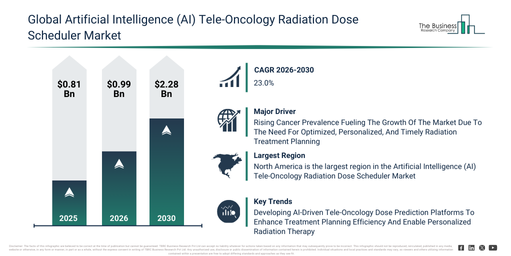
    The artificial intelligence (AI) tele-oncology radiation dose scheduler market has experienced significant expansion in recent years. It is projected to grow from $0.81 billion in 2025 to $0.99 billion in 2026, at a compound annual growth rate (CAGR) of 23.3%. The market’s growth in previous periods can be attributed to an increasing need for remote cancer treatment planning, the rising adoption of tele-oncology platforms, a growing demand for precise radiation dose calculation, the expanding use of AI in oncology decision support, a worldwide rise in cancer incidence, the advancing digital transformation within hospitals, the increasing deployment of cloud-based medical systems, an escalating need for workflow automation in radiotherapy, a growing focus on reducing treatment errors, and the increasing adoption of smart oncology scheduling tools.

    The artificial intelligence (AI) tele-oncology radiation dose scheduler market is expected to demonstrate significant growth in the coming years, with its valuation predicted to reach $2.28 billion by 2030, growing at a compound annual growth rate (CAGR) of 23.0%. This anticipated expansion during the forecast period can be attributed to factors such as the broadening of tele-oncology networks, the increasing uptake of AI-enabled treatment planning platforms, a heightened requirement for automated dose calculation systems, the adoption of cloud-based oncology scheduling modules, the deployment of predictive oncology algorithms, the creation of remote radiotherapy review tools, the demand for precise cancer care, the incorporation of AI tools within oncology departments, strategic partnerships between AI vendors and cancer centers, and the rising acceptance of tele-radiation workflows. Prominent trends throughout this period include advancements in AI-driven radiotherapy dose prediction, further development in cloud-based oncology scheduling platforms, enhancements in real-time dose optimization engines, innovations in automated treatment planning systems, new developments in predictive oncology algorithms, new virtual radiation oncology workflows, the integration of tele-oncology with hospital information systems, the merging of AI dose schedulers with imaging platforms, the inclusion of remote dose-review tools for oncologists, and the formation of multi-center tele-radiation networks.

    Get A Free Sample Report With In-Depth Market Insights:

    https://thebusinessresearchcompany.com/sample_request?id=35829742&type=smp&name=Artificial%20Intelligence%20%28AI%29%20Tele-Oncology%20Radiation%20Dose%20Scheduler%20Market%20Report%202026&utm_source=Blogs&utm_medium=Paid&utm_campaign=Oct_PR

    Artificial Intelligence (AI) Tele-Oncology Radiation Dose Scheduler Market Industry Drivers: What’s Behind The Revenue Growth?

    The escalating occurrence of cancer is anticipated to drive the expansion of the artificial intelligence (AI) tele-oncology radiation dose scheduler market moving forward. Cancer is defined as a disease characterized by the uninhibited proliferation and dissemination of atypical cells, which can harm nearby tissues and organs if not adequately managed. The incidence of cancer is on the rise, attributed to lifestyle-related factors like unhealthy eating habits, smoking, alcohol consumption, and contact with environmental contaminants, all of which elevate the likelihood of developing various cancers. Artificial intelligence (AI) tele-oncology radiation dose schedulers facilitate cancer treatment by optimizing and tailoring radiation therapy plans through remote, data-driven evaluations. They contribute to better patient outcomes by guaranteeing accurate dosing, reducing delays in treatment, and enabling uniform care across different geographical areas. As an illustration, in October 2025, NHS Digital, a UK government body, noted 354,820 new cancer diagnoses recorded in England in 2023, averaging 972 diagnoses each day. This represented an increase of 8,605 cases compared to 2022, with prostate cancer being the most frequently diagnosed at 58,137 new cases, indicating a 6% rise in registrations over the previous year. Hence, the growing prevalence of cancer is fueling the growth of the artificial intelligence (AI) tele-oncology radiation dose scheduler market.

    Artificial Intelligence (AI) Tele-Oncology Radiation Dose Scheduler Market Segment Landscape: Which Areas Lead Development?

    The artificial intelligence (AI) tele-oncology radiation dose scheduler market covered in this report is segmented –

    1) By Component: Software, Hardware, Services

    2) By Technology: Machine Learning Algorithms, Natural Language Processing, Computer Vision, Predictive Analytics

    3) By Deployment Mode: On-Premise (Local Installation), Cloud-Based (SaaS), Hybrid Deployment

    4) By Application: Auto-Contouring And Segmentation (OAR Or Target), Treatment Plan Generation And Optimization, Dose Prediction And Quality Assurance (QA), Workflow And Resource Scheduling Optimization, Adaptive Radiotherapy Planning

    5) By End-User: Hospitals, Cancer Treatment Centers, Research Institutes, Other End-Users

    Subsegments:

    1) By Software: Analytics And Reporting Software, Recommendation Engine Software, Natural Language Processing Software, Machine Learning Model Management Tools, Computer Vision Software, Integration And API Management Software, Mobile And Web Application Software

    2) By Hardware: AI-Optimized Servers, Edge Computing Devices, Sensors And IoT Devices, Smart Cameras, GPUs And AI Accelerators, Storage Systems, Networking And Connectivity Hardware

    3) By Services: Consulting Services, Implementation And Integration Services, Training And Support Services, Managed AI Services, Maintenance And Upgradation Services, Custom AI Development Services, Data Management And Annotation Services

    #Artificial Intelligence (AI) Tele-Oncology Radiation Dose Scheduler Market Growth Trends: What’s Shaping The Future Outlook?

    Leading companies in the AI tele-oncology and radiation therapy market are prioritizing the development of sophisticated solutions, such as AI-powered dose prediction, to forecast personalized radiation dose distributions and thereby enhance the efficiency of treatment planning. These AI-powered dose prediction platforms serve as software solutions designed to analyze imaging and anatomical data, generate clinically attainable 3D dose distributions, and facilitate timely adjustments for optimizing therapy. For instance, in March 2025, MVision AI, a Finland-based health-tech company, introduced Dose+. This AI-powered dose prediction platform features specialized models for prostate and pelvic lymph node cases, customizes dose distributions for each patient’s unique anatomy, and supports integration with standard treatment planning systems via DICOM to streamline planning workflows. The introduction of Dose+ signifies a considerable technological stride, integrating AI-driven dose prediction into routine clinical practice, connecting traditional planning with automated, patient-specific optimization, and supplying clinicians with a scalable, efficient tool for precise, personalized radiation therapy.

    Artificial Intelligence (AI) Tele-Oncology Radiation Dose Scheduler Market Company Landscape And Competitive Strategy

    Major companies operating in the artificial intelligence (AI) tele-oncology radiation dose scheduler market are IBM Corporation, Siemens Healthineers AG, GE HealthCare Technologies Inc., Koninklijke Philips N.V., Varian Medical Systems Inc., Elekta AB, Shanghai United Imaging Healthcare Co. Ltd., Accuray Incorporated, Brainlab AG, RaySearch Laboratories AB, MIM Software Inc., Sun Nuclear Corp., DeepHealth, Radformation Inc., MVision AI Ltd., Mirada Medical Ltd., ViewRay Inc., Oncora Medical, Enlitic, Optellum Ltd.

    View The Full Artificial Intelligence (AI) Tele-Oncology Radiation Dose Scheduler Market Report:

    https://thebusinessresearchcompany.com/report/artificial-intelligence-ai-tele-oncology-radiation-dose-scheduler-market-report?utm_source=Blogs&utm_medium=Paid&utm_campaign=Oct_PR

    Artificial Intelligence (AI) Tele-Oncology Radiation Dose Scheduler Market Largest Region: Which Geography Holds The Biggest Share?

    North America was the largest region in the AI tele-oncology radiation dose scheduler market in 2025. Asia-Pacific is expected to be the fastest-growing region in the forecast period. The regions covered in the artificial intelligence (AI) tele-oncology radiation dose scheduler market report are Asia-Pacific, South East Asia, Western Europe, Eastern Europe, North America, South America, Middle East, Africa.

    Reach Out To Our Team:

    The Business Research Company: https://www.thebusinessresearchcompany.com/

    Americas: +1 310-496-7795

    Asia: +44 7882 955267 & +91 8897263534

    Europe: +44 7882 955267

    Email us at: marketing@tbrc.info

    Follow us on:

    LinkedIn: https://in.linkedin.com/company/the-business-research-company

    YouTube: https://www.youtube.com/channel/UC24_fI0rV8cR5DxlCpgmyFQ

    Global Market Model: https://www.thebusinessresearchcompany.com/global-market-model
  • Artificial Intelligence (AI) Psychological Counseling Market Size Growth: From $5.39 Billion In 2026 To $10.77 Billion By 2030

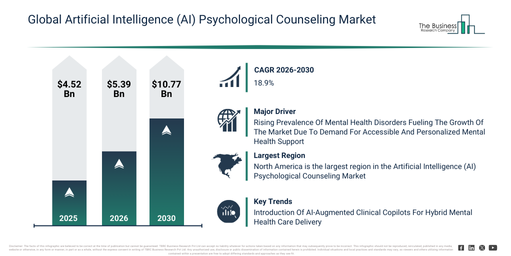
    Artificial Intelligence (AI) Psychological Counseling Market Size Growth: From $5.39 Billion In 2026 To $10.77 Billion By 2030

    Built to provide research that’s more actionable and strategically valuable, The Business Research Company’s 2026 market reports include market attractiveness analysis, total addressable market sizing, company benchmarking matrices, interactive Excel dashboards, broader supply chain intelligence, emerging startup tracking, and in-depth product insights.

    Artificial Intelligence (AI) Psychological Counseling Market Size Forecast: How Big Could The Market Get By 2030?

    Recent years have seen a rapid expansion in the market size for artificial intelligence (AI) psychological counseling. This sector is projected to expand from $4.52 billion in 2025 to $5.39 billion in 2026, demonstrating a compound annual growth rate (CAGR) of 19.2%. Historical growth within this market can be linked to several factors, including the increased embrace of AI tools in mental health, greater capital allocation towards digital therapeutics, a heightened understanding of mental health concerns, the proliferation of telehealth platforms, and the initial progress in natural language processing (NLP) and machine learning applications.

    The artificial intelligence (AI) psychological counseling market size is projected to undergo rapid expansion in the next few years. It is predicted to grow to $10.77 billion in 2030, demonstrating a compound annual growth rate (CAGR) of 18.9%. This anticipated growth can be attributed to several factors including an increasing demand for personalized mental health solutions, the growing adoption of cloud-based AI counseling, the rising integration of wearables and IoT for monitoring, the expansion of hybrid human-AI therapy models, and increasing investment in AI mental health startups. Additionally, major trends during this forecast period are expected to encompass technological advancements in generative AI and NLP, innovations in multimodal AI analytics, the development of personalized AI interventions, ongoing research in explainable AI (XAI), and further integration with digital therapeutics and telehealth platforms.

    Get A Free Sample Report With In-Depth Market Insights:

    https://thebusinessresearchcompany.com/sample_request?id=74976960&type=smp&name=Artificial%20Intelligence%20%28AI%29%20Psychological%20Counseling%20Market%20Report%202026&utm_source=Blogs&utm_medium=Paid&utm_campaign=Oct_PR

    Artificial Intelligence (AI) Psychological Counseling Market Demand Drivers: What’s Powering Industry Growth?

    The increasing occurrence of mental health conditions is anticipated to fuel the expansion of the artificial intelligence (AI) psychological counseling market in the future. These disorders are defined as states that markedly impact an individual’s feelings, cognition, actions, and general psychological well-being. The surge in mental health issues stems from heightened stress linked to contemporary living, encompassing demands at work, lack of social connection, and continuous engagement with digital platforms. Artificial intelligence (AI) psychological counseling assists in tackling mental health disorders by offering individualized, readily available, and expandable mental health assistance via virtual exchanges and insights derived from data. This approach enhances patient results through facilitating prompt intervention, ongoing observation, and customized therapeutic advice. For example, data from May 2024 indicates that, as per the American Psychiatric Association, a US-based non-profit organization, in 2024, 43% of adults report feeling more anxious than they did the year before, an increase from 37% in 2023 and 32% in 2022. Consequently, the growing occurrence of mental health conditions is propelling the development of the artificial intelligence (AI) psychological counseling market.

    Artificial Intelligence (AI) Psychological Counseling Market Segment Analysis: What Are The Core Market Categories?

    The artificial intelligence (AI) psychological counseling market covered in this report is segmented –

    1) By Component: Software, Hardware, Services

    2) By Deployment Mode: On-Premises, Cloud

    3) By Application: Clinical Therapy, Self-Help Tools, Mental Health Monitoring, Other Applications

    4) By End-User: Hospitals, Clinics, Research Institutes, Other End-Users

    Subsegments:

    1) By Software: Virtual Counseling Platforms, Emotion Recognition Algorithms, Natural Language Understanding Systems, Behavioral Analytics Software, Therapy Session Management Tools

    2) By Hardware: Wearable Monitoring Devices, Smart Therapeutic Headsets, Sensor Enabled Biofeedback Devices, Mental Health Tracking Devices, Home Based Diagnostic Tools

    3) By Services: Online Counseling Services, Professional Therapy Support Services, Technical Integration And Deployment Services, Training And Consultation Services, Maintenance And Remote Monitoring Services

    Artificial Intelligence (AI) Psychological Counseling Market Innovation Trends: What Developments Are Reshaping The Industry?

    Leading companies operating in the artificial intelligence (AI) psychological counseling market are concentrating on developing advanced mental health solutions, such as AI-powered clinical copilots, to enhance the effectiveness and efficiency of human therapists. AI-powered clinical copilots refer to artificial intelligence-driven software tools designed to assist healthcare professionals in clinical decision-making, documentation, and workflow management, thereby improving efficiency, accuracy, and patient care. For instance, in November 2024, Wysa Inc., a US-based provider of AI-driven mental health support, introduced Wysa Copilot. This platform is designed to elevate mental health therapy by seamlessly integrating AI support with human clinical care, offering secure, real-time and asynchronous messaging for patient-therapist communication. The solution enables clinicians to provide AI-guided tools to patients, monitor their progress through automated assessments, and receive alerts for crisis situations, effectively bridging the gap between digital self-help and professional therapy.

    Artificial Intelligence (AI) Psychological Counseling Market Competitive Analysis Of Leading Industry Participants

    Major companies operating in the artificial intelligence (AI) psychological counseling market are Lyra Health Inc., Noom Inc., Headspace Health Inc., Spring Health Inc., Cerebral Inc., Calm.com Inc., SonderMind Inc., WellDoc Inc., Meru Health Inc., Woebot Health Inc., Mindstrong Health Inc., Cognito Therapeutics Inc., Hume AI Inc., Wysa Ltd., Limbic Limited, RealizedCare Inc., Naluri Hidup Sdn Bhd, Youper Inc., Elomia Inc., Replika Inc., Videra Health Inc.

    View The Full Artificial Intelligence (AI) Psychological Counseling Market Report:

    https://thebusinessresearchcompany.com/report/artificial-intelligence-ai-psychological-counseling-market-report?utm_source=Blogs&utm_medium=Paid&utm_campaign=Oct_PR

    Artificial Intelligence (AI) Psychological Counseling Market Geographic Spread And Regional Opportunities

    North America was the largest region in the artificial intelligence (AI) psychological counseling market in 2025. Asia-Pacific is expected to be the fastest-growing region in the forecast period. The regions covered in the artificial intelligence (AI) psychological counseling market report are Asia-Pacific, South East Asia, Western Europe, Eastern Europe, North America, South America, Middle East, Africa.

    Reach Out To Our Team:

    The Business Research Company: https://www.thebusinessresearchcompany.com/

    Americas: +1 310-496-7795

    Asia: +44 7882 955267 & +91 8897263534

    Europe: +44 7882 955267

    Email us at: marketing@tbrc.info

    Follow us on:

    LinkedIn: https://in.linkedin.com/company/the-business-research-company

    YouTube: https://www.youtube.com/channel/UC24_fI0rV8cR5DxlCpgmyFQ

    Global Market Model: https://www.thebusinessresearchcompany.com/global-market-model
  • Artificial Intelligence (AI) Mental Service Robot Market Size In 2026 And Beyond: Understanding Future Growth Potential

    Artificial Intelligence (AI) Mental Service Robot Market Size In 2026 And Beyond: Understanding Future Growth Potential

    Built to provide research that’s more actionable and strategically valuable, The Business Research Company’s 2026 market reports include market attractiveness analysis, total addressable market sizing, company benchmarking matrices, interactive Excel dashboards, broader supply chain intelligence, emerging startup tracking, and in-depth product insights.

    Artificial Intelligence (AI) Mental Service Robot Market Forecast: What Value Will The Market Reach By 2030?

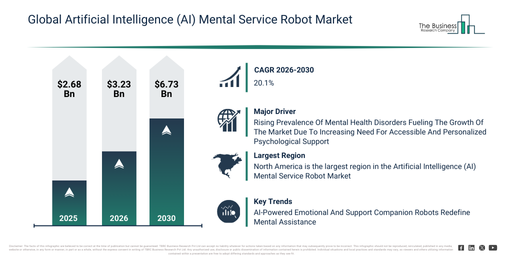
    The artificial intelligence (AI) mental service robot market has seen significant expansion in recent years. This market is projected to expand from $2.68 billion in 2025 to $3.23 billion in 2026, reflecting a compound annual growth rate (CAGR) of 20.4%. The historical development of this market can be linked to factors such as increased awareness of mental health, rising levels of stress and anxiety, an expanding elderly demographic, the broader adoption of digital health services, and an increasing need for tailored emotional assistance.

    The artificial intelligence (AI) mental service robot market size is projected to experience substantial growth over the upcoming years, with forecasts indicating it will reach $6.73 billion in 2030 at a compound annual growth rate (CAGR) of 20.1%. This anticipated expansion during the forecast period is primarily driven by the increasing adoption of AI mental service robots, their growing integration with telehealth platforms, rising investment in healthcare robotics, the expansion of corporate wellness programs, and a growing demand for cognitive-behavioral and mindfulness support. Significant trends for this period include technological advancements in emotion recognition, innovations in conversational AI and natural language processing (NLP), continued research and development in cognitive-behavioral assistance, ongoing developments in human-robot interaction, and progress in cloud-based AI and data analytics.

    Get A Free Sample Report With In-Depth Market Insights:

    https://thebusinessresearchcompany.com/sample_request?id=35059985&type=smp&name=Artificial%20Intelligence%20%28AI%29%20Mental%20Service%20Robot%20Market%20Report%202026&utm_source=Blogs&utm_medium=Paid&utm_campaign=Oct_PR

    Artificial Intelligence (AI) Mental Service Robot Market Demand Drivers Opening New Revenue Streams

    The increasing occurrence of mental health conditions is projected to drive the expansion of the artificial intelligence (AI) mental service robot market. Mental health disorders are defined as states that significantly influence an individual’s emotions, thoughts, actions, and overall psychological well-being. The rise in these disorders stems from heightened stress associated with contemporary lifestyles, including workplace pressures, social isolation, and continuous digital engagement. Artificial intelligence (AI) mental service robots contribute to addressing mental health disorders by offering interactive, tailored support and supervision for patients. They improve the accessibility and consistency of care by providing immediate counseling, behavioral guidance, and emotional aid in conjunction with conventional therapeutic approaches. For instance, in May 2024, the American Psychiatric Association, a US-based non-profit organization, reported that in 2024, 43% of adults experienced greater anxiety compared to the previous year, an increase from 37% in 2023 and 32% in 2022. Thus, the growing prevalence of mental health disorders is stimulating the growth of the artificial intelligence (AI) mental service robot market.

    Artificial Intelligence (AI) Mental Service Robot Market Segment Trends And Revenue Contributors

    The artificial intelligence (AI) mental service robot market covered in this report is segmented –

    1) By Component: Hardware, Software, Services

    2) By Type: Humanoid Or Anthropomorphic, Animal-Like Or Companion, Screen Or Virtual Assistants

    3) By Technology: Natural Language Processing, Machine Learning, Computer Vision, Emotional Recognition

    4) By Sales Channel: Direct Manufacturer Sales, Robotics Distributors, Online Sales Channels, Health-Technology Integrators

    5) By End Use: Health Care Facilities, Educational Institutions, Home Care, Research Institutes

    Subsegments:

    1) By Hardware: Sensors And Actuators, Cameras And Vision Modules, Processors And Control Units, Mobility And Locomotion Components, Communication And Connectivity Modules, Structural And Body Components

    2) By Software: Natural Language Understanding Software, Emotion Recognition Software, Learning And Adaptation Software, Interaction And Behavior Control Software, Navigation And Environmental Mapping Software, Safety And Compliance Monitoring Software

    3) By Services: Installation And Setup Services, Customization And Configuration Services, Training And User Support Services, Maintenance And Repair Services, System Integration Services, Remote Monitoring And Update Services

    Artificial Intelligence (AI) Mental Service Robot Market Trends Powering Strategic Industry Growth

    Leading companies in the artificial intelligence (AI) mental service robot market are concentrating on creating sophisticated products, such as AI-driven emotional support systems, to improve mental well-being, deliver therapy, and alleviate loneliness. AI-driven emotional support systems are intelligent platforms in companion robots capable of understanding, responding to, and adapting to a user’s emotional state through conversation, touch, and personalized interaction. For instance, in January 2025, Mind with Heart Robotics Co. Ltd., a China-based robotics company, launched AnAn, a bionic AI-powered panda cub robot. This advanced biomimetic robot features a patented tactile sensing system where realistic fur covers over 10 tactile sensor suites, allowing it to react to touch with unique sounds. It includes an intelligent AI Brain with core and long-term memory and reminder functions, functioning as a personal assistant for seniors and offering personalized companionship without operator intervention. It also incorporates a dedicated app for customizing the panda’s personality and connects users to a global community, expanding its therapeutic applications and fostering emotional bonds for users across diverse demographics.

    Artificial Intelligence (AI) Mental Service Robot Market Key Participants And Competitive Landscape

    Major companies operating in the artificial intelligence (AI) mental service robot market are Sony Group Corporation, UBTECH Robotics Corp. Ltd., Emotix Private Limited, GROOVE X Inc., Soul Machines Limited, Hanson Robotics Ltd., Blue Frog Robotics S.A.S., Realbotix Corp, LuxAI S.A., Yukai Engineering Inc., RoboKind Inc., PAL Robotics S.L., PARO Robots U.S. Inc., Tombot Inc., Pandorabots Inc., Embodied Inc., Luvozo Public Benefit Corporation, Intuition Robotics Ltd., Furhat Robotics AB, Kindroid Inc.

    View The Full Artificial Intelligence (AI) Mental Service Robot Market Report:

    https://thebusinessresearchcompany.com/report/artificial-intelligence-ai-mental-service-robot-market-report?utm_source=Blogs&utm_medium=Paid&utm_campaign=Oct_PR

    Artificial Intelligence (AI) Mental Service Robot Market Geographic Analysis: Where Is Demand Rising Fastest?

    North America was the largest region in the artificial intelligence (AI) mental service robot market in 2025. Asia-Pacific is expected to be the fastest-growing region in the forecast period. The regions covered in the artificial intelligence (AI) mental service robot market report are Asia-Pacific, South East Asia, Western Europe, Eastern Europe, North America, South America, Middle East, Africa.

    Reach Out To Our Team:

    The Business Research Company: https://www.thebusinessresearchcompany.com/

    Americas: +1 310-496-7795

    Asia: +44 7882 955267 & +91 8897263534

    Europe: +44 7882 955267

    Email us at: marketing@tbrc.info

    Follow us on:

    LinkedIn: https://in.linkedin.com/company/the-business-research-company

    YouTube: https://www.youtube.com/channel/UC24_fI0rV8cR5DxlCpgmyFQ

    Global Market Model: https://www.thebusinessresearchcompany.com/global-market-model
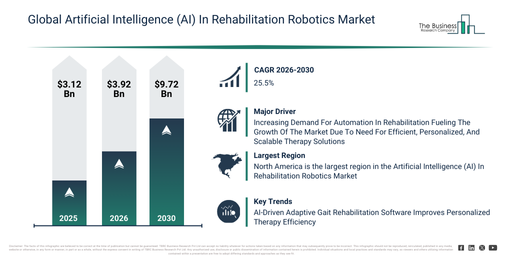
  • Artificial Intelligence (AI) In Rehabilitation Robotics Market Set To Expand From $10.85 Billion In 2026: Growth Outlook Through 2030

    Artificial Intelligence (AI) In Rehabilitation Robotics Market Set To Expand From $10.85 Billion In 2026: Growth Outlook Through 2030

    Featuring market attractiveness scoring, total addressable market sizing, company benchmarking matrices, interactive Excel dashboards, deeper supply chain intelligence, emerging startup tracking, and granular product-level insights, The Business Research Company’s 2026 market reports are built to deliver research that is both more actionable and more strategically valuable.

    Artificial Intelligence (AI) In Rehabilitation Robotics Market Forecast: Value Set To Climb From $5.23 Billion To $10.85 Billion

    The artificial intelligence (AI) in rehabilitation robotics market size has experienced substantial growth in recent years. It is projected to expand from $3.12 billion in 2025 to $3.92 billion in 2026, achieving a compound annual growth rate (CAGR) of 25.7%. The market’s historical growth can be attributed to the increasing adoption of robotic-assisted therapy, the growing prevalence of neurological disorders, a rising demand for personalized rehabilitation, expanding investments in AI-based healthcare technologies, and the increasing use of sensor-based patient monitoring.

    The artificial intelligence (AI) in rehabilitation robotics market is anticipated to undergo substantial expansion in the coming years. Its valuation is projected to reach $9.72 billion in 2030, exhibiting a compound annual growth rate (CAGR) of 25.5%. This projected surge in the forecast period stems from factors such as the increasing demand for home-based rehabilitation solutions, the expanding integration of AI with robotic hardware, a rise in investments within digital health ecosystems, the broadening clinical acceptance of data-driven therapy models, and the expanding elderly demographic requiring prolonged rehabilitation. Prominent trends throughout this period also include technological breakthroughs in AI-powered rehabilitation systems, advancements in human-robot interaction and motion analysis, progress in cloud-based and remote therapy platforms, ongoing research and development in soft robotics and adaptive control, and the growing incorporation of virtual and augmented reality in rehabilitation.

    Get A Free Sample Report With In-Depth Market Insights:

    https://thebusinessresearchcompany.com/sample_request?id=84562450&type=smp&name=Artificial%20Intelligence%20%28AI%29%20In%20Rehabilitation%20Robotics%20Market%20Report%202026&utm_source=Blogs&utm_medium=Paid&utm_campaign=Oct_PR

    Artificial Intelligence (AI) In Rehabilitation Robotics Market Expansion Drivers: What’s Shaping Future Growth?

    The projected expansion of the artificial intelligence (AI) in rehabilitation robotics market going forward is significantly influenced by the increasing demand for automation in rehabilitation. Automation in rehabilitation encompasses the utilization of robotic devices, AI-driven systems, and computer vision to precisely monitor, guide, and administer physical therapy exercises, leading to improved patient recovery and progress tracking. This rising demand for automation in rehabilitation is attributed to aging populations and a growing prevalence of chronic conditions, which heighten the necessity for consistent, high-intensity therapy. Robotic systems can deliver this more efficiently than traditional methods, offering personalized sessions with real-time feedback and remote monitoring. AI in Rehabilitation Robotics enhances automation by enabling adaptive robotic systems to analyze patient movements, adjust therapy intensity in real time, and deliver customized rehabilitation support. For instance, in October 2024, the International Federation of Robotics, a Germany-based robotics industry organization, noted that sales of medical robots surged by 36% to approximately 6,100 units in 2023, concurrently with a 128% rise in sales of rehabilitation and non-invasive therapy robots, highlighting strong growth in healthcare robotics adoption. Thus, the increasing demand for automation in rehabilitation is a key driver for the growth of the artificial intelligence (AI) in rehabilitation robotics market.

    Artificial Intelligence (AI) In Rehabilitation Robotics Market Segment Analysis And Revenue Potential

    The artificial intelligence (AI) in rehabilitation robotics market covered in this report is segmented –

    1) By Component: Hardware, Software, Services

    2) By Therapy Type: Physical Therapy, Occupational Therapy, Speech Therap, Other Therapy Types

    3) By Application: Neurological Rehabilitation, Orthopedic Rehabilitation, Geriatric Rehabilitation, Other Applications

    4) By End-User: Hospitals, Rehabilitation Centers, Home Care Settings, Clinics, Other End-Users

    Subsegments:

    1) By Hardware: Sensors, Actuators, Control Units, Power Systems, Embedded Processing Modules

    2) By Software: Motion Analysis Software, Rehabilitation Planning Software, Patient Monitoring Software, Artificial Intelligence Algorithms, User Interface Software

    3) By Services: Installation Services, Maintenance Services, Training Services, Technical Support Services, System Integration Services

    Artificial Intelligence (AI) In Rehabilitation Robotics Market Strategic Trends: What Defines The Next Growth Phase?

    Leading entities within the artificial intelligence (AI) in rehabilitation robotics market are concentrating on creating sophisticated systems, including intelligent gait therapy solutions, designed to analyze patient mobility and offer instantaneous feedback to facilitate personalized rehabilitation strategies and improve patient results. These intelligent gait therapy systems specifically denote software seamlessly incorporated into robotic exoskeletons, employing machine learning algorithms to decipher gait patterns, adapt support levels responsively, and furnish practical insights to medical professionals for enhancing walking therapy. An illustrative case occurred in January 2024, when Ekso Bionics Holdings Inc., a medical robotics firm based in the US, introduced its GaitCoach software, compatible with the EksoNR device. This extensive software suite is engineered to streamline the application of robotics, with the goal of fostering greater user confidence, supplying adaptive feedback, and delivering precise guidance, effectively serving as an additional pair of clinical observations.

    Artificial Intelligence (AI) In Rehabilitation Robotics Market Competitive Landscape: Who Leads The Industry?

    Major companies operating in the artificial intelligence (AI) in rehabilitation robotics market are Ottobock SE & Co. KGaA, Fourier Intelligence Co. Ltd., Neura Robotics GmbH, Kinova Inc., Myomo Inc., Wandercraft SAS, Cyberdyne Inc., EGZOTech Sp. z o.o., Hocoma AG , Ekso Bionics Holdings Inc., Tyromotion GmbH, Lifeward Ltd., ReWalk Robotics Ltd., AlterG Inc., DIH Medical Group, Rehab-Robotics Co. Ltd., Able Human Motion SL, B-Temia Inc., Reha Technology AG, Moterum Technologies Inc., INROBICS

    View The Full Artificial Intelligence (AI) In Rehabilitation Robotics Market Report:

    https://thebusinessresearchcompany.com/report/artificial-intelligence-ai-in-rehabilitation-robotics-market-report?utm_source=Blogs&utm_medium=Paid&utm_campaign=Oct_PR

    Artificial Intelligence (AI) In Rehabilitation Robotics Market Geographic Landscape: Which Region Dominates Industry Growth?

    North America was the largest region in the artificial intelligence (AI) in rehabilitation robotics market in 2025. Asia-Pacific is expected to be the fastest-growing region in the forecast period. The regions covered in the artificial intelligence (AI) in rehabilitation robotics market report are Asia-Pacific, South East Asia, Western Europe, Eastern Europe, North America, South America, Middle East, Africa.

    Reach Out To Our Team:

    The Business Research Company: https://www.thebusinessresearchcompany.com/

    Americas: +1 310-496-7795

    Asia: +44 7882 955267 & +91 8897263534

    Europe: +44 7882 955267

    Email us at: marketing@tbrc.info

    Follow us on:

    LinkedIn: https://in.linkedin.com/company/the-business-research-company

    YouTube: https://www.youtube.com/channel/UC24_fI0rV8cR5DxlCpgmyFQ

    Global Market Model: https://www.thebusinessresearchcompany.com/global-market-model