Category: Healthcare Services

  • 3D Printed Wearables Market Competitive Landscape: Open Bionics Ltd. And Other Key Players

    3D Printed Wearables Market Competitive Landscape: Open Bionics Ltd. And Other Key Players

    Designed to make market research more actionable and strategically valuable, The Business Research Company’s 2026 market reports feature market attractiveness scoring, total addressable market sizing, company benchmarking matrices, interactive Excel dashboards, deeper supply chain intelligence, emerging startup tracking, and granular product-level insights.

    What Is The Projected CAGR Of The 3D Printed Wearables Market Through 2030?

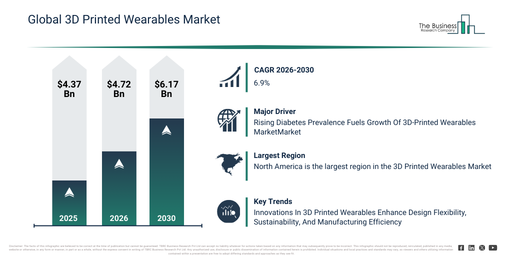
    The 3D printed wearables market size has experienced strong growth in recent years. It is forecast to increase from $4.37 billion in 2025 to $4.72 billion in 2026, achieving a compound annual growth rate (CAGR) of 8.0%. This historical growth can be ascribed to the early adoption of additive manufacturing technologies, increasing consumer interest in wearable devices, the growth of fitness and health monitoring trends, the expansion of prosthetics and orthopedic solutions, and improvements in 3D printing materials.

    The 3D printed wearables market is projected to experience substantial expansion in the coming years. This market is anticipated to reach a valuation of $6.17 billion by 2030, exhibiting a compound annual growth rate (CAGR) of 6.9%. This projected growth is fueled by progress in multi-material 3D printing, the increasing incorporation of sensors and electronics, a surge in demand for patient-specific medical devices, the proliferation of digital customization platforms, and the broadening of smart healthcare ecosystems. Key trends expected during this period involve an increasing appetite for customized and personalized wearables, a growing preference for lightweight and ergonomic designs, the expanding application of 3D printing for rapid prototyping, an enlargement of medical and healthcare wearable uses, and enhanced aesthetic appeal alongside greater design versatility in wearables.

    Claim Your Free 3D Printed Wearables Market Sample Report With Key Data And Trends:

    https://thebusinessresearchcompany.com/sample_request?id=86447898&type=smp&name=3D%20Printed%20Wearables%20Market%20Report%202026&utm_source=Blogs&utm_medium=Paid&utm_campaign=Nov_PR

    3D Printed Wearables Market Demand Analysis: The Driving Force Behind Expansion

    The escalating occurrence of diabetes is anticipated to fuel the expansion of the 3D-printed wearables market moving forward. Diabetes is a chronic medical ailment marked by persistently high blood glucose levels, typically resulting from insufficient insulin production or ineffective insulin utilization. The increase in diabetes cases primarily stems from rising obesity, which interferes with insulin function and elevates blood sugar, thereby increasing the risk of the condition. In diabetes management, 3D-printed wearables are custom-engineered devices that employ 3D printing technology to monitor and regulate blood glucose levels, administer insulin, and provide real-time health data to diabetic individuals. For example, in April 2025, the International Diabetes Federation (IDF), a Belgium-based non-profit organization, reported that globally, approximately 589 million adults aged 20–79 were living with diabetes, constituting 11.1% of the world’s population in this age group. This figure is projected to rise to 853 million (13%) by 2050. Additionally, an estimated 252 million adults with diabetes are believed to be unaware of their condition. Thus, the growing prevalence of diabetes is propelling the growth of the 3D-printed wearables market.

    Breaking Down The 3D Printed Wearables Market By Segment

    The 3D printed wearables market covered in this report is segmented –

    1) By Product Type: Prosthetics, Orthotics and Braces, Smart Wearable Housings and Structures, Fitness and Health Monitoring Wearables, Other Product Types

    2) By Technology: Polymer-Based 3D Printing, Metal-Based 3D Printing, Multi-Material 3D Printing, Flexible and Elastomeric 3D Printing, Other Technologies

    3) By Sales Channel: Online Retail Platforms, Offline Retail and Specialty Stores, Direct-to-Customer (DTC) Sales, Healthcare Provider Channels, Customization and Digital Design Platforms

    4) By End User: Individual Consumers, Hospitals and Clinics, Rehabilitation Centers and Prosthetic Clinics, Academic and Research Institutes, Other End Users

    Subsegments:

    1) By Prosthetics: Upper Limb Prosthetics, Lower Limb Prosthetics, Customized and Personalized Prosthetics, Lightweight and Modular Prosthetics

    2) By Orthotics and Braces: Foot Orthotics and Insoles, Knee Ankle and Limb Braces, Spinal and Posture Support Devices, Customized Orthotic Wearables

    3) By Smart Wearable Housings and Structures: Smartwatch Casings and Bands, Medical-Grade Wearable Enclosures, Modular and Customizable Wearable Frames

    4) By Fitness and Health Monitoring Wearables: Fitness Bands and Activity Trackers, Health Monitoring Wearables, Customized Fitness Wearables

    5) By Other Product Types: Fashion and Lifestyle Wearables, Protective and Ergonomic Wearables, Customized Sports Wearables

    Top Trend Influencing The 3D Printed Wearables Market Outlook

    Leading firms within the 3D printed wearables market are concentrating on creating sophisticated solutions, like additive manufacturing employing recycled metals, with the aim of boosting product design, lessening material waste, and increasing production scalability. This method, additive manufacturing with recycled metals, describes a 3D printing technique that utilizes premium recycled metal powders for manufacturing components of wearable devices, thereby reducing virgin material consumption while preserving structural integrity. An example of this is seen in November 2025, when Apple Inc., a US-based technology firm, unveiled 3D-printed titanium enclosures for its Apple Watch Ultra 3 and Apple Watch Series 11, signifying the corporation’s initial extensive application of additive manufacturing for millions of wearable device casings. This novel procedure incorporates aerospace-grade recycled titanium powder, which cuts down material consumption by 50% in contrast to conventional subtractive machining. Such an innovation not only improves durability and offers greater design flexibility but also contributes to Apple’s sustainability objectives by conserving over 400 metric tons of raw titanium in 2025 alone.

    3D Printed Wearables Market Competitive Landscape And Major Players

    Major companies operating in the 3D printed wearables market are Open Bionics Ltd., UNYQ Design Inc., Ottobock SE & Co. KGaA, Össur hf., LIM Innovations Pty Ltd., WillowWood Global LLC, Myomo Inc., Ekso Bionics Holdings Inc., ReWalk Robotics Ltd., Materialise NV, 3D Systems Corporation, Stratasys Ltd., EOS GmbH Electro Optical Systems, Carbon Inc., Desktop Metal Inc., Markforged Inc., Formlabs Inc., Cyfuse Biomedical K.K., Align Technology Inc., Limb-Art LLC, Alleles Design Studio Ltd., Aqua-Leg Inc.

    Read The Full 3D Printed Wearables Market Report By The Business Research Company:

    https://thebusinessresearchcompany.com/report/3d-printed-wearables-global-market-report?utm_source=Blogs&utm_medium=Paid&utm_campaign=Nov_PR

    Where Is The 3D Printed Wearables Market Largest? Key Regional Insights

    North America was the largest region in the 3D printed wearables market in 2025. Asia-Pacific is expected to be the fastest-growing region in the forecast period. The regions covered in the 3D printed wearables market report are Asia-Pacific, South East Asia, Western Europe, Eastern Europe, North America, South America, Middle East, Africa.

    Reach Out To Our Team:

    The Business Research Company: https://www.thebusinessresearchcompany.com/

    Americas: +1 310-496-7795

    Asia: +44 7882 955267 & +91 8897263534

    Europe: +44 7882 955267

    Email us at: marketing@tbrc.info

    Follow us on:

    LinkedIn: https://in.linkedin.com/company/the-business-research-company

    YouTube: https://www.youtube.com/channel/UC24_fI0rV8cR5DxlCpgmyFQ

    Global Market Model: https://www.thebusinessresearchcompany.com/global-market-model
  • Artificial Intelligence (AI)-Generated Surgical Prep Checklist Market Trends 2026: Spotlight On Integration Of Artificial Intelligence(AI) Operational Assistants To Improve Surgical Workflow Efficiency

    Artificial Intelligence (AI)-Generated Surgical Prep Checklist Market Trends 2026: Spotlight On Integration Of Artificial Intelligence(AI) Operational Assistants To Improve Surgical Workflow Efficiency

    With a focus on actionable insights and strategic value, The Business Research Company’s 2026 market reports include market attractiveness scoring, total addressable market sizing, company benchmarking matrices, interactive Excel dashboards, deeper supply chain intelligence, emerging startup tracking, and granular product-level insights.

    Artificial Intelligence (AI)-Generated Surgical Prep Checklist Market Size Analysis: Historical Growth And Future Revenue Projections

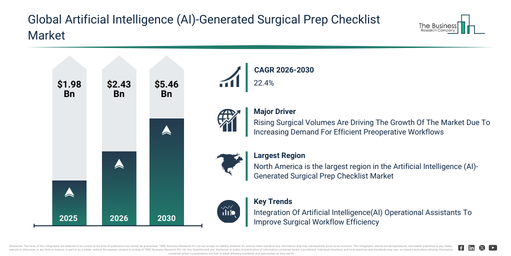
    The artificial intelligence (AI)-generated surgical prep checklist market size has seen significant expansion in recent years. It is anticipated to increase from $1.98 billion in 2025 to $2.43 billion in 2026, exhibiting a compound annual growth rate (CAGR) of 22.7%. The expansion observed in the past can be attributed to an increased focus on surgical safety protocols, the rising adoption of digital hospital systems, growing surgical procedure volumes, the broader implementation of clinical workflow automation, and a heightened emphasis on compliance documentation.

    The artificial intelligence (AI)-generated surgical prep checklist market is anticipated to experience significant growth in the upcoming years. It is projected to achieve a size of $5.46 billion by 2030, demonstrating a compound annual growth rate (CAGR) of 22.4%. This expansion during the forecast period can be attributed to advancements in AI-driven clinical decision support systems, increasing investments in smart operating room technologies, a growing demand for workflow optimization tools, the proliferation of cloud-based surgical platforms, and the increasing integration of predictive analytics in surgical practices. Major developments expected over this period include a greater adoption of AI-optimized preoperative checklists, enhanced integration with existing surgical workflow systems, a rise in the use of predictive risk identification tools, the expansion of real-time surgical readiness monitoring capabilities, and an intensified focus on solutions designed to minimize errors.

    Preview The Artificial Intelligence (AI)-Generated Surgical Prep Checklist Market Report With A Free Sample:

    https://thebusinessresearchcompany.com/sample_request?id=33324657&type=smp&name=Artificial%20Intelligence%20%28AI%29-Generated%20Surgical%20Prep%20Checklist%20Market%20Report%202026&utm_source=Blogs&utm_medium=Paid&utm_campaign=Nov_PR

    Artificial Intelligence (AI)-Generated Surgical Prep Checklist Market Drivers: What Is Fueling Demand Through 2030?

    The increasing number of surgical procedures is projected to boost the growth of the artificial intelligence (AI)-generated surgical prep checklist market in the coming years. Surgical volumes refer to the total count of operations performed annually across healthcare facilities. This rise in surgical volumes is primarily fueled by an aging population, as older individuals often require more surgical interventions for age-related ailments such as joint replacements, cardiovascular procedures, and cancer treatments. Artificial intelligence (AI)-generated surgical prep checklists assist in managing surgical volumes by streamlining preoperative workflows and minimizing delays, allowing for quicker and more accurate preparation while enabling hospitals to execute more procedures efficiently. Therefore, the growing surgical volumes are a key factor driving the expansion of the artificial intelligence (AI)-generated surgical prep checklist market.

    Artificial Intelligence (AI)-Generated Surgical Prep Checklist Market Segmentation Analysis: Core Categories And Subcategories

    The artificial intelligence (AI)-generated surgical prep checklist market covered in this report is segmented –

    1) By Component: Software, Services

    2) By Deployment Mode: Cloud-Based, On-Premises

    3) By Application: Hospitals, Ambulatory Surgical Centers, Specialty Clinics, Other Applications

    4) By End-User: Healthcare Providers, Surgeons, Nurses, Other End-Users

    Subsegments:

    1) By Software: Checklist Management Platforms, Data Analytics Modules, Integration Interfaces, User Dashboard Systems, Compliance Tracking Tools, Workflow Optimization Solutions

    2) By Services: Implementation Services, Training And Support Services, Consultation Services, Maintenance Services, System Upgradation Services, Workflow Customization Services

    Which Trends Will Define The Artificial Intelligence (AI)-Generated Surgical Prep Checklist Market Through 2030?

    Leading firms in the artificial intelligence (AI)-generated surgical prep checklist market are concentrating on creating sophisticated offerings, including AI operational assistants, to improve workflow automation, overall efficiency, and the oversight of surgical readiness. These AI operational assistants function as smart digital tools, utilizing natural language processing (NLP), machine learning (ML), and predictive analytics to independently execute administrative and coordination duties. This facilitates functionalities like real-time data retrieval, identification of patient risks, and streamlined workflow management. As an example, in January 2025, Qventus, a US-based company offering AI-driven care automation software for healthcare systems, introduced its Perioperative Care Coordination (PCC) solution. This AI-enabled solution seeks to lessen the administrative workload for clinical staff, especially pre-admission testing nurses, by offering AI assistants that handle patient records, arrange calls, and pinpoint potential risks. The PCC solution achieves a reduction in avoidable surgery cancellations by up to 40%, boosts the productivity of care teams by 50%, and refines patient preparation and follow-up processes both pre- and post-surgery. Developed in collaboration with prominent healthcare systems, it facilitates improved surgical outcomes and delivers substantial cost efficiencies for hospitals.

    Artificial Intelligence (AI)-Generated Surgical Prep Checklist Market Major Companies And Industry Participants

    Major companies operating in the artificial intelligence (AI)-generated surgical prep checklist market are Medtronic plc, Olympus Corporation, Fortive Corporation, Epic Systems Corporation, Health Catalyst Inc., LeanTaaS Holdings Inc., Connecteam, One Mnet Health, Qventus Inc., Caresyntax Inc., Surgical Safety Technologies Inc., PeekMed S.A., Buddy Healthcare Ltd., Asensus Surgical Inc., DocSpera Inc., Force Therapeutics Inc., SeamlessMD Inc., Calcium Inc., Preop.ai Inc., Hoopcare Technologies Pvt. Ltd.

    Buy The Full Artificial Intelligence (AI)-Generated Surgical Prep Checklist Global Market Report 2026:

    https://thebusinessresearchcompany.com/report/artificial-intelligence-ai-generated-surgical-prep-checklist-global-market-report?utm_source=Blogs&utm_medium=Paid&utm_campaign=Nov_PR

    Artificial Intelligence (AI)-Generated Surgical Prep Checklist Market Geographic Analysis: Which Region Accounts For The Biggest Share?

    North America was the largest region in the artificial intelligence (AI)-generated surgical prep checklist market in 2025. Asia-Pacific is expected to be the fastest-growing region in the forecast period. The regions covered in the artificial intelligence (AI)-generated surgical prep checklist market report are Asia-Pacific, South East Asia, Western Europe, Eastern Europe, North America, South America, Middle East, Africa.

    Reach Out To Our Team:

    The Business Research Company: https://www.thebusinessresearchcompany.com/

    Americas: +1 310-496-7795

    Asia: +44 7882 955267 & +91 8897263534

    Europe: +44 7882 955267

    Email us at: marketing@tbrc.info

    Follow us on:

    LinkedIn: https://in.linkedin.com/company/the-business-research-company

    YouTube: https://www.youtube.com/channel/UC24_fI0rV8cR5DxlCpgmyFQ

    Global Market Model: https://www.thebusinessresearchcompany.com/global-market-model
  • Artificial Intelligence (AI)-Generated Personalized Medical Reminder Market Growth Driven By Increasing Burden Of Non-communicable Diseases: Outlook To 2030

    Artificial Intelligence (AI)-Generated Personalized Medical Reminder Market Growth Driven By Increasing Burden Of Non-communicable Diseases: Outlook To 2030

    The Business Research Company’s 2026 market reports combine market attractiveness scoring, total addressable market sizing, company benchmarking matrices, interactive Excel dashboards, deeper supply chain intelligence, emerging startup tracking, and granular product-level insights to deliver research that is more actionable and strategically valuable.

    What Is The Artificial Intelligence (AI)-Generated Personalized Medical Reminder Market Growth Rate? A 21.9% CAGR Outlook Through 2030

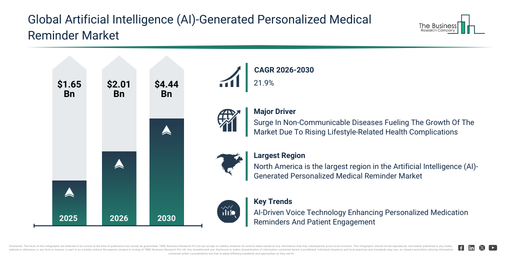
    The market size for artificial intelligence (AI)-generated personalized medical reminders has shown exponential growth in recent years. It is projected to increase from $1.65 billion in 2025 to $2.01 billion in 2026, at a compound annual growth rate (CAGR) of 22.2%. This historical expansion can be attributed to factors such as the rising prevalence of chronic diseases, increasing smartphone penetration in healthcare, growing acceptance of digital health solutions, expansion of remote patient monitoring programs, and an increased focus on medication adherence.

    The artificial intelligence (AI)-generated personalized medical reminder market is expected to experience significant growth in the upcoming years, with projections indicating it will reach $4.44 billion by 2030, demonstrating a compound annual growth rate (CAGR) of 21.9%. This expansion throughout the forecast period is fueled by improvements in the accuracy of AI health algorithms, an increasing demand for customized healthcare solutions, the proliferation of cloud-based health platforms, greater integration with electronic health records, and the expanding adoption of preventive healthcare technologies. Prominent trends for this period encompass the growing uptake of AI-driven medication adherence platforms, enhanced integration of wearables and smart devices, increased utilization of predictive analytics for optimizing reminders, the broadening of personalized health notification systems, and a stronger focus on patient engagement tools.

    Access A Free Sample Of The Latest Artificial Intelligence (AI)-Generated Personalized Medical Reminder Market Analysis:

    https://thebusinessresearchcompany.com/sample_request?id=54849296&type=smp&name=Artificial%20Intelligence%20%28AI%29-Generated%20Personalized%20Medical%20Reminder%20Market%20Report%202026&utm_source=Blogs&utm_medium=Paid&utm_campaign=Nov_PR

    Why Is The Artificial Intelligence (AI)-Generated Personalized Medical Reminder Market Growing? The Key Demand Driver Explained

    The increasing prevalence of non-communicable diseases is projected to stimulate the growth of the artificial intelligence (AI)-generated personalized medical reminder market moving forward. Non-communicable diseases (NCDs) are defined as long-term health conditions that are not caused by infections and cannot be transmitted between individuals. The rise in non-communicable diseases is linked to sedentary lifestyles, as reduced physical activity over time diminishes the body’s ability to regulate weight, blood pressure, and metabolism, leading to persistent health complications. Artificial intelligence-generated personalized medical reminders aid in managing non-communicable diseases by offering timely alerts for medication, necessary lifestyle adjustments, and follow-up care, thereby ensuring better adherence to treatment plans and improved long-term health outcomes. Consequently, the escalating burden of non-communicable diseases is a key factor driving the expansion of the artificial intelligence (AI)-generated personalized medical reminder market.

    What Are The Main Segments Of The Artificial Intelligence (AI)-Generated Personalized Medical Reminder Market?

    The artificial intelligence (AI)-generated personalized medical reminder market covered in this report is segmented –

    1) By Component: Software, Hardware, Services

    2) By Deployment Mode: Cloud-Based, On-Premises

    3) By Application: Medication Adherence, Chronic Disease Management, Elderly Care, Remote Patient Monitoring, Other Applications

    4) By End-User: Hospitals And Clinics, Homecare, Pharmacies, Individuals, Other End-Users

    Subsegments:

    1) By Software: Mobile Applications, Web-Based Platforms, Cloud-Based Solutions, Integrated Healthcare Systems, Artificial Intelligence Algorithms

    2) By Hardware: Smart Wearable Devices, Smart Speakers, Voice Assistants, Smartwatches, Medication Dispensers

    3) By Services: Installation And Integration Services, Maintenance And Support Services, Training And Consultation Services, Data Analytics And Monitoring Services, Personalization And Customization Services

    Artificial Intelligence (AI)-Generated Personalized Medical Reminder Market Trend Analysis: Where Leading Companies Are Focusing

    Leading companies operating in the artificial intelligence (AI)-generated personalized medical reminder market are concentrating on developing voice technology, such as AI-driven voice assistants, to provide timely medication reminders and improve patient involvement. These AI-powered voice assistants utilize artificial intelligence to recognize, interpret, and respond to spoken commands, offering real-time guidance, alerts, and interactive support for hands-free tasks and health management. For example, in April 2025, Medisafe International, a US-based medical device company, introduced Voice Intelligent Agent (VIA), an advanced artificial intelligence-powered voice assistant. This technology is engineered to tackle the pharmaceutical industry’s $5 billion patient support gap by optimizing patient engagement. It empowers specialty brands to more effectively activate, engage, and retain patients through personalized, intelligent interactions. This innovation marks a substantial advancement in boosting patient adherence and support throughout their treatment journeys.

    Which Companies Are Major Players In The Artificial Intelligence (AI)-Generated Personalized Medical Reminder Market?

    Major companies operating in the artificial intelligence (AI)-generated personalized medical reminder market are Google LLC, Microsoft Corporation, Oracle Corporation, Philips Healthcare, Otsuka Holdings Co. Ltd., Garmin Ltd., Teladoc Health Inc., Veradigm LLC, Tempus AI Inc., Merative LLC, MedMinder Systems Inc., MedAdvisor Ltd., Artera Services LLC, Medisafe Inc., AdhereTech Inc., CarePredict Inc., AiCure Inc., WatchMinder Company, Pivotell Ltd., CareClinic.

    Get The Complete Artificial Intelligence (AI)-Generated Personalized Medical Reminder Market Analysis Here:

    https://thebusinessresearchcompany.com/report/artificial-intelligence-ai-generated-personalized-medical-reminder-global-market-report?utm_source=Blogs&utm_medium=Paid&utm_campaign=Nov_PR

    Which Region Held The Largest Share Of The Artificial Intelligence (AI)-Generated Personalized Medical Reminder Market In 2025?

    North America was the largest region in the artificial intelligence (AI)-generated personalized medical reminder market in 2025. Asia-Pacific is expected to be the fastest-growing region in the forecast period. The regions covered in the artificial intelligence (AI)-generated personalized medical reminder market report are Asia-Pacific, South East Asia, Western Europe, Eastern Europe, North America, South America, Middle East, Africa.

    Reach Out To Our Team:

    The Business Research Company: https://www.thebusinessresearchcompany.com/

    Americas: +1 310-496-7795

    Asia: +44 7882 955267 & +91 8897263534

    Europe: +44 7882 955267

    Email us at: marketing@tbrc.info

    Follow us on:

    LinkedIn: https://in.linkedin.com/company/the-business-research-company

    YouTube: https://www.youtube.com/channel/UC24_fI0rV8cR5DxlCpgmyFQ

    Global Market Model: https://www.thebusinessresearchcompany.com/global-market-model
  • North America Leads The 3D Printed Crownplace Market: Regional Analysis And 2030 Forecast

    North America Leads The 3D Printed Crownplace Market: Regional Analysis And 2030 Forecast

    The Business Research Company’s 2026 market reports are designed to deliver research that is more actionable and strategically valuable. Key offerings include market attractiveness scoring, total addressable market sizing, company benchmarking matrices, interactive Excel dashboards, deeper supply chain intelligence, emerging startup tracking, and granular product-level insights.

    3D Printed Crownplace Market Revenue Projected To Rise To $3.23 Billion By 2030

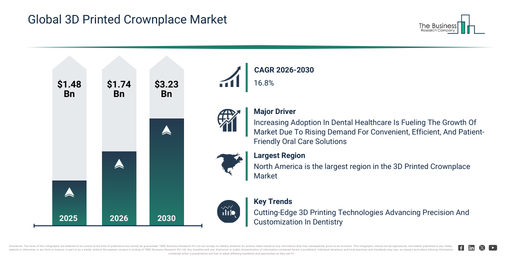
    The 3D printed crownplace market size has experienced significant expansion recently. It is projected to increase from $1.48 billion in 2025 to $1.74 billion in 2026, demonstrating a compound annual growth rate (CAGR) of 17.1%. Historically, this expansion was driven by factors such as the adoption of CAD/CAM dentistry systems, a growing demand for aesthetic dental restorations, the expansion of dental laboratory digitization, the availability of early dental 3D printers, and an increasing patient preference for faster treatments.

    The 3D printed crownplace market is projected to experience significant expansion in the coming years. This market is anticipated to reach a valuation of $3.23 billion by 2030, exhibiting a compound annual growth rate (CAGR) of 16.8%. Key factors driving this growth during the forecast period include the expanding use of completely digital dentistry approaches, increased funding for sophisticated dental materials, the proliferation of in-clinic additive manufacturing, a rising need for customized dental prosthetics, and a greater emphasis on economical dental restoration techniques. Notable trends expected over the forecast horizon involve the wider embrace of chairside 3D printing technologies, an uptick in the utilization of biocompatible printing substances, deeper integration of digital workflows in dentistry, the broadening availability of same-day dental restoration offerings, and a sharpened focus on accuracy and bespoke solutions.

    Want Deeper 3D Printed Crownplace Market Insights? Get A Free Sample Report:

    https://thebusinessresearchcompany.com/sample_request?id=73591776&type=smp&name=3D%20Printed%20Crownplace%20Market%20Report%202026&utm_source=Blogs&utm_medium=Paid&utm_campaign=Nov_PR

    Primary Growth Driver Shaping The 3D Printed Crownplace Market Outlook

    The expanding integration within dental healthcare is anticipated to drive the future expansion of the 3D printed crownplace market. Dental healthcare involves practices focused on preserving and enhancing oral well-being through prevention, diagnosis, and treatment of teeth, gums, and associated structures. This rising uptake in dental healthcare stems from patients’ demand for convenient, accessible, and effective oral care options that shorten treatment durations, improve comfort, and lead to superior overall oral health results. The 3D printed crownplace technology is elevating dental healthcare by delivering accurate, personalized crowns, which reduces procedural time, boosts patient comfort, and simplifies restorative procedures. Consequently, the expanding use in dental healthcare is propelling the growth of the 3D printed crownplace market.

    3D Printed Crownplace Market Structure: A Detailed Look At Segments And Subsegments

    The 3D printed crownplace market covered in this report is segmented –

    1) By Product Type: Metal 3D Printed Crownplace, Ceramic 3D Printed Crownplace, Resin 3D Printed Crownplace

    2) By Technology: Stereolithography, Selective Laser Sintering, Fused Deposition Modeling, Other Technologies

    3) By Application: Dental Clinics, Hospitals, Dental Laboratories, Other Applications

    4) By End-User: Adults, Pediatrics, Geriatrics

    Subsegments:

    1) By Metal 3D Printed Crownplace: Titanium, Cobalt-Chromium, Stainless Steel, Gold

    2) By Ceramic 3D Printed Crownplace: Zirconia, Alumina, Lithium Disilicate, Porcelain

    3) By Resin 3D Printed Crownplace: Photopolymer Resin, Biocompatible Resin, Composite Resin, Flexible Resin

    3D Printed Crownplace Market Innovation And Strategy Trends Among Leading Companies

    Leading firms within the 3D printed crownplace market are concentrating on creating sophisticated methods, including multi-material printing, to fabricate intricate, personalized restorations offering improved precision, efficiency, and visual appeal. This 3D printing technique, multi-material printing, facilitates the concurrent creation of items utilizing a minimum of two distinct materials, thereby enabling elaborate, practical, and bespoke designs to be produced in one print run. Consequently, the DentaJet XL improves precision, productivity, and safety for high-volume dental fabrication.

    Top Companies Competing In The 3D Printed Crownplace Market

    Major companies operating in the 3D printed crownplace market are 3M Company, Dentsply Sirona Inc., Align Technology Incorporated, DMG Dental-Material Gesellschaft mbH, Straumann Group AG, Planmeca Oy, Ivoclar Vivadent AG, Renishaw pPlc, Stratasys Ltd., 3D Systems Corporation, Formlabs Inc., Prodways Group S.A., GC Corporation, SprintRay Inc., BEGO GmbH & Co. KG, Shining 3D Tech Co. Ltd., ZORTRAX Sp. z o.o., Asiga Pty Ltd., 3DRESYNS S.r.l, Sinterex Co. Ltd., Micron Dental Services LLC.

    View The Complete 3D Printed Crownplace Market Study With Segment And Regional Data:

    https://thebusinessresearchcompany.com/report/3d-printed-crownplace-global-market-report?utm_source=Blogs&utm_medium=Paid&utm_campaign=Nov_PR

    3D Printed Crownplace Market Regional Outlook Across Major Geographies

    North America was the largest region in the 3D printed crownplace market in 2025. Asia-Pacific is expected to be the fastest-growing region in the forecast period. The regions covered in the 3D printed crownplace market report are Asia-Pacific, South East Asia, Western Europe, Eastern Europe, North America, South America, Middle East, Africa.

    Reach Out To Our Team:

    The Business Research Company: https://www.thebusinessresearchcompany.com/

    Americas: +1 310-496-7795

    Asia: +44 7882 955267 & +91 8897263534

    Europe: +44 7882 955267

    Email us at: marketing@tbrc.info

    Follow us on:

    LinkedIn: https://in.linkedin.com/company/the-business-research-company

    YouTube: https://www.youtube.com/channel/UC24_fI0rV8cR5DxlCpgmyFQ

    Global Market Model: https://www.thebusinessresearchcompany.com/global-market-model
  • Artificial Intelligence (AI)-Generated Personalized Bipolar Management Plan Market To Grow At A 26.6% CAGR Through 2030: Drivers, Trends And Forecast

    Artificial Intelligence (AI)-Generated Personalized Bipolar Management Plan Market To Grow At A 26.6% CAGR Through 2030: Drivers, Trends And Forecast

    Market attractiveness scoring, total addressable market sizing, company benchmarking matrices, interactive Excel dashboards, deeper supply chain intelligence, emerging startup tracking, and granular product-level insights are among the key offerings featured in The Business Research Company’s 2026 market reports, designed to deliver more actionable and strategically valuable research.

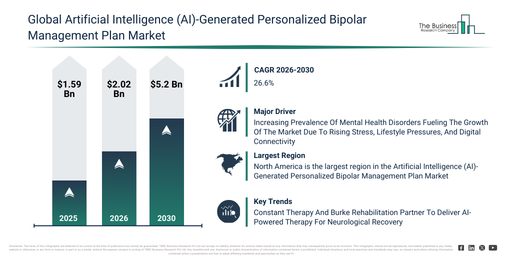
    Artificial Intelligence (AI)-Generated Personalized Bipolar Management Plan Market Valued At $2.02 Billion In 2026, Projected To Reach $5.2 Billion By 2030

    The artificial intelligence (AI)-generated personalized bipolar management plan market has seen significant expansion in recent years. It is projected to grow from $1.59 billion in 2025 to $2.02 billion in 2026, at a compound annual growth rate (CAGR) of 26.9%. This historical growth can be attributed to factors such as increasing diagnosis rates of bipolar disorder, the rising adoption of digital mental health tools, the expansion of telepsychiatry services, greater availability of patient health data, and continuous improvements in machine learning analytics.

    The market for artificial intelligence (AI)-generated personalized bipolar management plans is projected to experience rapid expansion over the coming years. By 2030, this market is anticipated to reach a valuation of $5.2 billion, demonstrating a compound annual growth rate (CAGR) of 26.6%. This projected growth can be attributed to several factors, including the increasing demand for tailored mental healthcare solutions, heightened investments in AI-driven clinical decision support systems, the broadening scope of remote mental health monitoring, an intensified emphasis on preventive psychiatry, and continuous advancements in predictive healthcare analytics. Key trends expected during this period involve the increasing adoption of AI-powered mood pattern analysis, the expanded utilization of predictive models for relapse detection, a greater integration with electronic health records, the proliferation of personalized therapy adjustment tools, and a strengthened focus on achieving long-term mental health stability.

    Request A Complimentary Artificial Intelligence (AI)-Generated Personalized Bipolar Management Plan Market Research Sample:

    https://thebusinessresearchcompany.com/sample_request?id=54113927&type=smp&name=Artificial%20Intelligence%20%28AI%29-Generated%20Personalized%20Bipolar%20Management%20Plan%20Market%20Report%202026&utm_source=Blogs&utm_medium=Paid&utm_campaign=Nov_PR

    Key Factor Propelling The Artificial Intelligence (AI)-Generated Personalized Bipolar Management Plan Market Forward

    The growing occurrence of mental health disorders is anticipated to stimulate the expansion of the artificial intelligence (AI)-generated personalized bipolar management plan market in the coming years. Mental health disorders are conditions that profoundly impact a person’s emotions, thought processes, behavior, and overall psychological health. These conditions are on the rise due to elevated stress stemming from modern lifestyles, including work pressures, social isolation, and constant digital interaction. Artificial intelligence (AI)-generated personalized bipolar management plans provide assistance with mental health disorders by offering customized treatment approaches, making them ideal for individualized patient care. They reduce clinical uncertainty through continuous monitoring and predictive insights, thereby enhancing treatment effectiveness and overall patient well-being. Thus, the increasing prevalence of mental health disorders is propelling the growth of the artificial intelligence (AI)-generated personalized bipolar management plan market.

    Artificial Intelligence (AI)-Generated Personalized Bipolar Management Plan Market Segments And Subsegments Explained

    The artificial intelligence (AI)-generated personalized bipolar management plan market covered in this report is segmented –

    1) By Component: Software, Services

    2) By Deployment Mode: Cloud-Based, On-Premises

    3) By Application: Clinical Management, Remote Monitoring, Patient Engagement, Decision Support, Other Applications

    4) By End-User: Hospitals And Clinics, Mental Health Centers, Homecare Settings, Other End Users

    Subsegments:

    1) By Software: Clinical Decision Support Systems (CDSS), Mobile And Web Applications, Artificial Intelligence (AI) Algorithms And Predictive Analytics Tools, Electronic Health Record (EHR) Integration Modules, Remote Monitoring Platforms

    2) By Services: Implementation And Integration Services, Training And Education Services, Consulting Services, Maintenance And Support Services, Data Management And Security Services

    Emerging Trends Transforming The Artificial Intelligence (AI)-Generated Personalized Bipolar Management Plan Market

    Leading companies active within the artificial intelligence (AI)-generated personalized bipolar management plan market are concentrating on creating sophisticated solutions, including AI-driven mental health platforms, with the goal of providing personalized treatment, tracking mood, forecasting relapses, and fostering optimized care. These artificial intelligence (AI)-driven mental health platforms serve as digital instruments employing AI to oversee mental health, tailor treatment plans, anticipate relapses, and assist in clinical decision-making.

    Artificial Intelligence (AI)-Generated Personalized Bipolar Management Plan Market Key Players: Major Companies In The 2026 Report

    Major companies operating in the artificial intelligence (AI)-generated personalized bipolar management plan market are JD Health International Inc., Cerebral Inc., Merative US L.P., Headspace Inc., Talkspace Inc., Quartet Health Inc., NUE Life Health P.A., Woebot Health Inc., Koa Health B.V., Mindstrong Health Inc., Altimate Health Inc., SilverCloud Health Limited, Pear Therapeutics Inc., Wysa Ltd., Youper Inc., Happify Health Inc., Ellipsis Health Inc., Flow Neuroscience AB, Earkick AG, Juli Health Inc.

    Explore The Full Artificial Intelligence (AI)-Generated Personalized Bipolar Management Plan Market Report With Forecasts To 2030:

    https://thebusinessresearchcompany.com/report/artificial-intelligence-ai-generated-personalized-bipolar-management-plan-global-market-report?utm_source=Blogs&utm_medium=Paid&utm_campaign=Nov_PR

    Artificial Intelligence (AI)-Generated Personalized Bipolar Management Plan Market By Region: Where Is Demand Strongest?

    North America was the largest region in the artificial intelligence (AI)-generated personalized bipolar management plan market in 2025. Asia-Pacific is expected to be the fastest-growing region in the forecast period. The regions covered in the artificial intelligence (AI)-generated personalized bipolar management plan market report are Asia-Pacific, South East Asia, Western Europe, Eastern Europe, North America, South America, Middle East, Africa.

    Reach Out To Our Team:

    The Business Research Company: https://www.thebusinessresearchcompany.com/

    Americas: +1 310-496-7795

    Asia: +44 7882 955267 & +91 8897263534

    Europe: +44 7882 955267

    Email us at: marketing@tbrc.info

    Follow us on:

    LinkedIn: https://in.linkedin.com/company/the-business-research-company

    YouTube: https://www.youtube.com/channel/UC24_fI0rV8cR5DxlCpgmyFQ

    Global Market Model: https://www.thebusinessresearchcompany.com/global-market-model
  • 3D Imaging Market Trends 2026: Spotlight On Product Innovation Drives Growth

    3D Imaging Market Trends 2026: Spotlight On Product Innovation Drives Growth

    With a focus on actionable insights and strategic value, The Business Research Company’s 2026 market reports include market attractiveness scoring, total addressable market sizing, company benchmarking matrices, interactive Excel dashboards, deeper supply chain intelligence, emerging startup tracking, and granular product-level insights.

    3D Imaging Market Size Analysis: Historical Growth And Future Revenue Projections

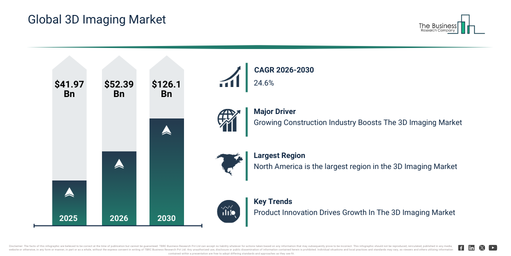
    The 3D imaging market has witnessed exponential growth recently. It is projected to expand from $41.97 billion in 2025 to $52.39 billion in 2026, demonstrating a compound annual growth rate (CAGR) of 24.8%. Historically, this growth has been driven by factors such as the increasing adoption of digital imaging technologies, a greater reliance on imaging for manufacturing inspection, the rising need for visualization tools in media and entertainment, the expansion of industrial automation, and the availability of sophisticated imaging hardware.

    The 3D imaging market is projected to experience substantial expansion over the coming years, reaching a valuation of $126.1 billion by 2030, exhibiting a robust compound annual growth rate (CAGR) of 24.6%. This anticipated growth during the forecast period is driven by several factors, including advancements in AI-based image reconstruction, the increasing embrace of cloud-based 3D imaging solutions, escalating demand from the healthcare and life sciences industries, the proliferation of smart manufacturing initiatives, and the broadening applications within the aerospace and automotive sectors. Key developments foreseen in this period encompass the wider implementation of 3D imaging for quality control, its escalating utilization in industrial inspection processes, a heightened need for high-precision visualization instruments, the extension of 3D imaging into non-contact measurement, and greater incorporation of 3D imaging in design and prototyping phases.

    Preview The 3D Imaging Market Report With A Free Sample:

    https://thebusinessresearchcompany.com/sample_request?id=94084488&type=smp&name=3D%20Imaging%20Market%20Report%202026&utm_source=Blogs&utm_medium=Paid&utm_campaign=Nov_PR

    3D Imaging Market Drivers: What Is Fueling Demand Through 2030?

    The expanding construction industry is anticipated to propel the 3D imaging market’s growth going forward. This sector encompasses commercial manufacturing and trade activities focused on developing, maintaining, and renovating infrastructure. Increasingly, 3D imaging is employed to generate precise and intricate 3D models of structures, enabling comparison with original designs to pinpoint flaws. Consequently, the expanding construction industry serves as a key driver for the 3D imaging market’s expansion.

    3D Imaging Market Segmentation Analysis: Core Categories And Subcategories

    The 3D imaging market covered in this report is segmented –

    1) By Component: Solutions, Hardware, Services

    2) By Deployment Mode: Cloud, On-premises

    3) By Application: 3D Modeling, 3D Scanning, Layout And Animation, 3D Rendering, Image Reconstruction

    4) By Vertical: Aerospace And Defense, Automotive And Transportation, Manufacturing, Healthcare And Life Sciences, Architecture And Construction, Media And Entertainment, Retail And Consumer Goods, Other Verticals

    Subsegments:

    1) By Solutions: Software (3D Modeling), Cloud-Based Solutions, Application-Specific Solutions

    2) By Hardware: 3D Scanners, Cameras, Display Systems (3D Monitors, Projectors), Sensors

    3) By Services: Consulting Services, Integration Services, Support And Maintenance, Training And Education

    Which Trends Will Define The 3D Imaging Market Through 2030?

    Leading companies operating in the 3D imaging market are developing innovative products, such as 3D mapping tools, to attract larger customer bases, increase sales, and boost revenue. These 3D mapping tools comprise various sensors, software, and techniques utilized for creating three-dimensional representations of objects, surfaces, and environments.

    3D Imaging Market Major Companies And Industry Participants

    Major companies operating in the 3D imaging market are Able Software Corporation, Tomtec Imaging Systems GmbH, FARO Technologies Inc., Koninklijke Philips N.V., Panasonic Corporation, Konica Minolta Inc., Trimble Inc., Bentley Systems Incorporated, Siemens AG, Dassault Systèmes SE, Visage Imaging Inc., Topcon Corporation, Autodesk Inc., Adobe Inc., Ametek Inc., Matterport Inc., Artec 3D Inc., 3D Systems Corporation, Zebra Imaging, Leica Geosystems, Planmeca Group, GOM GmbH, EON Reality Inc., Fuel3D Technologies, Basis Software Inc., RealD Inc., Euclideon Pty Ltd, Lightform Inc.

    Buy The Full 3D Imaging Global Market Report 2026:

    https://thebusinessresearchcompany.com/report/3D-imaging-global-market-report?utm_source=Blogs&utm_medium=Paid&utm_campaign=Nov_PR

    3D Imaging Market Geographic Analysis: Which Region Accounts For The Biggest Share?

    North America was the largest region in the 3D imaging market in 2025. Asia-Pacific is expected to be the fastest-growing region in the 3D imaging market report forecast period. The regions covered in the 3D imaging market report are Asia-Pacific, South East Asia, Western Europe, Eastern Europe, North America, South America, Middle East, Africa.

    Reach Out To Our Team:

    The Business Research Company: https://www.thebusinessresearchcompany.com/

    Americas: +1 310-496-7795

    Asia: +44 7882 955267 & +91 8897263534

    Europe: +44 7882 955267

    Email us at: marketing@tbrc.info

    Follow us on:

    LinkedIn: https://in.linkedin.com/company/the-business-research-company

    YouTube: https://www.youtube.com/channel/UC24_fI0rV8cR5DxlCpgmyFQ

    Global Market Model: https://www.thebusinessresearchcompany.com/global-market-model
  • Artificial Intelligence (AI)-Generated Digital Health Coaching Avatar Market Size To Reach $6.54 Billion By 2030: Growth Drivers, Trends And Forecast

    Artificial Intelligence (AI)-Generated Digital Health Coaching Avatar Market Size To Reach $6.54 Billion By 2030: Growth Drivers, Trends And Forecast

    Designed to make market research more actionable and strategically valuable, The Business Research Company’s 2026 market reports feature market attractiveness scoring, total addressable market sizing, company benchmarking matrices, interactive Excel dashboards, deeper supply chain intelligence, emerging startup tracking, and granular product-level insights.

    How Big Is The Artificial Intelligence (AI)-Generated Digital Health Coaching Avatar Market In 2026, And How Fast Will It Grow?

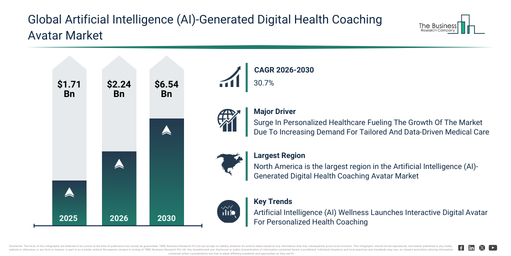
    In recent years, the market size for artificial intelligence (AI)-generated digital health coaching avatars has experienced exponential growth. This market is projected to expand from $1.71 billion in 2025 to $2.24 billion in 2026, demonstrating a compound annual growth rate (CAGR) of 31.0%. Historically, this growth is linked to factors such as increasing digital health adoption rates, the expansion of mobile health platforms, growing acceptance of virtual health assistants, rising chronic disease prevalence, and improvements in natural language processing models.

    The artificial intelligence (AI)-generated digital health coaching avatar market is anticipated to undergo significant expansion in the upcoming years. This market is projected to reach $6.54 billion by 2030, demonstrating a compound annual growth rate (CAGR) of 30.7%. This expansion during the forecast period is driven by factors such as the increasing need for personalized preventive healthcare, growing investments in AI-driven digital therapeutics, the broadening of remote patient engagement solutions, a heightened focus on mental wellness support, and continuous advancements in generative AI technologies. Significant trends expected in the forecast period include the wider adoption of conversational AI health interfaces, the increasing integration of emotional intelligence into avatars, a rise in the use of personalized behavioral coaching models, the expansion of multimodal health data integration, and an enhanced emphasis on continuous patient engagement.

    Download A Free Artificial Intelligence (AI)-Generated Digital Health Coaching Avatar Market Sample Report With Size And Forecast Data:

    https://thebusinessresearchcompany.com/sample_request?id=98997216&type=smp&name=Artificial%20Intelligence%20%28AI%29-Generated%20Digital%20Health%20Coaching%20Avatar%20Market%20Report%202026&utm_source=Blogs&utm_medium=Paid&utm_campaign=Nov_PR

    Artificial Intelligence (AI)-Generated Digital Health Coaching Avatar Market Growth Driver: The Key Factor Behind Rising Demand

    The artificial intelligence (AI)-generated digital health coaching avatar market is anticipated to expand due to the rising need for personalized healthcare. Personalized healthcare refers to medical care specifically adapted to an individual’s distinct requirements, way of life, and health status. The growth in personalized healthcare stems from improvements in data-driven understanding, which enables medical professionals to grasp patients’ individual health necessities and deliver more potent and focused therapies. Artificial intelligence (AI)-generated digital health coaching avatars assist personalized healthcare by providing customized, real-time advice and help, drawing from a person’s health information, behaviors, and aspirations, thereby enhancing care effectiveness and patient centricity. Consequently, the expanding demand for personalized healthcare is a key factor boosting the artificial intelligence (AI)-generated digital health coaching avatar market.

    Artificial Intelligence (AI)-Generated Digital Health Coaching Avatar Market Segmentation: Key Segments And Subsegments Covered

    The artificial intelligence (AI)-generated digital health coaching avatar market covered in this report is segmented –

    1) By Component: Software, Hardware, Services

    2) By Deployment Mode: Cloud-Based, On-Premises

    3) By Application: Chronic Disease Management, Mental Health Support, Fitness And Wellness, Nutrition Guidance, Other Applications

    4) By End-User: Hospitals And Clinics, Fitness Centers, Homecare, Corporate Wellness Programs, Other End-Users

    Subsegments:

    1) By Software: Cloud Based Platforms, Mobile Applications, Web Based Interfaces, Embedded Systems

    2) By Hardware: Sensors And Wearable Devices, Smart Displays, Virtual Reality Devices, Voice And Speech Recognition Devices

    3) By Services: Implementation Services, Training And Education Services, Support And Maintenance Services, Consulting Services

    Artificial Intelligence (AI)-Generated Digital Health Coaching Avatar Market Trends: Key Developments Shaping 2026 And Beyond

    Major companies operating in the artificial intelligence (AI)-generated digital health coaching avatar market are focusing on developing advanced solutions, such as AI-powered digital avatars, to deliver personalized health guidance. These AI-powered digital avatars are virtual representations that utilize artificial intelligence to mimic human behavior and interact intelligently in digital environments. For instance, in January 2025, Assisted Intelligence Wellness Inc. (AI Wellness), a US-based health technology company, launched the Ask My Avatar Challenge at CES 2025. This initiative featured interactive digital avatars that allowed clients to engage in real-time wellness coaching experiences. The avatars provided 24/7 support, unlimited educational content, and global visibility through immersive platforms, aiming to revolutionize health education and engagement.

    Leading Companies Operating In The Artificial Intelligence (AI)-Generated Digital Health Coaching Avatar Market

    Major companies operating in the artificial intelligence (AI)-generated digital health coaching avatar market are Google LLC, OpenAI LLC, Cera CARE LIMITED, Tempus AI Inc., CoachHub, Ada Health GmbH, Touchkin Eservices Private Limited, Infermedica Sp. z o.o, Hippocratic AI Inc., Buoy Health Inc., Woebot Labs Inc., Zing Coach Inc., Virti Inc., Hey Coach Education Private Limited, Rocky Robots Ltd., XpertDox LLC, Assisted Intelligence Wellness Inc., Luka Inc., RAVATAR, GOLD Health.

    Access The Full Artificial Intelligence (AI)-Generated Digital Health Coaching Avatar Market Research Report:

    https://thebusinessresearchcompany.com/report/artificial-intelligence-ai-generated-digital-health-coaching-avatar-global-market-report?utm_source=Blogs&utm_medium=Paid&utm_campaign=Nov_PR

    Artificial Intelligence (AI)-Generated Digital Health Coaching Avatar Market Regional Analysis: Largest Region And Key Geographies Covered

    North America was the largest region in the artificial intelligence (AI)-generated digital health coaching avatar market in 2025. Asia-Pacific is expected to be the fastest-growing region in the forecast period. The regions covered in the artificial intelligence (AI)-generated digital health coaching avatar market report are Asia-Pacific, South East Asia, Western Europe, Eastern Europe, North America, South America, Middle East, Africa.

    Reach Out To Our Team:

    The Business Research Company: https://www.thebusinessresearchcompany.com/

    Americas: +1 310-496-7795

    Asia: +44 7882 955267 & +91 8897263534

    Europe: +44 7882 955267

    Email us at: marketing@tbrc.info

    Follow us on:

    LinkedIn: https://in.linkedin.com/company/the-business-research-company

    YouTube: https://www.youtube.com/channel/UC24_fI0rV8cR5DxlCpgmyFQ

    Global Market Model: https://www.thebusinessresearchcompany.com/global-market-model
  • Artificial Intelligence (AI)-Enhanced Remote Patient Intravenous (IV) Monitoring Market Report 2026: Size, Segmentation, Regional Analysis And Key Players

    Artificial Intelligence (AI)-Enhanced Remote Patient Intravenous (IV) Monitoring Market Report 2026: Size, Segmentation, Regional Analysis And Key Players

    The Business Research Company’s 2026 market reports are designed to deliver research that is more actionable and strategically valuable. Key offerings include market attractiveness scoring, total addressable market sizing, company benchmarking matrices, interactive Excel dashboards, deeper supply chain intelligence, emerging startup tracking, and granular product-level insights.

    Artificial Intelligence (AI)-Enhanced Remote Patient Intravenous (IV) Monitoring Market Size 2026: Valuation, Growth Rate And Forecast To 2030

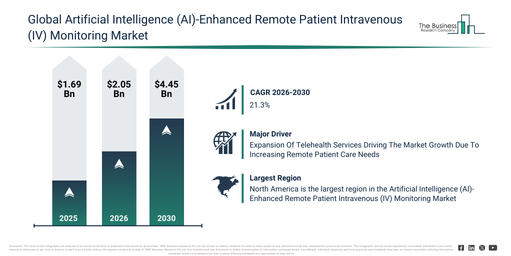
    The artificial intelligence (AI)-enhanced remote patient intravenous (iv) monitoring market size has experienced significant expansion in recent years. This market is expected to increase from $1.69 billion in 2025 to $2.05 billion in 2026, achieving a compound annual growth rate (CAGR) of 21.6%. Historically, this growth can be attributed to the increasing use of intravenous therapies in clinical care, the rising incidence of infusion-related complications, the expansion of hospital patient monitoring systems, the growing adoption of smart infusion devices, and an increased focus on medication safety protocols.

    The artificial intelligence (AI)-enhanced remote patient intravenous (iv) monitoring market is set to experience significant growth in the coming years. It is projected to expand to $4.45 billion by 2030, achieving a compound annual growth rate (CAGR) of 21.3%. This anticipated growth is primarily driven by the increasing integration of AI-enabled infusion monitoring, a rising demand for home-based IV therapy solutions, the expansion of predictive patient safety analytics, the growing integration of connected infusion systems, and a heightened focus on remote clinical monitoring. Furthermore, key trends for this period include the wider adoption of real-time IV flow analytics, increased utilization of AI-based infusion error detection, the growing incorporation of smart infusion sensors, the broadening of remote IV therapy management, and an enhanced emphasis on patient safety and compliance.

    Get A Free Sample Of The Artificial Intelligence (AI)-Enhanced Remote Patient Intravenous (IV) Monitoring Market Report 2026:

    https://thebusinessresearchcompany.com/sample_request?id=28017107&type=smp&name=Artificial%20Intelligence%20%28AI%29-Enhanced%20Remote%20Patient%20Intravenous%20%28IV%29%20Monitoring%20Market%20Report%202026&utm_source=Blogs&utm_medium=Paid&utm_campaign=Nov_PR

    What Is Driving The Growth Of The Artificial Intelligence (AI)-Enhanced Remote Patient Intravenous (IV) Monitoring Market?

    The increasing adoption of telehealth services is projected to fuel the expansion of the Artificial Intelligence (AI)-Enhanced Remote Patient Intravenous (IV) Monitoring Market. These services involve the use of digital communication to offer remote medical consultations, oversight, and therapeutic interventions. Its growth has been spurred by shifts in regulations and payment structures during the COVID-19 pandemic, rendering virtual healthcare more accessible and economically sound for both medical professionals and patients. AI-enhanced remote patient intravenous (IV) monitoring aids telehealth by facilitating real-time, distant tracking of IV treatments, automated complication detection, delivery of practical information to caregivers, and smooth integration with virtual care platforms. This ensures prompt interventions, enhanced patient safety, and more streamlined management of care provided at home and in outpatient settings. Consequently, the increased use of telehealth services is a key factor boosting the Artificial Intelligence (AI)-Enhanced Remote Patient Intravenous (IV) Monitoring Market.

    How Is The Artificial Intelligence (AI)-Enhanced Remote Patient Intravenous (IV) Monitoring Market Segmented?

    The artificial intelligence (AI)-enhanced remote patient intravenous (iv) monitoring market covered in this report is segmented –

    1) By Component: Hardware, Software, Services

    2) By Deployment Mode: On-Premises, Cloud-Based

    3) By Application: Hospitals, Clinics, Homecare Settings, Ambulatory Surgical Centers, Other Applications

    4) By End-User: Healthcare Providers, Patients

    Subsegments:

    1) By Hardware: Patient Monitoring Devices, Sensors And Infusion Pumps, Communication Devices, Data Storage Systems

    2) By Software: Predictive Analytics Software, Clinical Decision Support Software, Remote Monitoring Software, Data Management Software

    3) By Services: Implementation And Integration Services, Maintenance And Support Services, Training And Education Services, Remote Monitoring Services

    Who Are The Key Players In The Artificial Intelligence (AI)-Enhanced Remote Patient Intravenous (IV) Monitoring Market?

    Major companies operating in the artificial intelligence (AI)-enhanced remote patient intravenous (iv) monitoring market are Medtronic plc, Siemens Healthineers AG, GE HealthCare Technologies Inc., Koninklijke Philips N.V., Baxter International Inc., B. Braun Melsungen AG, Terumo Corporation, Nipro Corporation, Epic Systems Corporation, ICU Medical Inc., InfuSystem Holdings Inc., AlayaCare Inc., Huma Therapeutics Ltd., Health Recovery Solutions Inc., Arcomed AG, VitalConnect Inc., Cloud DX Inc., Empatica S.r.l., AccuHealth Inc., Serum Tracker Inc.

    Read The Complete Artificial Intelligence (AI)-Enhanced Remote Patient Intravenous (IV) Monitoring Market Report 2026:

    https://thebusinessresearchcompany.com/report/artificial-intelligence-ai-enhanced-remote-patient-intravenous-iv-monitoring-global-market-report?utm_source=Blogs&utm_medium=Paid&utm_campaign=Nov_PR

    Which Region Is The Largest In The Artificial Intelligence (AI)-Enhanced Remote Patient Intravenous (IV) Monitoring Market?

    North America was the largest region in the artificial intelligence (AI)-enhanced remote patient intravenous (IV) monitoring market in 2025. Asia-Pacific is expected to be the fastest-growing region in the forecast period. The regions covered in the artificial intelligence (AI)-enhanced remote patient intravenous (iv) monitoring market report are Asia-Pacific, South East Asia, Western Europe, Eastern Europe, North America, South America, Middle East, Africa.

    Reach Out To Our Team:

    The Business Research Company: https://www.thebusinessresearchcompany.com/

    Americas: +1 310-496-7795

    Asia: +44 7882 955267 & +91 8897263534

    Europe: +44 7882 955267

    Email us at: marketing@tbrc.info

    Follow us on:

    LinkedIn: https://in.linkedin.com/company/the-business-research-company

    YouTube: https://www.youtube.com/channel/UC24_fI0rV8cR5DxlCpgmyFQ

    Global Market Model: https://www.thebusinessresearchcompany.com/global-market-model
  • 3D Hydrogel Culture Market Growth Driven By Increasing Prevalence Of Cancer: Outlook To 2030

    3D Hydrogel Culture Market Growth Driven By Increasing Prevalence Of Cancer: Outlook To 2030

    The Business Research Company’s 2026 market reports combine market attractiveness scoring, total addressable market sizing, company benchmarking matrices, interactive Excel dashboards, deeper supply chain intelligence, emerging startup tracking, and granular product-level insights to deliver research that is more actionable and strategically valuable.

    What Is The 3D Hydrogel Culture Market Growth Rate? A 16.9% CAGR Outlook Through 2030

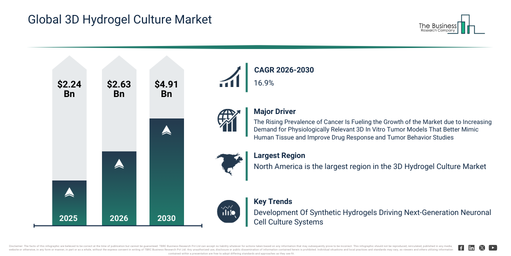
    The 3D hydrogel culture market has seen significant growth in recent years. It is anticipated to expand from $2.24 billion in 2025 to $2.63 billion in 2026, achieving a compound annual growth rate (CAGR) of 17.2%. Historically, this market expansion has been driven by advancements in cell culture techniques, the increased adoption of in vitro disease models, the growth of pharmaceutical R&D activities, a rising demand for predictive drug testing models, and the increasing use of tissue engineering tools.

    The 3D hydrogel culture market is set to experience substantial growth over the next few years, with its valuation expected to reach $4.91 billion by 2030, driven by a compound annual growth rate (CAGR) of 16.9%. This anticipated expansion can be attributed to increasing investments in regenerative medicine research, the rising adoption of personalized medicine approaches, the broadening scope of organ-on-chip technologies, a greater demand for advanced toxicology testing platforms, and ongoing innovation in hydrogel material science. Key trends during this period are projected to include the wider adoption of organoid and spheroid culture models, an increased utilization of biomimetic hydrogel matrices, deeper integration of microfluidic 3D culture platforms, the expansion of bioprinting-based cell culture systems, and a heightened emphasis on physiologically relevant drug screening.

    Access A Free Sample Of The Latest 3D Hydrogel Culture Market Analysis:

    https://thebusinessresearchcompany.com/sample_request?id=95125360&type=smp&name=3D%20Hydrogel%20Culture%20Market%20Report%202026&utm_source=Blogs&utm_medium=Paid&utm_campaign=Nov_PR

    Why Is The 3D Hydrogel Culture Market Growing? The Key Demand Driver Explained

    The rising occurrence of cancer is anticipated to drive the expansion of the 3D hydrogel culture market in the future. Cancer refers to a collection of illnesses marked by unregulated cell proliferation and the capacity to infiltrate or spread to other bodily regions, posing intricate challenges for scientific investigation and pharmaceutical development. The increase in cancer diagnoses is generating a need for sophisticated in vitro models that can closely replicate human tissue environments, facilitating more precise investigations into tumor behavior and treatment responses. 3D hydrogel culture assists cancer research by supplying three-dimensional scaffolds that imitate the extracellular matrix, allowing researchers to examine cell-cell interactions, tumor progression, and drug effectiveness within a physiologically relevant setting. For instance, in October 2025, according to the Australian Institute of Health and Welfare, an Australia-based government agency, it is projected that approximately 969,000 people will be alive who were diagnosed with cancer over the last 10 years, and roughly 170,000 new cases of cancer will be diagnosed in Australia. This indicates an increase of around 93% over 25 years, with age-standardized cancer incidence estimated at 614 cases per 100,000 people and mortality rates projected to decline to 194 deaths per 100,000 people. Hence, the increasing prevalence of cancer is fueling the 3D hydrogel culture market.

    What Are The Main Segments Of The 3D Hydrogel Culture Market?

    The 3D hydrogel culture market covered in this report is segmented –

    1) By Product: Scaffold Based, Scaffold Free, Bioreactors, Microfluidic, Bioprinting

    2) By Application: Cancer Research, Stem Cell Research And Tissue Engineering, Drug Discovery And Toxicology Testing, Other Applications

    3) By End-User: Pharmaceutical And Biotechnology Companies, Academic And Research Institutes, Hospitals, Other End-Users

    Subsegments:

    1) By Scaffold Based: Natural Polymer Hydrogels, Synthetic Polymer Hydrogels, Composite Hydrogels, Functionalized Hydrogels, Thermoresponsive Hydrogels

    2) By Scaffold Free: Multicellular Spheroids, Patient Derived Organoids, Cell Sheets, Low Attachment Plate Aggregates, Magnetic Levitation Microtissues

    3) By Bioreactors: Spinner Flask Bioreactors, Rotating Wall Vessel Bioreactors, Perfusion Bioreactors, Wave Bag Bioreactors, Stirred Tank Bioreactors

    4) By Microfluidic: Organ On A Chip Platforms, Perfusion Microfluidic Chips, Droplet Microfluidic Systems, Gradient Generation Chips, Barrier Model Chips

    5) By Bioprinting: Inkjet Bioprinting, Extrusion Bioprinting, Laser Assisted Bioprinting, Microvalve Bioprinting, Stereolithography Bioprinting

    3D Hydrogel Culture Market Trend Analysis: Where Leading Companies Are Focusing

    Major companies operating in the 3D hydrogel culture market are prioritizing innovation in tissue engineering, focusing on developing synthetic and xeno-free hydrogels. This initiative seeks to enable more physiologically relevant, accurate, and reproducible three-dimensional neuronal cell culture systems. The development of synthetic and xeno-free hydrogels involves creating formulations that exclude animal-derived components while still supporting robust cell-cell and cell-matrix interactions for improved in vitro modeling and potential in vivo applications. For instance, in September 2025, TheWell Bioscience Inc., a US-based company specializing in advanced 3D cell culture platforms, commercially launched its VitroGel NEURON. This innovative synthetic and xeno-free hydrogel establishes a defined, reproducible, and scalable environment for neuronal growth, differentiation, and network formation. The product effectively overcomes the limitations of animal-derived matrices by efficiently supporting both 3D and 2D neuronal cultures and serving as an injectable carrier for in vivo delivery. This hydrogel is engineered to foster robust cell-cell and cell-matrix interactions, empowering researchers to create more physiologically relevant neuronal models for studies in neurodevelopment and neurodegeneration.

    Which Companies Are Major Players In The 3D Hydrogel Culture Market?

    Major companies operating in the 3D hydrogel culture market are Merck KGaA, Thermo Fisher Scientific Inc., Corning Incorporated, Lonza Group AG, Sartorius, Bio-Techne Corporation, PromoCell GmbH, Cosmo Bio, AIM Biotech, AMSBIO (AMS Biotechnology), TheWell Bioscience, Cell Guidance Systems (CellGS), Cellendes GmbH, CD Bioparticles, Ferentis (Ferentis AG), Gelomics, TissueLabs, CELLINK (BICO), PepGel LLC, 3D Biotek Inc.

    Get The Complete 3D Hydrogel Culture Market Analysis Here:

    https://thebusinessresearchcompany.com/report/global-3d-hydrogel-culture-market-report?utm_source=Blogs&utm_medium=Paid&utm_campaign=Nov_PR

    Which Region Held The Largest Share Of The 3D Hydrogel Culture Market In 2025?

    North America was the largest region in the 3D hydrogel culture market in 2025. Asia-Pacific is expected to be the fastest-growing region in the forecast period. The regions covered in the 3D hydrogel culture market report are Asia-Pacific, South East Asia, Western Europe, Eastern Europe, North America, South America, Middle East, Africa.

    Reach Out To Our Team:

    The Business Research Company: https://www.thebusinessresearchcompany.com/

    Americas: +1 310-496-7795

    Asia: +44 7882 955267 & +91 8897263534

    Europe: +44 7882 955267

    Email us at: marketing@tbrc.info

    Follow us on:

    LinkedIn: https://in.linkedin.com/company/the-business-research-company

    YouTube: https://www.youtube.com/channel/UC24_fI0rV8cR5DxlCpgmyFQ

    Global Market Model: https://www.thebusinessresearchcompany.com/global-market-model
  • What Is Driving The Artificial Intelligence (AI)-Enhanced Remote Neonatal Monitoring Market? A Closer Look At Rising Incidence Of Preterm Births

    What Is Driving The Artificial Intelligence (AI)-Enhanced Remote Neonatal Monitoring Market? A Closer Look At Rising Incidence Of Preterm Births

    With a focus on actionable insights and strategic value, The Business Research Company’s 2026 market reports include market attractiveness scoring, total addressable market sizing, company benchmarking matrices, interactive Excel dashboards, deeper supply chain intelligence, emerging startup tracking, and granular product-level insights.

    Artificial Intelligence (AI)-Enhanced Remote Neonatal Monitoring Market Size Outlook: A $2.98 Billion Market By 2030, Growing At 18.6% Annually

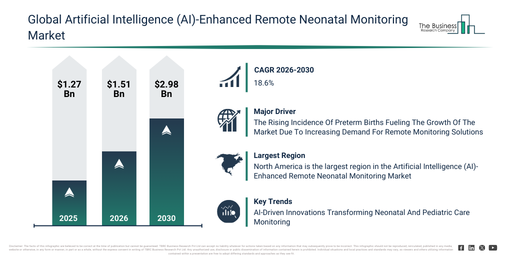
    The artificial intelligence (AI)-enhanced remote neonatal monitoring market has seen substantial growth in recent years. It is forecast to grow from $1.27 billion in 2025 to $1.51 billion in 2026, exhibiting a compound annual growth rate (CAGR) of 18.9%. This past expansion can be attributed to several factors including increasing premature birth rates, the expansion of neonatal intensive care services, the growing adoption of remote patient monitoring technologies, a heightened focus on early intervention in neonatal care, and advancements in neonatal sensor technologies.

    The artificial intelligence (AI)-enhanced remote neonatal monitoring market is projected to experience substantial expansion over the next few years. Its valuation is anticipated to reach $2.98 billion by 2030, demonstrating a compound annual growth rate (CAGR) of 18.6%. This expected growth is driven by factors such as the increasing adoption of AI-driven neonatal monitoring, a rising demand for home-based neonatal care solutions, the broadening scope of predictive health analytics, greater integration of cloud-based monitoring platforms, and an intensified focus on preventive neonatal healthcare. Key trends during this period will include the growing uptake of continuous neonatal vital monitoring, the expanded utilization of AI-based early warning systems, the wider deployment of wearable neonatal sensors, the evolution of remote neonatal care models, and an enhanced emphasis on predictive neonatal analytics.

    Make Data-Driven Decisions With A Free Artificial Intelligence (AI)-Enhanced Remote Neonatal Monitoring Market Sample Report:

    https://thebusinessresearchcompany.com/sample_request?id=35073574&type=smp&name=Artificial%20Intelligence%20%28AI%29-Enhanced%20Remote%20Neonatal%20Monitoring%20Market%20Report%202026&utm_source=Blogs&utm_medium=Paid&utm_campaign=Nov_PR

    Key Demand Driver Expected To Lift Artificial Intelligence (AI)-Enhanced Remote Neonatal Monitoring Market Revenue

    The increasing occurrence of preterm births is expected to drive the growth of the artificial intelligence (AI)-enhanced remote neonatal monitoring market going forward. Preterm birth refers to infants born before 37 completed weeks of gestation, often requiring specialized medical care due to underdeveloped organs, and is a major factor affecting neonatal health outcomes. The incidence of preterm births is rising as more women are having children at an older age, which increases the risk of pregnancy complications and early delivery. Artificial intelligence (AI)-enhanced remote neonatal monitoring assists in managing preterm births by continuously analyzing vital signs to detect early signs of complications, enabling timely interventions and safer post-discharge care. Therefore, the rising incidence of preterm births is propelling the expansion of the artificial intelligence (AI)-enhanced remote neonatal monitoring market.

    Exploring The Artificial Intelligence (AI)-Enhanced Remote Neonatal Monitoring Market Through Its Key Segments

    The artificial intelligence (AI)-enhanced remote neonatal monitoring market covered in this report is segmented –

    1) By Component: Hardware, Software, Services

    2) By Monitoring Type: Vital Signs Monitoring, Respiratory Monitoring, Cardiac Monitoring, Other Monitoring Types

    3) By Deployment Mode: Cloud-Based, On-Premises

    4) By End User: Hospitals, Neonatal Intensive Care Units, Homecare Settings, Clinics, Other End Users

    Subsegments:

    1) By Hardware: Monitoring Devices, Wearable Sensors, Imaging Equipment, Communication Modules, Data Storage Units

    2) By Software: Analytics Platforms, Patient Management Systems, Predictive Algorithms, Visualization Tools, Alert And Notification Systems

    3) By Services: Remote Monitoring Support, Technical Maintenance, Training And Education, Consulting Services, Integration Services

    New Trends Redefining Competition In The Artificial Intelligence (AI)-Enhanced Remote Neonatal Monitoring Market

    Leading companies within the artificial intelligence (AI)-enhanced remote neonatal monitoring market are prioritizing the development of advanced solutions, such as AI-driven neonatal and pediatric care monitoring platforms. These efforts aim to improve the early detection of health complications, refine clinical decision-making, and facilitate continuous, real-time monitoring of newborns. AI-driven neonatal and pediatric care monitoring platforms are systems that utilize artificial intelligence to consistently track and analyze health data from newborns and children, identify anomalies, and generate actionable insights for prompt medical intervention. For example, in April 2025, AngelEye Health, a US-based provider of neonatal and pediatric family engagement technology, unveiled AIVision. This significant advancement integrates artificial intelligence (AI) and computer vision into neonatal intensive care units (NICUs) and pediatric units. The platform transforms existing bedside cameras into intelligent clinical tools, furnishing clinical teams with proactive, data-driven insights. Its key features include AI-powered motion analysis for the early identification of neuromotor risks, video EEG synchronization, monitoring of respiratory status to detect initial signs of distress, AI-assisted pain and sedation assessment, and crash/coding event recording to support clinical training.

    Artificial Intelligence (AI)-Enhanced Remote Neonatal Monitoring Market Competition: Key Players And Industry Participants

    Major companies operating in the artificial intelligence (AI)-enhanced remote neonatal monitoring market are Philips Healthcare, GE HealthCare Technologies Inc., Mount Sinai Health System Inc., Mindray Medical International Limited, Drägerwerk AG & Co. KGaA, Hill-Rom Company Inc., Masimo Corporation, Sheba Medical Center, Natus Medical Incorporated, Spacelabs Healthcare Inc., Aver Information Inc., Owlet Inc., Nanit Inc., AngelEye Health Inc., Raybaby Inc., Zoundream Inc., Sempulse Inc., Kriba Inc., Luscii B.V., Bloomlife Inc.

    Get The Detailed Artificial Intelligence (AI)-Enhanced Remote Neonatal Monitoring Market Research Report Here:

    https://thebusinessresearchcompany.com/report/artificial-intelligence-ai-enhanced-remote-neonatal-monitoring-global-market-report?utm_source=Blogs&utm_medium=Paid&utm_campaign=Nov_PR

    Artificial Intelligence (AI)-Enhanced Remote Neonatal Monitoring Market Regional Overview: Largest Market And Global Coverage

    North America was the largest region in the artificial intelligence (AI)-enhanced remote neonatal monitoring market in 2025. Asia-Pacific is expected to be the fastest-growing region in the forecast period. The regions covered in the artificial intelligence (AI)-enhanced remote neonatal monitoring market report are Asia-Pacific, South East Asia, Western Europe, Eastern Europe, North America, South America, Middle East, Africa.

    Reach Out To Our Team:

    The Business Research Company: https://www.thebusinessresearchcompany.com/

    Americas: +1 310-496-7795

    Asia: +44 7882 955267 & +91 8897263534

    Europe: +44 7882 955267

    Email us at: marketing@tbrc.info

    Follow us on:

    LinkedIn: https://in.linkedin.com/company/the-business-research-company

    YouTube: https://www.youtube.com/channel/UC24_fI0rV8cR5DxlCpgmyFQ

    Global Market Model: https://www.thebusinessresearchcompany.com/global-market-model